
Woodworking fairs help plywood importers find panel mills, inspect sample construction and arrange factory follow-ups. Choose professional events by exhibitor type rather than show size: machinery exhibitions reveal production capability, while furniture fairs connect buyers with panel users. Bring a written specification, ask for traceable documents and compare suppliers after the event.

Which woodworking fairs are useful for plywood buyers?
For commercial plywood sourcing, prioritise professional exhibitions with panel manufacturers, furniture supply chains or production machinery rather than general craft markets. A show crowded with tool demonstrations can still be useful for understanding production, but it is less efficient for identifying exporters of finished sheets.
| Event type | Typical visitor | Best sourcing task | What to check first |
|---|---|---|---|
| Wood-processing machinery | Mill engineers, factory owners | Understand pressing, calibration and cutting | Exhibitor categories and appointment access |
| Furniture manufacturing | Cabinet and furniture producers | Compare decorative faces and panel formats | Materials and components halls |
| Joinery trade | Joiners, fit-out buyers | Discuss surfaces and cut-to-size | Panel and sheet-material exhibitors |
| Woodcraft fair | Makers and consumers | Discover tools and craft techniques | Whether industrial sheet suppliers attend |
A buying team should classify its objective before choosing a ticket. A factory machinery exhibition is not automatically a finished-panel sourcing exhibition. Keep the supplier shortlist checklist beside the event catalogue.
What does the 2027 woodworking fairs calendar show?
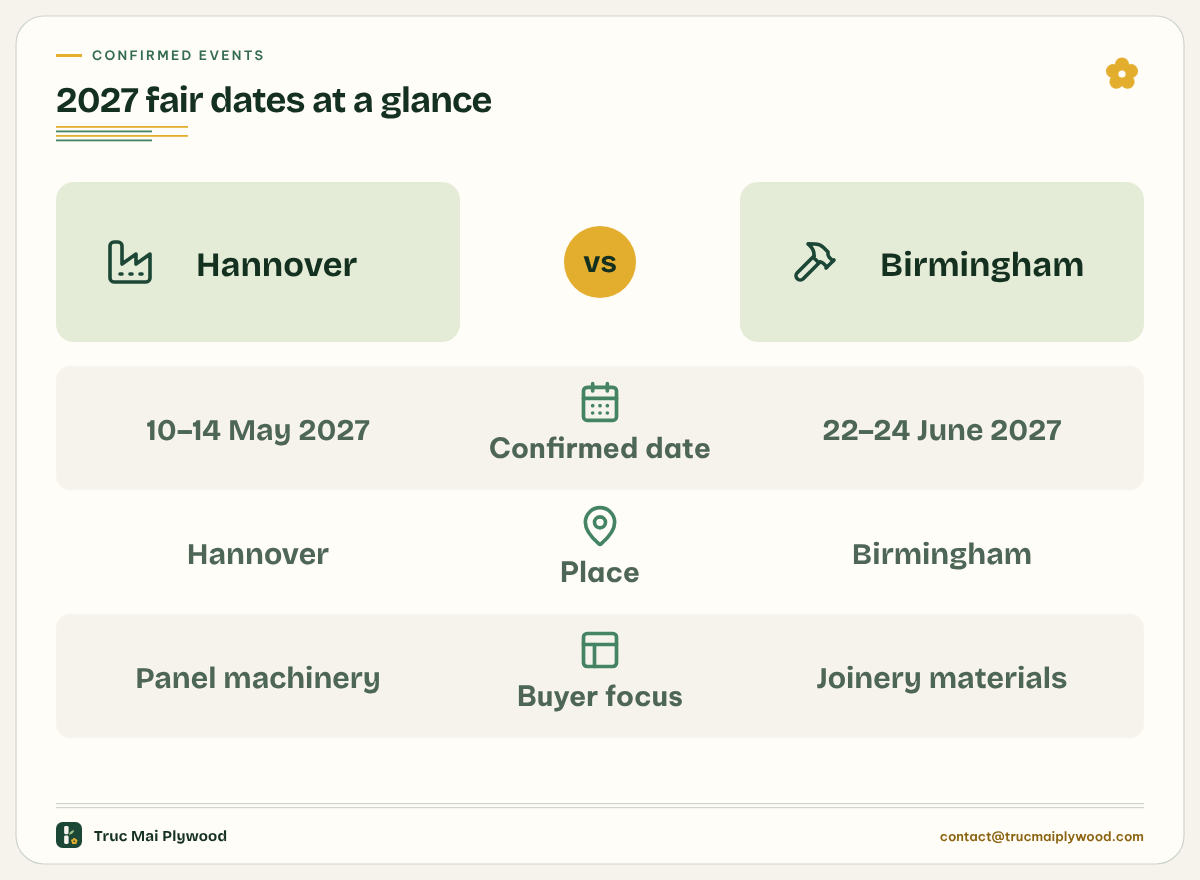
The most useful confirmed upcoming dates in the reviewed organiser material are LIGNA in Hannover, 10–14 May 2027, and Professional Woodworking Expo at NEC Birmingham, 22–24 June 2027. Both are professional events, but they address different parts of the production chain.
| Event | Confirmed date | Place | Buyer relevance | Organiser evidence |
|---|---|---|---|---|
| LIGNA | 10–14 May 2027 | Hannover, Germany | Panel production machinery and surface technology | LIGNA organiser |
| Professional Woodworking Expo | 22–24 June 2027 | NEC Birmingham, UK | Joinery, materials and production demonstrations | PWE organiser |
The calendar is a starting point for appointments. Review the current exhibitor list for actual plywood mills rather than treating an event title as proof of their presence. A show without suitable exhibitors can still provide technical knowledge, but a direct factory appointment can be more productive.
Where does Professional Woodworking Expo fit for UK buyers?
Professional Woodworking Expo is a UK trade event for joinery and woodworking manufacturing. Its organiser places machinery demonstrations alongside materials, components and production expertise at NEC Birmingham. It is relevant to a UK cabinet maker looking at panel surfaces, machining and the supply chain behind a finished interior.
The event is co-located with InstallerSHOW and the Painting & Decorating Show, which broadens the audience beyond mill procurement. For a plywood importer, the practical approach is to ask for a list of exhibitors handling sheet materials and arrange meetings with those firms before visiting demonstrations.
A buyer seeking imported plywood should ask whether the exhibitor makes the panels, distributes them locally or supplies machinery. These are different commercial roles. Record the answer against the company name so that the follow-up RFQ reaches the correct decision-maker.
Is IWF woodworking a good place to meet panel manufacturers?
IWF Atlanta is a major North American woodworking industry exhibition, with an emphasis on machinery, supplies and manufacturing technology. The organiser’s IWF event FAQ confirms that its 2026 edition ran from 25 to 28 August 2026. That edition is past, so use the organiser’s current schedule for the next visit.
An importer attending IWF can learn which machining and finishing processes affect panel purchasing specifications. The useful questions concern calibration, edge quality, veneer preparation and overlay compatibility. A distributor sourcing finished sheets should identify actual panel producers from the exhibitor directory before assuming they will be on the floor.
For US-bound veneer-core hardwood plywood, bring the intended formaldehyde documentation requirements into the conversation. The US regulation at 40 CFR Part 770 sets the applicable composite-wood product framework. Compare certificates against the proposed product, rather than against the show stand.
Why visit LIGNA for a panel sourcing programme?
LIGNA is particularly useful for understanding how panel mills manufacture, calibrate and finish boards. The organiser’s categories include wood-based panel production, surface technology, sawmill technology and tools for mass production. That breadth helps buyers recognise why two sheets described simply as commercial plywood can behave differently in a furniture factory.
Use the panel-production area to understand veneer preparation and pressing equipment, then move to surface technology to discuss sanding, calibration and overlay preparation. Ask machinery exhibitors what a buyer should inspect in a finished board, without treating their explanation as a performance certificate for any particular mill.
An import programme can use those observations to improve its written acceptance criteria: surface appearance, thickness measurement, bond specification and packing. A separate mill audit is still needed to verify how a shortlisted supplier operates.
Which Vietnam wood exhibitions are relevant to importers?
Vietnam furniture and wood-industry exhibitions can introduce buyers to finished furniture makers, component suppliers and manufacturing businesses. A buyer searching for plywood mills should distinguish an export furniture fair from an exhibition focused on machinery and processing technology.
At a furniture event, ask which exhibitors buy panels and which actually manufacture them. At a machinery event, look for panel-production and finishing suppliers, then arrange factory meetings separately. The best itinerary combines commercial introductions with a mill visit rather than assuming every booth represents a plywood production site.
For a Vietnamese factory visit, ask for the manufacturing location, product range and sample preparation in advance. A visit to Ha Hoa, Phu Tho can be organised as a separate sourcing appointment when discussing Truc Mai’s commercial and furniture plywood. The mill verification checklist gives the evidence to request before travel.
Do wood shows and craft fairs serve the same purpose?
No. A public wood show is usually designed for craft demonstrations, tools, makers and family activities, while an industrial woodworking exhibition is organised around professional equipment and business purchasing. Both can teach visitors about wood, but their supplier mix differs sharply.
A craft event can be valuable for seeing joinery and finishing methods at close range. It is a poor substitute for inspecting commercial plywood cores, container packing and export paperwork. The buyer should first identify whether the show offers business matchmaking, an industrial exhibitor directory and appointments with panel manufacturers.
For a small joinery business, a local demonstration may help define what surface finish or machining quality it needs. Once the requirement is written, a factory-direct discussion can focus on production capability and repeat supply rather than general woodworking interests.
How do you shortlist a plywood mill before the event?
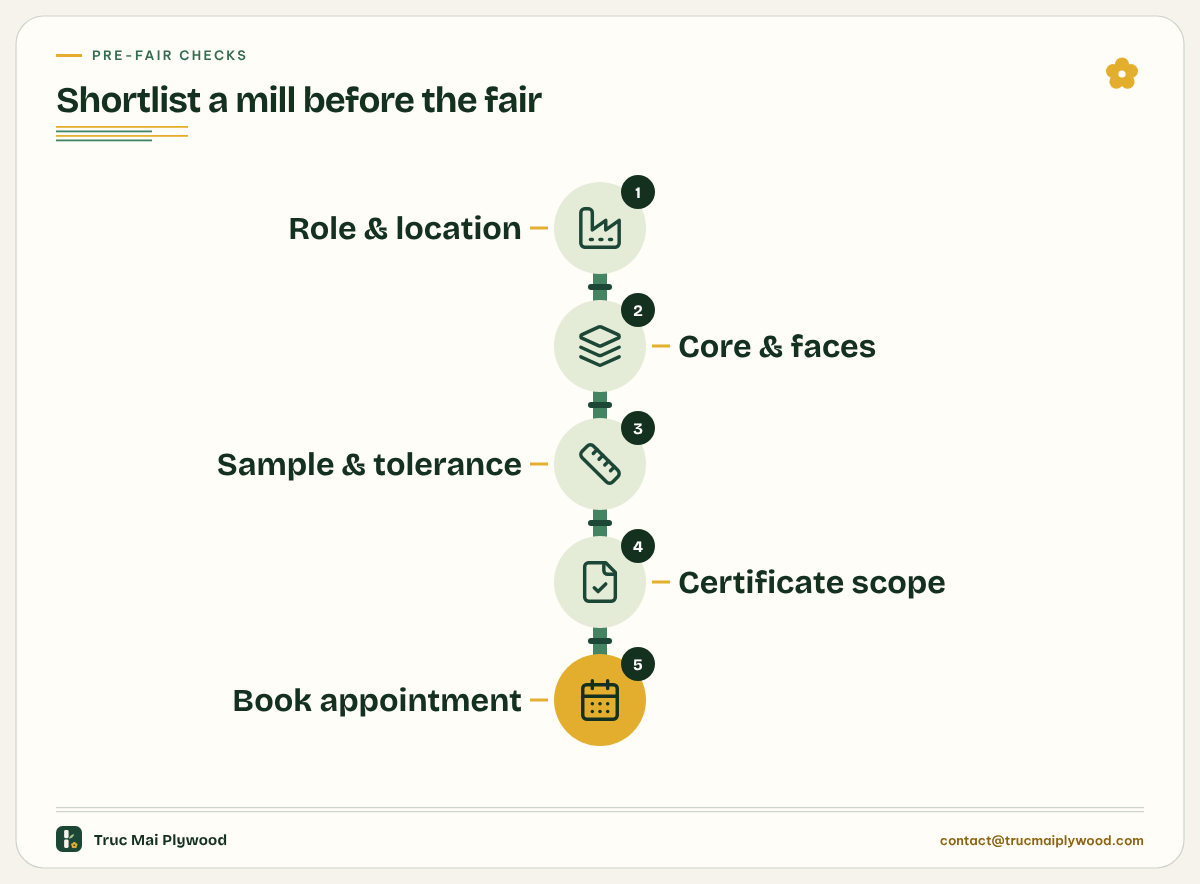
Start with the application and a written sheet specification, then shortlist factories that can discuss that construction in detail. A useful first email contains the intended use, face and back appearance, core, glue and emission requirement, dimensions, quantity and destination.
- Check the company’s manufacturing role and location.
- Ask which core and face combinations it produces.
- Request a sample description and thickness tolerance.
- Ask for the relevant certificate numbers and scope.
- Arrange an appointment with a technical or commercial contact.
- Record unresolved questions for a factory follow-up.
Use writing a plywood RFQ to prepare the comparison sheet. A vague request for an 18 mm board creates quotations with different constructions, so the specification should precede the meeting.
What should you bring to a plywood trade fair meeting?
Bring a cut list, a reference sample and a concise written specification. The sample shows the appearance target; the document gives the factory the information needed to quote the same construction each time.
| Bring | What the mill needs to see | Decision supported |
|---|---|---|
| Sample panel | Face, back, edge and finish | Appearance match |
| Dimension drawing | Length, width, thickness and cut pattern | Production and packing |
| Application note | Cabinet, door, interior or packing use | Core and surface choice |
| Glue/emission line | Buyer specification and destination | Documentation route |
| Purchase plan | Volume and delivery pattern | Production scheduling |
| Packaging sketch | Bundle, label and unloading method | Container preparation |
Photograph the sample reference beside its label only with the supplier’s permission. A clear written record prevents later confusion between a display sample and the panel construction offered for shipment. For first samples, see ordering plywood samples.
Which plywood specifications should you discuss face to face?
Discuss the construction that drives quality and repeatability: face veneer, core species, core joining, thickness tolerance, adhesive and emission requirement. Truc Mai offers furniture and commercial panels with EV, poplar, birch-faced and other decorative surfaces on Styrax, Eucalyptus, Acacia, Pine or combined cores.
A practical meeting compares a sanded furniture panel with a commercial-grade board. For furniture work, ask about stitched core and calibrated faces; for packing, ask about the appropriate surface and packing arrangement. The mill’s typical thickness tolerance is written per order, commonly ±0.3–0.5 mm. The approved sample and the order specification should identify the actual target.
Discuss sheet formats separately from surface grades. Standard formats include 1220 × 2440, 1220 × 2280 and 1250 × 2500 mm. For a cut-to-size order, provide the exact cut list and label arrangement rather than a generic request for smaller sheets.
How can you check certificates during a supplier meeting?
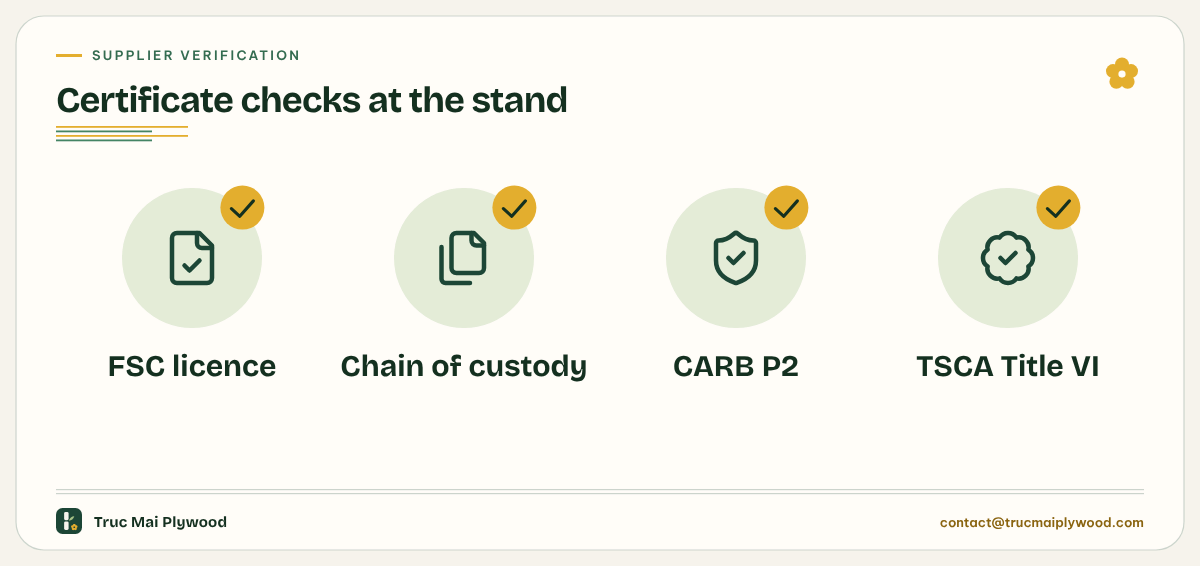
Check the certificate identifier, issuing body, product scope and the sales-document claim. A badge or certificate photograph at an exhibition is only the starting point for document review.
The FSC Chain of Custody standard requires the relevant certificate code and FSC claim on sales documents for eligible products. Truc Mai’s FSC licence is FSC-C196493 and its chain-of-custody certificate is SA-COC-014545; eligible sales use FSC 100% documentation. Use verify an FSC licence code for the registry check.
For US hardwood plywood, check the certificate against the offered veneer-core thickness and product type. Truc Mai’s CARB P2 and TSCA Title VI certification covers hardwood plywood with veneer core from 3–25 mm under certificate CARB/EPA26053. Ask which supporting papers accompany the actual order line.
What should EU buyers ask about timber origin?
EU importers should ask for origin records and geolocation information for both the core wood and the face veneer. A plywood sheet can combine timber from different sources, so a single factory address does not describe every wood component.
The European Commission’s EUDR due-diligence guidance describes the information used to assess timber origin and legality. For a proposed panel, request species details, country of production, plot geolocation and the records that connect each veneer supply to the finished product.
Truc Mai supplies EUDR due-diligence files with geolocation for core and face veneer. The buyer can use the EU import steps alongside the source documents when preparing an import workflow. Keep origin-document questions separate from surface-grade discussions so the required file set is clear.
How do you compare quotations collected at a fair?
Compare quotations against one identical specification and delivery basis. A low-looking total tells little about the actual plywood construction if face grade, core joining, thickness and shipping terms are different.
Create a comparison sheet with columns for face/back, core, thickness tolerance, adhesive/emission, sheet size, pack quantity, shipment term and documents. Ask each supplier to annotate deviations from the requested construction. Then compare samples against the same appearance reference and record which changes require a fresh quotation.
A useful commercial question is whether the mill can repeat the approved construction across successive containers. Truc Mai’s standard minimum order is one 40HC, with FOB Hai Phong, CFR or CIF terms. The documents per container page helps buyers compare the paperwork alongside the panel specification.
What happens after you meet a potential mill?
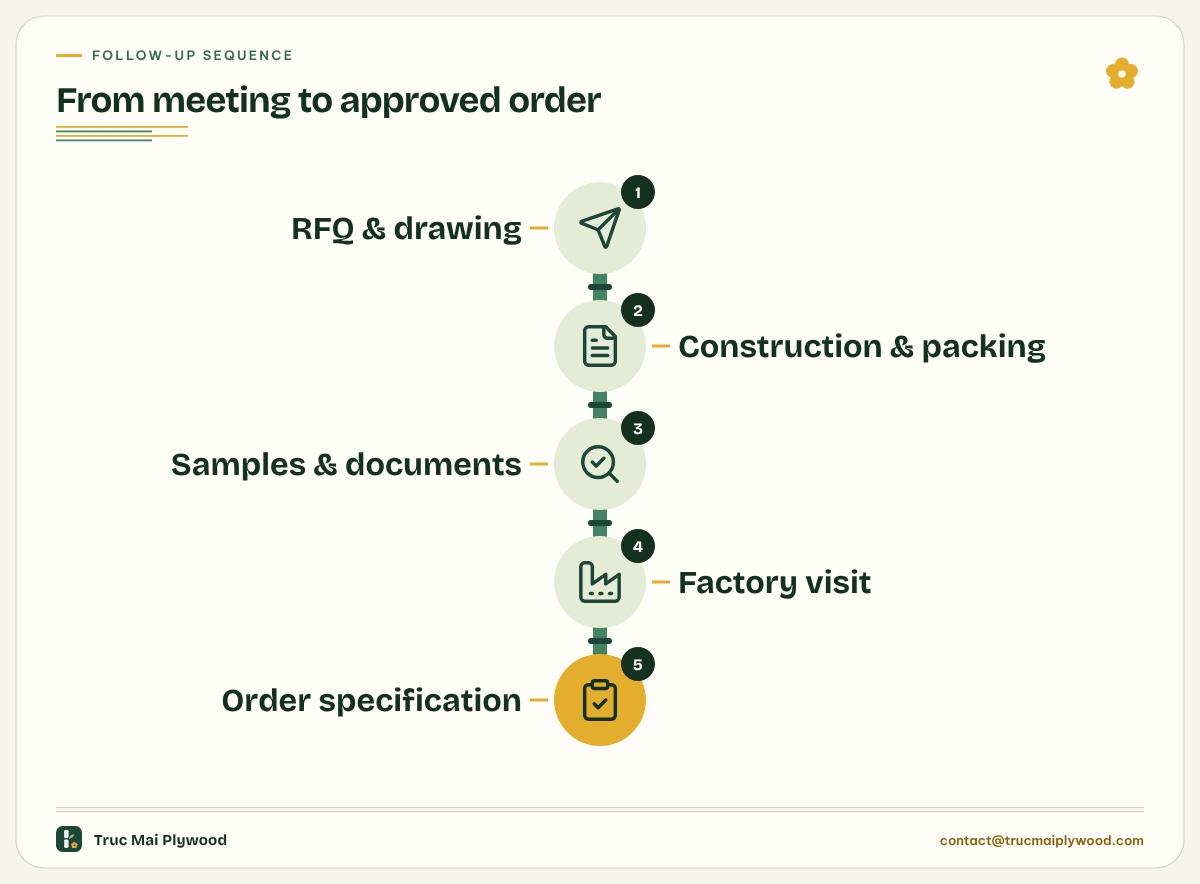
Send a meeting record and request a written quotation against the agreed specification. Identify the sample reference, unresolved tests, required shipping papers and the person responsible for each follow-up.
- Send the final RFQ and drawing.
- Receive the supplier’s construction and packing proposal.
- Review samples and documents for that product.
- Arrange a factory visit or production discussion.
- Approve the written order specification.
- Track the first container against the approved packing list.
The first order to monthly supply process explains how an initial container can become a repeat specification. Keep every revision dated so that a change in face or core is visible to both parties.
How can a fair meeting turn into a repeat container programme?
A repeat programme starts with one approved construction and a written packing specification. The buyer should record the face and core combination, tolerance, dimensions, bundle labels and document requirements so each later purchase order refers to the same baseline.
For a furniture importer, that might mean a consistent birch-faced panel for cabinet components, with a separate EV-faced line for visible interiors. For a distributor, it may mean keeping one common size while varying face appearance by customer segment. The mill then plans production around clear stock-keeping lines rather than a fresh verbal description every month.
A factory discussion should cover the process for approving substitutions, sample changes and revised cut lists. The commercial objective is a stable specification that purchasing, production and receiving teams can all read.
What should a buyer send to request a factory quotation?
Send the application, core, glue and emission specification, face/back grade, thickness and sheet size, packing arrangement, quantity and destination port. Include the exhibition meeting reference if there was one, plus photographs or drawings that clarify the approved sample.
For cut-to-size panels, identify each finished piece and its label. The factory can cut a standard sheet into halves, thirds, quarters or six pieces against an agreed drawing. The precise cut layout belongs in the quotation, because a name such as cabinet panel does not identify the finished dimensions.
Send the RFQ to contact@trucmaiplywood.com or use the quotation route specified for the order. The next useful document is a line-by-line specification, not another general brochure.
Questions buyers ask
Can a buyer arrange a mill meeting without attending a fair?
Yes. Send a panel specification and request a video call or a scheduled factory visit before arranging travel.
Should I carry physical plywood samples through customs?
Carry small labelled reference pieces and check the destination customs rules for wood samples before travel.
Can a UK cabinet maker meet exporters at a machinery show?
Yes. Ask exhibitors and organisers which material suppliers or visiting export manufacturers are attending before booking meetings.
What should be written on a sample label?
Write the face species, core, thickness, glue and emission specification, surface grade and sample reference on the label.
Can I ask for a private-label carton at the first meeting?
Yes. Provide the label artwork, pack configuration and intended destination so the mill can assess the packing requirement.
Is an exhibitor badge evidence that a company owns a mill?
No. Request the manufacturing address, production documentation and a factory visit as part of supplier verification.
Should I request a certificate scan at the stand?
Request the certificate identifier, scope and issuing body, then check the relevant public registry and the documents for the proposed product.
What should a distributor do after receiving a quotation?
Compare construction, shipment terms, sample approval and the documents attached to each quoted specification before placing an order.
How early should I book meetings at a trade exhibition?
Contact shortlisted suppliers before travelling and reserve a specific appointment, leaving time to inspect samples and discuss shipping.
Can several plywood specifications share a container?
Yes. A mixed container can be planned by agreement, with each specification identified separately on the packing list.