
eucalyptus vs poplar plywood is chiefly a choice between a denser, stiffer core and a lighter, easier-handling panel. Eucalyptus is useful for loaded furniture parts; poplar is attractive for lightweight interior work. But the face veneer, core construction, glue, thickness and test evidence decide what a finished sheet will actually do.

How does eucalyptus vs poplar plywood compare for furniture buyers?
Eucalyptus core plywood is usually the denser option; poplar core plywood is the lighter option. The distinction matters most when a buyer is choosing a core rather than a decorative face. A panel with eucalyptus faces and a lightweight inner construction may behave differently from one built with eucalyptus throughout. Ask for the full lay-up before comparing offers.
| Buying criterion | Eucalyptus-core construction | Poplar-core construction | What to specify |
|---|---|---|---|
| Handling weight | Generally heavier | Generally lighter | Actual sheet mass and moisture condition |
| Shelf stiffness | Often advantageous with a comparable build | Better suited to modest loads | Span, load and bending data |
| Screw fixing | Dense material can support firm fixing | Softer material needs careful pilot holes | Edge distance and pull-out test |
| Machining | Tool sharpness and feed control matter | Often easier to cut and rout | Trial cut and edge acceptance |
| Visible finish | Depends on the face selected | Depends on the face selected | Approved face/back sample |
| Freight planning | Weight can limit the load | Lower mass can favour more sheets | Packing plan and booking payload |
| Moisture exposure | Determined by bond and protection | Determined by bond and protection | Adhesive system and bond test |
The eucalyptus plywood range and poplar plywood range show the face options; the purchase specification should describe the internal construction independently.
What does the species name actually describe?
The species name may describe either the face or the core. The face is the thin visible veneer, while the core contributes most of the sheet’s mass and much of its bending behaviour. A buyer ordering a eucalyptus face for its colour should not assume the panel has a eucalyptus core. Likewise, a pale poplar face does not make a dense-core panel lightweight.
Truc Mai Plywood manufactures furniture and commercial plywood with eucalyptus, Styrax, acacia, pine or combined cores. Its face choices include eucalyptus, poplar, bleached poplar and engineered veneer. The engineered veneer option provides another pale surface choice without changing the core decision.
Read the offer as a stack of materials, from front veneer through the cross-bands and core to the back veneer. Ask the supplier to name the core species, whether core veneers are stitched or loose-laid, and the face/back grade. A sample edge and a written lay-up reveal more than a timber name in a catalogue.
Which plywood is heavier, and why does density matter?
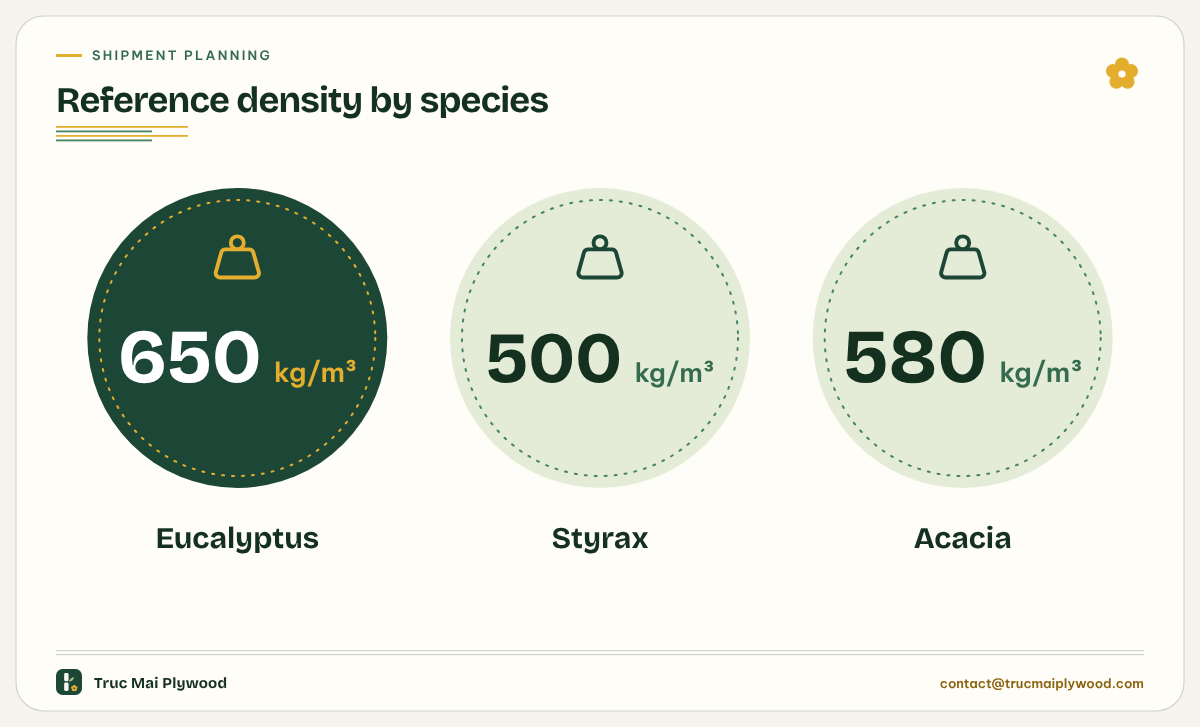
Eucalyptus-core panels generally weigh more because their core wood is denser. For shipment planning, the mill uses reference densities of 650 kg/m³ for eucalyptus, 500 kg/m³ for Styrax and 580 kg/m³ for acacia. These are planning inputs, not universal density ratings for every tree or finished board. Poplar plywood weight should be taken from the particular supplier’s sample and packing specification.
Density influences how a cabinet door feels in the hand, how a large carcass is lifted on the assembly line and how many sheets a container can carry. For furniture exported as flat-pack components, the assembled unit’s handling weight may be just as important as the stiffness of a single shelf. An importer should compare mass at the same dimensions, moisture condition and surface treatment.
Where a light drawer bottom or decorative partition carries little load, a lighter construction may be the more efficient engineering choice. Where a wide shelf carries books or equipment, bending performance deserves greater attention than the nominal species label.
How do bending strength and stiffness differ?
Eucalyptus is often favoured for stiffer furniture parts, but the finished plywood lay-up sets its bending performance. Stiffness describes resistance to deflection; strength describes resistance to failure. Span, support points, grain direction and sustained load also change the outcome.
Plywood is cross-laminated: adjacent veneers run in different grain directions. That improves dimensional balance compared with a single board, but it does not erase the effect of face orientation or veneer quality. Compare bending test results in both principal directions on the same thickness and construction. A single marketing value without the test direction gives a buyer little basis for specifying long shelves.
For cabinets, choose the span and expected contents first. Then check panel thickness, core voids, face quality and test evidence. The cabinet-grade plywood specification is a useful companion when a purchaser needs to compare furniture-ready builds rather than broad timber categories.
Which core holds screws and fittings more reliably?
A well-made dense core can offer useful screw-holding performance, especially in demanding cabinet joints. The joint still depends on screw diameter, pilot-hole size, edge distance, veneer integrity and installation torque. Dense wood alone does not prevent splitting near an edge; a poorly joined core can weaken the fixing point regardless of species.
Ask for a trial assembly using the actual hinge plate, connector bolt or drawer-runner screw. Test the edge as well as the face. If the product uses repeated assembly and disassembly, include the relevant furniture fasteners in the trial. Inspect whether the screw strips, the veneer lifts or the joint pulls out. These observations identify a useful specification more quickly than a generic statement that one timber has “better screw holding”.
The 18 mm plywood specification provides a reference point for discussing common cabinet stock. Record the chosen fixing system on the sample approval so the mill and furniture factory are testing the same joint.
Is eucalyptus or poplar plywood more stable in humidity?
Neither species name determines moisture resistance: adhesive bond, panel construction and edge protection do. The USDA Forest Products Laboratory explains that bonded wood performance depends on veneer surface preparation, moisture control, adhesive selection and pressing, not only the timber species (Wood Handbook, chapter 10).
A flat sample should be checked after storage in the conditions it will experience at the furniture plant. Inspect bow, twist, edge opening and face checking, especially on long, narrow parts. Balanced face and back veneers matter because uneven surface construction can encourage distortion. For an interior cabinet, a good dry-service build is more relevant than an unsupported claim that eucalyptus naturally makes a waterproof panel.
Specify the glue and the emission grade on separate lines. If humid-service bonding is needed, request the relevant bond test for the proposed construction. The adhesive choice belongs to the actual use environment, not to the colour or botanical name of the veneer.
What do eucalyptus and poplar faces look like after finishing?
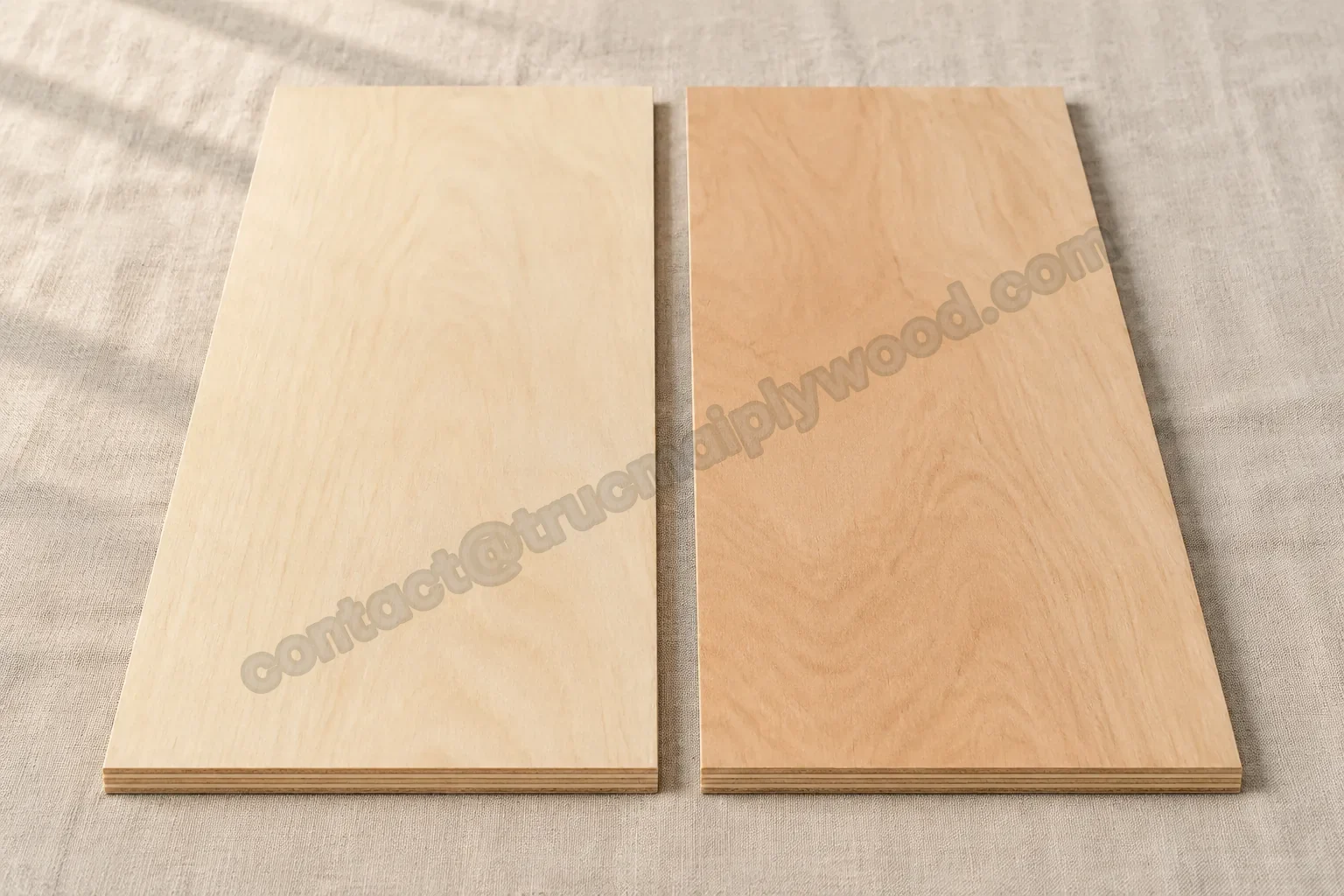
Poplar gives buyers a pale, discreet surface; eucalyptus can offer a more pronounced natural wood appearance. The exact colour and grain vary by veneer selection, so approve a physical sample under the furniture maker’s intended finish. An opaque coating hides much of the natural difference, while clear lacquer or stain can make colour matching the dominant buying concern.
A face veneer is thin enough that sanding and preparation deserve close attention. At this mill, face veneers are commonly 0.2–0.5 mm, with 0.3 mm frequently used for European orders. Excessive sanding can expose the underlying layer. Specify whether the surface is sanded, calibrated or prepared for the buyer’s coating line.
For a painted cabinet programme, the supplier can offer a pale face over a stronger core. For a clear-finished door, a buyer should assess grain, patches, joints and front/back matching under the actual coating. Laminates for plywood are another option where the decorative surface is supplied by an overlay rather than the wood grain itself.
Which species is easier to machine and cut?
Poplar is generally easier to machine, while eucalyptus calls for closer control of cutting conditions. Tool wear, tear-out and edge quality are also affected by adhesive, veneer direction, core gaps and the number of layers. A furniture plant using CNC nesting should approve the complete panel rather than a small piece of raw wood.
Run a trial through the production operations that matter: saw cutting, routing, drilling, sanding and edge finishing. Inspect the top and underside of each cut for splintering. Check the narrow strips that will become rails or drawer components, since an edge defect can be more visible there than on a large cabinet side.
If the parts are to arrive ready for assembly, use the mill cut-to-size option and agree the cutting drawing and labels before production. A precise cut list is more valuable than assuming the species alone determines machining yield.
Can a mixed core provide a useful compromise?
A mixed-species core can balance handling weight and furniture performance. The useful design is one in which the veneer arrangement is consistent from panel to panel and the joining method is controlled. A buyer should not treat “combi core” as a single international grade: the term describes a family of constructions, not a standardised strength rating.
For example, a mill may combine locally available core veneers to balance weight, appearance and the application. Ask for a cross-section sample showing where each species sits, then compare it with a full-core alternative at identical thickness. Examine edge colour and core continuity if the furniture exposes machined edges.
The key procurement decision is whether the mixed build satisfies the same acceptance criteria as the alternative: flatness, bending, fastening, surface finish and packing mass. Where these criteria are met, there is no benefit in demanding a heavier construction solely because it has a more prestigious-sounding species name.
A mixed-core offer should identify the veneer arrangement rather than give only a percentage of each species. Two panels with similar average mass can have different outer plies, joint positions and edge appearance. For a cabinet factory, those details influence how consistently the panels behave during routing and assembly. Request a labelled cross-section from the proposed production construction. Compare it with the approved sample after cutting along both sheet directions. Record whether open joints, overlapping veneers or local gaps are acceptable in hidden and exposed components.
For painted furniture, check the face separately from the core. A pale poplar face can sit over a eucalyptus-rich core, but the coating trial should still include primer, sanding and the final topcoat. Inspect large flat doors under angled light, where surface ripples and veneer repairs become easier to see. Test a narrow routed edge as well: its exposed layers may need a different edge treatment from a full sheet face. If edge banding will conceal the layers, approve the adhesive and machining sequence on the actual panel build.
A repeat-order specification can make these checks practical without asking the factory to repeat a full design exercise for every shipment. Keep a reference sample, record the accepted core lay-up and face/back grade, and attach the relevant cutting drawing. State the finished thickness tolerance and the intended use for the parts. When a supplier proposes changing the core mix, compare the replacement against the same physical sample and assembly tests before approving it. This gives purchasing and production teams one common acceptance basis, even when timber availability or a quoted construction changes.
For container planning, request sheet mass from the final construction rather than estimating from the face species. Use that mass with the packing configuration and the cargo payload agreed for the route. A lighter sample is useful only if the finished panel still meets the furniture maker’s stiffness, flatness, edge and fastening requirements. Compare those requirements before choosing a core on freight efficiency alone.
How do 40HC loading figures change with the core?
The heavier core reaches the planning payload with fewer sheets. The following values are the supplied 40HC planning model for panels only, not a historical loading record. Basis: Styrax 18 packs, acacia 16 and eucalyptus 15; packs are about 1,000 mm high; sheets per pack are rounded down from pack height divided by thickness and capped by a 28,000 kg planning cargo payload. Reference densities are Styrax 500, acacia 580 and eucalyptus 650 kg/m³. The carrier and route determine the actual booking payload, and real sheets are weighed before loading.
| Core | Thickness (mm) | Sheet size (mm) | Packs | Sheets/pack | Sheets | Volume (m³) | kg/sheet | Total kg | Weight-capped |
|---|---|---|---|---|---|---|---|---|---|
| Styrax | 12 | 1220x2440 | 18 | 83 | 1494 | 53.4 | 17.9 | 26680 | No |
| Acacia | 12 | 1220x2440 | 16 | 83 | 1328 | 47.4 | 20.7 | 27510 | No |
| Eucalyptus | 12 | 1220x2440 | 15 | 80 | 1200 | 42.9 | 23.2 | 27860 | Yes |
| Styrax | 15 | 1220x2440 | 18 | 66 | 1188 | 53.0 | 22.3 | 26520 | No |
| Acacia | 15 | 1220x2440 | 16 | 66 | 1056 | 47.2 | 25.9 | 27350 | No |
| Eucalyptus | 15 | 1220x2440 | 15 | 64 | 960 | 42.9 | 29.0 | 27860 | Yes |
| Styrax | 18 | 1220x2440 | 18 | 55 | 990 | 53.0 | 26.8 | 26520 | No |
| Acacia | 18 | 1220x2440 | 16 | 55 | 880 | 47.2 | 31.1 | 27350 | No |
| Eucalyptus | 18 | 1220x2440 | 15 | 53 | 795 | 42.6 | 34.8 | 27690 | Yes |
| Styrax | 21 | 1220x2440 | 18 | 47 | 846 | 52.9 | 31.3 | 26440 | No |
| Acacia | 21 | 1220x2440 | 16 | 47 | 752 | 47.0 | 36.3 | 27270 | No |
| Eucalyptus | 21 | 1220x2440 | 15 | 45 | 675 | 42.2 | 40.6 | 27430 | Yes |
This table compares the three Vietnamese core options in the provided model. It does not invent a poplar load. For a poplar quote, request the supplier’s measured sheet mass and proposed packing plan, then compare it on the same booking assumptions. The container volume by thickness explains why identical nominal sheet dimensions can produce different container totals.
What sizes and tolerances should appear on the order?
Specify the sheet dimensions, thickness and permitted deviation before comparing species. Standard ordering sizes include 1220 × 2440 mm and 1250 × 2500 mm, with 1220 × 2280 mm also used for furniture parts. The regular thickness range is 3–40 mm. A face veneer or core change should not silently alter the finished dimensions.
For calibrated furniture panels, the mill quotes a thickness tolerance of ±0.3 mm; other furniture and commercial tolerances are written to the order. Record length and width tolerance separately, together with the sanding requirement. EN 315 is a dimensional-tolerance reference, but an individual purchase order may call for a more closely controlled furniture panel. The standard’s scope can be checked in the EN 315 preview.
For labelled parts, the mill can cut a sheet lengthwise into two 610 × 2440 mm pieces, into three 1200 × 800 mm pieces from a suitable parent format, or into four 1220 × 610 mm pieces. Six-piece patterns can also be agreed from the buyer’s drawing. Exact cut dimensions, saw kerf and parent sheet are agreed by email, rather than inferred from a nominal cut count.
How should buyers specify glue and formaldehyde emissions?
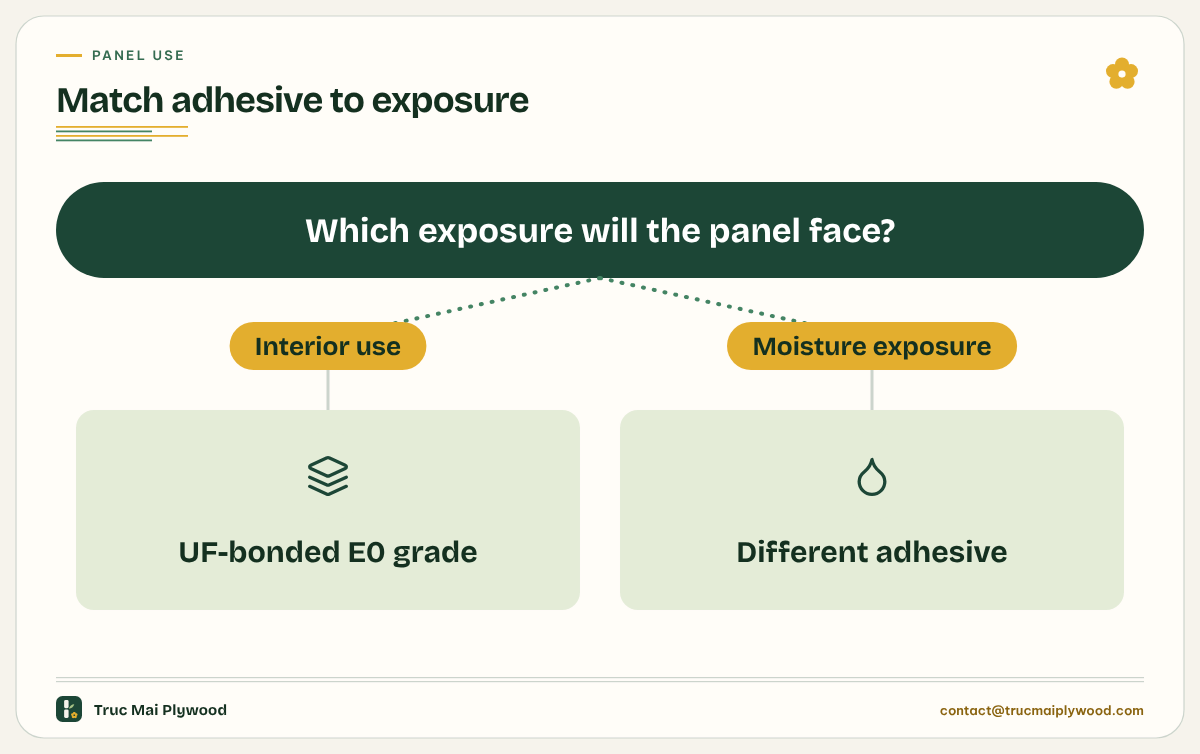
Adhesive type and formaldehyde emission are separate purchasing requirements. A UF-bonded interior panel can be specified with the mill’s E0 emission grade, while a different adhesive formulation may be chosen for moisture exposure. The term E0 is a buyer or supplier specification, not a universal emission limit under EN 13986; obtain the stated test method and limit for the ordered build.
For US hardwood plywood with veneer core, 40 CFR Part 770 sets a formaldehyde emission standard of 0.05 ppm under the relevant test framework. Truc Mai holds CARB Phase 2 and TSCA Title VI third-party certification for hardwood plywood with veneer core in the certified 3–25 mm range. That scope should be reflected in the order’s certificate documents, rather than transferred to a different thickness or construction.
The Phase 2 formaldehyde limits explainer helps importers separate regulatory emission limits from adhesive-bond performance. A boil-resistance statement addresses bonding, not chamber emissions. Keep both acceptance tests visible in the purchase specification.
What documentation matters for EU furniture buyers?
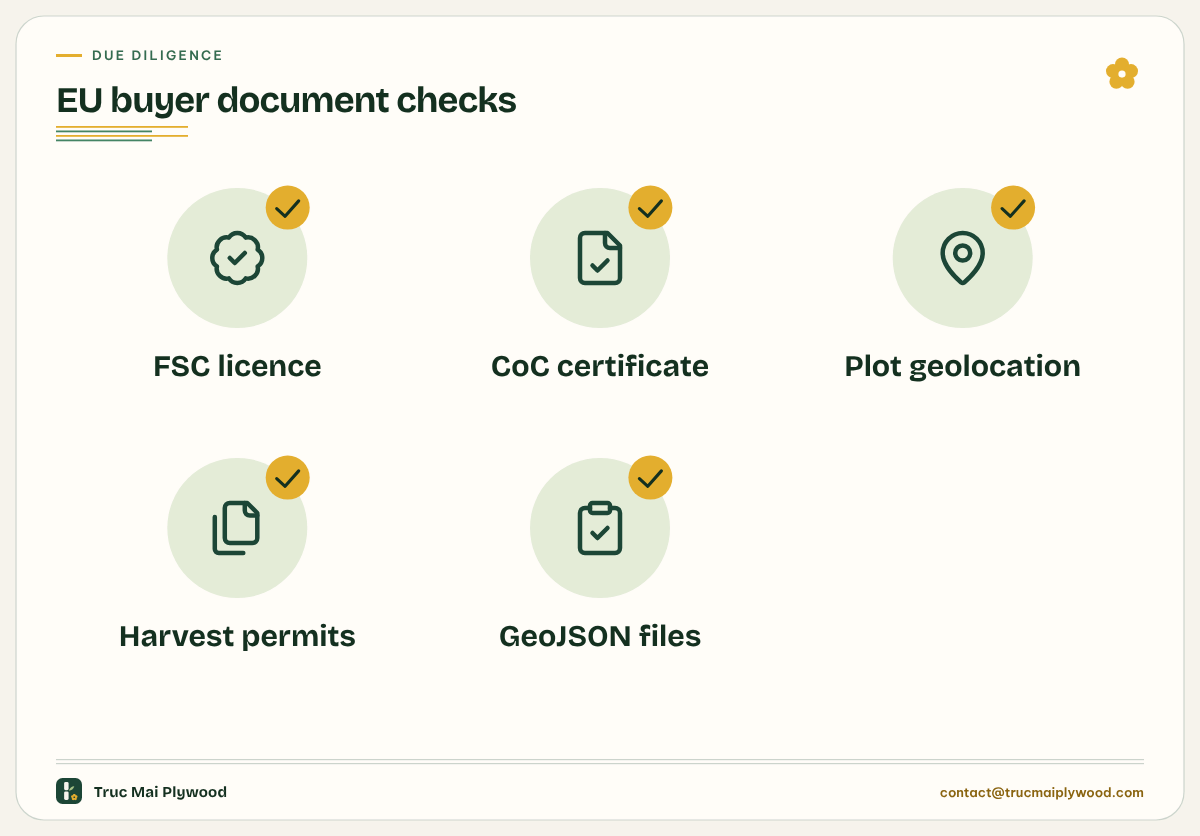
An EU buyer needs the panel specification and the relevant wood-origin and compliance documents. Start with the core species, face veneer and country of origin for each material. The documentation trail matters when the face is imported and the core comes from Vietnamese plantation timber, because the two inputs can have different origin records.
For EUDR due diligence, the manufacturer can supply origin records and plot geolocation files for the Vietnamese core and imported face veneer. The EU importer uses that information in its own due-diligence process. The face veneer origin files describe the practical distinction between a face supplier’s evidence and a core log dossier.
FSC chain-of-custody documentation is a separate matter. Truc Mai holds FSC licence FSC-C196493 and certificate SA-COC-014545 for eligible FSC 100% products. The FSC chain-of-custody standard requires the appropriate certificate code and product claim on sales documentation. Write the requested claim into the order and review the documents against the eligible product.
How can a buyer compare quotations without confusing face and core?
Compare offers only after normalising the panel construction. Two sheets described as “eucalyptus plywood” can differ in core joining, face preparation, adhesive system and tolerance. Those differences can matter more to a furniture factory than the broad species name. The goal is to compare usable panels for the same component, not labels on two quotations.
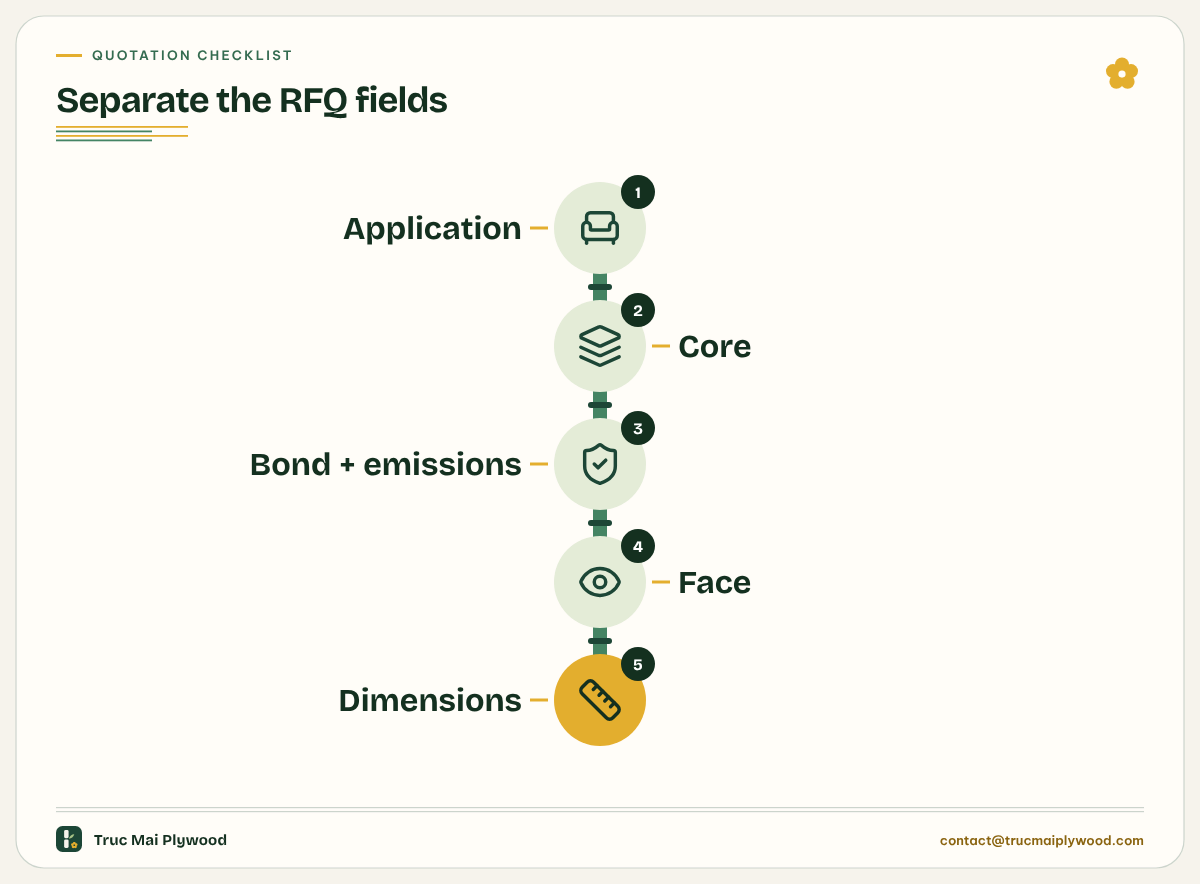
Use the following order when requesting comparable offers:
- Application: name the furniture part, loading conditions and visible surfaces.
- Core: specify species, permitted combinations and joining or stitching method.
- Bond and emissions: state adhesive requirements and the applicable test or certificate scope.
- Face: identify the front and back veneer, grade pair and finish preparation.
- Dimensions: write thickness, sheet size, tolerance and any cutting drawing.
- Packing: request pack count, sheet mass, labels and total quantity, including destination port.
Send the same brief to each mill. The plywood RFQ checklist can be used to turn those choices into a repeatable purchasing specification. A fair comparison should include the cost of rejected or reworked components in the buyer’s internal assessment, without relying on a generic species ranking.
Which samples should be approved before a repeat order?
Approve a full construction sample, not only a face swatch. For a cabinet programme, the most useful sample is one that can be machined and coated in the furniture factory.
Inspect both faces under the chosen finish. Cut across the sheet to reveal veneer arrangement and joint quality. Measure thickness at several positions, drill the specified fasteners, and check the parts after conditioning. Keep the approved sample with the order record so subsequent shipments can be judged against the same physical reference.
Truc Mai offers free samples; new buyers arrange the courier, with the courier charge credited against an actual order. The sample ordering process helps organise the face grade, core build and machining trial before a container order is placed. Ask for the sample identification to match the final purchase description.
When should a furniture buyer choose each option?
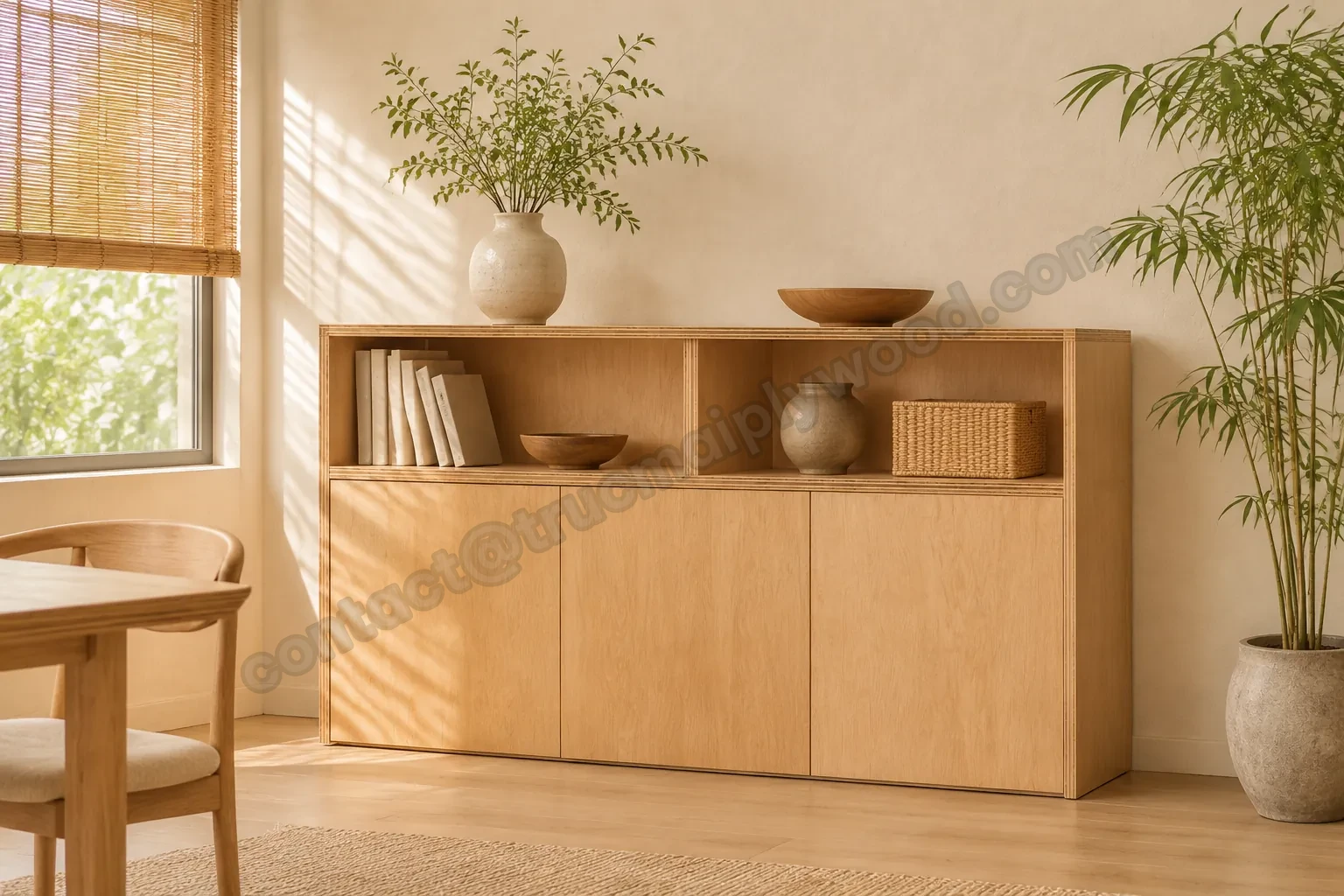
Choose a eucalyptus-rich core for stiffness-sensitive furniture parts and a lighter construction for weight-sensitive parts. For visible doors, choose the face on appearance first, then choose the core for performance. A mixed construction is worth testing when the product needs both a particular weight and a reliable machining edge.
Specify one construction for the parts that share acceptance requirements, and separate the parts that genuinely need another.
For a first order, send the intended use, preferred face, core, glue and emission requirement, sheet size, cutting drawing, packing quantity and destination port. The mill can then prepare a quotation and samples against a defined furniture specification instead of guessing what “poplar versus eucalyptus” means on the shop floor.
Send your specification to contact@trucmaiplywood.com or through the quotation form.
Questions buyers ask
Is eucalyptus plywood always stronger than poplar plywood?
A denser eucalyptus veneer construction can provide greater stiffness, but strength must be checked for the actual panel lay-up and test direction. Compare bending data for the same thickness and span.
Is poplar a hardwood or softwood?
Poplar is botanically a hardwood, although its timber is generally lighter and softer than many other hardwoods. The botanical category does not specify a finished plywood panel’s strength.
Can I use poplar-faced plywood for painted cabinet doors?
Yes. A smooth, calibrated poplar face is suitable for a painted interior door when the finish system and panel construction match the application.
Will eucalyptus veneer show through a thin paint finish?
Grain and repairs may show through thin coatings. Use an approved face sample, appropriate primer and a trial finish before selecting the visible grade.
Does an FSC certificate cover every plywood order?
No. The ordered product must be eligible for the FSC claim and the sales documents must identify that claim. Ask for the relevant product and certificate details.
Can I specify a eucalyptus core with a pale decorative face?
Yes. Core species and face veneer are separate specification lines, so a dense eucalyptus core can carry a pale face selected for the furniture design.
What thickness should I request for a shelf?
Select thickness from shelf span, load, support arrangement and the actual panel bending properties. Ask the furniture designer to verify deflection and fastening.
Do plywood grades such as B/BB mean the same thing at every mill?
No. Trade face-grade names are agreed against a supplier’s written grading rules and an approved sample. Record the front and back grade as a pair.
Can a mixed-core panel be machined on standard cabinet equipment?
Yes, with tooling and feed settings matched to the veneer lay-up. Test edge routing, drilling and coating on a sample from the proposed construction.
What documents should accompany an EU plywood order?
Agree the invoice, packing list, bill of lading, origin documents and any specified test or chain-of-custody papers before production. For applicable EU trade, obtain the wood-origin and geolocation dossier.