
To import plywood from vietnam to australia, specify the panels and approve a sample, verify the mill and timber origin, check Australian biosecurity conditions, classify the goods, arrange preferential-origin evidence and shipping papers, then complete customs and biosecurity clearance. Build the legality file before the container leaves Vietnam, not after it reaches port.
How do I import plywood from vietnam to australia, step by step?
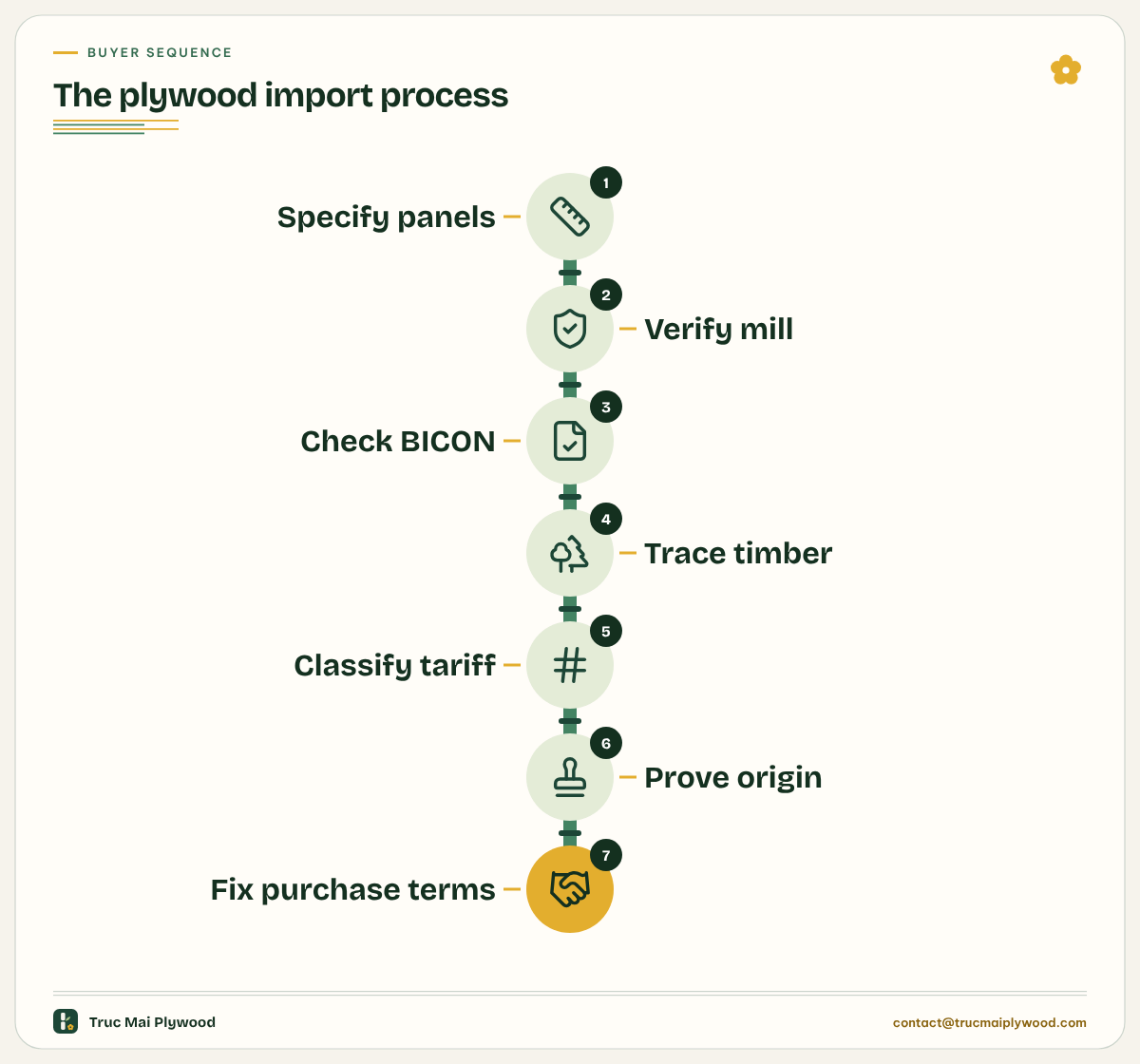
There are 10 connected steps to import plywood from vietnam to australia, starting with the product specification and ending with a checked delivery at the Australian warehouse. The buyer controls the Australian entry, while the Vietnamese manufacturer prepares the agreed product and export documents. Treat product, packaging, origin and shipping records as separate files that must agree with one another.
- Define the end use. Choose furniture, cabinet, interior lining or commercial packing panels and write a measurable specification.
- Check the manufacturer. Compare factory capability, the sample, production scope and document evidence before the deposit.
- Run the Australian biosecurity search. Identify the relevant BICON case for processed plywood and a separate case for timber packaging.
- Build the timber legality record. Identify the species and harvest locations for both core and face material, then assess risk under Australian rules.
- Classify the product. Give the broker its full construction so the correct Australian tariff line is selected.
- Choose the origin treatment. Check eligibility under the applicable trade agreement and request the right proof of origin.
- Approve the contract. Fix the sample, packing plan, named Incoterm, document list and shipment responsibilities.
- Inspect and load. Match production samples, bundle labels, pack counts and container weight to the order.
- Lodge entry and clear biosecurity. Send the broker the final shipping file and respond to any inspection direction.
- Receive and reconcile. Check seals, packaging and actual sheets against the loading documents.
Australia’s Department of Agriculture, Fisheries and Forestry (DAFF) requires timber and wooden products to meet the conditions in its timber import guidance. Its illegal logging importer guidance adds a distinct due diligence process. Begin with the broader Vietnam plywood import guide if this is your first overseas panel order.
The useful output of these steps is a single order file with named owners: procurement owns the approved panel, compliance owns harvest-origin evidence, the broker owns classification and entry, and the freight contact owns the vessel and delivery instructions. That division prevents a production question from becoming a border-clearance problem.
Which plywood specification should the Australian buyer approve?
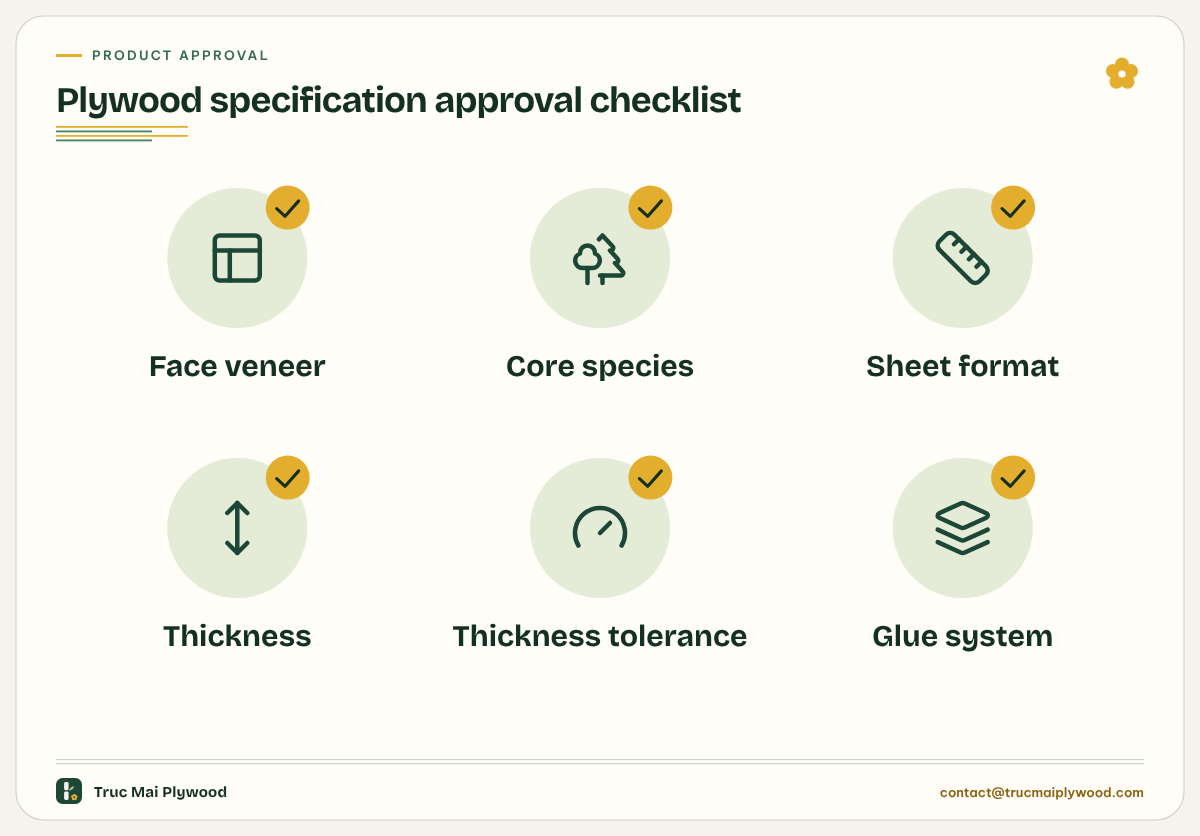
Start with the application, then record the face veneer, core, adhesive system, emission requirement, thickness, sheet size, face grade and packing. A single label such as commercial plywood does not fix those characteristics. For a cabinet door, a visible face and a calibrated thickness matter; for concealed furniture components, core consistency and machining behaviour may matter more than decorative grain.
Truc Mai Plywood manufactures furniture/interior and commercial plywood in Ha Hoa, Phu Tho, Vietnam. Its panel range includes engineered veneer, poplar, bleached poplar, birch-faced, okoume, bintangor, pine, eucalyptus and other face options over Styrax, Eucalyptus, Acacia, Pine or combined cores. The birch is a face veneer rather than an all-birch core. UV-ready panels are prepared for the buyer’s coating process; the mill also offers melamine and HPL faces. The specification must name the exact construction rather than relying on a species name alone.
| Order field | What to write | What the receiving team checks |
|---|---|---|
| Use | Cabinet parts, furniture faces, interiors or packing | Product matches the intended machining and finish |
| Face and back | Species, appearance grade pair, approved sample | Colour, patches, repairs and visible defects |
| Core | Species or specified mix, jointing and core grade | Edge construction and gaps |
| Bond and emission | Adhesive type and separate emission specification | Relevant test evidence for the agreed build |
| Sheet | Length × width × thickness, tolerance | Calliper and tape measurements |
| Packing | Pieces per pack, protection and label text | Labels agree with packing list |
Available sheet formats include 1220 × 2440 mm, 1220 × 2280 mm and 1250 × 2500 mm; the standard thickness range is 3–40 mm. Thickness tolerance is agreed per order, typically ±0.3–0.5 mm for the appropriate furniture or commercial line, rather than a universal tolerance for every grade. Face grades are agreed against the approved sample. For the first shipment, have the warehouse team sign off on the exact surface they will accept, not only a photograph from a quotation.
A concise plywood RFQ checklist helps procurement capture the fields in one exchange. Keep the signed specification and the sample reference together so the production team can match the exact face, core and finishing standard.
How should you verify a Vietnamese plywood mill before the deposit?
Verify the actual manufacturing scope, the production sample and the issuer records for any certificate used in the purchase decision. A factory name, a catalogue and a certificate image answer different questions. A catalogue describes possible products; a production sample shows the construction offered; a certificate scope tells you what an independent body has assessed.
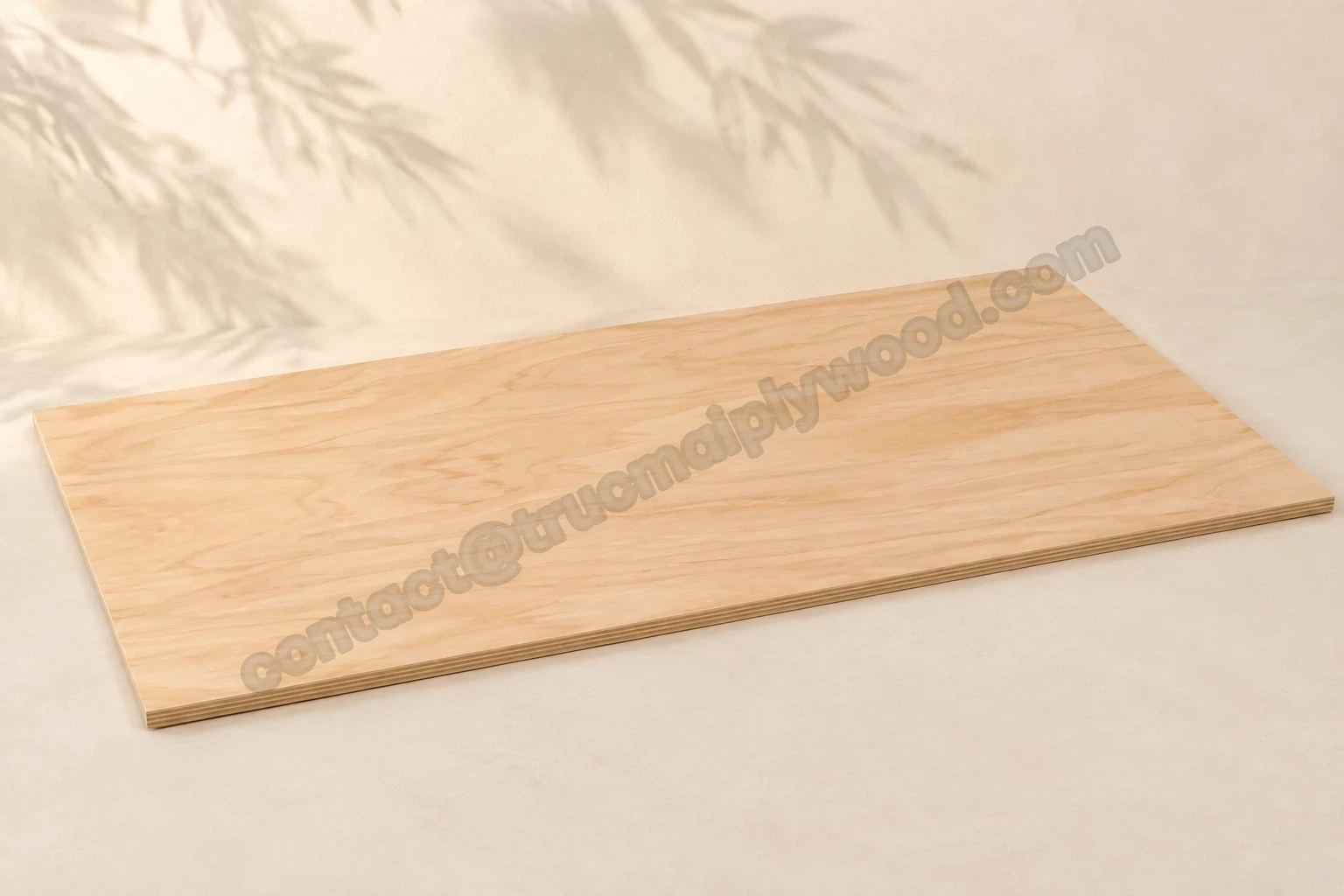
Ask the mill for a current sample with its face/back pair, a clear photograph of the edge plies, a written thickness tolerance and a pack label example. Compare the same points across offers. Two quotations with identical dimensions may use different core jointing, sanding and face veneer thickness. A mill that can explain the difference in a simple specification table is easier to inspect than one quoting only a product name.
For eligible products, Truc Mai holds FSC chain-of-custody licence FSC-C196493 and certificate SA-COC-014545, with FSC 100% output claims within the certificate’s product scope. It also holds ISO 9001:2015 quality management certification for plywood manufacturing. A buyer intending to use the FSC certified-product pathway should verify the actual output claim on the transaction documents, rather than assuming every panel is certified. The FSC licence verification page explains the check.
Request the same sample and document evidence from each shortlisted mill. Compare whether the product schedule, species list and packing information match the proposed order. The pre-deposit verification checklist is useful when the purchasing manager and the person approving payment are different people.
Do the commercial and technical review before releasing funds. A first order can use an approved physical sample and a separate pre-shipment inspection instruction, with the acceptance points written on the purchase order. This creates a measurable record for the receiving warehouse.
What Australian biosecurity checks apply to plywood and packaging?
The Biosecurity Import Conditions system, BICON, is the starting point for imported plywood and the wood used to support it. DAFF’s official timber import page states that import conditions apply to timber, wooden articles, bamboo and related products. The department assesses manufacturing or treatment evidence and may inspect goods after arrival.
Search the product as processed plywood, then separately describe any solid-wood pallets, blocks, battens or dunnage. A plywood sheet and a rough solid-wood pallet have different manufacturing histories. The first has been assembled and pressed into a panel; the second may retain wood characteristics relevant to pest risk. Ask the freight or customs agent to record the exact BICON case and any documentary condition in the shipment file.
For the plywood itself, prepare a manufacturing description showing the material, processing and finished state. For the packaging, prepare the packaging specification and any treatment or marking evidence required by its own BICON conditions. Inspect bundles before loading for bark, soil, insects and loose wood debris. Clean handling at the factory reduces avoidable examination issues at the destination.
An important distinction is between the cargo’s wood legality record and its biosecurity entry. Legal harvest documents explain where timber came from and how it was obtained. Biosecurity documents address pest and contamination risks. Neither document replaces the other. Record the supplier’s manufacturing description, the chosen packaging type and the BICON decision before the container booking is finalised.
The arrival team should have a process for an inspection direction: the broker receives the notice, the depot makes the container available and the warehouse waits for the release. A container can be correctly invoiced and still require a biosecurity examination. Treat that as a planned workflow, with the freight contact ready to supply the relevant manufacturing and packaging papers.
What does Australian illegal logging due diligence require?
Australian importers of regulated timber products need a written due diligence system and a documented assessment of the timber supply chain. DAFF’s importer due diligence instructions describe the system required under the Illegal Logging Prohibition Act 2012 and the Illegal Logging Prohibition Rules 2024, including gathering product and species information, assessing risk and recording the decision.
Collect the common and scientific species names for the wood components, the country and area of harvest, the manufacturing country, the supplier identity and the quantity imported. For plywood, distinguish face veneer from core veneer: they can come from different forests or countries. A document stating only ‘Vietnam origin plywood’ describes manufacture, but does not tell the compliance reviewer where every timber input was harvested.
The Australian rules provide certified-product and non-certified-product risk-assessment pathways. Under the certified pathway, check the relevant certification database record, scope, supplier identity and the certification claim shown on sales documents. Under the non-certified pathway, consider the source information and the specific risk factors DAFF identifies, then document the assessment. Certification is evidence to evaluate, not a substitute for recording the process.
The regulated timber products page explains how regulated goods are identified by tariff classification and product characteristics. It also explains that grouping product codes can be appropriate where the timber characteristics and supply chain are genuinely the same. This matters for importers carrying several face colours or panel thicknesses from one documented material source.
A practical file has a species-and-origin sheet, harvest or supplier records, certification evidence where relevant, a written risk assessment and a link to the purchase order. Keep evidence traceable to the shipment rather than storing an unlabelled certificate in a shared folder. Truc Mai can supply origin records and geolocation information for the core and face veneer, giving buyers material they can evaluate within their Australian due diligence process.
The Australian legal framework was updated in March 2025. Use the current DAFF process when building the file, especially if your organisation last imported panels under an older procedure.
How do you choose the Australian HS code for plywood?
Heading 4412 is the Australian tariff starting point for plywood, veneered panels and similar laminated wood. The Australian Border Force Chapter 44 schedule then distinguishes products by their construction and outer plies. Give the customs broker the complete lay-up, face species and any overlay or processing before asking for the final Australian classification.
The six-digit international HS structure is a starting language for cross-border trade; the Australian tariff uses more detailed national lines and statistical codes. A generic ‘plywood 4412’ entry on a quotation is insufficient for calculating the final duty treatment. The precise Australian code belongs on the broker’s classification record and import declaration.
For example, a face veneer of birch over a Vietnamese plantation core should be described as birch-faced veneer-core plywood, with its actual veneer arrangement. A melamine-faced panel needs its overlay described. A cut rectangular panel can still fall under the relevant plywood heading; the full description decides the line. Do not copy a supplier’s code from another country’s invoice into the Australian entry without reviewing the Australian tariff wording.
| Classification evidence | Why the broker asks for it |
|---|---|
| Face and back species | Helps identify outer-ply treatment under Chapter 44 |
| Core material | Distinguishes veneer-core construction from other laminated panels |
| Ply arrangement | Supports the description of plywood construction |
| Surface finish | Identifies overlays or other working |
| Dimensions and quantity | Supports statistical units and shipment declaration |
| Origin documentation | Supports any separate preferential-duty claim |
Keep the customs description aligned across invoice, packing list and order. If a supplier writes ‘hardwood plywood’ while the purchase order specifies a particular face and core, send the more detailed specification to the broker. A consistent description is easier to defend and reduces questions at document review.
Can Vietnamese plywood qualify for preferential Australian duty?
Vietnamese-origin plywood can be assessed under Australia’s relevant free trade agreements, including AANZFTA, CPTPP and RCEP. The Australian Border Force agreement directory lists Vietnam among the participating parties and links to the agreement schedules and origin requirements. Preferential treatment follows the correct tariff line and the applicable rules of origin, not merely the export port printed on the bill of lading.
Ask the broker to compare the ordinary tariff rate with the preferential rate available for the classified product. Then identify which agreement’s origin rule is satisfied and what proof of origin that agreement accepts. The supplier’s commercial invoice and the preferential-origin evidence should identify the same goods. A country-of-origin statement and a preferential certificate serve different functions, so record which document the chosen agreement requires.
The AANZFTA information page identifies Vietnam as a party and describes the Second Protocol’s entry into force for Vietnam in August 2025. Use the agreement text and current tariff schedule rather than an older template for origin paperwork. Imported face veneer is a reason to check the actual origin rule carefully: the country of manufacture and the country where the face wood grew are separate facts.
Build an origin decision note for the broker: final tariff line, agreement considered, product-specific origin rule, evidence received and declaration treatment. If the panel construction changes between orders, revisit that note. Preferential treatment is a customs classification and origin exercise, while the timber legality review asks a different question about harvest and risk. Keeping both records clear avoids using one certificate for two unrelated purposes.
Which Incoterm and purchase-order terms should you use?
Use a named port and a written Incoterm to allocate freight tasks, insurance and the point where shipment risk transfers. Truc Mai offers FOB Hai Phong, CFR and CIF terms. For an Australian importer, the difference is operational: who arranges the main carriage, who obtains insurance and which party handles the freight booking.
Under FOB Hai Phong, the buyer arranges the main sea carriage. Under CFR, the seller arranges and pays for carriage to the named destination port, while insurance is a separate buyer decision. Under CIF, the seller arranges the specified carriage and insurance. Risk allocation under these sea terms follows the ICC Incoterms 2020 rules and is separate from the person paying a particular invoice. Write the named port after the term, not simply ‘FOB Vietnam’ or ‘CIF Australia’.
The purchase order should reference the approved sample, product description, panel tolerance, face/back grade, pack count, marking requirements, document list and the selected shipping term. The buyer’s agent should also know the discharge port, receiving depot and contact who can approve the shipping document drafts. A separate line should name who handles any inspection at the Vietnamese loading point.
The mill’s standard commercial terms are a one-40HC minimum order, production normally 15–45 days after a 30% deposit and a 70% balance against the scanned bill of lading, using T/T or an irrevocable sight letter of credit as agreed. Production time is not sea transit time. For a first order, make the timing of sample approval and final artwork or labels explicit so the factory knows when the production specification is frozen.
Use the deposit and balance terms resource to separate production milestones from shipping milestones. In the contract, record the person who can approve a deviation. A change from one core species to another may affect weight and appearance even if the sheet dimensions remain identical.
Which documents should travel with each plywood container?
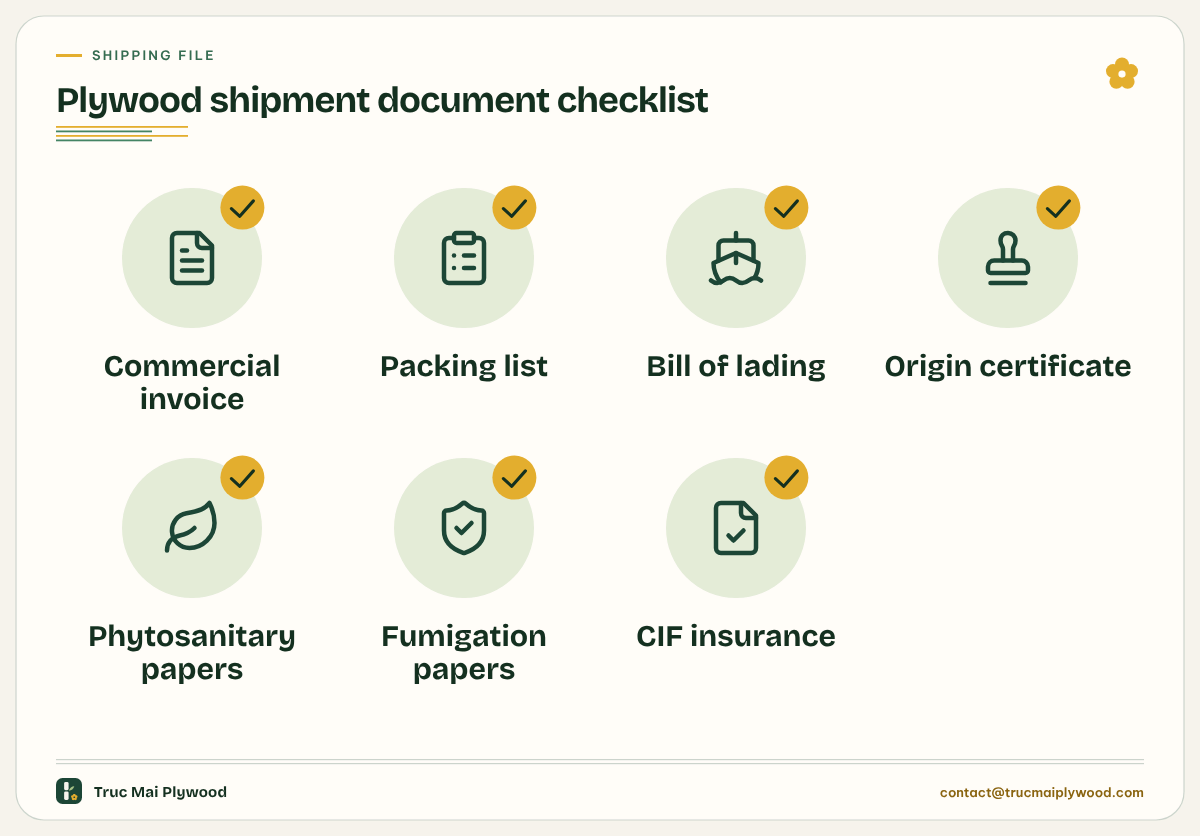
The shipment file starts with a commercial invoice, packing list and bill of lading, then adds origin, timber legality and biosecurity records required for the particular entry. Each document has a separate job. The invoice states the commercial goods, the packing list counts and identifies them, and the bill of lading records the carriage.
| Document | Principal purpose | Cross-check before dispatch |
|---|---|---|
| Commercial invoice | Goods and transaction details | Seller, buyer, description and quantities |
| Packing list | Physical loading record | Packs, sheets, net and gross weights |
| Bill of lading | Sea carriage record | Consignee, vessel, ports and container |
| Origin evidence | Customs origin treatment | Product and applicable agreement |
| Timber origin dossier | Illegal logging risk assessment | Face and core species, harvest source |
| Manufacturing or treatment record | Biosecurity entry evidence | Product and packaging description |
| Insurance document | CIF shipment insurance | Insured cargo and voyage |
| Product test or certification record | Agreed specification evidence | Correct panel build and scope |
The export side may also provide phytosanitary and fumigation papers where applicable to the consignment and packaging. Australian entry is determined against the relevant BICON case, so give the broker the document set associated with that case. A phytosanitary paper does not automatically answer a request about solid-wood dunnage treatment, and an FSC claim does not answer the customs tariff question.
Truc Mai sends the agreed certificate files before order confirmation and shipping document drafts to the buyer for approval after loading. Use that draft approval to compare invoice and packing list quantities, product names and destination instructions. Keep the final files in a folder named for the container number, with a simple index that identifies which paper supports each entry field.
The documents per container page gives a useful buyer-side handover checklist. The best time to find a missing origin record is before the shipment sails, when the mill can still match the document to the actual veneer and packed goods.
How do you calculate a plywood loading plan for a 40HC?
A 40HC loading plan starts with sheet size, thickness, core density, pack height and the cargo weight allowed on the booking. The figures below are a planning model for panels, not a record of weighed export loads. Use the actual container booking, measured pack weights and packaging mass to finalise the loading instructions.
The supplied calculation uses 1220 × 2440 mm panels, approximately 1,000 mm pack height, up to 18 Styrax packs, 16 Acacia packs or 15 Eucalyptus packs, and a 28,000 kg planning cargo payload. Reference densities are 500 kg/m³ for Styrax, 580 for Acacia and 650 for Eucalyptus. Sheets per pack are limited by thickness and, where marked, by weight. The values below reproduce the calculation inputs without adjustment.
| Core | Thickness (mm) | Size (mm) | Packs | Sheets/pack | Sheets | Volume (m³) | kg/sheet | Total panel kg | Weight-capped |
|---|---|---|---|---|---|---|---|---|---|
| Styrax | 12 | 1220x2440 | 18 | 83 | 1494 | 53.4 | 17.9 | 26680 | No |
| Acacia | 12 | 1220x2440 | 16 | 83 | 1328 | 47.4 | 20.7 | 27510 | No |
| Eucalyptus | 12 | 1220x2440 | 15 | 80 | 1200 | 42.9 | 23.2 | 27860 | Yes |
| Styrax | 15 | 1220x2440 | 18 | 66 | 1188 | 53.0 | 22.3 | 26520 | No |
| Acacia | 15 | 1220x2440 | 16 | 66 | 1056 | 47.2 | 25.9 | 27350 | No |
| Eucalyptus | 15 | 1220x2440 | 15 | 64 | 960 | 42.9 | 29.0 | 27860 | Yes |
| Styrax | 18 | 1220x2440 | 18 | 55 | 990 | 53.0 | 26.8 | 26520 | No |
| Acacia | 18 | 1220x2440 | 16 | 55 | 880 | 47.2 | 31.1 | 27350 | No |
| Eucalyptus | 18 | 1220x2440 | 15 | 53 | 795 | 42.6 | 34.8 | 27690 | Yes |
| Styrax | 21 | 1220x2440 | 18 | 47 | 846 | 52.9 | 31.3 | 26440 | No |
| Acacia | 21 | 1220x2440 | 16 | 47 | 752 | 47.0 | 36.3 | 27270 | No |
| Eucalyptus | 21 | 1220x2440 | 15 | 45 | 675 | 42.2 | 40.6 | 27430 | Yes |
The model’s stated basis is panels only: 40HC, 1,000 mm packs, packs per core as listed, sheets per pack rounded down from pack height divided by thickness and capped against the 28,000 kg planning payload. The carrier and route determine the permitted cargo load. The actual booking also needs room and weight for pallets, protection and other packaging. A calculated panel total should therefore be checked against the complete loaded gross mass.
The core is not simply an appearance choice. A denser core makes each sheet heavier and changes the practical container count. A mixed load should be calculated pack by pack rather than applying a single core figure to all bundles. The 40HC volume-by-thickness table explains the wider range of panel sizes and thicknesses. When approving a loading plan, request the actual sheet count, pack count, weights, packing arrangement and container seal reference together.
How can cut-to-size plywood change the Australian receiving plan?
Cut-to-size plywood lets the importer receive labelled parts rather than only full sheets, reducing the amount of cutting required at the destination warehouse. The order must define the parent sheet, finished piece dimensions, cutting pattern, labels and packing count. These are manufacturing instructions, not a separate tariff classification by themselves.
Available cutting patterns include dividing a standard sheet lengthwise into two 610 × 2440 mm pieces, into three 1200 × 800 mm pieces where the agreed parent format supports the layout, or into four 1220 × 610 mm pieces. Six-piece patterns can also be agreed.
The exact cut dimensions are set from the buyer’s parent sheet and cutting list. Cutting waste and blade kerf belong in the factory cutting plan rather than in an assumed finished yield.
For Australian cabinet makers, specify whether the panel is a finished visible component or a blank for subsequent machining. A finished component may need a face orientation mark, a face/back designation and a carton or pack identifier that corresponds to the installation sequence. A blank may only need a piece code and quantity. Separate packs by part type so the warehouse does not have to sort mixed sizes before production.
The cut-to-size panel options show how the mill can prepare labelled panels. Ask the supplier to provide a cutting diagram for approval, then keep the drawing revision with the purchase order. At the receiving end, count pieces by part code rather than inferring quantities from the number of original sheets.

What quality checks belong before the container is sealed?
Inspect the finished plywood against the approved sample and written specification before loading. The receiving warehouse should be able to repeat the same checks using the order sheet, which makes a pre-shipment report more useful than an unstructured photo collection.
Check panel thickness at agreed positions, sheet length and width, face/back appearance, edge construction, visible delamination, surface preparation and pack protection. If the buyer requires a particular emission report or bond test, match its panel configuration to the ordered build. Adhesive type, emission class and bond performance are separate specification lines; an emission document is not a test of wet bond durability.
For furniture panels, inspect a representative visible face under consistent lighting. For laminated panels, check the overlay finish and edge protection. For packing panels, focus on whether the agreed core and sheet dimensions match the handling application. The sample ordering process establishes the appearance benchmark, while the signed order states the measurable tolerances.
Before sealing, photograph the container floor and walls, the first packed bundles, the completed load and the closed doors with the seal number. Record any solid-wood dunnage used, because it will matter to the packaging biosecurity review. A dry, clean loading surface and secured packs help preserve the surface condition through handling. The packing list should match what can be counted from the loading record.
The person approving the final inspection should have authority to hold a pack that differs from the approved sample. Write the hold decision and corrective action in the shipment record. This is more practical than discovering at the Australian warehouse that the face grade, pack count or core construction was described differently in the order and invoice.
How does customs and biosecurity clearance work on arrival?
The Australian customs broker prepares the import declaration from the tariff classification and shipment papers, while the biosecurity process assesses the goods and packaging against the applicable import conditions. Both streams need accurate descriptions and the final shipping documents. The container is then delivered according to the release and transport arrangements.
Send the broker the final invoice, packing list, bill of lading, origin evidence, timber legality record and biosecurity supporting papers as soon as they are ready. Identify the contact who can obtain an extra manufacturing description or supplier document if an officer requests it. A broker can classify the goods from the supplied construction, but cannot infer the species and harvest source of the face veneer from a generic product name.
DAFF’s timber import guidance explains that compliance can be verified through documents and inspection. Prepare the receiving depot for an examination if directed, including access to pack labels and the container. The importer should know which transport company is collecting the released container and which warehouse will record its arrival condition.
For the warehouse check, compare the container number and seal, then count bundles by their labels. Open a sample of packs and inspect corners, edges and visible surfaces. Keep a separate record of damage observed before unloading and damage discovered after moving goods. The container arrival inspection checklist can be used by the warehouse supervisor even when procurement is based elsewhere.
Close the import file only after the entry records, delivery note, pack reconciliation and any inspection outcome are stored together. This creates a usable starting point for a repeat shipment and lets the next purchase order improve its packing or document instructions.
What should Australian buyers do differently on the second order?
Use the first shipment’s receiving report to refine the specification and document request for the second container. A repeat order is most efficient when the buyer can point to a known sample, an agreed core construction and a pack layout that the warehouse has already handled successfully.
Review the actual sheet counts, pack condition, inspection observations and the time spent obtaining documents. If a particular face grade created too much sorting, tighten the sample description rather than asking for a vague ‘better grade’. If bundle labels were hard to read, change the label format before production. If the broker needed more timber species information, add that field to the standard order file.
For the legality assessment, DAFF explains that a repeat assessment exception can apply in defined circumstances when the same timber product and supply chain have already been assessed within the relevant period. The importer still gathers the prescribed information for each import and checks that the product and supply chain remain materially unchanged. See the DAFF due diligence procedure for the current repeat-import conditions.
Use the first container as a measured baseline, not as evidence that every future container will weigh the same. Ask for actual pack weights and verify any change of face, core, overlay or thickness against the order. A repeatable purchasing file is a competitive advantage for the importer because procurement, compliance and the receiving warehouse can work from the same approved facts.
What should you send to request an Australian plywood shipment?
Send one written request with the end use, face and core construction, adhesive and emission specification, dimensions, quantity, packing plan and destination port. Attach the approved sample reference or a request for samples, and identify the person who will approve the biosecurity and timber-origin document set.
A practical request names the Australian receiving use first, then asks for the proposed panel build. For example, an interior cabinet component request should describe the visible face, thickness, tolerance, core and whether the mill supplies a full sheet or labelled cut pieces. Ask for the matching packing arrangement and a sample of the pack label. If the container combines different items, list each as a separate order line.
Include the nominated Incoterm and Australian discharge port. Ask the supplier to prepare the manufacturing description and harvest-origin information alongside the commercial documents so the customs broker can review the entry before arrival. The sample ordering process and landed-container worksheet help organise the next exchange.
Truc Mai Plywood can prepare a quotation from that specification and supply the agreed product and document file. The buyer’s strongest next step is to send a complete RFQ with the Australian broker’s documentary requirements attached, so the first sample and the final shipment are assessed against the same order.
Send your specification to contact@trucmaiplywood.com or through the quotation form.
Questions buyers ask
Is plywood automatically cleared because it has been heat pressed?
No. Australia assesses the relevant timber product and packaging against the Biosecurity Import Conditions system; manufacturing details and supporting documents form part of the entry evidence.
Can I use a certificate of origin instead of timber legality records?
No. A certificate of origin supports a customs origin claim, while Australia’s illegal logging due diligence asks for timber species, harvest origin and a documented risk assessment.
Do I need to send samples before ordering a container?
A physical approved sample gives the mill and buyer a shared reference for face grade, colour, core and finish. Record the sample reference on the purchase order.
Does FSC certification remove the Australian due diligence process?
No. The certified-product assessment pathway still calls for checking the certification record, product scope and the FSC claim on the sales documentation.
Are solid-wood pallets treated the same as plywood sheets?
No. Packaging is assessed separately from the plywood cargo, and solid-wood packaging has its own import conditions.
Can I combine several panel thicknesses in one container?
Yes. A mixed container can be agreed in the order, with each pack labelled and its actual weight recorded on the final packing list.
What should I do when a panel is damaged at discharge?
Record the container seal, pack identification, condition and photographs before moving the damaged goods, then reconcile them with the packing list and the agreed inspection terms.
Is a birch-faced panel necessarily made entirely from birch?
No. Birch-faced plywood describes the visible veneer. The core species and construction should be written separately in the order.
Does Australia use the EU EUDR filing system for plywood imports?
No. Australian importers follow Australia’s illegal logging laws and biosecurity rules; an EU due diligence statement is a different regulatory process.
What should the importer give the customs broker before arrival?
Provide the commercial invoice, packing list, bill of lading, full panel construction and origin details, preferential-origin evidence if claimed, and the biosecurity and legality records relevant to the shipment.