
10mm ply and 11mm plywood are intermediate furniture-panel specifications, selected for a drawing, groove or component schedule rather than by thickness alone. Compare them with 9 and 12 mm sheets, then specify the core, face, finished tolerance and cut list. Truc Mai Plywood handles the enquiry as a defined panel construction.

What is 10mm ply used for in furniture production?
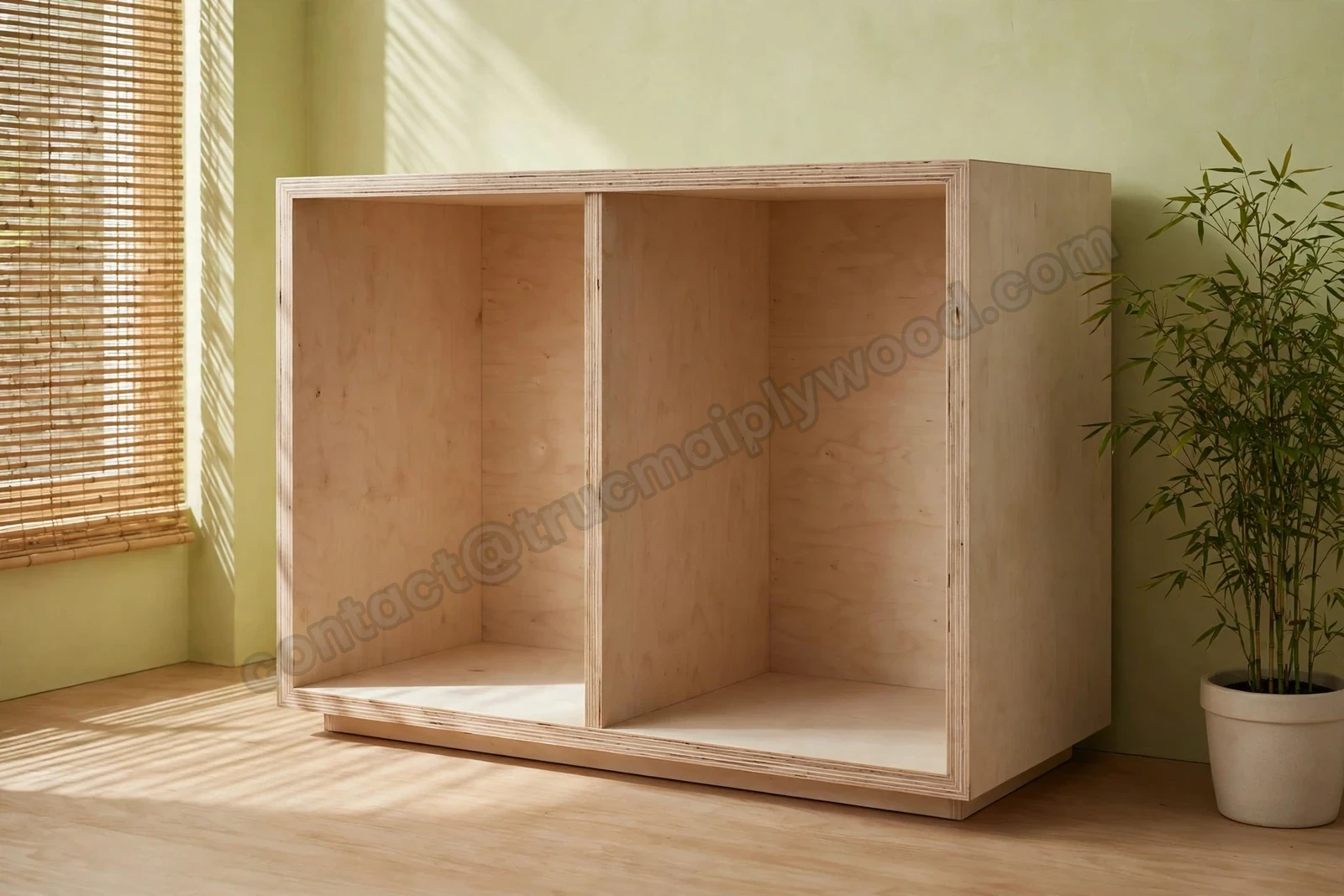
10mm ply is a mid-thickness furniture panel used where a maker wants more substance than a thin backing sheet without specifying a full cabinet carcass thickness. Typical buying enquiries concern drawer components, partitions, cabinet inserts, display fixtures and interior lining. The design team still decides span, support spacing and fastening details for the finished item.
The practical decision begins with the component rather than the catalogue label. A narrow, continuously supported divider asks something different of a sheet than a wide, unsupported shelf. A panel hidden behind a laminate can accept a different face appearance from a clear-finished exposed component. Specify which faces will remain visible, which edges will be exposed, and whether the factory will cut the pieces before shipment.
An importer comparing samples should ask whether the panel is intended to be left exposed, edge-banded or hidden inside an assembly. This changes the acceptance criteria. A clear-finished partition can be rejected for face colour variation even when its thickness is correct, while a concealed insert may be accepted on appearance but rejected because a groove breaks through an open core joint. Keep those two inspections separate.
For a furniture programme, cabinet-grade plywood gives the wider face and core selection framework. The 10 mm enquiry should then identify the exact component, the planned finish and the desired core construction. These three details turn an ambiguous thickness request into a repeatable manufacturing specification.
Why do buyers request 10mm ply or 11mm plywood instead of 9mm or 12mm?
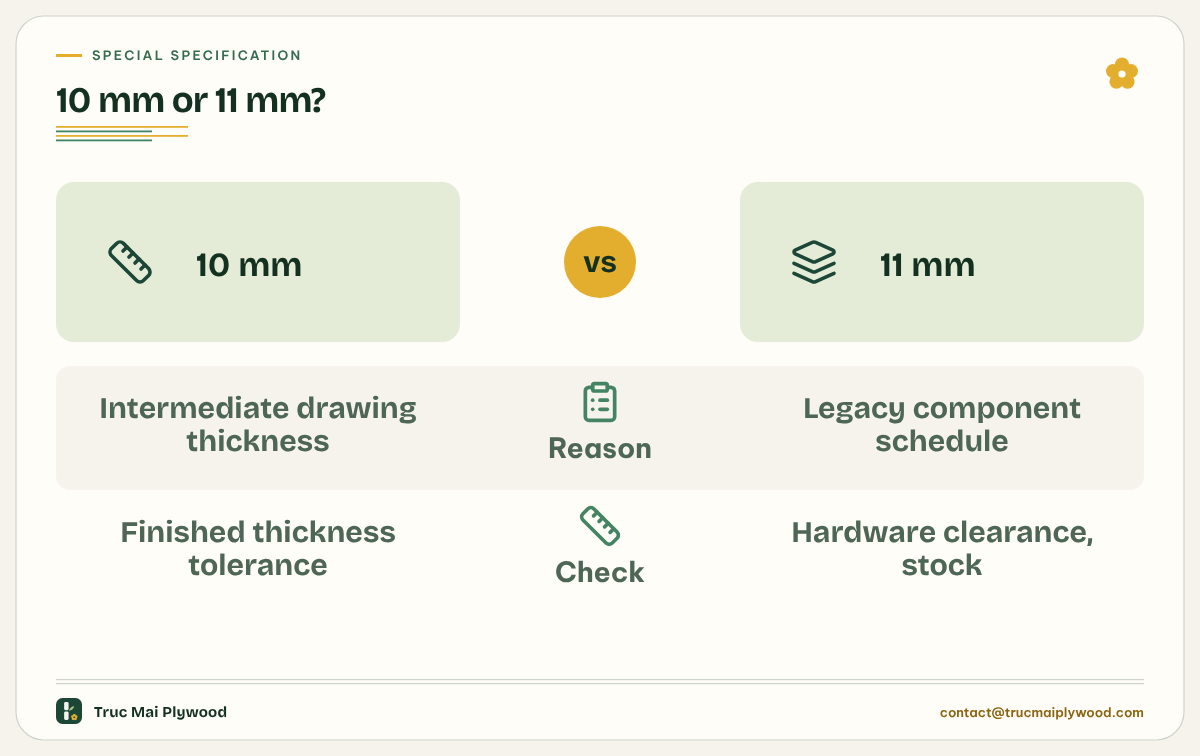
Buyers request 10 mm or 11 mm when a component drawing, hardware clearance or established bill of materials calls for that nominal thickness. Neither is a universal substitute for 9 mm or 12 mm. A repeat cabinet programme may have grooves and rebates cut for a particular panel, so changing thickness affects fit even if the sheet looks similar.
| Nominal thickness | Common purchasing reason | What to check before substitution |
|---|---|---|
| 9 mm | Existing thinner-panel specification | Groove fit, support and finish |
| 10 mm | Drawing calls for an intermediate thickness | Finished thickness and tolerance |
| 11 mm | Legacy or market-specific component schedule | Hardware clearance and matching stock |
| 12 mm | Standardised thicker component specification | Weight, machining and assembly |
Truc Mai’s regularly listed thicknesses include 9 mm and 12 mm. A request for 10 mm or 11 mm should therefore be submitted as a special specification rather than treated as an automatically stocked thickness. The mill can discuss a build against the buyer’s drawing. Do not place a repeat order by changing the number on an old purchase order while leaving its cutting programme untouched.
The 18 mm loading and specification article illustrates why a thickness name alone does not describe the whole panel.
Which core should a buyer specify for a 10 or 11 mm panel?
Styrax, Eucalyptus, Acacia and Pine are the core choices offered for Truc Mai furniture and commercial plywood; combined-species cores are another option. The right selection follows the finished component’s weight, machining and appearance requirements. Core choice also affects the number of panels that can travel in a weight-limited shipment.
An interior maker who needs a lighter panel can ask for Styrax, while a purchaser specifying a denser construction can compare Acacia and Eucalyptus. A mixed core should be written as a construction requirement, with the species and arrangement agreed on the sample, rather than as an undefined discount alternative.
When requesting samples from two constructions, cut them with the same tooling and compare the cut edges under the same lighting. Look for veneer tear-out, gaps behind the face and variation where an edge band must adhere. An attractive top face alone will not reveal those differences.
Look at the exposed edge of a sample. Check for open joints, overlaps and local voids where a screw, rebate or edge band will land. The outer core plies are often stitched in the furniture line; a buyer can request the joining arrangement in the order specification. The point is repeatability across containers, not a species name alone.
Which face veneers work with intermediate-thickness plywood?
Poplar, engineered veneer (EV), birch, okoume, bintangor, pine, eucalyptus and gurjan faces are available within the manufacturer’s wider interior and commercial range. Choose the face against the finishing process and the appearance of the approved sample, then pair the front and back grades on the purchase order.
For paint or an opaque overlay, a smooth and consistent prepared surface matters more than a dramatic grain. For a transparent finish, colour and grain matching across the delivered lot deserve closer attention. A birch face is a veneer option on a Vietnamese core; it should be described as birch-faced plywood, rather than as a through-birch construction.
The birch-faced plywood range and engineered-veneer range show two distinct appearance directions. Ask for photographs of the face and back separately and inspect the edge at the same time. A face grade cannot compensate for gaps in the core.
How should thickness tolerance be written on the order?
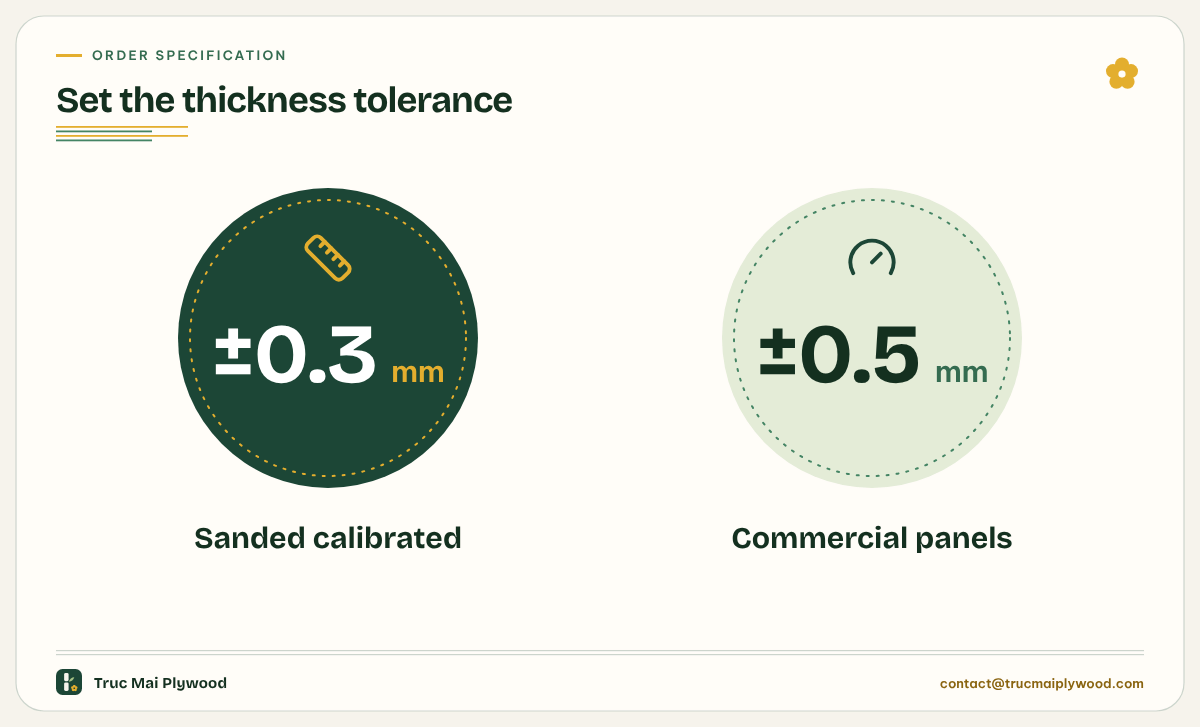
Write the nominal thickness and the permitted measured deviation together. Truc Mai’s furniture-panel specification uses ±0.3 mm on sanded, calibrated work, while commercial panels commonly use ±0.5 mm; the agreed order line controls the actual supply.
Measure several boards from the same sample pack rather than relying on the nominal label on the carton. Record the measuring tool, the points selected and the treatment of any decorative overlay. A supplier can then discuss the same acceptance rule with the buyer instead of comparing unrelated measurements.
The buyer should also say whether the dimension is measured before or after an added decorative surface. For a component entering a machined slot, the final assembly dimension matters. A sample taken from the approved production construction provides a useful reference for the first run.
EN 315:2000 describes dimensional tolerances for plywood, including different provisions for sanded and unsanded boards. Its framework is distinct from a tighter commercial tolerance agreed directly between buyer and mill. The BSI EN 315 standard listing identifies the standard and its scope. Put the contracted tolerance in the RFQ instead of assuming that a generic standard label captures the desired machining fit.
How do sanded and unsanded panels differ at this thickness?
Sanded and calibrated panels offer a more controlled surface and finished thickness for furniture work. Unsanded or lightly sanded commercial panels can suit hidden components and subsequent processing where a decorative face is unnecessary.
A buyer should examine both faces under the intended finish. Sanding can reveal veneer defects or glue-line issues that were less visible on a rough surface; it also changes the amount of material left above the outer glue line. On a thin construction, the finish plan should be agreed before the veneer lay-up is approved.
Truc Mai’s furniture line normally uses an A-grade stitched core and sanded faces. The commercial line commonly uses an AB core with a looser joining specification. Compare the actual sample and edge section, not merely the words ‘sanded plywood’ on a quotation. The Vietnamese plywood grading article explains the construction differences in more detail.
What glue and emission specification belongs on a 10 mm order?
Specify adhesive type and emission requirement as separate lines. Truc Mai’s default interior construction uses UF glue at E0 emission; a moisture-related requirement calls for a separately agreed adhesive system and evidence for the finished panel construction.
The buyer’s application decides the test request. A dry interior cabinet is different from a component expected to experience repeated damp conditions. A supplier’s description of the resin cannot replace the result of a bond test on the panel. Equally, an emission class does not describe the resistance of a glue line to moisture.
For the United States, 40 CFR Part 770 sets the TSCA Title VI requirements for regulated composite wood products. The hardwood-plywood veneer-core emission limit is 0.05 ppm under the specified test framework. Truc Mai’s CARB Phase 2 and TSCA Title VI certificate covers hardwood plywood with veneer core within its stated 3–25 mm product range. Include the product configuration and certificate number CARB/EPA 26053 in the document request.
What does the ply construction tell the buyer?
The number and arrangement of veneers matter more than an assumed ply count attached to a nominal 10 mm label. The mill’s standard 18 mm furniture construction commonly uses 11–13 plies, while its 3–5 mm thin panels use five. An intermediate custom thickness needs its own approved lay-up.
Inspect the edge from end to end. Adjacent veneers normally alternate grain direction, and a well-assembled core should show regular bonding without obvious open channels. A buyer ordering a narrow machined strip should identify which edge will remain visible after cutting and whether any void can interfere with edge finishing.
A sample specification can record face veneer, cross-bands, core species, joining method and finished thickness. Keep that reference with the purchase order so a repeat shipment is judged against the same construction. Avoid selecting a panel solely because a sales listing promises more layers: veneer quality and the finished component’s performance remain part of the decision.
Which sheet formats and cut sizes can be ordered?
The regular sheet formats are 1220 × 2440 mm, 1220 × 2280 mm and 1250 × 2500 mm. For furniture production, the shorter format can reduce unnecessary trimming when the component programme is built around it. Custom cutting is also available from the selected parent sheet.
The mill can supply labelled pieces cut lengthwise into two, divided into three, or cut into four or six parts according to the agreed cutting list. Examples include 610 × 2440 mm halves, 1200 × 800 mm pieces and 1220 × 610 mm quarters. Exact piece dimensions are established from the source sheet and the approved cutting layout, rather than inferred from the nominal subdivision alone.
Send the cutting drawing with grain direction, face orientation, edge allowance and label reference. This prevents a packing team from grouping visually similar pieces with different destinations in the customer’s assembly line. See cut-to-size plywood panels and 1220 × 2280 mm sheets for the ordering routes.
How should a buyer inspect a sample before committing to volume?
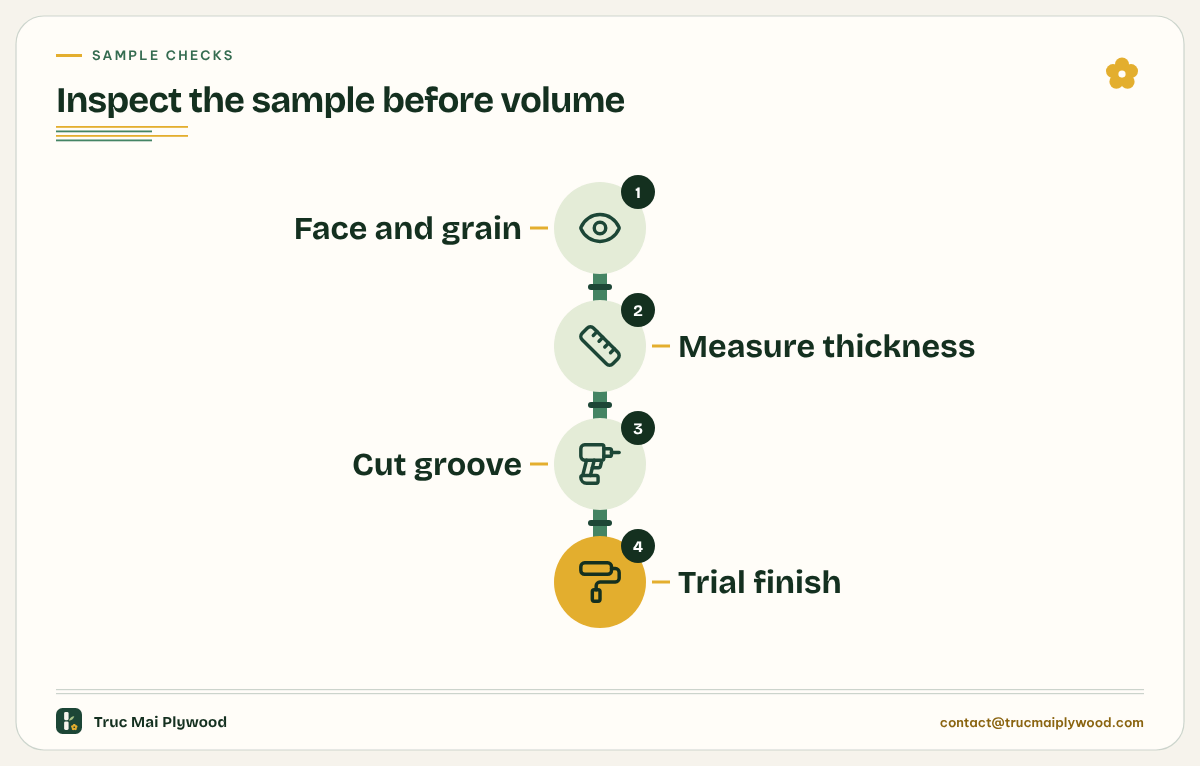
Inspect one sample against the proposed end use, then record its construction as the reference for the order. A useful inspection covers measured thickness, face appearance, edge voids, flatness, machining response and the result after the buyer’s intended finish is applied.
- Mark the intended visible face and the direction of the grain.
- Measure thickness at several points, including near opposite edges.
- Cut a representative groove or rebate using production tooling.
- Apply the intended coating, laminate or edge band to a trial piece.
- Compare the result with the approved drawing and record any required change.
Do not use a tiny decorative offcut as the only acceptance sample for a large cabinet part. The test piece should include the operation most likely to expose a defect. Ordering plywood samples describes how to send the reference construction to the mill.
How should 10 and 11 mm sheets be packed for export?
Pack intermediate-thickness panels by the agreed sheet size, face protection and handling method, with the quantity and pack identification stated on the order. The buyer should ask for a packing list that separates distinct thicknesses and face constructions rather than combining them under a broad ‘plywood’ description.
For a furniture maker receiving pre-cut pieces, labels should match the cutting schedule. For full sheets, pack protection should reflect the intended face finish and the unloading equipment at the destination. A clean, sanded decorative face needs different handling from a commercial panel intended for further overlaying.
The standard minimum order is one 40HC. Truc Mai’s production window is 15–45 days after the agreed deposit, with FOB Hai Phong, CFR or CIF shipment terms. These are manufacturing and trade terms, so the booking and delivery schedule should be planned separately. Documents per container sets out the paperwork that accompanies the physical packs.
How does thickness affect the quantity loaded in a 40HC?
Thickness changes the sheet count; core density and the booked payload also determine the final loading plan. A 40HC plan should therefore start from the exact sheet size, core construction, pack height and cargo weight, rather than from a single advertised number of sheets.
The mill’s planning method works with packs approximately 1,000 mm high and a 28,000 kg cargo payload reference. These are planning inputs for the wider listed thickness range, not a computed 10 mm or 11 mm shipment result. The attached calculation input for this article contains no rows, so there is no authorised sheet-count figure for either intermediate thickness.
Ask the supplier to return a proposed pack schedule after the construction and format are fixed. Then compare that schedule with the booking limits and the physical weight of the first production packs. The m³ per 40HC by thickness article explains the core-dependent loading method without substituting an unrelated thickness line for this order.
Which documents should accompany an EU or US order?
An EU order needs the normal commercial shipping documents and the origin evidence requested for the particular plywood construction. A US order for regulated hardwood plywood should include the relevant TSCA Title VI and CARB certification information for the specified panel.
Keep the evidence for the decorative face distinct from the evidence for the core. A shipment can contain locally produced core veneers and an imported face, so a single generic country-of-origin description may not answer the buyer’s traceability question. A consistent material description helps the importer connect the order, shipment and due-diligence file.
For EU buyers, the European Commission’s EUDR overview explains the due-diligence framework and its application dates. The mill supplies origin records and geolocation files for core wood and face veneer, enabling the importer to prepare the required due-diligence information. The veneer source deserves separate attention because an imported decorative face can have a different country of production from the core.
For chain-of-custody orders, the FSC claim should appear on the relevant sales documentation. Truc Mai holds FSC licence FSC-C196493 and chain-of-custody certificate SA-COC-014545 for eligible FSC 100% products. The buyer should identify the certified item and claim in the purchase order. Face veneer origin files explains the traceability handover.
How can importers compare two quotations for the same thickness?
Compare the complete panel specification, not just the nominal 10 mm or 11 mm thickness. Two offers can differ in face veneer, core grade, joining, sanding, glue, emission documentation, packing and the quantity of usable finished pieces.
| RFQ field | Offer A | Offer B | Decision to record |
|---|---|---|---|
| Nominal and finished thickness | Buyer fills | Buyer fills | Tolerance and measuring point |
| Face and back | Buyer fills | Buyer fills | Approved appearance pair |
| Core construction | Buyer fills | Buyer fills | Species, grade and joining |
| Adhesive and emission | Buyer fills | Buyer fills | Test or certificate scope |
| Format and cutting | Buyer fills | Buyer fills | Parent sheet and piece labels |
| Packing and shipment | Buyer fills | Buyer fills | Pack identification and terms |
For a distributor, consistency of labels and packing descriptions is part of specification control. A delivery marked only with thickness and species can still contain panels with different face preparation or joining methods. Put the grade pair and the core build into the stock code used by the warehouse.
Ask both suppliers to quote against one controlled drawing and one reference sample. If a quotation offers 9 mm in place of 10 mm, record that as an alternative for engineering approval rather than silently treating the specifications as equal. Writing a plywood RFQ provides a reusable request structure.
What should the final 10 mm or 11 mm RFQ contain?
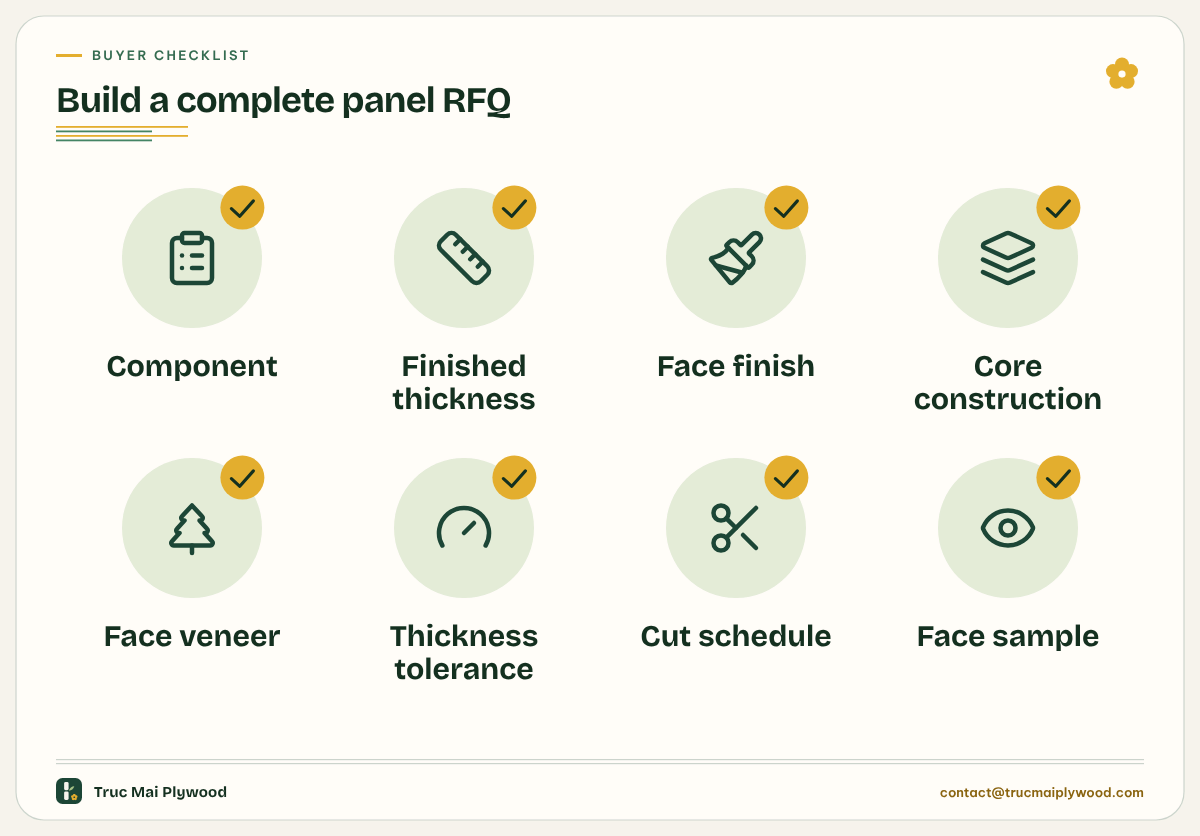
A complete RFQ names the application, requested intermediate thickness, core, adhesive and emission requirement, face pair, sheet size, cutting plan, packing and quantity. Attach the drawing and state which measurements are critical to assembly.
For example, describe the component as an interior cabinet divider; request a 10 mm finished panel with sanded faces; identify the chosen core and veneer; specify the desired thickness tolerance; then attach the required cutting schedule and face sample. Where 11 mm is the legacy dimension, say so explicitly and include the mating groove or hardware drawing.
Truc Mai Plywood manufactures furniture and commercial plywood in Ha Hoa, Phu Tho, Vietnam, with annual capacity around 60,000 m³. Send the specification to contact@trucmaiplywood.com or use the quotation route. The reply can address the requested construction, sample and container packing on the same order line.
Questions buyers ask
Is 10 mm plywood a standard stock thickness?
The regularly listed Truc Mai thicknesses include 9 mm and 12 mm. Submit 10 mm as a special specification with the required finished dimension.
Can I ask for 11 mm instead of 10 mm?
Yes, submit the 11 mm drawing and tolerance as a separate request. The two nominal dimensions should not be treated as interchangeable.
Can a 10 mm sheet be faced with birch veneer?
Birch-faced plywood is within the face range. Specify the Vietnamese core separately from the birch face veneer.
Is a 10 mm sheet suitable for painting?
A sanded, prepared face can be selected for a paint finish. Test the actual coating on an approved sample.
Can I order pre-cut 11 mm cabinet parts?
Cut-to-size is an available option. Supply the parent-sheet choice, cutting layout and piece labels with the request.
Does the face grade describe the back too?
No. Specify front and back appearance as an agreed pair and compare both sides with the sample.
Can different components share a container?
A 40HC normally carries one or two products, with larger mixes possible by agreement. Give each component its own packing-list line.
What is the minimum order?
The standard minimum is one 40HC. State the mix of products and destination port in the enquiry.
Can I request FSC 100% material?
Yes, for eligible products covered by the chain-of-custody scope. State FSC 100% on the purchase order and request the matching sales-document claim.
Should the RFQ say E0 glue?
Specify the adhesive and emission requirement separately, for example UF glue at E0 emission. Include the required test documentation for the intended market.