
A ply worktop starts with a flat, well-bonded plywood substrate selected for the finished surface, support layout and exposed edges. For laminate-faced counters, specify the core, face preparation, thickness tolerance and adhesive system separately. Truc Mai Plywood supplies furniture-grade panels for fabricators who laminate, machine and finish worktops to their own drawings.

What makes a ply worktop substrate suitable for fabrication?
A worktop substrate needs a flat face for bonding, a coherent veneer core for machining and an edge that can be finished without revealing open joints. These properties matter more to a fabricator than a decorative face grade alone.
A plywood kitchen worktop is a built-up product: the substrate carries the decorative laminate or other specified finish, while the installer provides the supports and jointing. A bare plywood sheet can also be the visible surface, but then the finish and edge treatment become part of the worktop specification. Decide which assembly is being made before selecting the sheet. Compare laminate options before finalising the substrate.
For volume orders, request a reference sample showing both faces and a freshly cut edge. A smooth face can conceal a loose inner veneer. Check the cut edge for overlapping strips, gaps and inconsistent glue lines, then compare the approved sample with the production specification. A substrate intended for a bonded decorative finish should be judged on what happens after pressing and machining, not on its colour alone.
Which plywood core should a worktop maker specify?
Styrax, Eucalyptus, Acacia, Pine and combined-species veneer cores are available for furniture and interior panels. Choose among them by panel weight, edge appearance, machining behaviour and the required finish, rather than assuming that a face species describes the whole board.
Styrax is useful where handling weight and container utilisation matter. Acacia and Eucalyptus offer denser core options for buyers who prefer a heavier sheet. Combined cores allow the purchase specification to balance those priorities. A birch-faced sheet can still contain a Vietnamese veneer core; the face does not identify the inner plies.
A fabricator should inspect the core after a sink cut-out or an exposed front edge is machined. Veneer joints that are acceptable inside a concealed cabinet part may be visible on a worktop edge. Where the edge will remain on show, approve the edge sample separately from the top-face sample. Birch-faced plywood is one face option; it should be ordered with the core explicitly named.
What thickness works for a plywood kitchen worktop?
An 18 mm furniture-grade panel is a practical substrate starting point for a fabricator who designs the finished assembly around its supports. Truc Mai supplies nominal thicknesses from 3–40 mm, so thicker builds can be specified where the design calls for them. Thickness alone does not establish the allowable unsupported span.
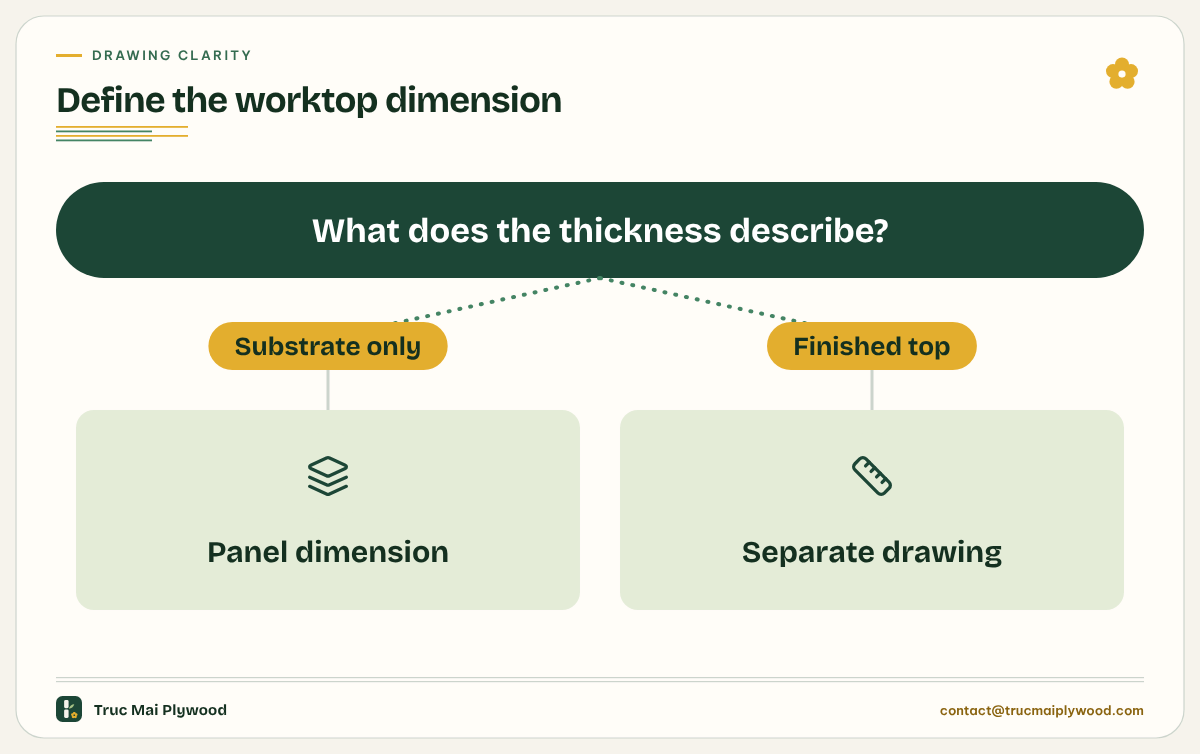
A laminate, backing sheet, adhesive and any edge build-up all contribute to the finished profile. A drawing that says only “worktop 18 mm” leaves open whether the dimension refers to the substrate or the complete assembly. State the nominal substrate thickness, the finished thickness target and the required support spacing as separate entries.
A worktop joint, sink aperture or overhang needs the fabricator’s fixing and support detail. For orders that also include cabinets, 18 mm plywood provides a related sheet specification; the counter assembly still needs its own drawing.
How should flatness and thickness tolerance be written?
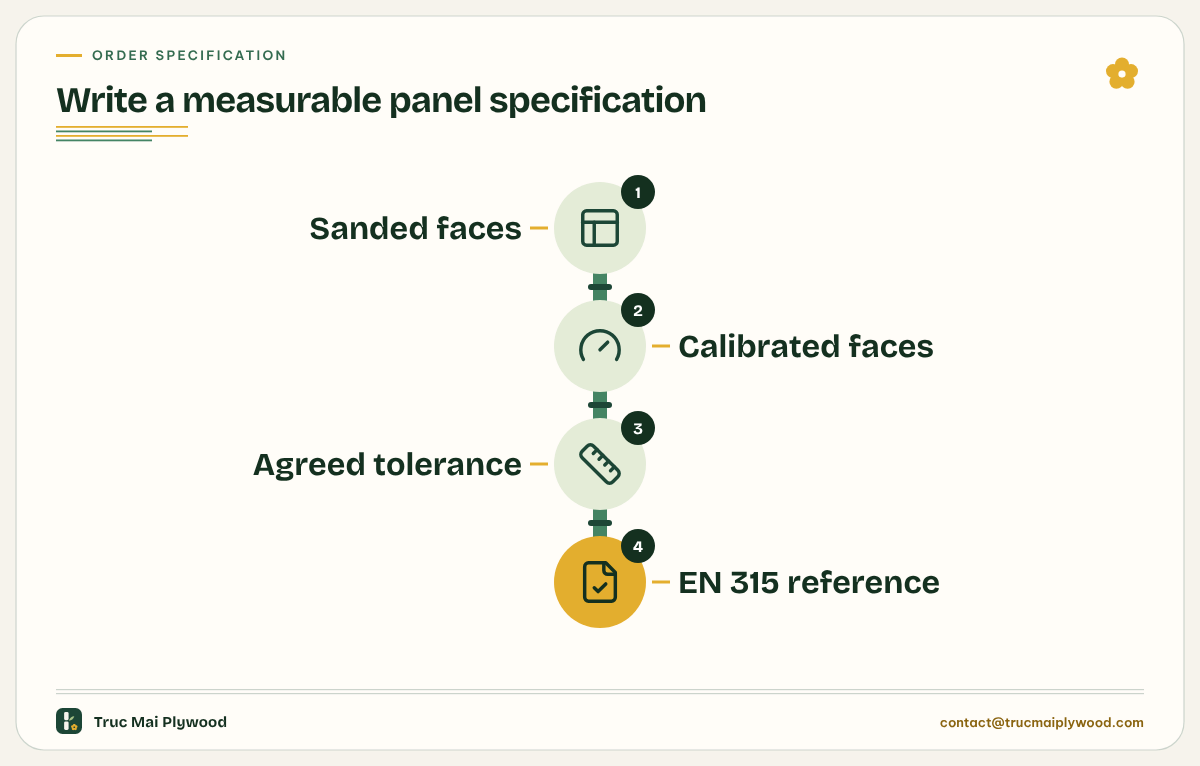
Specify sanded and calibrated faces with a thickness tolerance of ±0.3 mm for furniture panels where that is the agreed order grade. Commercial panels are commonly written at ±0.5 mm. The worktop maker should also set an acceptance method for flatness, since thickness and bow are different measurements.
For example, a thickness reading at the middle of a panel does not describe a corner that lifts from a flat inspection surface. Request a measurement pattern across the sheet, a defined conditioning method and an agreed flatness check before bonding a large decorative surface. The fabricator should document the press conditions for its laminate and the support used during curing.
The European dimensional reference EN 315 describes plywood dimensional tolerances. A purchase order can set a tighter mill-specific target than a general standard, with its own inspection agreement.
Which face preparation is right beneath laminate?
A sanded, calibrated face is the starting surface for a separately laminated plywood countertop. The bonding contractor then selects adhesive, surface cleaning, press cycle and any balancing layer for the chosen laminate system.
A decorative face veneer may add an unnecessary interface when it will be fully hidden under opaque laminate. If the design exposes the plywood edge, however, the face and inner plies both affect appearance. Tell the mill whether the panel will receive high-pressure laminate, a different overlay or a transparent finish; the surface requirement is different in each case.
The mill supplies HPL faced plywood as well as substrate panels. Buyers who laminate in their own workshop should distinguish a factory-faced order from a raw panel order. The laminates for plywood page explains related finish options.
How do laminate, melamine and bare plywood differ?
High-pressure laminate (HPL), melamine facing and an exposed plywood surface are three different worktop constructions. Their wear surfaces, edge details and fabrication sequences should be written separately.
| Construction | Surface supplied | Work remaining at fabricator | Key inspection point |
|---|---|---|---|
| Raw plywood substrate | Sanded plywood face | Bond chosen finish, machine and seal edges | Flatness and glue-line integrity |
| HPL-faced plywood | Decorative laminate face | Cut, join and finish edges | Laminate adhesion and edge transitions |
| Melamine-faced plywood | Factory-applied decorative facing | Machine and protect cut edges | Surface damage around cut-outs |
| Visible plywood top | Exposed veneer | Apply specified protective finish | Face appearance and edge quality |
A factory-faced panel is not automatically a finished kitchen counter. The buyer’s drawing still determines the edge profile, sink opening, joining method and installation. For cabinets that share a matching finish, cabinet-grade plywood provides a separate material selection framework.
How should the exposed plywood edge be designed?
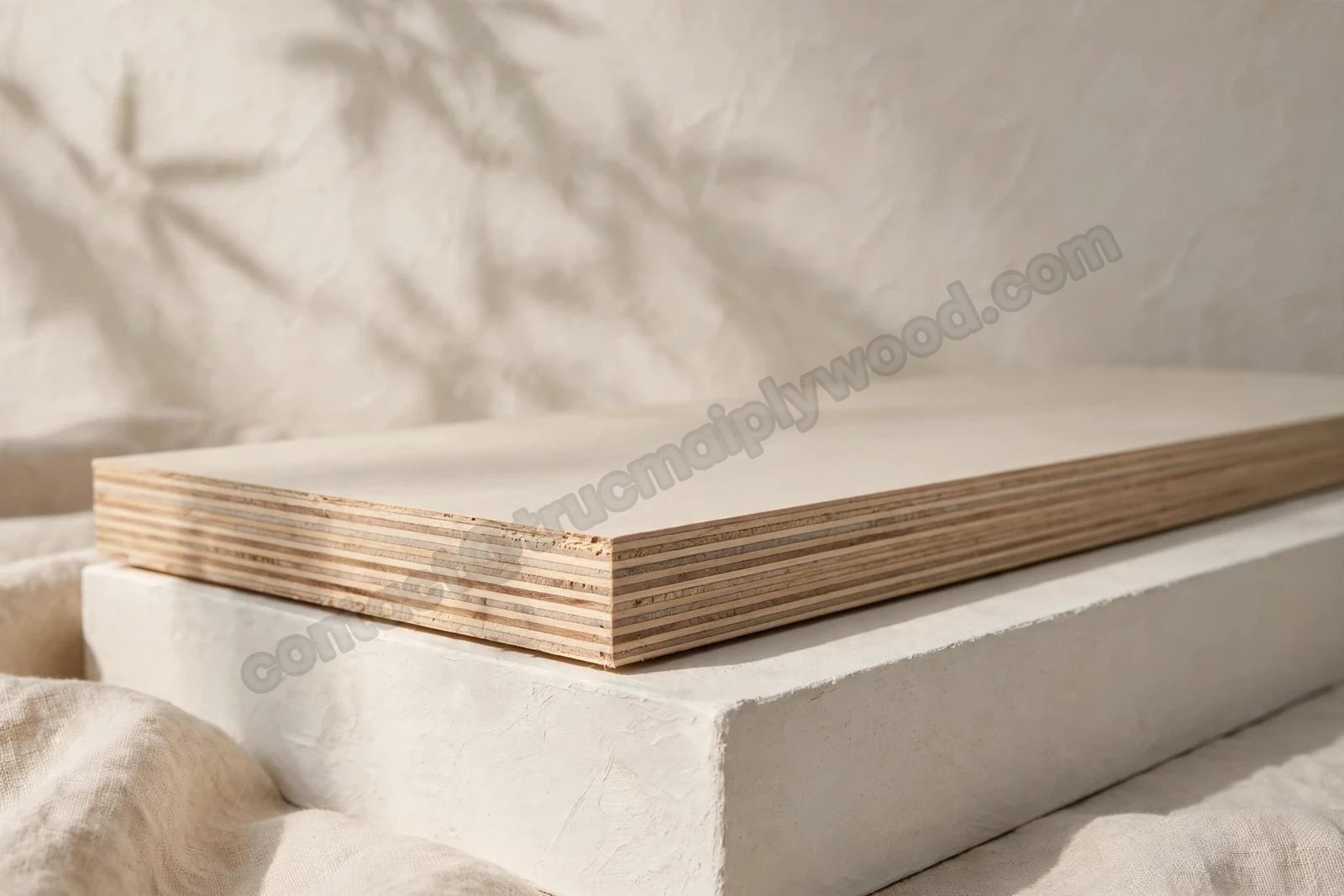
Choose either a deliberately visible layered edge or a concealed, lipped edge before approving the core. A visible edge calls for clean veneer alignment, controlled machining and a finishing system that reaches every cut surface.
On an exposed edge, a tiny void becomes conspicuous after sanding. An opaque edge strip conceals the inner layers but needs its own adhesive and corner detail. For an edge that wraps around a laminate top, the laminate thickness and corner radius influence the final appearance. Ask the fabricator to make a full-depth edge mock-up rather than approving only a face swatch.
Cut-outs and end grain are particularly sensitive to water entering the assembly. The installer should follow the chosen finish manufacturer’s sealing instructions at sink rims, joints and appliance openings. A polished face alone does not protect a newly sawn edge. Agree the edge detail when ordering samples.
Can plywood support a stone or solid-surface countertop?
Plywood can be used as a support layer beneath a stone or solid-surface top when the surface manufacturer or fabricator specifies that assembly. The substrate selection follows the approved support and fixing detail, rather than a universal plywood thickness rule.
Stone, quartz and solid-surface products have different requirements for continuous support, expansion, cut-outs and attachment. Ask for the approved drawing showing whether plywood is needed, how it is fixed to the cabinets and how its edges are kept clear of moisture. A substrate that works under HPL should not automatically be substituted beneath stone.
Where plywood is called for, specify the core, surface flatness and cut-out positions against that drawing. Delivering uncut sheets may be preferable if the final aperture positions are set after the cabinets are installed. Refer to cut-to-size plywood when the apertures and dimensions are confirmed.
What glue and emission specification belongs on the order?
Glue type, bond performance and formaldehyde emission are separate purchase-order fields. For dry interior furniture panels, Truc Mai’s standard construction uses UF glue at E0 emission; a buyer requesting a particular bond or emission test should name the method and acceptance criterion.
For US hardwood plywood with veneer core, 40 CFR 770.10 sets a formaldehyde emission limit of 0.05 ppm. The brand’s CARB Phase 2 and TSCA Title VI certificate CARB/EPA 26053 covers the specified veneer-core hardwood plywood range of 3–25 mm. Do not extend that scope to a thicker sheet or to an unlisted construction.
Bond durability is assessed separately from emissions. A worktop that may see damp conditions needs the fabricator to specify its adhesive system, edge sealing and intended service environment. Ask for the relevant test evidence for the actual panel construction rather than treating a glue name as a complete performance specification. Formaldehyde limits gives the regulatory context.
Which face grade should the buyer approve?
Approve a face-and-back grade pair against a physical sample, with defects, repairs and colour variation described in the order. A single label such as “A grade” does not tell a fabricator what will appear after machining or coating.
For a substrate hidden beneath an opaque finish, consistent sanding and bonding are more important than a decorative grain match. For a visible plywood worktop, face colour and patch visibility become part of the finished product. Mark which side is the show face and which side is the back, and include an edge specimen.
The buyer can use ISO 2426-2 to understand hardwood plywood appearance classes E, I, II, III and IV. Trade labels are agreed by sample rather than assumed to match those classes.
Which sheet sizes and cutting options fit production?
Standard formats include 1220 × 2440 mm, 1220 × 2280 mm and 1250 × 2500 mm. A worktop maker should nest finished parts on the ordered sheet and mark grain direction before approving any mill cutting.
Cut-to-size production can divide a standard sheet into two lengthwise panels, three parts, four parts or six parts. Common patterns include 610 × 2440 mm halves, 1200 × 800 mm thirds and 1220 × 610 mm quarters. Narrower parts can be specified from a standard sheet, with the exact cut list agreed by email. These are cutting patterns, not finished worktop dimensions.
The drawing should identify each piece by code, show the face orientation and state which edges need to remain clean for subsequent machining. Where a cut-out is close to a joint, the fabricator may prefer a full sheet for final trimming. Cut-to-size plywood covers the mill-cut option.
What should a fabricator check before bonding the top?
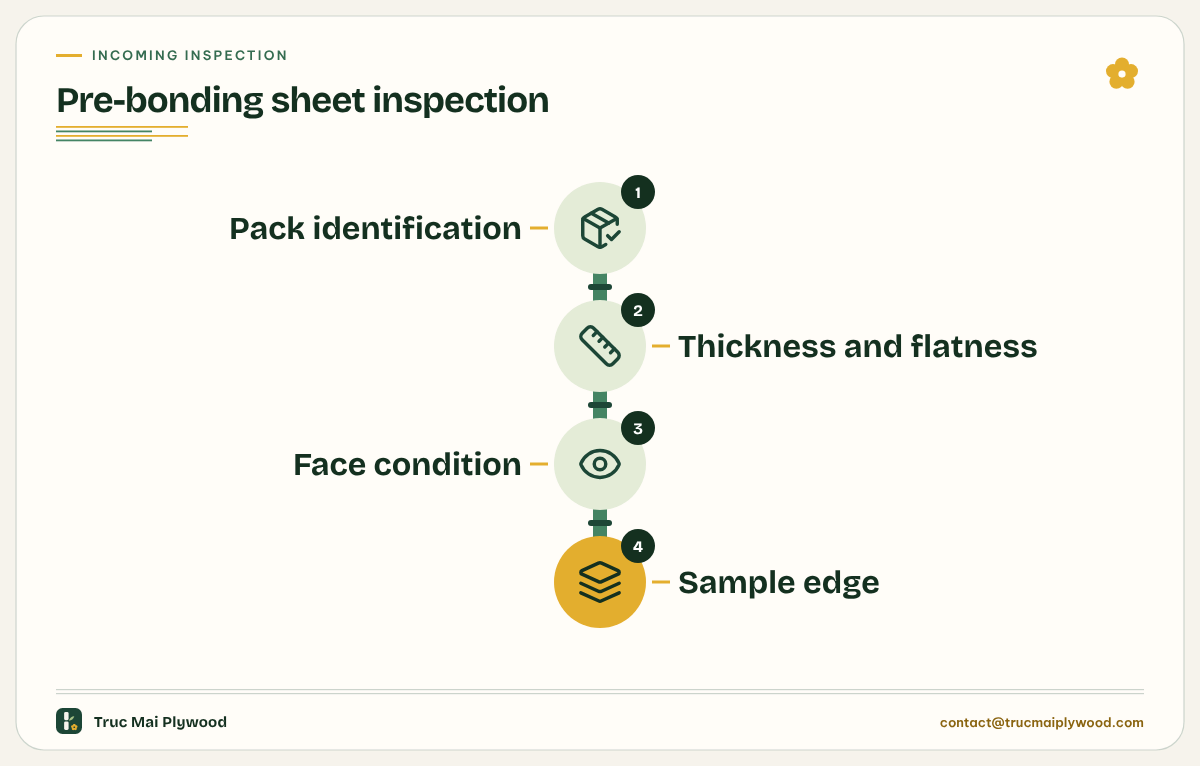
Inspect the face, edge and dimensions of the incoming substrate before applying the decorative surface. A useful incoming inspection follows the same order as the manufacturing process:
- Match the pack label and purchase-order line to the intended worktop build.
- Check nominal thickness at agreed points and record any bow or twist on a flat reference surface.
- Inspect both faces for sanding marks, contamination and raised veneer joints.
- Cut a sample edge to look for gaps and loose inner plies.
- Bond a trial laminate using the fabricator’s adhesive and press settings, then inspect the finished panel and edge.
Keep the approved sample beside the production inspection record. This makes a repeat container easier to compare with the first accepted run. Where a face is intended for a later UV coating, specify UV-ready preparation and arrange coating trials in the buyer’s own finishing line.
How should a repeat worktop programme be packed?
Pack substrate panels by identical construction, thickness and face orientation, with a separate identification line for each variant. The handling plan should protect the sanded surface and corners before the fabricator applies its final finish.
For a 40HC order, container planning starts with the core and sheet size because the heavier cores reach the payload with fewer packs. The 40HC loading by thickness article separates planning volumes from the final packing list. A repeat programme should retain the accepted core and surface specification so that a change of face or joining method does not arrive as an unexpected difference at the press.
Ask for the packing list to separate raw substrate, factory-faced sheets and cut parts. Labels should match the cut schedule and purchase-order references. This reduces sorting at the receiving warehouse and lets the buyer trace a damaged pack to its exact product line.
What compliance documents matter for imported worktop plywood?
Request the documents that match the market and the actual panel construction. The invoice, packing list and certificate references should describe the same product rather than treating a mill certificate as coverage for every possible specification.
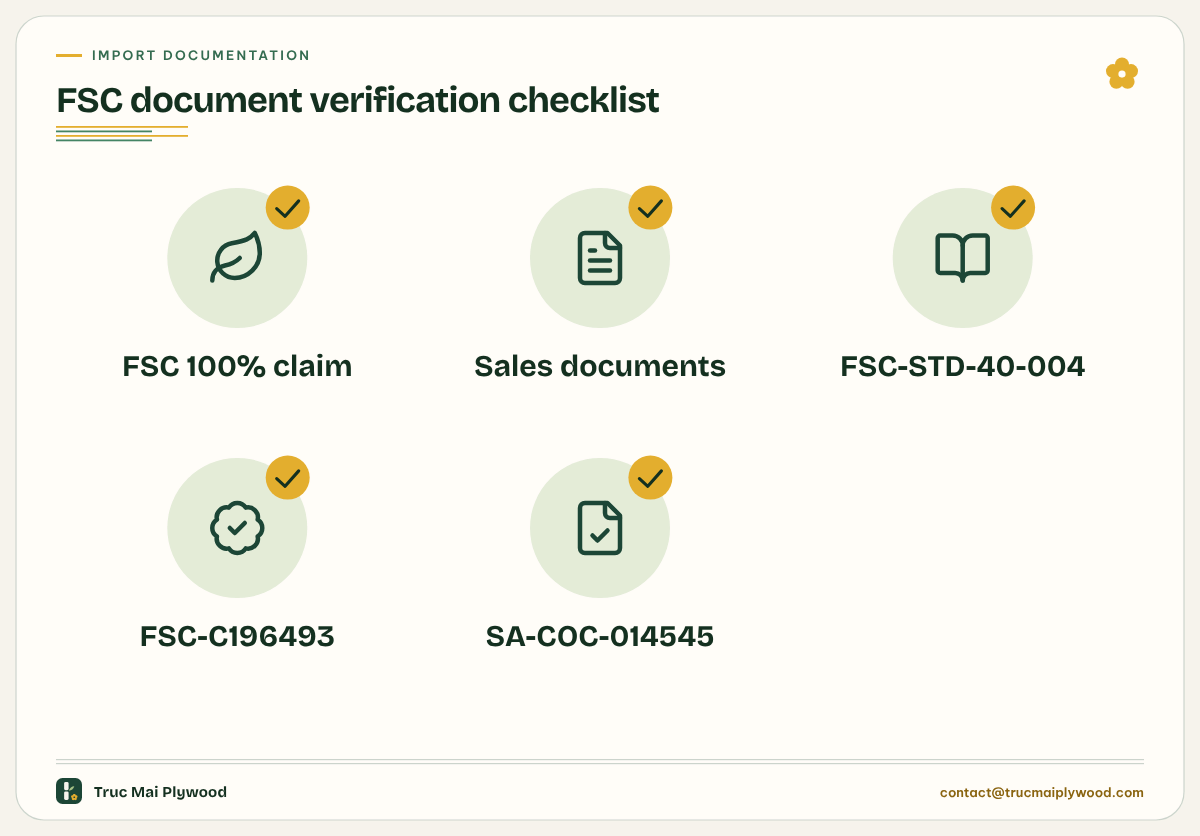
For eligible FSC 100% goods, the sales documents carry the relevant claim and chain-of-custody certificate code. FSC-STD-40-004, section 5.1, sets out those sales-document requirements. The Truc Mai licence is FSC-C196493, with chain-of-custody certificate SA-COC-014545. Buyers can use FSC licence verification to check the record.
For EU buyers, the EUDR file set includes origin records and geolocation for both core wood and face veneer. The importer uses those records in its due-diligence process. Specify the intended destination when requesting documents so the shipment file matches the sales contract.
What belongs in a worktop substrate RFQ?
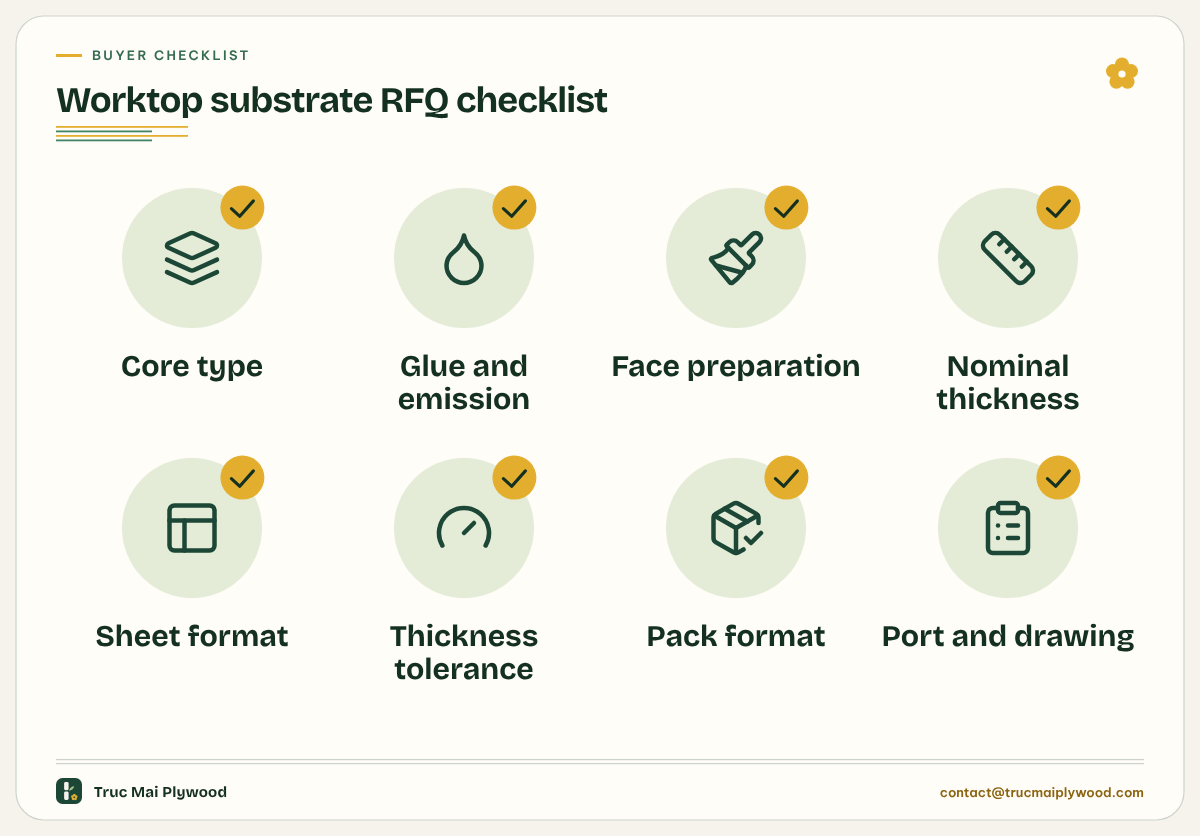
Send a construction line and a fabrication drawing together. The RFQ should state the final use, core, adhesive and emission requirement, face preparation, nominal thickness, sheet size, cutting pattern, packing and quantity.
A workable example is: “Kitchen worktop substrate for HPL bonding; Styrax veneer core; UF glue at E0 emission; sanded and calibrated faces; 18 mm nominal; 1220 × 2440 mm; thickness tolerance ±0.3 mm; full sheets; labelled packs; one 40HC.” Add the chosen destination port and a separate drawing for joints and cut-outs. This is a specification example, not a finished worktop design.
The standard order minimum is one 40HC, with production normally 15–45 days after the deposit. For the initial material approval, ordering plywood samples gives the sample route. Use the plywood RFQ checklist to prepare the final enquiry, or send the specification to contact@trucmaiplywood.com for a quotation.
Send your specification to contact@trucmaiplywood.com or through the quotation form.
Questions buyers ask
Can plywood be used beneath a quartz worktop?
Yes, plywood can form a supporting layer where the stone fabricator specifies one. Obtain the stone supplier’s support and fixing detail before choosing the panel.
Is a plywood kitchen worktop the same as a laminate-faced panel?
No. A finished worktop includes its decorative surface, edges and joint details; a substrate panel is the plywood component before those operations.
Can I order a birch-looking face without a birch core?
Yes. Birch-faced plywood has a birch veneer over a specified Vietnamese core; it is different from an all-birch construction.
Does the factory apply a UV coating?
No. UV-ready panels are prepared for the buyer to coat after delivery.
What information belongs on a panel label?
Use the part reference, panel dimensions, face orientation and batch identification agreed in the cut list.
Can I mix worktop substrate and cabinet panels in one order?
Yes. A mixed 40HC can carry several agreed product lines, each identified separately on the packing list.
Can a worktop order use a melamine face?
Melamine-faced plywood is offered, but the worktop fabricator must assess the finish, edges and intended service conditions.
Is FSC 100% available for a worktop substrate?
FSC 100% is available for eligible products covered by the current certificate schedule. The claim and certificate code must appear on the sales documents.
Should a buyer specify grain direction?
Yes. Mark the face grain direction and the orientation of each finished part on the cutting drawing.
Can the same substrate serve a kitchen island?
Yes, if the dimensions, supports, joints and finish system are specified for that island rather than copied from a straight run.