
1 1/8 plywood means a nominal 1.125-inch panel, equivalent to 28.575 mm. For furniture worktops, workshop benches and production jigs, buyers can specify a 30 mm commercial or furniture plywood build instead, provided the finished thickness and fit are agreed. Truc Mai Plywood offers 30 mm panels with core, face and tolerance written into the order.
What does 1 1/8 plywood mean in millimetres?
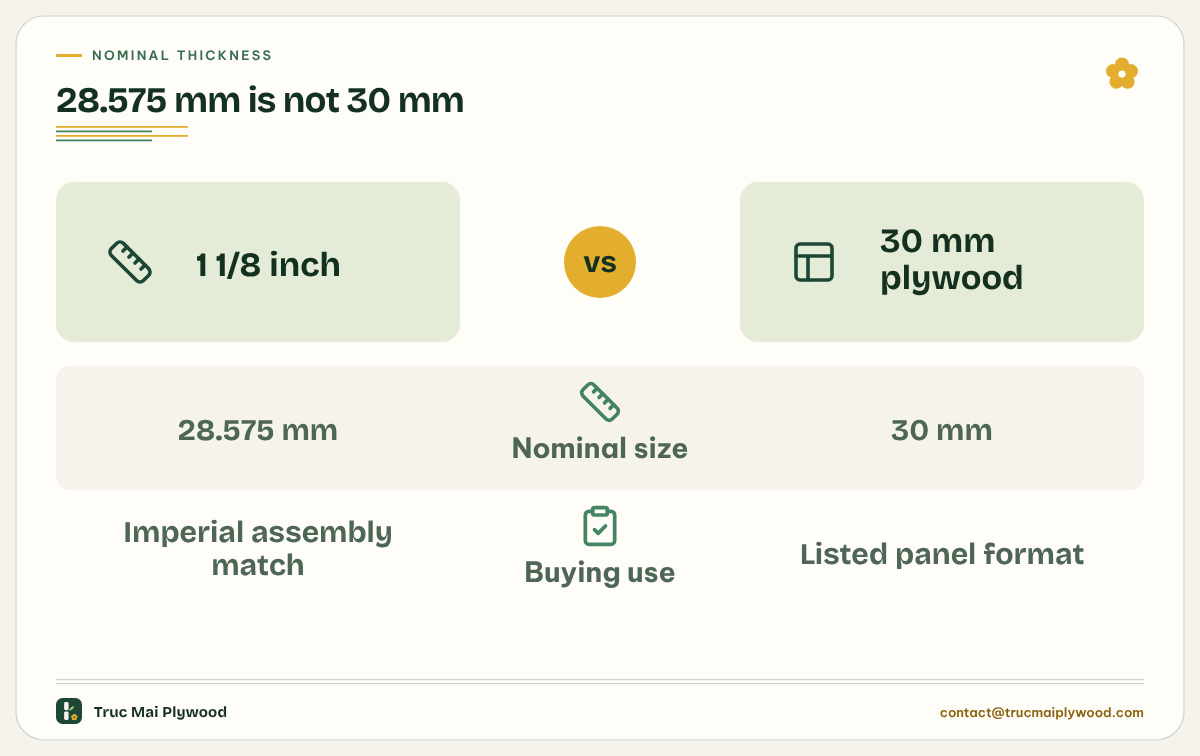
1 1/8 plywood is nominally 28.575 mm thick, because one inch is 25.4 mm and 1.125 multiplied by 25.4 gives 28.575. That conversion matters when a panel must fit a metal channel, existing worktop or machining fixture. A 30 mm sheet is a listed alternative, not an exact replacement.
In North American catalogues, the same search can lead to tongue-and-groove sheathing intended for subfloors. Such products have their own edge profile and performance marking. A flat-edged furniture panel has a different job: it provides a broad, machinable surface for cabinets, benches, worktops and workshop fixtures.
A useful RFQ states the required finished thickness rather than merely copying a nominal imperial label. For an existing assembly, measure the available opening and state the acceptable upper and lower dimensions. See the plywood thickness selection page for the surrounding sizes.
Is 1 1/8 plywood the same product as a 30 mm panel?
No: 1 1/8 inch is 28.575 mm, while 30 mm is a separate nominal thickness. Both suit substantial furniture or workshop components, but a purchasing specification should not substitute one for the other. An oversize panel can foul hardware or make a surface stand proud; a thinner panel changes adjoining part heights.
| Specification | Nominal measurement | Buying implication |
|---|---|---|
| 1 1/8 inch | 28.575 mm | Specify an exact finished size when matching an imperial assembly |
| 30 mm plywood | 30 mm | Listed thick furniture/commercial panel format |
| 25 mm plywood | 25 mm | Alternative where the design permits a slimmer build |
| 40 mm plywood | 40 mm | Thickest regular listed format for substantial interior components |
These measurements describe thickness, not strength or load capacity. The 25 mm plywood page covers the slimmer alternative. A purchasing drawing should also identify edge treatment and whether sanding occurs before or after final thickness inspection. The mill can write a finished-thickness tolerance into the order, allowing the buyer to compare measured samples rather than two nominal descriptions.
Which applications suit thick furniture plywood?
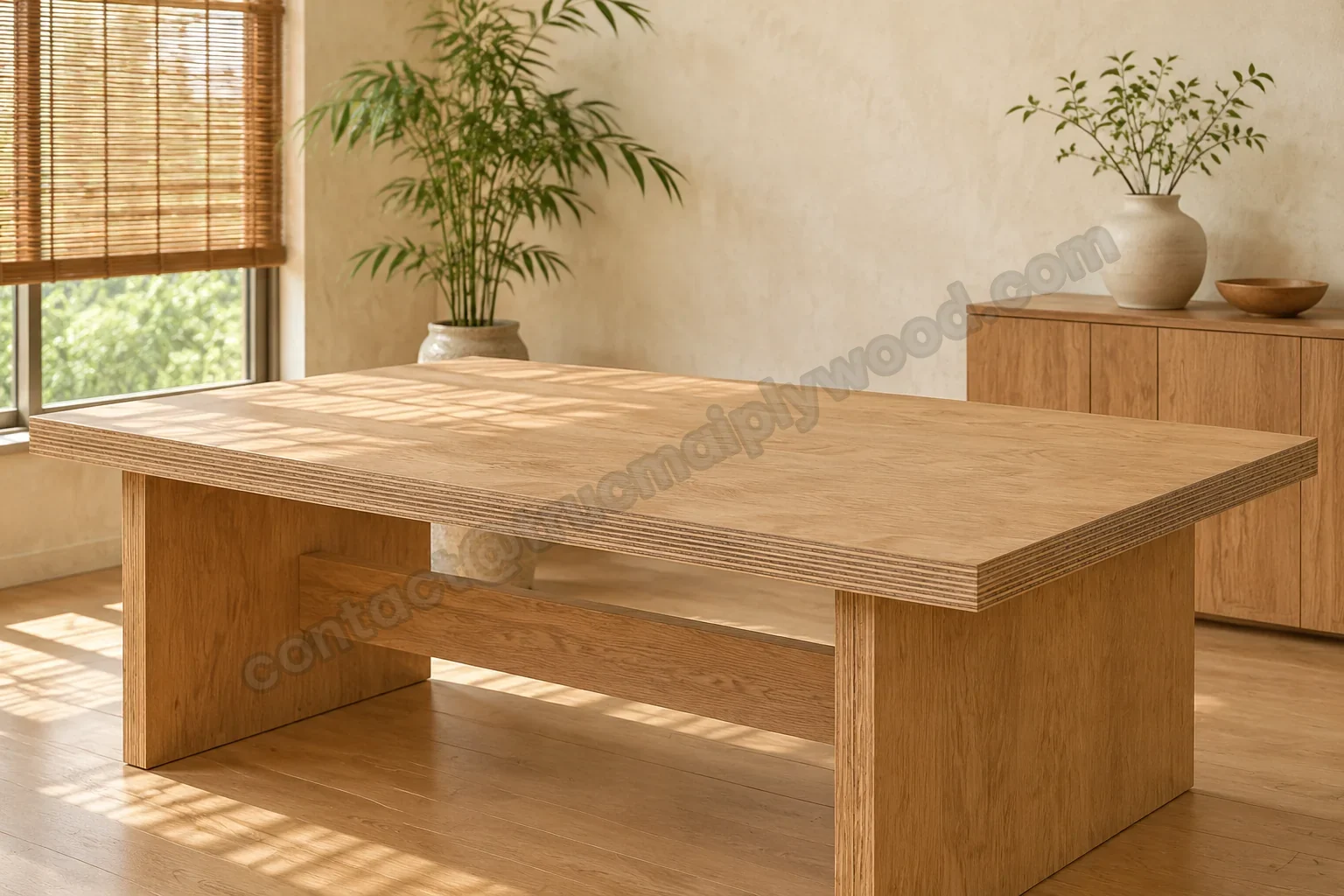
Worktops, workshop benches, jigs, large cabinet components and interior fixtures are practical uses for thick furniture plywood. The design should determine the core, face, fixing pattern and support arrangement. A jig that is drilled repeatedly needs a consistent surface and predictable edge; a display worktop needs an appearance grade suited to its visible side.
For a workshop bench, a thick plywood panel can provide a useful replaceable top over a separately designed frame. For a production jig, a calibrated panel reduces variation when locating clamps or drilling repeat holes. For a furniture worktop, the face and finish determine the visual result, while the core construction influences machining and screw-holding behaviour. None of these applications automatically calls for a tongue-and-groove edge.
Specify the exposure environment too. A dry interior bench and a wet industrial station impose different requirements on the adhesive and surface finish. The panel specification should be written around the actual service conditions, rather than an attractive thickness figure alone. Buyers planning cabinets can compare the interior plywood selection guide with the bench requirements.
Why is thick T&G subfloor sheathing a different purchase?
Tongue-and-groove subfloor sheathing is a structural flooring product, whereas the thick panels discussed here are furniture and commercial plywood. T&G refers to the shaped edges that interlock adjoining sheets; it is not a statement of face quality or core species. A plain square-edge panel does not become rated subfloor sheathing merely because its nominal thickness matches a retail listing.
The US NIST PS 1-22 structural plywood standard describes structural plywood grades, performance categories, bond classifications and marking. A buyer designing a floor must select a panel with the required structural marking and follow the applicable design requirements. Thickness by itself cannot provide a span rating or allowable floor load.
For worktops and benches, the relevant questions are instead whether the face is suitable for finishing, whether the core is sound at cut edges and whether the completed panel matches the equipment drawing.
Which core should I choose for a heavy bench or worktop?
Styrax, Acacia and Eucalyptus are the three cores used in the 30 mm loading comparison. They give different planned weights for an otherwise identical sheet. Styrax is the lightest reference build, Eucalyptus the heaviest, and Acacia sits between them. A combined core or Pine core can also be specified for an interior panel order.
A lighter core can simplify manual handling and increase cubic metres carried per container. A denser core can be useful when the buyer wants a heavier panel feel, although density alone does not prove a particular screw-withdrawal, bending or impact result. Those properties require a test on the chosen construction when the application calls for a numerical performance value.
Ask for a cut edge from the proposed production build. The edge reveals how the veneers meet, where joints occur and how evenly the core has been laid. Furniture-grade construction normally uses a stitched A-grade core, while commercial construction can use a jointed or loose-laid AB core. That difference is worth specifying before choosing a face veneer, because the decorative surface cannot reveal every internal joint.
Which face and finish belong on a thick interior panel?
Choose the face by visibility and finishing method: birch-faced plywood for a pale decorative appearance, engineered veneer for a repeatable visual pattern, or another approved veneer for the desired colour. Available faces include poplar, bleached poplar, okoume, bintangor, pine, eucalyptus, gurjan and sapele. The chosen face is laid over a separately specified Vietnamese core.
For a worktop that will receive a coating at the buyer’s facility, request sanded and calibrated, UV-ready faces. UV-ready means surface preparation for a later coating process, not that a UV coating has already been applied. For a factory fixture that will be covered with laminate, surface smoothness and adhesion preparation can matter more than the natural veneer pattern. Melamine, high-pressure laminate and paper-overlay options serve different finishing plans.
Face and back grades should be written as a pair against an approved sample. A single appearance label can hide a substantial difference between the two sides. See the birch-faced plywood product details when a pale face is wanted; the buyer should still name the core and finishing requirement separately.
How many plies should a thick plywood sheet have?
Specify the ply construction on the approved sample rather than assuming a fixed ply count from the nominal thickness. Veneer thickness, species, sanding allowance and core joining determine the final lay-up. The 30 mm sheet is part of the 3–40 mm range, but the published brand facts do not assign one universal ply count to this thickness.
An inspection sample should show the face veneer, the cross-bands and the inner core arrangement clearly enough to identify gaps and overlaps. Ask for the proposed lay-up alongside the agreed face/back grade and thickness tolerance. If a production jig will have many holes near the edge, show their locations on the drawing; the core build and edge condition can then be assessed against the intended machining operation.
Better purchasing language identifies core species, core grade, joining method, face veneer and the finished dimensions. The same specification can then be repeated on subsequent orders without relying on an ambiguous label such as “heavy-duty plywood”.
What thickness tolerance should go on the order?
Write the finished thickness tolerance explicitly: the regular furniture specification uses ±0.3 mm on sanded and calibrated panels, while commercial panels commonly use ±0.5 mm. The general order range is ±0.3–0.5 mm, with length and width tolerance of ±2 mm. The mill records the chosen requirement on the order line.
For an imperial assembly, compare the required fit against the actual nominal panel selected. A nominal 30 mm order with a tight manufacturing tolerance remains a 30 mm order; tolerance is not a substitute for agreeing a different nominal size. Send a dimensioned drawing if the panel enters a fixed-width groove, abuts a machined bracket or must finish flush with another material.
The European EN 315 dimensional-tolerance preview describes standard measurement and tolerance rules for plywood. A mill-specific order tolerance is a separately agreed purchasing requirement. Ask that sample inspection and production inspection use the same measuring points, especially where the panel has been sanded on both faces.
How heavy is a 30 mm plywood sheet by core?
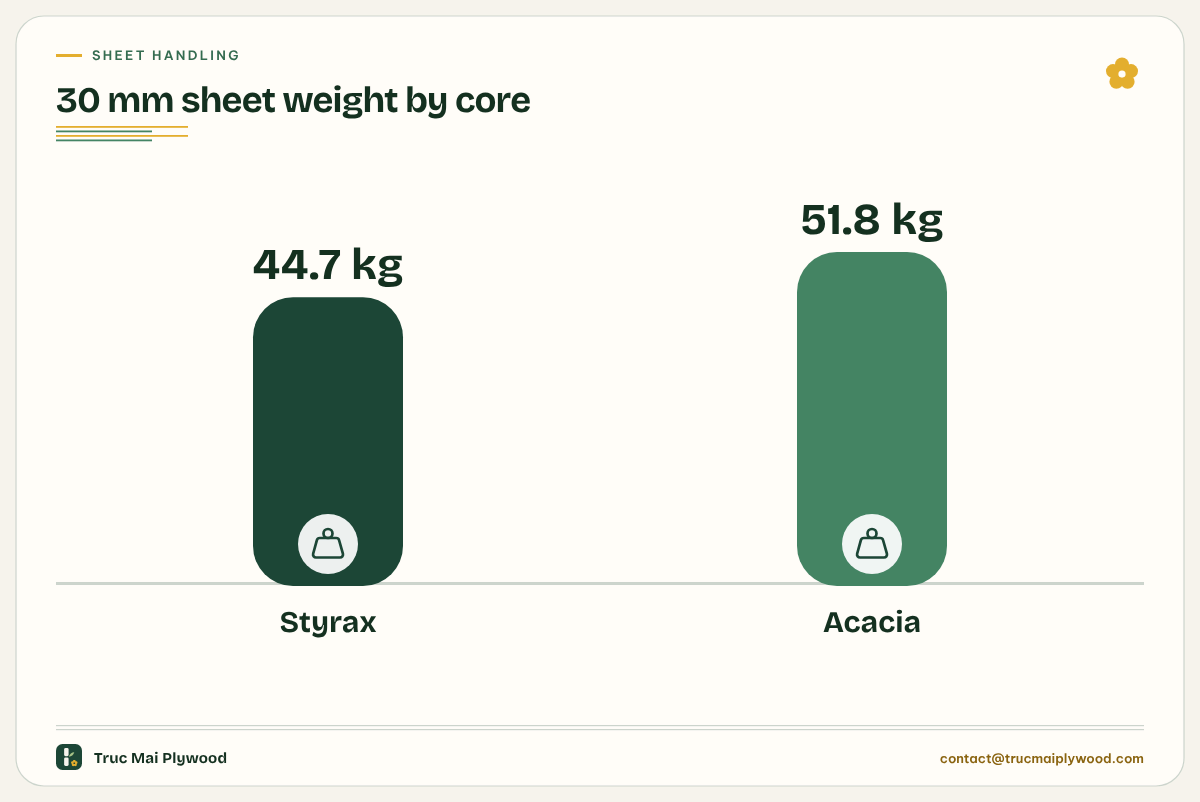
A 1220 × 2440 × 30 mm sheet weighs approximately 44.7 kg with Styrax core, 51.8 kg with Acacia core and 58.0 kg with Eucalyptus core in the supplied packing model. These are modelled panel weights using reference densities, not individually weighed dispatch sheets. They help buyers plan handling equipment and compare container configurations.
| Core | Reference density | Modelled kg per 30 mm sheet | Main handling consideration |
|---|---|---|---|
| Styrax | 500 kg/m³ | 44.7 | Lightest of the three reference builds |
| Acacia | 580 kg/m³ | 51.8 | Intermediate sheet mass |
| Eucalyptus | 650 kg/m³ | 58.0 | Heaviest of the three reference builds |
Weight influences the handling plan at both ends of the shipment. A panel used as a large bench top may require mechanical lifting, protective support under the edges and enough space to turn it without damaging the face. The weight calculation is also useful when comparing a quote by sheets with another quote by cubic metres. For a different thickness, refer to the 18 mm loading specification rather than carrying the 30 mm weight across unchanged.
How many 30 mm sheets fit in a 40HC container?
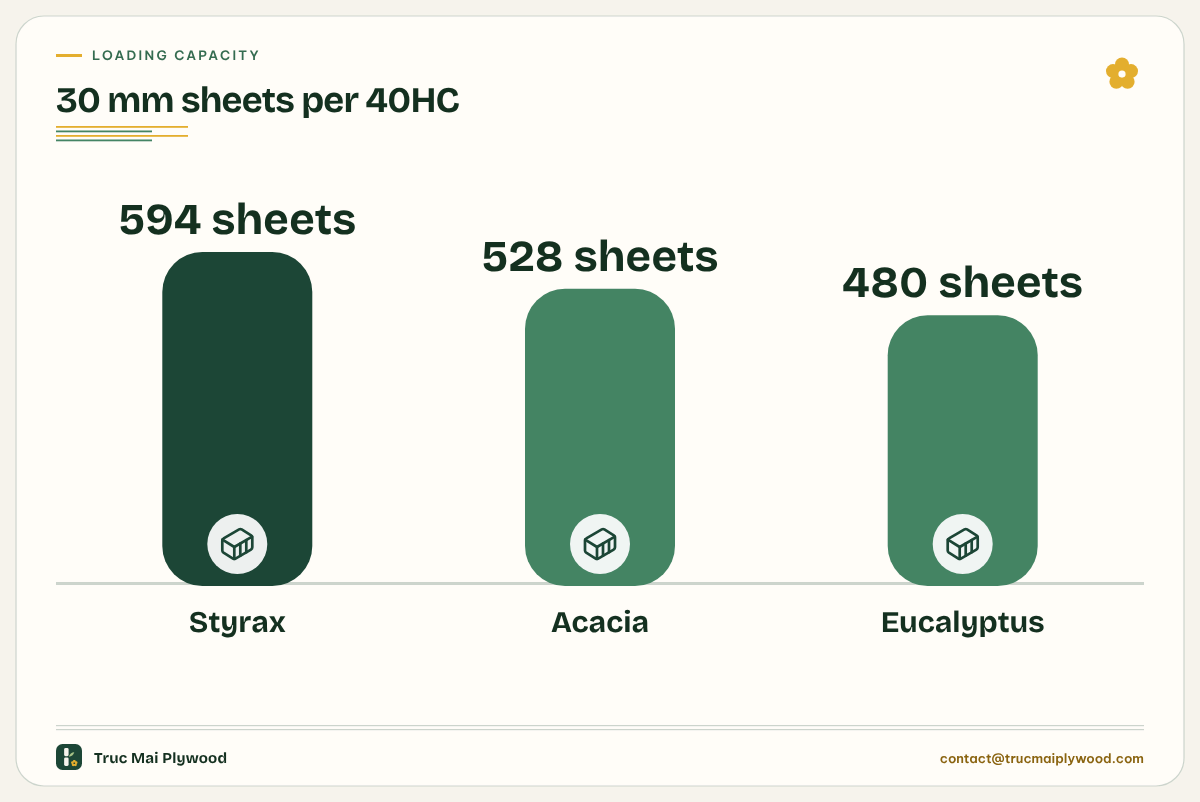
The supplied 40HC model gives 594 Styrax sheets, 528 Acacia sheets or 480 Eucalyptus sheets at 1220 × 2440 × 30 mm. Every value below comes from the supplied calculation file and is retained as provided. It is a planning model for panels only, with 1,000 mm nominal pack height, reference core densities and a 28,000 kg cargo planning payload. Actual packing uses the booked route limit and weighed cargo.
| Core and size | Packs | Sheets per pack | Sheets per 40HC | Panel volume | kg per sheet | Total panel kg | Weight-capped |
|---|---|---|---|---|---|---|---|
| Styrax, 30 mm, 1220 × 2440 | 18 | 33 | 594 | 53.0 m³ | 44.7 | 26,520 | No |
| Acacia, 30 mm, 1220 × 2440 | 16 | 33 | 528 | 47.2 m³ | 51.8 | 27,350 | No |
| Eucalyptus, 30 mm, 1220 × 2440 | 15 | 32 | 480 | 42.9 m³ | 58.0 | 27,860 | Yes |
The model assigns up to 18 packs to Styrax, 16 to Acacia and 15 to Eucalyptus. Sheets per pack are based on 1,000 mm divided by panel thickness, rounded down, then capped by the planning payload where required. Reference densities are 500, 580 and 650 kg/m³ respectively. The Eucalyptus line is explicitly weight-capped in the supplied model. The 40HC volume comparison shows how the pattern changes at other thicknesses.
The International Maritime Organization’s verified gross mass rules require the mass of the packed container to be verified before vessel loading. That figure includes packaging and container tare as well as the panels. Use the model for procurement planning and the shipment documentation for the final booked load.
Should I order full sheets or panels cut at the mill?
Order full sheets for flexible downstream machining; order labelled cut parts when the production drawing already fixes the dimensions. Regular formats include 1220 × 2440 mm, 1220 × 2280 mm and 1250 × 2500 mm. The mill also cuts standard sheets into agreed smaller panels before packing.
A standard sheet can be split into two lengthwise pieces of 610 × 2440 mm, into three pieces of 1200 × 800 mm, or into four pieces of 1220 × 610 mm. Six-piece patterns can be agreed against the actual sheet and saw layout. The exact cutting pattern and labels are agreed by email from the buyer’s cut list.
Send a drawing showing grain direction, finished piece size, saw-kerf allowance and the face that must remain visible. Ask for a packing sequence that matches the receiving factory’s part numbers. This reduces sorting work when parts move straight from the container to a machining cell. The mill-cut panel options describe this purchasing route.
Which adhesive and emission documents matter for interior use?
Specify glue system and formaldehyde emission separately. A common interior build uses UF glue at E0 emission according to the agreed buyer specification. A different bond requirement calls for a different adhesive and a test matched to the intended service conditions. An appearance-grade name does not answer either question.
For US-bound hardwood plywood with veneer core, 40 CFR Part 770 sets a formaldehyde emission limit of 0.05 ppm under the applicable test framework, as explained in the US EPA guidance. Truc Mai Plywood holds CARB Phase 2 and TSCA Title VI certification for hardwood plywood with veneer core in the 3–25 mm range, certificate CARB/EPA 26053. A 30 mm panel falls outside that stated certificate thickness scope, so the quotation should identify the applicable document set for the selected build.
Bond resistance and emissions are tested for different purposes. Ask for the adhesive specification, emission requirement and any test documents relevant to the exact finished product. Buyers can review the Phase 2 emission limits when building a US import file.
What should I inspect before approving a thick-panel sample?
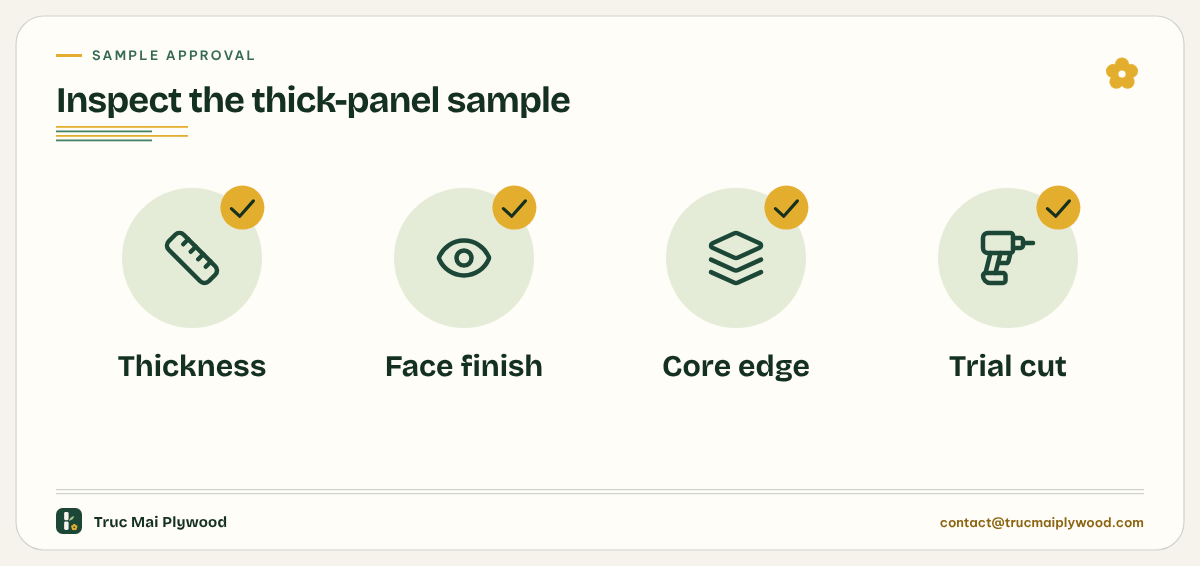
Approve the face, core edge, finished dimensions and machining result against one written sample specification. A thick panel can look even on the surface while containing core joints that become visible only after routing or drilling. The sample should therefore represent the construction being purchased, not simply a veneer swatch.
- Measure thickness at several positions and record the finished result against the order tolerance.
- Inspect both faces under the lighting used for the intended finish, noting patches, sanding marks and veneer joints.
- Examine the exposed edge for core gaps, overlaps and joining consistency.
- Make the intended cut, groove or drilled hole in a trial piece and inspect the newly exposed core.
- Record the approved face/back grade, core and adhesive in the purchase specification.
If parts will be labelled after cutting, compare the part drawing with the physical sample before production. The plywood RFQ checklist helps organise these fields without losing the distinction between appearance and construction.
How should a repeat order for thick panels be written?
Write one complete line for each panel build: application, core, glue and emission, face/back, finished size, tolerance, packing and quantity. A repeatable order is easier to inspect when every change appears in a controlled field rather than in a chain of emails. The product name alone is too broad to carry all those choices.
For example, an interior worktop order can state: “Furniture plywood; Styrax stitched core; UF adhesive, emission specification agreed; birch face/back against approved sample; 30 mm, 1220 × 2440 mm; sanded and calibrated, ±0.3 mm; labelled packs; one 40HC; FOB Hai Phong.” Add a cut list and drawing where the mill supplies finished parts.
Production normally takes 15–45 days after a 30% deposit, with the 70% balance against the scanned bill of lading. FOB Hai Phong, CFR and CIF are available terms. For a first order, send the intended receiving port and packing requirements along with the construction line; the shipment document checklist shows what accompanies the goods.
To request a quotation, send the worktop or bench application, preferred core, glue/emission requirement, face and back, finished thickness and sheet or cut-part dimensions, packing plan, quantity and destination port to contact@trucmaiplywood.com. The response can then be built around the same dimensions and construction that purchasing and production will use.
Questions buyers ask
Can I buy a panel exactly 1.125 inches thick?
Specify a finished thickness of 28.575 mm in the purchase order. A nominal 30 mm panel is a different size and should be approved against the required fit.
Is 30 mm plywood thicker than 1 1/8 inch?
Yes. Nominal 30 mm is thicker than 1 1/8 inch, which converts to 28.575 mm.
Does a birch face mean every ply is birch?
No. Birch-faced plywood describes the surface veneer; the core species must be specified separately.
Can thick plywood be ordered with a melamine surface?
Yes. Melamine-faced panels are within the interior panel range; specify colour, surface, core and finished thickness together.
What should a buyer check on a sample edge?
Inspect core joints, visible voids, face adhesion and edge finish. Compare the sample with the approved construction and thickness line.
Is a plywood face grade the same as a bond class?
No. Appearance grade describes the visible veneer; bond performance concerns the glue lines and their test conditions.
Can different thicknesses share one container?
Yes. Mixed specifications can be arranged by agreement, with a separate packing-list line for each panel build.
What sheet dimensions should be put on the quotation?
Write width and length in millimetres, plus finished thickness and dimensional tolerance. Identify whether the measurements refer to the full sheet or cut parts.
Do I need a full container for a first order?
The standard minimum order is one 40HC. Sample arrangements can be discussed before the production order.
Can a thick panel be sanded for later finishing?
Yes. Specify sanded and calibrated faces, the face veneer and the intended coating process; UV-ready panels are prepared for the buyer to coat.