
sp101 plywood is a branded UK flooring-underlay product, not a generic grade of hardwood plywood. A Vietnamese commercial panel can fill some joinery and furniture purchasing requirements when its face, core, bond, thickness and documentation are specified. Flooring underlay requires separate evidence against the flooring specification, rather than a name-based substitution.

What is sp101 plywood in the UK trade?
SP101 is a branded flooring plywood associated with a defined underlay specification, rather than a universal code for all hardwood plywood. A buyer searching the code may want the named panel for resilient floor coverings, or may be trying to describe a smooth, reliable commercial hardwood sheet for a different use. Those are distinct purchasing decisions.
For a flooring installation, the project specification governs selection. For cabinet backs, drawer components, shopfitting or laminated furniture parts, a buyer can instead write a performance-based commercial plywood specification. That opens a useful conversation with a Vietnamese manufacturer without implying that a different sheet carries the branded product’s approvals.
A product name gives a convenient starting point, but it does not replace a bill of materials. Ask whether the purchasing requirement is a floor-system approval, an appearance requirement, a machining requirement or simply repeatable stock dimensions. The answer determines which tests and samples deserve attention.
Which SP101 characteristics should a substitute specification capture?
A workable comparison starts with face, core, bond, thickness tolerance and intended application. Treat each as an independent line in the enquiry. A visually similar sheet may have a different veneer arrangement, adhesive or test history, while two sheets with different face species may work equally well in an interior joinery process.
| Specification line | Branded flooring-panel reference | Vietnamese commercial-panel RFQ |
|---|---|---|
| Application | Flooring underlay with documented system requirements | State cabinet, joinery, lining, lamination or another intended use |
| Face | Smooth, consistent surface | Poplar or okoume face, graded against approved sample |
| Core | Controlled construction | Styrax, Eucalyptus, Acacia, Pine or agreed mixed core |
| Adhesive | Defined bond performance | Name adhesive and required bond test separately |
| Thickness | Nominal dimension plus tolerance | Nominal finished thickness and written tolerance |
| Evidence | Relevant product and flooring documents | Configuration-specific reports, inspection and shipping documents |
A buyer can use the supplier shortlist checklist to keep quotations comparable. The important distinction is between a product carrying a named flooring approval and a panel built for a specified furniture or commercial application.
Can Vietnamese commercial plywood replace SP101 flooring underlay?
For general interior joinery, a properly specified Vietnamese commercial panel can be an alternative; for specified flooring underlay, choose a panel with the required flooring evidence. This is a question about the use, not the country of manufacture.
Flooring underlay sits beneath a finished surface where local irregularities can show through resilient coverings. The purchasing file therefore needs the prescribed surface, bond, moisture and dimensional characteristics, alongside any approval named in the flooring contract. A furniture panel is designed around different acceptance criteria, including face appearance, machining and bonding to decorative finishes.
The distinction matters to stockists serving both trades. A merchant can keep a flooring-approved line for fitters and a separately described commercial line for joiners. The latter may offer more flexibility in face species and core selection. It should be labelled and sold by its actual specification, rather than presented as an identical branded floor product.
How do face veneers affect the finished panel?
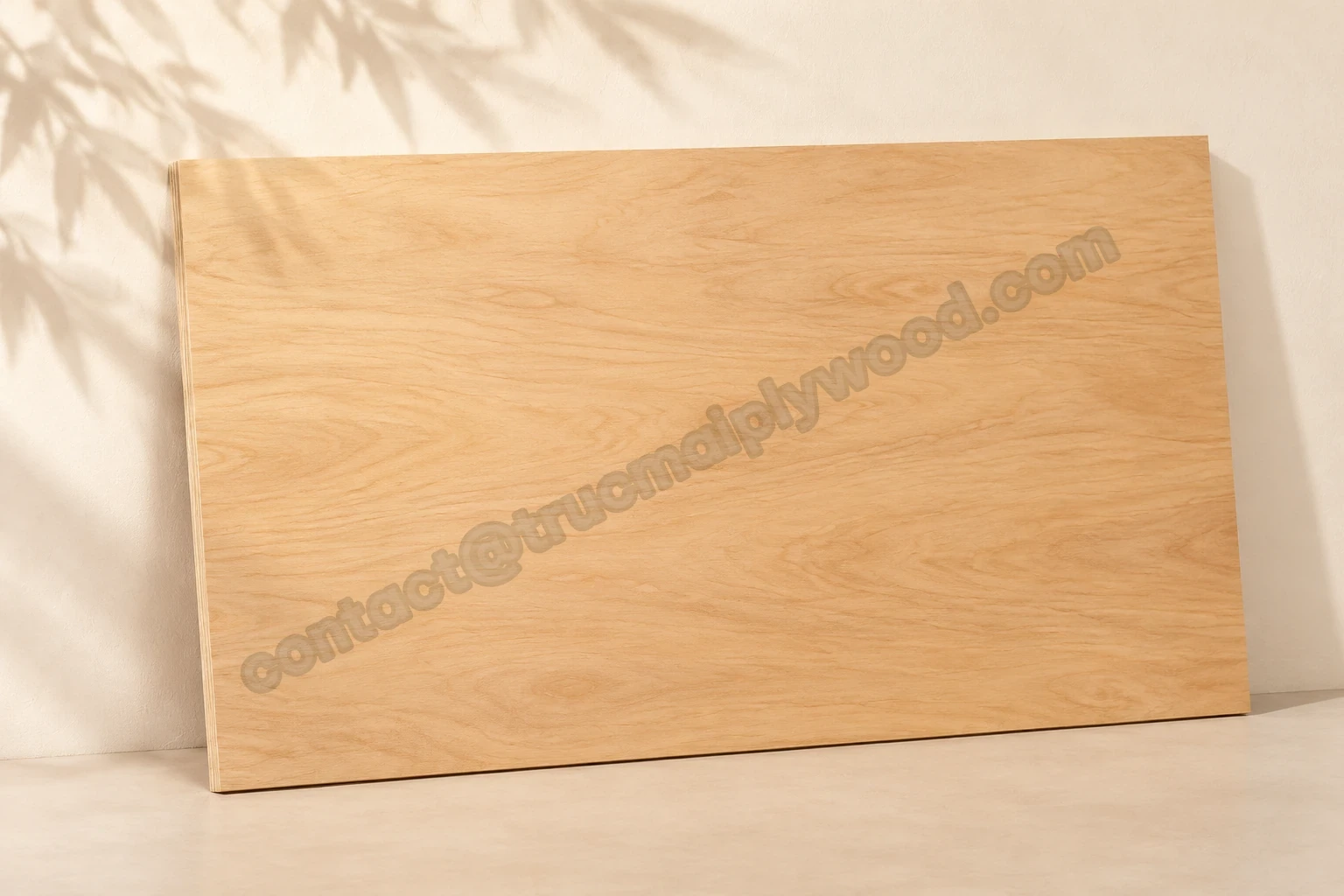
Poplar offers a pale, relatively even surface, while okoume offers a warmer visual character. Either can be chosen for a commercial panel when the buyer specifies the surface finish and accepts a physical reference sample. The face is the first thing a cabinet maker sees, but the outer veneer also affects sanding and finishing behaviour.
For an overlay or laminate, inspect local roughness, patches, splits, open joints and telegraphing from the core. For clear-finished joinery, agree colour range, grain and face/back pairing. A face that is satisfactory beneath opaque laminate may be unsuitable for a transparent lacquer finish.
Truc Mai Plywood supplies poplar-faced plywood and okoume-faced plywood on Vietnamese plantation-wood cores. The face veneer and the core are separate parts of the order description. A pale face does not mean that the entire panel consists of poplar, and an okoume face does not establish a marine or exterior performance class.
Ask for photographs of full sheets and cut edges, followed by a sample from the intended construction. Small decorative samples alone can conceal core gaps that become visible during routing or drilling.
Which core construction should a UK importer specify?
Specify core species, joining method and permitted gaps together. A core described only as hardwood leaves substantial room for differences in weight, machining and face support. The commercial decision is often between a lighter core that helps handling and a denser core chosen for a different machining or stiffness preference.
For furniture/interior panels, stitched core veneers and sanded faces support a more uniform panel. Commercial panels may use a loose-laid or jointed core, with a different appearance and cost structure. The distinction should be visible on a sawn edge and written into the order rather than inferred from a marketing grade.
Inspect the outer core plies especially closely. Gaps immediately below the face can appear as depressions after pressing or finishing. Overlaps can create ridges. Internal repairs should be agreed by location and size. A supplier’s sample should show both the best face and representative cut edges.
The Vietnamese plywood grade guide explains why grade names alone are a weak comparison. When two suppliers offer the same nominal thickness, request the same core specification and inspection method before comparing quotations.

What glue and bond tests belong on the purchase order?
Write the adhesive system and bond-performance requirement on separate lines. Urea-formaldehyde (UF) adhesive is used widely for interior panels. Melamine-modified systems are used where additional moisture resistance is wanted. A trade term for adhesive is not a substitute for a test report on the proposed construction.
The USDA Forest Products Laboratory’s Wood Handbook, chapter 10, explains the different moisture-resistance characteristics of wood adhesives. A buyer should therefore identify the service environment before selecting a bond requirement.
A laboratory report should identify the sample, pre-treatment, test method and result. Ask for the panel construction to match the proposed order. A report for one face/core/glue combination is useful evidence for that combination; it should not be casually transferred to a materially different build.
The exterior-glue panel options provide a separate purchasing route for buyers whose intended service conditions call for greater bond resistance. Keep bond durability separate from formaldehyde emissions in the RFQ.
Which standards distinguish flooring, general-purpose and structural plywood?
BS 8203 concerns resilient-floor-covering installation; EN 636 classifies plywood by service conditions; PS 1 concerns US structural plywood. They answer different questions. A flooring buyer must check the floor specification itself rather than assuming a general plywood label resolves installation suitability.
EN 636 uses dry, humid and exterior service conditions. The selected class concerns the panel’s intended environment and associated requirements. EN 314-2 addresses bonding quality, while EN 315 addresses dimensional tolerances. The full requirement should be identified by the buyer’s designer or specification writer.
The NIST PS 1-22 standard expressly covers structural plywood, including its grades, bond classifications and performance requirements. That structural classification is not a synonym for commercial furniture plywood. A commercial panel should not be given a structural designation merely because its veneers are cross-laminated.
A useful document check asks: what is the named standard, which edition is required, what panel configuration was tested, and which party issued the evidence? These questions prevent a general-purpose sheet from being compared with a project-approved flooring product on appearance alone.
How should thickness and sheet size be written for merchants?
Quote finished thickness in millimetres and give sheet length and width explicitly. A nominal size without a tolerance leaves uncertainty for CNC machining, edging and overlay operations. For calibrated furniture panels, Truc Mai’s written thickness tolerance can be ±0.3 mm; other commercial constructions use their agreed tolerance.
Standard available sheet formats include 1220 × 2440 mm, 1220 × 2280 mm and 1250 × 2500 mm. A buyer stocking British joinery sheets may prefer the first, while a continental furniture production line may be arranged around the last. The cutting layout should be selected from the actual sheet format, not a nominal trade nickname.
A flooring system calling for a specific underlay thickness should be sourced to that exact finished requirement. A nearby commercial nominal thickness is a different specification. For a joinery purchase, send the cutting drawing and thickness gauge procedure with the enquiry.
How can cut-to-size panels be packed for a UK stock programme?
Cut-to-size is an order option, with each finished size agreed from the parent sheet and cut list. Truc Mai can cut a standard sheet into two lengthwise pieces such as 610 × 2440 mm, into three pieces such as 1200 × 800 mm, into four such as 1220 × 610 mm, or into six pieces to the agreed layout. Other dimensions are set from the selected parent sheet and saw plan.
For a merchant, this changes the warehouse question. Full sheets are flexible but take more handling and cutting space. Pre-cut pieces simplify picking for repeat cabinet or lining orders. They also require careful pack identification because similar-looking panels may differ by thickness, face grade or core.
Send a cut list with piece length, width, orientation, acceptable kerf allowance, quantity and labelling convention. Include the required face-up orientation if the finished pieces will be processed directly from the pack. A clear cutting diagram is more reliable than a description such as half-sheet or quarter-sheet.
What do 40HC container planning figures show by core and thickness?
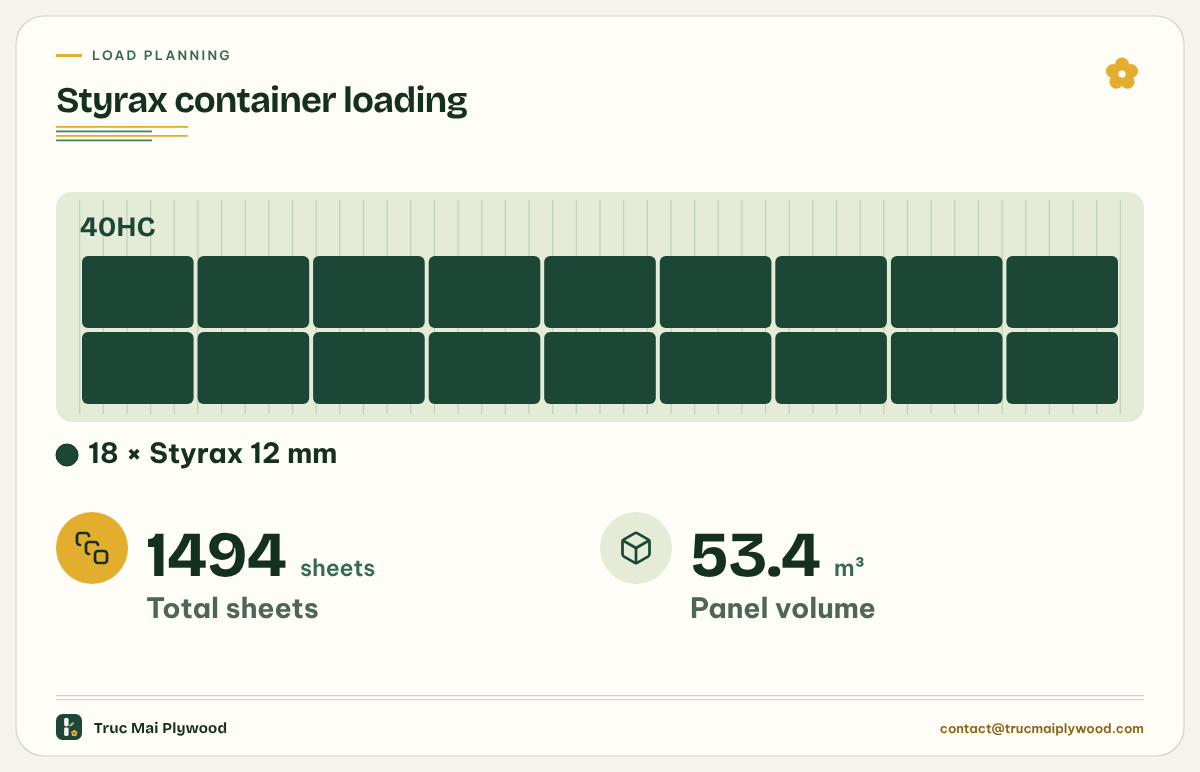
The planning model gives different sheet counts for Styrax, Acacia and Eucalyptus cores because their reference densities differ. The figures below are computed planning values for panels, not shipment records. Use them to prepare a purchase mix and then check the actual loading plan.
| Core | Thickness (mm) | Sheet (mm) | Packs | Sheets/pack | Sheets | Volume (m³) | kg/sheet | Total kg | Weight-capped |
|---|---|---|---|---|---|---|---|---|---|
| Styrax | 12 | 1220 × 2440 | 18 | 83 | 1494 | 53.4 | 17.9 | 26680 | No |
| Acacia | 12 | 1220 × 2440 | 16 | 83 | 1328 | 47.4 | 20.7 | 27510 | No |
| Eucalyptus | 12 | 1220 × 2440 | 15 | 80 | 1200 | 42.9 | 23.2 | 27860 | Yes |
| Styrax | 15 | 1220 × 2440 | 18 | 66 | 1188 | 53.0 | 22.3 | 26520 | No |
| Acacia | 15 | 1220 × 2440 | 16 | 66 | 1056 | 47.2 | 25.9 | 27350 | No |
| Eucalyptus | 15 | 1220 × 2440 | 15 | 64 | 960 | 42.9 | 29.0 | 27860 | Yes |
| Styrax | 18 | 1220 × 2440 | 18 | 55 | 990 | 53.0 | 26.8 | 26520 | No |
| Acacia | 18 | 1220 × 2440 | 16 | 55 | 880 | 47.2 | 31.1 | 27350 | No |
| Eucalyptus | 18 | 1220 × 2440 | 15 | 53 | 795 | 42.6 | 34.8 | 27690 | Yes |
| Styrax | 21 | 1220 × 2440 | 18 | 47 | 846 | 52.9 | 31.3 | 26440 | No |
| Acacia | 21 | 1220 × 2440 | 16 | 47 | 752 | 47.0 | 36.3 | 27270 | No |
| Eucalyptus | 21 | 1220 × 2440 | 15 | 45 | 675 | 42.2 | 40.6 | 27430 | Yes |
Basis: 40HC planning model, panels only: Styrax 18 packs, Acacia 16 packs, Eucalyptus 15 packs; pack height 1,000 mm; sheets per pack are the pack height divided by thickness and rounded down, subject to a 28,000 kg planning payload. Reference densities are Styrax 500 kg/m³, Acacia 580 kg/m³ and Eucalyptus 650 kg/m³. Carrier, route and actual weighing determine the final loading plan.
For a mixed-stock programme, combine pack lines rather than adding separate full-container totals. The container loading guide explains the effect of thickness and core on space and weight. A packing proposal should show actual pack dimensions and gross weight, so the importer can plan unloading equipment and warehouse positions.
What formaldehyde documentation should accompany a commercial panel?
Ask for the emission class, test method and certified product scope. Emission limits are measured by specific methods; a glue description alone does not state the emission result. The UK buyer should identify the required product market and the test documentation applicable to the intended use.
For US-bound hardwood plywood with veneer core, 40 CFR Part 770 specifies a formaldehyde limit of 0.05 ppm under TSCA Title VI. That rule is a US product requirement, not an automatic UK flooring approval. Truc Mai holds CARB Phase 2 and TSCA Title VI certification for veneer-core hardwood plywood within its certified 3–25 mm scope.
The order file should pair the selected adhesive and emissions requirement with the relevant certificate and the agreed configuration. Buyers comparing quotes can use a single document checklist to avoid mixing laboratory results from unrelated products.
How do FSC records and timber-origin files enter the enquiry?
Ask for the claim on the sales document and the chain-of-custody code where FSC material is ordered. Truc Mai holds FSC chain-of-custody certification, licence FSC-C196493 and certificate SA-COC-014545, for eligible FSC 100% products. The claim belongs to the qualifying product line on the transaction documents.
A buyer can start with FSC licence verification and then compare the certificate scope with the proposed order. The purpose is to make the material description on the purchase order, invoice and supporting records consistent.
For EU-bound consignments, the EUDR file set addresses the origin of both the Vietnamese core timber and imported face veneer. It can include origin records and plot geolocation files. The European Commission’s Access2Markets guidance describes the staged application of the EU deforestation rules from 30 December 2026. Origin paperwork and product performance tests answer separate questions, so keep both in the buyer’s document schedule.
How should SP101 plywood stockists compare competing offers?
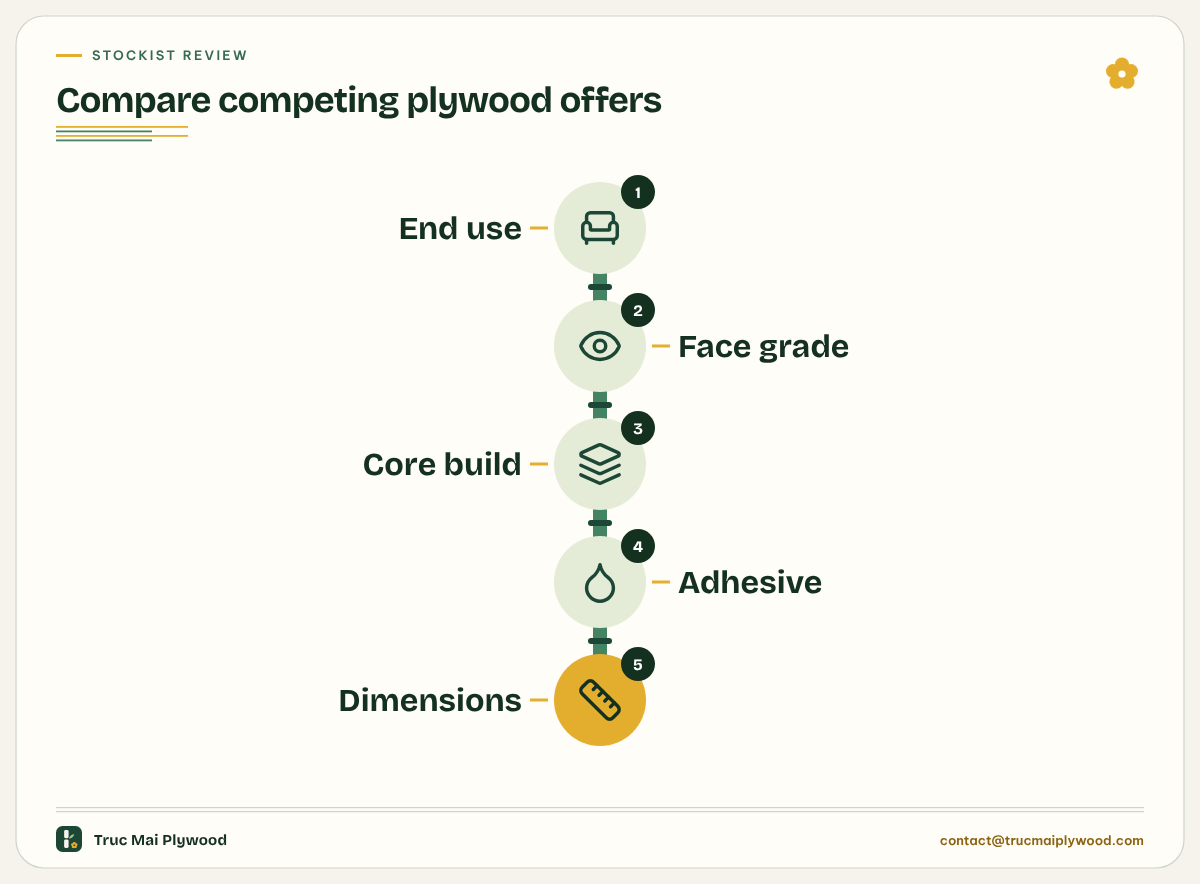
Compare written constructions, not merchant labels alone. A stockist who receives several offers under the broad heading of hardwood plywood should ask each supplier to complete the same schedule. A sample and a price-free technical comparison are more useful than promotional adjectives.
- Identify whether the stock line serves flooring installers, joiners or furniture manufacturers.
- State face and back species, appearance grades and the reference sample.
- Specify core species, joining method and allowable internal defects.
- Record adhesive system, bond requirement and emissions documentation.
- Fix finished dimensions, tolerance and cutting pattern.
- Agree packing marks, shipment documents and inspection evidence.
This format helps a merchant distinguish an approved flooring product from a general commercial panel, and helps the importer compare offers without asking every mill to interpret a trade code differently. The plywood RFQ guide provides a practical order-line structure.
What should a UK buyer inspect before approving a trial order?
Inspect the approved sample against the written specification before releasing a repeat order. The most revealing checks are face quality, cut-edge construction, thickness consistency and identification of the exact adhesive/emission configuration. Photographs are useful for screening, but a physical panel is needed for machining and finishing trials.
Run the intended process on the sample: sawing, drilling, edge finishing, lamination or coating. Check whether core voids become visible at the cut, whether the face remains smooth after the proposed finishing step and whether the panel fits the buyer’s machine settings. Record the result against the approved sample rather than relying on an undefined description such as premium hardwood.
A new buyer can request plywood samples before finalising the production specification. Keep the sample reference with the purchase order and packing instructions. The inspection report should state which characteristics were checked and which remain covered by the supplied laboratory documents.
Which shipping documents and terms belong in a container RFQ?
Write the destination, Incoterm, shipment documents and pack schedule into the RFQ. A factory quotation is easier to compare when the commercial terms and the technical specification are fixed at the same time. For a UK importer, the destination port and onward delivery plan also influence the preferred pack dimensions.
Truc Mai’s standard minimum order is one 40HC. Production is normally 15–45 days after a 30% deposit, with the remaining 70% against the scanned bill of lading. Available shipment terms are FOB Hai Phong, CFR or CIF. A buyer can arrange a repeat-stock schedule after the first configuration is approved.
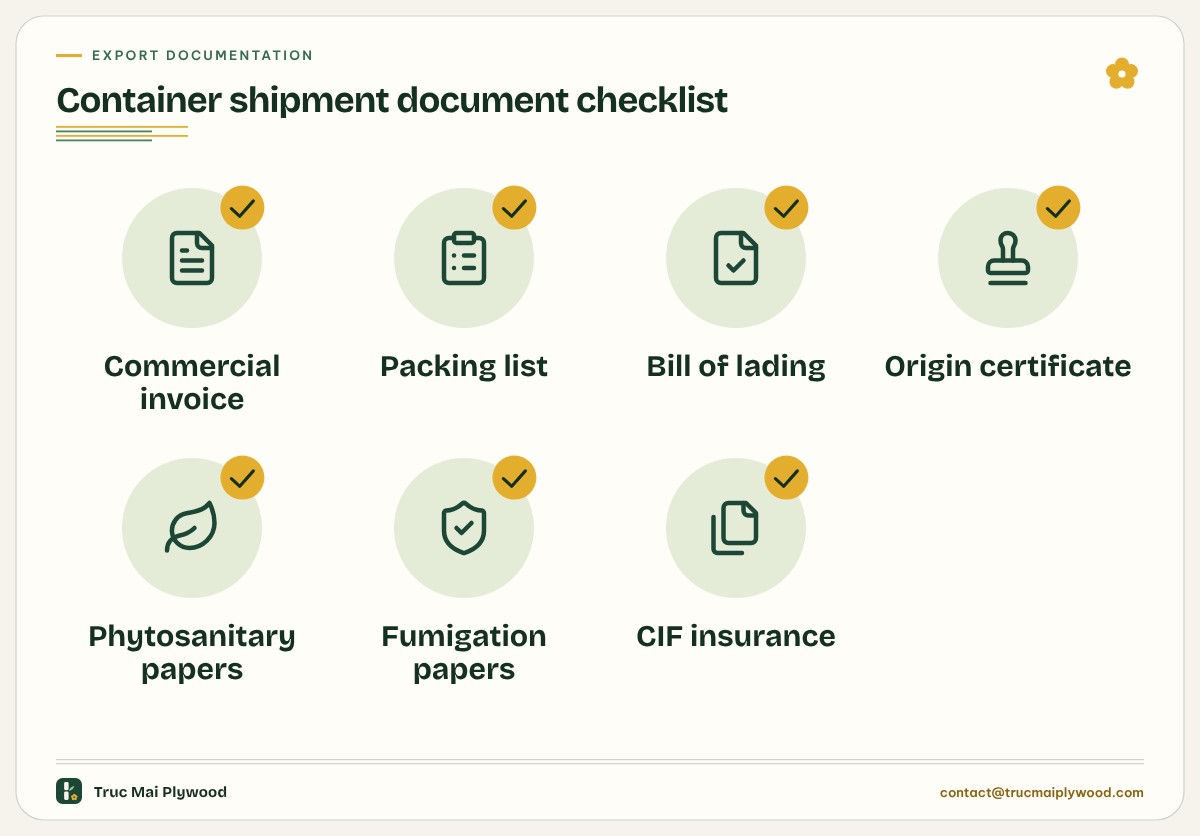
The normal shipping file includes commercial invoice, packing list and bill of lading, with origin and treatment documents as applicable to the shipment. Add the certificates and test reports named in the contract. The container document checklist is a useful companion to the technical specification.
How should the final purchase enquiry be written?
Send one complete specification line for each panel construction. Begin with the end use and work towards the measurable properties: face/back, core, adhesive, emissions, finished thickness, sheet size, cut pattern, packaging, quantity and destination port. Attach the intended sample or photographs showing the required face and edge quality.
For a UK merchant, describe a commercial joinery alternative as a commercial joinery alternative. For a flooring contractor, retain the specified flooring approval and the accompanying evidence. This keeps product naming accurate and makes the supplier’s response actionable.
Include a request for a sample, the proposed production schedule and a pack-marking example. A well-written enquiry allows the mill to respond with one defined build and a coherent document set instead of several incomparable variants.
Send your specification to contact@trucmaiplywood.com or through the quotation form.
Questions buyers ask
Can SP101 be ordered directly from a Vietnamese mill?
SP101 is a named flooring plywood product. A Vietnamese mill can quote a panel to a separately written specification, but that panel should be described by its own construction and test evidence.
Is 6 mm plywood the same as 5.5 mm flooring underlay?
No. Nominal thickness and tolerance are separate order details. Specify the finished thickness required by the floor system rather than substituting a nearby nominal size.
Does a smooth face mean the plywood is suitable beneath vinyl?
No. Surface smoothness is one criterion; the flooring specification also considers bond, moisture, core quality and dimensional consistency.
Can an importer request a different back veneer?
Yes. Specify face and back separately, with an approved reference sample and written defect limits.
Are FSC and formaldehyde certificates interchangeable?
No. FSC chain of custody concerns traceable material claims, while formaldehyde certification concerns emissions from a defined panel product.
What should appear on a plywood sample label?
Identify the face, core, nominal thickness, sheet size, glue system, emission requirement and intended application so the approved sample can be matched to the order.
Can a buyer combine sheet thicknesses in one shipment?
Yes. Mixed specifications can be agreed for a container, with separate pack marks and packing-list lines.
Should a merchant advertise a substitute as SP101?
Use the manufacturer’s own product description and documented specification. Reserve the SP101 name for the branded product.
What is the first inspection after a trial delivery?
Compare pack labels with the packing list, then measure panel thickness, inspect faces and edges and review the agreed test documents.
Can UV-ready plywood be supplied with an applied UV finish?
UV-ready identifies prepared faces for the buyer’s subsequent coating. It is not the same as a factory-applied UV coating.