
Birch vs pine plywood is primarily a choice of surface appearance when both panels use the same specified core. Birch offers a fine, restrained grain for painted or clear-finished furniture; pine gives stronger growth-ring contrast and a more rustic face. For weight, stiffness and screw holding, compare the complete lay-up rather than the face name.
What does birch vs pine plywood actually compare?
Birch vs pine plywood can mean two quite different comparisons: the species of the visible face, or the species throughout the panel. A buyer choosing cabinet doors usually cares about the face, while a buyer ordering exposed-edge drawer parts must inspect every ply. These are separate purchasing decisions.
A birch-faced sheet may carry imported birch veneer over a Vietnamese hardwood core. A pine-faced sheet may use the same core construction. That controlled comparison isolates the appearance of the face rather than confusing a face choice with a different panel altogether.
The alternative is an all-birch or all-pine construction. Those products change the material in the inner plies, so differences in panel mass, machining and fastener behaviour cannot be assigned to the face alone. Ask suppliers for an edge image and a face/back sample, not simply the trade name.
Truc Mai Plywood offers birch-faced plywood and pine-faced plywood over specified Styrax, Eucalyptus, Acacia, Pine or combined cores for furniture and commercial applications.
Which is better for furniture: birch or pine?
Birch is the straightforward choice for quiet, fine-grained cabinet fronts; pine is the stronger choice when visible knots and pronounced grain are part of the design. Neither selection decides the panel’s internal construction.
| Buying criterion | Birch-faced plywood | Pine-faced plywood |
|---|---|---|
| Face character | Fine, relatively even grain | Stronger earlywood/latewood contrast |
| Visible knots | Select a clean appearance grade | Knots can be a design feature |
| Clear finish | Restrained, light-toned appearance | Warm, prominent grain pattern |
| Paint | Smooth face can reduce visual grain | Grain and knots need more preparation |
| Exposed edge | Core layers determine appearance | Core layers determine appearance |
| Cabinet hardware | Core and fastening design matter | Core and fastening design matter |
| Sheet mass | Set mainly by core and thickness | Set mainly by core and thickness |
| Best brief | Matched doors and neat interiors | Rustic or character furniture |
For kitchen carcasses, both faces can work where the edges are banded and the construction is specified correctly. A cabinet buyer should therefore begin with the intended finish, then choose the core, machining tolerance and face grade. See the cabinet-grade plywood buying criteria for the wider specification.
Is birch harder than pine?
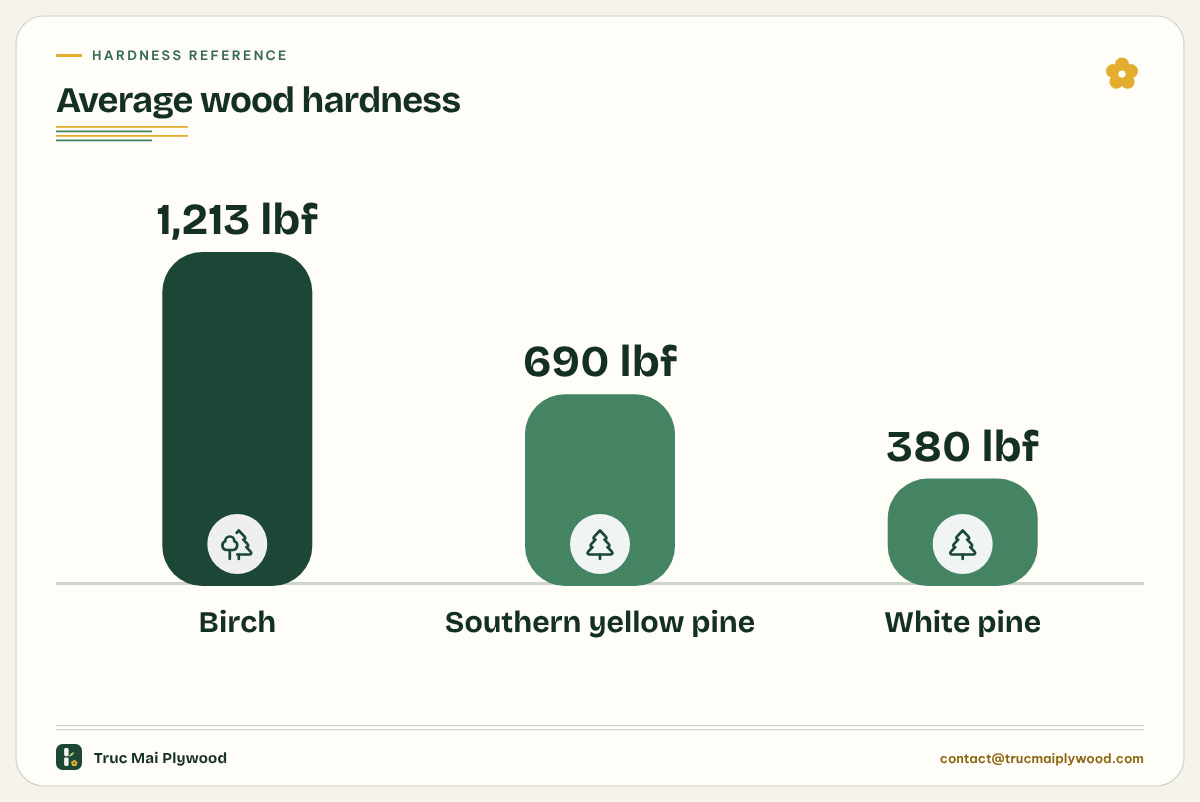
Yes. Birch is generally harder than commonly used white pine and southern yellow pine in solid-wood testing, although the species within each group matters. The ANSI/HPVA HP-1-2024 standard, Table 1, reports average birch hardness at 1,213 lbf, southern yellow pine at 690 lbf and white pine at 380 lbf, under the standard’s stated moisture conditions.
These are Janka values for lumber specimens. They are not hardness ratings for finished plywood sheets. The same standard explains that a thin decorative veneer transfers much of its indentation response to the inner plies or substrate beneath it. A birch veneer over a soft core can dent differently from an all-birch panel.
For a desk top, request the proposed surface build and a finish sample. For a drawer box or screw-fixed component, ask for the core construction and relevant panel tests. Hardness is one property; it cannot stand in for bending stiffness, surface abrasion resistance or edge screw withdrawal.
How do birch and pine faces differ in colour and grain?
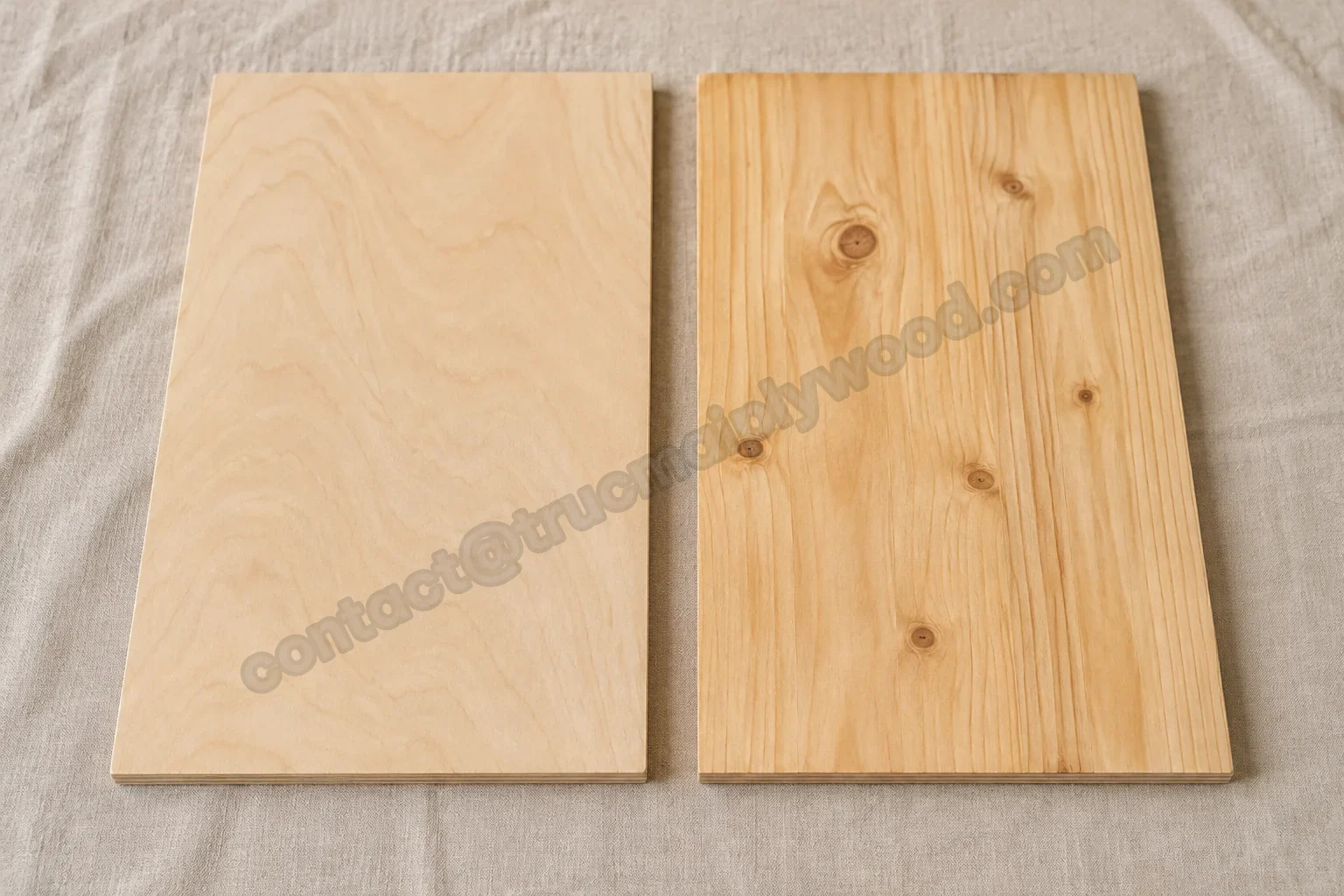
Birch normally presents a pale, relatively fine and even grain, whereas pine often shows stronger bands of earlywood and latewood and more conspicuous knots. Both vary with veneer cut, tree and face selection. That variation matters most when multiple doors are installed next to one another.
A sample should show more than one small patch. Examine a full face for colour transitions, grain direction, repairs, open knots and splice lines. Lay adjacent pieces under the lighting used in the finished room. For clear coating, check the face after the actual sanding and coating sequence because the finish changes contrast.
If the project uses a deliberately rustic look, specify which knots may remain visible and how they should be repaired. For a pale contemporary look, specify the permitted colour range and veneer matching method. Appearance is an agreed face-and-back sample, not an adjective such as premium.
Which plywood face paints and clear-coats more cleanly?
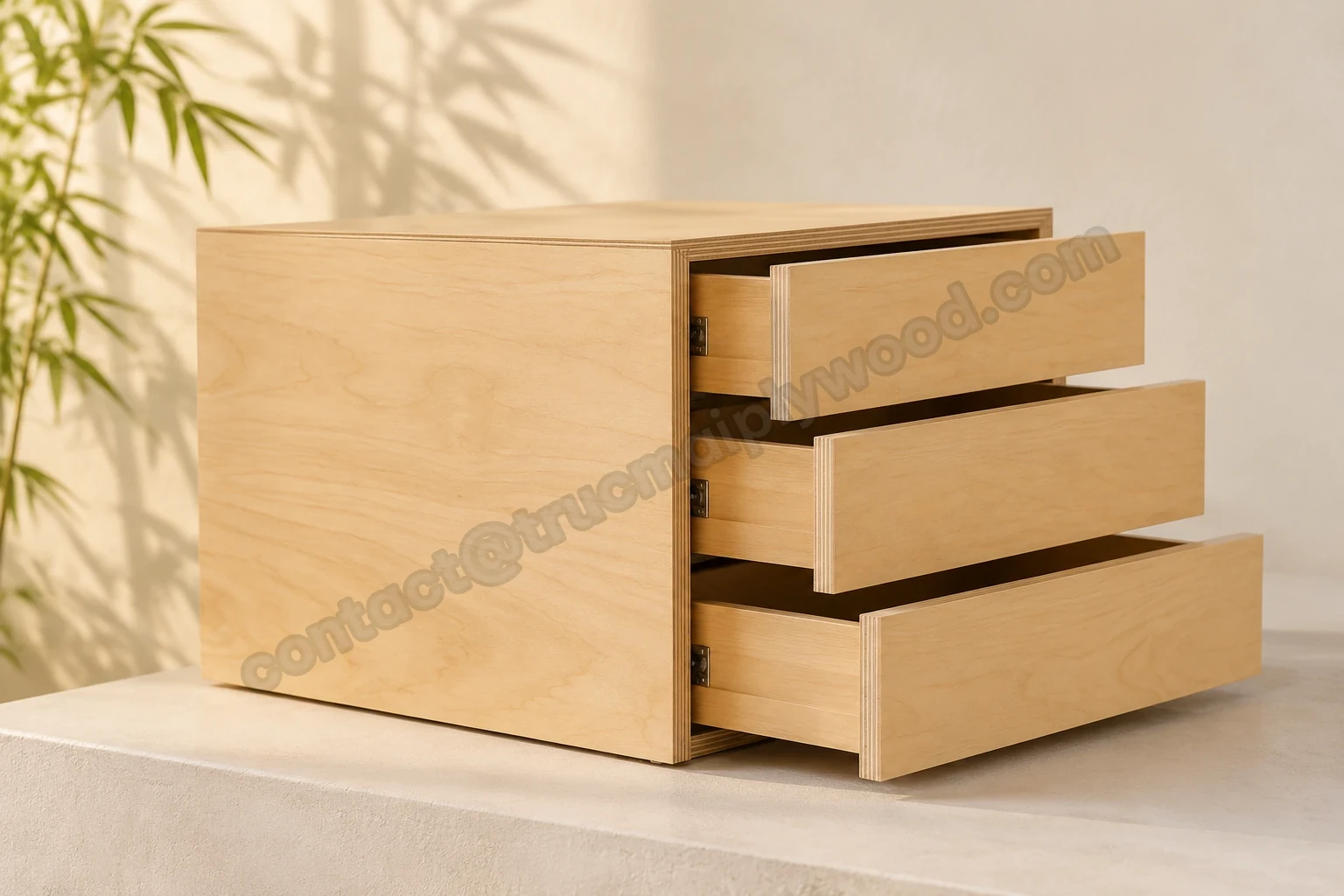
Birch usually gives a more even-looking painted face, while pine rewards clear finishes that reveal grain. The paint result is determined by preparation as well as species. Pine knots and resin-rich areas need attention in the coating schedule, and an unfilled grain or veneer repair can remain visible after painting.
For a painted production line, test primer adhesion, sanding between coats, colour uniformity and the visibility of repairs. For a clear finish, inspect stain absorption and the appearance of veneer joins. Specify which side receives the show finish and whether the back has a matching visual grade.
A UV-ready sheet means the faces have been prepared for the buyer’s coating operation; it is not a factory-applied UV finish. A furniture maker can order a prepared face and run its own coating trials. The best plywood for interiors selection starts with the finish and use conditions rather than a species name alone.
Does a birch face make plywood stronger than a pine face?
No. Changing only a thin face veneer does not establish a higher bending strength for the entire sheet. Core species, ply thickness, orientation, adhesive bond and panel defects all influence bending and stiffness.
The US Forest Service Wood Handbook distinguishes clear-wood properties from engineered panel performance. The NIST PS 1-22 standard provides separate structural plywood classifications and testing requirements. A furniture panel sold by face species should never be treated as a structural-rated panel on the strength of its veneer label.
For long shelves, ask for a load-and-span design based on the actual panel build. For tall cabinet doors, assess flatness and the intended hinges. A different core may matter much more than changing birch to pine on the outer face.
What happens to screws, CNC cuts and exposed edges?
The core and the edge construction dominate screw holding and exposed-edge appearance. A birch-faced board with Styrax inner veneers does not turn into an all-birch board at the saw line. Similarly, a pine-faced board over Eucalyptus keeps Eucalyptus inner plies.
When routing cabinet components, inspect the edge for open joints, overlapping core strips, tear-out and glue-line gaps. Core stitching across and along the sheet helps close veneer joints in furniture constructions. Check whether the outer plies have been stitched and whether the core was sanded and calibrated before the final face finish.
For screws, specify pilot-hole diameter, edge distance, fastener type and the number of assembly cycles in your own production trial. For visible edges, either select a construction whose layers are part of the design or use edge banding. The Baltic birch alternatives discussion separates an all-birch edge from a birch-faced hardwood-core edge.
What is the difference between radiata pine and birch plywood?
Radiata pine is a named pine species, whereas birch describes a hardwood genus. A radiata-pine plywood specification therefore still needs to say whether radiata appears only on the faces or through the core. The same question applies to birch.
Australian and New Zealand buyers often encounter radiata-faced panels in appearance and utility applications. A birch-faced hardwood-core alternative may be preferred for a finer face, but the two offers should use the same sheet size, core grade, surface preparation and bond specification before the buyer compares results.
Do not infer an Australian structural rating from the words radiata pine. A structural panel is identified by its applicable certification and grade marking, not merely by its species. Furniture-grade imports are ordered against the face sample and the agreed construction.
How do hoop pine and spruce comparisons change the choice?
Hoop pine and spruce are separate species groups, so neither name should be treated as a synonym for pine-faced plywood. A buyer comparing hoop pine vs birch plywood or spruce plywood vs birch needs the precise species and construction on both offers.
Hoop pine is familiar in Australian appearance-panel discussions. Spruce is common in northern European softwood-panel discussions. Their visible grain and knot distribution differ from birch, but the practical questions remain identical: which veneer is visible, which wood forms the core, what finish will be applied and how are edges treated?
Use a face sample to settle colour and knot acceptance, and a cut edge to settle ply construction. For coated cabinet doors, a smooth birch face may be the preferred visual starting point; for a natural softwood design, a selected pine-family face may be more suitable.
Which cores change sheet weight and handling?
Core choice changes sheet weight even when the two visible faces look similar. Truc Mai’s planning densities are Styrax 500 kg/m³, Acacia 580 kg/m³ and Eucalyptus 650 kg/m³. Those figures support packing calculations, rather than a measured density for every individual sheet.
A lighter Styrax core helps with repeated handling of furniture components and gives more panel volume within a container plan. Eucalyptus is denser and changes the lifting and packing calculation. Acacia sits between these reference cases. A buyer selecting pine or birch faces should request the core on the same quotation line.
For manual assembly, compare the weight of the complete cut component. For CNC lines, weigh representative panels and check suction handling. A lighter board is not automatically a stiffer board, and a denser board is not automatically better for every fastening pattern.
How many birch- or pine-faced sheets fit in a 40HC?
The same core and thickness produce the same planning sheet count for birch-faced and pine-faced orders in the supplied packing model. Face choice is not a separate loading variable in this calculation. The table below reproduces every supplied CALC.json row without altering its values.
Calculation basis: 40HC planning model, panels only; Styrax 18 packs, Acacia 16 packs, Eucalyptus 15 packs; pack height 1,000 mm; sheets per pack calculated from thickness and limited by a 28,000 kg planning payload; reference densities Styrax 500, Acacia 580 and Eucalyptus 650 kg/m³. Carrier, route and booking determine the final cargo allowance. These are modelled planning figures, not loading records.
| Core | Thickness (mm) | Sheet (mm) | Packs | Sheets/pack | Weight-capped | Sheets | m³ | kg/sheet | Total kg |
|---|---|---|---|---|---|---|---|---|---|
| Styrax | 12 | 1220x2440 | 18 | 83 | No | 1494 | 53.4 | 17.9 | 26680 |
| Acacia | 12 | 1220x2440 | 16 | 83 | No | 1328 | 47.4 | 20.7 | 27510 |
| Eucalyptus | 12 | 1220x2440 | 15 | 80 | Yes | 1200 | 42.9 | 23.2 | 27860 |
| Styrax | 15 | 1220x2440 | 18 | 66 | No | 1188 | 53.0 | 22.3 | 26520 |
| Acacia | 15 | 1220x2440 | 16 | 66 | No | 1056 | 47.2 | 25.9 | 27350 |
| Eucalyptus | 15 | 1220x2440 | 15 | 64 | Yes | 960 | 42.9 | 29.0 | 27860 |
| Styrax | 18 | 1220x2440 | 18 | 55 | No | 990 | 53.0 | 26.8 | 26520 |
| Acacia | 18 | 1220x2440 | 16 | 55 | No | 880 | 47.2 | 31.1 | 27350 |
| Eucalyptus | 18 | 1220x2440 | 15 | 53 | Yes | 795 | 42.6 | 34.8 | 27690 |
| Styrax | 21 | 1220x2440 | 18 | 47 | No | 846 | 52.9 | 31.3 | 26440 |
| Acacia | 21 | 1220x2440 | 16 | 47 | No | 752 | 47.0 | 36.3 | 27270 |
| Eucalyptus | 21 | 1220x2440 | 15 | 45 | Yes | 675 | 42.2 | 40.6 | 27430 |
The table illustrates why a quote should identify core, thickness, face, size and pack configuration separately. See the wider container volume by thickness reference for planning other builds. Request the packed dimensions and verified sheet weight when turning a plan into a shipment.
Which sizes, thicknesses and face grades should an importer specify?
Start with the finished component, then write the sheet specification. Truc Mai supplies 3–40 mm panels, including 3, 4, 5, 6, 9, 12, 15, 18, 21, 25, 30 and 40 mm. Standard sheet formats include 1220 × 2440 mm, 1220 × 2280 mm and 1250 × 2500 mm.
Furniture-grade sanded and calibrated panels can be ordered at a thickness tolerance of ±0.3 mm; other commercial constructions use their agreed tolerance. Length and width tolerance is ±2 mm. Thin 3–5 mm sheets use five plies, while 18 mm furniture panels usually use 11–13 plies. Write the intended machining tolerance rather than relying on a generic face name.
For appearance, identify the face and back as a pair and approve a reference sample. The ISO 2426-2:2020 preview describes hardwood appearance classes E, I, II, III and IV. Commercial labels such as B/BB or BB/CC need a supplier-specific definition; they are not automatic translations of the ISO classes.
Can the mill cut birch- or pine-faced sheets to size?
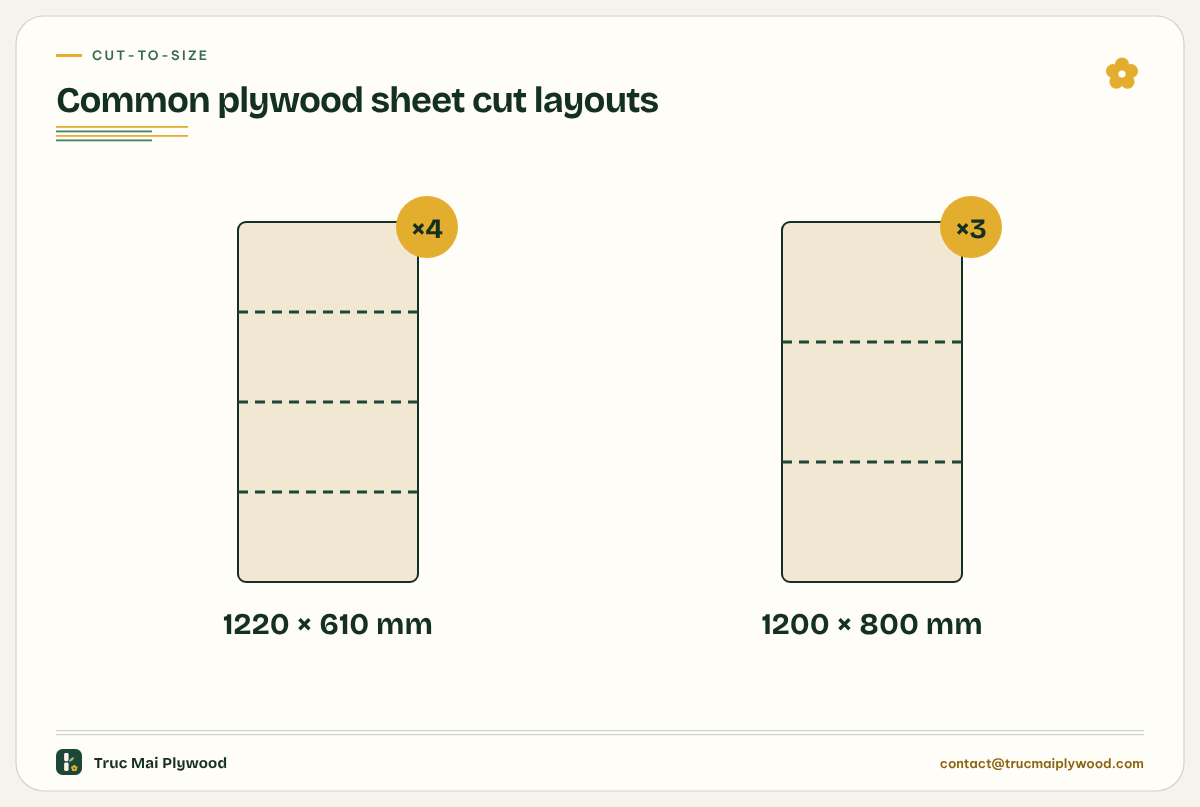
Yes. Cut-to-size panels are a production option when the buyer supplies a cut list and the finished dimensions are agreed in writing. A 1220 × 2440 mm sheet can be split lengthwise into 610 × 2440 mm pieces or divided into four 1220 × 610 mm pieces. A three-part 1200 × 800 mm layout is another common furniture requirement, with the parent sheet and trimming allowance specified on the order.
For six-part layouts, the mill works from the chosen parent sheet and the buyer’s final dimensions. A nominal part dimension should not be assumed from the number of cuts alone: the cutting pattern, grain direction and saw allowance determine what can be supplied. Labels can identify each panel group for downstream assembly.
Send the cut list as a dimensioned drawing or spreadsheet, including which face must remain visible, grain orientation, edge-banding allowance and acceptable offcut. That is more reliable than a sketch with only an overall sheet size.
Which glue and emission requirements belong in the order?
Specify adhesive performance and formaldehyde emission as separate lines. A glue family describes the bonding system; an emission class or tested limit describes a different property. UF resin is commonly used for interior plywood, while moisture-resistant formulations are selected for different service conditions.
For US-bound veneer-core hardwood plywood, 40 CFR Part 770 sets a formaldehyde emission limit of 0.05 ppm under the applicable testing framework. Truc Mai holds CARB Phase 2 and EPA TSCA Title VI third-party certification for hardwood plywood with veneer core in its 3–25 mm certified scope, certificate CARB/EPA 26053, mill ICTT-26053. Specify the actual panel construction covered by the order.
The US formaldehyde requirements page explains the relevant product category. A face change by itself does not define the adhesive or emission result. Put the agreed resin system, emission requirement and supporting certificate documentation on the purchase specification.
What should a buyer inspect before approving a production lot?
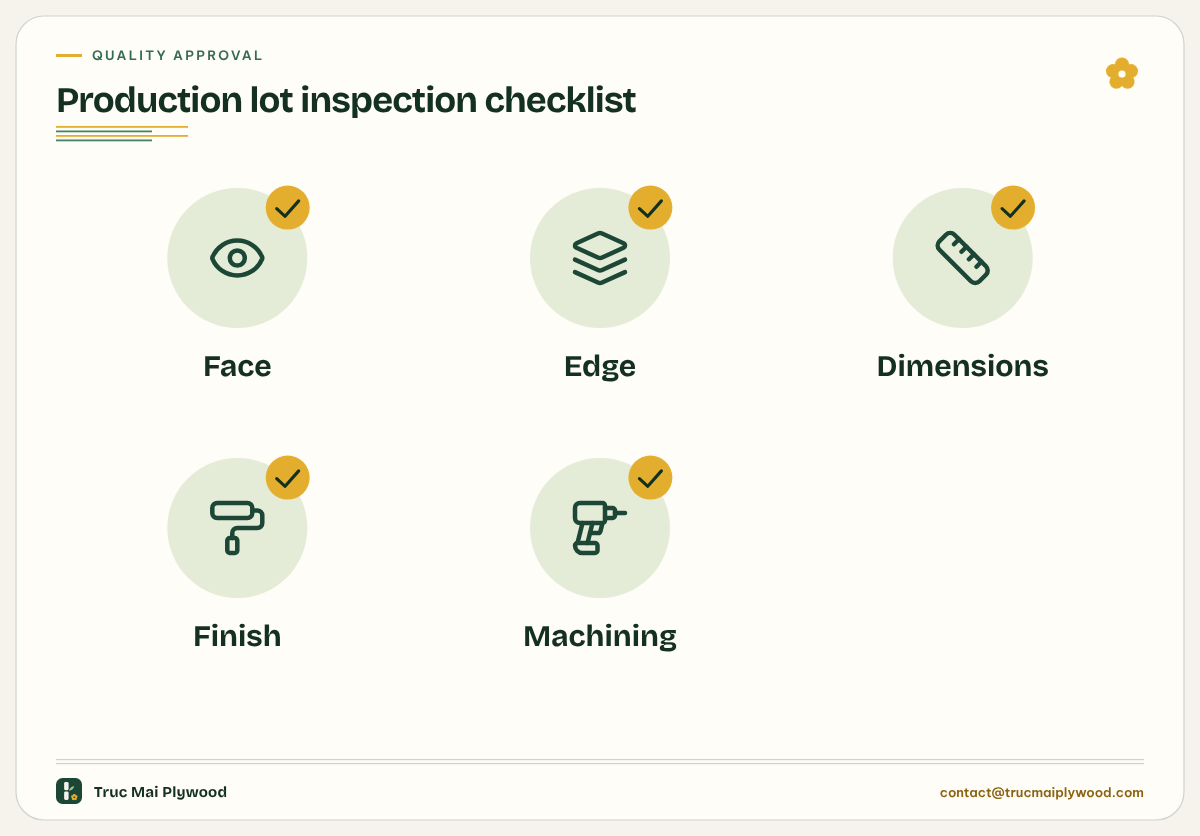
Inspect the face, the edge and the finished component, in that order. A small attractive face swatch can hide core openings, machining tear-out or inconsistent backs. A full-thickness offcut gives the buyer a much clearer view of the construction.
- Face: check colour, knots, patches, veneer matching and sanding marks under the intended lighting.
- Edge: check ply count, joining quality, visible voids and any overlap between core strips.
- Dimensions: measure thickness across the sheet and check squareness against the cut drawing.
- Finish: apply the intended paint, clear coat or laminate to a representative piece.
- Machining: route a test component, drill hinge positions and test the chosen fastener.
- Packing: check labels, protection of face surfaces and the count by part identifier.
A practical sample approval records the visible face and back, edge construction and finished result. Ordering plywood samples is the next step before committing a full container to an untested finish.
How should birch and pine plywood be written on an RFQ?
Write a complete bill of construction, not just “birch plywood” or “pine plywood”. A useful RFQ starts with the furniture application, then the core, glue and emission requirement, face and back, sheet dimensions, finishing preparation, packing and destination port.
For example, a cabinet-front enquiry can request a birch face and matching back over Styrax core, calibrated furniture construction, a specified thickness and an approved clear-finish sample. A rustic furniture enquiry can request a pine face with permitted sound knots over the same core, keeping the other conditions equal for a meaningful comparison.
Truc Mai Plywood manufactures furniture and commercial plywood in Ha Hoa, Phu Tho, Vietnam, with annual production around 60,000 m³. Its standard order starts at one 40HC, with production scheduled 15–45 days after the deposit according to the agreed order. Request a quotation with the application, face/back sample target, core, sheet or cut-list dimensions, coating method, quantity and destination. The plywood RFQ checklist gives a format the purchasing and production teams can both use.
Send your specification to contact@trucmaiplywood.com or through the quotation form.
Questions buyers ask
Can birch-faced plywood have a pine core?
Yes. A birch face can be pressed over pine inner veneers. Specify the complete ply construction because the surface species alone does not identify the core.
Does pine-faced plywood always have pine throughout?
No. Pine-faced plywood can have a hardwood or mixed core. Request an edge photograph and written core specification.
Is Baltic birch the same as birch-faced plywood?
No. Baltic birch commonly denotes an all-birch construction, while birch-faced plywood can use other inner veneers.
Which face shows knots more clearly?
Pine generally shows more pronounced knots and growth-ring contrast. Specify the permitted knots against an approved face sample.
Can pine plywood be used for painted doors?
Yes. Select a sound, well-prepared face and trial the primer and paint system before approving the production finish.
What is the most useful cabinet sample?
Ask for a full-thickness panel offcut showing both faces and the edge, plus a representative piece finished with your intended coating.
Can I specify a different face on the back?
Yes. Write the face and back grades as a pair and approve a sample showing both surfaces.
Does a higher ply count always mean a stronger board?
No. Veneer species, orientation, bonding, thickness and defects also affect panel performance.
Are pine and birch face grades interchangeable?
No. Appearance descriptions differ by species and grading system; agree the allowable repairs and knots against a physical sample.
How should cut panels be labelled?
Specify the cut-list identifier, finished dimensions, grain direction and pack label for each part group.