
Wooden shipping crates combine a load-bearing base, a frame and protective panels. Packing plywood commonly forms the sides, ends and lid, while timber runners and braces manage handling loads. Buyers should specify the cargo mass, handling method, panel construction and destination rules before ordering a crate or its cut-to-size plywood components.

What is the difference between a wooden crate and a wooden box?
A wooden crate uses a frame as its principal supporting structure; a wooden box relies more on continuous walls for enclosure and support. Both can use plywood, solid timber or a combination, and both can be fully enclosed. Because the names overlap in trade, compare construction drawings rather than invoice labels.
An open crate exposes part of the contents between rails. A closed crate has sheeted walls and can resemble a wooden box from outside. The distinction matters when the cargo is tall, irregular or heavy: an engineered frame can route forces into the base and lifting points without asking a thin side panel to act as a beam. A box is often practical for smaller regular goods, where a continuous enclosure is straightforward to assemble and stack.
| Buyer comparison | Framed crate | Panel-sided wooden box |
|---|---|---|
| Primary load path | Frame, corner posts, base and runners | Walls, joints and base, sometimes reinforced |
| Wall construction | Open slats or plywood infill | Continuous plywood or timber panels |
| Access | Removable side or top, as designed | Lid or removable wall |
| Typical drawing priority | Bracing and lifting points | Wall joints and closure |
| Packing method | Built around cargo or assembled from a kit | Assembled before or around cargo |
Ask the packer for the base drawing, not simply a photograph of the enclosure. The broader material choices are covered in plywood for export packing.
What wood is best for wooden crates?
Packing plywood is a practical choice for the enclosed sides and lid of a framed crate, while appropriately sized solid timber is commonly selected for runners, corner posts and load-bearing bracing. The best combination follows the cargo’s weight, centre of gravity, lifting method and exposure during transit.
Plywood has cross-laminated veneers, so large faces can be cut into repeatable wall panels with fewer joints than narrow boards. Its flat surface also accepts printed handling labels and fastener layouts. A timber frame offers convenient connection points and allows the base to be designed around forklift access or other lifting arrangements. For a light enclosed case, plywood can contribute to the enclosure’s stiffness; for a heavy machine, the load must be taken through a purpose-designed base.
Specify the core separately from the face. Truc Mai Plywood offers packing-grade panels using Vietnamese core species such as Styrax, Acacia and Eucalyptus. A denser core changes sheet mass and loading capacity; a cleaner face changes appearance but does not replace a sound base design. Compare actual construction rather than selecting a species by reputation alone. The packing plywood product is a starting point for the material specification.
For exposed transit conditions, distinguish panel bond performance from surface protection. Urea-formaldehyde (UF) adhesive is used widely for interior panels, while moisture-resistant adhesive systems have different properties; the USDA Forest Products Laboratory’s Wood Handbook, chapter 10 describes those adhesive families. A crate designer should specify the service exposure and request evidence for the selected panel build.
What are the parts of a wooden shipping crate?
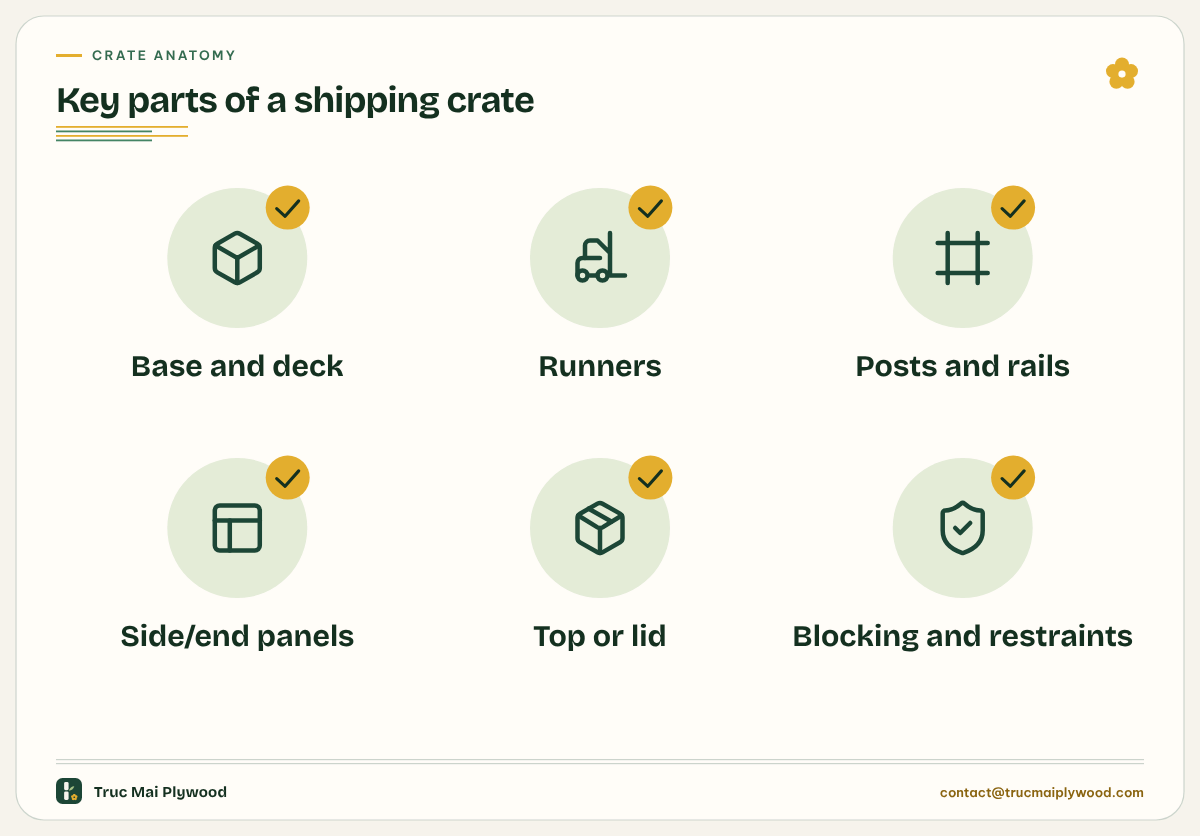
A wooden shipping crate has a base, runners, corner posts, rails or braces, side panels, end panels, a top and the fixings that connect them. A particular design may add cushioning, blocking, strapping and moisture barriers. Each component performs a different job, so an apparently minor substitution can change how the crate behaves when lifted.
- Base and deck: the cargo bears on this assembly; its support locations match the product’s feet or skid.
- Runners: members beneath the base provide handling clearance and transfer loads to the ground or forks.
- Corner posts and rails: the frame locates the walls and resists racking during handling.
- Side and end panels: plywood encloses the contents, helps keep loose items contained and provides a surface for markings.
- Top or lid: closes the enclosure and provides access for inspection or removal.
- Blocking and restraints: prevent the product moving inside the crate, independently of the wall cladding.
- Fixings and seals: screws, bolts, nails or straps complete the assembly and show where access is intended.
A simple drawing should show these parts in exploded view and in assembled position. Identify which components can be removed without disturbing the cargo restraints. When the lid carries no stacking load, describe it as a cover rather than a platform for another package.
Which plywood panels belong in wooden shipping crates?
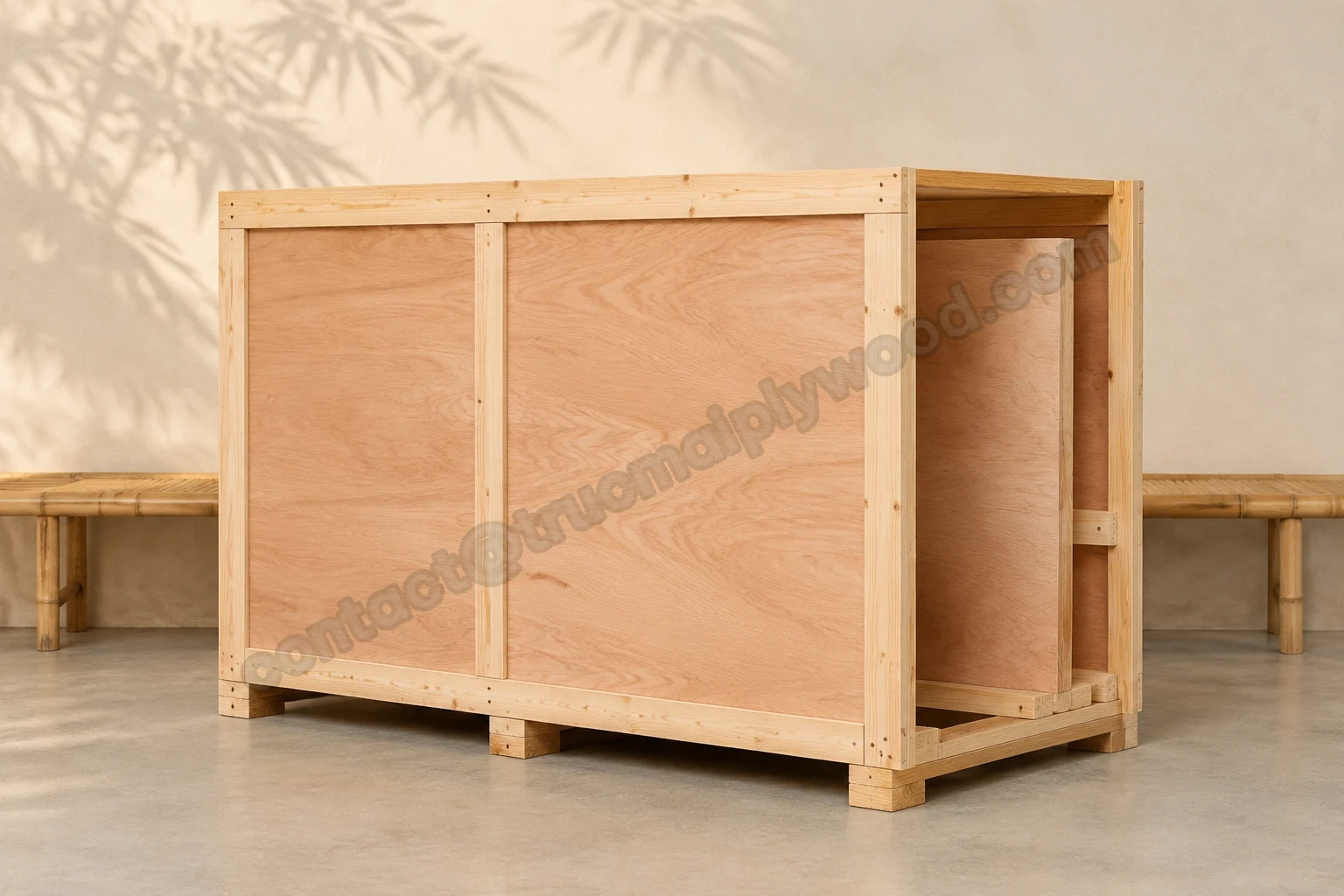
Side and end panels provide enclosure; lid panels provide a removable or fixed cover. They can share a sheet specification, but their cut dimensions, edge positions and fixing schedules often differ. A panel on the side may be fixed to vertical posts, whereas a lid spans horizontal rails and needs an opening method.
| Component | Main duty | What to specify |
|---|---|---|
| Long side | Enclose lengthwise face | Clear span, joints, fastener edge distance |
| End wall | Close shorter face | Opening direction, corner connection |
| Lid | Protect top and allow access | Rail support, removable fixings, label position |
| Base skin | Cover gaps in a designed base | Support spacing, attachment and cargo contact |
| Internal divider | Separate goods | Restraint layout and attachment points |
Packing-grade plywood is generally chosen for functional surfaces rather than furniture-grade appearance. Face veneer species, patching allowance and sanding should be written on the approved sample. A buyer who wants clean printed handling instructions may specify a smoother face on the outward side without paying for the same finish on every hidden surface.
The export-case panel discussion addresses panel selection by crate component. It is worth separating this from the base engineering: a neat wall sheet does not demonstrate forklift capacity.
How thick should crate plywood be?
Panel thickness is selected from the unsupported span, fastening pattern, expected contact and intended handling, rather than from the cargo mass alone. The frame can reduce the clear span of a wall; the base needs its own load assessment. The same cargo may therefore use different panel thicknesses in the enclosure and deck.
For a material order, list thickness in millimetres alongside the actual panel dimensions. Truc Mai’s commercial and packing range covers 3–40 mm, with common order thicknesses including 9, 12, 15, 18 and 21 mm. Packing-panel thickness tolerance is specified for the order; a typical packing-grade range is ±0.5–1.0 mm. Length and width tolerance is ±2 mm. These are manufacturing specifications, not allowable structural spans.
Ask the crate engineer to show the distance between supports and the fastener schedule. A sheet that performs well as a close-spaced wall infill may behave differently across a wide lid opening. Also decide whether a joint falls on a frame member. A butt joint suspended between rails is not equivalent to a continuous sheet.
How do you size a wooden crate around its cargo?
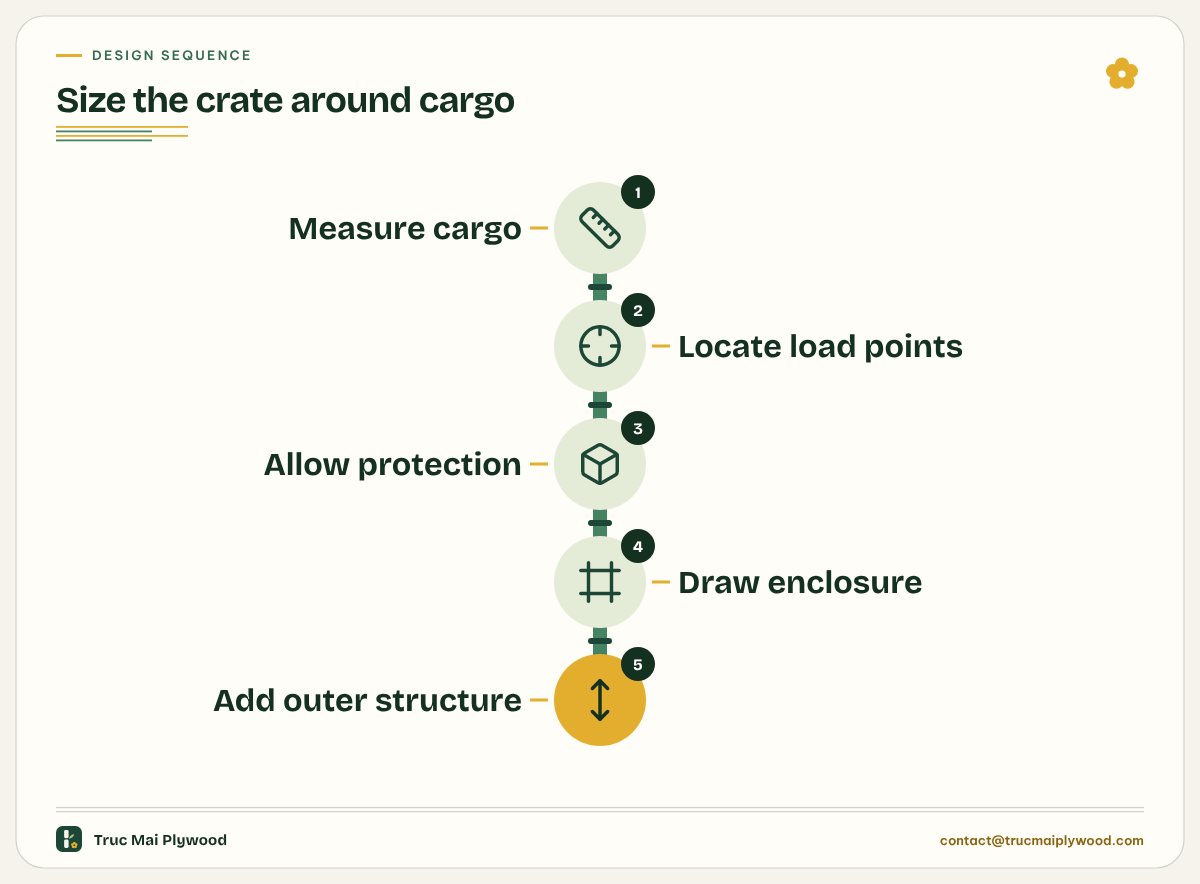
Start with the cargo envelope and its handling clearances, then draw the inside dimensions before adding the wall, frame and runner build-up. The resulting outside dimensions are the figures used for vehicle, container and doorway checks. This order prevents a nominal crate size from consuming the clearance intended for cushioning.
- Record the product’s maximum length, width and height, including protruding fittings.
- Locate the centre of gravity, feet and approved lifting or restraint points.
- Add the space required for blocking, wrapping, cushioning and access to fixings.
- Draw the internal enclosure and the frame around it.
- Add wall thickness, external posts, runners and any lifting projections.
- Check the outside dimensions against the transport route and unloading equipment.
A removable instrument or accessory may need its own compartment. Mark its position before finalising the side-panel cut list. For machinery with a projecting control cabinet, protecting that projection can be more important than minimising the overall crate dimensions.
How should the base carry heavy or awkward loads?
A heavy crate needs a base that supports the cargo at its actual bearing points and transfers the weight to the handling equipment. The plywood walls are not a substitute for this load path. The design should identify the bearing blocks, cross-members, runner spacing, fastening and permitted lift direction.
When a forklift approaches, the forks should engage beneath members designed for that contact. If the cargo is off-centre, the centre-of-gravity marking and the lift arrangement must reflect it. Crane handling needs its own approved lifting arrangement rather than an assumption that the roof rails are lifting points.
The base drawing should also show how the cargo is attached. Restraints must prevent sliding and tipping while allowing the intended unpacking sequence. A bolted machine may require access holes in the deck; an irregular item may require shaped blocking. Treat those details as part of the packing design, not a last-minute addition after the crate is assembled.
How can cut-to-size panels simplify crate assembly?
A cut-to-size panel kit reduces on-site measuring when the crate design repeats. The mill can supply labelled pieces from an agreed sheet and cut list, allowing the packing team to identify each side, end and lid before assembly. Label names should match the drawing revision.
Truc Mai supplies standard sheet formats of 1220 × 2440 mm and 1250 × 2500 mm, with 1220 × 2280 mm also available. A standard sheet can be divided into two lengthwise pieces such as 610 × 2440 mm, three pieces such as 1200 × 800 mm, four pieces such as 1220 × 610 mm, or six pieces to an agreed pattern. The exact finished dimensions are established from the parent sheet and cutting schedule, allowing for saw kerf.
Send a cutting diagram rather than only a count of finished parts. Mark grain or face direction if appearance matters, and identify the face that must point outward. A crate with left and right end panels may look symmetrical until a fastening or access hole is added. The cut-to-size panel option explains how to describe the pieces in an RFQ.
Which export crates need ISPM 15 treatment and marks?
Solid-wood runners, posts and dunnage in international wood packaging generally fall under ISPM 15; plywood manufactured using glue, heat or pressure is excluded from that standard’s wood-packaging treatment requirements. A mixed plywood-and-solid-wood crate must therefore be assessed component by component.
The International Plant Protection Convention’s ISPM 15 standard explicitly includes crates, cases, pallets and dunnage made from raw wood, while excluding processed plywood. The UK Forestry Commission guidance makes the same distinction for movements involving Great Britain. For regulated solid-wood packaging, the recognised treatment and official mark are central to acceptance.
A crate maker should identify the treated timber and keep the mark visible after assembly. The mark belongs to the authorised wood-packaging treatment system, not to a plywood supplier simply because its sheets are used in the walls. Check the final assembled package, including added blocks and replacement runners, rather than relying on a statement about the plywood alone.
What paperwork should accompany an export crate?
The shipment file should identify the goods, packing units, dimensions, gross and net weights, origin and the relevant transport documents. Crate construction records are a separate practical layer: drawing revision, material schedule, treatment mark details for regulated timber and a packing photograph or inspection record.
For plywood shipments from Vietnam, the commercial invoice, packing list and bill of lading form the core shipping file; a certificate of origin and other agreed documents are supplied for the destination and shipment terms. The documents per container page separates these trade documents from the crate maker’s construction records.
A useful packing list describes the crate as a handling unit and the goods as its contents. Include external dimensions and gross mass so a warehouse can select appropriate equipment. Where several crates contain different parts of one machine, number the crates and cross-reference the contents list. Avoid relying on an informal label such as “large wooden box” to carry operational information.
What matters when a crate is shipped to the United States?
For a crate used solely as wood packaging, the US formaldehyde rules distinguish that packaging from regulated composite-wood products. Under 40 CFR Part 770, section 770.1(c)(10), wood packaging including pallets, crates, spools and dunnage is excluded from the specified certification and testing subparts. That is a different question from whether plywood sold as a panel product falls within the hardwood-plywood rules.
The purchasing documents should identify the intended use clearly. A plywood wall supplied as part of a finished export crate is described differently from a sheet bought for cabinet manufacture. Buyers arranging a US shipment should also have the crate maker check applicable wood-packaging entry requirements for any solid-wood components.
For standalone hardwood plywood products, the relevant regulatory scope and mill documentation are covered in US import steps. Keeping product compliance and packaging controls on separate lines avoids mixing certificates that answer different questions.
How should crate panels be fixed to the frame?
Fix panels through the planned frame members with a fixing schedule that gives edge distances, spacing and the opening sequence. The drawing should distinguish permanent connections from removable ones, especially around the lid and inspection side.
A screw head that tears through a thin veneer can leave a loose corner even if the timber frame remains sound. Pilot holes, washers or backing strips can be considered where the assembly design calls for them. At the same time, the number of fixings alone does not prove resistance to racking: the panel joints, braces and load path must work together.
If the crate will be opened at customs or at the receiving factory, specify reusable fixings in the access panel. Mark which screws can be removed and which restraints must stay in place until the cargo is supported. A repeatable sequence helps flat-packed kits.
How do you protect the contents against damp and abrasion?
Use a suitable internal barrier, cushioning and restraint arrangement for cargo sensitive to moisture or surface damage. Plywood panels provide an enclosure, but condensation management and product protection need to be specified separately.
For metal equipment, the packing engineer may choose a barrier wrap, desiccant and a defined sealing method. For painted or polished goods, prevent direct rubbing against frame members and fasteners. Where ventilation is needed, openings should be deliberate and protected against splash. The correct approach follows the cargo material, route and expected storage conditions.
Inspect exposed plywood edges and cut-outs before packing. Rough edges can damage film or strapping during assembly. If the crate has a removable top, check that the opening operation cannot drag fasteners across the protected product. These details are easiest to resolve while the panel kit is still on the bench.
How are plywood crate panels packed into a 40HC container?
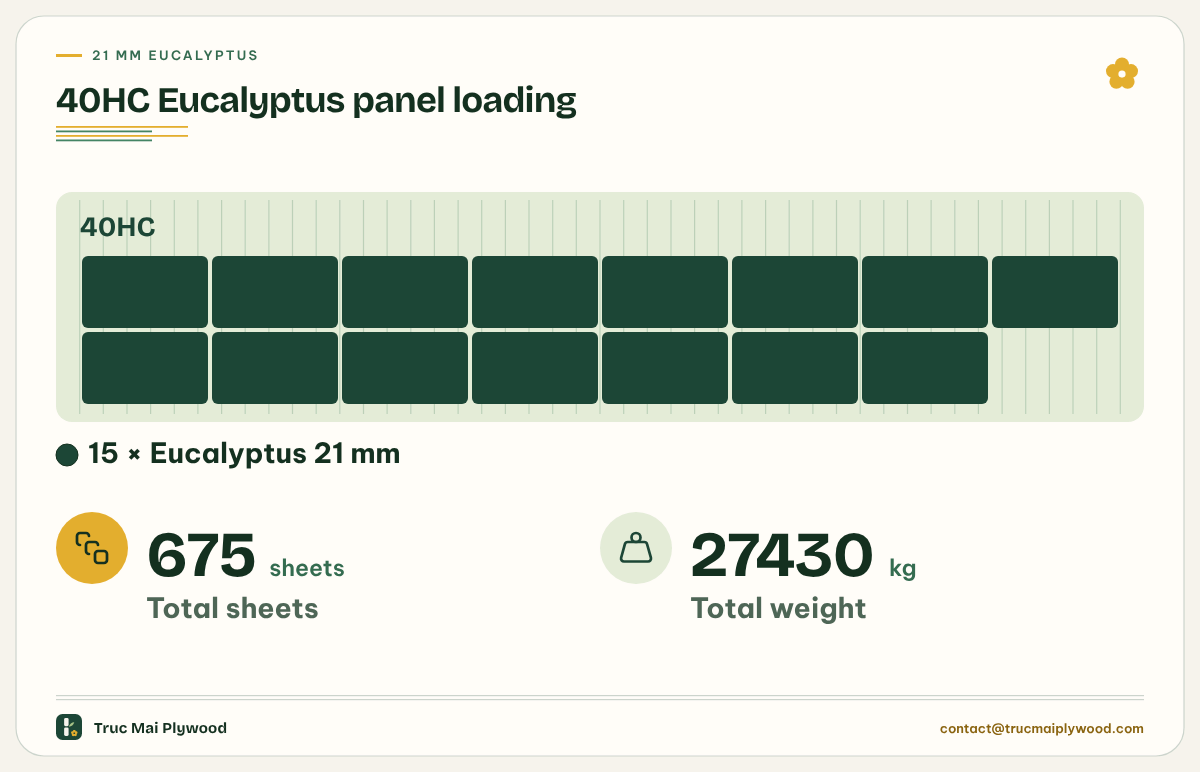
A 40HC panel-loading plan is driven by sheet size, thickness, core density, pack height and allowable cargo mass. The following values are planning figures for unassembled plywood sheets, not counts of finished wooden crates. They help a crate manufacturer schedule raw panel purchases separately from the finished-case freight plan.
Calculation basis: 40HC, panels only; Styrax 18 packs, Acacia 16 packs, Eucalyptus 15 packs; nominal pack height 1,000 mm; sheets per pack calculated from pack height and thickness, then weight-capped against a 28,000 kg planning payload. Reference densities: Styrax 500 kg/m³, Acacia 580 kg/m³ and Eucalyptus 650 kg/m³. Carrier, route and the final packed weight determine the shipping limit.
| Core | Thickness (mm) | Sheet (mm) | Packs | Sheets/pack | Weight-capped | Sheets | Volume (m³) | kg/sheet | Total kg |
|---|---|---|---|---|---|---|---|---|---|
| Styrax | 12 | 1220 × 2440 | 18 | 83 | No | 1494 | 53.4 | 17.9 | 26680 |
| Acacia | 12 | 1220 × 2440 | 16 | 83 | No | 1328 | 47.4 | 20.7 | 27510 |
| Eucalyptus | 12 | 1220 × 2440 | 15 | 80 | Yes | 1200 | 42.9 | 23.2 | 27860 |
| Styrax | 15 | 1220 × 2440 | 18 | 66 | No | 1188 | 53.0 | 22.3 | 26520 |
| Acacia | 15 | 1220 × 2440 | 16 | 66 | No | 1056 | 47.2 | 25.9 | 27350 |
| Eucalyptus | 15 | 1220 × 2440 | 15 | 64 | Yes | 960 | 42.9 | 29.0 | 27860 |
| Styrax | 18 | 1220 × 2440 | 18 | 55 | No | 990 | 53.0 | 26.8 | 26520 |
| Acacia | 18 | 1220 × 2440 | 16 | 55 | No | 880 | 47.2 | 31.1 | 27350 |
| Eucalyptus | 18 | 1220 × 2440 | 15 | 53 | Yes | 795 | 42.6 | 34.8 | 27690 |
| Styrax | 21 | 1220 × 2440 | 18 | 47 | No | 846 | 52.9 | 31.3 | 26440 |
| Acacia | 21 | 1220 × 2440 | 16 | 47 | No | 752 | 47.0 | 36.3 | 27270 |
| Eucalyptus | 21 | 1220 × 2440 | 15 | 45 | Yes | 675 | 42.2 | 40.6 | 27430 |
These figures retain the source calculation values without rounding the sheet counts. Packaging, pallets and actual cargo weights are checked in the final loading plan. The 40HC volume-by-thickness reference covers a wider set of panel specifications; it is a different exercise from estimating how many assembled crates fit inside a container.
How do you inspect plywood before building crates?
Inspect the panel against the written order and approved sample before the first crate is assembled. The receiving team should look at dimensions, thickness, edge condition, core continuity, face damage and pack identification. A good inspection plan records the defect and the affected batch rather than merely labelling a sheet “good” or “bad”.
Check representative sheets from the pack, including edges where core gaps or loose plies are easiest to see. Lay a panel flat to examine twist and surface condition. Verify that labelled cut pieces correspond to the current drawing; a panel from an earlier revision can fit the frame but place an opening or joint in the wrong location.
Where a purchaser requires a particular bonding or emission test, write the method and acceptance criterion in the purchase specification. An adhesive name by itself does not describe the finished panel’s tested performance. The packing plywood specification gives a useful format for comparing material offers.
How do you compare suppliers for crate-panel orders?
Compare suppliers using the same bill of materials, sample and inspection conditions. A quotation for an unnamed “packing plywood” grade can hide differences in core construction, joining, surface preparation, tolerance and packaging. Those differences affect repeat cutting.
A practical comparison asks each mill to return the proposed core, face grade, thickness tolerance, sheet size, glue system, packing method and lead time in a single specification. Request photographs of the panel edges and a representative sample when surface or core construction affects the assembly. Ask whether cut pieces can be labelled to the crate drawing, and whether mixed thicknesses can be grouped by pack.
Truc Mai manufactures commercial and furniture/interior plywood in Ha Hoa, Phu Tho, Vietnam, with annual capacity around 60,000 m³. Its commercial panels can be supplied for export-case production, including cut-to-size requirements. For a new supplier relationship, the mill verification checklist helps organise the document and sample review.
What belongs in a crate-panel RFQ?
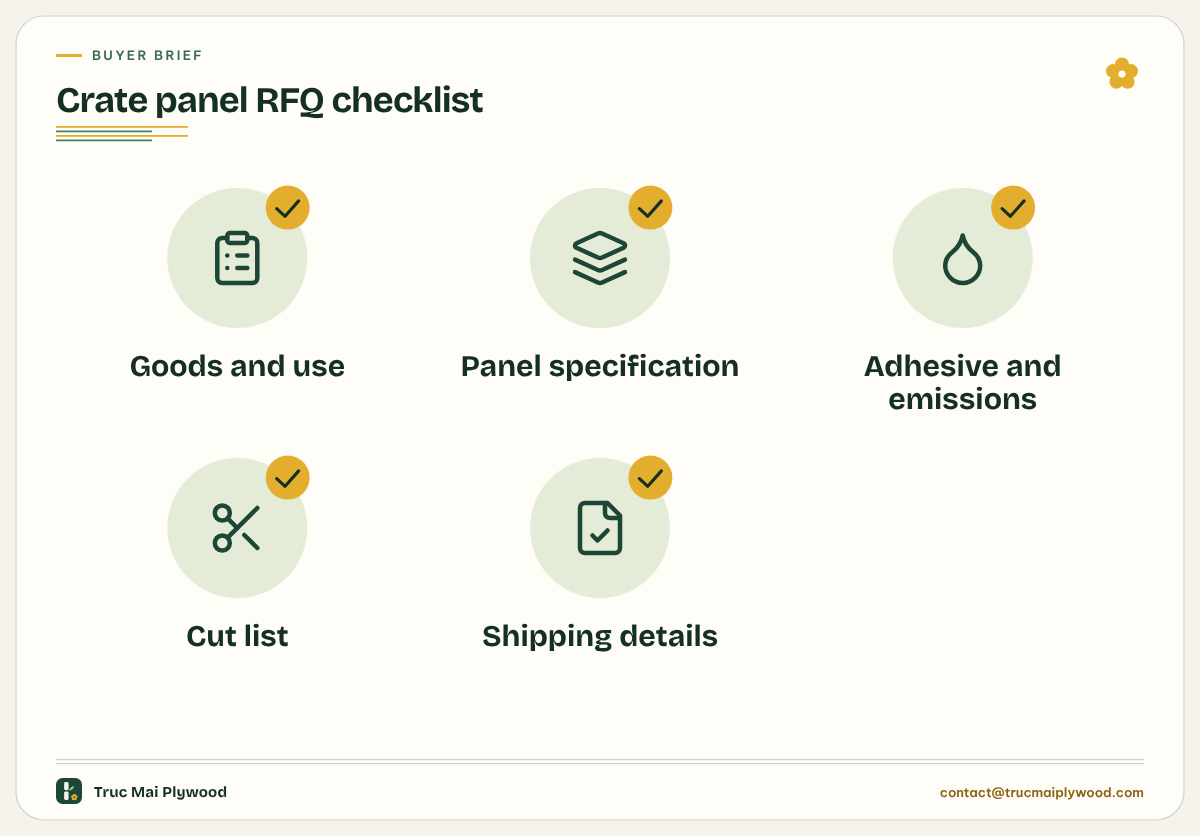
A crate-panel request for quotation should state the end use, required sheet construction and the cut-piece schedule, then identify the delivery and packing arrangement. A clear RFQ lets the mill price the same material the crate maker intends to assemble.
- Describe the goods and whether the panels form sides, ends, lid or base skin.
- Provide the plywood core, face finish, thickness and sheet dimensions.
- State the adhesive and emission specification as separate lines where relevant.
- Attach the cut list, parent-sheet layout, part labels and drawing revision.
- Define pack grouping, quantity, destination port and required shipping documents.
- Identify the inspection sample and any requested test report for the ordered construction.
For a first production run, the drawing and material sample should be approved together. A pack label that matches the assembly drawing is useful only if the cut pieces match the same revision. The plywood RFQ guide provides a buyer-ready structure. Send the finished specification through the quotation page when the crate dimensions and panel schedule are ready.
Questions buyers ask
Can a plywood crate be shipped flat-packed?
Yes. Side panels, lid and base can be supplied as a knock-down kit with a numbered assembly plan. Specify the fixing positions and assembly sequence on the drawing.
Are plywood crates suitable for fragile equipment?
Yes, when the equipment is restrained on an engineered base and cushioned against the expected handling shocks. The plywood enclosure supplies containment; the internal supports protect the equipment.
Should I order a removable lid?
Choose a removable lid when customs inspection, unloading or repeated access is expected. State whether the lid is screwed, clipped or bolted and where the lifting clearance sits.
Can a crate carry two products?
Yes, with an internal divider and separate restraints designed for the mass and centre of gravity of each product. The packing drawing should show the position of both items.
What is the difference between internal and external crate dimensions?
Internal dimensions describe the usable space for the goods and cushioning. External dimensions include panel thickness, framing, runners and lifting projections.
Should the crate be waterproof?
For a damp shipping route, specify a moisture-management design with appropriate wrapping, ventilation or barrier material. A plywood wall alone is not a sealed moisture barrier.
Can I order labelled cut-to-size plywood?
Yes. Send the parent sheet size, panel schedule and marking convention so each cut panel can be identified at assembly.
How do I inspect a batch of crate panels?
Check thickness and dimensions against the order, then inspect edges, core gaps, surface damage and pack labels. Retain the approved sample as the appearance reference.
Can a plywood crate be reused?
A crate can be reused after inspection of panels, joints, runners and fasteners. Replace cracked or wet-damaged components before another handling cycle.
What details belong on the crate drawing?
Show overall dimensions, panel thickness, frame members, runner positions, fixing schedule, opening direction, gross mass and handling points.