
What is packing grade plywood? It is a utility panel used to make export crates, cases, protective walls and packing components. Buyers control repeatability by writing five order lines: application and thickness, core construction, adhesive and emission requirement, face and back grade, and dimensions with packing quantity. Those details matter more than the label “packing grade” alone.
What is packing grade plywood, and why is Vietnam a major supplier?
Packing grade plywood is a utility-grade veneer panel for packaging, not decorative appearance. Its job is to become a crate side, lid, partition, protective cover or packing component. The face can show repairs and colour variation where the agreed grade allows them.
Vietnam is a source of packing panels because its plywood production combines plantation-grown core species with sheet processing and export packing. Truc Mai Plywood manufactures commercial and furniture/interior plywood in Ha Hoa, Phu Tho, and offers a dedicated packing line.
The case maker still designs the joints, supports, fasteners, lifting points and load path around the cargo. A crate for a delicate instrument needs different reinforcement and interior restraint from a disposable cover for machinery. Start with the packed article and handling method, then specify the panel.
For available constructions and faces, see packing plywood panel options.
Which core and thickness of packing plywood for export crates?
Three core choices are Acacia, Styrax and Eucalyptus; specify thickness against the component’s supported span. Truc Mai’s packing construction normally uses an AB loose-laid core, with surface and bond requirements written separately. Pine and combined-species constructions are also available within the wider plywood range.
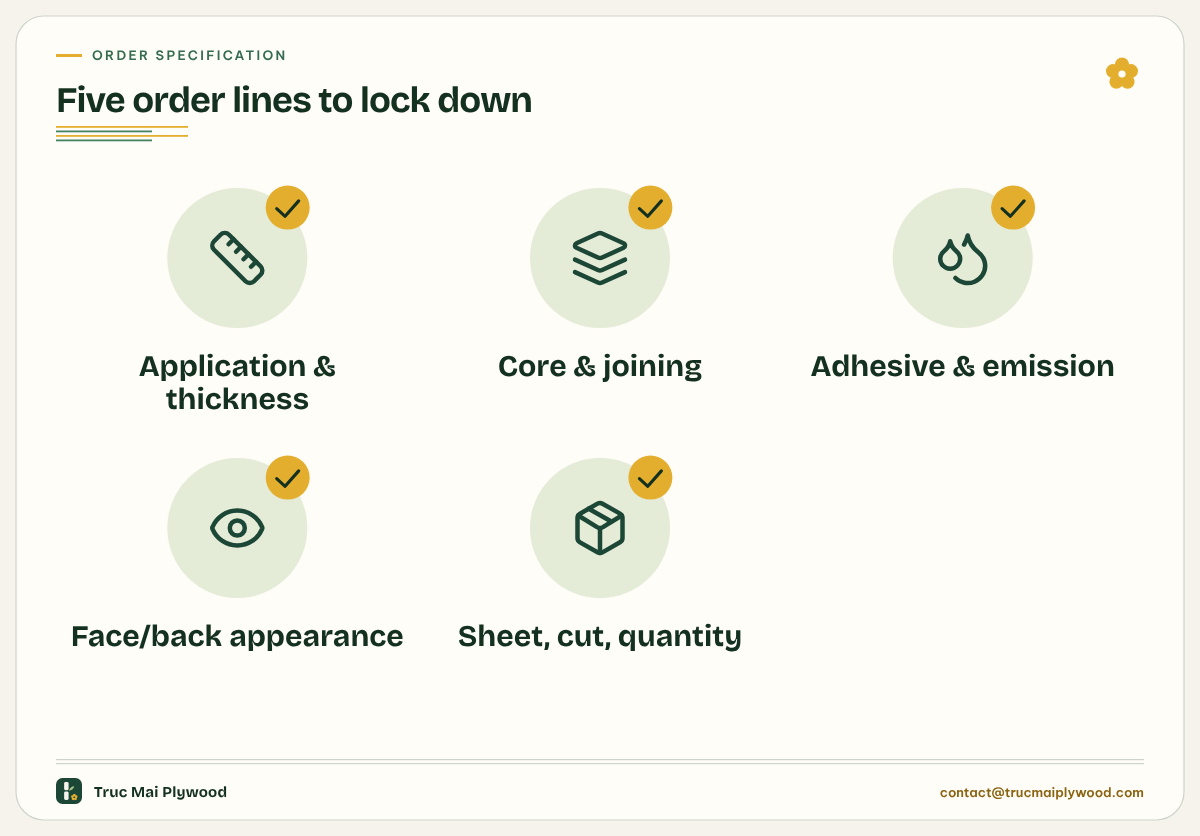
A five-line specification prevents substitution between a light panel for a side wall and a denser panel intended for repeated handling. The lines are: 1. application and thickness; 2. core species and joining; 3. adhesive and emission; 4. face/back appearance; 5. sheet dimensions, cut plan and packing quantity.
A buyer can send a component drawing with fixing centres, unsupported spans and any fork-lift or strapping contact points. The supplier can then quote a reproducible build, while the crate designer verifies strength and handling loads.
Use the plywood RFQ format to put those choices on one purchase order.
Which packing plywood thickness suits crate walls, crate bases and pallet decks?
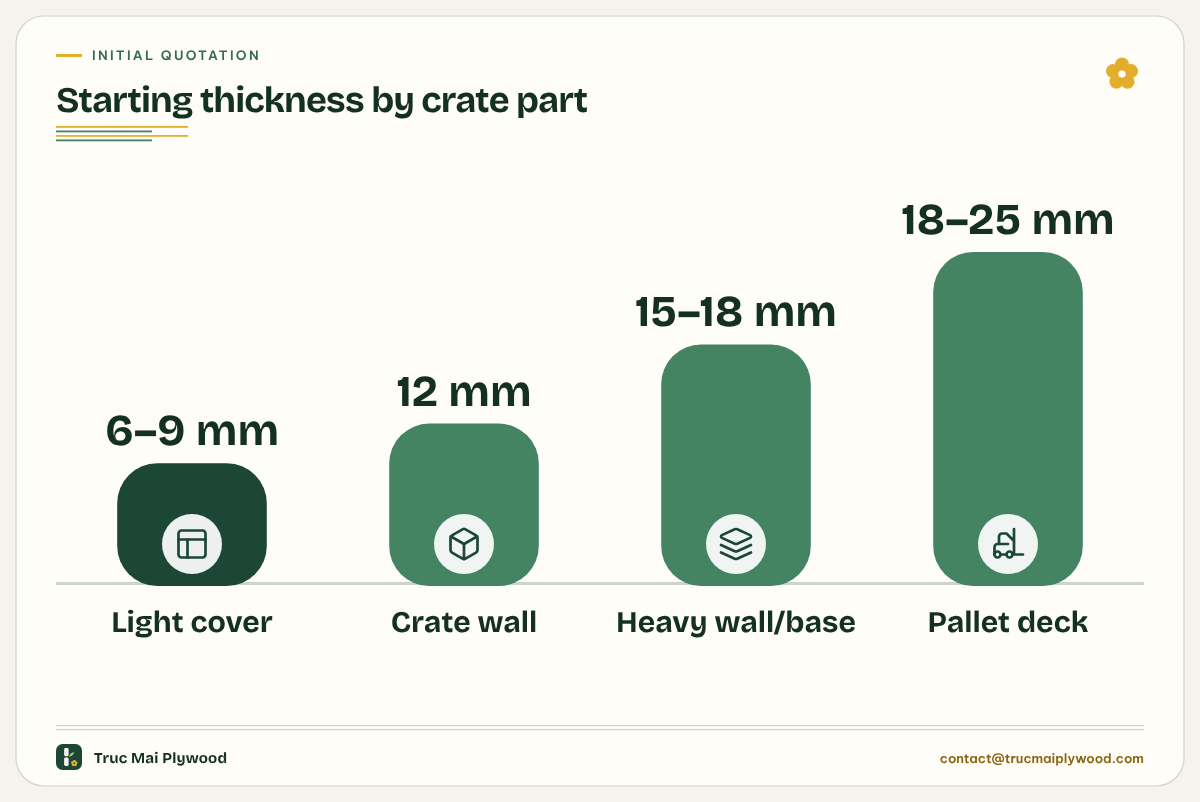
For an initial crate quotation, request 12 mm for ordinary side panels and 18 mm for heavier bases, then check the design against cargo weight, support spacing and handling loads. These are specification starting points, not universal structural ratings. A light cover can use a thinner panel; a pallet deck may need a different supporting frame or engineered design.
| Crate component | Starting thickness to quote | What controls the final choice |
|---|---|---|
| Light lid or protective cover | 6–9 mm | Fixing pattern, handling and panel span |
| General crate wall | 12 mm | Frame spacing, impact and screw retention |
| Heavier wall or base skin | 15–18 mm | Cargo restraint and local bearing |
| Pallet deck panel | 18–25 mm | Runner spacing, fork entry and point loads |
Do not select a pallet deck by thickness alone. Check where the cargo bears, how loads pass to runners and how a loaded pallet is lifted. Screws close to edges and cut-outs around straps also affect performance. For large or valuable loads, use a design calculation or tested crate assembly.
The mill’s nominal range is 3–40 mm, so the buyer can keep one supplier while varying components. A cut list can reduce waste where a crate uses repeated wall panels. 18 mm loading and specification gives a separate shipping reference for that common nominal thickness.
Acacia or styrax core for packing plywood: which lasts longer in export crates?
Acacia has a planning density of 580 kg/m³ versus 500 kg/m³ for Styrax. Choose Acacia where the crate design benefits from the heavier sheet, and Styrax where reducing tare weight and increasing container volume matter. Neither species name alone proves a longer service life in an export crate.
The decisive durability questions are the adhesive bond, moisture exposure, edge protection, fastening design and the number of handling cycles. A dense panel with poorly protected edges can deteriorate sooner than a lighter panel kept dry. Ask for the actual bond specification and a representative sample rather than a species-based lifespan estimate.
| Core | Planning density | Typical purchasing trade-off |
|---|---|---|
| Styrax | 500 kg/m³ | Lower sheet weight and higher modelled volume per container |
| Acacia | 580 kg/m³ | Denser construction with a higher weight per sheet |
| Eucalyptus | 650 kg/m³ | Heavier sheet; container planning reaches payload earlier |
For repeat crates, record whether panels are handled in rain, stored under cover or dismantled after arrival. Compare the same thickness and fixing layout when testing two samples.
How should packing plywood sheets for shipping be specified?
Five details specify packing plywood sheets for shipping: nominal dimensions, sheets per pack, core, thickness and pack identification. The standard sheet is 1220 × 2440 mm; 1250 × 2500 mm and 1220 × 2280 mm are also offered. State whether the order needs full sheets or labelled pieces for a crate assembly line.
Truc Mai can cut a standard sheet lengthwise into two 610 × 2440 mm pieces, or into three, four or six pieces according to the agreed cutting plan. A three-piece format can be 1200 × 800 mm, while a quarter-sheet example is 1220 × 610 mm. Include saw-kerf allowance and the required finished size on the drawing rather than treating nominal divisions as a machining instruction.
Mill-cut panels are useful when the receiving workshop wants to assemble crates without recutting sheets. Put the component code on the label, separate unlike sizes in the packing list and inspect edge damage before loading. For export cases, the export case panels page addresses the finished component application.
Pack height, banding and separation sheets affect handling even when the plywood itself is unchanged.
What grade of plywood is used for export packaging and crates from Vietnam?
Yes, Vietnamese export packing plywood can be ordered to a supplier-defined utility or packing grade, with face and back agreed by sample. Terms such as AB, BB/CC or other trade labels do not have one universal meaning across mills.
The ISO 2426-2:2020 hardwood appearance standard uses appearance classes E, I, II, III and IV. A supplier’s AB packing description is therefore a commercial specification, not an automatic ISO grade conversion. For a practical receiving check, compare the shipment with the approved sample and written defect allowances.
A packing order can use an unsanded or lightly sanded face. Specify sanding only where the surface will be printed, bonded to a lining or handled frequently. Inspect exposed edges as well as faces: a neat face can conceal a core gap that affects a fastener or cut edge.
Use a photographed sample board and a marked edge offcut as the reference. Ask the mill to identify face and back on the purchase order, because crate makers often place the more presentable face outside and the working face inside.
What adhesive and moisture exposure should be written on the order?
Write the adhesive chemistry and intended exposure as separate requirements. For dry, protected export packaging, UF is an established interior-panel adhesive; for repeated damp exposure, specify the required bond performance and supporting test evidence. A glue name by itself is not a measured bond class.
The USDA Forest Products Laboratory Wood Handbook describes UF as having limited resistance to prolonged wetting and higher temperatures, while melamine-containing and phenolic systems offer different moisture performance. The purchaser should describe the actual exposure, including open loading yards, container condensation and storage after delivery.
Truc Mai’s usual specification is UF glue at E0 emission; adhesive type and emission are separate order lines. E0 is not a harmonised EN 13986 emission class. If an importer requires a particular chamber result, the order needs its method and limit rather than an unqualified E0 label.
Keep crate ventilation, drainage and edge protection in the packaging design. Moisture can enter through exposed cut edges, nail holes and unprotected joints regardless of the appearance of the face veneer.
How do bond classifications differ from appearance grades?
Bond classification describes resistance of the glue line under specified conditions; appearance grade describes visible defects on the face. The two must be ordered independently. A clean face is not evidence of wet-service bonding, and a strong bond does not imply a decorative surface.
EN 636 distinguishes dry, humid and exterior service conditions. EN 314-2 bond classes also distinguish these conditions through defined tests. If a buyer needs a named class, request a report for the panel construction being supplied, including the adhesive and veneer combination.
The US NIST PS 1-22 structural plywood standard uses Exposure 1 and Exterior bond classifications for structural plywood. Those classifications should not be copied onto a commercial packing sheet without the relevant product evidence. For a shipping crate, write the required exposure in ordinary terms first and select an appropriate tested construction.
How should a buyer inspect a packing plywood sample?
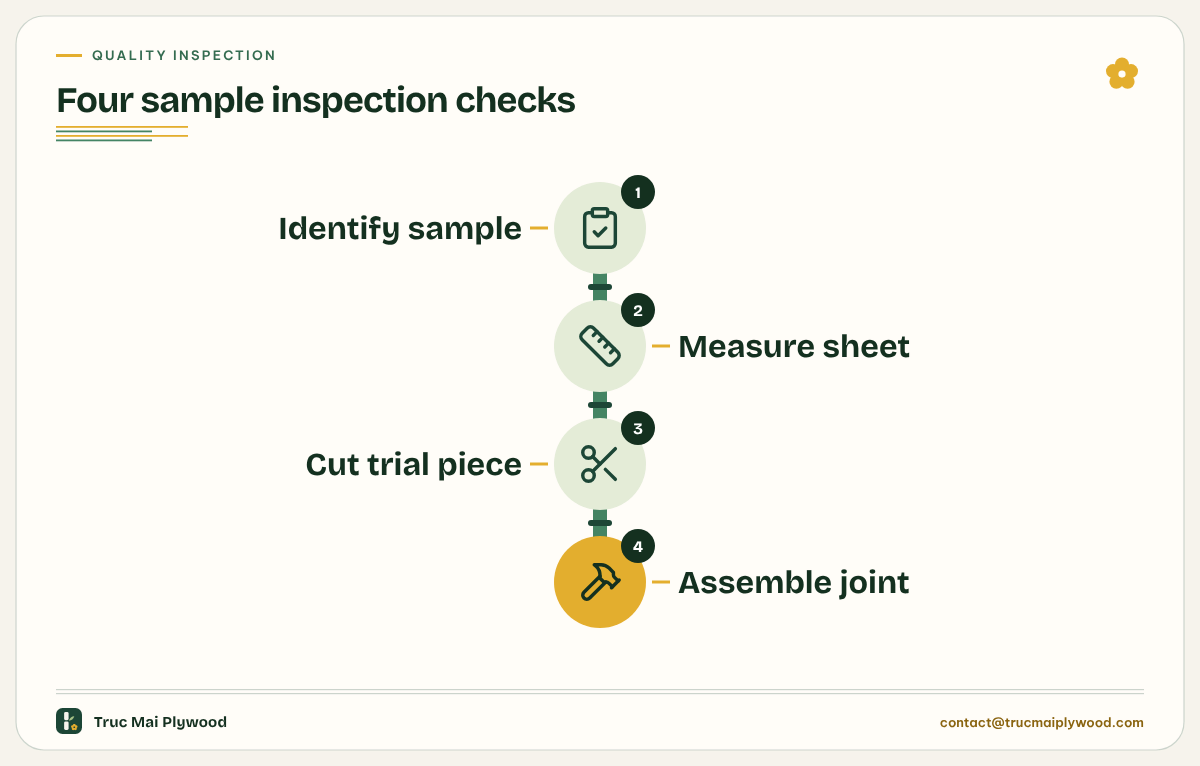
Inspect a full sheet and an exposed edge, not only a small face coupon. A useful approval set includes the face, back, cut edge, nominal thickness, measured thickness and an example of the intended fastener or joint.
- Identify the sample with its core, adhesive, face/back grades and thickness.
- Measure several positions across the sheet and record the tolerance agreed for that order.
- Cut a trial piece to expose veneer joins and voids near the planned fixing line.
- Assemble a short crate joint and check splitting, screw holding and surface damage.
- Sign and retain the approved sample beside the purchase-order revision.
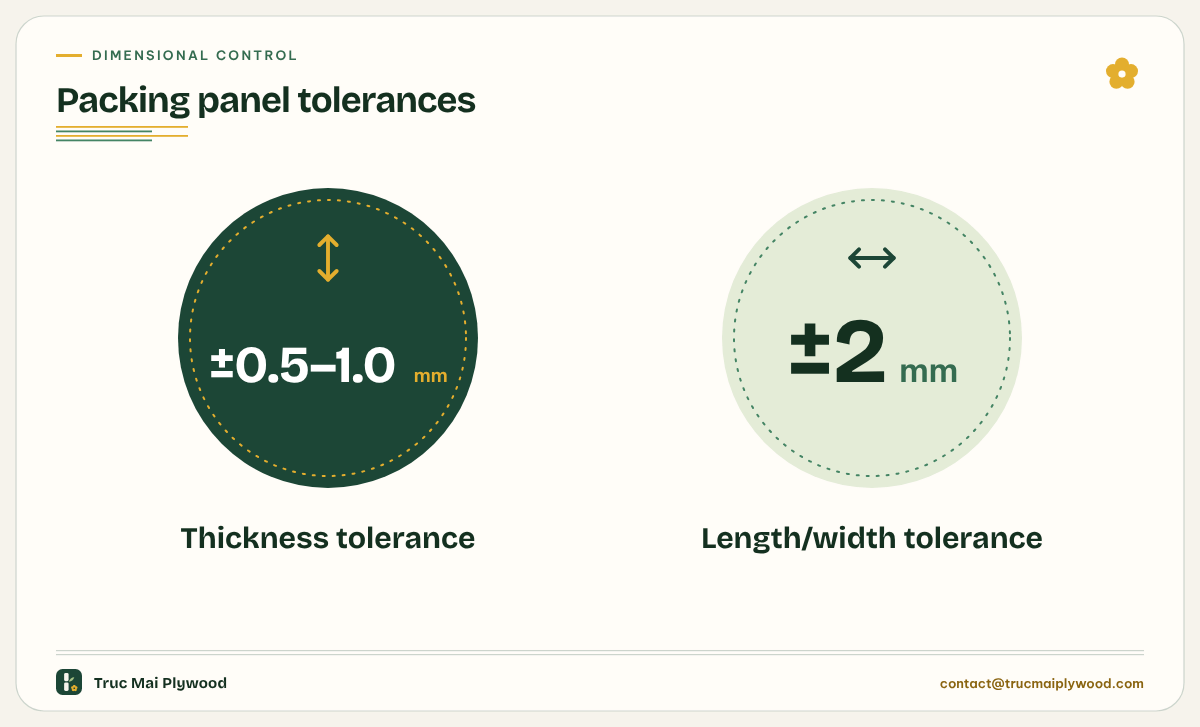
For Truc Mai packing panels, the order can use a ±0.5–1.0 mm thickness tolerance, while length and width are specified at ±2 mm. Agree the grade and any calibration requirements before the sample is signed. Ordering plywood samples explains the sample route.
How many packing plywood sheets fit in a 40HC?
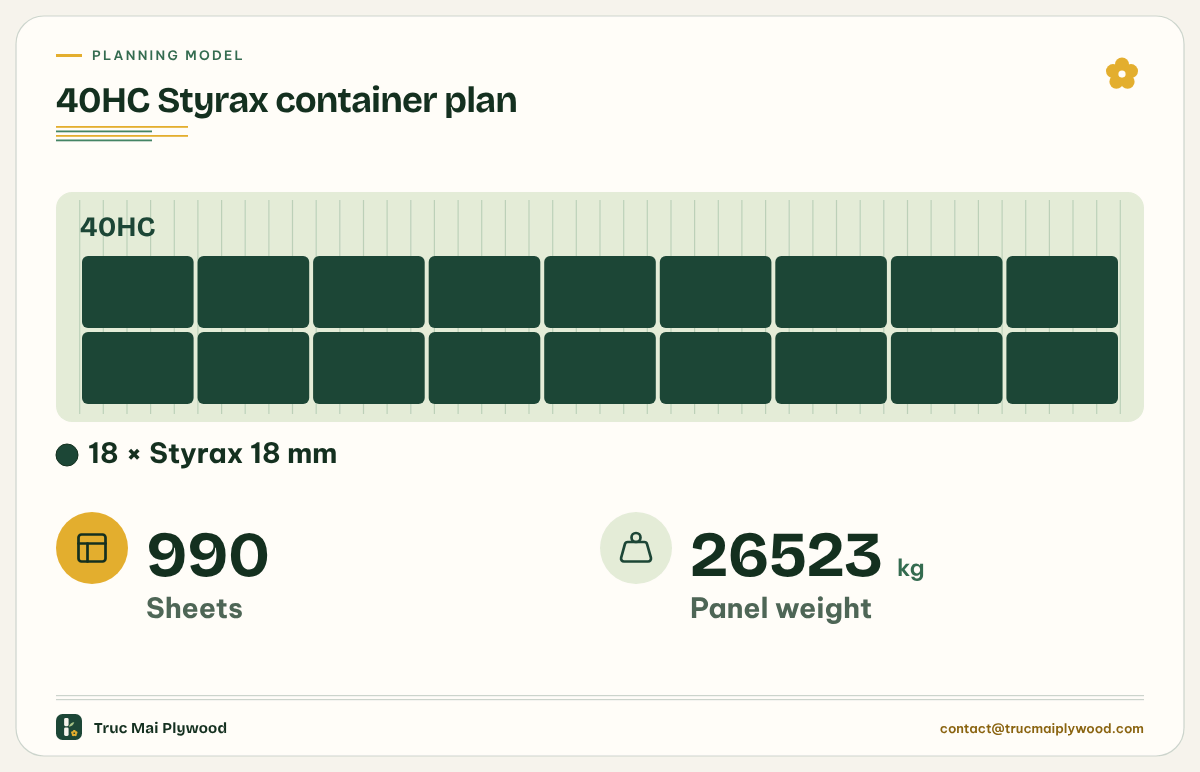
A 40HC planning load changes with the core and thickness. The following figures are the supplied calculation outputs for 1220 × 2440 mm sheets; the model uses a 28,000 kg cargo planning payload, reference densities and packs around 1,000 mm high. They describe panels only, before the final allowance for packaging and the actual carrier booking.
| Core | Thickness | Packs | Sheets/pack | Sheets | Volume | kg/sheet | Total panel kg | Weight capped |
|---|---|---|---|---|---|---|---|---|
| Styrax | 12 mm | 18 | 83 | 1,494 | 53.4 m³ | 17.9 kg | 26,684 kg | No |
| Acacia | 12 mm | 16 | 83 | 1,328 | 47.4 m³ | 20.7 kg | 27,514 kg | No |
| Eucalyptus | 12 mm | 15 | 80 | 1,200 | 42.9 m³ | 23.2 kg | 27,863 kg | Yes |
| Styrax | 18 mm | 18 | 55 | 990 | 53.0 m³ | 26.8 kg | 26,523 kg | No |
| Acacia | 18 mm | 16 | 55 | 880 | 47.2 m³ | 31.1 kg | 27,348 kg | No |
| Eucalyptus | 18 mm | 15 | 53 | 795 | 42.6 m³ | 34.8 kg | 27,689 kg | Yes |
Use the container volume by thickness reference when comparing configurations. The forwarder and carrier determine the final allowable gross weight; actual sheets and packing materials are weighed for the shipping plan.
Does plywood packaging require an ISPM 15 mark?
Packaging made entirely from processed plywood is exempt from ISPM 15 treatment and marking. The International Plant Protection Convention’s ISPM 15 standard distinguishes processed plywood from raw-wood packaging material.
A mixed crate can contain plywood walls and solid-wood runners, braces or pallets. Identify those components separately in the packing specification so the solid-wood elements receive the appropriate treatment and mark. The rule concerns pest risk in wood packaging; it does not specify plywood strength, moisture resistance or crate engineering.
Ask the crate assembler for a component list showing which pieces are plywood and which are solid wood. The shipping file should match the physical package, including any loose dunnage placed in the container.
Which documents accompany an export packing plywood order?
An export order normally uses a commercial invoice, packing list and bill of lading, plus the destination’s agreed origin and phytosanitary documents. The buyer should identify required certificates before the production order is confirmed, rather than request them after the container is sealed.
For eligible FSC 100% goods, the seller’s sales documentation records the FSC claim and chain-of-custody certificate code, following FSC-STD-40-004. Truc Mai’s FSC licence is FSC-C196493 and certificate code is SA-COC-014545. Record the actual claim on the relevant order lines.
For EU-bound plywood within the regulation’s scope, origin and plot-geolocation information support the importer’s due diligence. The European Commission’s EUDR overview explains the due-diligence statement and deforestation-free sourcing requirements. The mill provides origin records and geolocation files for core and face veneer.
Review the documents per container checklist with the importer and freight agent.
How can two suppliers be compared without a misleading grade label?
Compare suppliers using one identical purchase specification and two physical samples, then record deviations rather than comparing the product names alone. A quotation that says only “packing plywood, 18 mm” omits the construction that determines weight, finish and repeatability.
Use a comparison sheet with five columns matching the order lines. Put core species and joining method next to thickness; keep glue and emission as separate entries; record both face and back grades; and include the pack plan. Ask each mill for a sample with the same intended application and sheet dimensions.
Check the manufacturing identity, current certificate scope and sample consistency before a deposit. The mill verification checklist is a useful companion. A lower nominal thickness tolerance or a nicer face may be irrelevant to a one-way shipping case, while an unrecorded core change can affect both handling and container weight.
What should be sent to request a repeatable packing plywood quotation?
Send a five-line purchase specification, a crate component drawing and the destination port. The enquiry should identify the intended application, core and joining, glue and emission, face/back grade, nominal thickness and sheet or cut-piece size, pack labels and quantity.
A practical order line reads: “Crate wall panel; Styrax core, AB loose-laid; UF adhesive, emission requirement per approved specification; utility face/back against signed sample; 1220 × 2440 × 12 mm; labelled packs and stated sheet count.” The buyer can substitute a different core or bond requirement without changing the structure of the enquiry.
Attach photographs of the assembly, fastening points and receiving storage. Include the number of full sheets and cut pieces, and specify whether packs are to be segregated by component. This gives production and inspection teams a shared reference for the next container.
For related use cases, read plywood in export packing. Send the completed specification with the crate drawing, pack count and destination port to request a production quotation.
Send your specification to contact@trucmaiplywood.com or through the quotation form.
Questions buyers ask
Can packing plywood be left unfinished?
Yes. Unfinished faces are common for enclosed crates and temporary protective panels; specify the surface preparation and any required marking.
Do both faces need the same appearance grade?
No. Specify the face and back separately, using an approved reference sample for each.
Can packing plywood be supplied cut to size?
Yes. The mill can label cut pieces against an agreed cutting list and pack them by destination assembly.
Is packing plywood exempt from ISPM 15?
Packaging made wholly from processed plywood is exempt under ISPM 15. Solid-wood pallets, battens and dunnage used with it remain within the standard.
Should I order by sheet count or cubic metres?
State both the sheet count and the nominal dimensions. Cubic metres help compare shipment volume, while the sheet count controls production and assembly.
Can different thicknesses share a container?
Yes, a mixed load can be agreed with the pack breakdown written for each thickness and core.
What inspection evidence should I request?
Request a signed specification, approved samples, panel measurements and photographs of the marked packs before shipment.
Does E0 describe the glue chemistry?
No. Glue chemistry and formaldehyde emission are separate specification lines; write the adhesive type and the agreed emission requirement.
Can a packing plywood order use FSC 100% material?
Eligible products may be ordered with FSC 100% claims. The relevant claim and certificate code must appear on the sales documents.
Which shipping terms are offered?
FOB Hai Phong, CFR and CIF are available, with the destination port and shipping documents agreed in the order.
What should be printed on each pack label?
Use the purchase-order reference, core, thickness, sheet or cut-piece dimensions, grade, quantity and pack number.
Can a sample approval control repeat orders?
Yes. Keep the approved face and edge samples with the written construction specification so later deliveries can be compared against the same reference.