
A plywood box uses layered wood panels for its sides, lid and sometimes its base. Export-case makers choose panel thickness, core, face and cut dimensions to suit the load and the joining system. For collapsible cases, consistent cut parts and compatible metal profiles matter as much as the plywood itself.
What is a plywood box used for in export packing?
A plywood box is a shipping enclosure built with plywood walls and a base-and-lid arrangement suited to the packed goods. Manufacturers use plywood packing boxes for machine components, electrical equipment, spare parts and mixed industrial consignments. A box differs from a pallet because it encloses the load; it differs from a framed crate because the panel and frame carry different shares of the handling forces.
The buyer’s first choice is whether to procure a complete assembled box or to procure panel components for a local case maker. Those are different purchases. A panel manufacturer supplies sheet material and cut parts; a case assembler selects joints, runners, hinges, fasteners and any special fittings. Keeping that division clear makes a quotation comparable and avoids paying for assembly services that the buyer already performs.
For a sheet-based purchasing route, begin with packing plywood panels and a dimensioned case drawing. The drawing should identify which parts become walls, which become the lid and which sit under the load. Include any internal supports as separate line items. A panel suitable for a side wall should not automatically be treated as a load-bearing base.
What is a nailless plywood box?
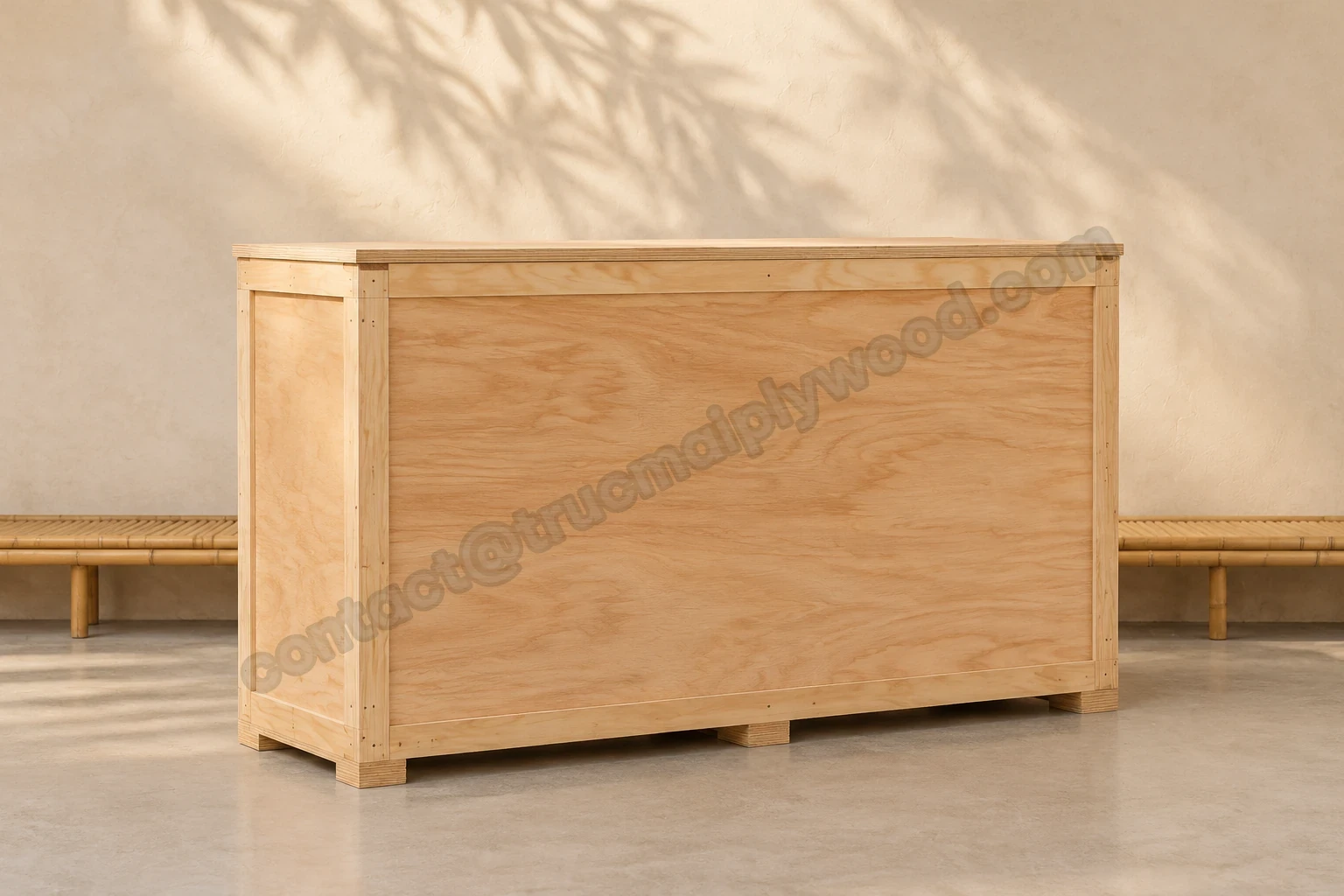
A nailless plywood box is a case assembled without driving nails through its plywood walls, commonly using interlocking metal profiles, tabs or other purpose-designed connectors. The sides can fold or separate for flat delivery, while a lid and base complete the enclosure. The exact locking arrangement belongs to the selected case system.
A collapsible plywood box helps where the empty packaging occupies warehouse space before packing. Flat components can be staged beside a production line, identified by part number and assembled when the shipment is ready. The operational advantage comes from a repeatable kit: a base, correctly oriented sides, a lid and the matching hardware. Missing one profile can stop an otherwise complete pack.
Ask the case supplier to demonstrate assembly and opening on a sample. Inspect the corners, lid restraint and handling clearance rather than judging the design from a photograph. If the load needs a forklift, its base and entry direction must be designed with that handling method in mind. A nailless joint is an assembly feature, not a measured stacking or impact rating.
Which plywood box construction should a buyer choose?
Choose a fixed case for a simple one-way packing operation, a knock-down case for separate panels and local assembly, or a foldable nailless case where repeated set-up and compact storage matter. These are packaging formats, not plywood grades. The panel specification can be similar while the connection hardware changes completely.
| Construction | What the buyer receives | Drawing priority | Typical procurement question |
|---|---|---|---|
| Fixed box | Assembled sides and base | External envelope and handling points | Who assembles and closes the lid? |
| Knock-down case | Separate flat parts | Part IDs, holes and joint allowances | Who fits the corners and runners? |
| Foldable nailless case | Hinged or interlocking kit | Profile compatibility and fold sequence | Is the locking hardware included? |
| Panel-only order | Full sheets or cut plywood | Cut list, face orientation and packs | Who supplies the complete case? |
Compare the drawing revision, delivered components and handling arrangement before comparing offers. A kit with an integrated base is not interchangeable with loose walls supplied without runners. A buyer who already has approved hardware should give its profile dimensions to the panel cutter, since the finished edge must fit the connector.
What panel thickness works for box sides, lids and bases?
Start with the approved case design, then select from the mill’s 3–40 mm plywood range. Thin panels are useful for compact enclosures and partitions; mid-thickness panels suit many case walls; thicker parts may be chosen for reinforced designs. Select the final thickness against the cargo weight, case geometry and handling loads.
A useful purchasing schedule distinguishes the four functions rather than writing one thickness for the entire box. Side walls resist local knocks and keep contents enclosed. The lid spans an opening and takes closing loads. The base interfaces with runners, pallet blocks or other handling supports. Internal partitions separate goods and need their own fastening detail. A change to the base design can matter more than adding material to the side walls.
Truc Mai Plywood makes packing and commercial plywood, with Styrax, Acacia, Eucalyptus and Pine core options. State the intended use first and request a consistent construction. A case maker that uses metal edge profiles should also state the permitted panel-thickness range for the profile. Review the packing plywood specification alongside the case drawing, rather than treating nominal thickness as a complete mechanical specification.
How should plywood cores and faces be specified for cases?
Specify the core species, joining method and face finish separately. A face that looks uniform can conceal differences in internal gaps, veneer joints and panel weight. The core determines much of the panel’s mass and influences machining; the face determines what the packer sees and whether labels, printing or protective lining will sit neatly.
For packing panels, an AB loose-laid core is a standard production route. Furniture-grade construction uses a more carefully prepared core and sanded faces, which may be appropriate for presentation packaging or cases with exposed decorative surfaces. These are different cost and appearance decisions. Do not order a furniture face merely because the finished case will be exported.
A core schedule should identify whether the case maker needs a smooth saw edge, tight screw fixing or a clean visible surface. For a box that is later covered by a liner, an attractive veneer face may add little. Where identification marks are printed directly onto a panel, request a sample print on the chosen face. For cases that open repeatedly, inspect the joint area after a trial opening rather than relying on a face-grade name.
The panels inside an export crate page covers how different panel positions change the specification. Keep the face and back grade written as an agreed pair, supported by an approved sample.
How do cut-to-size plywood panels become a box kit?
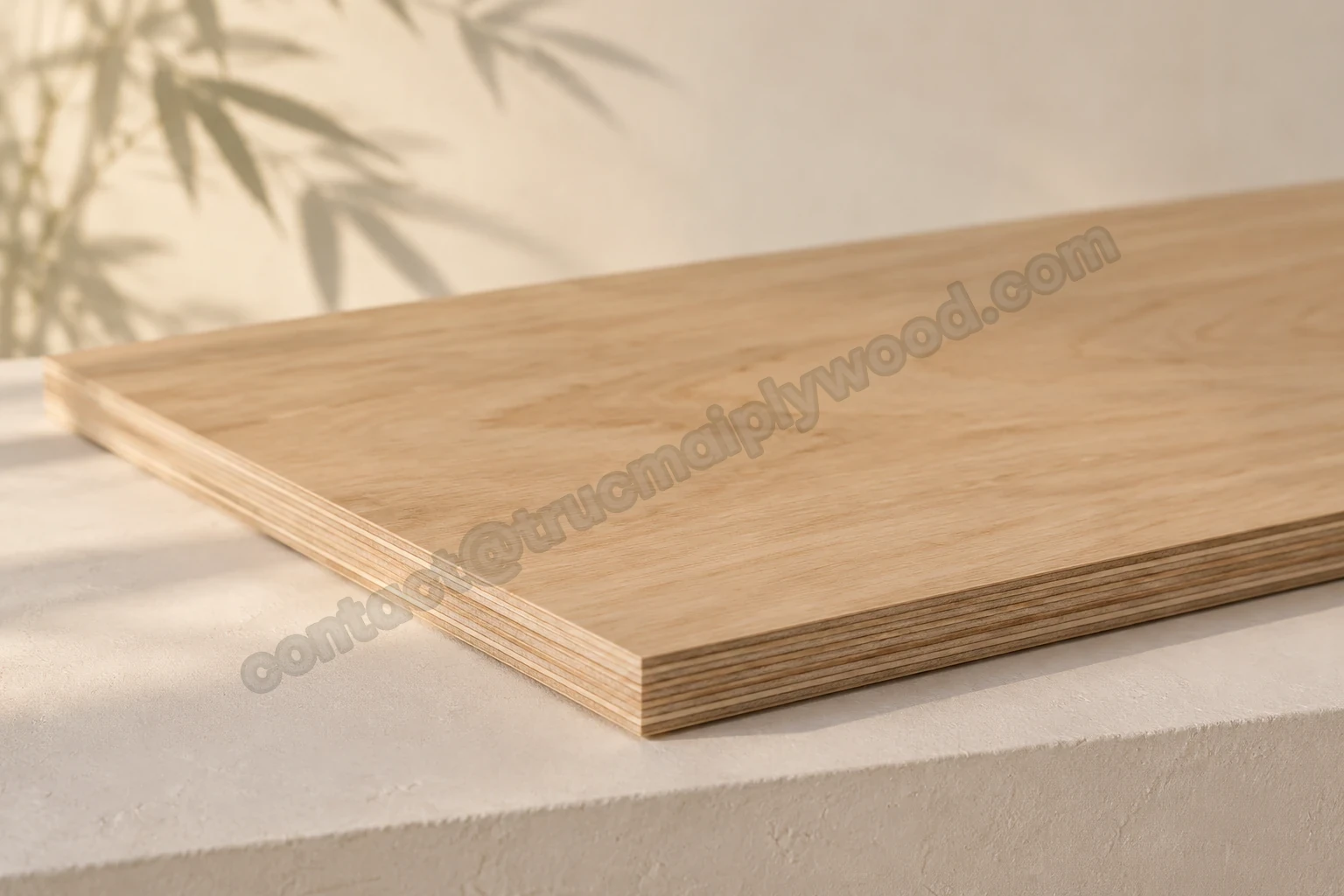
A box kit begins with a part list, not a rough request for small sheets. The mill can split a standard sheet into two, three, four or six labelled pieces. For a simple two-way cut, a nominal 610 × 2440 mm half-sheet comes from 1220 × 2440 mm stock. Saw kerf reduces the actual finished dimension, so the purchase order should state finished size rather than merely the nominal fraction.
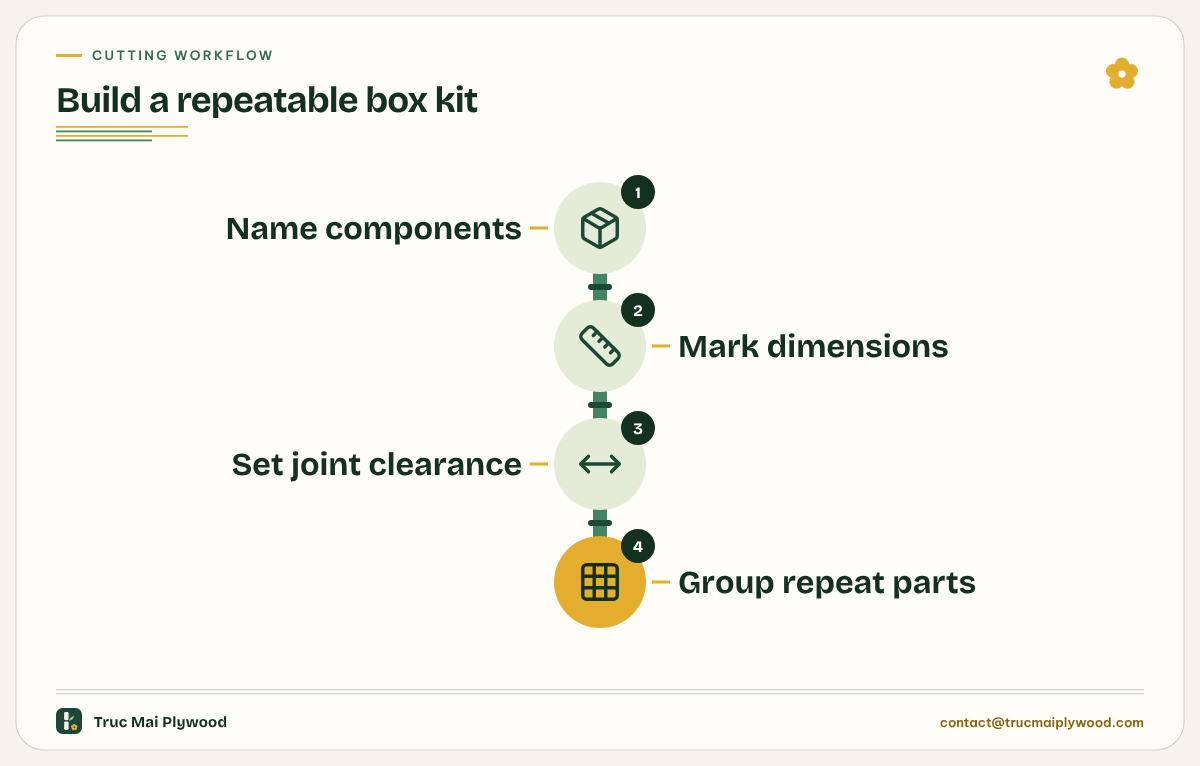
- Number the case components: base, lid, long side, short side and any partition.
- Mark each part’s finished width, length and thickness, including the grain or face orientation where important.
- Identify the joint clearance and whether a steel profile covers the sawn edge.
- Group identical parts into repeatable cutting patterns, then check the yield against the parent sheet.
- Approve a labelled sample kit before issuing the production cutting schedule.
The figures below reproduce the supplied cutting model unchanged. They use a 4 mm kerf per cut; the nominal dimension is the ideal division before kerf. The actual cut geometry is a planning input for the approved cut list, not an instruction to substitute an approximate dimension for the finished part.
| Pattern ID | Parent (mm) | Pieces | Saw cuts | Kerf (mm) | Actual piece W × L (mm) | Nominal W × L (mm) |
|---|---|---|---|---|---|---|
| cut2-1220x2440 | 1220x2440 | 2 | 1 | 4 | 608.0 × 2440.0 | 610.0 × 2440.0 |
| cut3-1220x2440 | 1220x2440 | 3 | 2 | 4 | 1220.0 × 810.7 | 1220.0 × 813.3 |
| cut4-1220x2440 | 1220x2440 | 4 | 3 | 4 | 1220.0 × 607.0 | 1220.0 × 610.0 |
| cut6-1220x2440 | 1220x2440 | 6 | 3 | 4 | 608.0 × 810.7 | 610.0 × 813.3 |
Cut layouts should be checked against the case assembler’s drawing before production. A sheet split into three strips is different from a sheet split into three shorter sections; the cutter needs the intended orientation. See mill-cut plywood panels for the supply option and send the component labels with the drawing.
How many case panels fit in a 40HC container?
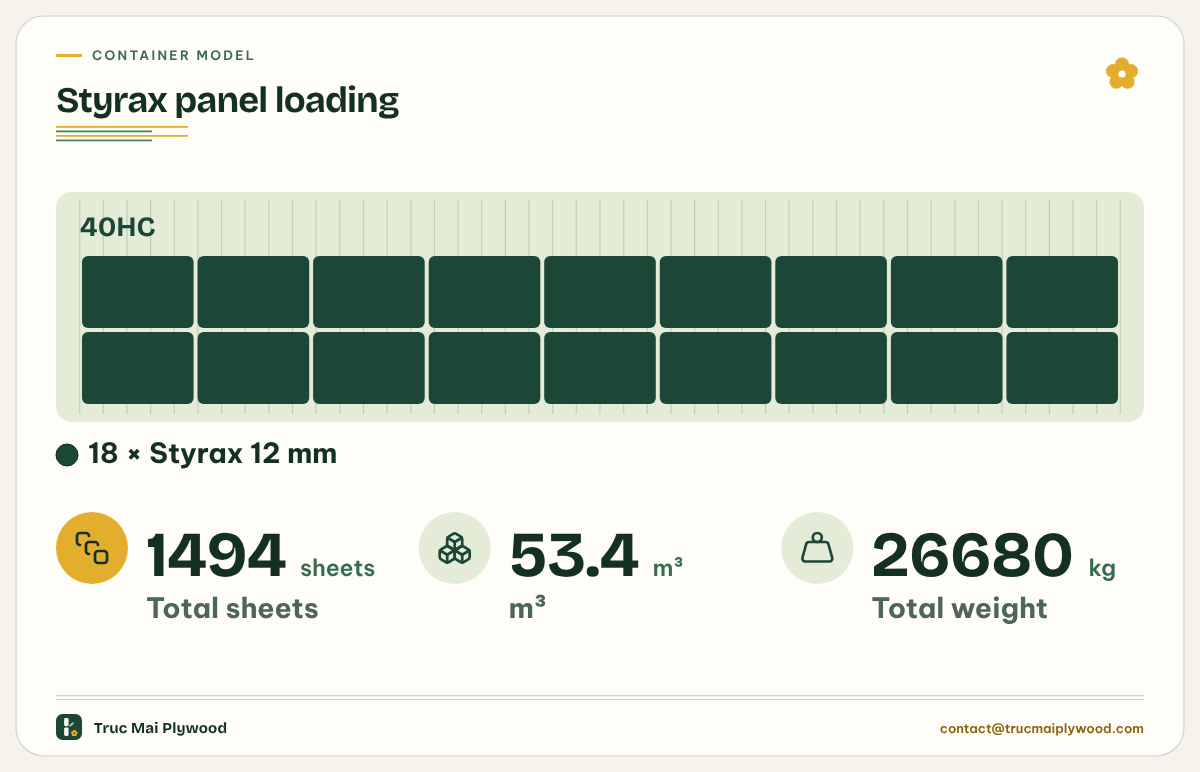
The supplied 40HC planning model counts full 1220 × 2440 mm sheets at four selected thicknesses and three cores. It models panel cargo only, with pack counts and a 28,000 kg planning payload; the carrier and route determine the booked payload. Core density affects the sheet count because denser panels reach the weight limit sooner.
The next table retains every full-sheet row of the calculation, including the original total-weight figures. Packs and sheets per pack are shown so a buyer can reconcile the number of bundles on a pro-forma packing plan. Weight-capped rows are explicitly marked. Packaging mass, real sheet weights and the carrier’s booking are checked before loading.
| Model ID | Core | Thickness (mm) | Size (mm) | Packs | Sheets/pack | Sheets | m³ | kg/sheet | Total kg | Weight-capped |
|---|---|---|---|---|---|---|---|---|---|---|
| styrax-12-1220x2440 | Styrax | 12 | 1220x2440 | 18 | 83 | 1494 | 53.4 | 17.9 | 26680 | No |
| acacia-12-1220x2440 | Acacia | 12 | 1220x2440 | 16 | 83 | 1328 | 47.4 | 20.7 | 27510 | No |
| eucalyptus-12-1220x2440 | Eucalyptus | 12 | 1220x2440 | 15 | 80 | 1200 | 42.9 | 23.2 | 27860 | Yes |
| styrax-15-1220x2440 | Styrax | 15 | 1220x2440 | 18 | 66 | 1188 | 53.0 | 22.3 | 26520 | No |
| acacia-15-1220x2440 | Acacia | 15 | 1220x2440 | 16 | 66 | 1056 | 47.2 | 25.9 | 27350 | No |
| eucalyptus-15-1220x2440 | Eucalyptus | 15 | 1220x2440 | 15 | 64 | 960 | 42.9 | 29.0 | 27860 | Yes |
| styrax-18-1220x2440 | Styrax | 18 | 1220x2440 | 18 | 55 | 990 | 53.0 | 26.8 | 26520 | No |
| acacia-18-1220x2440 | Acacia | 18 | 1220x2440 | 16 | 55 | 880 | 47.2 | 31.1 | 27350 | No |
| eucalyptus-18-1220x2440 | Eucalyptus | 18 | 1220x2440 | 15 | 53 | 795 | 42.6 | 34.8 | 27690 | Yes |
| styrax-21-1220x2440 | Styrax | 21 | 1220x2440 | 18 | 47 | 846 | 52.9 | 31.3 | 26440 | No |
| acacia-21-1220x2440 | Acacia | 21 | 1220x2440 | 16 | 47 | 752 | 47.0 | 36.3 | 27270 | No |
| eucalyptus-21-1220x2440 | Eucalyptus | 21 | 1220x2440 | 15 | 45 | 675 | 42.2 | 40.6 | 27430 | Yes |
For a case producer, sheet count is only the first calculation. It tells purchasing how many parent sheets could arrive; it does not tell assembly how many completed boxes will be available. That second count depends on the part layout, scrap allowance, lids and bases, and the number of each component needed per finished kit. The 40HC loading by thickness resource explains the core-weight effect in more detail.
How many cut components can the same 40HC supply?
The supplied model converts each 12 mm full-sheet count into two-, three-, four- and six-piece patterns. It assumes the pieces from each parent sheet are retained and multiplies the full-sheet count by the number of parts. The values are a planning schedule for cut components, not an assembled-case count.
| Model ID | Core | Thickness (mm) | Parent (mm) | Pieces/sheet | Full sheets | Cut pieces |
|---|---|---|---|---|---|---|
| cut2-40hc-styrax-12 | Styrax | 12 | 1220x2440 | 2 | 1494 | 2988 |
| cut3-40hc-styrax-12 | Styrax | 12 | 1220x2440 | 3 | 1494 | 4482 |
| cut4-40hc-styrax-12 | Styrax | 12 | 1220x2440 | 4 | 1494 | 5976 |
| cut6-40hc-styrax-12 | Styrax | 12 | 1220x2440 | 6 | 1494 | 8964 |
| cut2-40hc-acacia-12 | Acacia | 12 | 1220x2440 | 2 | 1328 | 2656 |
| cut3-40hc-acacia-12 | Acacia | 12 | 1220x2440 | 3 | 1328 | 3984 |
| cut4-40hc-acacia-12 | Acacia | 12 | 1220x2440 | 4 | 1328 | 5312 |
| cut6-40hc-acacia-12 | Acacia | 12 | 1220x2440 | 6 | 1328 | 7968 |
| cut2-40hc-eucalyptus-12 | Eucalyptus | 12 | 1220x2440 | 2 | 1200 | 2400 |
| cut3-40hc-eucalyptus-12 | Eucalyptus | 12 | 1220x2440 | 3 | 1200 | 3600 |
| cut4-40hc-eucalyptus-12 | Eucalyptus | 12 | 1220x2440 | 4 | 1200 | 4800 |
| cut6-40hc-eucalyptus-12 | Eucalyptus | 12 | 1220x2440 | 6 | 1200 | 7200 |
A buyer should translate the parts into complete kits using the bill of materials. If a case uses different sizes for its two ends, walls and lid, the cutting plan must account for each size independently. A single repeated split pattern may be convenient for production yet produce too many of one part and too few of another. Ask for the final pack list by part ID, with each bundle labelled for the assembly line.
Does plywood box packaging need ISPM 15 treatment?
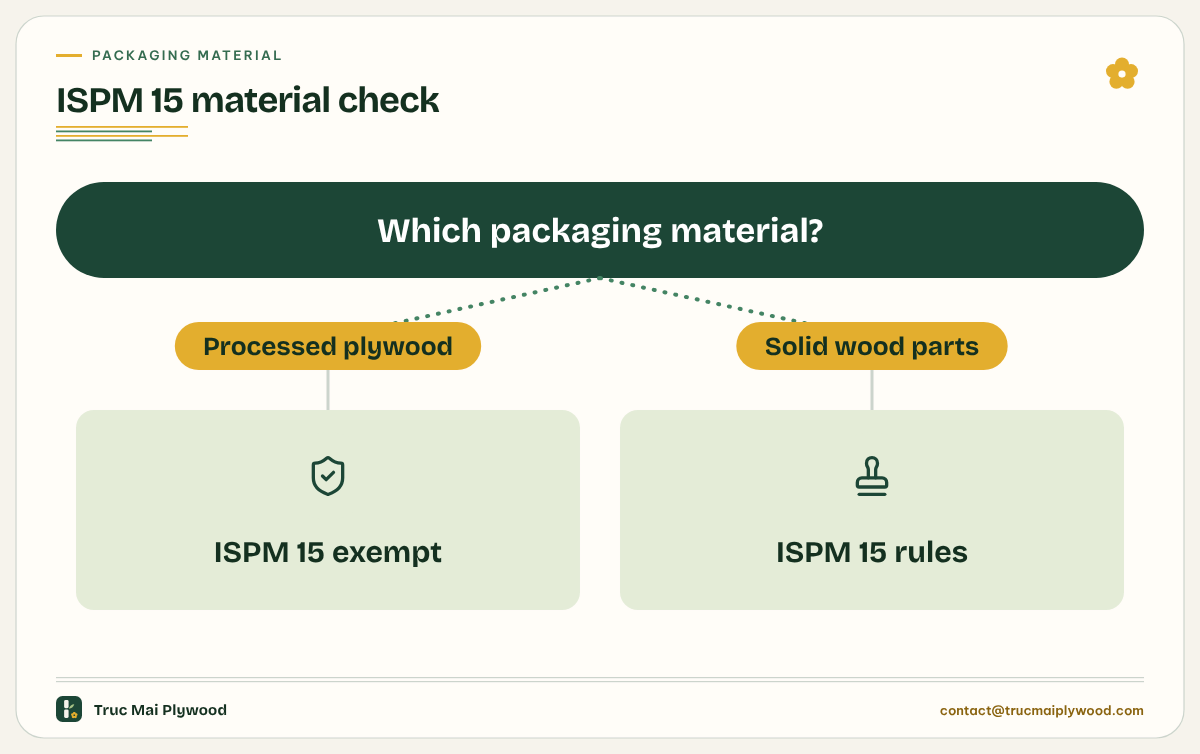
Plywood packaging made wholly from processed plywood is exempt from ISPM 15 treatment under section 2.1 of the International Plant Protection Convention’s ISPM 15 standard. The standard distinguishes processed wood from solid-wood packaging that can carry forest pests.
The distinction matters for mixed construction. A case with plywood walls may also have solid-wood runners, blocks or battens. Those solid-wood components are assessed under the applicable ISPM 15 rules. The UK Forestry Commission’s export guidance specifically lists plywood among processed materials outside the treatment requirement and identifies crates, boxes and dunnage among regulated solid-wood packaging.
When buying a complete case, request a materials breakdown that identifies plywood and solid-wood parts. When buying panels alone, describe them as processed plywood rather than asking the mill to apply an ISPM 15 stamp to each sheet. For load-securing components, the separate plywood used as dunnage article helps distinguish the panel from the additional timber in the shipment.
What paperwork matters for EU-bound plywood cases?
EU-bound plywood supply should include the agreed commercial documents and wood-origin information needed for the buyer’s compliance process. For covered wood products, the European Commission’s EUDR guidance explains the due-diligence requirements, including harvest-plot geolocation and a digital statement or simplified declaration. The Commission lists 30 December 2026 for large and medium operators and 30 June 2027 for micro and small enterprises, subject to the applicable transition provisions.
For Truc Mai Plywood, the EUDR information file includes origin records and geolocation files for the Vietnamese core and imported face veneer. Keep those supply-chain records associated with the actual material configuration. A face veneer from one origin and a core from another need separate traceability information. A box maker ordering panels for onward processing should preserve the panel lot identity through cutting and assembly.
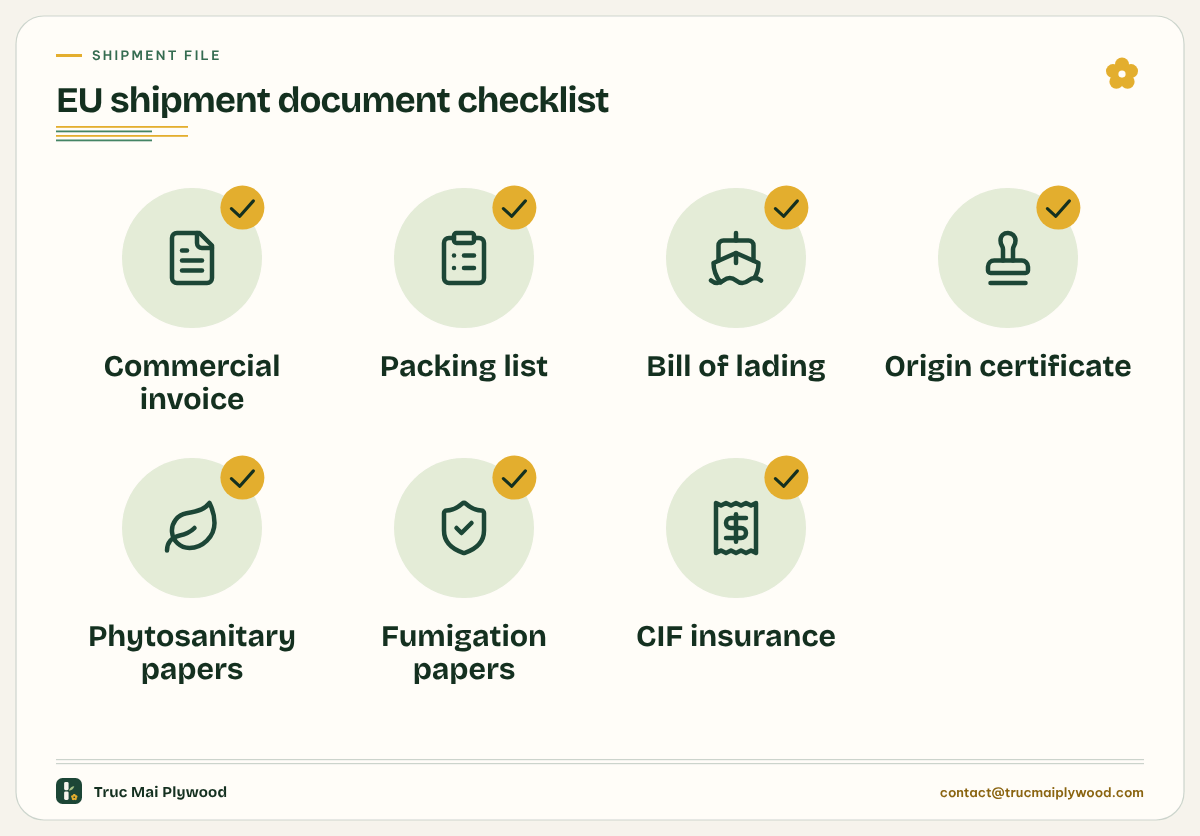
The shipping file normally starts with the invoice, packing list and bill of lading. The agreed origin and inspection papers are added to the order file. Use documents per container as the checklist when preparing the shipping instructions. Do not mix up a customs origin document, a chain-of-custody sales claim and an EUDR due-diligence record: they answer different buyer questions.
How do formaldehyde requirements affect a plywood packing case?
Specify formaldehyde emission separately from adhesive bond performance. A case made from veneer-core hardwood plywood can fall within the scope of US composite-wood rules when supplied as a regulated product. Under 40 CFR §770.10, the hardwood plywood emission limit is 0.05 ppm using the referenced test basis. A glue description alone does not show an emission test result.
Truc Mai Plywood holds CARB Phase 2 and EPA TSCA Title VI certification for hardwood plywood with veneer core in the 3–25 mm range. Buyers should put the actual panel thickness and construction on the order specification. For an enclosed industrial shipping case, discuss the destination’s product classification and documentation with the importer rather than substituting a furniture-panel certificate for the entire assembled package.
An E0 emission description, an adhesive system and a moisture-bond test describe different properties. The purchase order should keep them on separate lines. This also makes it easier to compare a packing-grade quotation with a more closely specified interior-grade panel when the same sheet is used for a display or reusable storage case.
How should a case maker check cutting accuracy and assembly fit?
Check the cut components against a physical sample kit before approving a production batch. A nominal sheet-size tolerance does not automatically control the final joint clearance after cutting. The fit inspection should include the actual edge profile, the orientation of each part and the lid closure.
For calibrated furniture panels, Truc Mai specifies thickness tolerance at ±0.3 mm; commercial panels use ±0.5 mm and packing panels ±0.5–1.0 mm. The order records the appropriate line and the approved cut dimensions. A case assembler using an interlocking steel profile should state the allowable panel thickness in the hardware drawing, then trial-fit the intended panel build.
Inspect a side panel at several positions rather than at a single corner. Check the long edge for bow, the cut edge for splintering and the face for defects that interfere with a label or seal. If panels are supplied in bundles, compare the labels against the part list before releasing them to assembly. A simple receiving sheet with part ID, nominal dimensions, accepted tolerance and counted quantity is more useful than a generic statement that the plywood is good quality.
What is the difference between a plywood case and a UN 4D box?
A UN 4D designation identifies a plywood box packaging type within the dangerous-goods packaging system. It is not a general trade name for a strong plywood case. A buyer moving regulated dangerous goods needs the relevant tested and marked packaging design, with the correct closure instructions and performance approval for the intended contents.
Ordinary plywood panel supply and approved dangerous-goods packaging are different procurement scopes. The panel producer can provide material to a packaging manufacturer, while the finished packaging design, testing and marking are managed by the responsible packaging supplier. Do not assume that adding thicker plywood or metal corners turns an ordinary case into a UN-rated package.
For a standard export enclosure, request a case drawing and the cargo handling specification. For dangerous goods, start with the shipper’s classification and the approved packaging instructions, then select the packaging supplier qualified for that design. This prevents a material specification from being mistaken for a transport approval.
How can buyers compare plywood boxes suppliers in uae?
Compare plywood boxes suppliers in uae by separating local assembly capability from plywood panel supply. A UAE case assembler may quote finished, fitted and marked cases delivered to the packing site; a panel manufacturer may quote full sheets or labelled cut components shipped to the assembler. Ask each supplier to identify exactly what is included.
For a practical shortlist, request a sample kit, a drawing revision, a material schedule and the finished delivery format. The supplier should show how the lid closes, how the case is lifted and how the packed cargo is restrained. A business offering a folding case should demonstrate its locking system rather than only describing it as nailless. A sheet supplier should show the cut list and the packaging of the flat components.
Use the same technical enquiry for every candidate: destination, cargo dimensions and mass, opening method, panel construction, cut tolerances, number of kits, delivery point and required documents. A local assembly quote can then be compared with a separate material-plus-assembly route on equivalent terms. This is more informative than a list of company names without evidence of what each company manufactures.
How are plywood box panels ordered from a Vietnamese mill?
Order cut-to-size panels by submitting the end use, approved drawing, core, glue and emission requirements, face specification, dimensions, packing method and quantity. The mill can then quote a consistent build rather than a vague request for packing plywood. Use the writing a plywood RFQ checklist to put these items into a single specification.
The standard minimum order is one 40HC. Production is normally 15–45 days after receipt of the deposit, according to the agreed production plan. Standard commercial terms are a 30% deposit and 70% against the scanned bill of lading, by T/T or irrevocable sight L/C, with FOB Hai Phong, CFR or CIF options. The shipment should identify part labels and bundle quantities in the packing instructions.
Ask for ordering plywood samples before finalising a new case profile. The most useful sample is a small group of actual cut parts assembled with the intended connectors, not a polished display board. The receiving team should be able to identify the correct parts directly from the bundle labels and drawing revision.
Send the case application, core, glue/emission line, face grade, parent and finished sizes, cut layout, packing instructions, quantity and destination port for a quotation. Include the hardware profile drawing if the panels are to fit a nailless system.
Send your specification to contact@trucmaiplywood.com or through the quotation form.
Questions buyers ask
Can I buy flat panels rather than assembled cases?
Yes. Order plywood sheets or cut components to your approved case drawing; assembly hardware and the finished case can be sourced separately.
Are all plywood packing boxes reusable?
No. Reuse is a design choice involving joint wear, panel condition and the way the case is opened. Specify the intended opening and closing cycle.
Can I specify a removable lid?
Yes. Give the case assembler the access direction, fastening detail and lifting method, then size the plywood lid to the drawing.
What should a cutting drawing show?
Show finished length, width, thickness, grain direction if relevant, hole locations, tolerances, quantity and part labels.
Can different parts be packed together?
Yes. Request part labels and a pack schedule that identifies each panel type and count.
Should I order face grade by a letter alone?
No. Agree the visible face and back against an approved sample, since commercial face-grade names are not universal.
Can a supplier send a sample before production?
Yes. Truc Mai Plywood offers free samples; new buyers arrange the courier and that charge can be credited against a real order.
Does a plywood case need corner protection?
The case designer selects corner reinforcement around expected knocks, stacking and strapping. Plywood panel thickness alone does not define corner performance.
Can I combine several panel specifications in a shipment?
Yes. A container normally carries one or two products; three to six can be mixed by agreement.
Which shipment documents accompany the panels?
Commercial invoice, packing list and bill of lading are standard. Origin and other agreed documents are specified in the order file.