
Birch vs oak plywood is chiefly a choice of visible grain and panel construction. Birch gives a pale, fine-textured face suited to painted or quiet interiors; real oak gives prominent grain for stained doors and furniture. Oak-look engineered veneer offers a third appearance route. Compare samples, cores and finishing specifications before ordering.
What does birch vs oak plywood actually compare?
Birch vs oak plywood compares two face appearances, not automatically two different cores. In decorative plywood, a thin hardwood face is bonded to cross-laid inner veneers. A birch-faced sheet may therefore have a Vietnamese hardwood core, while an oak-faced sheet may use another construction entirely. Compare the face species and core schedule as separate order lines.
| Buying criterion | Birch-faced plywood | Real oak-faced plywood | Oak-look engineered veneer |
|---|---|---|---|
| Visible grain | Fine, quiet, pale | Strong pores and pronounced figure | Repeated, designed oak-style pattern |
| Natural variation | Pale tone and occasional figure | Wider grain and colour variation | Controlled pattern selection |
| Typical finish direction | Clear pale finish or paint | Stain, oil or clear finish | Approved decorative finish |
| What to verify | Face grade and core | Oak species, cut and matching | Actual veneer material and approved design |
| Key ordering risk | Assuming all-birch construction | Assuming every oak face looks alike | Describing a printed or reconstituted face as natural oak |
A birch-faced plywood specification is useful when a buyer wants the birch look without specifying birch in every ply. For a different core and edge appearance, see Baltic birch alternatives.
Red oak vs birch plywood: which is better for a visible face?
Red oak is the stronger visual choice for a pronounced, open-grain stained face; birch is the cleaner choice for a pale, restrained surface. Red oak commonly shows large pores and distinct growth-ring figure. Birch usually presents a finer texture that allows cabinet makers to build a quieter field across adjacent doors.
The choice becomes clearer when viewing full sheets rather than small swatches. Look at the centre and edges of each face, not just the most attractive patch. Ask whether the oak is plain sliced, quarter sliced or rift cut; those cuts produce different patterns from the same general wood group. For birch, ask for the accepted natural marks, repairs and colour contrast on both faces.
The USDA Forest Products Laboratory’s wood-property tables distinguish individual oak and birch species. They report clear-wood specimens, not the performance of a decorative plywood panel.
Oak vs birch cabinets: which should a cabinet maker specify?
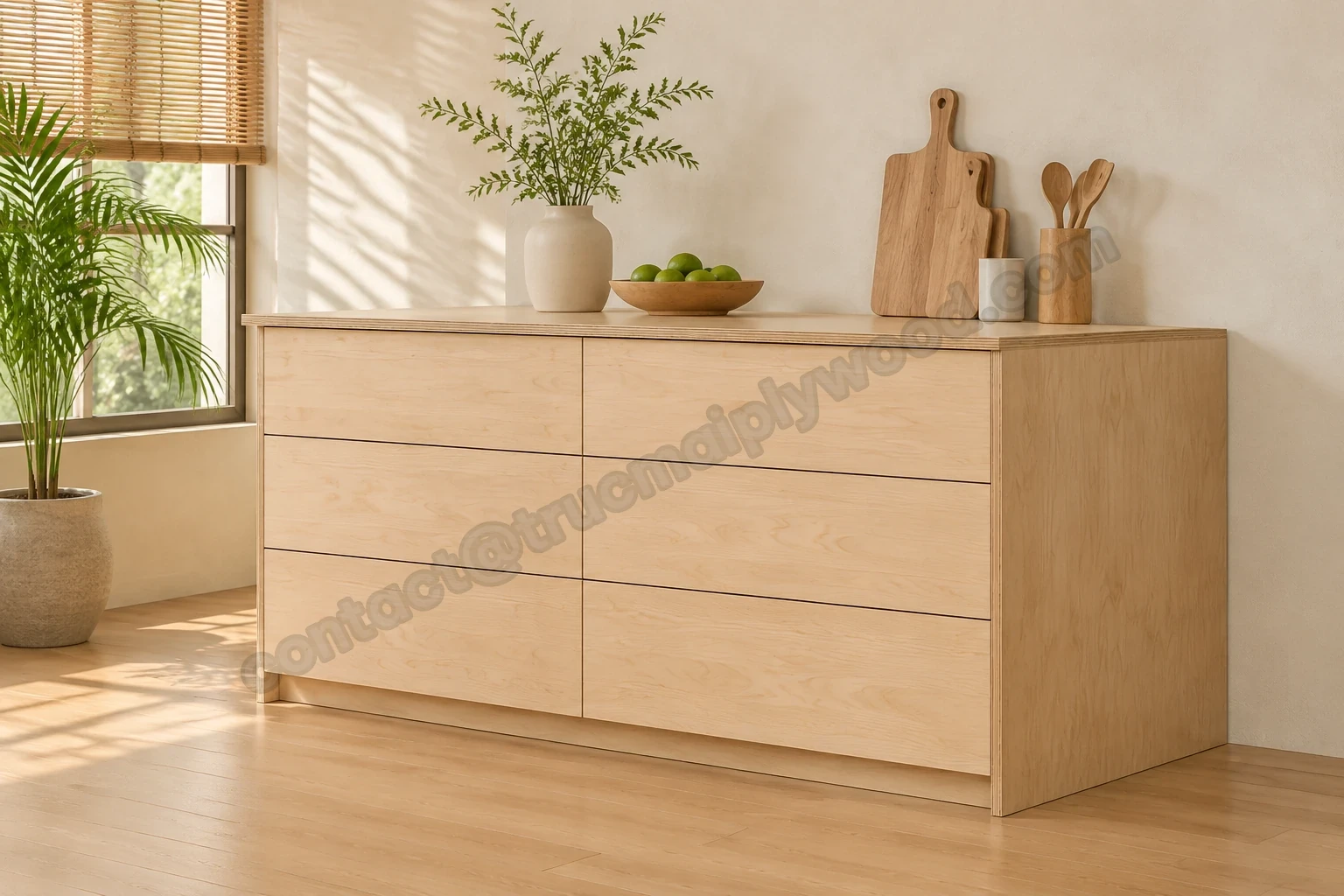
Birch suits painted cabinet boxes and understated exposed panels; oak suits stained show doors, end panels and furniture where grain is a design feature. A single cabinet range can use both. The face visible to the customer need not dictate the material inside the carcass.
For a painted kitchen, test whether birch takes the primer smoothly and whether the finished surface hides veneer joins. For a natural-grain kitchen, approve oak doors as a matched group rather than selecting each panel separately. The side panel should relate visually to the door, even when it is cut from another sheet.
Cabinet boxes need an agreed core grade, edge quality, machining tolerance and fastener schedule. Door faces need colour, grain and finishing approval. A designer choosing a cabinet material from photographs alone misses that difference.
How do red oak and white oak differ on plywood faces?
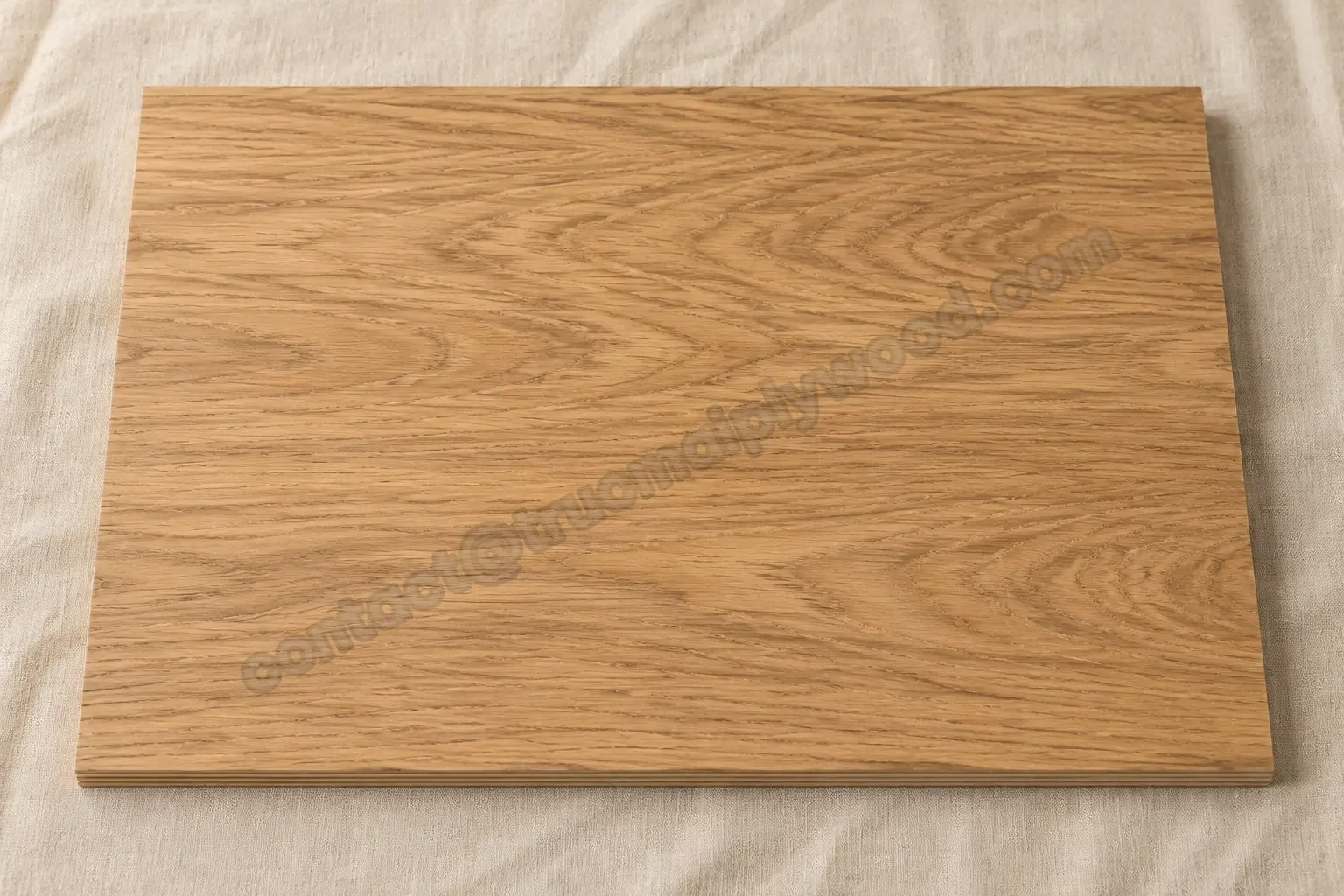
Red oak usually offers a warmer, more open-pored face, while white oak can give a cooler brown or grey cast and is often chosen for a more linear contemporary look. Neither label specifies the veneer cut. Plain-sliced white oak can show broad cathedral figure; rift-cut red oak can show straighter lines.
Ask for the botanical or trade species description, veneer cut, face thickness and a photographed approved panel. These details matter when a furniture range has multiple replenishment orders. A vague request for “oak colour” can result in a technically usable panel that does not match the earlier production.
White oak’s reputation for better liquid resistance concerns certain solid-wood anatomical properties. Decorative plywood durability still follows its entire construction, adhesive and finishing system.
Where does oak-look EV fit between birch and natural oak?
Oak-look engineered veneer is an appearance option for buyers who want an oak-style pattern with a more controlled visual repeat. EV means engineered veneer, often reconstituted from other wood species and processed to create a chosen grain design. A specification should name its actual material and its decorative pattern separately.
Natural oak remains attractive when each door’s individual grain is part of the product. Engineered veneer can suit a large range where the design team wants repeatable stripe width and colour direction. Birch remains the simpler choice where the brief calls for a pale, nearly neutral face rather than an oak pattern.
Truc Mai Plywood offers engineered veneer faces and natural birch faces on furniture and commercial panels. Its documented white poplar EV uses reconstituted plantation poplar, rather than natural oak. An oak-look design is therefore a sample-led request, with the actual construction written on the order.
How should grain direction and veneer matching be ordered?
Specify grain direction and the matching method before cutting door parts. Grain running vertically on a tall door can make the cabinet look taller; horizontal grain across a bank of doors can create a continuous visual line. The same veneer looks different when rotated.
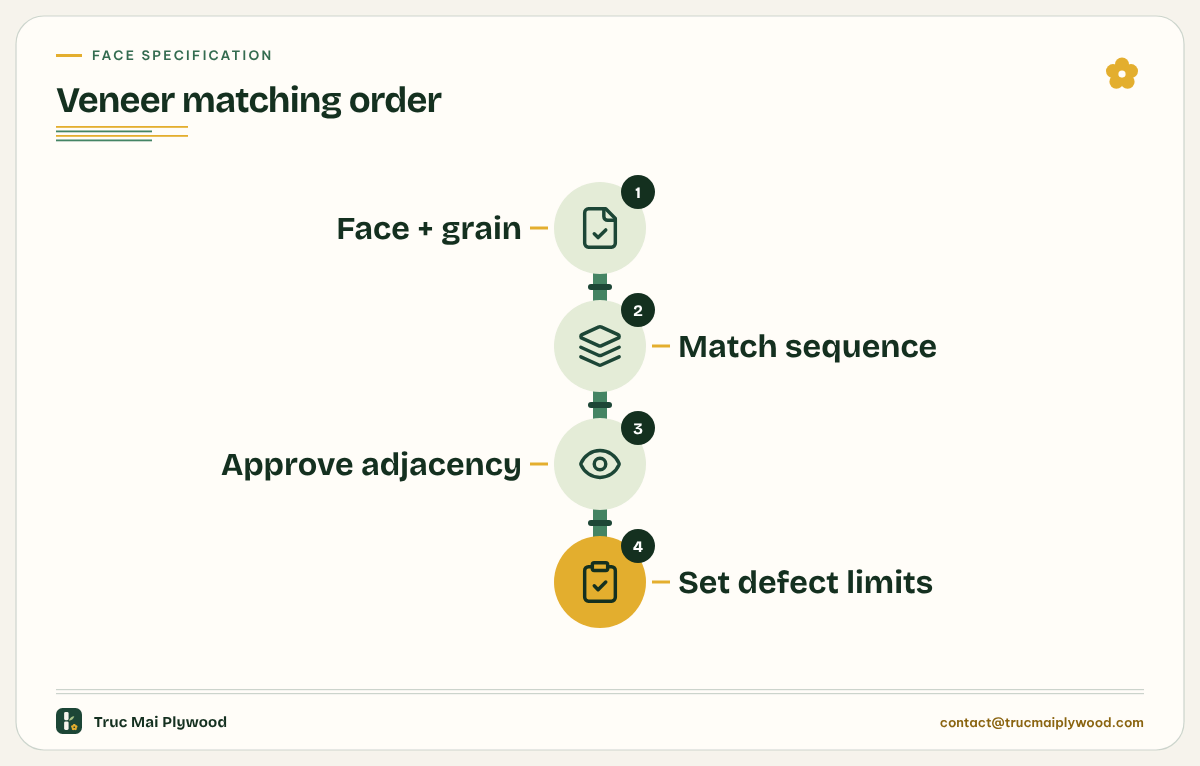
- Mark the finished face and the direction of the grain on a drawing.
- Choose random matching, book matching or another explicitly approved sequence.
- Approve a representative set of adjacent faces under the final coating.
- Record allowable colour movement, knots, repairs and open defects.
- Mark the door positions or panel identifiers on the packing instructions.
For birch, the matching decision often concerns subtle shade changes. For oak, it also concerns prominent figure and pore direction. A cabinet maker should reject a visually inconsistent group before machining, when replacement is simpler.
Does birch or oak make a stronger plywood sheet?
The core construction determines most practical panel strength comparisons between decorative birch-faced and oak-faced plywood. Face species contributes, but the number and direction of plies, veneer quality, adhesive bond and finished thickness also matter. A face-only comparison cannot establish shelf span or screw-holding.
The NIST PS 1-22 standard classifies structural plywood using panel grades and performance requirements. Decorative furniture panels should be assessed against their own specified construction and intended loading rather than assigned PS 1 performance by resemblance.
For shelves, test deflection at the intended span and load. For hinges, test screws in the actual edge or face position, including the intended pilot hole and fastener. For CNC routing, inspect the cut edge for gaps and tear-out.
What core construction should a furniture importer request?
A stitched, well-assembled core is the starting point for a calibrated furniture panel. Truc Mai uses Eucalyptus, Acacia, Styrax and Pine, including combinations selected for weight, appearance and application. Furniture panels use an A-grade stitched core and sanded faces; commercial builds use a different core preparation.
Ask the mill to show an edge sample and state the core species, joining method, number of plies and permitted gaps. A sound-looking face can conceal uneven inner veneer, which becomes apparent when a cabinet part is routed or a hinge is fitted. Where edge exposure is critical, the edge sample is as important as the face sample.
For an 18 mm furniture sheet, the usual construction is 11 to 13 plies, most often 11. Face veneer is generally 0.2 to 0.5 mm. The veneer face should be chosen for finish, while the core is selected for the mechanical and machining requirements.
Which face finishes more predictably: paint, stain or clear coat?
Birch is a practical first choice for a smooth painted face; oak is a first choice when a visible grain texture is wanted under stain or clear coat. Both need an approved finishing trial. The finish can alter the apparent colour far more than the raw veneer suggests.
A clear coat may warm pale birch, while stain can highlight irregular absorption. Oak’s open pores remain a visible design element unless they are filled. For a pale white-oak effect, compare the approved coating on actual oak veneer against the same colour applied to an engineered face. Colour names on a sales sheet are not a finishing standard.
Truc Mai supplies sanded and calibrated faces, with polishing on request. Its UV-ready panels have surfaces prepared for the buyer’s own UV coating. They are not described as factory UV-coated.
What grades and thickness tolerances belong in the order?
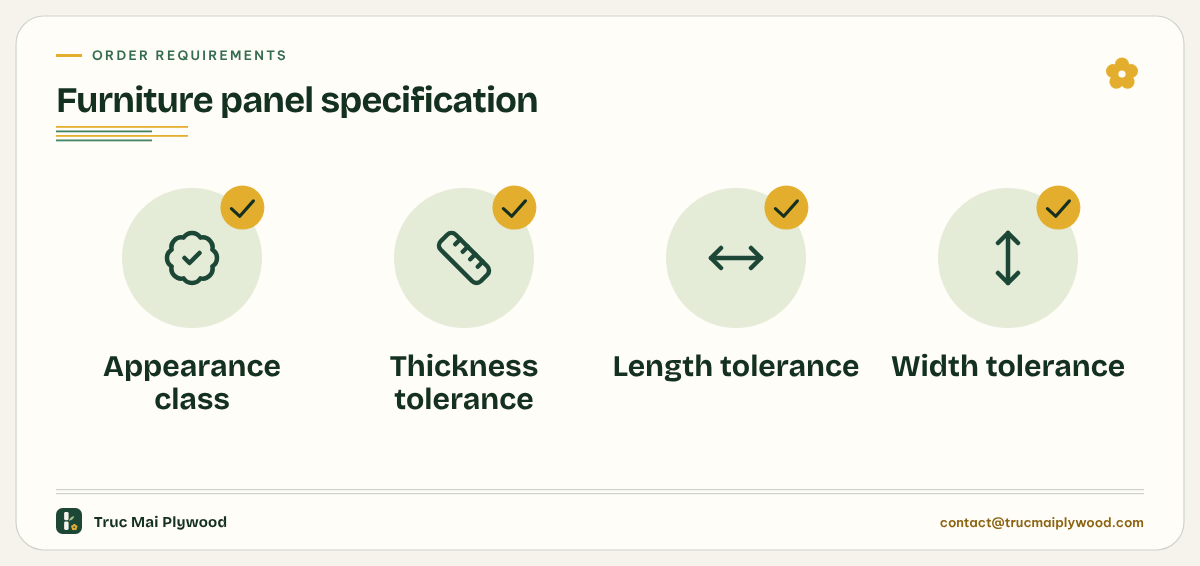
Write face and back grades as an agreed pair, then add a physical reference sample. Commercial names such as B/BB or BB/CC are not a universal promise of identical defects across mills. The ISO 2426-2 hardwood plywood appearance classification uses classes E, I, II, III and IV, a different naming system from many trade quotations.
For Truc Mai’s sanded, calibrated furniture panels, ±0.3 mm is an available order tolerance; general furniture specifications can be written at ±0.3–0.5 mm. Length and width tolerance is ±2 mm. The purchase order should also state whether dimensions are nominal before or after cutting.
Inspect thickness at multiple points, especially where a CNC operation relies on a consistent Z reference. Check face repairs under the proposed coating.
How do adhesive and emissions requirements affect the choice?
Adhesive and emission class are separate specifications for both birch-faced and oak-faced panels. Truc Mai’s default interior system is UF glue at E0 emission, with other bond systems selected for the intended application. A face veneer name cannot substitute for the finished-panel emissions documentation.
For US hardwood plywood with veneer core, 40 CFR 770.10 sets a formaldehyde limit of 0.05 ppm under the applicable test framework. Truc Mai’s CARB Phase 2 and TSCA Title VI third-party certification covers veneer-core hardwood plywood in the 3–25 mm range. Its certification identifier is CARB/EPA 26053, mill ICTT-26053.
The buyer should request the certificate and matching product configuration before shipment. A coating, core substitution or thickness outside the documented scope changes the specification being purchased.
How can a buyer keep the same colour across repeat containers?
Keep a retained master sample, a documented acceptance range and a veneer-matching instruction for every repeat order. Natural oak changes visually from log to log; birch also shows variation in tone and figure. A consistent purchasing process controls what arrives, even when the material remains naturally variable.
Ask the supplier to photograph the approved face in neutral lighting with a colour reference and show multiple full sheets, not one hand-picked offcut. Retain the sample with the finished coating. Record whether adjacent panels must be sequenced and whether slight tone variation is acceptable within a cabinet group.
For EV designs, keep the pattern reference and face material description. A repeating design may simplify matching, but the coating can still alter the result. For real oak, define the species and cut as well as the acceptable figure.
What does a 40HC planning table tell a cabinet importer?
The 40HC planning table describes core-dependent loading, not a difference between birch and oak faces. It uses the same core model for either decorative face, so it helps estimate logistics once the core and thickness have been selected. The figures below are copied unchanged from the supplied calculation file.
Calculation basis: 40HC planning model, panels only; 18 packs for Styrax, 16 for Acacia and 15 for Eucalyptus; pack height 1,000 mm; sheets per pack equal pack height divided by thickness, rounded down and capped by a 28,000 kg planning payload. Reference densities are 500 kg/m³ Styrax, 580 kg/m³ Acacia and 650 kg/m³ Eucalyptus. The carrier and route determine the actual payload; this is a planning figure rather than a loading record.
| Core | Thickness (mm) | Sheet size (mm) | Packs | Sheets/pack | Weight-capped | Total sheets | Volume (m³) | kg/sheet | Total kg |
|---|---|---|---|---|---|---|---|---|---|
| Styrax | 12 | 1220 × 2440 | 18 | 83 | No | 1494 | 53.4 | 17.9 | 26680 |
| Acacia | 12 | 1220 × 2440 | 16 | 83 | No | 1328 | 47.4 | 20.7 | 27510 |
| Eucalyptus | 12 | 1220 × 2440 | 15 | 80 | Yes | 1200 | 42.9 | 23.2 | 27860 |
| Styrax | 15 | 1220 × 2440 | 18 | 66 | No | 1188 | 53.0 | 22.3 | 26520 |
| Acacia | 15 | 1220 × 2440 | 16 | 66 | No | 1056 | 47.2 | 25.9 | 27350 |
| Eucalyptus | 15 | 1220 × 2440 | 15 | 64 | Yes | 960 | 42.9 | 29.0 | 27860 |
| Styrax | 18 | 1220 × 2440 | 18 | 55 | No | 990 | 53.0 | 26.8 | 26520 |
| Acacia | 18 | 1220 × 2440 | 16 | 55 | No | 880 | 47.2 | 31.1 | 27350 |
| Eucalyptus | 18 | 1220 × 2440 | 15 | 53 | Yes | 795 | 42.6 | 34.8 | 27690 |
| Styrax | 21 | 1220 × 2440 | 18 | 47 | No | 846 | 52.9 | 31.3 | 26440 |
| Acacia | 21 | 1220 × 2440 | 16 | 47 | No | 752 | 47.0 | 36.3 | 27270 |
| Eucalyptus | 21 | 1220 × 2440 | 15 | 45 | Yes | 675 | 42.2 | 40.6 | 27430 |
How should cut-to-size parts be specified?
Send a cut list with the original sheet size, final piece dimensions, grain direction, edge finish and labels. A cut-to-size programme can reduce handling at the cabinet shop, but the cutting pattern must respect the chosen veneer direction and the available stock sheet.
Truc Mai can split a standard sheet lengthwise into two 610 × 2440 mm parts, into three 1200 × 800 mm parts, or into four 1220 × 610 mm parts, with six-part patterns also available. Exact piece dimensions and the cut layout are agreed by email. Saw kerf and grain orientation are part of the drawing, not assumptions hidden in the quotation.
Where doors need consecutive oak grain, label them in the cutting sequence. For painted birch box components, the labels may instead follow cabinet assembly positions. Record whether edges are left for the buyer to band or are prepared for another operation. Avoid ordering only by the finished part name, such as “side panel”, without dimensions and orientation.
What should be checked before accepting a plywood sample?
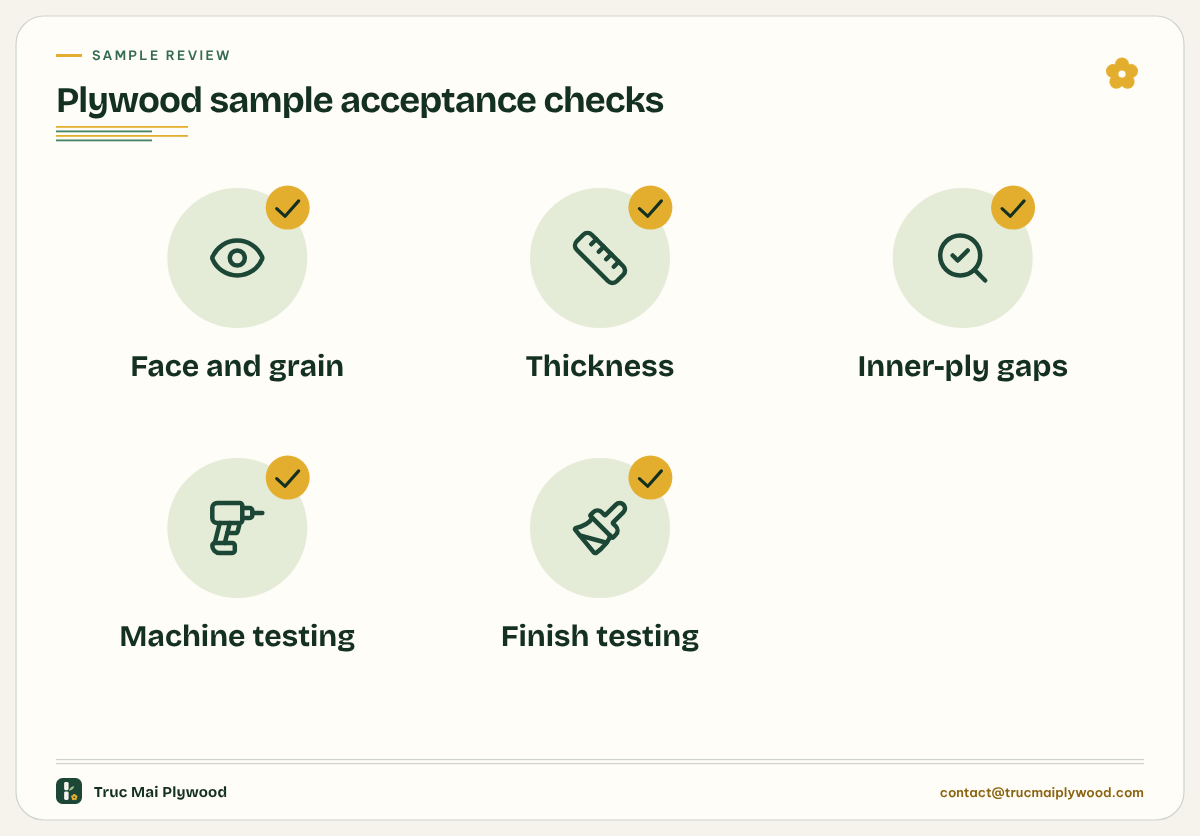
Approve the face, edge and finished coating on the same panel construction that will be ordered. A sample evaluation is most useful when it imitates the actual cabinet production process rather than a showroom display.
- Check face colour, grain and allowable repairs against the signed reference.
- Measure thickness and inspect the full edge for inner-ply gaps.
- Machine a hinge pocket, drill an edge screw and cut a representative CNC shape.
- Apply the specified primer, stain or clear coat and inspect the cured result.
- Record acceptance criteria and attach the approved sample identity to the RFQ.
Truc Mai provides free samples; a new buyer arranges the courier. The ordering plywood samples page covers the request process. A useful sample request identifies the target market and the intended application, so the supplied panel is relevant to the finished furniture.
How should the purchase order and RFQ be written?
Write a complete construction and appearance specification rather than asking only for “oak plywood” or “birch plywood”. The purchasing team should be able to compare two quotations line by line without guessing what a supplier meant by a familiar trade name.
Include the application, natural or engineered face material, face/back grades, veneer cut and matching, core species and joining method, adhesive and emissions requirement, thickness and sheet size, tolerance, coating preparation, cutting plan, packing, quantity and destination port. Attach the retained face sample and the finish reference.
For traceable material, specify the claim on the sales documents. Truc Mai holds FSC chain-of-custody licence FSC-C196493, with FSC 100% available for eligible products. The FSC chain-of-custody standard requires the applicable claim to appear on sales documents; see how to verify an FSC licence code.
The standard order starts at one 40HC, with production scheduled for 15–45 days after the deposit. Use the plywood RFQ checklist to send the application, core, glue and emission class, face, size, packing and quantity together with the destination port. Request a quotation and a matching physical sample before final approval.
Send your specification to contact@trucmaiplywood.com or through the quotation form.
Questions buyers ask
Can birch plywood be stained dark?
Yes. Use a sample board with the intended stain and clear coat because pale birch can show uneven absorption; a washcoat or conditioner can help.
Can oak plywood be painted?
Yes. Oak grain pores can remain visible beneath paint, so specify a grain-filling finish when a flat painted appearance is required.
Is birch-faced plywood the same as Baltic birch?
No. Birch-faced describes the outer veneer; Baltic birch normally refers to a multi-ply construction with birch veneers throughout.
What is rift-cut oak veneer?
Rift-cut oak veneer is cut to emphasise straighter, more even grain lines. Ask for an approved sample and a matching sequence for visible doors.
Should cabinet backs match cabinet doors?
Not necessarily. A cabinet back can use a practical face grade while exposed doors use a separately approved decorative veneer.
Can a buyer order FSC 100% birch-faced panels?
Truc Mai Plywood holds FSC chain-of-custody certification FSC-C196493; FSC 100% applies to eligible products documented with that claim on the sales paperwork.
Does a face veneer determine formaldehyde emissions?
No. The finished panel construction and adhesive system determine the relevant emissions test result; request documentation for the specified panel.
Can oak-look EV veneer be specified as real oak?
No. Engineered oak-look veneer is a decorative appearance specification; the material description should identify the actual veneer rather than describing it as natural oak.
Can panels be supplied cut to cabinet-part dimensions?
Yes. Truc Mai offers labelled cut-to-size panels from standard sheets using an agreed cut list and layout.
How should a buyer approve a new veneer colour?
Approve physical samples under the intended finish and lighting, then record the accepted colour range, grain orientation and matching rule on the purchase specification.