
Poplar vs birch plywood is primarily a choice of face appearance, machining needs and panel construction. Poplar offers a pale, understated surface, while birch offers a tighter, more distinct grain. For cabinets, cutting and container loads, compare the actual veneer core, thickness, bond and finish rather than the face name alone.
What are the poplar vs birch plywood pros and cons?
Yes, both faces have distinct advantages: poplar suits a pale, easily finished face; birch suits a more pronounced, fine-grained hardwood appearance. The trade-off is not a universal strength ranking. A poplar face on a dense core can be heavier than a birch face on a light core, and neither face name identifies the adhesive or inner veneers.
| Buyer criterion | Poplar-faced panel | Birch-faced panel | What to put on the order |
|---|---|---|---|
| Visible surface | Pale, relatively quiet grain | Light cream with clearer grain character | Approved face/back sample |
| Paint preparation | Useful where a subdued grain is wanted | Useful where a fine grain is acceptable | Sanding and coating sample |
| Clear finish | Soft, even visual field | More recognisable wood figure | Finished sample under site lighting |
| CNC routing | Assess fuzzing and tear-out on the actual face | Assess edge breakout and grain lift | Tooling trial and edge acceptance |
| Laser cutting | Test glue-line char and edge colour | Test the same factors on identical settings | Cut sample from production lay-up |
| Weight | Governed mainly by core and thickness | Governed mainly by core and thickness | Core, size, density and pack plan |
| Decorative value | Understated | More visibly timber-like | Face grade pair |
Neither species should be treated as a performance certificate. Specify the actual panel before making a substitution. See poplar-faced plywood and birch-faced plywood for the two face options. A fair trial compares panels with the same thickness, core, sanding, moisture condition and coating.
How do poplar and birch faces differ from the plywood core?
The face is the thin outer veneer; the core is the inner assembly that contributes most of the sheet volume. Truc Mai Plywood makes birch-faced panels using imported birch veneer over Vietnamese veneer cores, rather than presenting them as all-birch plywood. Available core species include Styrax, Acacia, Eucalyptus and Pine, with combined cores for specified orders.
A face veneer commonly falls in the 0.2–0.5 mm range, while a core veneer is typically much thicker. This is why changing a thin face cannot be used to infer a large change in shipping mass. The core lay-up, joints, glue spread and sanding have their own effects on flatness and machining. A comparison headed only “birch versus poplar” can conceal more important construction differences.
Ask the supplier for a cross-section photo and a written ply schedule. Look for continuous face coverage, sound bonding and consistent core joints. On furniture panels, stitched core veneers help control gaps beneath the face. If you need matching fronts and backs, specify both surfaces instead of assuming the reverse side mirrors the face.
Is bleached poplar vs birch for kitchen cabinets a better choice?
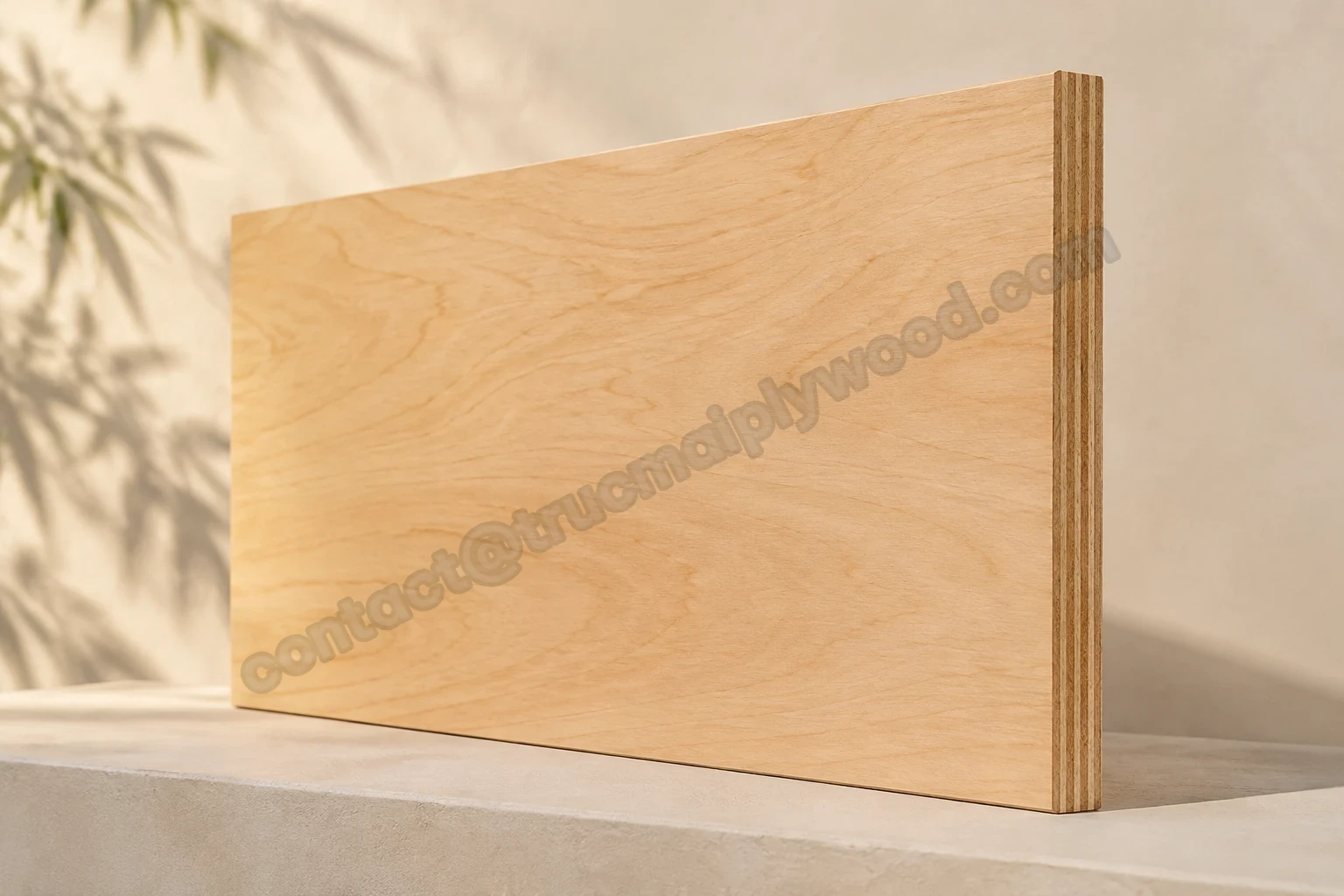
Yes, bleached poplar is a strong candidate for painted or pale cabinet interiors; birch is a strong candidate for clear-finished doors and visible end panels. For kitchen cabinets, the finish and service environment matter more than a blanket species ranking.
Bleached poplar gives a bright, quiet starting surface. It can help when cabinet interiors need to read as uniformly light, but the approved sample must show how the actual finish behaves. Birch presents a more recognisable hardwood pattern and can be attractive on exposed cabinet parts. Under opaque paint, that decorative distinction becomes less important; surface preparation and finish compatibility take priority.
For cabinet carcasses, compare screw retention, edge integrity, dimensional consistency and the intended hardware positions on samples made with the specified core. A beautiful face does not repair an open core joint under a hinge cup. For fronts, compare matching across adjacent sheets and the appearance after coating. Use the cabinet plywood selection checklist and the bleached poplar panels specification when building a finish schedule.
Where humidity is expected, order a tested bond system suited to the service conditions. Do not confuse an emission designation with bond durability: they are different properties. Edge sealing and sensible detailing protect cabinet components during cleaning and normal use.
How does poplar vs birch plywood vs Baltic birch compare?
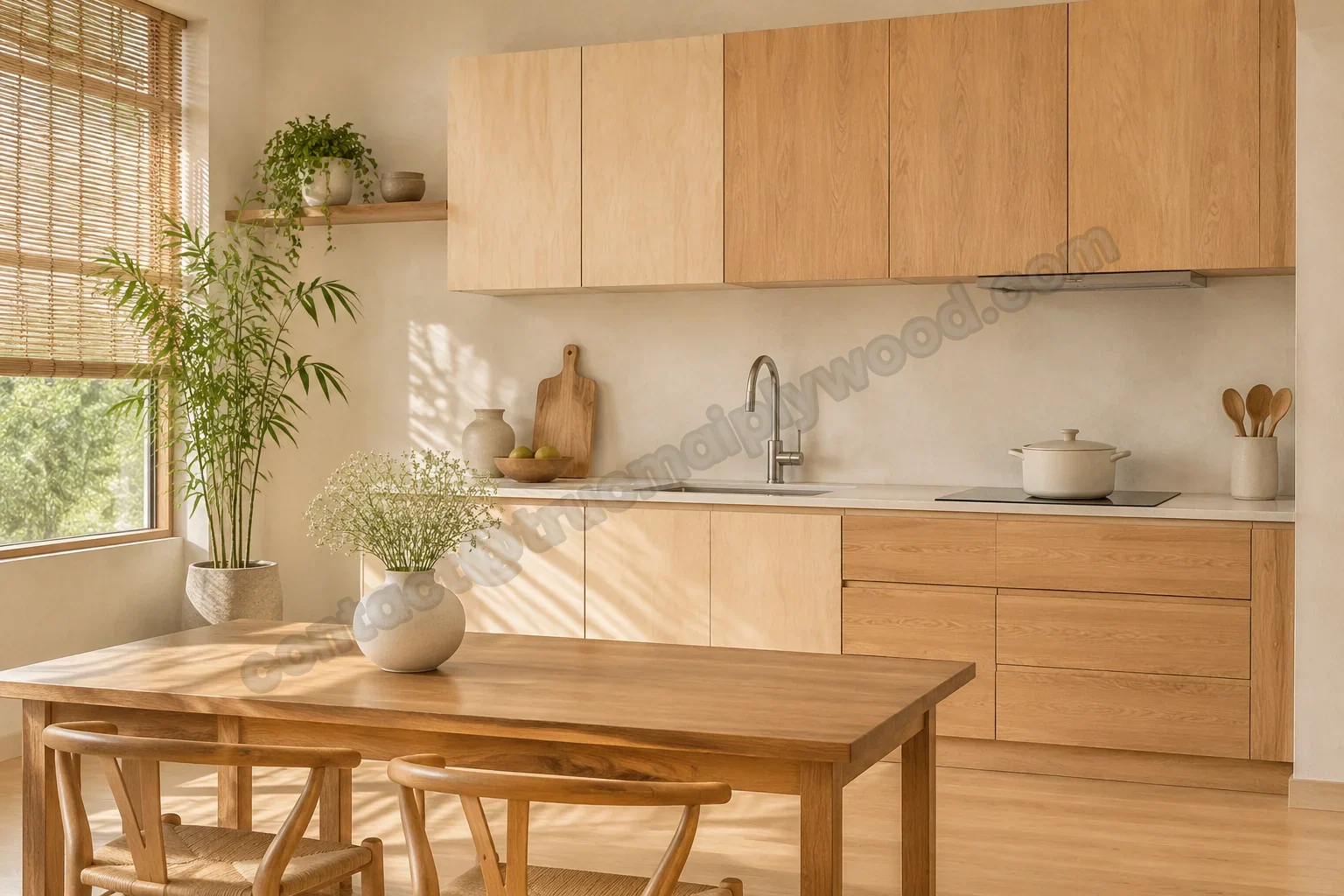
No, Baltic birch is not interchangeable with birch-faced plywood: buyers commonly associate Baltic birch with multi-ply birch throughout, while birch-faced plywood specifies the outer appearance only. Poplar-faced plywood also describes the surface, not the whole panel. Those categories must be compared by lay-up rather than by label.
A buyer replacing an all-birch specification should begin with the requirement that matters: exposed layered edges, hardware performance, machining repeatability or a particular face. If the edges will remain visible, the internal veneer sequence may be central to the design. If the edges are banded and the face is painted, a well-made alternative core may meet the practical brief without duplicating the original lay-up.
Request a sample with the actual cut edge exposed. Check voids, layer symmetry, routing and the appearance of any clear-coated edge. For a substitution schedule, record each acceptance point rather than approving by country or species name. The Baltic birch alternatives page expands the comparison without equating birch-faced Vietnamese plywood with an all-birch construction.
Which face performs better under a laser cutter?
For a pale decorative edge, start the laser trial with poplar; for visible birch grain, start with birch. The most useful test is a paired cut using the same thickness, core construction, adhesive system and machine settings. The laser crosses several glue lines and core veneers, so a face-only comparison misses much of the process.
Start with a simple shape containing a straight line, tight corner and small hole. Record whether the cut completes, the colour and width of the charred edge, smoke marking on the top face and any underside staining. Repeat with the intended masking and extraction arrangements. A small clean sample may behave differently from a densely nested production sheet because heat accumulates along repeated paths.
Inspect both sides after wiping and finishing, not just the first attractive cut. For decorative laser-cut items, consistent colour after coating can matter more than the fastest pass. If the product needs a pale unpainted edge, use a sample showing the actual glue lines. Thin-panel construction deserves particular attention because 3–5 mm panels can contain several veneer interfaces even at modest thickness.
What should CNC shops check before switching faces?
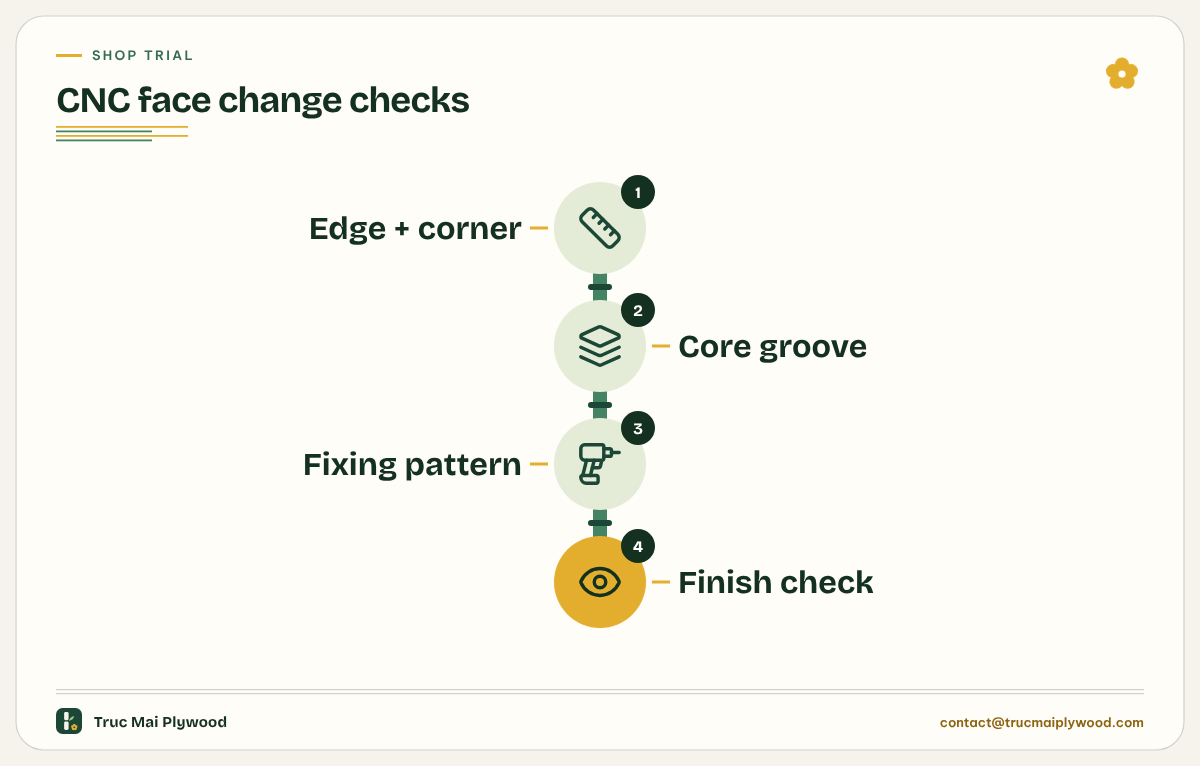
CNC shops should check face breakout, core voids, edge finish and tool wear on the specified panel. A face species change is only one variable. Cutter geometry, feed, support and core density can alter the result more than the visible veneer.
- Cut a straight edge and a small-radius inside corner using the production tool.
- Route a groove that exposes the inner veneers, then inspect the core joints.
- Drill the intended fixing pattern and assess breakout at both faces.
- Sand the machined edge, apply the specified finish and inspect under workroom lighting.
- Approve the sample and retain it beside the written purchase specification.
For nesting, record part yield and reject reasons rather than relying on a generic “easy to machine” description. Where edges are covered with banding, the glue-ready edge and flatness may be more important than decorative ply stripes. Where edges remain exposed, insist on a consistent lay-up and inspect multiple positions across the sheet.
How much does a 40HC carry at different core weights?
Core species drives the planning weight more directly than the poplar or birch face. The following 40HC figures come from the supplied packing model and apply to panels only. The model uses packs approximately 1,000 mm high, a planning cargo payload of 28,000 kg and reference densities of 500 kg/m³ for Styrax, 580 for Acacia and 650 for Eucalyptus. Pack count is modelled at 18, 16 and 15 respectively. Carrier booking and actual packed mass determine the shipping plan.
These rows preserve the calculation output, including its total kilograms. They are not measured loading records. Compare the container planning by thickness guide when selecting a core for a mixed shipment.
| ID | Core | Thickness mm | Sheet mm | Packs | Sheets/pack | Weight capped | Sheets | m³ | kg/sheet | Total kg |
|---|---|---|---|---|---|---|---|---|---|---|
| styrax-12-1220x2440 | Styrax | 12 | 1220x2440 | 18 | 83 | false | 1494 | 53.4 | 17.9 | 26680 |
| acacia-12-1220x2440 | Acacia | 12 | 1220x2440 | 16 | 83 | false | 1328 | 47.4 | 20.7 | 27510 |
| eucalyptus-12-1220x2440 | Eucalyptus | 12 | 1220x2440 | 15 | 80 | true | 1200 | 42.9 | 23.2 | 27860 |
| styrax-15-1220x2440 | Styrax | 15 | 1220x2440 | 18 | 66 | false | 1188 | 53.0 | 22.3 | 26520 |
| acacia-15-1220x2440 | Acacia | 15 | 1220x2440 | 16 | 66 | false | 1056 | 47.2 | 25.9 | 27350 |
| eucalyptus-15-1220x2440 | Eucalyptus | 15 | 1220x2440 | 15 | 64 | true | 960 | 42.9 | 29.0 | 27860 |
| styrax-18-1220x2440 | Styrax | 18 | 1220x2440 | 18 | 55 | false | 990 | 53.0 | 26.8 | 26520 |
| acacia-18-1220x2440 | Acacia | 18 | 1220x2440 | 16 | 55 | false | 880 | 47.2 | 31.1 | 27350 |
| eucalyptus-18-1220x2440 | Eucalyptus | 18 | 1220x2440 | 15 | 53 | true | 795 | 42.6 | 34.8 | 27690 |
| styrax-21-1220x2440 | Styrax | 21 | 1220x2440 | 18 | 47 | false | 846 | 52.9 | 31.3 | 26440 |
| acacia-21-1220x2440 | Acacia | 21 | 1220x2440 | 16 | 47 | false | 752 | 47.0 | 36.3 | 27270 |
| eucalyptus-21-1220x2440 | Eucalyptus | 21 | 1220x2440 | 15 | 45 | true | 675 | 42.2 | 40.6 | 27430 |
How many cut pieces come from a standard sheet?
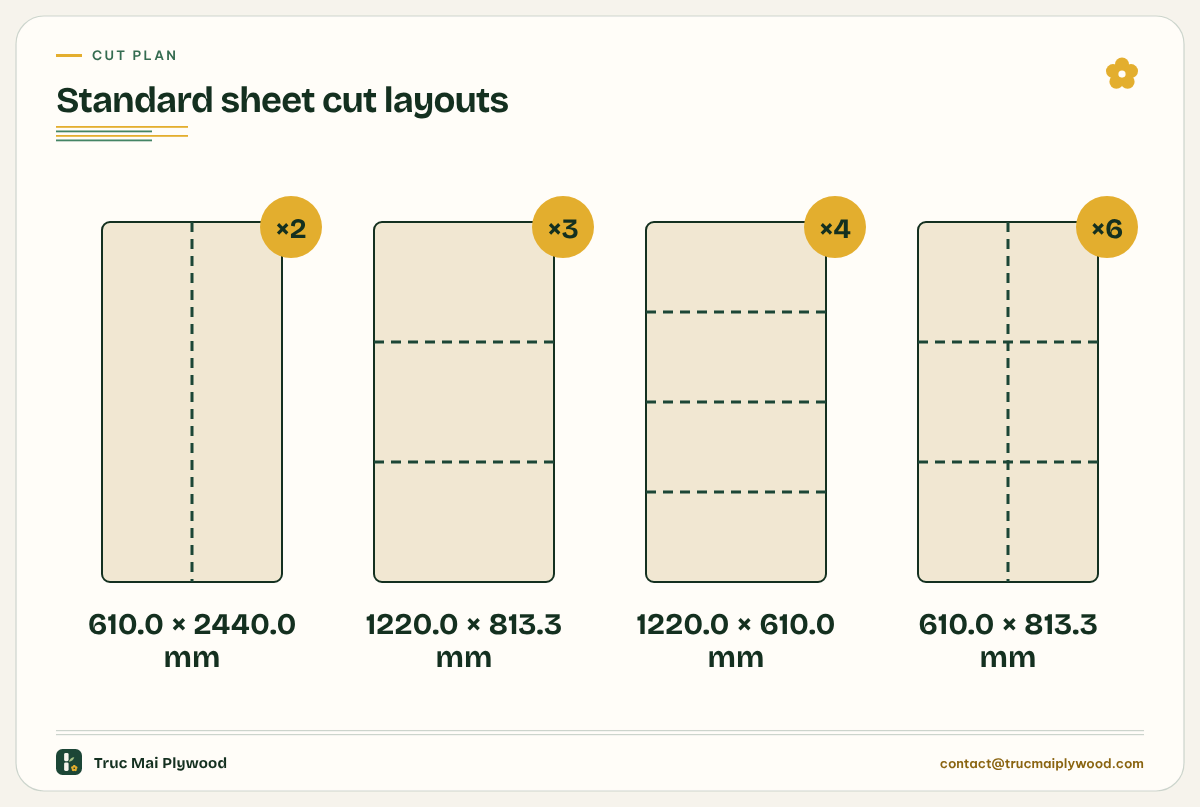
A cut plan starts with the parent sheet, the number of pieces and the saw kerf. The supplied model uses a 4 mm kerf per cut. It reports both nominal divisions and the usable piece dimensions after kerf; the mill and buyer agree the final cutting drawing before production.
A two-piece lengthwise split creates two narrower pieces. Three-piece and four-piece patterns can orient cuts differently, so the parent dimension and orientation must be shown on the drawing. Truc Mai offers two, three, four or six pieces from a standard sheet, with labels to the buyer’s cut list. For a furniture line, identify grain direction and the visible face on each piece, particularly where adjacent doors need to match.
The cut table below retains the calculator’s exact values. Use the usable dimension rather than the nominal division when checking fit in a CNC fixture or packing carton.
| ID | Parent | Cut | Kerf mm | Saw cuts | Pieces | Usable width mm | Usable length mm | Nominal width mm | Nominal length mm |
|---|---|---|---|---|---|---|---|---|---|
| cut2-1220x2440 | 1220x2440 | 2 | 4 | 1 | 2 | 608.0 | 2440.0 | 610.0 | 2440.0 |
| cut3-1220x2440 | 1220x2440 | 3 | 4 | 2 | 3 | 1220.0 | 810.7 | 1220.0 | 813.3 |
| cut4-1220x2440 | 1220x2440 | 4 | 4 | 3 | 4 | 1220.0 | 607.0 | 1220.0 | 610.0 |
| cut6-1220x2440 | 1220x2440 | 6 | 4 | 3 | 6 | 608.0 | 810.7 | 610.0 | 813.3 |
How many cut components can a 40HC plan produce?
The component count equals the modelled sheets multiplied by the specified pieces per sheet. The supplied output below applies the cut counts to the same 12 mm core-based container plan. It is useful for a first component-count estimate, while the final packing arrangement follows the approved part dimensions and shipping weight.
Cutting at the mill can reduce handling at the destination and make component labelling easier. Buyers should send a drawing with part identifiers, grain orientation, permitted edge defects and a packing sequence. A container of small components may need a different packing arrangement from the modelled parent-sheet packs; the table preserves the parent-sheet calculation basis rather than assuming a measured component load.
| ID | Core | Thickness mm | Parent | Cut | Sheets | Pieces |
|---|---|---|---|---|---|---|
| cut2-40hc-styrax-12 | Styrax | 12 | 1220x2440 | 2 | 1494 | 2988 |
| cut3-40hc-styrax-12 | Styrax | 12 | 1220x2440 | 3 | 1494 | 4482 |
| cut4-40hc-styrax-12 | Styrax | 12 | 1220x2440 | 4 | 1494 | 5976 |
| cut6-40hc-styrax-12 | Styrax | 12 | 1220x2440 | 6 | 1494 | 8964 |
| cut2-40hc-acacia-12 | Acacia | 12 | 1220x2440 | 2 | 1328 | 2656 |
| cut3-40hc-acacia-12 | Acacia | 12 | 1220x2440 | 3 | 1328 | 3984 |
| cut4-40hc-acacia-12 | Acacia | 12 | 1220x2440 | 4 | 1328 | 5312 |
| cut6-40hc-acacia-12 | Acacia | 12 | 1220x2440 | 6 | 1328 | 7968 |
| cut2-40hc-eucalyptus-12 | Eucalyptus | 12 | 1220x2440 | 2 | 1200 | 2400 |
| cut3-40hc-eucalyptus-12 | Eucalyptus | 12 | 1220x2440 | 3 | 1200 | 3600 |
| cut4-40hc-eucalyptus-12 | Eucalyptus | 12 | 1220x2440 | 4 | 1200 | 4800 |
| cut6-40hc-eucalyptus-12 | Eucalyptus | 12 | 1220x2440 | 6 | 1200 | 7200 |
Which specifications make two supplier quotations comparable?
Use one written specification for both face options. Start with the intended application and appearance, then record the core species, veneer construction, adhesive, emission requirement, thickness, tolerance, dimensions and packaging. A price comparison without these fields compares different goods.
| Order field | Example of a precise instruction |
|---|---|
| Use | Interior cabinet carcass or visible door |
| Face/back | Poplar/approved back or birch/approved back |
| Core | Styrax, Acacia or Eucalyptus veneer core |
| Thickness | 12, 15 or 18 mm as specified |
| Size | 1220 × 2440 or 1250 × 2500 mm |
| Surface | Sanded, calibrated, UV-ready if requested |
| Bond and emission | Separate adhesive and emission lines |
| Cut list | Parent sheet, orientation, kerf and labels |
| Acceptance | Signed face sample, edge sample and drawing |
The face grade is agreed against an approved sample and quoted as a face/back pair. Commercial grade and furniture grade may have different core preparation, so state which line is required. For a first purchase, use the plywood RFQ checklist and ordering plywood samples instructions.
What do US emission rules require for cabinet plywood?
US TSCA Title VI sets a formaldehyde emission limit of 0.05 ppm for regulated hardwood plywood, measured on the ASTM E1333 basis. The US Environmental Protection Agency guidance explains the covered veneer-core and composite-core products. This limit concerns emissions, not the strength of a birch or poplar face.
Truc Mai holds CARB Phase 2 and TSCA Title VI third-party certification for hardwood plywood with veneer core in the 3–25 mm scope, certificate CARB/EPA 26053, mill ICTT-26053, third-party certifier TPC-43. When preparing an order, match the panel build and thickness to the certificate scope. A specification that names only “E0” is not a substitute for the required US certification and paperwork.
For buyer records, match the product identification on the invoice and panel documentation to the agreed construction. A coating or decorative face change should be considered within the documented product specification, rather than inferred from a generic sales name.
How should European buyers specify bond and emissions?
European buyers should write bond performance and formaldehyde emissions as separate requirements. EN 314-2 describes plywood bond classes for dry, humid and exterior service conditions; EN 636 addresses plywood use conditions. A glue trade name by itself does not supply a tested class.
For formaldehyde, the EU restriction under REACH Annex XVII entry 77 applies to furniture and wood-based articles from 6 August 2026, with a limit of 0.062 mg/m³ under its prescribed chamber conditions. The European Commission explanation describes the restriction. Do not substitute a US ppm result for a European mg/m³ test: the methods and conditions differ.
A purchasing document should identify the intended service environment, the required test method and the report for the agreed panel. An interior cabinet surface may be decorative, but the adhesive and emissions still belong in the technical schedule.
What paperwork matters for traced veneer and core origin?
EU buyers need species and origin records for the core and face veneer, because the two can originate in different countries. The European Commission’s July 2026 EUDR update describes the implementation framework. The EUDR applies from 30 December 2026 for the relevant larger operators, with the later date for other small and micro operators under the amended rules.
Truc Mai supplies origin records and geolocation files for both Vietnamese core wood and imported face veneer to support the EU buyer’s due-diligence work. The order file should identify the species, source country, plot data and shipment relationship without confusing face origin with panel manufacturing origin. See the shipment document checklist for the commercial document sequence.
For FSC orders, the Forest Stewardship Council’s explanation identifies the certificate code and product-specific claim as sales-document information. Truc Mai’s FSC licence is FSC-C196493 and chain-of-custody certificate is SA-COC-014545; eligible products carry the FSC 100% claim on their sales documents. The FSC licence verification page gives the buyer a practical check.
How do you approve a poplar or birch sample before ordering?
Approve 3 features of the actual finished panel construction, not a loose veneer swatch: face colour, exposed core edge and machined detail. A useful sample set contains a face area large enough to judge colour, an exposed edge for checking core assembly, and at least one machined detail representing the final part. Label the face and back clearly.
Compare samples side by side under the same light, then apply the proposed coating. Check the surface after sanding and handling, since raised grain or small veneer repairs can become more visible after finishing. For cabinetry, inspect a hinge hole and a banded edge. For laser-cut decorative work, keep a representative cut with the approved edge colour.
Record the agreed appearance grade against the signed sample, and write the dimensions and thickness tolerance on the purchase order. This prevents a later shipment from being judged against a different informal understanding of “white” or “clear”. Samples should be identified by the exact construction and finish process used for the trial.
What should an importer include in the final RFQ?
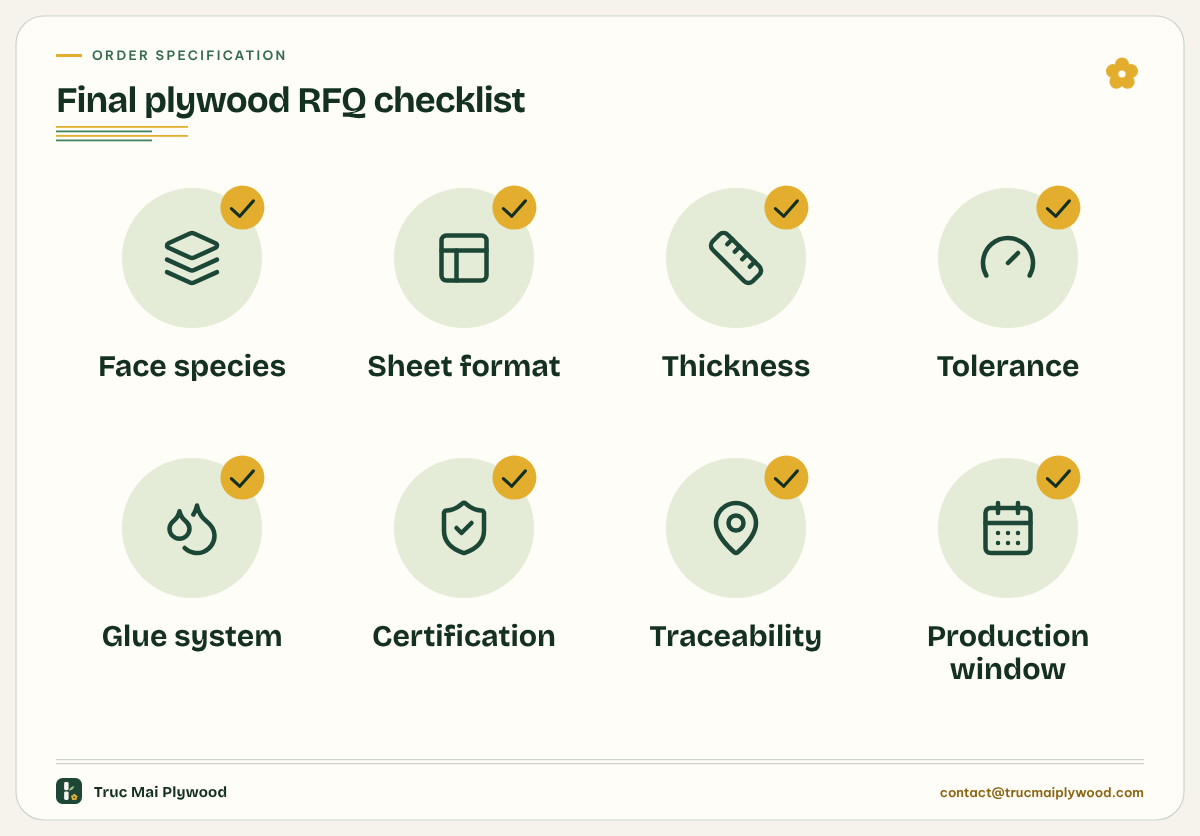
A useful RFQ asks for the application, core, adhesive and emission specification, face/back grade, sheet or cut dimensions, packing and quantity. State the destination port and whether the buyer needs an EU or US document set. The answer can then be prepared against one construction rather than a broad species label.
For Truc Mai’s furniture and commercial plywood, standard sheet choices include 1220 × 2440, 1220 × 2280 and 1250 × 2500 mm, with calibrated furniture panels available to a specified tolerance. Buyers can request free samples and an agreed cut list. The standard minimum order is one 40HC; the factory’s usual production window is 15–45 days after deposit, according to the agreed order.
Send the application, finish sample, required core and face pair, thickness, cut drawing, quantity and destination to obtain a construction-specific quotation. If the visible result is the priority, include a photograph of the intended cabinet or component alongside the dimensional drawing.
Send your specification to contact@trucmaiplywood.com or through the quotation form.
Questions buyers ask
Can a poplar face be applied over an Acacia core?
Yes. Face species and core species are separate order specifications; a poplar-faced panel can use an Acacia veneer core.
Is bleached poplar the same as white poplar EV?
No. Bleached poplar describes the appearance treatment of natural poplar veneer; white poplar EV is a reconstituted veneer made from plantation poplar.
Will a pale face stay white under clear lacquer?
Clear coatings can warm or darken the appearance. Approve a coated sample under the intended lighting before ordering.
Should I specify the back veneer separately?
Yes. Write the face and back as a pair and approve a sample, particularly when both sides will be visible.
Can 3 mm plywood be made with three plies?
Truc Mai uses five plies for its 3–5 mm thin panels. The lay-up differs between 3 mm and the thicker thin-panel options.
Does a birch face make the entire sheet birch?
No. Birch-faced plywood describes the outer veneer; the core species must be listed separately.
Can a 40HC contain both face types?
Yes. Mixed products can be agreed in the order, with pack counts and weights calculated for each construction.
What should I send with a laser-cut sample request?
Send the artwork, cut geometry, thickness, face requirement and acceptable edge colour, then compare trial cuts from the intended panel construction.
Is E0 a recognised EU formaldehyde class?
E0 is not a class defined by EN 13986. State the test method and emission limit in the purchasing specification.
Are FSC claims printed on every plywood invoice?
FSC claims appear on sales documents for eligible FSC products, with the seller certificate code and the claim for the product.
Is plywood supplied already UV coated?
UV-ready panels have prepared surfaces for the buyer to coat; UV-ready does not mean a factory-applied UV finish.