
No. For buyers asking is mdf banned in america, MDF is not banned in America. US law regulates formaldehyde emissions from medium-density fibreboard, particleboard and hardwood plywood rather than prohibiting their sale. For furniture buyers, the useful checks are the panel category, applicable emission limit, third-party certification and traceable paperwork. Truc Mai Plywood supplies veneer-core furniture plywood with a defined certification scope.
Is MDF banned in America?
No. Medium-density fibreboard (MDF) is legal to manufacture, import and sell in the United States when it meets federal composite wood requirements. The US Environmental Protection Agency (EPA) regulates formaldehyde emissions under Title VI of the Toxic Substances Control Act (TSCA), implemented through 40 CFR Part 770.
The rule covers MDF, thin MDF, particleboard and specified hardwood plywood, including components and finished goods containing regulated panels. It reaches producers, importers, fabricators, distributors and retailers. The EPA’s consumer explanation sets out the categories, labels and third-party certification arrangements. A buyer should identify the actual panel inside a cabinet before applying a limit. A veneered panel, a fibreboard back and a particleboard shelf can sit in the same furniture unit while belonging to different regulatory categories.
The practical question is therefore whether the material and its paperwork match the intended market. The US plywood import steps page covers the purchasing sequence alongside the emission documents.
What is MDF, and why is it used in furniture?
MDF is a wood-based board made from refined wood fibres bonded into a dense, uniform panel, one of the regulated categories described by the EPA. Its even surface suits painted doors, routed profiles, decorative panels and furniture components where a consistent substrate matters. A cut edge shows fibres rather than the visible alternating veneer layers of plywood.
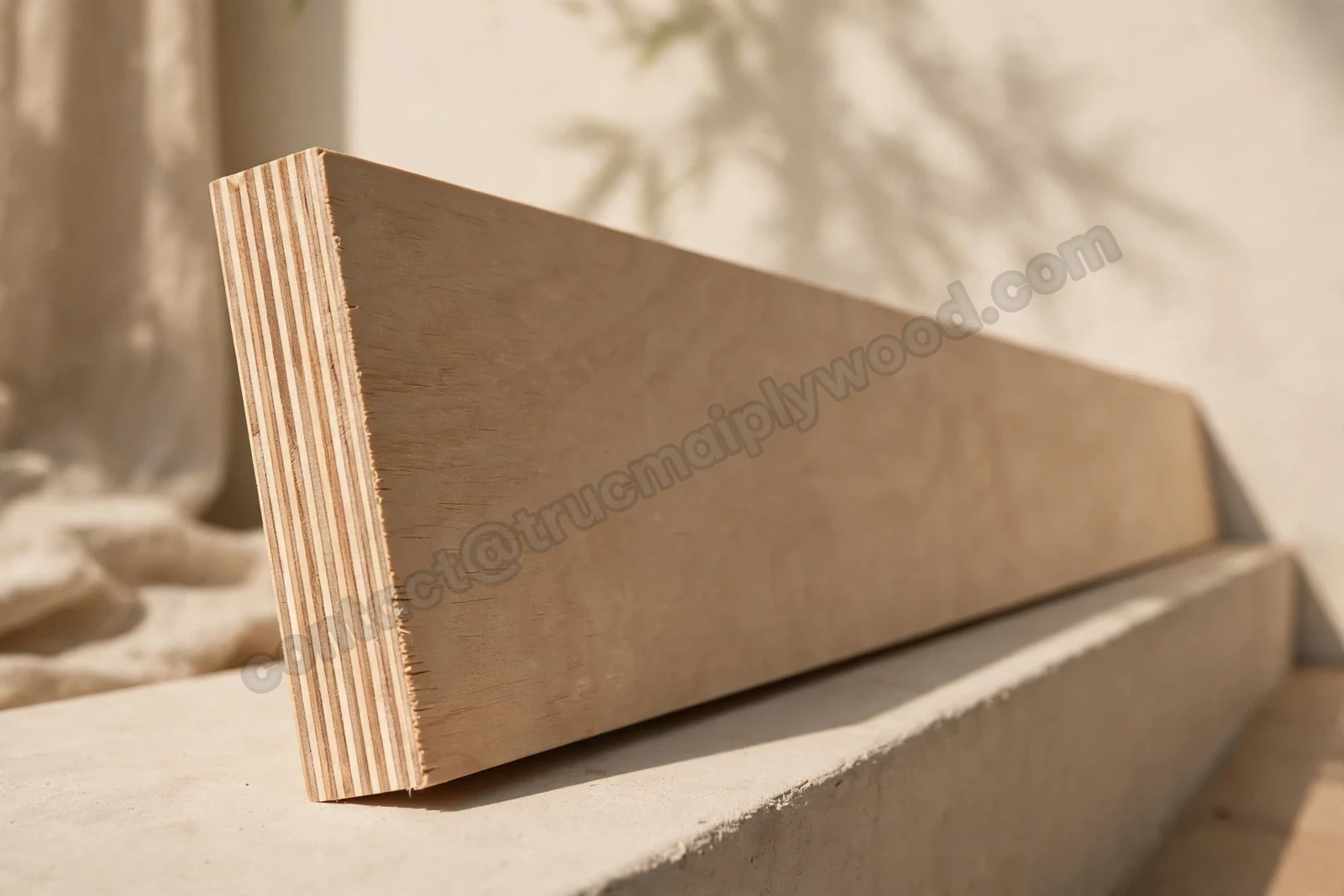
Veneer-core plywood instead builds its thickness from wood sheets with alternating grain directions. Neither name tells a purchaser the emission result.
Is MDF toxic or dangerous in normal use?
Formaldehyde exposure is the principal chemical concern addressed by 40 CFR Part 770; MDF itself is not classified as a prohibited furniture material. The EPA explains that formaldehyde can irritate the eyes, skin, nose and throat, and that higher exposures are associated with serious longer-term health risks.
A panel’s emissions can be influenced by its resin system and manufacturing process.
Does MDF still contain formaldehyde?
Yes, MDF made with formaldehyde-based resins can contain and emit formaldehyde after pressing. Formaldehyde is used in several wood adhesives, including urea-formaldehyde (UF) systems. The EPA describes its use in composite wood resin and regulates the amount released under specified chamber test conditions. The amount emitted is a measured characteristic of a particular panel product, not something inferred from the letters MDF.
Some manufacturers use no-added-formaldehyde-based resin systems or ultra-low-emitting formulations. Under EPA’s regulated-stakeholder guidance, qualifying products can follow defined reduced-testing or certification-exemption provisions. These categories have technical eligibility rules. A purchasing specification should request the relevant evidence rather than treating an adhesive description as a substitute for the compliance record.
What US formaldehyde limits apply to MDF and plywood?
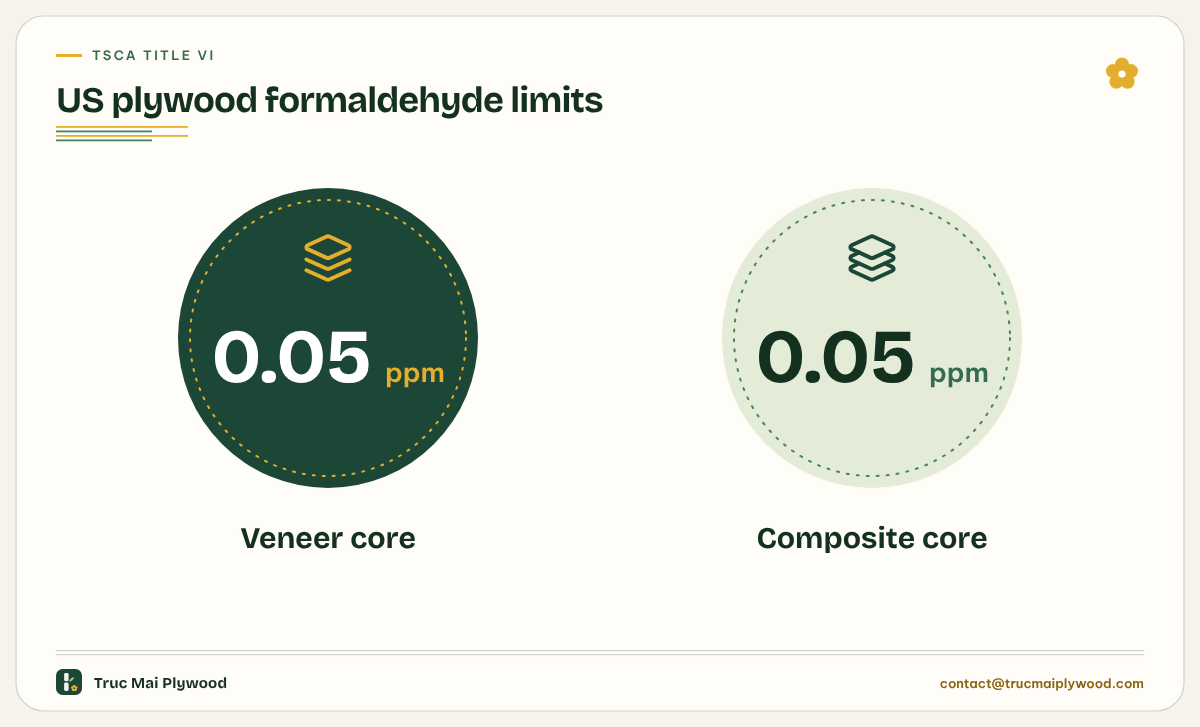
US TSCA Title VI sets separate formaldehyde emission limits for each regulated composite wood product. The figures below are chamber-based parts per million (ppm) limits, not indoor room-air predictions. They come from EPA’s published standards table and 40 CFR 770.10.
| Regulated panel category | TSCA Title VI formaldehyde limit | Basis for checking an offer |
|---|---|---|
| Hardwood plywood, veneer core | 0.05 ppm | Certificate covering the plywood construction |
| Hardwood plywood, composite core | 0.05 ppm | Certificate identifying the applicable core category |
| Particleboard | EPA category limit | Particleboard producer and product records |
| MDF | EPA category limit | MDF producer, category and certificate |
| Thin MDF | EPA category limit | Thin-MDF classification and certificate |
The figures are not a ranking of which finished furniture item has the cleanest indoor air. Each category is tested under the regulatory method. The higher numerical limit for MDF does not mean every MDF panel emits more than every plywood panel. Buyers comparing offers should ask for the tested configuration and result rather than treating the regulatory maximum as a typical emission value.
California’s CARB Phase 2 programme uses the same numerical emission limits for these categories, while federal and state compliance arrangements have distinct documentation details. See the Phase 2 formaldehyde limits page for the plywood-specific requirements.
How does US certification work for imported panels?
Regulated US-bound panels require the appropriate third-party certification and traceable labelling arrangements under TSCA Title VI. The EPA programme recognises third-party certifiers that oversee panel testing and production controls. The panel label identifies the producer, lot, certifier and compliance statement, while finished goods follow their own labelling rules.
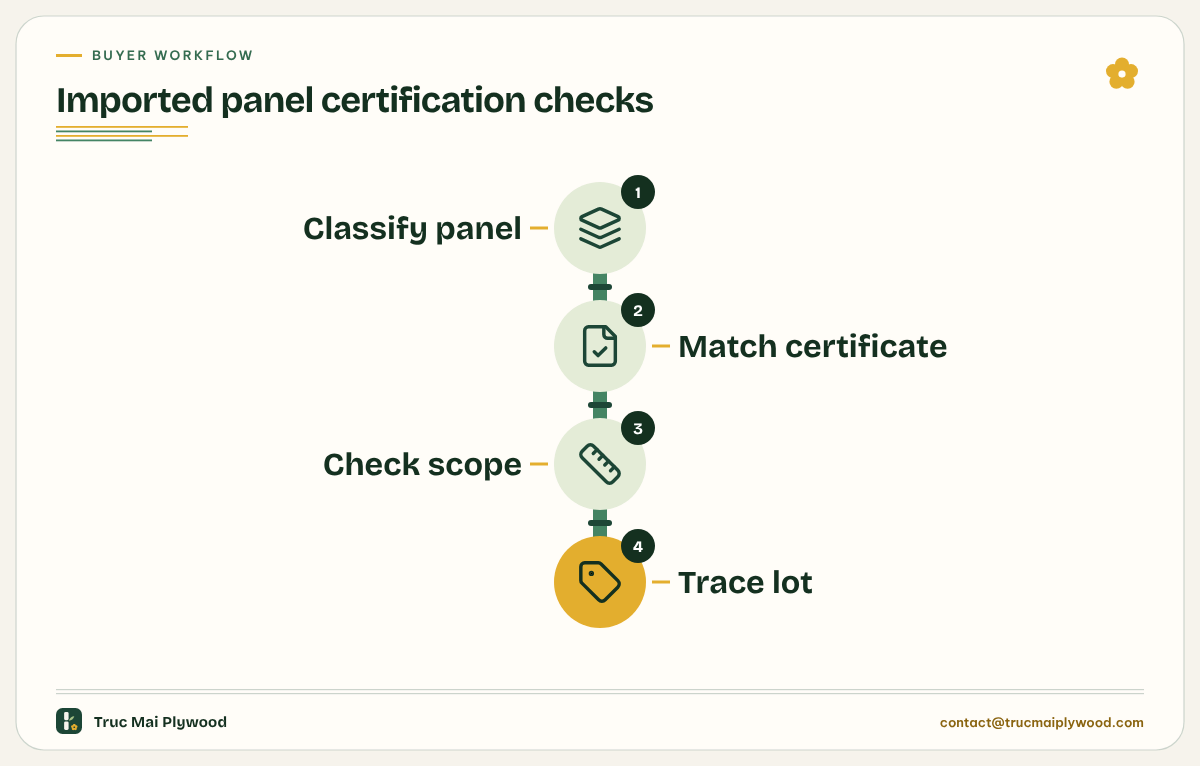
A purchasing team can use a simple sequence:
- Identify whether each component is MDF, thin MDF, particleboard or hardwood plywood.
- Request the certificate and check that the producer and panel category match the offer.
- Check the covered thickness and construction before approving the sample.
- Record the lot identification on incoming material and link it to production.
- Match shipping documents, labels and the agreed specification before release.
A document issued for veneer-core plywood should be read as a veneer-core plywood document. It does not cover a separately purchased MDF board. Likewise, a certificate for one factory is not a blanket approval of material sourced from another. For importers, this traceability is as useful as the headline emission limit because mixed furniture programmes may involve several panel producers.
What does Truc Mai’s plywood certification cover?
Truc Mai Plywood holds CARB Phase 2 and EPA TSCA Title VI certification for hardwood plywood with veneer core, in the 3–25 mm thickness range and 3–15 plies. The certificate identifier is CARB/EPA 26053, the mill identifier is ICTT-26053 and the third-party certifier is ICTT Corporation, TPC-43. These details give a buyer a specific record to match to a plywood order.
The factory makes furniture and commercial plywood in Ha Hoa, Phu Tho, Vietnam, using veneer cores such as Styrax, Acacia, Eucalyptus, Pine and combinations. Its furniture construction typically uses stitched core veneers and sanded, calibrated faces. The face veneer can be specified independently of the core, including birch, poplar or engineered veneer. That separation matters when a buyer needs the same appearance on different core builds.
The certified scope ends at 25 mm; the mill’s wider 3–40 mm production range includes thicker panels outside that certificate. For a purchase, write the chosen construction and thickness on the order and match them to the scope. A useful next step is to compare birch-faced plywood against the desired cabinet or interior component.
Is MDF banned in the UK or Australia?
No general UK ban on MDF is identified by the Health and Safety Executive (HSE). Its woodworking frequently asked questions explicitly address the ban rumour and explain workplace controls for wood dust and formaldehyde. UK purchasers should distinguish the legality of the board from workplace exposure duties and any emission specification set by the finished-product customer.
For Australia, buyers should use the requirements applicable to their finished furniture, workplace and procurement contract rather than assume that US TSCA labelling is a universal approval. Import markets do not all use the same test basis or classification. A certificate can be useful evidence, but the purchaser should specify which test and threshold the receiving market or customer requires.
Is MDF dust dangerous when it is cut or sanded?
Yes. Cutting and sanding MDF generate airborne wood dust that requires workplace controls. The UK HSE treats wood dust and formaldehyde as separate occupational exposures and advises employers to control both under the Control of Substances Hazardous to Health framework. The HSE woodworking guidance explains the relevant exposure-control approach.
A furniture factory should collect dust at the cutting or routing point, maintain extraction equipment and use suitable respiratory protection where the risk assessment calls for it. Cleaning methods should avoid putting settled dust back into the air. Those measures matter for MDF and for plywood machining, especially where repetitive cutting produces fine particles throughout a shift.
How do MDF and plywood glue lines differ?
MDF distributes resin through a mat of wood fibres; veneer-core plywood bonds discrete wood veneers along glue lines. The different constructions affect how the panels are manufactured and which product category a regulator tests. They do not, by themselves, establish that either product has a lower emission result.
For plywood, a mill can specify a veneer core, the number of plies, the face species and the adhesive system. For MDF, a buyer usually specifies board grade, thickness, surface treatment and emission classification. In either case, the factory’s quality control should connect the resin and production process to the finished panel’s measured performance.
The US Department of Agriculture Wood Handbook, chapter 10 distinguishes the moisture resistance of common wood adhesives. UF is widely used for interior panels; melamine-containing and phenolic systems have different water-resistance characteristics. A stronger wet bond does not automatically mean lower formaldehyde emissions. An order should name the bond requirement and the emission test independently.
What do E1, E0 and EU formaldehyde rules mean?
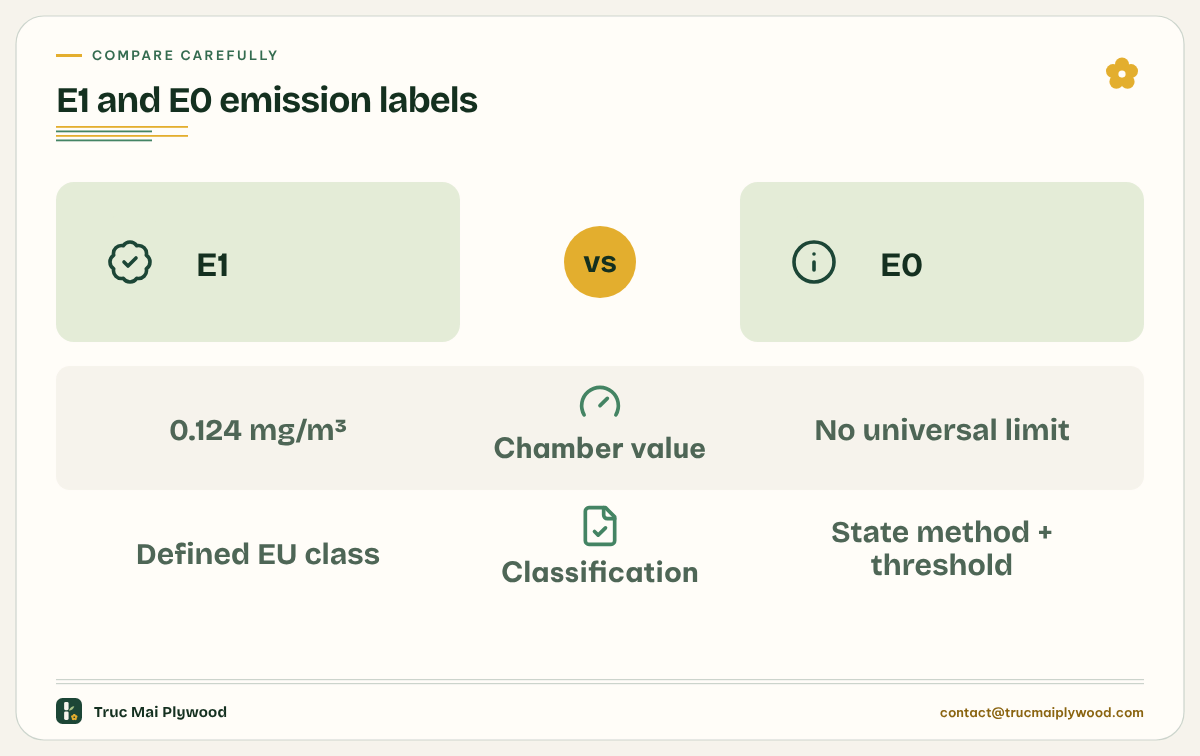
E1 is a defined European panel emission classification, while E0 needs a stated test method and threshold in the buyer’s specification. For EN 13986 construction-panel classification, the E1 chamber reference is 0.124 mg/m³ under EN 717-1. The label E0 has no single universal limit in that standard, so the letters alone are insufficient for comparing offers.
The European Union also has a separate restriction on formaldehyde released from articles. The European Commission’s 14 July 2023 announcement describes a 0.062 mg/m³ limit for furniture and wood-based articles and 0.080 mg/m³ for other articles. Under REACH Annex XVII entry 77, the furniture and wood-based article restriction applies from 6 August 2026. Its chamber conditions are specified separately from EN 717-1.
US ppm values and European mg/m³ values should remain in their original methods and units. A purchaser cannot substitute one numerical label for another. For EU furniture programmes, state the destination and request a report matching the applicable article test conditions. The planned emission-class-per-order resource addresses how to write that requirement.
Does a sealed or laminated surface make a panel compliant?
No. A melamine, high-pressure laminate or painted finish does not replace the applicable TSCA Title VI certification of the regulated wood panel beneath it. A finished surface can change how an assembly behaves in use, but the purchasing file must still identify the substrate and the regulatory category.
A supplier’s test report for a bare substrate should be read against its stated specimen and method.
Which panel is better for a kitchen or interior order?
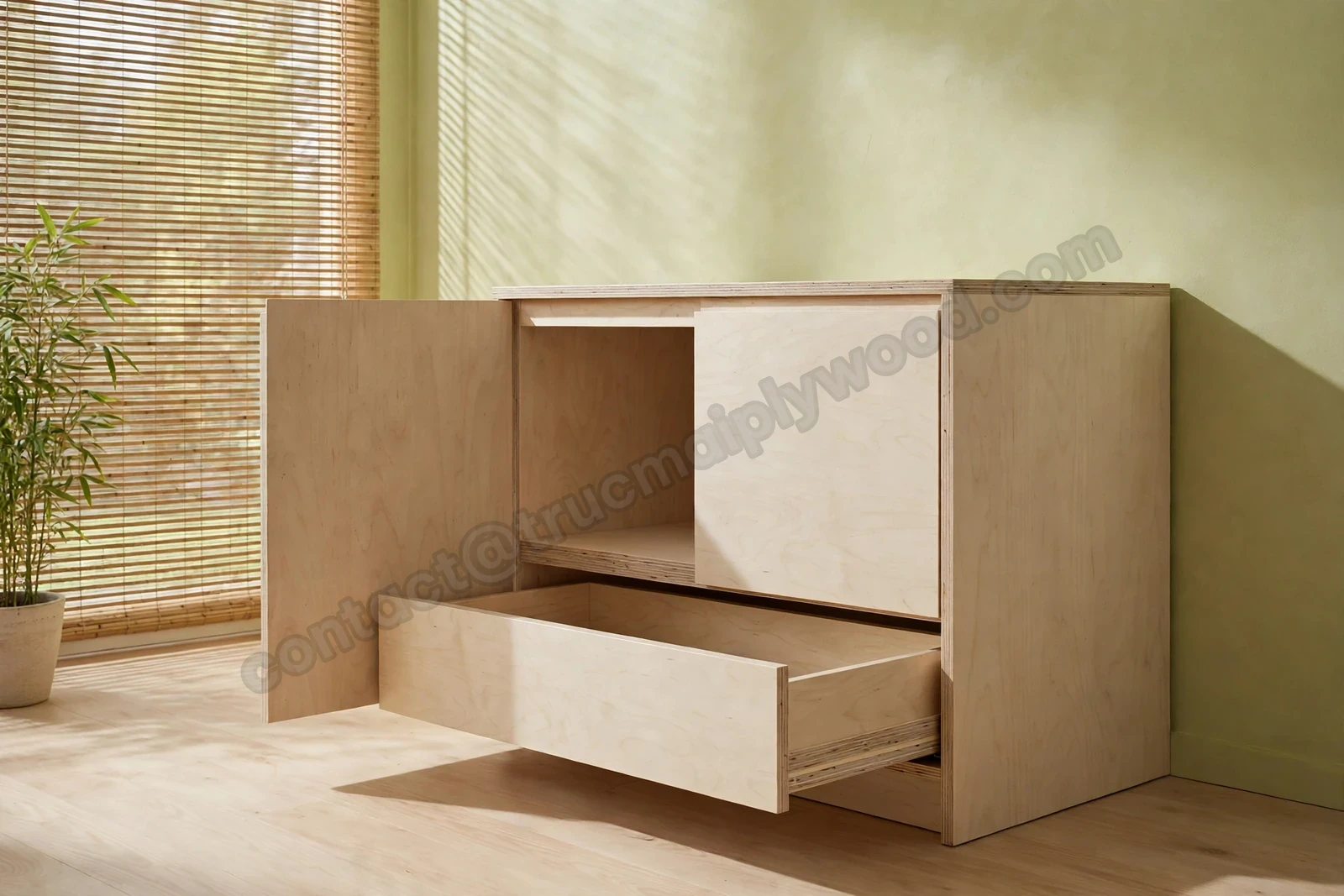
Choose MDF for a smooth painted or routed surface, and consider veneer-core plywood where the order requires a specified veneer appearance, layered edge or core construction. The better option is the one whose physical performance, emission documentation and finish match the component’s duty.
| Buyer requirement | MDF approach | Veneer-core plywood approach |
|---|---|---|
| Painted routed door | Uniform fibre surface | Face preparation and edge treatment need specification |
| Visible wood veneer face | Decorative veneer or finish over MDF | Selected face veneer bonded to veneer core |
| Edge appearance | Fibre edge normally finished | Visible plies or covered edge |
| US emission file | MDF category certificate | Hardwood plywood veneer-core certificate |
| Repeat procurement | Board grade, finish, thickness, lot | Face, core, glue, thickness, lot |
A furniture buyer should also evaluate fixing performance, machining quality, flatness and moisture exposure against the intended design. Emission compliance is one selection criterion, not a complete mechanical specification. When comparing quotations, ask for the same panel thickness, finish preparation and test evidence on each line. The plywood RFQ checklist gives a useful order structure.
What evidence should buyers request from a panel mill?
Request a product-specific certificate, a defined emission specification and traceable lot documentation before approving the material. A broad statement that a factory supplies ‘low-formaldehyde boards’ does not tell the buyer which product category, thickness or testing method was assessed.
For a repeat furniture programme, put the following fields in the technical schedule:
- Application: cabinet carcass, drawer part, door, interior lining or another named component.
- Construction: MDF category or plywood face, core species and joining method.
- Adhesive and emissions: adhesive type, destination-market requirement, test method and certificate identifier.
- Dimensions: nominal thickness, length, width and agreed tolerances.
- Finish: sanded, UV-ready, melamine-faced, HPL-faced or other agreed preparation.
- Dispatch: packing method, lot labels, quantity and destination port.
For veneer-core furniture plywood, the mill can supply an approved face sample and write the face/back pairing into the order. Thickness tolerance is agreed by product line, commonly ±0.3–0.5 mm. A sample is useful for checking visible surface quality; emission compliance is documented through the relevant technical file. Keeping those checks distinct reduces disputes when a later container must match the first approved construction.
How should a buyer compare emission test reports?
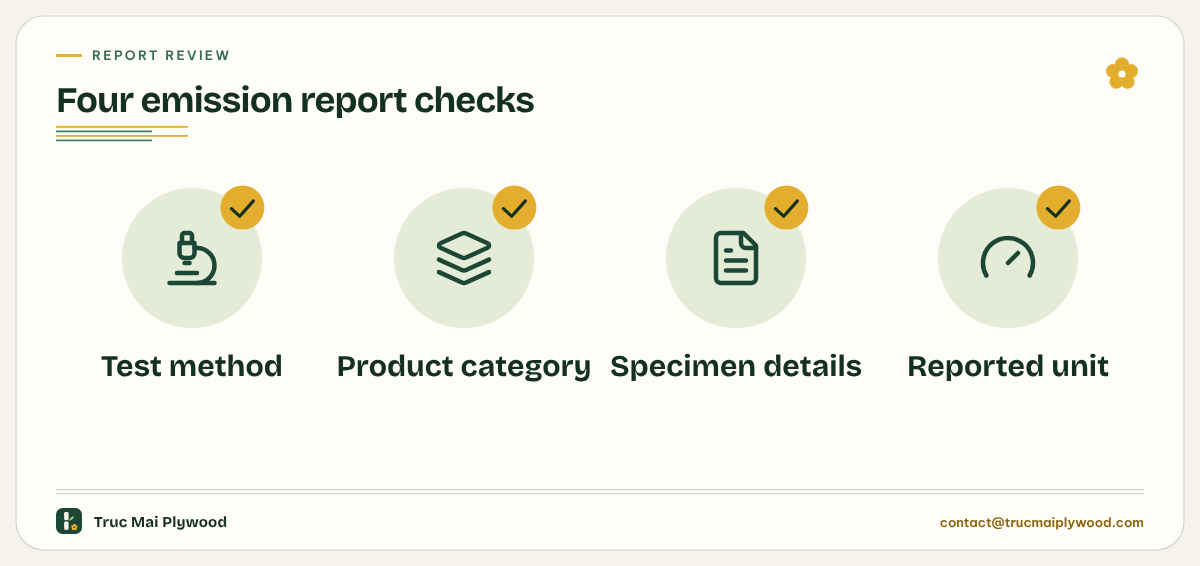
Compare the method, product category, specimen description and reported unit against 40 CFR Part 770 before comparing the measured values. An ASTM chamber result stated in ppm and an EN chamber result stated in mg/m³ are different reporting systems. A numerical comparison without the methods can lead to the wrong purchasing decision.
A useful report review starts with the laboratory and method, then checks the panel thickness, resin or construction description, sample identification, date and measured result. Next, match the report to the certificate scope and the order line.
How do you write a compliant plywood order without over-specifying it?
Write the intended application, exact panel construction and destination-market emission requirement on the same purchase order. This gives the mill a build to quote and the importer a document set to check. Avoid substituting a broad phrase such as ‘export quality’ for the test category.
For example, a buyer can request: furniture carcass plywood, Styrax veneer core, birch face and agreed back grade, UF glue at the specified emission class, sanded and calibrated, 1220 × 2440 × 18 mm, agreed thickness tolerance, labelled packs and one 40HC. The applicable certification scope and test evidence are then attached to that build rather than inferred from the wood species.
For a different cabinet finish, the buyer can change the face to engineered veneer or specify a melamine or HPL surface while keeping the core and emission requirement explicit. Cut-to-size panels can be labelled to the agreed cutting list, including halves, thirds, quarters or six-piece patterns. That lets the factory plan machining and packing around the actual furniture components.
Send the application, core, glue and emission requirement, face, dimensions, packing and quantity through the planned quotation page or to contact@trucmaiplywood.com. The requested documents should correspond to the exact configuration being purchased.
Questions buyers ask
Can a US retailer sell an MDF cabinet?
Yes. A cabinet containing regulated MDF can be sold in the United States when the applicable TSCA Title VI requirements for its composite wood components and finished-goods labelling are met.
Is an old MDF shelf automatically illegal?
No. The federal rule distinguishes new regulated products from finished goods already sold to an end user. Age alone does not identify an emission result.
Can I identify formaldehyde emissions by smelling a panel?
No. Smell cannot give an ASTM chamber result or establish compliance with an emission limit. Request the product's certification and test documentation.
Does painting MDF remove the need for certification?
No. Painting or laminating a panel does not replace the underlying composite wood compliance requirements. Specify the panel category and its documentation before finishing.
Is an FSC label an emissions certificate?
No. FSC chain-of-custody documentation concerns the certified material claim and its traceability. Formaldehyde compliance uses a separate emission standard and supporting records.
Can I order a plywood face in birch without a birch core?
Yes. Birch-faced plywood can combine birch face veneer with a different veneer core. State both face and core species on the purchase order.
What should a furniture factory record when it changes panel suppliers?
Record the new producer, product type, thickness, certification scope, lot identification and approved sample. Keep the specification linked to the finished furniture bill of materials.
Is E0 a recognised US TSCA emission class?
No. US TSCA Title VI sets limits by regulated panel category rather than an E0 label. Ask for the named test method and measured result when a seller offers E0.
Does a moisture-resistant adhesive mean lower formaldehyde emissions?
No. Moisture resistance is a bond-performance characteristic, while formaldehyde emission is measured separately. Put both requirements on the order.
Should an importer ask for documents before loading?
Yes. Agree the emission category and certificate scope before confirming the order, then match lot and shipping records to the goods dispatched.