
Formaldehyde emission test methods measure different things. Chamber tests measure formaldehyde released into air; perforator tests measure extractable content, while desiccator and gas-analysis tests use different collection conditions. For plywood orders, specify the destination-market limit, named method, laboratory scope and panel construction together. Truc Mai Plywood can supply its US certification details and arrange order-specific test documentation.
Which formaldehyde emission test methods answer which question?
Chamber, desiccator, gas-analysis and perforator methods answer four different laboratory questions. The choice starts with whether the buyer needs a concentration in room-like air, release under accelerated conditions, or formaldehyde extracted from the board. A single label such as E1 or E0 cannot replace that distinction.
| Method family | What the laboratory examines | Common reported unit | Main buying use |
|---|---|---|---|
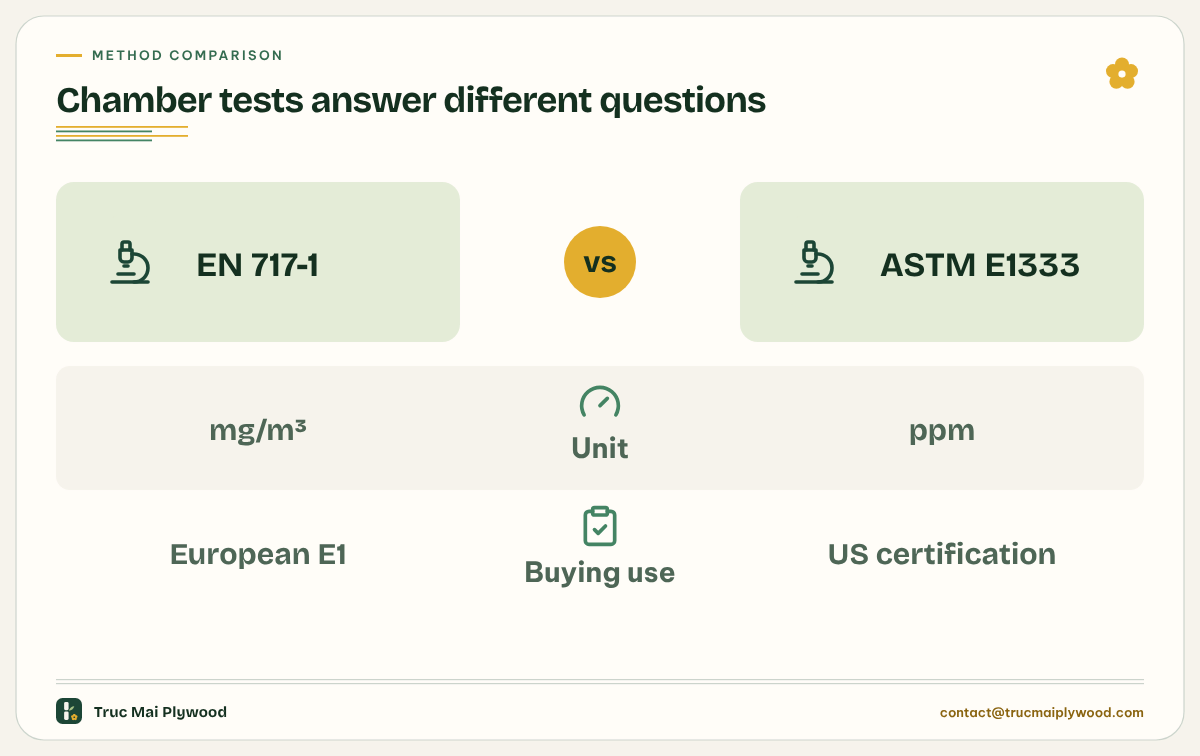
| EN 717-1 chamber | Formaldehyde concentration in controlled chamber air | mg/m³ | European E1 reference assessment |
| ASTM E1333 chamber | Formaldehyde concentration in controlled chamber air | ppm | US hardwood-plywood certification reference |
| ASTM D6007 small chamber | Emission in a smaller controlled chamber | ppm | US equivalent method under the required programme |
| JIS A 1460 desiccator | Formaldehyde collected in water from a specimen enclosure | mg/L | Desiccator-based specifications and quality control |
| ISO 12460-3 gas analysis | Formaldehyde released under specified test conditions | mg/m²h | Factory control and correlated testing |
| ISO 12460-5 perforator | Formaldehyde extracted from wood-based material | mg/100 g | Factory control and correlated testing |
The US Environmental Protection Agency’s testing guidance identifies chamber methods for certification and lists other methods that can be used for quality control with the required correlation. Fraunhofer WKI’s E1 hEN technical description makes the same distinction between a reference chamber result and factory-control methods in its European programme.
For a buyer, the useful comparison is the test method printed beside the result. A supplier offering a perforator value and another offering a chamber concentration have provided different measurements. Request the method, edition, specimen description and acceptance criterion before comparing their reports.
How does the EN 717-1 chamber method assess E1 plywood?
EN 717-1 is the reference chamber method used for the European E1 assessment described in EN 13986. The E1 reference concentration is at most 0.124 mg/m³ under that method, as set out in Fraunhofer WKI’s E1 hEN certification document.
The laboratory places prepared specimens into a chamber and controls the surrounding conditions. It measures formaldehyde in the chamber air, rather than the amount of formaldehyde that could be extracted from the panel. Conditioning, exposed surfaces and the laboratory’s specimen description matter when matching a report to a furniture-panel order.
A buyer asking for “EN 717-1 E1 plywood” should put both the method and the E1 acceptance limit on the specification. The report should show the actual measured value, not merely a class tick box. For a birch-faced cabinet panel, the sample description should distinguish imported birch face veneer from the Vietnamese veneer core. The birch-faced plywood specification gives the product context for that distinction.
What does REACH entry 77 require for European furniture?
REACH Annex XVII entry 77 sets a 0.062 mg/m³ formaldehyde-release limit for furniture and wood-based articles placed on the EU market from 6 August 2026. The legal reference is Commission Regulation (EU) 2023/1464, including its Appendix 14 chamber procedure.
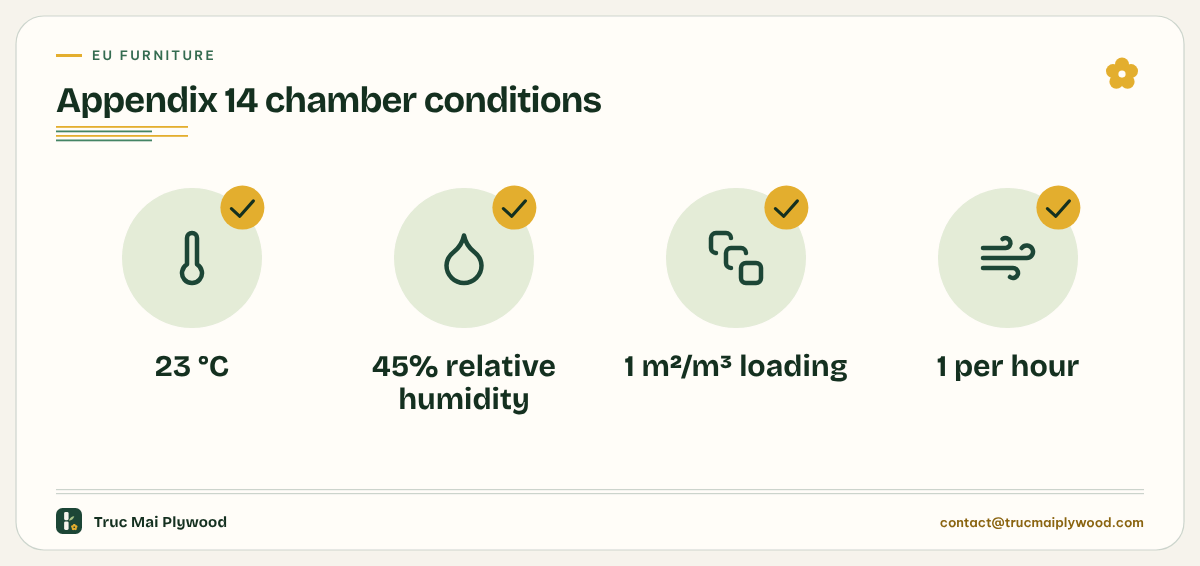
The Appendix specifies reference conditions of 23 °C, 45% relative humidity, a loading factor of 1 m²/m³ and an air exchange rate of 1 per hour, with stated tolerances. These conditions are part of the measurement. A report for a different chamber regime needs assessment against the procedure and any legally permitted alternative conditions.
Entry 77 also sets a separate limit for other articles and lists exclusions, including articles used exclusively outdoors. Furniture importers should ask the laboratory to state that the test configuration follows the relevant Appendix 14 conditions. A historic E1 result answers a different specification question; the EU order file should identify the current intended article and its applicable requirement.
The EU plywood import steps provide the wider paperwork sequence. Keep the emission report with the specification and commercial documents so the receiving buyer can identify the tested construction.
Which ASTM chamber test does the US market use?
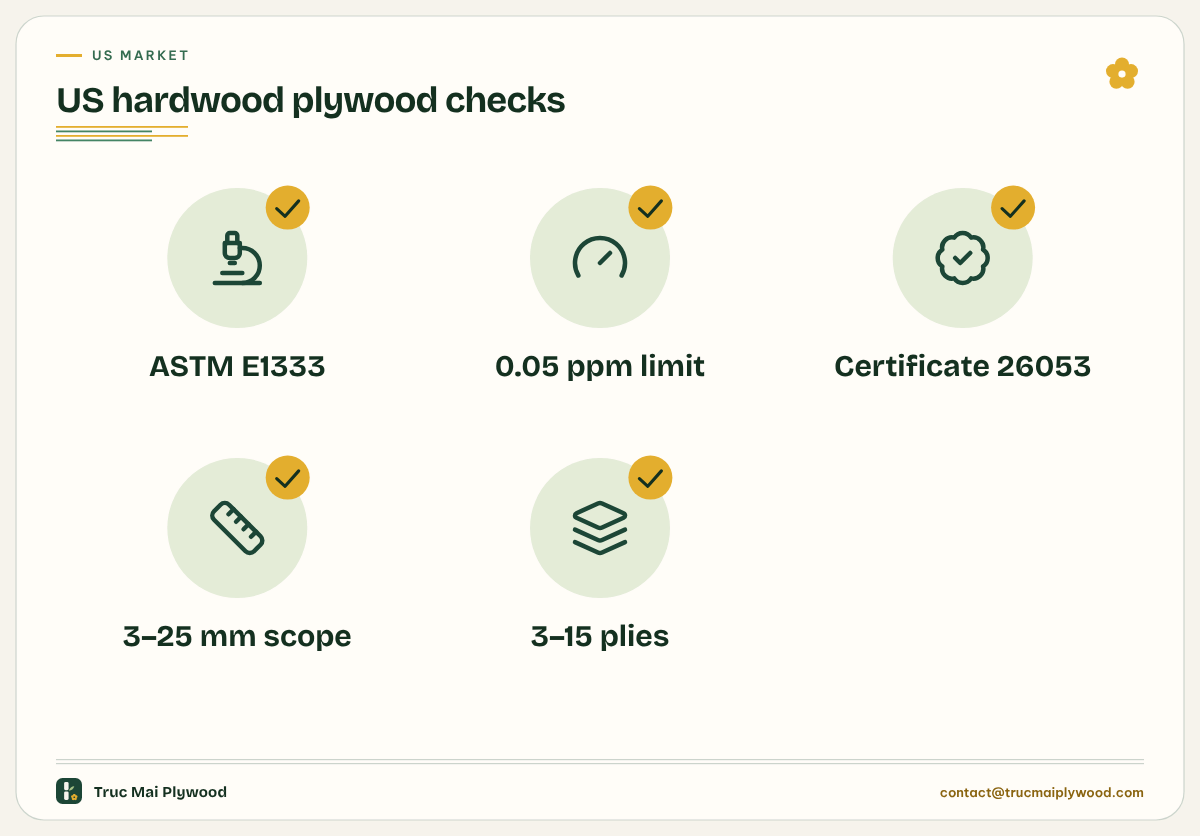
ASTM E1333 is the reference chamber method under US TSCA Title VI for regulated composite wood products, with ASTM D6007 available under the rule’s equivalence provisions. The hardwood-plywood emission limit is 0.05 ppm. See 40 CFR Part 770 and the EPA implementation questions.
The US programme involves recognised third-party certifiers, product certification and continuing mill quality control. It therefore asks for more than an isolated number on an unsigned laboratory sheet. The importer should identify the certifier, the regulated product category and the scope of the mill’s certificate.
Truc Mai holds CARB Phase 2 and TSCA Title VI certification for hardwood plywood with veneer core, within its certified 3–25 mm and 3–15-ply scope. Its certificate identifier is CARB/EPA 26053, and the mill identifier is ICTT-26053. The Phase 2 limits page and US import steps are useful companion documents for a US order.
The certificate scope matters when the buyer orders several constructions. Put each thickness and ply build on its own line so the certificate can be matched to the actual products, rather than attaching the same description to an entire mixed container.
How do small-chamber and large-chamber results differ?
ASTM D6007 uses a smaller chamber than ASTM E1333, and the US programme requires the specified demonstration of equivalence when D6007 is used in place of the reference method. The EPA’s testing explanation describes this relationship and the role of routine quality-control tests.
A laboratory should identify its chamber method, specimen loading and the applicable programme. A buyer should compare reports produced under the same accepted method and specimen conditions. The printed unit alone does not establish that two chamber results are directly comparable.
For repeat purchasing, a sensible file contains the initial qualification result, the recognised certifier’s details and the factory-control records called for by the programme. That gives the importer a way to trace an order specification through production without turning every shipment into a new certification project.
When is a desiccator test useful?
JIS A 1460 is a desiccator method used to measure formaldehyde collected in water under its defined procedure. It is useful where a buyer’s specification explicitly calls for that method and as a factory-control technique under an accepted correlation programme. EPA identifies JIS A 1460 among the possible quality-control methods in its formal testing guidance.
A desiccator result is commonly reported in mg/L. This describes the collection liquid, not the concentration in a European or American test chamber. Write the desiccator method and the buyer’s acceptance limit together rather than converting the result into a chamber classification.
The practical sample question is whether the tested pieces represent the ordered panel. An unfinished veneer-faced sheet, a melamine-faced board and an HPL-faced board have different exposed surfaces. Record which one entered the desiccator, along with the edge preparation specified by the laboratory.
What do gas-analysis and perforator tests measure?
Gas analysis measures formaldehyde released from a panel under specified conditions, while the perforator method measures formaldehyde extracted from the material. ISO 12460-3 and ISO 12460-5 are named factory-control methods in the Fraunhofer WKI certification programme.
The gas-analysis result is commonly expressed as release per unit area and time; perforator results express extracted content per mass of dry board. Neither is simply another unit for the chamber-air concentration. WKI describes establishing a quality-control limit by correlating the selected factory method with the reference chamber test.
For purchasing, a factory-control report is useful evidence of a repeatable production process. Ask the supplier which chamber qualification supports its control limit and which panel family is included. For a programme that alternates face veneers or resin systems, record the changes explicitly so the laboratory can select representative samples.
Why should buyers avoid converting ppm to mg/m³ across methods?
A ppm result from ASTM chamber testing and an mg/m³ result from an EN chamber test belong to their named methods and conditions. The acceptance decision follows the applicable standard, not a numerical shortcut. The US 40 CFR Part 770 and European REACH Appendix 14 specify different regulatory frameworks.
Even where two laboratories report chamber-air concentration, specimen preparation, loading, ventilation and conditioning can affect the measured result. A simple physical-unit conversion cannot supply missing method equivalence. Desiccator, gas-analysis and perforator results are further removed because they measure different quantities.
Use a comparison sheet with separate columns for method, unit, measured result and applicable threshold. Leave a cell blank when the required test has not been performed. That is more useful than a universal converter that prints an apparently precise compliance verdict for an unrelated method.
Which labs in Vietnam test plywood formaldehyde and are they accredited?
ICTT Corporation is the third-party certifier identified in Truc Mai’s US hardwood-plywood certification file; its recognised certifier identifier is TPC-43. For a specific Vietnamese testing laboratory, verify the laboratory’s current ISO/IEC 17025 scope and the exact formaldehyde method before placing the test order. The EPA list of recognised third-party certifiers provides the official US programme lookup.
A certifier and a laboratory have different roles. The certifier evaluates the product under the certification programme; the laboratory performs the named measurements. The EPA accreditation guidance describes oversight by recognised accreditation bodies. An ISO/IEC 17025 accreditation should be checked against the actual method on the report, not inferred from the laboratory’s general marketing material.
Use this verification sequence:
- Ask the proposed laboratory for its accreditation certificate and current schedule of accredited tests.
- Find the exact standard and edition requested, including chamber or extraction method.
- Check that the laboratory’s accredited scope covers the sample and method offered.
- For US certification, check the named third-party certifier against the EPA recognition list.
- Put the laboratory name, report number, test date and specimen description into the purchase documentation.
A laboratory can offer tests outside its accredited scope. The buyer should therefore request the scope schedule before authorising the sample. This is particularly relevant when an order needs both an EU chamber assessment and a US certification file.
How should the sample represent the ordered plywood?
The test sample should represent the face, core, adhesive system, thickness and surface finish written on the purchase order. A report for a bare veneer panel should identify that construction; an overlaid panel needs its own clear specimen description. The buyer’s sample approval is the reference for matching the test to production.
At this mill, the interior range includes EV, poplar, birch and other face veneers over Styrax, Eucalyptus, Acacia, Pine or combined cores. Standard panel thicknesses run from 3 to 40 mm. The buyer can request sanded, calibrated or overlay-ready surfaces and write the intended end use beside the build.
Start with a physical sample and its specification label. If a laboratory cuts smaller specimens from it, the original panel identifier should remain on the test request and report. The sample-ordering process and RFQ specification checklist help keep the sample description aligned with the commercial order.
For furniture makers, distinguish the substrate from the finished component. Adhesive, edging and a decorative overlay can change what surfaces are exposed in the finished article. The test request should identify the article configuration required by the market rule.
Which report should be requested for each destination market?
For EU furniture, request a report addressing REACH entry 77 Appendix 14; for US regulated hardwood plywood, request the applicable TSCA Title VI certification and test-method evidence. For a UK buyer, state the contractual standard and destination requirements explicitly instead of treating an EU classification as an automatic answer to every UK purchase specification.
| Destination or contract | Document to request | What to check on receipt |
|---|---|---|
| EU furniture and wood-based articles | Applicable Appendix 14 chamber report | Tested article, chamber conditions and measured result |
| European E1 specification | EN 717-1 reference result or accepted programme documentation | EN 13986 context, product family and E1 assessment |
| USA regulated hardwood plywood | TSCA Title VI / CARB certification file | Recognised TPC, product type, thickness and ply scope |
| UK commercial contract | Named test method and buyer’s acceptance criterion | Exact edition, specimen and laboratory accreditation scope |
| Other contract using desiccator or extraction testing | Report for the specified method | Correct unit and method-specific acceptance limit |
This matrix is a purchasing decision tool, not a substitute for the buyer’s contract. A repeat programme can maintain one agreed specification sheet and attach the correct market documents to each shipment. The documents-per-container checklist explains how test files sit alongside the shipping paperwork.
What should a complete emission report contain?
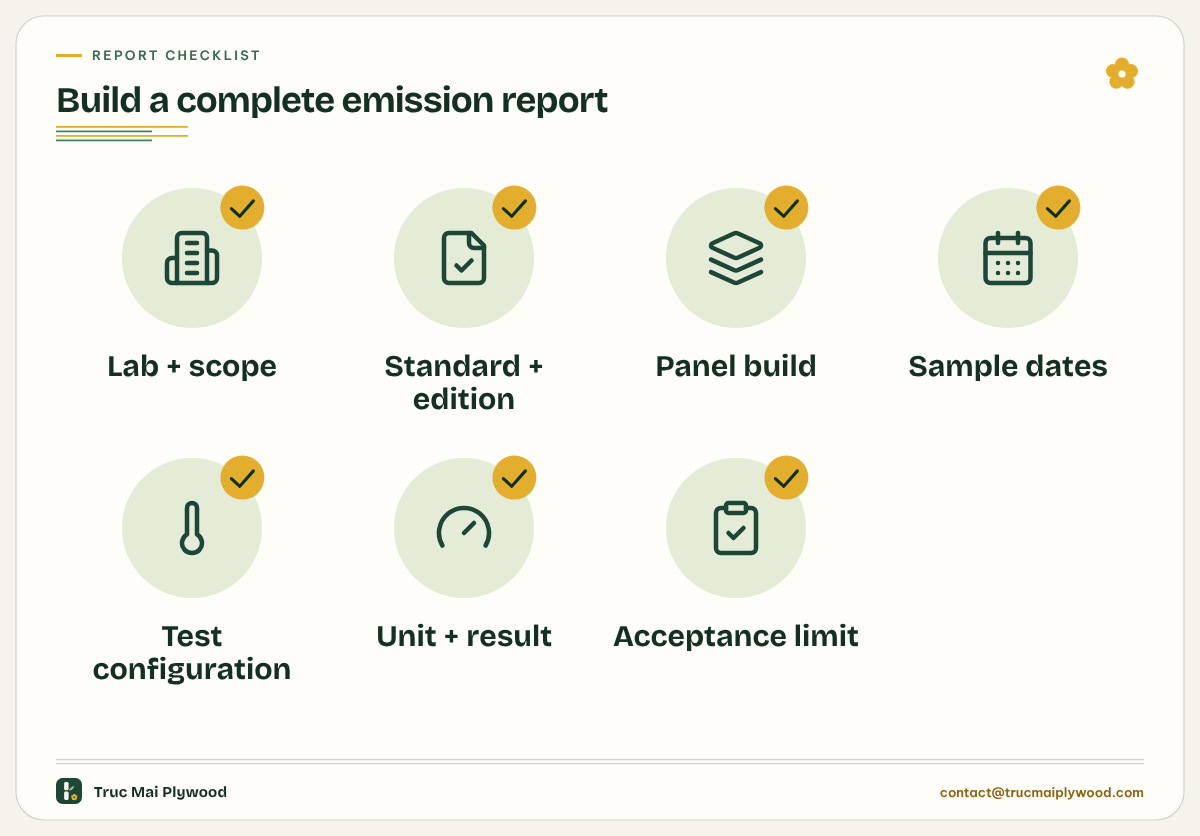
A useful report identifies the laboratory, report number, sample, method, measured result and the conditions needed to interpret it. Buyers should be able to match the report to an actual purchase-order line without guessing what was tested.
Ask for these fields:
- Laboratory identity and accreditation scope for the named test.
- Test standard, edition and any stated deviations.
- Panel face, core, adhesive system, thickness and finish.
- Sample receipt, conditioning and test dates.
- Test configuration, reporting unit and measured result.
- Applicable acceptance limit and the laboratory’s assessment where included.
- Report identifier and authorised signatory or verification mechanism.
Keep the original PDF and the order’s specification together. For mixed containers, use separate product lines rather than a single description such as “commercial plywood”. An importer receiving a claim for a different thickness or coating can then identify the exact gap and order the correct supplementary test.
The document should be read alongside the supplier’s certification scope. A laboratory test and a product-certification programme serve related but distinct functions, and both are relevant where the destination rule calls for third-party certification.
How do glue selection and emission classification relate?
Adhesive type and formaldehyde emission classification are separate specification lines. A buyer can specify UF glue at E0 emission, but the E0 designation needs an agreed method and numerical limit. For the US market, the required certified product category and method take priority over an informal resin label.
A glue-bond test answers whether veneers remain bonded under a prescribed treatment. An emission test measures formaldehyde under its own laboratory procedure. The USDA Forest Products Laboratory Wood Handbook describes the differing moisture-resistance characteristics of common wood adhesives; it does not make a boil result an emission result.
On a furniture order, write the face appearance and bonding requirements separately from the emission target. This allows the mill to prepare the correct construction and lets the laboratory report the requested property. The buyer should also keep surface coating instructions separate from the base-panel emission designation.
How should an importer write the emission requirement in an RFQ?
Write the market, product construction, named test method, acceptance limit and required report together in the RFQ. The most useful specification is one that the laboratory can quote and the mill can manufacture without interpreting shorthand.
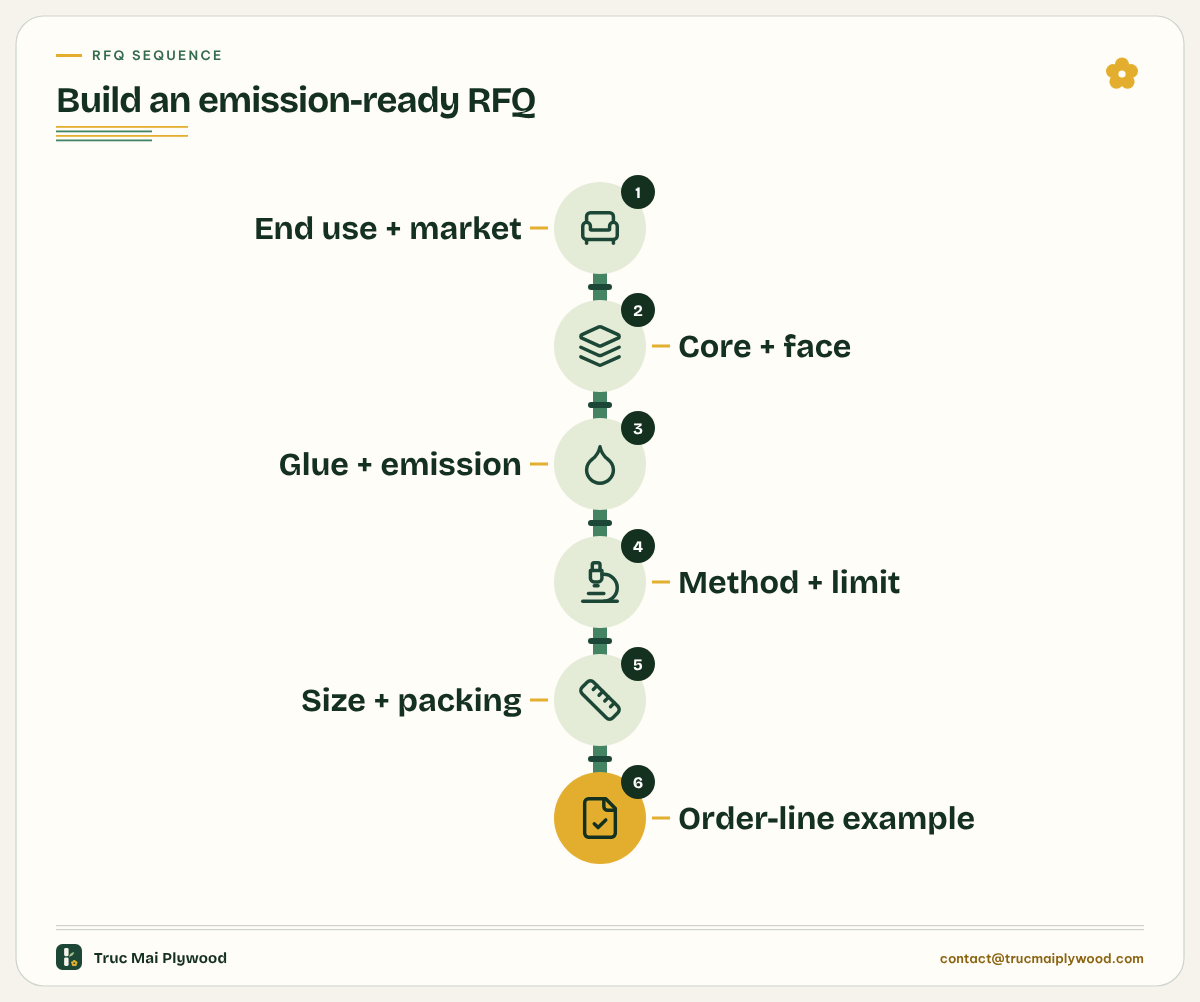
A workable order sequence is:
- State the end use, such as cabinet carcasses or interior door skins, and destination country.
- Select core and face veneer, including face/back grade and surface finish.
- Specify glue and emission as separate requirements.
- Name the laboratory method and market acceptance criterion.
- Add sheet dimensions, thickness tolerance, packing format and quantity.
- Request the relevant certificate scope and sample test documents before production approval.
For example, a buyer might request a sanded, birch-faced interior panel on Styrax core, 1220 × 2440 × 18 mm, with the agreed emission test and report identified on the same order line. The example defines a configuration, not a test result.
Send the specification through the plywood RFQ guide or to contact@trucmaiplywood.com. Include the intended application, core, glue/emission requirement, face, size, packing and container quantity so the quotation and test-document request refer to the same build.

Send your specification to contact@trucmaiplywood.com or through the quotation form.
Questions buyers ask
Can I use a desiccator result on a European purchase order?
A desiccator result can support factory screening. Specify an accepted European chamber method and its applicable limit for the formal market assessment.
Should the test report identify the face veneer?
Yes. The report should identify the tested face, core, thickness, adhesive system and surface finish so the buyer can match it to the order.
Is E0 a single European legal emission limit?
No. E0 has no single limit under EN 13986. Write the numerical acceptance limit and the method beside any E0 designation.
Can a laboratory test a sample before the container is ready?
Yes. Agree the sample identification and laboratory schedule during specification approval, then retain the report with the order file.
Does a boil test measure formaldehyde release?
No. Boiling and shear tests assess bond performance. Formaldehyde emission needs a separately named emission method.
Do I need a new certificate for every shipment to the USA?
US panel certification operates through recognised third-party certification and factory quality control. Buyers should obtain the applicable certificate details and shipment documents for their purchase.
Should a coated panel be tested with its coating?
Specify the final surface construction and the laboratory's specimen preparation. A report for an unfinished board should be distinguished from a report for a coated article.
Can a ppm figure be entered into a European mg/m³ limit?
Use the method required by the relevant European rule. Different chamber conditions and test families need their own assessment rather than a simple comparison of printed figures.
What should be included in the laboratory quotation?
State the specimen construction, method and edition, number of specimens, conditioning, requested reporting units and the destination-market acceptance criterion.
Can one test report cover every plywood thickness?
Ask the laboratory and certification body to identify the product family and thickness scope covered. The tested configuration and authorised certification scope determine which order lines the document supports.