
Good one side plywood (G1S plywood) has one selected show face and a less decorative reverse. For cabinets, shelves and wall panels, specify the visible veneer, back acceptance standard, core, thickness and finish separately. This buys appearance where people see it while keeping the concealed side fit for machining, bonding and installation.
What does good one side plywood mean?
Good one side plywood has a selected display face and a utility-grade reverse. G1S describes that face/back arrangement, not the species, strength, adhesive or finish. Canadian suppliers use the term for both fir sheets and decorative hardwood-faced cabinet panels, so buyers should specify the two veneer grades and the intended application.
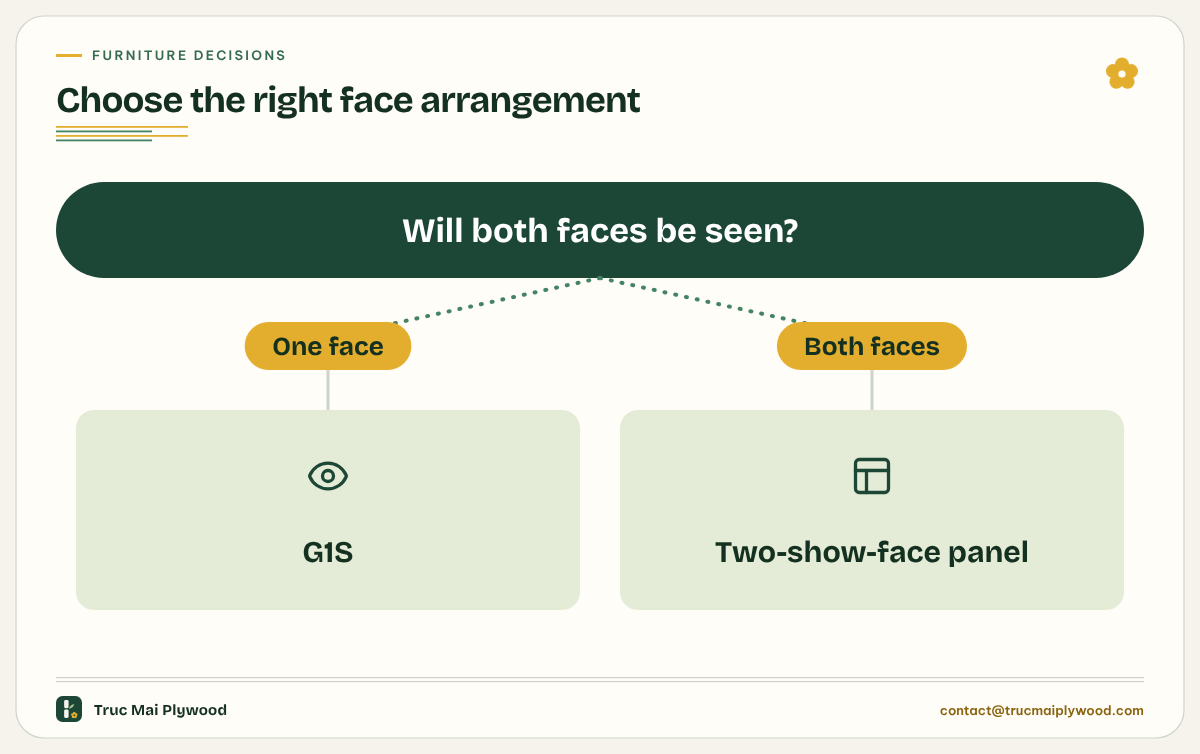
Think of a cabinet end panel: the room-facing surface needs a consistent grain, colour and repair standard. Its inner face sits against a carcase, so an equally decorative veneer brings little visible benefit. On a freestanding divider, by contrast, both faces are seen and a two-show-face specification is more sensible. The buyer should identify which side will be visible after assembly, not merely how the sheet looks on the rack.
The sheet specification guide separates appearance, core and finish into orderable properties. A G1S label is useful shorthand only after those properties have been written down.
How are G1S plywood face and back grades specified?
A G1S order needs two face descriptions, one for the show side and one for the reverse. For the front, record species, grain character, colour range, sound knots, filled repairs, splits and sanding quality. For the back, record defects that would interrupt glue contact, machining or the required finish. The same panel may pass a visual check yet fail the buyer’s assembly requirement if the reverse contains a raised repair where a fitting must sit.
| Inspection item | Show face | Utility back | Buyer acceptance method |
|---|---|---|---|
| Veneer | Named species and approved colour range | Agreed species or utility veneer | Signed front/back samples |
| Knots and patches | Visible repairs limited by sample | Repairs accepted to back-grade sample | Mark representative defects |
| Surface | Sanded for the planned coating | Sanded where bonding or contact needs it | Raking-light and touch inspection |
| Edge | Neat veneer and core junction | Sound enough for machining | Inspect cut edge and corners |
| Grain | Direction aligned with finished part | Direction recorded if it affects machining | Mark face arrow on cut list |
Trade labels such as BB/CC or A/B are negotiated descriptions. They are not automatically the classes in ISO 2426-2:2020, which classifies hardwood plywood appearance as E, I, II, III and IV. Compare the BB/CC face-pair explanation and the face grade letters before approving a sample.
Is G1S the same as A-C, BB/CC or select plywood?
No. G1S says one side is the preferred display side; A-C, BB/CC and select describe different grading conventions whose meaning must be checked. The US PS 1-22 structural plywood standard lists A-C as an Exterior structural grade with an A face and C back. That designation cannot simply be transferred to an imported non-structural furniture panel.
For decorative plywood, a supplier might offer an attractive birch face with a utility veneer reverse and call it select or G1S. Another supplier might mean a sanded fir face with visible plugs. The correct comparison is the sample and the technical schedule, not the letters alone. Specify a clear photograph of both sides, a physical sample from the intended construction, and written limits for defects.
Ask the supplier to distinguish appearance class from bond classification. Even a beautifully sanded face tells you nothing about the glue-line test or formaldehyde emissions. The sanded or unsanded face guide explains the preparation decision separately.
Where does a single show face make sense in furniture?
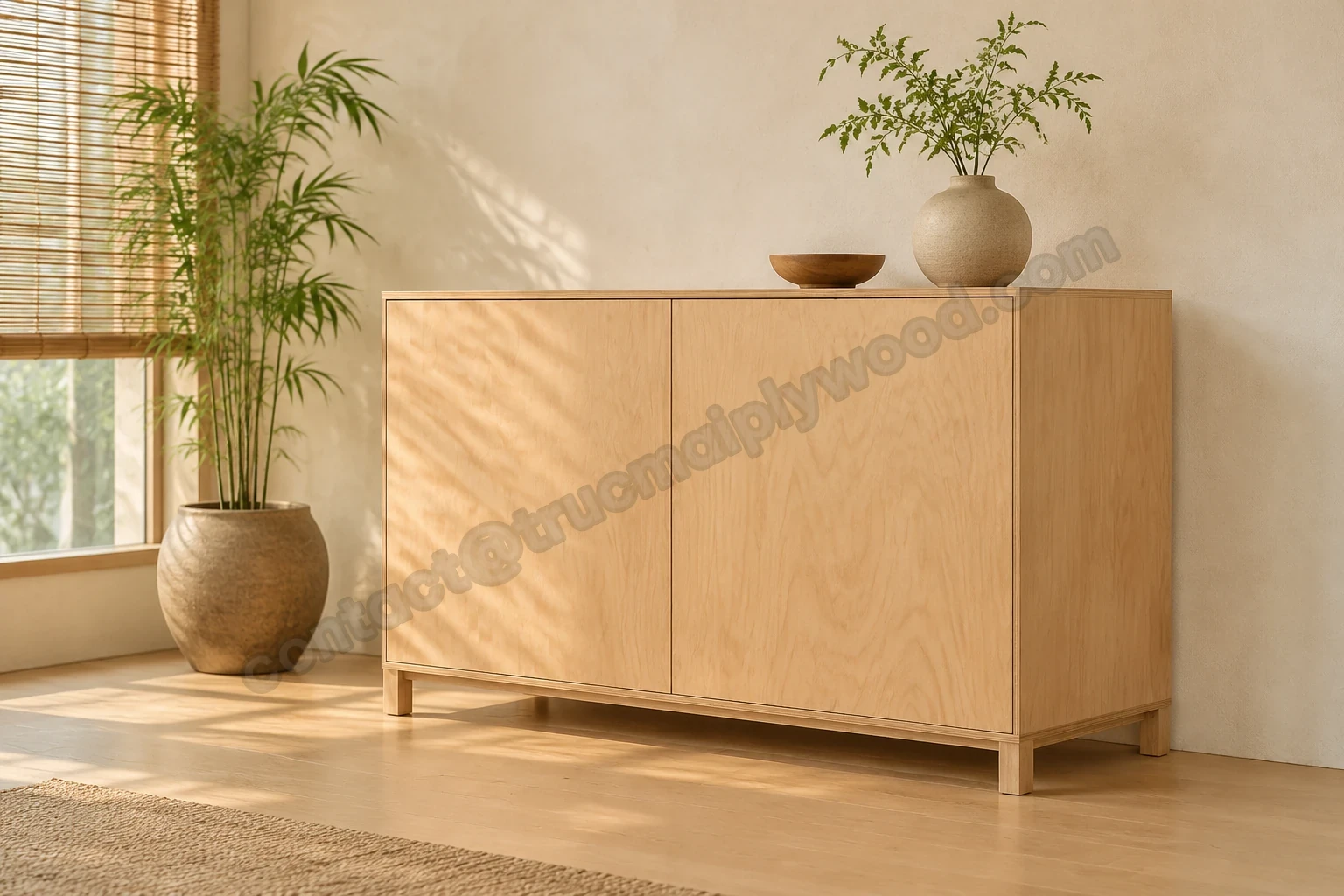
A single show face makes sense when only one face remains visible after the piece is fitted. Typical interior uses include cabinet end panels facing a room, shelf tops above eye level, wardrobe linings, fixed wall panelling and backs of built-in furniture where one surface is exposed. The reverse still needs sufficient quality for the installation method.
A kitchen cabinet side beside a doorway needs a tidy outer face. The inner side may be covered by shelving, drawers or another component. A tall open shelf, however, can expose the underside to seated users, making the supposed back visible. A wall panel may hide its reverse completely but needs a flat bonding surface against battens or adhesive beads.
Before buying, walk through the installation drawing and shade the surfaces a user will see. That simple exercise identifies where G1S reduces unnecessary decorative grading and where a two-show-face panel prevents awkward repairs after assembly. For visible kitchen furniture, compare the cabinet-grade plywood selection guide.
When should both faces be decorative instead?
Specify two decorative faces when the reverse is visible in normal use or when a finishing process treats both faces as presentation surfaces. Open bookcases, freestanding room dividers, double-sided display fixtures and exposed cabinet doors are common examples. A back face hidden during assembly can also become visible when a removable unit is relocated.
Balance matters even if one face is concealed. Unequal veneer appearance is the purpose of G1S; unequal moisture response is not. The construction, veneer lay-up, conditioning and finishing schedule should support the flatness expected for the final part. If a buyer plans to laminate one side, the reverse treatment and panel conditioning belong in the manufacturing specification.
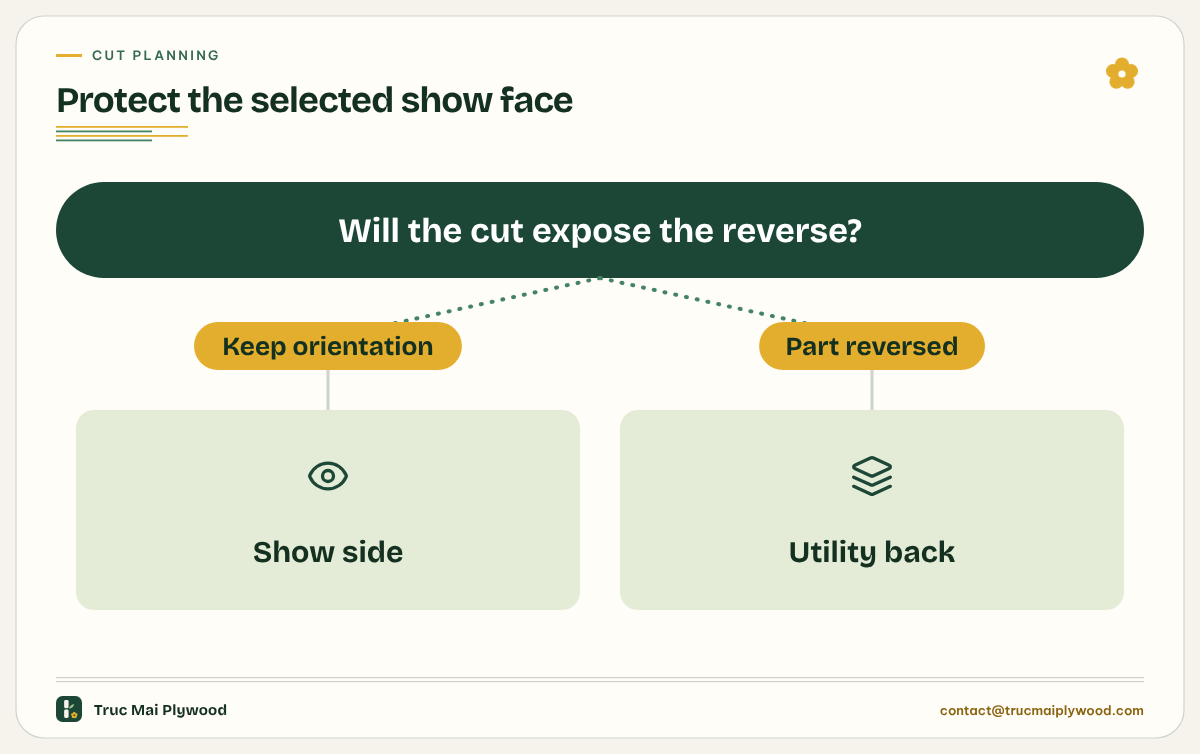
A useful drawing marks front, back, top edge and grain arrow for each component. This avoids sending a visually acceptable panel into a cutting programme that exposes the utility side at the wrong location.
Which thickness works for 3/4 and 3/8 good one side plywood?
Choose thickness from the part’s dimensions, span, fixing method and machining requirements. Canadian buyers often search for 3/4 plywood good one side, 3/4 4x8 plywood good one side and 3/8 plywood good one side. These are shopping descriptions, not a complete engineering specification. Nominal inch labels and measured metric thickness must be reconciled on the order.
| Buyer term | Practical specification question | Typical furniture decision |
|---|---|---|
| 3/8 G1S | What measured thickness fits the groove or rebate? | Thin cabinet backing, lining or small supported part |
| 1/2 G1S | Is the part supported continuously or at intervals? | Carcase components and shallow shelving |
| 3/4 G1S | What is the finished panel thickness after sanding? | Cabinet sides, partitions and shelf stock |
| Thin decorative sheet | Does the veneer survive the chosen machining operation? | Door skins, drawer parts and laminated components |
Truc Mai Plywood makes furniture and commercial panels from 3 to 40 mm, including 9, 12, 15 and 18 mm selections. A calibrated furniture panel can be specified at ±0.3 mm; write the tolerance beside the actual metric thickness. For thin panels, the thin plywood range provides the appropriate construction context.
What core should sit behind the selected veneer?
The core should be selected for weight, machining, fastening and the desired finished appearance, independently of the face veneer. A birch-looking face does not establish a birch core. Veneer-faced furniture plywood can use plantation hardwood cores with very different handling and edge characteristics.
Styrax gives a lighter sheet and is useful where handling and container utilisation matter. Acacia and Eucalyptus provide denser alternatives for buyers prioritising a firmer core feel or a different machining response. Pine and mixed-species cores are additional options. The best core is the one tested in the intended joint, edge treatment and finished assembly.
Inspect a freshly cut edge for overlapping veneers, gaps, loose fibres and repairs that interfere with the part. For a cabinet hinge, the relevant evidence is a representative fixing trial at the planned screw location. For a shelf, the relevant evidence is the part’s supported span and expected load. Face beauty cannot compensate for an unsuitable core specification.
How much back-face quality can a cabinet maker give up?
Give up only decorative appearance that the customer will never see. Keep the functional properties needed for assembly: sound veneer, flat contact areas, acceptable thickness and an edge that machines cleanly. A back-grade sample should show the worst acceptable repair, not the prettiest example from a bundle.
For a cabinet side, a darker patch on the concealed surface may be harmless. An open split crossing a dowel position is a different issue. A shelf underside can be invisible in a high installation but clearly visible in a low open unit. A panel destined for veneering or lamination may need a more uniform substrate than its finished appearance suggests.
Write two acceptance tests: a visual check at the viewing distance relevant to the installation and a functional check at the drilling, gluing or finishing operation. This turns the vague request for a cheaper back into a specification that production and incoming inspection can follow.
How do sanding and surface finishing affect G1S orders?
Specify the finish-ready condition of each side. A selected veneer face may be sanded for the buyer’s lacquer, paint, stain or clear coat, while the reverse may receive lighter sanding for adhesive contact or assembly. G1S by itself says nothing about whether the sheet arrives coated.
UV-ready means the surface is prepared for the buyer’s own UV coating. It does not mean a UV finish has already been applied. For visible grain, test the actual veneer with the intended finish: stain can emphasise repairs, while opaque paint may hide colour differences but expose dents and sanding marks. On the reverse, a bonding process may demand consistent surface contact even though nobody sees the wood.
Use a raking light across the show face to reveal sanding scratches, filled repairs and waviness. Check the back where glue or fittings will land. Keep the approved sample under the same lighting as incoming goods so the inspection compares like with like.
What does G1S cost compared with two good faces?
G1S reduces the amount of decorative face quality purchased when only one side is shown. The actual commercial difference is set by veneer species, face/back selection, core construction, sanding, yield and order quantity; there is no reliable universal percentage saving. A quotation for two show faces may also involve different veneer matching or surface preparation.
Compare offers on identical sheet size, actual thickness, core, adhesive and emission specification. Then ask for two face/back variants using the same approved show-face sample. This isolates the appearance decision from other changes that could distort the comparison. Evaluate the landed usable-panel quantity after inspection, not just the nominal sheet count.
For repeat cabinet parts, make a cutting schedule and record which face becomes visible. That allows the purchasing team to calculate the number of sheets that truly need a second decorative surface. The plywood RFQ guide provides a structured specification format without confusing the face choice with the rest of the panel.
How do sheet sizes and cut-to-size options change the order?
Start from the cabinet cut list, then select the sheet format that gives the cleanest yield and grain orientation. Standard sheet options include 1220 × 2440 mm and 1250 × 2500 mm; a shorter 1220 × 2280 mm sheet is also available for furniture parts. Dimensions on a cut drawing should be written in millimetres, with the grain direction indicated before nesting.
The mill can supply labelled pieces cut from standard sheets. Common layouts include two lengthwise pieces of 610 × 2440 mm, three pieces around 1200 × 800 mm, or four pieces of 1220 × 610 mm, with six-piece layouts agreed to the cutting plan. Actual pieces and kerf allowances are set from the buyer’s source sheet and cut list, rather than assumed from a retail label.
A cut list should identify the visible face of every part, edge-banding sides, finished versus rough dimensions, label format and packing sequence. This is particularly important for G1S: reversing a part to improve sheet yield may put the utility back in view. See cut-to-size plywood panels for ordering the labelled components.
What does a 40HC planning table show for G1S cores?
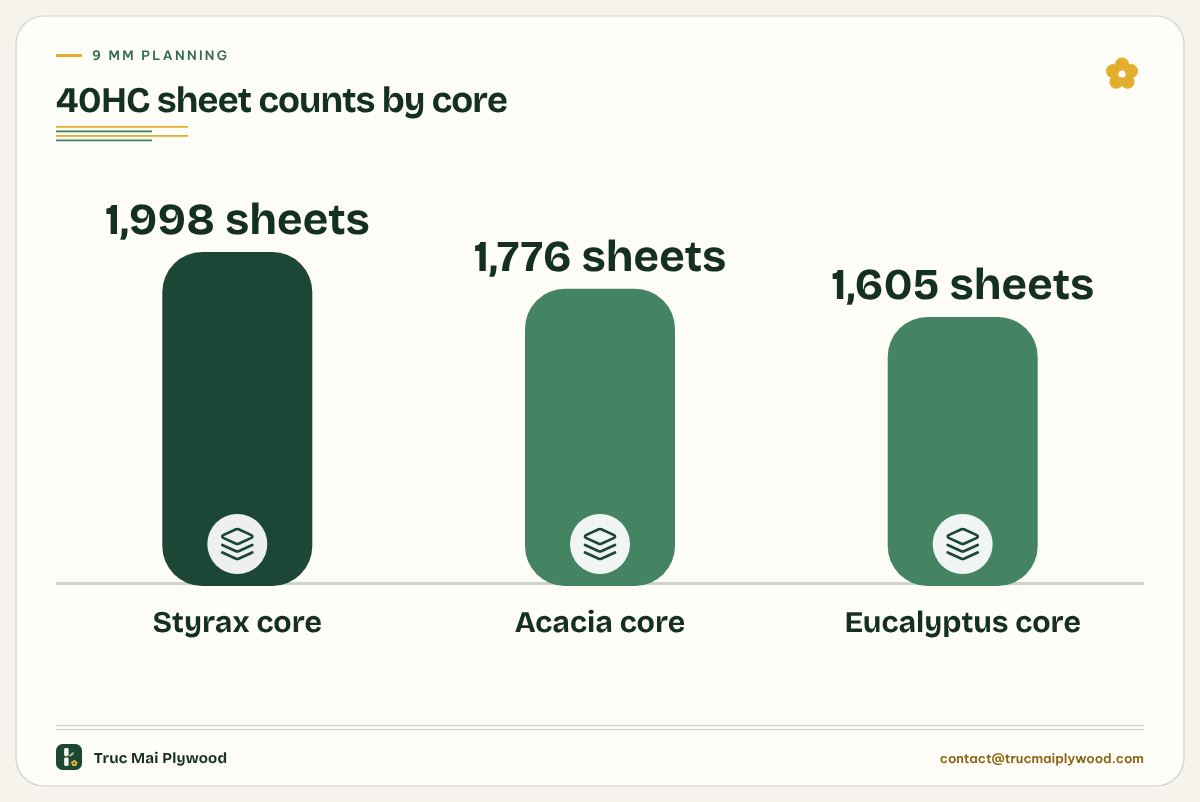
The 40HC table shows planning sheet counts and weights for selected 9 mm and 18 mm core configurations, rather than a separate capacity for G1S appearance grade. All rows below reproduce the supplied calculation without changing the values. The model is for panels only: up to 18 Styrax packs, 16 Acacia packs or 15 Eucalyptus packs, each around 1,000 mm high, using a 28,000 kg planning payload. Reference densities are 500, 580 and 650 kg/m³ respectively; the carrier and route set the booked payload.
| Core | Thickness | Sheet size (mm) | Packs | Sheets/pack | Sheets | Volume (m³) | kg/sheet | Total kg | Weight capped |
|---|---|---|---|---|---|---|---|---|---|
| Styrax | 9 mm | 1220 × 2440 | 18 | 111 | 1,998 | 53.5 | 13.4 | 26,760 | No |
| Acacia | 9 mm | 1220 × 2440 | 16 | 111 | 1,776 | 47.6 | 15.5 | 27,600 | No |
| Eucalyptus | 9 mm | 1220 × 2440 | 15 | 107 | 1,605 | 43.0 | 17.4 | 27,950 | Yes |
| Styrax | 18 mm | 1220 × 2440 | 18 | 55 | 990 | 53.0 | 26.8 | 26,520 | No |
| Acacia | 18 mm | 1220 × 2440 | 16 | 55 | 880 | 47.2 | 31.1 | 27,350 | No |
| Eucalyptus | 18 mm | 1220 × 2440 | 15 | 53 | 795 | 42.6 | 34.8 | 27,690 | Yes |
A G1S face selection can alter the purchased construction and therefore the actual sheet weight; weigh representative finished sheets before booking. Packaging and pallets must also be included in the shipment weight. For other thicknesses and cores, consult 40HC loading by thickness.
Which emission and bonding documents belong with the order?
Specify adhesive system, formaldehyde emission requirement and any bond-performance test separately. Appearance grade does not determine any of them. For US hardwood plywood with veneer core, 40 CFR Part 770 sets a formaldehyde emission limit of 0.05 ppm under the relevant test regime. A US-bound order should identify the product category and applicable certification scope on the documents.
The manufacturer’s CARB Phase 2 and EPA TSCA Title VI third-party certification covers hardwood plywood with veneer core from 3 to 25 mm, under certificate CARB/EPA 26053, mill ICTT-26053, TPC-43. The scope is a better purchasing reference than a general statement that a product is low-emission. A buyer can consult the Phase 2 formaldehyde limits when preparing the US file set.
For chain-of-custody orders, FSC-STD-40-004 requires the seller’s certificate code and the product’s FSC claim on sales documents. FSC 100% can be specified for eligible products in the manufacturer’s certified scope, with licence FSC-C196493 and certificate SA-COC-014545. Check the FSC licence verification guide when reviewing the paperwork.
How should a buyer inspect a G1S sample sheet?
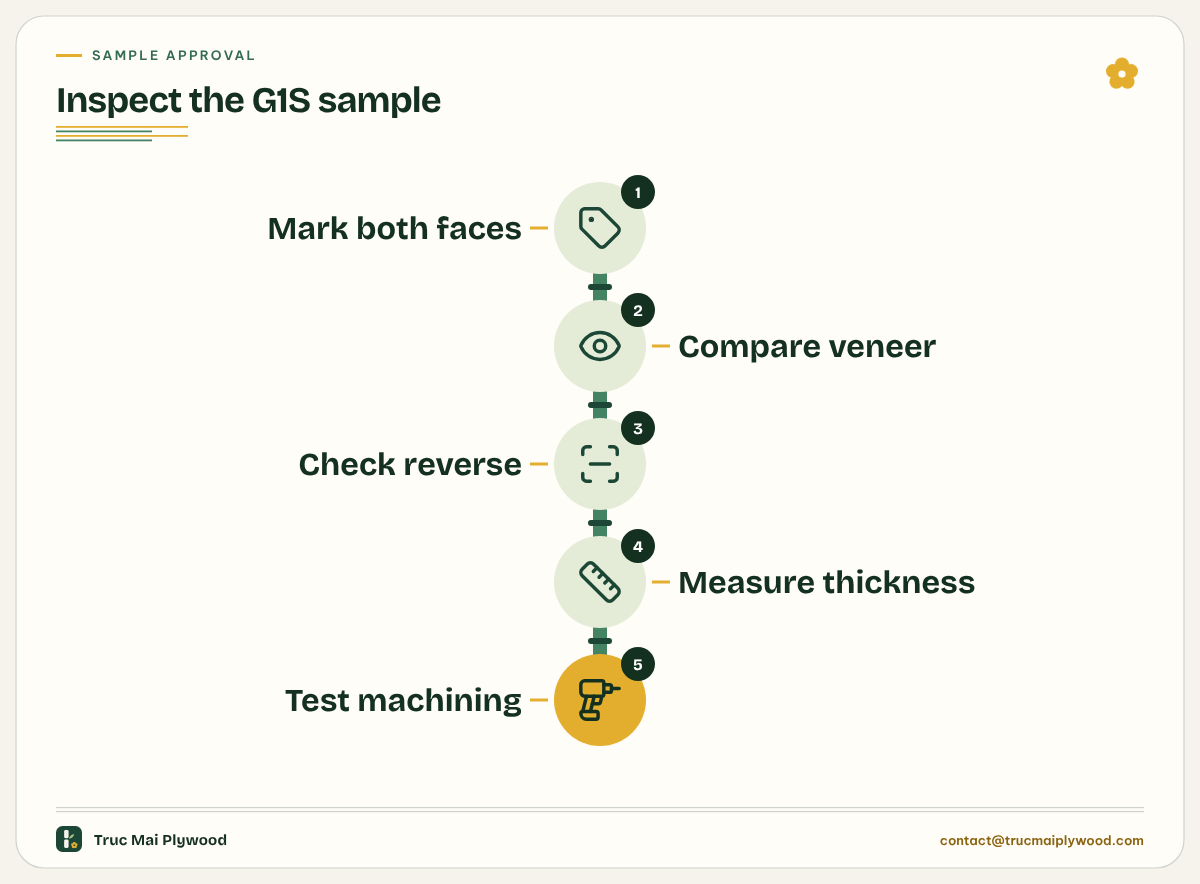
Inspect both faces and a fresh cut edge, then machine a representative component. A single photograph of the front cannot show whether the back will accept adhesive or whether the core will hold the intended joint. The purpose of a sample is to approve a repeatable construction and appearance boundary.
- Label the show face and utility back before cutting.
- Compare veneer colour, grain and repairs against the approved front sample under consistent lighting.
- Check the reverse against the agreed back-grade sample, especially at fixing and glue positions.
- Measure thickness at several positions and check the cut edge for gaps and loose veneers.
- Drill, rout or saw a typical part and examine tear-out, edge quality and fastening response.
- Apply the planned finish to a sample offcut and assess the dry result, including any repair marks.
Record failures as specific observations, with photographs showing the face, measurement and location. An inspector can then separate a cosmetic difference from a machining problem. The sample-ordering guide helps turn this inspection into a repeatable approval process.
What should a Canadian G1S plywood RFQ include?
A useful G1S request for quotation names the application and exposed side first, followed by the construction and delivery details. The manufacturer can then quote a face/back pair that serves the intended part rather than a generic retail label. For repeat programmes, attach the approved sample reference and the cutting drawing.
| RFQ line | Information to provide |
|---|---|
| Application | Cabinet side, shelf, wardrobe lining or display panel; identify visible surfaces |
| Show face | Veneer species, colour, grain direction, repairs and finish preparation |
| Back | Accepted defects, sanding, adhesive contact and any visible areas |
| Core | Styrax, Acacia, Eucalyptus, Pine or agreed mixed core |
| Bond and emission | Adhesive specification, destination-market emission documentation |
| Sheet | Actual thickness, tolerance, full-sheet format or labelled cut list |
| Packing | Face protection, bundle labels, quantity and destination port |
Truc Mai Plywood manufactures furniture and commercial plywood in Ha Hoa, Phu Tho, Vietnam, with an annual capacity of around 60,000 m³. Its standard commercial terms use one 40HC minimum order, with production normally 15–45 days after deposit. A buyer can send the specification and approved face/back sample for a quotation, then compare the response with the mill verification checklist before placing the order.
Send your specification to contact@trucmaiplywood.com or through the quotation form.
Questions buyers ask
Is G1S the same as G2S?
No. G1S calls for one selected visible face; G2S calls for two. Compare the written face and back acceptance samples rather than relying on the abbreviation.
Can I paint the reverse side of G1S plywood?
Yes, if the supplied back is prepared for the chosen coating. Specify back sanding and permitted patches in the purchase order.
Does G1S mean the sheet is waterproof?
No. G1S describes appearance allocation, while bond performance is a separate specification.
Can I use G1S for a floating shelf?
Yes, for a furniture shelf designed for its span and load. Choose thickness and core after deciding the shelf dimensions and support spacing.
Is select plywood always G1S?
No. Select is a supplier-specific trade description. Ask for the face/back sample and the written grading schedule.
Do G1S sheets have a finished face?
They usually have a selected veneer face, not a factory-applied clear coat. Specify whether the face must arrive sanded, ready for coating or already laminated.
Can the back have open knots?
Only within the agreed back-grade acceptance limits. A photographed reference sample should define permissible repairs, openings and splits.
Are birch-faced G1S panels all birch?
No. Birch-faced plywood can use a different core species; identify the face veneer and the core separately on the order.
Can I order G1S sheets cut to cabinet dimensions?
Yes. Supply a cut list with grain direction, piece labels and tolerances so the factory can plan yield and packing.
Does FSC chain of custody apply to every G1S order?
No. FSC 100% is available for eligible products in the certificate scope, with the claim and certificate code on the sales documents.