
BB plywood describes a trade appearance grade, not a complete panel specification. B/BB, BB/BB and BB/CC identify the requested front and back veneer quality, with exact defect allowances set by an approved sample. Furniture buyers should select the visible face first, then specify the core, bonding, sanding and dimensions separately.

What does bb plywood mean on a quotation?
In a trade quotation, bb plywood identifies a face-veneer appearance grade, not the entire panel construction. In a pair such as BB/CC, BB describes the front and CC describes the back. The slash separates those two surface grades; neither letter identifies the core species. Agree the permitted defects against a supplier grading sheet and approved sample.
For example, a BB/CC poplar-faced panel can have a eucalyptus, acacia or Styrax core. A birch-faced panel can also carry a BB/CC description while having a different core. The same letters on two offers therefore do not identify the same product. Start with the intended visible face, then check the back, construction, bonding and dimensions separately.
A buyer should request photographs of the complete face and back, close-ups of acceptable repairs, and a retained reference sample. The sample makes terms such as small knot, filled split and colour variation measurable at the inspection table. For an order specification, face-grade letters provide a useful starting vocabulary.
How do B/BB, BB/BB and BB/CC face pairs differ?
B/BB, BB/BB and BB/CC describe three different front/back combinations in common trade usage. B/BB requests a cleaner-looking front than its reverse; BB/BB requests the same named appearance level on both faces; BB/CC permits a more utilitarian reverse. Actual permissible repairs and discolouration must be agreed with the seller’s grade sheet.
| Trade face/back pair | Front specified | Back specified | Practical buying use | Inspection priority |
|---|---|---|---|---|
| B/BB | B appearance | BB appearance | Visible cabinet fronts with a concealed reverse | Front continuity and repairs |
| BB/BB | BB appearance | BB appearance | Components with both faces exposed | Both surfaces against sample |
| BB/CC | BB appearance | CC appearance | Cabinet carcasses and lined interiors | Visible front and usable back |
| B/B | B appearance | B appearance | Matching visible surfaces | Both faces and veneer matching |
| A/B | A appearance | B appearance | Decorative front with secondary back | Supplier’s A definition |
These are selection patterns, not a universal hierarchy of allowed knot diameters or patch counts. A supplier may use B for a nearly clear face, while another uses a different defect allowance. In the purchase order, attach the sample number and identify which surface faces the room. Vietnamese plywood quality by grade discusses how grade terminology sits alongside construction quality.
Is BB/CC a recognised international plywood grade?
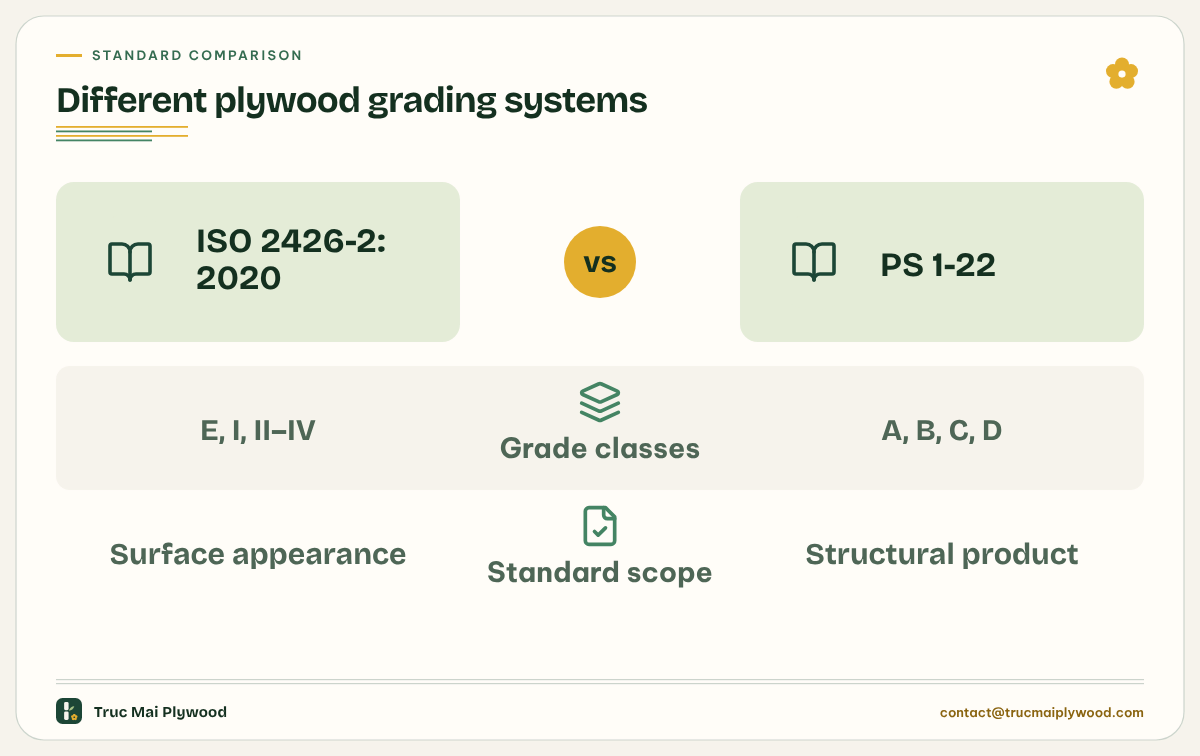
BB/CC is a commercial face/back designation rather than a grade defined in the principal international surface-appearance standards. ISO 2426-2:2020 classifies hardwood plywood surface appearance using classes E, I, II, III and IV. Its scope covers hardwood-faced plywood, including tropical and temperate species, and excludes overlaid panels.
The American PS 1-22 structural plywood standard uses its own veneer letters, including A, B, C and D, and distinguishes the grade of each outer veneer. Those PS 1 definitions belong to a structural product standard. A commercial BB/CC offer should therefore be judged by its agreed visual criteria, not silently converted into a PS 1 grade or an ISO class.
The useful document is a signed grade schedule: front and back photographs, maximum permitted visible features, whether repairs are allowed, sanding condition and a sample reference. That document travels with the purchase order and receiving inspection.
What defects can appear on a BB face?
A BB face is generally purchased as a usable, visually selected surface with some permitted natural features and repairs. The precise number, size and type of those features belong in the approved supplier specification. Buyers commonly inspect sound knots, filled knot holes, veneer joints, mineral streaks, colour variation, splits and patches.
Ask the supplier to separate open defects from sound or filled defects. A filled knot can remain visually apparent after a clear finish; a tight knot can create a dark spot even when the veneer is sound. The photograph used for approval should include both an overall sheet view and close-ups under ordinary light. For a painted component, filler compatibility and the sanded surface matter more than matching natural grain. For a clear-coated cabinet end, patch shape and colour may dominate the decision.
At the mill, a graded face should be identified before the panel is packed. Once sheets are cut into small components, a repair near the original edge may fall in the centre of a visible part. This is why the buyer’s cutting layout belongs in the appearance discussion.
What is acceptable on a CC back?
A CC back is normally selected for a less visible side, such as the rear of a cabinet component or the underside of an enclosed shelf. It can carry more visible repairs or natural variation than the front grade described as BB. The approved sample sets the actual acceptance boundary.
Back quality still matters to manufacturing. A projecting repair can affect stacking; an open split can interfere with adhesive contact; a rough surface can mark the adjacent sheet in a tight pack. Inspect whether the back will be laminated, painted, glued, left bare or covered by another part. A reverse hidden in the finished cabinet may still need a uniform sanding condition for automated handling.
For components that will be visible from both directions, order a matched two-face grade rather than assuming the back will resemble the front. The decision should be recorded before the first production batch, especially when multiple furniture parts share the same plywood order.
Which face pair works for cabinets and interior furniture?
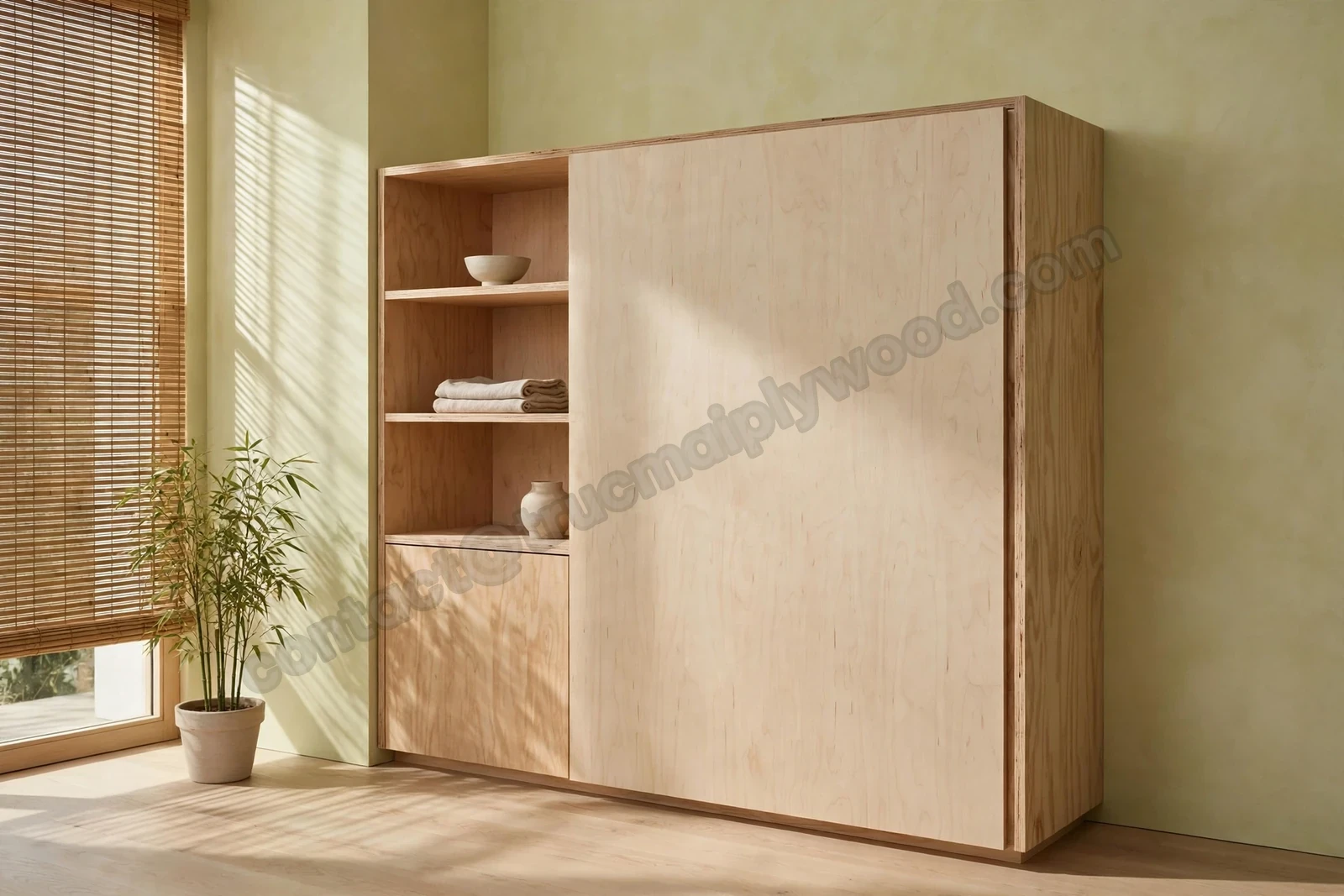
BB/CC is often a sensible starting specification for a cabinet part with one visible face, while BB/BB or a cleaner agreed pair suits parts seen from both sides. The right choice follows the installed orientation, surface finish and cutting plan, rather than the room name alone.
A cabinet side next to a wall has a different exposure pattern from an open shelving divider. A drawer base may need a smooth working face but no decorative reverse. A wardrobe door blank has a front and back that can both be seen when opened. Map each component to the surface the customer will actually inspect, then group parts that can share a grade.
For visible joinery, consult cabinet-grade plywood and plywood for kitchen cabinets. The grade schedule should distinguish a clear-finished wood face from a panel intended for opaque paint or a decorative overlay. A good face on the wrong core or adhesive specification still produces the wrong cabinet part.
How should poplar and okoume faces be graded?
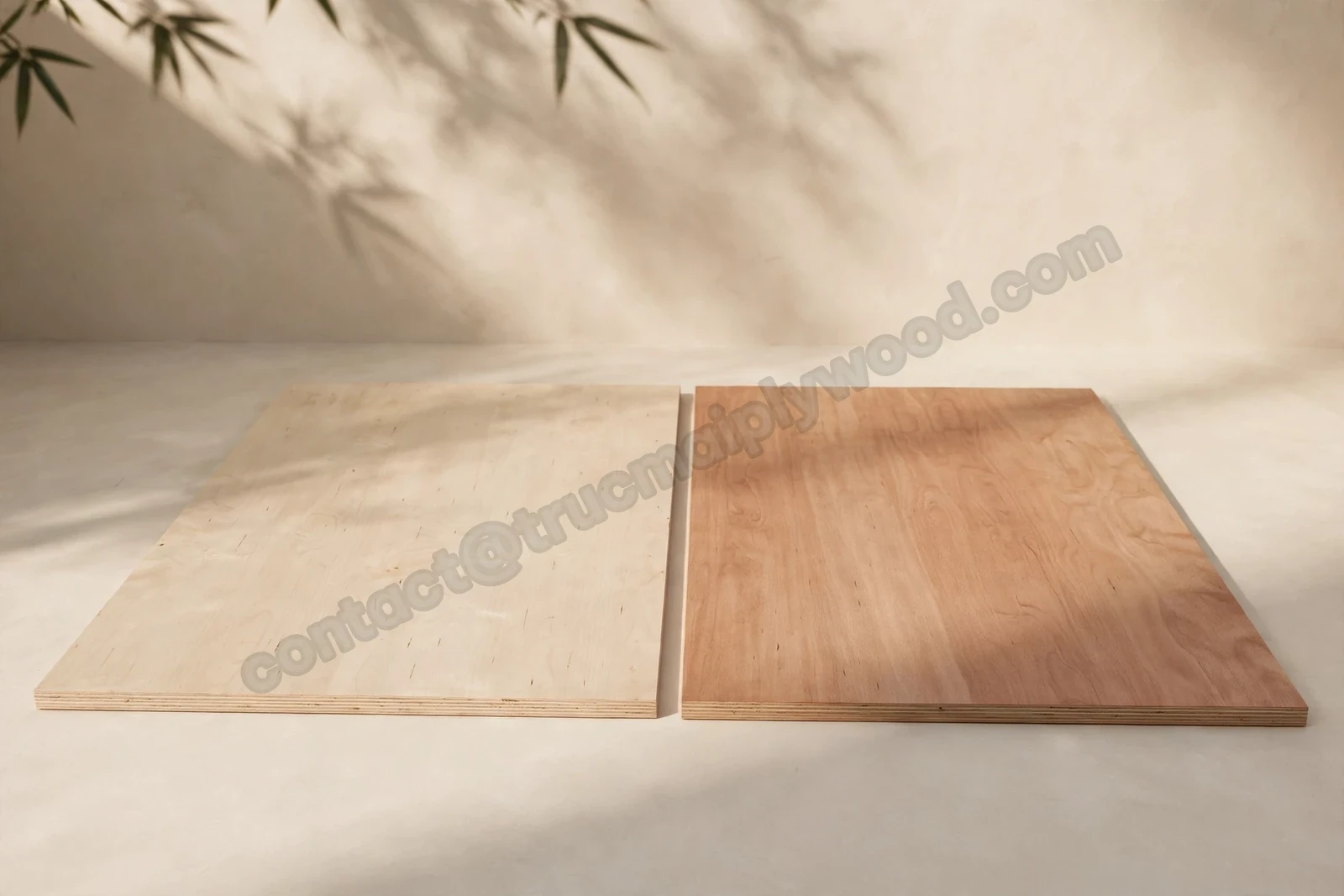
Poplar and okoume faces should each be assessed against an approved appearance sample, with front and back grades written as a pair. A BB label does not make two species look alike. Poplar often presents a relatively pale surface, while okoume brings a different colour and grain character; natural variation and veneer preparation remain part of the selection.
For poplar-faced commercial plywood, inspect colour distribution across a full sheet, veneer joins, visible fills and whether the surface is ready for the buyer’s finish. For okoume-faced door and furniture components, pay attention to grain direction, visible patches and how adjoining panels will look when installed side by side. A face intended for painting may tolerate features that stand out under a transparent finish.
A buyer can compare poplar plywood with okoume-faced plywood before fixing the purchase specification. Specify the face species separately from the core species: an okoume face is not evidence of an okoume core. For decorative applications, ask for photographs of adjacent sheets rather than a single hand-picked sample.
Does a B/BB grade always mean birch plywood?
No. B/BB is a face/back trade description used across different plywood offerings; it does not identify birch as the veneer species or the core. The quotation must name both the face species and the core construction.
Birch-faced plywood means that birch veneer forms the visible surface. It should not be read as an all-birch construction. For a furniture buyer comparing a birch face with poplar, engineered veneer or okoume, the face-grade pair answers only the appearance question. Density, edge appearance, machining behaviour and bonding are separate purchasing decisions.
Ask for a cut-edge photograph beside the full-face photograph. The edge shows the number and arrangement of plies and may reveal core joints that are invisible under a decorative face. Birch-faced plywood and Baltic birch alternatives help separate a birch surface requirement from a particular all-birch panel construction.
Does the face grade tell you the plywood core quality?
No. The two face letters assess the outer surfaces; core species, veneer joints, voids and lay-up must be specified independently. A clean face can cover a loosely laid core, and a modest commercial face can sit on a carefully joined core.
For furniture work, inspect the cross-section at several positions, not only at one corner. Look for veneer overlap, open gaps, thickness changes and any separation along glue lines. Ask whether core veneers are stitched, jointed or loose-laid. The choice affects edge machining and the behaviour of narrow parts cut from the sheet.
Truc Mai Plywood offers furniture/interior builds with stitched cores and sanded faces, alongside commercial builds with other core preparation. Its available core species include Styrax, eucalyptus, acacia and pine, or combined species. The approved construction should be written on the order line beside the appearance pair. Writing a plywood RFQ gives a practical sequence for recording those separate decisions.
How does sanding change the appearance grade?
Sanding determines surface preparation, while the face-grade pair identifies the visual allowance. A sanded BB face may be suitable for subsequent finishing, but sanding cannot remove every knot, patch, colour difference or veneer joint. Equally, a visually attractive face can still require calibration before precision furniture machining.
Specify whether both faces are sanded, whether the panel is thickness-calibrated and what surface finish the next process requires. For an opaque painted part, examine whether repairs telegraph through the coating. For a clear finish, inspect the grain and filler under the actual coating system. When using a thin decorative veneer, excessive sanding can change the visible face; the manufacturing specification should therefore cover veneer thickness and calibration together.
Truc Mai’s furniture panels use sanded, calibrated faces, with polishing available on request. UV-ready panels have surfaces prepared for the buyer’s coating operation. They are not supplied as factory UV-coated panels. Sanded or unsanded faces is a useful companion specification topic.
Does BB/BB or BB/CC describe glue or moisture resistance?
No. BB/BB and BB/CC describe surface appearance, while the adhesive system and tested bond performance occupy separate specification lines. A face-grade pair cannot establish whether a panel is intended for dry furniture interiors or more demanding moisture conditions.
European EN 314-2 defines bonding-quality classes for dry, humid and exterior conditions. The corresponding EN 314-1 describes pre-treatment and test methods. For a buyer, the meaningful question is whether the ordered panel construction has test evidence for the required condition.
The standard adhesive option at this mill is UF resin at E0 emission. A moisture-resistant build uses a different adhesive specification. Bond testing and formaldehyde emission are separate measurements; request the relevant report for each when the application requires it. A neat-looking BB face does not change that distinction.
Can face grades prove formaldehyde compliance?
No. Appearance grading measures visible veneer characteristics, not formaldehyde release. For US hardwood plywood with veneer core, 40 CFR 770.10 sets a 0.05 ppm formaldehyde emission limit under the TSCA Title VI programme. That legal limit is independent of whether the visible face is labelled B, BB or CC.
Truc Mai holds CARB Phase 2 and TSCA Title VI third-party certification for hardwood plywood with veneer core in the certified 3–25 mm range. The certification identifies a defined product category and thickness scope. The buyer should list the required market and emission documentation in the order, then match the certificate to the supplied configuration.
A surface grade cannot substitute for a test result, and a laboratory emission result cannot substitute for visual approval. Keep the appearance sample and the compliance paperwork as two distinct approval records, each tied to the ordered panel.
Which sizes and tolerances belong on a graded-panel order?
A graded-panel order should specify nominal length, width, thickness, thickness tolerance and which face is the front. Typical sheet formats offered by the mill include 1220 × 2440 mm, 1220 × 2280 mm and 1250 × 2500 mm. The face grade should apply to the supplied sheet or the agreed cut pieces, as written in the purchase order.
The mill’s sanded, calibrated furniture specification can be written at ±0.3 mm thickness tolerance; commercial grade commonly uses ±0.5 mm. The buyer should identify the required tolerance on the order line instead of treating the BB grade as a dimensional class. For reference, EN 315 sets dimensional and tolerance rules for plywood under its own measurement conditions.
When cut components are required, provide the original sheet format, cutting diagram, grain direction and labels for each bundle. The mill offers cuts into two, three, four or six pieces from a standard sheet, with final piece dimensions agreed against the cut list. A clear cutting instruction prevents a decorative face being turned away from the intended finished surface.
How do buyers inspect BB/CC plywood before shipment?
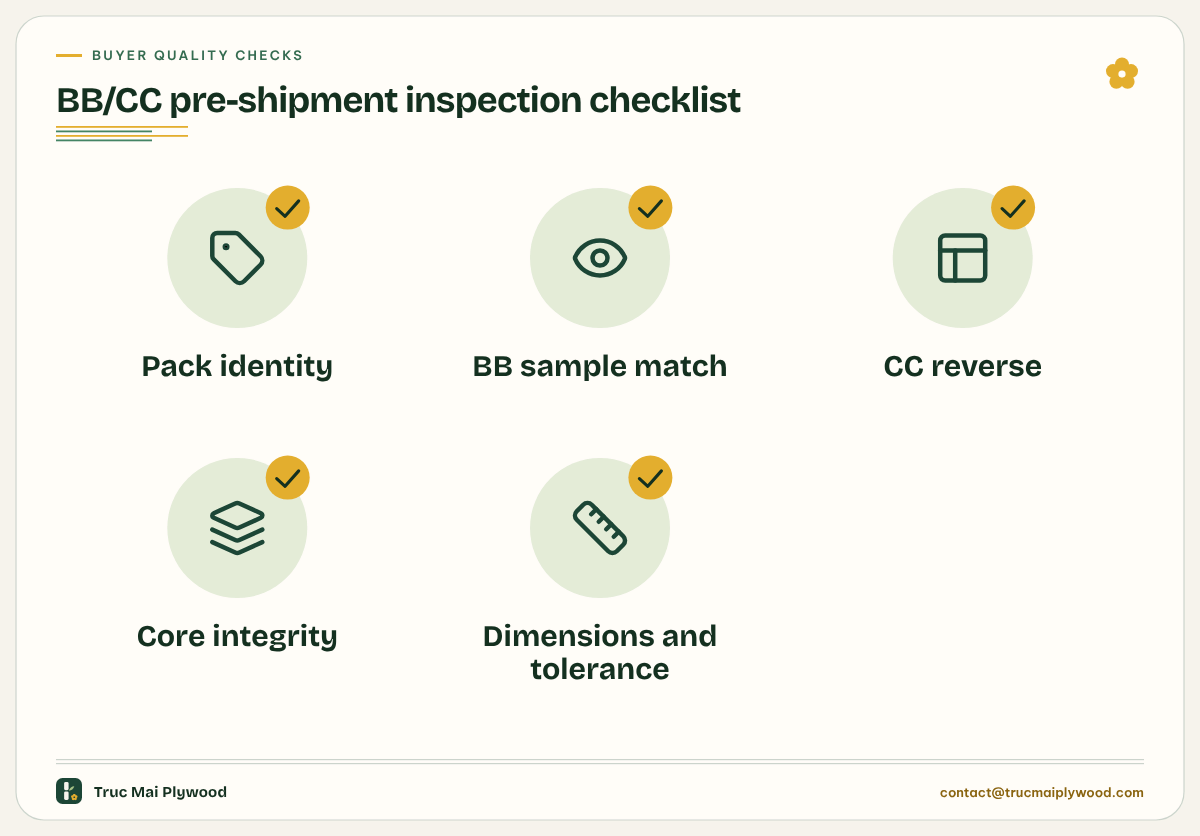
Inspect BB/CC plywood against a signed reference sample and an agreed defect schedule, checking both faces separately. The first task is to establish the viewing conditions, then compare randomly selected sheets with the same lighting and orientation used for approval.
- Identify the lot. Match the packing label, species, grade pair, dimensions and order reference.
- Inspect the front. Check colour distribution, veneer joins, knots, repairs and surface sanding against the BB sample.
- Turn the sheet. Assess the CC reverse independently; do not judge it using the front-face standard.
- Check the edge. Look for core gaps, overlap, separation and irregular ply thickness.
- Measure and record. Verify sheet dimensions, thickness and any agreed calibration tolerance.
- Retain evidence. Photograph accepted and rejected examples with the sample reference visible in the inspection record.
A small sample photograph should not replace inspection of full sheets. In furniture production, defect location relative to the cutting layout can be as important as defect size. The inspection record should state whether repair is acceptable, whether the sheet can be redirected to a hidden component, or whether it falls outside the purchase specification.
What should be written on a B/BB or BB/CC purchase order?
A purchase order should identify the application, face species, exact front/back grade, approved sample, core, adhesive and emission requirement, size, tolerance, packing and quantity. The phrase BB plywood alone leaves too many variables open for a repeatable order.
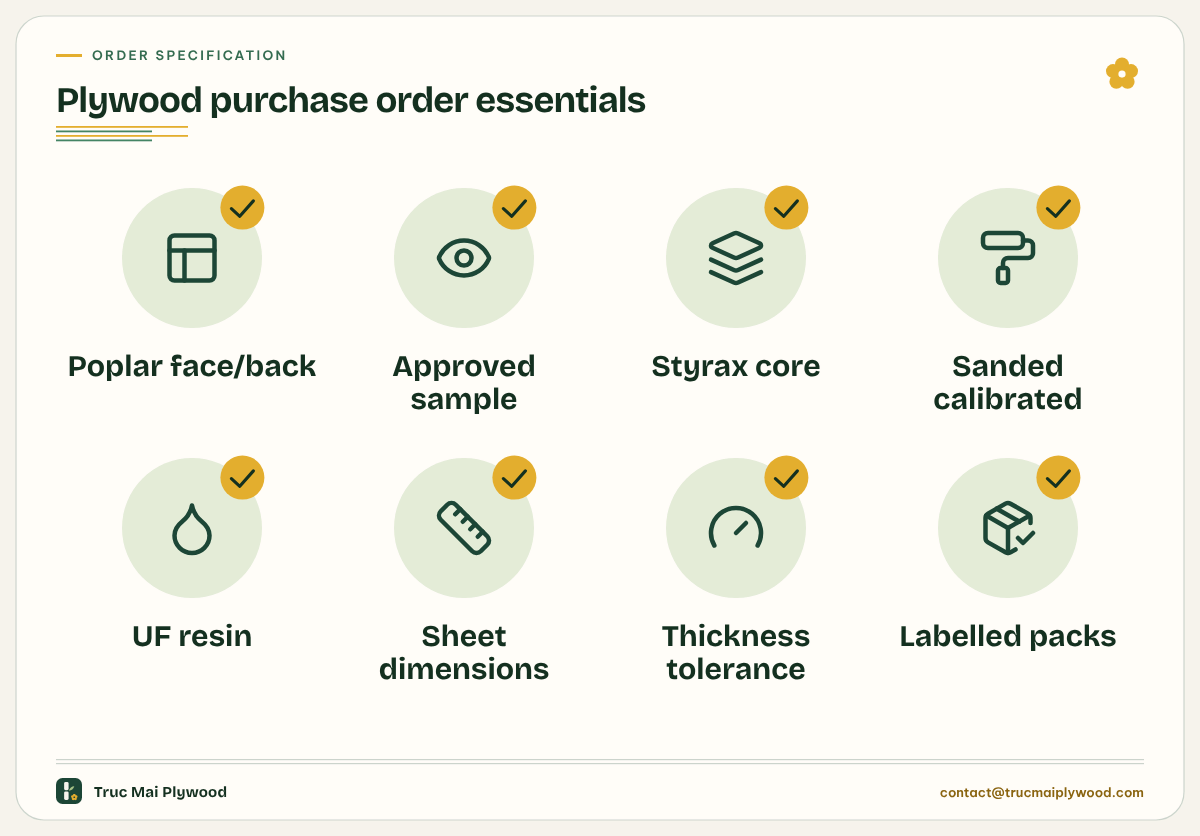
Use a line such as: “Poplar face/back, BB/CC against approved sample TM-FACE-01, Styrax core, sanded and calibrated, UF resin at E0 emission, 1220 × 2440 × 18 mm, agreed thickness tolerance, labelled packs.” The sample identifier here is an illustrative buyer-created reference, not a mill-issued document. If the reverse will be laminated, add its required sanding condition. If components will be visible on both sides, specify a matching pair rather than relying on a verbal description.
Attach the cutting list where needed and state the destination market so the documentary set can be assembled. The mill offers free samples; new buyers arrange their own courier. For ordering sequence, see ordering plywood samples and the supplier shortlist checklist. The final quotation should reproduce the approved construction, not merely repeat the headline grade.
How do you request a quotation for graded plywood?
Send one specification for each intended component family, with the face that will be visible clearly marked. Start with the furniture or interior application, then give the core, adhesive and emission requirement, face species and grade pair, sheet size, packing arrangement, quantity and destination port.
A useful request includes the finishing method and whether both surfaces will be seen. Include full-sheet photographs or a reference sample when matching an existing programme. For cut-to-size parts, attach a dimensioned cutting diagram and state grain direction and labelling needs. The quotation can then distinguish a decorative front from a utility back without substituting an unspecified panel.
For repeat supply, ask that the same reference sample and inspection checklist be used on subsequent orders. This makes the grade pair operational for production, quality control and receiving teams. Submit the complete brief through the quotation page or use the furniture and interior plywood range to select the starting construction.
Questions buyers ask
Is BB a species of wood?
No. BB is a trade appearance designation for a veneer surface. Specify the face species and the core species separately.
Can I paint a BB face?
Yes. Select a sanded face and approve the filler and surface preparation with the intended paint system.
Is a CC back always rough?
No. CC describes a commercial appearance allowance; sanding is a separate specification. The approved sample should show the required back finish.
Can I use a BB/CC panel for drawer parts?
Yes, where one surface is the visible or working face. Identify which side will face the drawer interior and specify its finish.
Can I mix different face grades in one shipment?
Yes, by agreement. Give each grade pair its own order line and pack label so the receiving team can separate the lots.
Should I ask for full-sheet photographs?
Yes. Request both overall views and close-ups of permitted repairs, with the approved sample used as the reference.
Are patches automatically a defect in BB plywood?
No. A repaired feature may be allowed by the agreed BB specification. The accepted size, appearance and location should be illustrated in the sample schedule.
Does a clear coating hide veneer repairs?
Usually no. Clear finishes often make colour and patch differences more noticeable, so approve a coated sample for visible parts.
Can the same plywood be used for doors and cabinet backs?
A panel can serve different furniture parts when its construction and appearance meet both uses. The visible face and machining requirements should be checked for each component.
What paperwork should accompany a repeat order?
Keep the approved face/back sample reference, panel specification, inspection record and shipment documents together. This helps receiving staff check the same grade on subsequent lots.