
A plywood desk needs a flat, calibrated furniture panel, a face suited to its final finish and an edge detail designed for daily use. Truc Mai Plywood offers veneer-faced, melamine-faced and HPL-faced options on specified veneer cores, with cut-to-size panels for repeat furniture production. Select the build before choosing the decorative surface.
What type of plywood is best for a tabletop?
An A-grade calibrated furniture plywood panel with a stitched veneer core suits a dry-interior tabletop. Choose birch or poplar veneer for visible wood grain, or HPL or melamine for a decorative surface. Specify the face and back, thickness, edge finish and core separately. Check the finished tabletop’s span, support and fastenings.
A tabletop order is a construction, not a species name. The visible veneer, inner plies, adhesive, sanding and finishing route each answer a different manufacturing question. For a natural-grain surface, ask for a matched face/back grade and a reference sample. For a coloured office range, approve the overlay and the edge treatment together. See birch-faced plywood and HPL-faced plywood for the two distinct purchasing routes.
A stitched A-grade core is useful when the top will be routed or its edges remain visible. The outer core plies are normally stitched across and along the sheet, reducing loose joints at the machining line. A sanded, calibrated face provides a more predictable starting surface for the furniture maker’s finishing process. A glossy coating does not hide a poor substrate; it often makes waves and core impressions easier to see.
Can I use plywood as a table top?
Yes. Plywood works as a table top in dry interior furniture when its thickness, support frame, edge treatment and surface finish are designed as one assembly. A veneered plywood table can show its grain and layered edge; a laminate-faced top can prioritise cleaning and repeated contact.
The panel alone does not define the finished table’s performance. A long unsupported span, concentrated monitor arm load or repeated screw removal changes what the designer must check. The furniture maker should prototype the largest top, test its chosen fixings and evaluate any deflection before releasing the cutting programme. These are furniture-design checks, separate from the panel’s face grade.
For dining or meeting tables, specify how the surface responds to drinks, cleaning products and hot objects using the selected coating supplier’s instructions and the interior plywood selection guide. A bare plywood face is a substrate, while a sealed, finished face is the working surface. That distinction belongs on the drawing and on the approved sample.
Which plywood desk construction should a factory order?
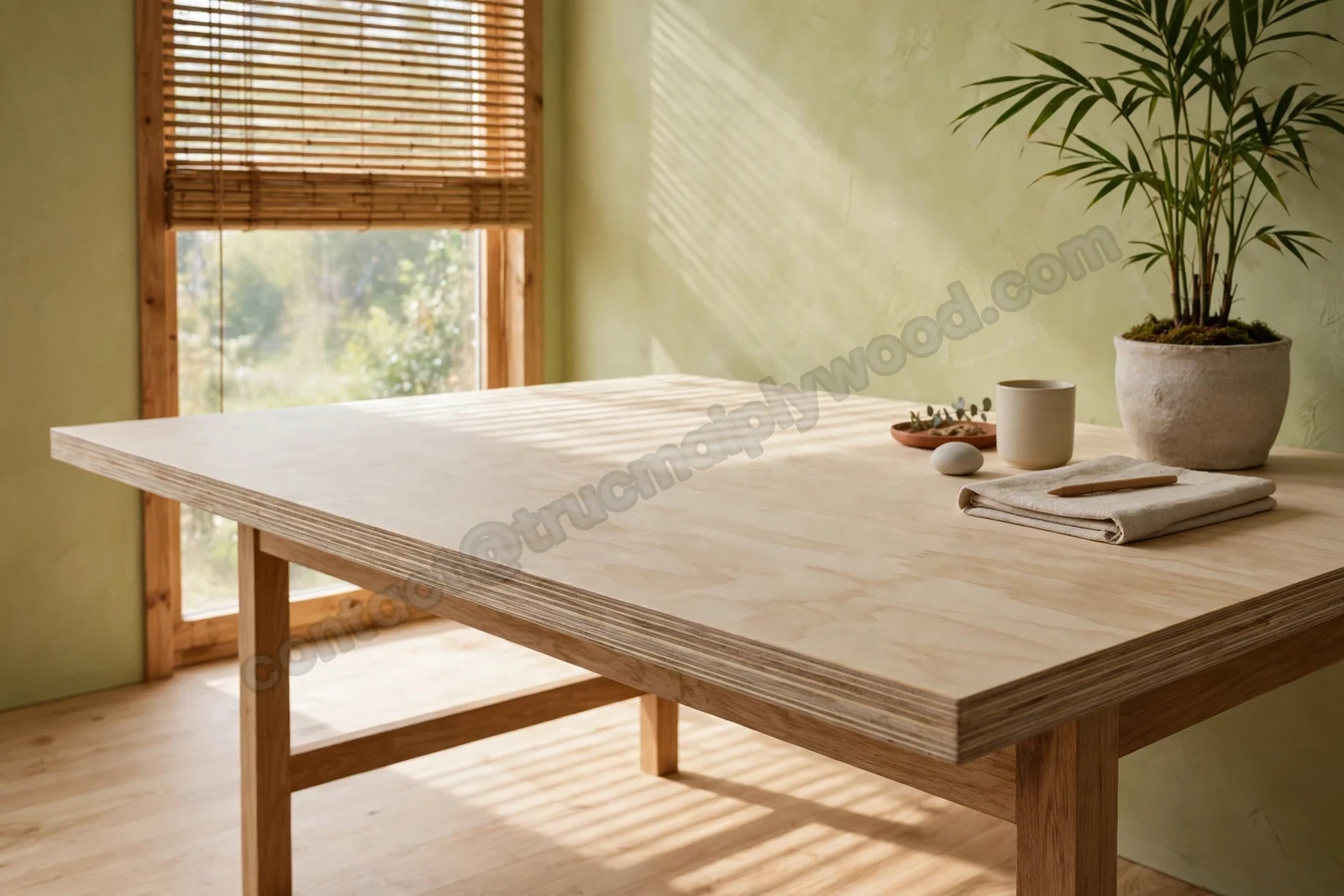
Order an A-grade, stitched-core furniture panel for a visible plywood desk, and specify the face/back pair, adhesive and final surface separately. The factory’s normal furniture construction has stitched inner veneers and sanded faces; commercial loose-laid core is a different purchasing grade.
| Desk component | Starting panel choice | Surface instruction | Inspection priority |
|---|---|---|---|
| Visible desktop | Calibrated furniture plywood | Veneer for coating or HPL face | Flatness, face and exposed edge |
| Desk return | Matching furniture plywood | Match desktop decor | Colour match and edge profile |
| Modesty panel | Furniture or commercial plywood | Decorative face on visible side | Face/back orientation |
| Pedestal side | Cabinet-grade plywood | Melamine or laminate | Thickness and fastener trial |
| Drawer box | Furniture plywood | Sanded interior face | Edge quality and machining |
This is a selection matrix, not a universal bill of materials. Separate the lines for the desktop and supporting parts so that the mill can quote the actual constructions rather than treating every board as identical. Cabinet-grade plywood explains the cabinet-body specification used alongside office furniture tops.
What thickness works for a plywood desktop?
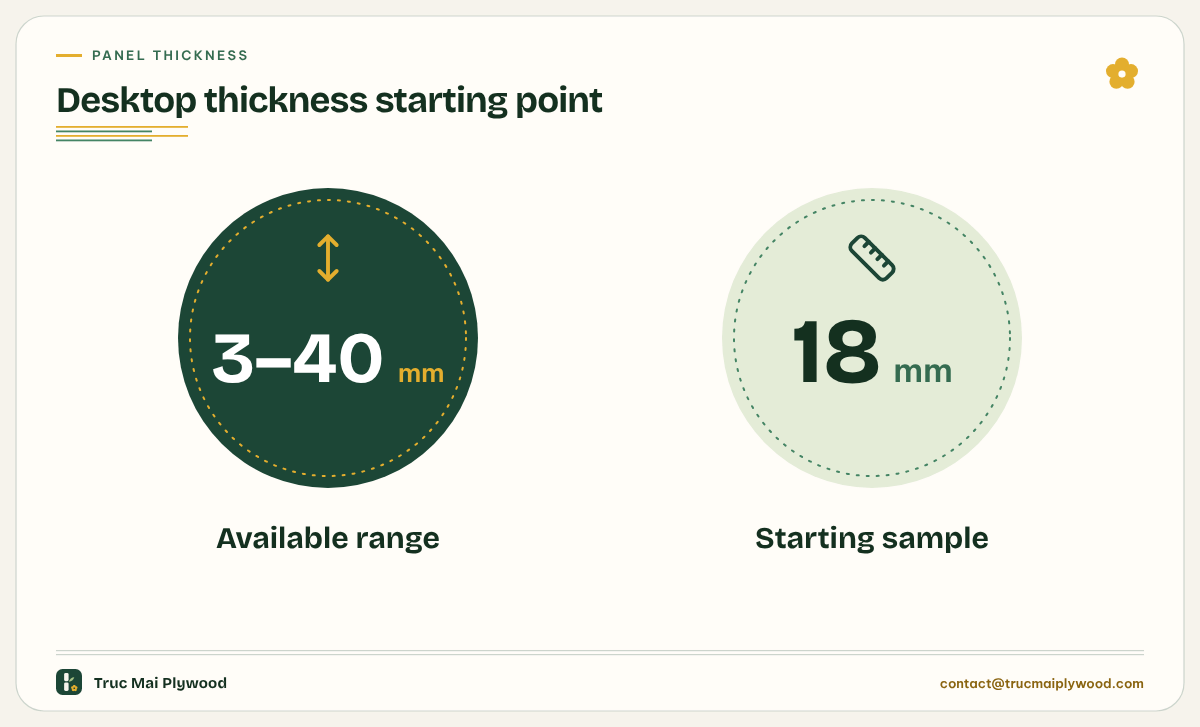
An 18 mm furniture panel is a practical starting sample for a supported desktop, while thicker options can be specified where the design needs a deeper visible edge or different stiffness. Thickness alone cannot establish a safe span or load rating. The support geometry, cut-outs and attachment method belong to the furniture drawing.
Truc Mai’s furniture and commercial plywood range covers 3–40 mm, including 12, 15, 18, 21 and 25 mm options. An 18 mm panel commonly has 11–13 plies, most often 11. These are construction details rather than performance ratings. Compare actual samples of the nominated build, especially at the edge and at the fixing points. The 18 mm plywood specification gives the corresponding panel and order terminology.
If the design uses a thick-looking desktop with a light internal structure, the furniture maker may choose a built-up edge. Specify that as an assembly detail, not as a thicker single sheet. A thick edge does not change the thickness of the panel spanning between supports.
Which face veneer suits a visible plywood desk?
Birch-faced plywood suits a pale, clean-grain desk design; poplar and bleached poplar offer other light appearances, while okoume, bintangor, pine, eucalyptus, gurjan and engineered veneer provide different visible patterns. The right choice is the face that matches the approved colour, grain and finishing sample.
Birch-faced describes the surface veneer, not an all-birch construction. A Vietnamese veneer core may use Styrax, eucalyptus, acacia or pine beneath that face. Buyers should write the face and core as separate lines, then specify the reverse face as well. This avoids receiving a good-looking top whose underside or edge differs from the furniture drawing.
Face veneer is typically 0.2–0.5 mm, with 0.3 mm common for European furniture orders. That makes sanding and finishing trials important: excessive sanding can damage the decorative layer. Engineered veneer can be useful for a repeatable visual pattern, while natural veneer should be accepted against an agreed range of grain and colour. The interior plywood selection guide gives the wider context for visible furniture faces.
Is a laminate plywood table top better than a natural veneer top?
Choose HPL-faced plywood for a specified decorative working surface and veneer-faced plywood for a finish that displays natural timber grain. Melamine-faced plywood offers another factory-applied decorative route. Each option changes the downstream machining and finishing work.
| Finish route | Appearance | Furniture-maker operation | Detail to approve |
|---|---|---|---|
| Natural veneer | Wood grain | Sand and apply the chosen finish | Face/back grade and coating sample |
| HPL-faced | Specified laminate decor | Cut, machine and finish edges | Laminate reference and bond |
| Melamine-faced | Decorative paper surface | Cut and edge-finish | Decor match and edge treatment |
| UV-ready veneer | Prepared wood face | Apply buyer’s UV coating | Sanding and coating trial |
For a plywood laminate table top with a visible layered edge, the exposed edge becomes part of the product design. Specify whether it is clear sealed, painted or covered by an edging material. Do not assume that the surface finish automatically seals a machined edge or a cable aperture. The laminates for plywood article covers the surface families in more detail.
Which core gives a flat, machinable desk panel?
A stitched Styrax or eucalyptus veneer core with the outer 2–4 plies stitched is a suitable starting point for calibrated furniture panels; acacia, pine and combined cores are other available constructions. Select the core by the approved edge appearance, weight and machining trial rather than by the face veneer name.
The core is the material exposed when a CNC router cuts a cable opening, curved corner or joint. Ask to see a cross-section of the same build that will enter production. Check for open joints, gaps that intersect a visible edge and any local thickness steps. Outer core plies can be stitched, with additional stitching specified for demanding visible-edge work.
Weight also affects handling and freight. A denser core changes the loaded mass of a pallet and the finished desk, so the purchasing team should keep core species constant across repeat orders. A core substitution requires a new sample and machining approval. For a factory planning both desks and cabinets, record separate acceptable core constructions for each component family.
How flat and accurate should desk plywood be?
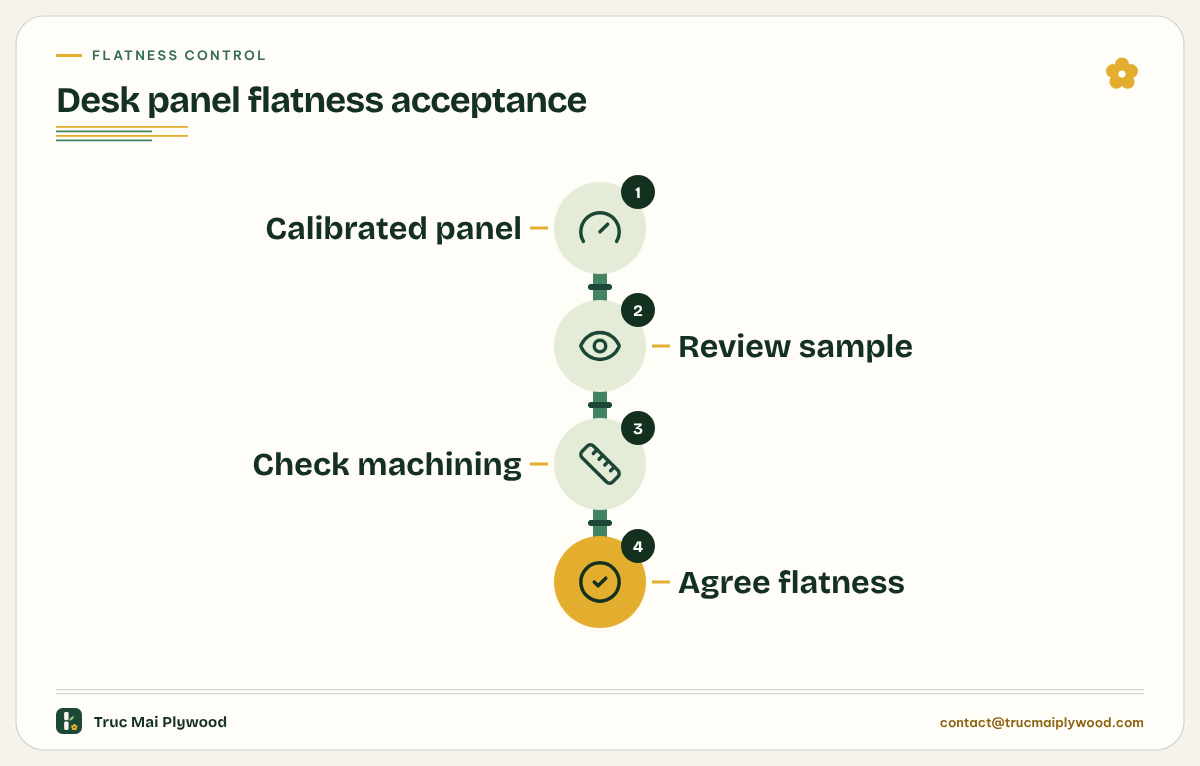
Specify calibrated furniture plywood at ±0.3 mm thickness tolerance for the sanded order line, and agree flatness acceptance using a sample and the furniture maker’s machining method. Truc Mai’s usual order tolerance is ±0.3–0.5 mm; commercial panels use a different finish and tolerance specification.
Thickness is only one measurement. Check the panel across its width, length and corners, and inspect its surface under raking light. A small thickness difference can affect flush joints, edging equipment and stacked CNC parts. Record the measurement positions and acceptable appearance in the purchase specification.
Dimensional tolerances and visible face appearance are separate inspection criteria. The purchase order should identify each rather than relying on a general grade label. A furniture maker buying calibrated sheets can set the agreed mill tolerance on the order and check it at incoming inspection.
How should the plywood desk edge be finished?
Seal or cover every exposed desktop edge according to the finished furniture design, including routed cable openings and underside cut-outs on cut-to-size plywood panels. A clear edge reveals the veneer layers; an opaque painted or banded edge hides them. Choose the method before approving the core.
For a visible layered edge, request a sample that includes a straight cut, a routed radius and the intended final coating. Check that veneer joints do not leave distracting voids at the exposed edge. For a laminate-faced top, trial the edge profile with the actual laminate thickness and the edge-finishing equipment used in production.
Fastener locations deserve a separate drawing. Edge screws and knock-down fittings should be trialled in the nominated core, with the same drilling pattern and repeated assembly cycle expected in production. A decorative edge photograph alone does not show how the fitting performs.
Can a mill supply pre-cut desk and tabletop panels?
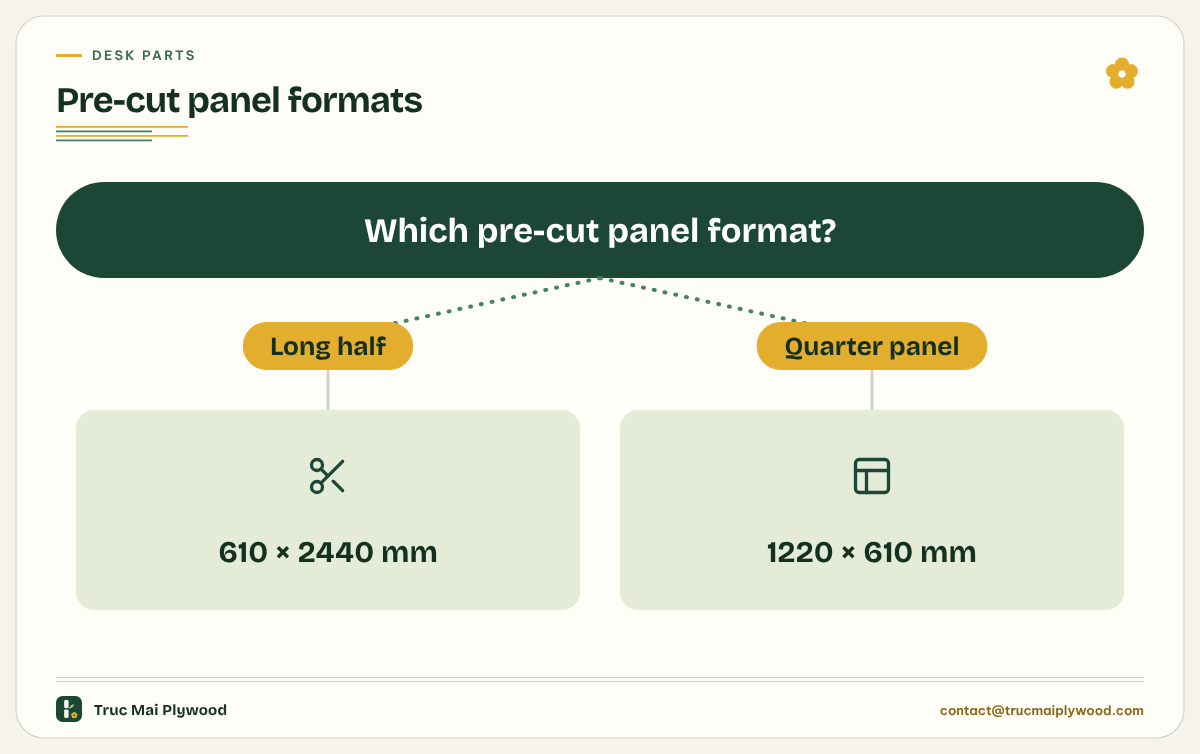
Yes. Cut-to-size plywood panels can be supplied with labels for the buyer’s furniture-part list. Common patterns include two lengthwise pieces from a standard sheet, three parts for a furniture programme, and four or six parts according to the cutting drawing.
The mill agrees exact part dimensions by email against the source sheet and cutting list. Examples include 610 × 2440 mm halves and 1220 × 610 mm quarters; a 1200 × 800 mm part is also used in furniture programmes. The buyer should identify grain direction, visible face, permitted edge trim and label format for every part number.
A cut list should show the source panel, finished piece, quantity, grain direction, machining allowance and packing group. These fields prevent the common mistake of counting pieces while ignoring orientation or edge finishing. The cut-to-size panel page is the relevant product route for labelled parts.
What sizes should an office furniture buyer specify?
The regular sheet formats are 1220 × 2440 mm, 1220 × 2280 mm and 1250 × 2500 mm. Choose the source sheet that suits the actual desk parts and the factory’s cutting layout; do not select a sheet format solely because it is familiar in the destination market.
The shorter format can fit certain furniture components with less trimming. The European-format sheet can suit another nesting programme. Compare the part drawings before placing an order, keeping veneer grain orientation consistent. Any custom cut remains within the mill’s available parent-sheet range.
For repeat manufacturing, include a drawing revision code on the cut list. A new revision can change a cable aperture or edge profile without changing the headline desktop dimensions. If purchasing and production use different drawing versions, labelled panels can still arrive in the wrong configuration.
How do glue and emission requirements affect the desk specification?
Specify the adhesive system and formaldehyde-emission requirement as separate purchase-order fields. For dry-interior furniture, UF glue at the agreed emission grade is a standard mill construction; a different exposure condition calls for a different bond specification and corresponding test evidence.
For US-bound hardwood plywood with veneer core, 40 CFR Part 770 sets a 0.05 ppm formaldehyde emission limit under TSCA Title VI. The Truc Mai CARB Phase 2 and TSCA Title VI certificate CARB/EPA 26053 covers the specified hardwood plywood veneer-core product scope at 3–25 mm. A furniture programme using other thicknesses needs its own appropriate compliance specification.
For EU furniture, the European Commission’s 2023 formaldehyde restriction notice describes the 0.062 mg/m³ limit for wood-based articles and furniture, applying from August 2026. The US ppm method and the EU chamber measurement are different tests. Keep the market and test method beside the emission requirement on the RFQ.
What documents should accompany a repeat office-panel order?
A repeat order should identify the approved panel sample, specification revision, packing list and the compliance documents relevant to the destination market. The mill can supply its FSC chain-of-custody details and due-diligence data for qualifying orders, alongside the agreed emission documentation.
FSC licence FSC-C196493 and chain-of-custody certificate SA-COC-014545 identify the manufacturer’s certification. The FSC chain-of-custody standard requires the certificate code and product-specific FSC claim on sales documentation. If FSC 100% is specified, write that claim on the order line and match it to the supplied sales documents. The FSC licence verification page explains the buyer’s check.
EU-bound orders can include origin records and plot geolocation files for both core and face veneer to support importer due diligence. The face veneer origin files page describes those records. Store the approved specification and incoming inspection record with each production batch so a repeat programme can be traced to its accepted sample.
How should a furniture factory inspect desk panels before cutting?
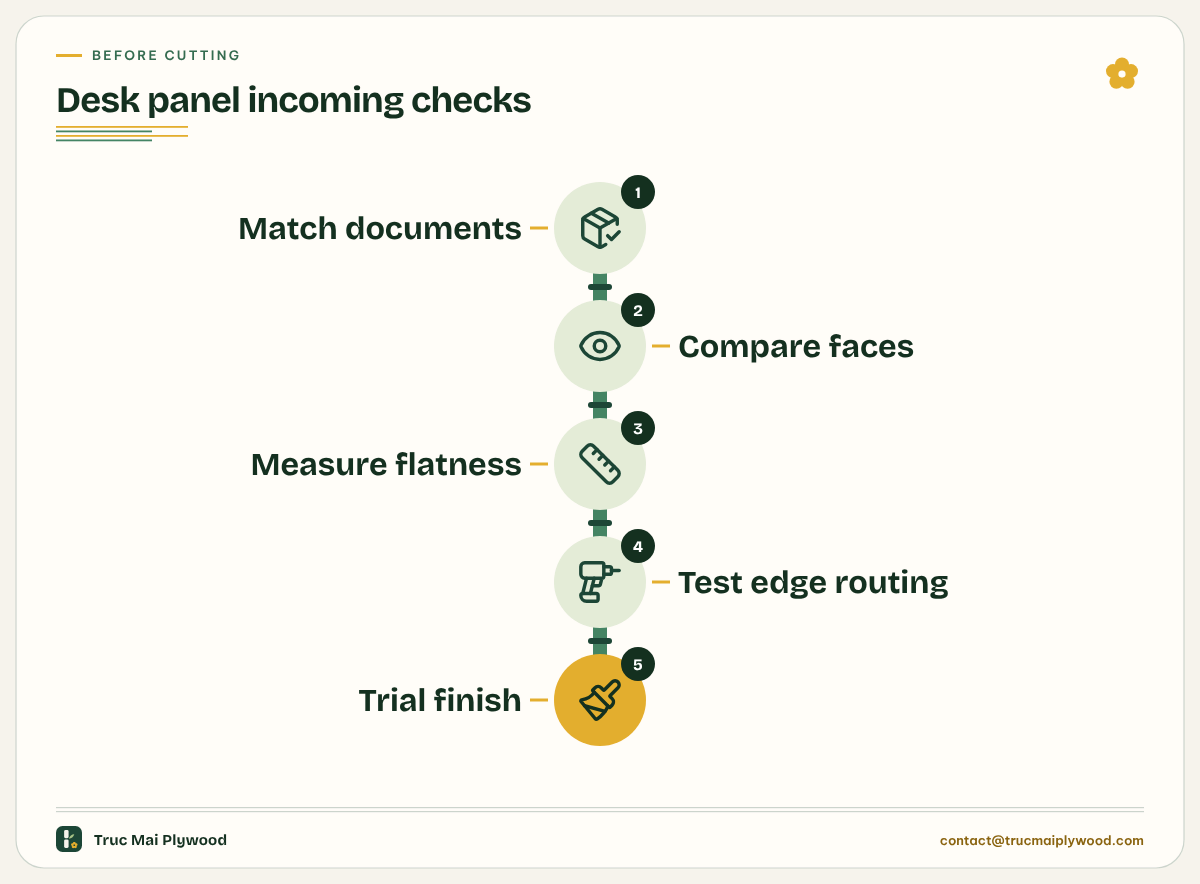
Inspect a representative sample of panels for face appearance, thickness, edge construction and the intended machining result before releasing the batch to production. The approved reference panel is the comparison point for every repeat order.
- Match the label and packing-list line to the purchase-order construction.
- Compare the visible face and back against the approved sample under consistent lighting.
- Measure thickness at agreed positions and check flatness on a suitable reference surface.
- Cut a sample edge and route the specified cable opening or corner profile.
- Trial the chosen finish, edging and hardware on the same construction.
- Record defects by pack and part number before the cutting programme proceeds.
This sequence catches problems while panels are still identifiable by pack. A furniture maker that cuts every sheet before testing the edge may discover a repeated core defect only after it has produced finished components. Keep the inspection method aligned with the real design, rather than relying on a generic appearance grade.
How can an importer keep desk panel specifications consistent?
Use one controlled specification per panel construction and carry its sample reference into every order. For a repeat plywood desk range, the core, face, thickness, finish and cut list should be stable even when the desktop colour changes.
A practical specification record includes the application, face/back grade, core species and joining method, adhesive and emission requirement, thickness tolerance, parent-sheet dimensions, finished-part drawings, edge detail and packing method. The mill’s approximate annual capacity of 60,000 m³ supports volume-oriented conversations, but the purchasing decision should still be based on the exact approved build.
A first shipment is the opportunity to compare the proposed pack layout with the actual production workflow. Record the acceptance findings and use them for the next purchase order. First order to monthly supply covers the repeat-order process; writing a plywood RFQ helps translate the drawings into a commercial enquiry.
What should go into a quotation request for plywood desk panels?
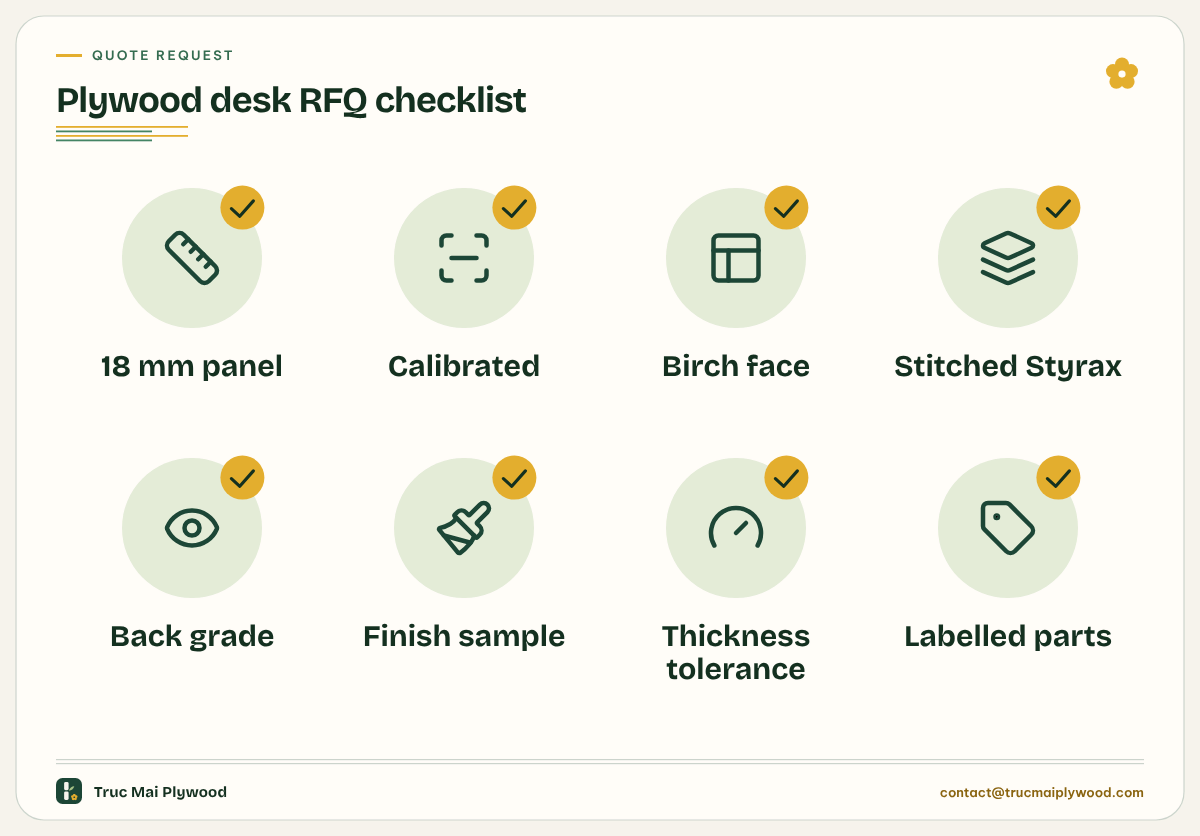
Send the desk application, core, adhesive and emission requirement, face/back finish, sheet or cut size, packing and container quantity on one specification sheet. Add the destination port, drawing revision and reference sample so that the quote corresponds to the panel the factory will actually machine.
For example, a furniture buyer can request an 18 mm calibrated birch-faced panel on a stitched Styrax core, with the back grade stated separately, a finish trial sample, agreed thickness tolerance and labelled desk parts. Another buyer can request HPL-faced tops with a matching decor reference and specified edge machining. These are alternative constructions, so quote them on separate lines.
The normal minimum is one 40HC, with FOB Hai Phong, CFR or CIF terms available. Production timing is agreed against the quantity and configuration. Send the specification through the planned quotation page or email contact@trucmaiplywood.com with the drawing and cut list. A useful response identifies the panel build, sample route and packing plan, not merely a generic product name.
Questions buyers ask
Should a desktop be finished on both faces?
Specify a balanced finish where the furniture design calls for it. Record the underside treatment on the sample and purchase order.
Can a factory supply matching desk and modesty panels?
Yes. Put the desktop, modesty panel and return panel on separate cut-list lines with their own face and edge requirements.
What should I inspect on a sample desk panel?
Check the face under working light, inspect the exposed edge, measure thickness at several positions and trial the intended finish and fasteners.
Are white melamine-faced plywood panels available?
White melamine-faced plywood is in the product range. Specify the decor, face and back treatment and edge finish against a sample.
Can I request a short plywood sheet for desk components?
Yes. The 1220 × 2280 mm format is available for furniture-part production.
Can plywood desk components be labelled before shipment?
Yes. Cut-to-size panels can be labelled to the buyer’s cutting and packing instructions.
Does birch-faced plywood mean every ply is birch?
No. Birch-faced plywood describes the visible birch veneer; the core species must be specified separately.
How do I keep the colour consistent across repeat desk orders?
Approve a face or decor sample and refer to it on every order. Agree the acceptable colour and grain variation before production.
Can a desk order include several panel types in one container?
Yes. Mixed-product loads can be planned by agreement, with each construction identified on its own packing-list line.
Is the plywood supplied with a finished UV coating?
UV-ready plywood has prepared faces for the furniture maker to coat. The mill supplies the prepared substrate rather than applying the UV coating.