
Void free plywood is plywood specified and inspected for a continuous inner veneer core, without unacceptable openings between plies. A clean face alone cannot establish core quality. Buyers should compare cut edges, distinguish gaps from overlaps, sample sheets across packs, and write a measurable defect limit into the purchase order before loading.

Which plywood has no voids, and what does void free plywood mean?
Void free plywood has inner veneers without unacceptable openings at inspected locations. For exposed furniture edges, choose closely jointed or stitched veneer-core panels with written gap limits. No plywood species name guarantees a voidless core: birch-faced plywood, for example, can contain a different core species. Inspect cut edges against the agreed specification.
The term voidless plywood is commonly used in purchasing discussions, but buyers should turn it into a measurable acceptance condition. Define the opening width, length, location, inspection method and number of permitted findings. Without those terms, two suppliers can offer different constructions under the same product description.
For cabinet work, compare the cabinet-grade plywood specification with a cut-edge sample. For a decorative birch appearance, birch-faced plywood describes the face, not the species in every inner ply. Ask to see the entire cross-section rather than judging a pale face veneer.
What are core gaps and overlaps?
A core gap is an unfilled space between neighbouring inner veneer pieces; a core overlap occurs where adjacent pieces lie over one another. Both begin during veneer lay-up, but their signatures differ. The gap removes local support; the overlap adds local thickness and can leave a ridge after pressing.
| Feature | Core gap | Core overlap |
|---|---|---|
| What the cut edge shows | Opening or missing wood between veneer pieces | Double veneer thickness or a compressed fold |
| Likely surface clue | Hollow, depressed or unsupported patch | Raised line, telegraphing or uneven sanding |
| Most useful record | Opening width and length | Ridge width and location |
| Manufacturing response | Better veneer alignment, jointing and repair | Remove double-lapped veneer and align joints |
How to check core voids on arrival?
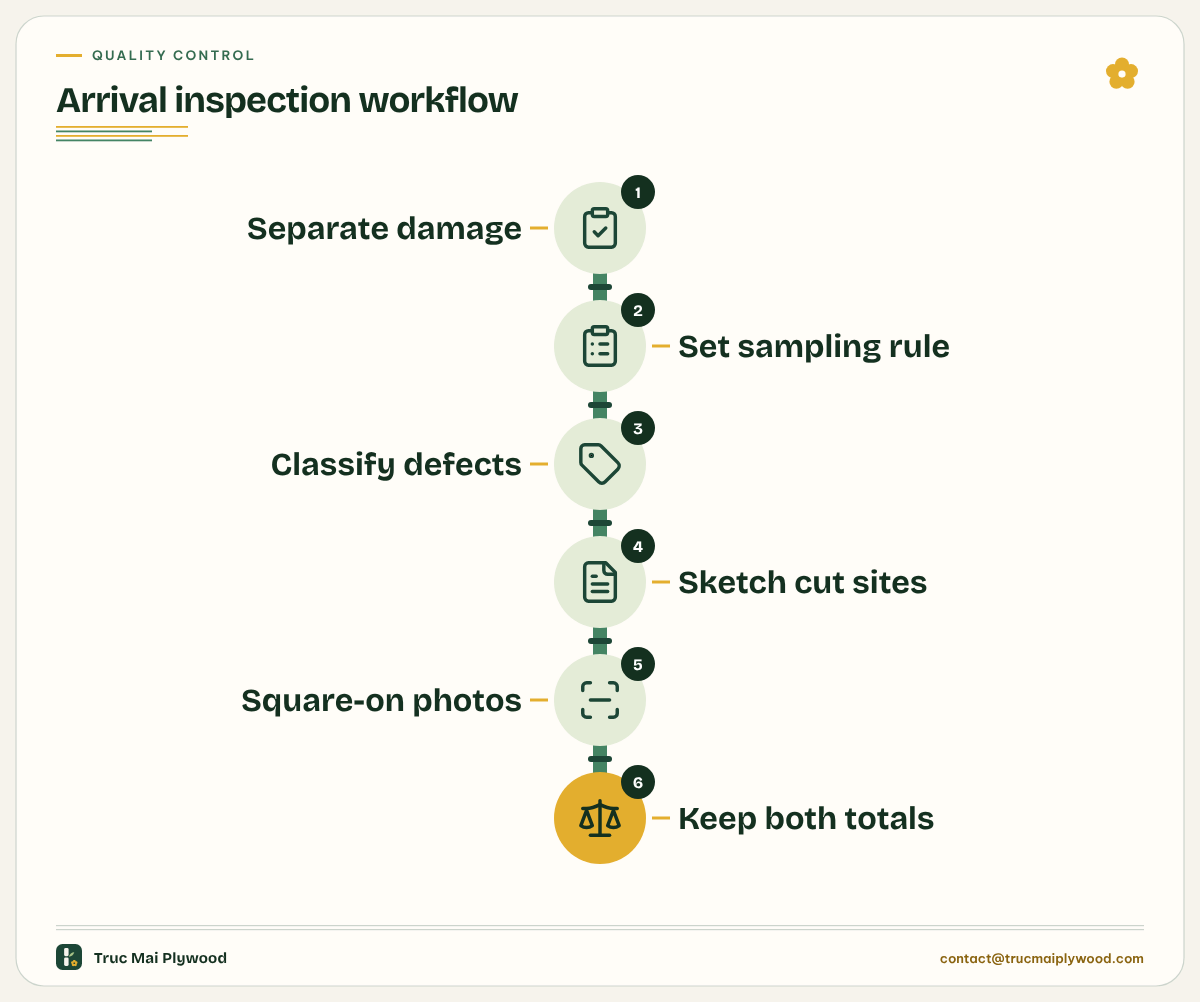
Cut and inspect samples from several packs, then count each opening against the order’s written limit. Start with a receiving record before sheets are mixed into production. The following method is practical for an importer, cabinet maker or distributor checking a commercial load.
- Photograph the unopened packs and their identification labels. Record visible handling damage separately from internal construction defects.
- Select sheets across the shipment, including different pack positions and the first, middle and last accessible sheets. Write down the sampling rule before choosing them.
- Inspect all exposed factory edges under even light. Mark openings, overlaps and repaired patches in different categories.
- Cut a representative strip across the veneer direction and another along it. Keep the cut locations on a simple sheet sketch.
- Use a rule or calliper to record each opening’s maximum width and visible length. Photograph the reading square-on.
- Count affected cuts and sheets. Keep both totals; a single badly affected sheet and many lightly affected sheets tell different stories.
- Compare the tally with the approved sample and purchase-order limits. Segregate the affected packs while the evidence is reviewed.
The ordering plywood samples process is the best place to agree on a reference cut. Keep a matching approved sample for comparison with arrival findings.
Why can a flawless face conceal a weak core?
A sanded face can look uniform while a veneer joint below it contains an opening. Face grading, sanding and decorative overlays address the outer appearance; the hidden construction must be inspected independently. A routed groove or drilled hole may reveal an internal defect that was invisible on delivery.
Where do veneer gaps originate during manufacture?
The common starting points are irregular veneer width, broken edges, poor alignment during assembly and movement before pressing. A veneer sheet with a tapered edge may touch its neighbour at one end and leave a widening gap at the other. Pieces assembled without stable joints can shift as the lay-up is handled.
Core stitching joins veneer pieces across and along a sheet. Truc Mai Plywood uses stitched core construction for its furniture/interior line, typically stitching the outer inner plies, with all-ply stitching available by order. Commercial constructions can use loose-laid or jointed inner veneers. The buyer’s application should decide which construction appears on the purchase order.
How do core gaps affect furniture machining?
A gap near a cut line can leave an unsupported face strip, especially where a router removes material beside the opening. A core overlap can create a local thickness high point, affecting panel flatness and laminate bonding. These are different manufacturing problems, so the inspection report should not combine them into one vague defect count.

Which core construction should a buyer specify?
Stitched, closely jointed veneer core is the appropriate request where cut-edge continuity is critical. Loose-laid commercial core can be selected for less demanding concealed applications when its agreed defect limits suit the use. Core species and core assembly method belong on separate lines of the specification.
| Order line | What to write | Why it matters |
|---|---|---|
| Application | Cabinet side, drawer part, shelving or concealed backing | Establishes the inspection priority |
| Core species | Styrax, Eucalyptus, Acacia, Pine or agreed combination | Defines the material construction |
| Inner veneer joining | Stitched, jointed or loose-laid | Defines how adjacent pieces are held |
| Edge criterion | Maximum gap width and length, plus count | Turns ‘voidless’ into an acceptance rule |
| Surface | Sanded, calibrated, veneer-faced or overlaid | Separates finish from inner construction |
| Reference | Approved cut sample and inspection drawing | Gives both parties the same comparison |
What gap limit should be written into the purchase order?
Write a numeric width, length and count limit chosen for the finished part, rather than the phrase ‘no visible defects’. For a buyer who needs uninterrupted exposed edges, the order can require zero visible unfilled openings on the specified inspected cuts. That is an acceptance rule, not a universal plywood grade.
The order can use this wording: ‘On the agreed sample cuts, no open core joints are permitted at exposed furniture edges; record any overlap separately. Inspect according to the signed sampling plan and retain labelled photographs.’ Where the application permits limited openings, replace that condition with the agreed measured limits.
The writing a plywood RFQ checklist helps keep core joining, face preparation, adhesive and tolerances as separate specification lines.
How should the sampling plan cover a whole container?
Sample across packs and sheet positions, not only from the top of the first pallet. A load can contain sheets made at different moments in the production run, and defects can cluster by veneer batch or lay-up position. Stratified selection gives the buyer better evidence than a handful of convenient sheets.
Start by numbering packs. Choose a repeatable selection pattern and record any substitutions caused by inaccessible packs. On each selected sheet, inspect the factory edge, then take cuts at mapped positions. Keep the inspected count and defective count visible in the same table. If one pack shows repeated findings, expand the inspection within that pack and compare it with another pack.
What does a cut-edge inspection reveal about bonding?
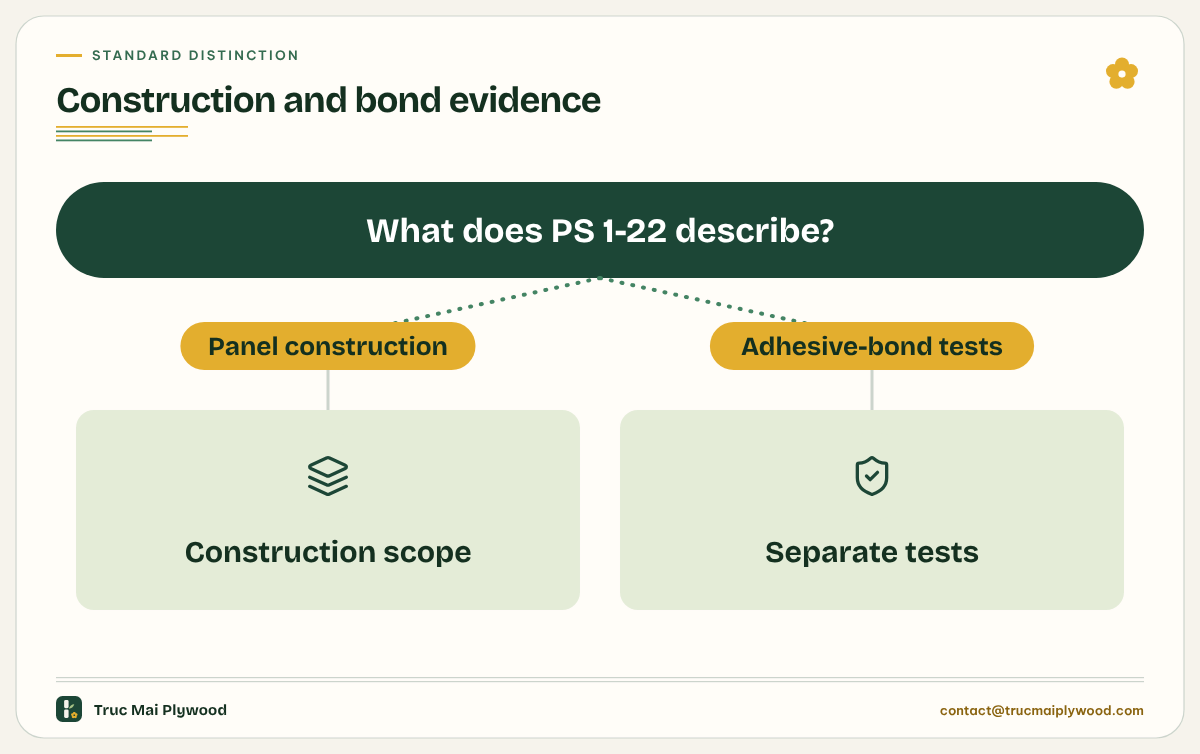
An edge cut reveals layer arrangement and visible openings, while adhesive bond performance requires a separate test. A dark glue line alone cannot establish bond strength, and an open veneer joint differs from glue-line separation.
The NIST PS 1-22 structural plywood standard describes panel construction and separate adhesive-bond tests for structural products. Its scope is different from furniture plywood, but the distinction between workmanship inspection and bond testing is useful when writing separate order criteria.
Does an emission certificate tell you whether a core is voidless?
No. An emission certificate addresses formaldehyde release, not the continuity of veneer joints. For the United States, 40 CFR Part 770 sets formaldehyde requirements for regulated hardwood plywood and identifies veneer-core products separately from composite-core products.
Truc Mai’s CARB Phase 2 and TSCA Title VI certification covers hardwood plywood with veneer core in the stated certified thickness range. A buyer evaluating cut-edge quality should still request the core construction and an approved sample. The certification number and the defect acceptance sheet serve different procurement purposes.
How does voidless birch plywood differ from birch-faced plywood?
Voidless birch plywood describes a requested core condition; birch-faced plywood describes the outer veneer. A buyer seeking a pale, consistent visible face may select birch veneer over a Styrax or Eucalyptus core. A buyer needing exposed edges should separately specify the inner veneer assembly and allowable openings.
This distinction is especially important when comparing offers from different markets. A similar photograph of a pale plywood face can hide substantial differences in core species, veneer jointing and number of plies.
What do recognised plywood standards actually grade?
Standards grade specified product properties, not a universal marketing phrase called ‘void free’. The NIST voluntary standards programme lists the current structural plywood standard, while BSI’s BS 1088:2018 page describes a separate marine plywood specification. Neither name should be substituted for the purchase-order requirements of a commercial furniture panel.
Use a specification sheet with separate rows for each property and attach the approved sample. This keeps the factory’s internal construction choices aligned with the actual finished component rather than a loosely defined trade adjective.
How can cut-to-size orders expose hidden core defects?
Cutting a parent sheet into parts reveals more inner-ply edges, so the cut plan is also an inspection opportunity. The mill can supply labelled parts from a standard parent sheet, with the exact finished dimensions agreed against the buyer’s cutting drawing.
The planning examples below use the supplied calculation model. The model assumes a 4 mm saw kerf per cut. Nominal widths describe the theoretical division without kerf; finished widths include the stated kerf. A production cut list should use the finished dimensions.
| Cut plan | Parent sheet | Saw cuts | Pieces | Finished piece (mm) | Nominal piece (mm) |
|---|---|---|---|---|---|
| 2 parts | 1220x2440 | 1 | 2 | 608.0 × 2440.0 | 610.0 × 2440.0 |
| 3 parts | 1220x2440 | 2 | 3 | 1220.0 × 810.7 | 1220.0 × 813.3 |
| 4 parts | 1220x2440 | 3 | 4 | 1220.0 × 607.0 | 1220.0 × 610.0 |
| 6 parts | 1220x2440 | 3 | 6 | 608.0 × 810.7 | 610.0 × 813.3 |
What do the 40HC planning rows mean for inspection coverage?
The number of sheets changes with core and thickness, so the same number of sampled sheets represents a different fraction of each load. The table preserves the supplied 40HC planning model values, not a measured packing list.
Basis: 40HC planning model, panels only; Styrax 18 packs, Acacia 16, Eucalyptus 15; pack height 1,000 mm; sheets per pack are the rounded-down height divided by thickness, with a 28,000 kg planning payload cap; reference densities Styrax 500 kg/m³, Acacia 580 kg/m³, Eucalyptus 650 kg/m³. The carrier and route determine the booked payload. The figures below retain the source calculation values unchanged.
| Core | Thickness (mm) | Sheet (mm) | Packs | Sheets/pack | Weight capped | Sheets | m³ | kg/sheet | Total kg |
|---|---|---|---|---|---|---|---|---|---|
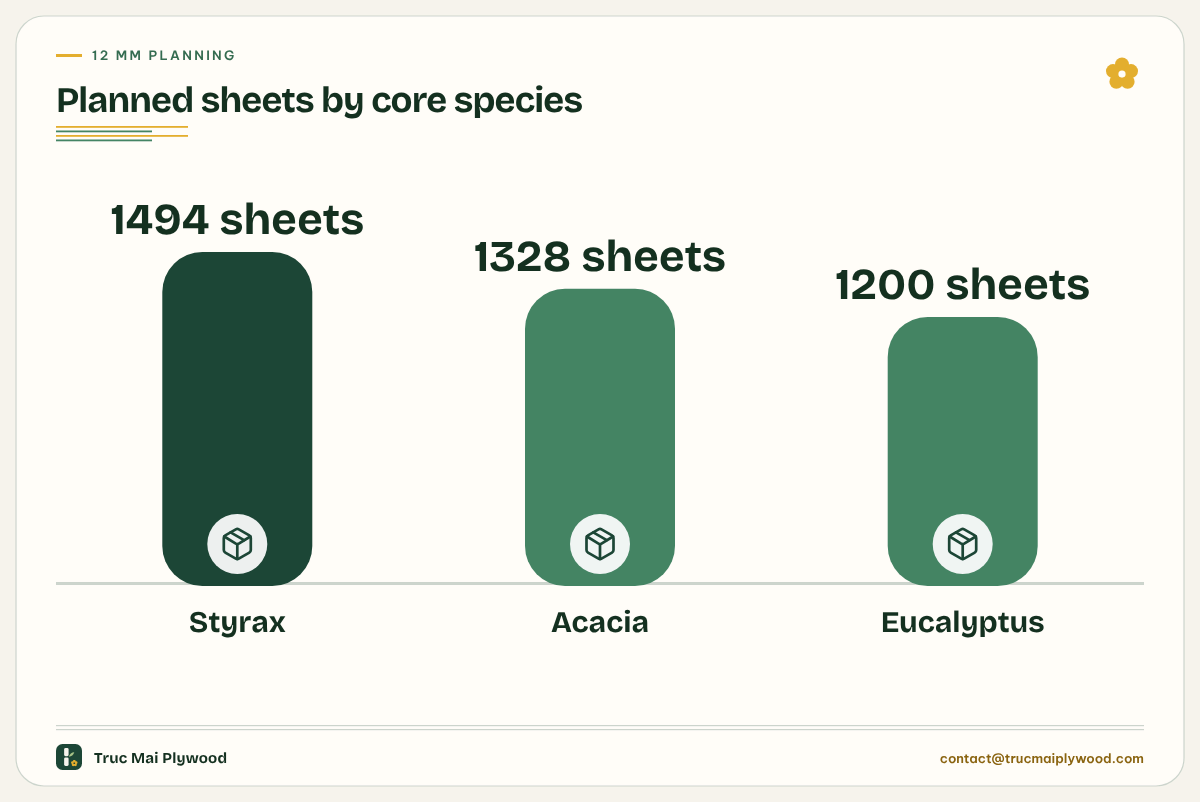
| Styrax | 12 | 1220x2440 | 18 | 83 | false | 1494 | 53.4 | 17.9 | 26680 |
| Acacia | 12 | 1220x2440 | 16 | 83 | false | 1328 | 47.4 | 20.7 | 27510 |
| Eucalyptus | 12 | 1220x2440 | 15 | 80 | true | 1200 | 42.9 | 23.2 | 27860 |
| Styrax | 15 | 1220x2440 | 18 | 66 | false | 1188 | 53.0 | 22.3 | 26520 |
| Acacia | 15 | 1220x2440 | 16 | 66 | false | 1056 | 47.2 | 25.9 | 27350 |
| Eucalyptus | 15 | 1220x2440 | 15 | 64 | true | 960 | 42.9 | 29.0 | 27860 |
| Styrax | 18 | 1220x2440 | 18 | 55 | false | 990 | 53.0 | 26.8 | 26520 |
| Acacia | 18 | 1220x2440 | 16 | 55 | false | 880 | 47.2 | 31.1 | 27350 |
| Eucalyptus | 18 | 1220x2440 | 15 | 53 | true | 795 | 42.6 | 34.8 | 27690 |
| Styrax | 21 | 1220x2440 | 18 | 47 | false | 846 | 52.9 | 31.3 | 26440 |
| Acacia | 21 | 1220x2440 | 16 | 47 | false | 752 | 47.0 | 36.3 | 27270 |
| Eucalyptus | 21 | 1220x2440 | 15 | 45 | true | 675 | 42.2 | 40.6 | 27430 |
A receiving team can use pack IDs from the shipping paperwork to spread sample cuts across the load. For other configurations, consult the 40HC loading by thickness reference and match the sampling record to the actual packing list.
How many finished parts do the modelled loads represent?
Finished-piece counts multiply parent sheets by the specified cut pattern. The following rows preserve every calculated 12 mm cut-to-size 40HC result. They are planning arithmetic based on the container rows above, with the 4 mm saw-kerf cut basis stated in the preceding section; they are not observed output from a shipment.
| Core | Thickness (mm) | Parent (mm) | Pieces/sheet | Parent sheets | Finished pieces |
|---|---|---|---|---|---|
| Styrax | 12 | 1220x2440 | 2 | 1494 | 2988 |
| Styrax | 12 | 1220x2440 | 3 | 1494 | 4482 |
| Styrax | 12 | 1220x2440 | 4 | 1494 | 5976 |
| Styrax | 12 | 1220x2440 | 6 | 1494 | 8964 |
| Acacia | 12 | 1220x2440 | 2 | 1328 | 2656 |
| Acacia | 12 | 1220x2440 | 3 | 1328 | 3984 |
| Acacia | 12 | 1220x2440 | 4 | 1328 | 5312 |
| Acacia | 12 | 1220x2440 | 6 | 1328 | 7968 |
| Eucalyptus | 12 | 1220x2440 | 2 | 1200 | 2400 |
| Eucalyptus | 12 | 1220x2440 | 3 | 1200 | 3600 |
| Eucalyptus | 12 | 1220x2440 | 4 | 1200 | 4800 |
| Eucalyptus | 12 | 1220x2440 | 6 | 1200 | 7200 |
What should be included in a supplier comparison?
Compare the same construction and inspection method across every offer. Request an edge photograph, a cross-cut sample, a veneer species schedule, a description of the core joining method and the proposed acceptance criteria. A smooth decorative face is useful evidence of surface preparation, but the cut sample is the evidence for hidden joint quality.
For a first transaction, verify a mill before deposit and retain the signed specification with the order. Keep the sample, packing reference and inspection record together so subsequent shipments can be compared against the same acceptance method.
What should the buyer send with the next RFQ?
Send the application, core construction, glue and emission requirement, face grade pair, sheet size, cut plan, packing and quantity. Add the permitted core-gap and overlap limits, sampling method, intended edge finish and destination port. That is enough information for a mill to quote the construction rather than guessing what ‘voidless’ means.
For Truc Mai Plywood, the furniture/interior and commercial range includes veneer-faced, prepared-for-UV, melamine-faced and HPL-faced options. The mill is based in Ha Hoa, Phu Tho, Vietnam. Attach photographs of the edge quality you want and a drawing showing where the finished part exposes the core. Request a matching sample before committing the production specification.
Send your specification to contact@trucmaiplywood.com or through the quotation form.
Questions buyers ask
Can a smooth plywood face hide a core void?
Yes. Sanding and decorative veneer can conceal an internal gap; inspect the edge and cut samples from different positions.
Is a filled core gap the same as a continuous veneer?
No. A filled opening and a sound veneer joint are different constructions; describe permitted repairs in the purchase specification.
Does a thicker face veneer remove internal gaps?
No. Face veneer changes the visible surface, while gaps originate in the inner plies.
Can melamine-faced plywood contain hidden gaps?
Yes. The overlay conceals the core, so edge inspection and cut samples remain useful.
Should I inspect the back face as well?
Yes. Record face and back separately, especially where both surfaces will be visible after machining.
Does a small edge opening mean the entire sheet is defective?
An exposed opening is a finding at that location. Additional cuts establish whether it is isolated or repeated across the lot.
What evidence should accompany a core-quality complaint?
Keep the pack label, sheet identification, ruler photographs, cut position and a tally of inspected pieces.
Can I request stitched core veneer?
Yes. Specify stitched or jointed core construction and approve a representative sample before production.
Should void limits be measured before or after machining?
Specify the inspection stage in the order. A cut-edge acceptance check should use the same machining and measurement method on both sides.
Is a face grade enough to specify core quality?
No. Face grades describe visible veneer appearance; inner-ply jointing and allowable openings need separate written limits.