
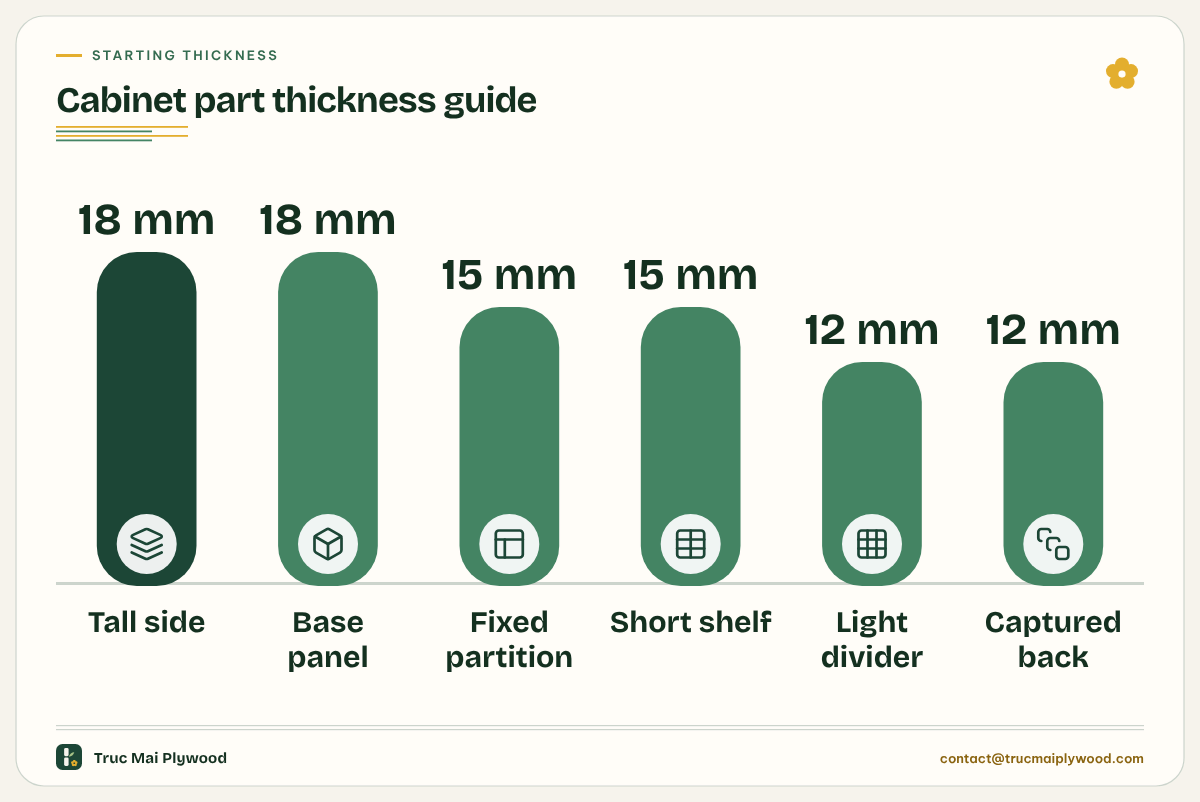
For cabinet boxes, 18 mm plywood is the practical default for sides and bases, 15 mm suits many supported partitions, and 12 mm works for lighter, well-supported parts. The right plywood thickness for cabinets follows each part’s span, fixing method and hardware, not one number for the whole kitchen.
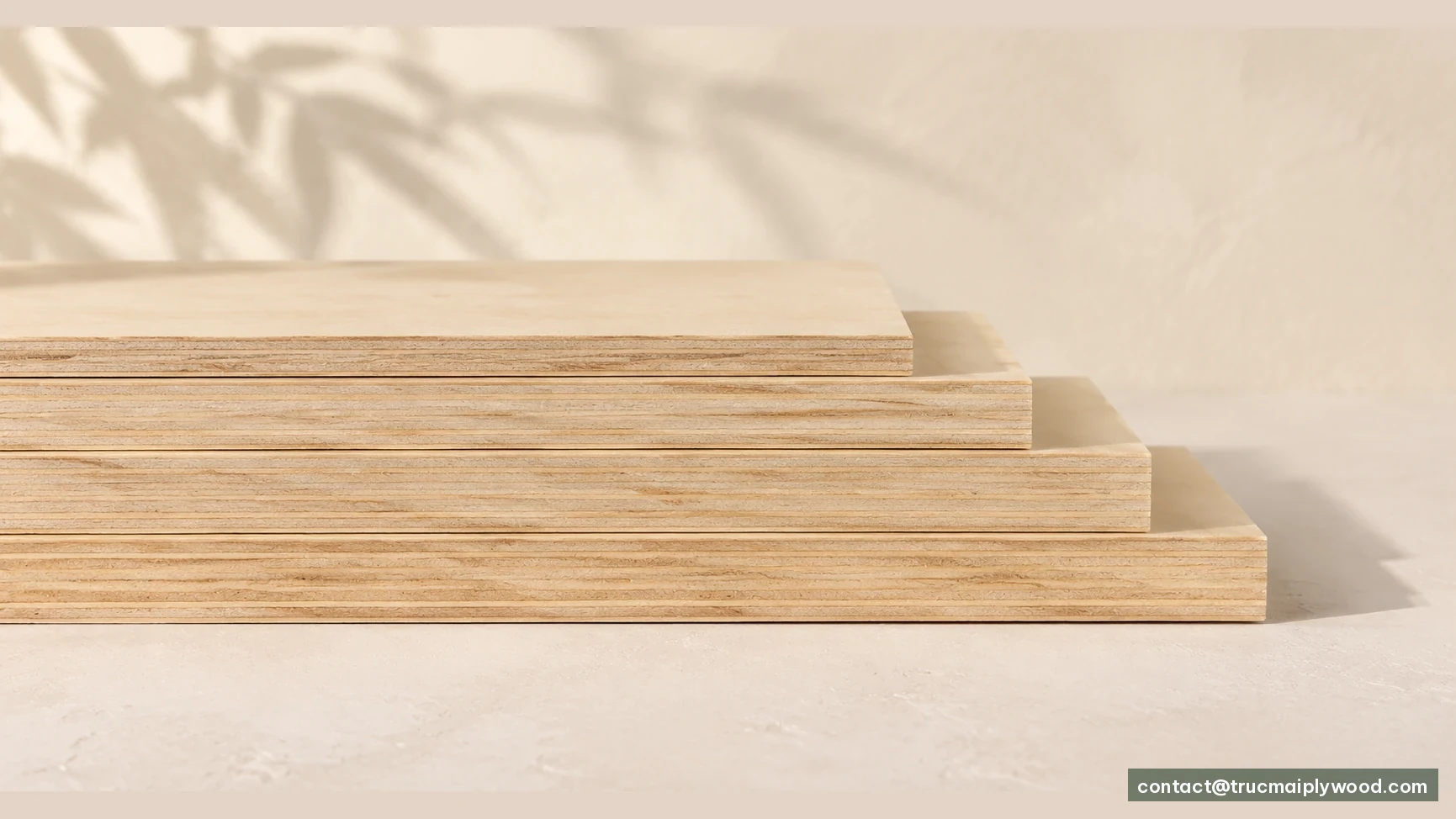
Which is better for cabinets, 1/2 inch or 3/4 inch plywood?
3/4 inch is the usual starting point for full cabinet boxes; 1/2 inch suits lighter, supported parts. Compare actual 18 mm and 12 mm sheets rather than treating nominal inch sizes as exact equivalents. Thicker sides provide more material for screws and hinges; thinner sides reduce weight but need suitable support and joints.
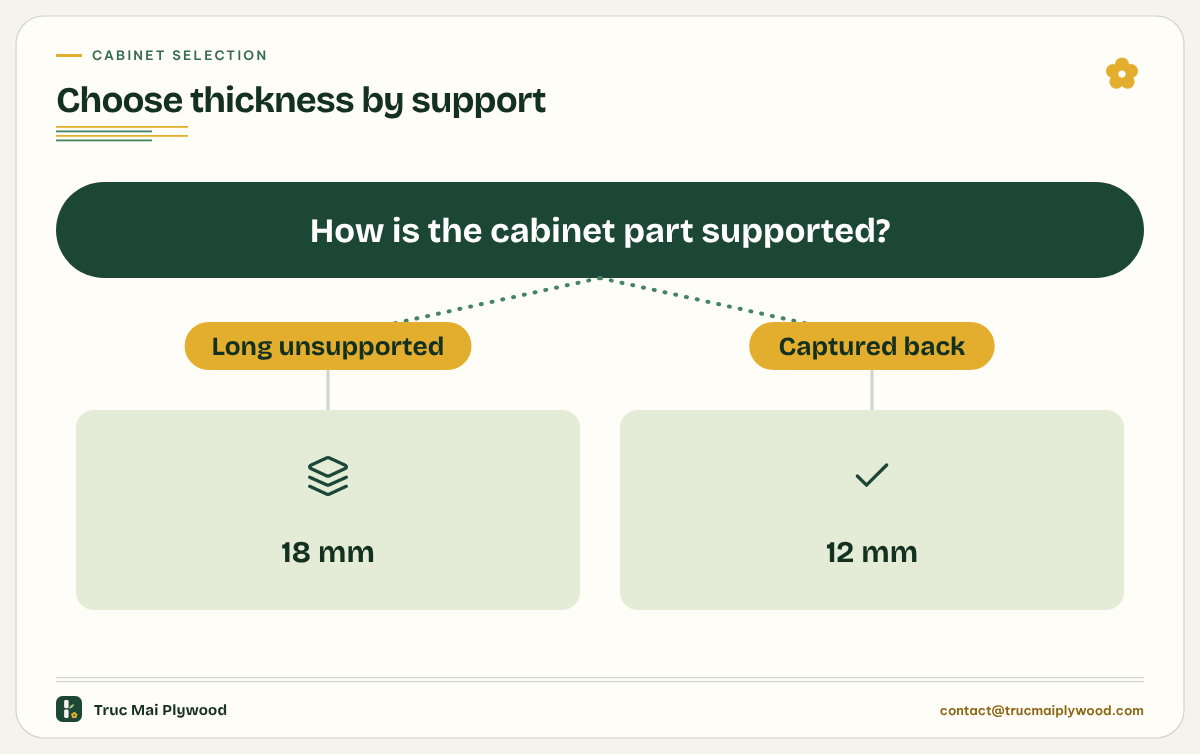
For a tall pantry side with long unsupported edges, start with 18 mm. For a compact wall unit with a captured back, close-fitting shelves and sound joinery, 12 mm can be sensible. The critical distinction is the way the panel is supported, not whether the cabinet is called a kitchen, bathroom or utility cabinet. The kitchen cabinet plywood guide discusses panel selection beyond thickness.
The inch label can also hide a machining problem. A drawing dimensioned for an exact 19.05 mm panel will not automatically fit an 18 mm board. Dados, hinge plates, shelf pins and edge-banding equipment use actual dimensions. Ask for a measured, sanded sample, then lock the finished thickness into the bill of materials. US structural plywood uses performance categories under NIST PS 1-22; furniture plywood is ordered against its own agreed construction and finished dimensions.
Is 1/2 inch plywood strong enough for cabinets?
Yes, 12 mm plywood can make a sound cabinet when the spans are short and the panels are supported. It is a useful choice for smaller partitions, backs designed as part of the structure and compact boxes with a rigid frame. It is less forgiving when used for a long shelf, a tall unsupported end panel or a heavily loaded base.
Consider where the load travels. A shelf supported continuously along both sides behaves differently from one fixed only at its ends. A back housed in a groove helps resist racking; a loosely pinned thin back contributes less. A tall cabinet also places demands on the corner joint and on the wall-fixing system. A cabinet-maker should test the complete assembly, not infer performance from panel thickness alone.
The core matters at the fastener line. A sound, well-jointed veneer core supports cleaner machining than a sheet with gaps at the edge. Check the edge of the sample after cutting, then drive the intended screw at the specified pilot-hole size. The USDA Forest Products Laboratory explains how veneer bonding, moisture and the adhesive system affect panel behaviour in its Wood Handbook chapter on wood adhesives. For visual and core requirements, compare cabinet-grade plywood against a signed-off sample.
What thickness plywood is best for cabinets?
18 mm is the best all-round starting thickness for cabinet carcasses; use 15 mm for supported components and 12 mm for lighter parts. A cabinet is an assembly of parts with different duties. Buying every component in one thickness can simplify stock control, but it is rarely the most economical cutting plan.
| Cabinet component | Practical starting thickness | Design reason | Check before release |
|---|---|---|---|
| Tall side or exposed end | 18 mm | Joint and fixing material | Hinge and fastener positions |
| Base or bottom panel | 18 mm | Load and joint support | Plinth or leg positions |
| Fixed internal partition | 15 mm | Intermediate rigidity | Span and connector depth |
| Short, supported shelf | 15 mm | Balance of weight and stiffness | Load, span and edge support |
| Light internal divider | 12 mm | Reduced material in a supported position | Groove and attachment detail |
| Captured back | 12 mm or thinner design-specific panel | Cabinet squareness and closure | Groove, fixings and cable openings |
| Drawer box side | 12 or 15 mm | Hardware clearance | Runner and joint geometry |
| Full-height flat door | 18 mm | Hinge fixing and flatness | Door size and hinge schedule |
These are procurement starting points, not a structural span-rating table. A cabinet with an unusually wide shelf or concentrated appliance load needs its own layout and hardware assessment. The key is to define the load and attachment before specifying thickness.
For repeat production, draw the cabinet and label every part with its finished thickness, surface, visible face and grain direction. A door and an internal shelf may use the same nominal board but require different surface preparation. This is where a complete plywood RFQ prevents mismatched quotations.
Should I use 1/2 or 3/4 plywood for drawers?
Use 12 mm for many drawer box sides and 18 mm for a substantial applied drawer front. A drawer box is governed by its runners, joints and clearances. Thicker sides reduce usable internal width, while thinner sides require the right joint and screw placement. Deep, heavy-duty drawers may justify 15 mm sides after checking the hardware specification.
Separate the visible front from the working box. The applied front controls appearance and carries handle fixings; the box sides travel on the runners. A recessed or captured bottom can be thinner than either, provided the groove, span and contents suit the design. Specify the bottom panel separately rather than calling the whole assembly a 3/4 inch drawer.
A useful production drawing shows the runner model, cabinet opening, side thickness, bottom groove and front overlay. Trial-fit one complete drawer before cutting the batch. Where a buyer wants a consistent visible edge, approve the veneer-core appearance alongside the outer face, not after the CNC nesting has been completed.
How thick should plywood be for cabinet doors?
18 mm is a practical starting thickness for a flat plywood cabinet door. It provides material for common concealed-hinge fixing patterns and an edge that can be banded or finished. The final door thickness follows the hinge cup depth, overlay, door dimensions and whether a decorative facing is applied.
A door is different from a carcass side: its large visible surface and repeated movement make flatness and surface matching especially important. Specify a balanced construction and the face/back pair. A thin decorative face on one side does not remove the need to consider the reverse side. Ask for the actual face sample under the finish you intend to use.
For exposed wood, birch-faced plywood offers a birch veneer face over a Vietnamese veneer core, not an all-birch construction. For a ready decorative surface, melamine-faced panels offer a different finishing route. Record the edge treatment and hinge drilling after the surface choice, so the workshop does not have to remake doors when the finish changes.
Where does 15 mm fit in plywood thickness for cabinets?
15 mm belongs in the middle: fixed partitions, compact shelves and drawer components with adequate support. It is especially useful when 12 mm feels too flexible for the part but 18 mm adds unnecessary weight or takes space from the cabinet interior.
A cabinet with 18 mm outer sides and 15 mm internal divisions can keep strong corner joints while allowing more room inside. The 15 mm components must still be specified as individual parts, because connector screws and shelf supports designed for a thicker side may need different drilling. The machining schedule should distinguish through-holes, blind holes and edge fixings.
One advantage of a mixed-thickness order is that the manufacturer can choose a face grade appropriate to each part. Hidden partitions need a clean, stable surface, while an exposed end demands more careful visual matching. The order can keep one core species across the parts to simplify handling without paying for the same face specification everywhere.
What matters more than thickness when choosing cabinet plywood?
Core quality, bonding, flatness and machining consistency matter alongside the millimetre figure. A 12 mm panel with a sound stitched core can be easier to machine cleanly than a thicker panel with open core gaps. Surface preparation matters too: a painted or laminated panel calls for a different face than one sold for visible veneer.
Truc Mai Plywood manufactures furniture/interior and commercial panels with Styrax, Acacia, Eucalyptus or Pine cores, including combinations agreed for the order. Furniture panels use stitched core construction and sanded faces; face and back grades are agreed against a sample. Its standard furniture-panel thickness tolerance is specified per order, with ±0.3 mm for sanded, calibrated panels. That gives the cabinet shop a measurable acceptance point at incoming inspection.
For a production sample, check three areas: the face under the intended lighting, the cut edge after sawing and the drilled fixing point after assembly. Record the defect type rather than simply calling a board good or bad. A small void hidden behind an edge band may be tolerable in one part; a gap at a hinge screw line is a different purchasing decision.
How do face veneer and finish affect the thickness choice?
Choose the surface first, then keep the finished panel thickness consistent with the drawing. A cabinet maker can select natural veneer faces, engineered veneer, melamine or HPL according to the final appearance and cleaning requirements. The core and the facing should be recorded as separate specification lines.
For a visible wood-grain kitchen, decide which faces are exposed and whether adjacent doors need a matched appearance. For a painted kitchen, the sanding quality and preparation for coating become central. UV-ready means a prepared surface for the buyer to coat; it is not a factory-applied UV finish. For melamine, specify colour, texture, face/back combination and edge-banding method.
Truc Mai offers 0.2–0.5 mm face veneers, commonly 0.3 mm for European furniture orders. This veneer thickness is part of the panel build, not an extra amount to add casually to the quoted finished thickness. Put the complete assembly on the purchase specification so the thickness gauge and the cutting drawing refer to the same product.
Which sheet size gives the cleanest cabinet cutting plan?
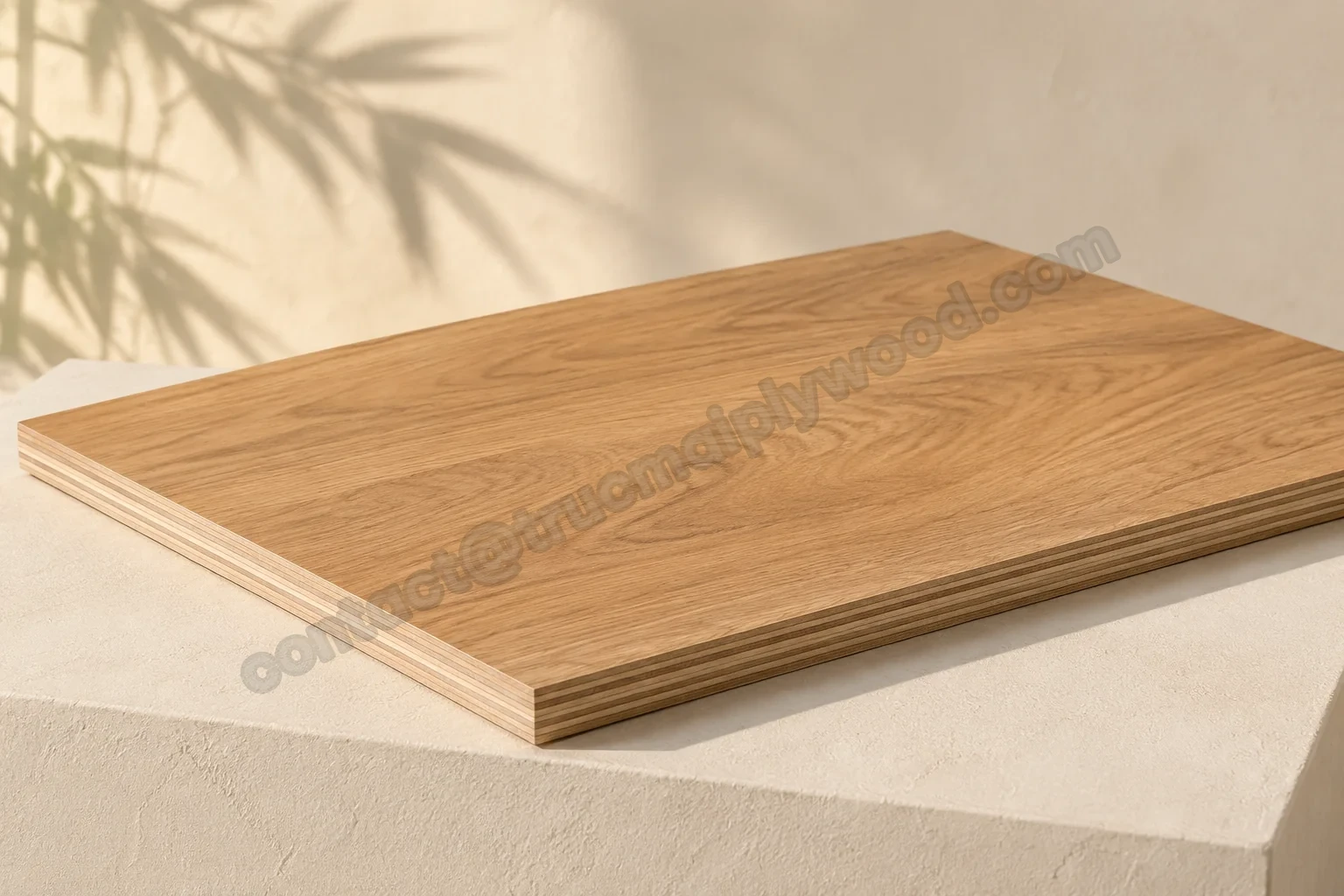
1220 × 2440 mm is a practical default for cabinet production; 1250 × 2500 mm suits workshops laid out for the European format. The 1220 × 2280 mm option can suit shorter furniture components. Choosing the sheet by the number of useful parts, rather than by its nominal area alone, reduces awkward offcuts.
Start from a part list containing width, length, quantity, grain direction and which edges will remain visible. Group similar parts into a nesting plan. A tall door might determine the grain direction for the entire sheet, while short partitions can be rotated when their surface permits. Include the saw kerf and trim allowance in the cutting software rather than promising that theoretical rectangles will fit without loss.
Cut-to-size supply is available as labelled pieces. Common patterns include a standard sheet halved lengthwise into 610 × 2440 mm strips, a three-piece 1200 × 800 mm pattern, and four 1220 × 610 mm pieces; six-piece arrangements are also possible. The exact dimensions are agreed from the buyer’s source sheet and cut list. See panels cut at the mill for the purchasing option.
How should a buyer specify thickness tolerance and flatness?
Specify the finished thickness and an agreed tolerance on the order, then measure production samples at several points. A thickness name alone is insufficient for CNC dado depths, edge-band application and repeatable drawer clearances. A sanded and calibrated furniture panel has a different purchasing specification from a rough packing panel.
The European plywood dimension standard EN 315 addresses dimensions and tolerances; a buyer’s tighter mill agreement can be written independently. For Truc Mai, the ordered furniture range uses ±0.3–0.5 mm depending on construction, and length/width tolerance is ±2 mm. Put the target and tolerance on the same line as the size, rather than relying on a general catalogue entry.
Measure the sheet near the edges and across the middle, avoiding local damage. For CNC work, machine a sample groove and check the fit with the actual mating part. Also examine bow and twist with the sheet supported in a repeatable way. A panel that measures correctly at one corner may still create assembly work if the rest of the sheet is inconsistent.
Which bonding and emission documents belong on a cabinet order?
Request the adhesive system, emission classification and product-specific supporting documents as separate items. Bond performance describes how the veneers remain joined; formaldehyde emission describes a different characteristic. A buyer should never infer one from the other.
For interior furniture, Truc Mai’s default specification is UF glue at E0 emission. The order records the actual glue and emission requirements, and a different bonding system can be chosen for the application. The USDA Wood Handbook adhesive reference describes UF’s suitability for interior wood products and its limitations under prolonged wetting.
For US-bound hardwood plywood, 40 CFR Part 770 sets the TSCA Title VI veneer-core hardwood plywood emission limit at 0.05 ppm. Truc Mai holds CARB Phase 2 and TSCA Title VI third-party certification for hardwood plywood with veneer core in the 3–25 mm range. The certification scope is checked against the actual product ordered; it does not extend to every possible thickness. Keep the emission document with the purchase specification and the corresponding shipment paperwork.
How many 12, 15 and 18 mm sheets fit in a 40HC?
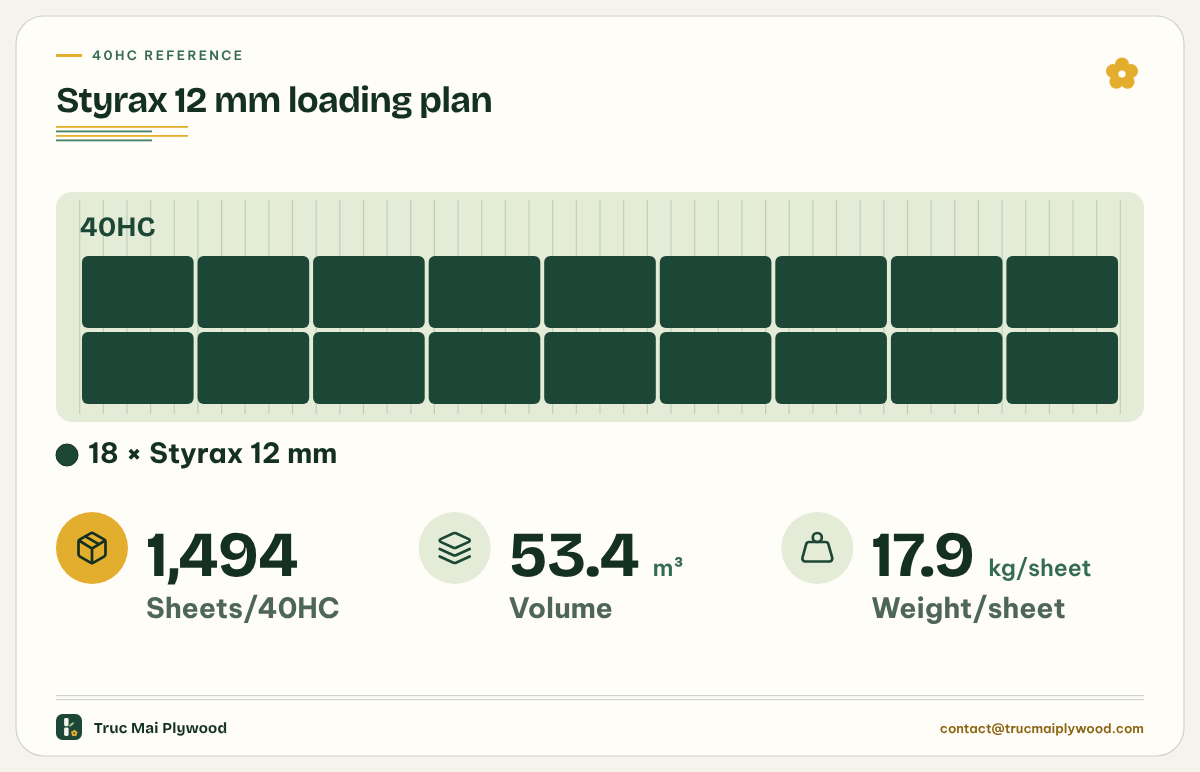
The planning table below gives all nine combinations of thickness and core for 1220 × 2440 mm sheets. The same cabinet order can include different thicknesses, but its pack plan must be assembled from the actual mix. A single-thickness figure is useful for budgeting sheet quantities, not as the final mixed-load tally.
| Core | Thickness | Sheet size | Packs | Sheets/pack | Sheets/40HC | Volume (m³) | kg/sheet | Total panel kg | Weight-capped |
|---|---|---|---|---|---|---|---|---|---|
| Styrax | 12 mm | 1220 × 2440 mm | 18 | 83 | 1,494 | 53.4 | 17.9 | 26,680 | No |
| Acacia | 12 mm | 1220 × 2440 mm | 16 | 83 | 1,328 | 47.4 | 20.7 | 27,510 | No |
| Eucalyptus | 12 mm | 1220 × 2440 mm | 15 | 80 | 1,200 | 42.9 | 23.2 | 27,860 | Yes |
| Styrax | 15 mm | 1220 × 2440 mm | 18 | 66 | 1,188 | 53.0 | 22.3 | 26,520 | No |
| Acacia | 15 mm | 1220 × 2440 mm | 16 | 66 | 1,056 | 47.2 | 25.9 | 27,350 | No |
| Eucalyptus | 15 mm | 1220 × 2440 mm | 15 | 64 | 960 | 42.9 | 29.0 | 27,860 | Yes |
| Styrax | 18 mm | 1220 × 2440 mm | 18 | 55 | 990 | 53.0 | 26.8 | 26,520 | No |
| Acacia | 18 mm | 1220 × 2440 mm | 16 | 55 | 880 | 47.2 | 31.1 | 27,350 | No |
| Eucalyptus | 18 mm | 1220 × 2440 mm | 15 | 53 | 795 | 42.6 | 34.8 | 27,690 | Yes |
Calculation basis: 40HC planning model, panels only. Styrax uses 18 packs, Acacia 16 and Eucalyptus 15, each about 1,000 mm high. Sheets per pack equal 1,000 divided by panel thickness, rounded down, with the count capped against a 28,000 kg planning payload. Reference core densities are Styrax 500 kg/m³, Acacia 580 kg/m³ and Eucalyptus 650 kg/m³. The model excludes packaging weight from the table; carrier and route limits set the final permissible load. These are planning figures, not recorded shipments.
The table shows why a purchase planner cannot simply multiply the 18 mm count by a thickness ratio and expect the same load. Packs have discrete sheet counts, and the heavier core reaches the weight cap sooner. Before booking, add the actual packaging mass and weigh representative finished sheets. The 40HC loading reference explains the model for other thicknesses, while the 18 mm specification focuses on that common cabinet size.
Can a cabinet order combine 12, 15 and 18 mm panels?
Yes, a mixed 40HC can carry all three thicknesses when the pack layout is agreed in advance. One or two products per container is common, while three to six can be arranged by agreement. A cabinet maker can therefore order thick carcass sides, medium partitions and thinner components against the same assembly schedule.
Mixed orders work best when the cutting list is divided into clearly labelled product lines. Each line should state the core, face/back pair, finished sheet size, thickness, quantity and pack marking. Separate the visible-door material from hidden partitions if the surface grades differ. Packing labels should let the receiving warehouse identify the parts before breaking the packs.
The loading table above is for uniform packs. A mixed order needs its own weight calculation and placement plan, including packaging and the booking payload. For a first purchase, ordering plywood samples helps the workshop verify the different thicknesses with the same tools and edge-banding equipment it will use in production.
How do you compare two cabinet-plywood quotations fairly?
Compare the same finished construction, not just a quoted 18 mm thickness. Two offers described as cabinet plywood may have different core species, core-joint quality, veneer faces, sanding and thickness tolerances. Those differences affect cutting yield, hardware fitting and the finish of the installed kitchen.
Use the same sample and drawing for both suppliers. Request the face and back grades as a pair, state whether the board is intended for visible veneer, paint or laminate, and identify the approved core construction. Ask the supplier to show the actual edge after cutting. The sample should then be machined using the cabinet shop’s real joint, hinge and edge-banding processes.
A sensible acceptance schedule includes a thickness measurement, a face appearance comparison and a check of the intended fastener. It also names the packing method and labels for mixed thicknesses. This approach allows the purchasing team to evaluate total usable parts instead of focusing on a single nominal sheet description.
What should the cabinet-maker send with the purchase enquiry?
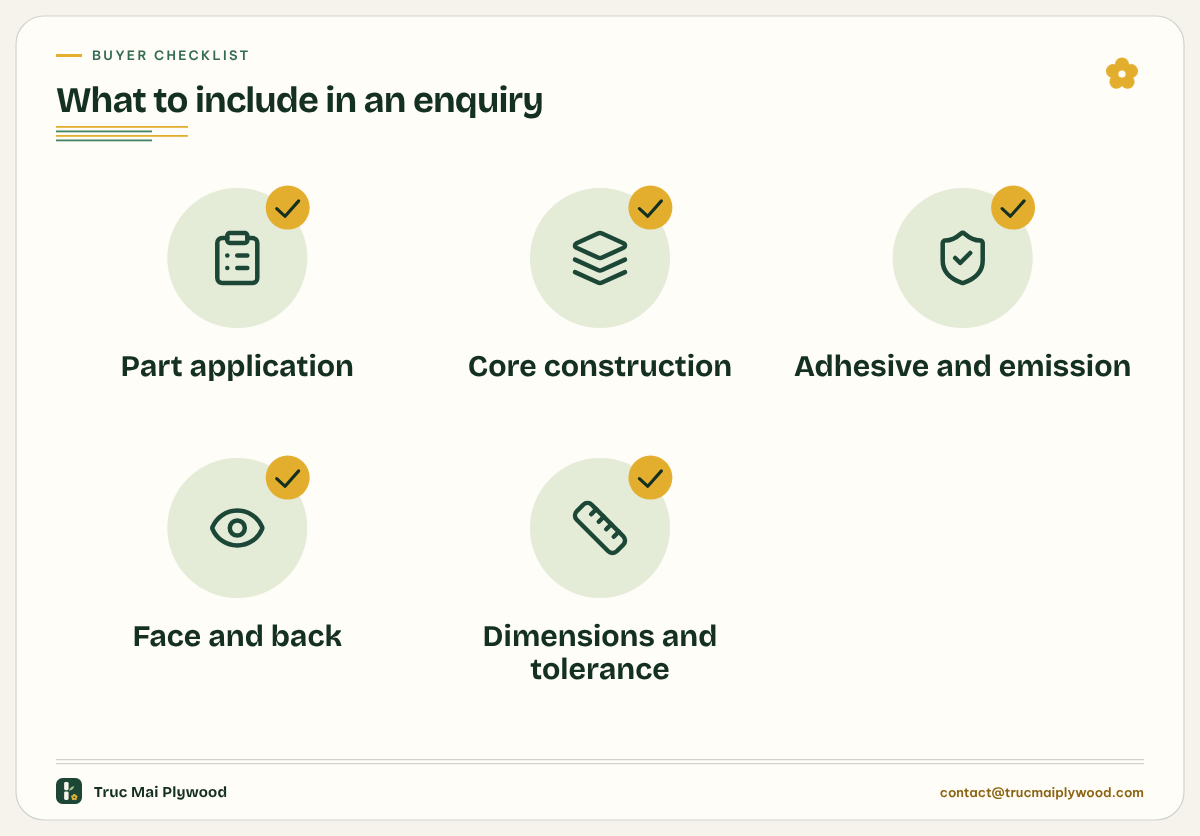
Send a cabinet-part schedule with thickness, application and machining requirements for every line. A drawing with part names is more useful than a general request for cabinet plywood, because it tells the mill where the panel will be visible and where the fixing loads occur.
- Application: mark each line as side, base, shelf, partition, drawer component or door.
- Construction: choose the core species and the required jointing and surface grade.
- Adhesive and emission: state the intended market and the agreed specification.
- Face: identify face/back veneers or decorative overlays and the visible side.
- Dimensions: give finished thickness, sheet size or labelled cut sizes, grain direction and tolerance.
- Packing and quantity: list each thickness separately, the preferred pack labels and destination port.
For a repeat cabinet programme, attach a sample reference and a nesting export from the cutting software. That lets the factory quote consistent material while the workshop controls its own cutting yield. The next useful step is a sample set for the 12, 15 and 18 mm parts in the drawing, followed by a quotation against the approved specification.
Send your specification to contact@trucmaiplywood.com or through the quotation form.
Questions buyers ask
Can a 15 mm cabinet side accept concealed hinges?
Yes, when the hinge cup depth, fixing pattern and remaining material match the hardware specification. Check the drilling drawing on an approved sample before machining a production batch.
Is nominal 3/4 inch plywood exactly 19.05 mm?
No. Nominal inch categories and actual measured thickness are different purchasing conventions. Record the finished thickness in millimetres on the cutting list.
Should the back panel sit in a groove or on the rear edge?
A back captured in a groove can help keep a cabinet square. The groove depth, back thickness and fixing method belong on the cabinet drawing.
Can I order different face and back veneers?
Yes. Specify the face and back as a pair and approve a reference sample, especially when only one face will remain visible.
Is an engineered veneer the same as a solid birch face?
No. Engineered veneer is reconstituted wood veneer; birch-faced plywood has birch veneer on the face. Specify the appearance and face material rather than relying on a colour name.
Can melamine-faced plywood be cut for cabinet parts?
Yes. Include edge treatment, orientation, finished sizes and labels in the cut list so machining and assembly can identify each piece.
What should be checked on a cabinet plywood sample?
Measure thickness at several positions, inspect exposed core edges, check surface flatness and machine a representative hinge and screw joint.
Can 12 mm and 18 mm sheets share a shipment?
Yes. Mixed thicknesses can be arranged by agreement; the pack schedule and cargo weight are prepared for the actual mix.
Does an FSC chain-of-custody certificate cover every plywood order?
No. An eligible FSC product carries its specified FSC claim and certificate details on the sales documentation.
What emission evidence should a US importer request?
Request the third-party certification covering the actual hardwood plywood configuration and the applicable TSCA Title VI product scope.
What size sheet should a cabinet workshop specify?
Choose the sheet format that suits its cutting layout, then provide a finished-part schedule and grain direction for the mill or workshop.