
Poplar core plywood has poplar veneers inside the sheet, regardless of its visible face. It is commonly chosen for lightweight interior furniture. Vietnamese furniture plywood instead uses locally available plantation species such as Styrax, Acacia, Eucalyptus and Pine; a white poplar face on those panels does not make the core poplar.

What does a poplar-core plywood panel contain?
Poplar core plywood is a veneer-core panel whose inner layers are made from poplar wood, while the face and back may be poplar or another species. A buyer can therefore receive a birch-faced, red-faced or eucalyptus-faced sheet that still has a poplar core. The face description and the core description answer different questions.
In plywood, adjacent veneers are usually arranged with their grain directions crossing. The resulting panel behaves differently from a solid board because the bonded layers restrain movement across the grain. The US Forest Products Laboratory explains this cross-lamination principle in its Wood Adhesives chapter. For a purchase order, the important distinction is between the decorative surface and the veneers that make up most of the panel thickness.
The word poplar itself needs care. Commercial poplars include species of Populus, whereas American yellow-poplar is Liriodendron tulipifera, a different botanical genus. The US Forest Service species account identifies yellow-poplar and its uses in furniture and veneer. Ask for the scientific name when botanical identity matters to the order.
A practical specification names the face, back, inner core, adhesive, thickness and use. That is more informative than a catalogue title such as “white core plywood”. See the related core construction and glue choices for the distinction between veneer lay-up and adhesive performance.
Is poplar core plywood strong enough for cabinets?
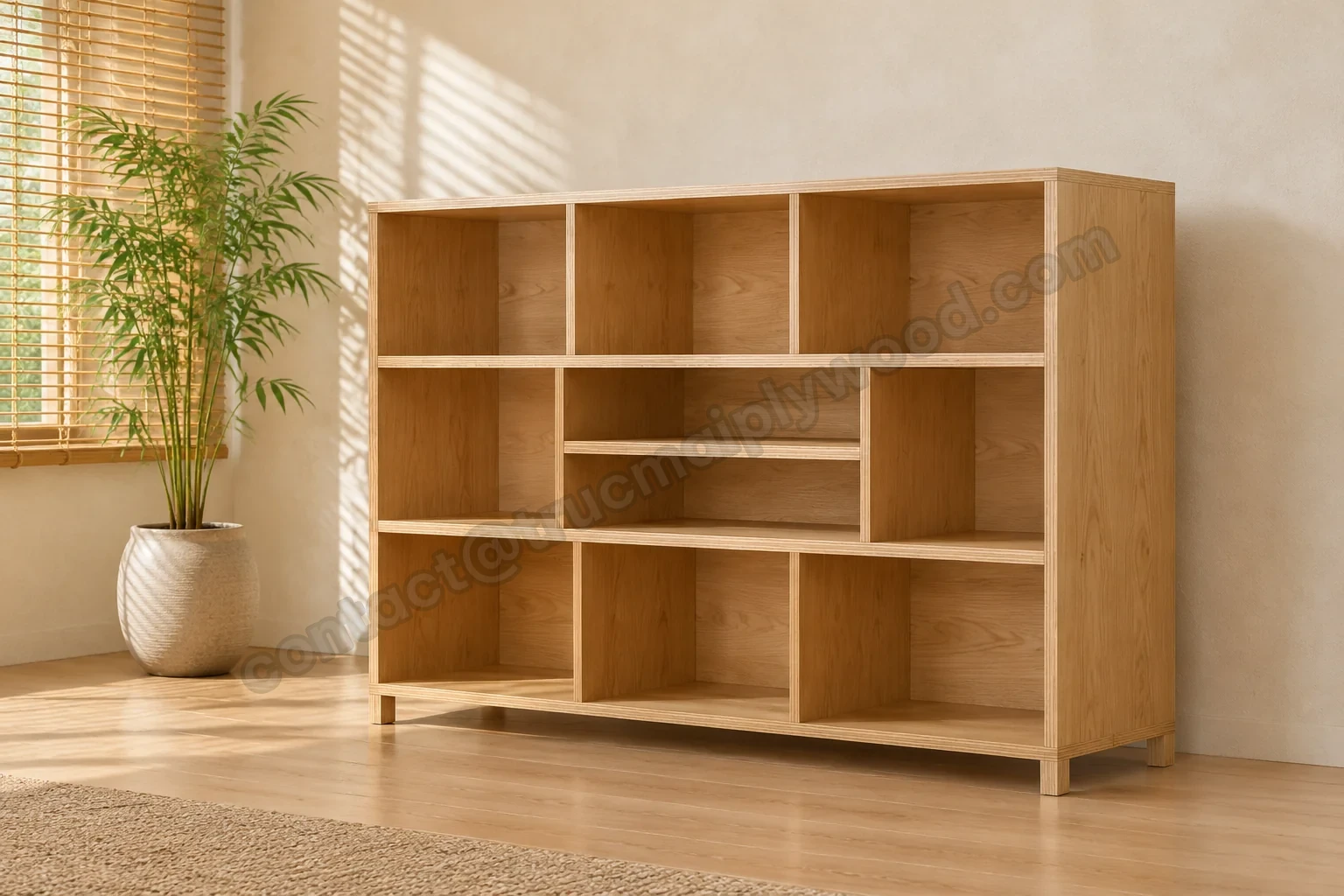
Yes. Poplar core plywood is suitable for cabinet carcasses, wardrobe interiors and drawer components when the panel construction matches the furniture design. For shelves, doors and other loaded parts, check the actual span, fixing method, panel thickness, edge quality and finish. Core species alone cannot establish the strength of a finished cabinet panel.
Cabinet sides usually have support along several edges. Shelves may have a longer unsupported span, while doors need flatness and stable hinges. Those are different mechanical demands. A lightweight panel that performs well as a cabinet back is not automatically the preferred choice for a heavily loaded shelf. A shop should check bending under the intended load, edge screw retention, surface flatness and whether the edge will be visible.
When comparing samples, drill and fasten at the intended edge distance, cut the real hinge-cup detail, and inspect the edge for voids. Test an assembled prototype rather than judging the panel solely by how hard the face feels. The plywood for kitchen cabinets discussion separates face appearance from carcass construction.
The designation “cabinet grade” describes an intended finish and workmanship level, not a universal bending-strength figure. Ask for an approved face/back sample and a core construction specification. For heavier shelf designs, evaluate the finished panel in its actual supported arrangement.
Poplar core vs eucalyptus core: which should a buyer choose?
Choose poplar core for a lightweight interior panel where handling and machining are priorities; choose Eucalyptus core when the project benefits from a denser hardwood construction and stronger edge support. Compare finished-panel tests before treating species as a performance rating.
| Buyer criterion | Poplar veneer core | Eucalyptus veneer core | What to verify |
|---|---|---|---|
| Handling | Generally lighter | Generally heavier | Actual sheet mass at the ordered thickness |
| Screw fixing | Depends on veneer quality and edge construction | Dense veneers can favour firm edge engagement | Screw withdrawal in the finished panel |
| Long shelves | Assess deflection at the planned span | Candidate for demanding furniture parts | Supported-span deflection test |
| Routing | Usually easy to machine | May demand different tooling or feed | Routed edge and tool finish |
| Surface colour | Determined by face veneer | Determined by face veneer | Approved face/back samples |
| Core uniformity | Depends on lay-up and joints | Depends on lay-up and joints | Cut-edge inspection |
| Adhesive durability | Depends on bond system | Depends on bond system | Test report for the exact construction |
The comparison is qualitative because species alone cannot supply a trustworthy finished-panel strength number. A denser veneer may improve one fixing test while an unevenly joined core can spoil machining or flatness. The most useful trial is the same thickness, face and fastener geometry with only the core construction changed.
For a Vietnamese sourcing comparison, Acacia and Eucalyptus core comparison addresses another common hardwood choice. The separate core choices compared page provides a wider purchasing framework.
Why Vietnam has no poplar core in its usual plywood range
Northern Vietnamese furniture-plywood production commonly uses Eucalyptus, Acacia, Styrax and Pine plantation timber for its cores rather than poplar. In Truc Mai Plywood’s Ha Hoa, Phu Tho production range, poplar is offered as a face veneer, not as an inner core species.
The distinction reflects the raw-material system feeding the mill. Core veneer is peeled from logs that can be sourced, sorted and dried consistently. Nearby plantation wood provides a practical input for repeated furniture and commercial panel production. Buying an imported pale face is a different supply decision from sourcing the many thicker inner veneers required for each sheet.
This is a statement about the specified Vietnamese product range, not a botanical assertion that poplar trees cannot grow anywhere in Vietnam. A buyer should read “Vietnamese poplar plywood” as an incomplete product description until the mill identifies the actual core. For example, poplar-faced plywood and engineered veneer sheets can have the light appearance associated with poplar while retaining a Vietnamese hardwood core.
A mill that peels local plantation timber can also coordinate core grading and joining around its own pressing process. That gives a buyer a concrete question: which core species and joining method are on the approved production sheet?
What does a white core actually tell you?
A white-looking edge tells you the veneer is pale; it does not identify the species. Styrax, pale sapwood and some mixed-core constructions can resemble a poplar core when viewed casually under warehouse lighting.
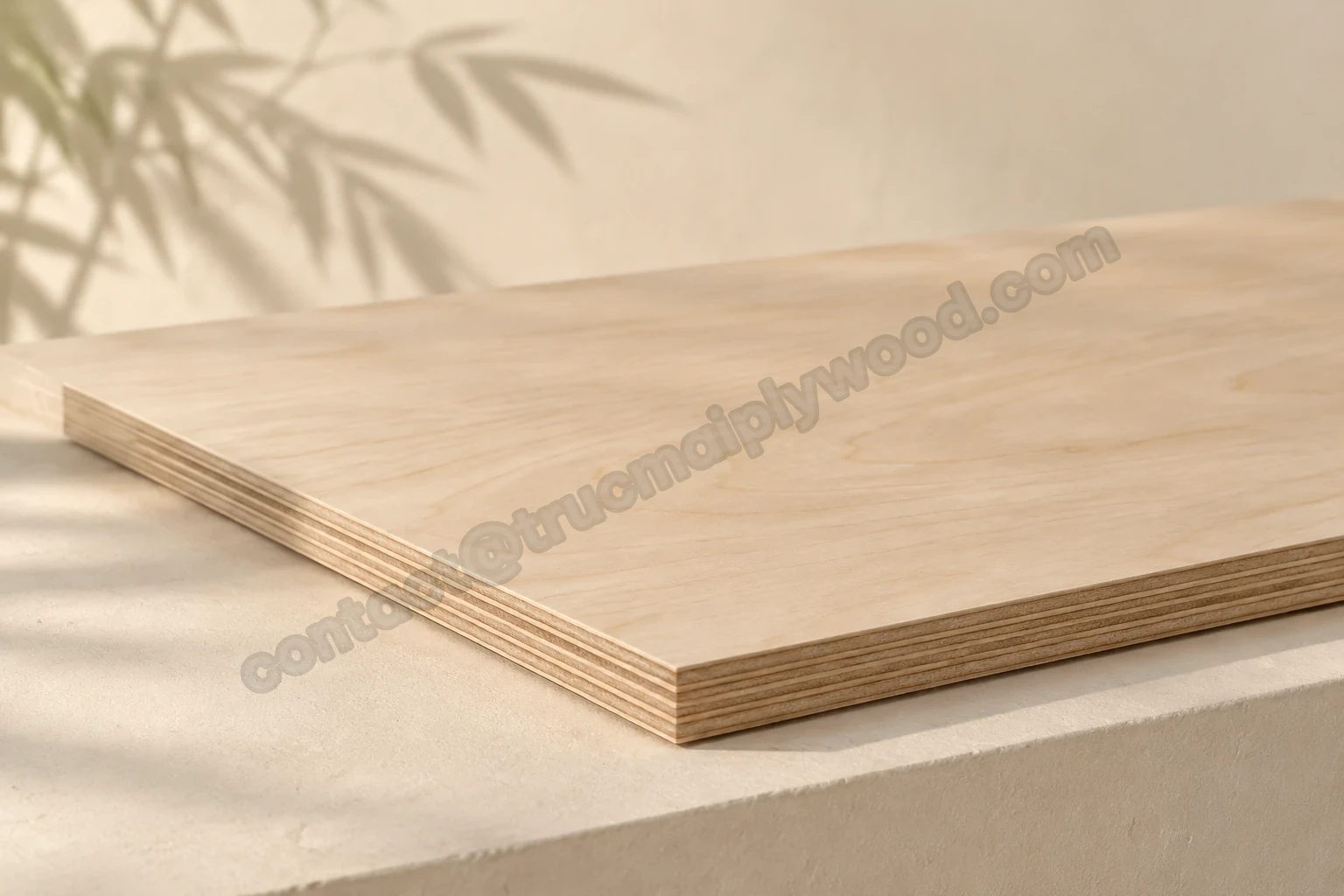
Inspect several clean cuts across the sheet rather than a painted edge or a single corner. Look for distinct veneer bands, joints, overlaps and changes in grain. A surface photograph is useful for colour approval, but a cut edge is the better starting point for discussing the core.
For the purchase file, request a written species schedule. A supplier can describe a mixed core accurately without suggesting that every inner ply is the same wood. When the order requires a specific species, put it in the contractual description rather than leaving it to an appearance-based nickname.
Does a poplar face mean poplar inside?
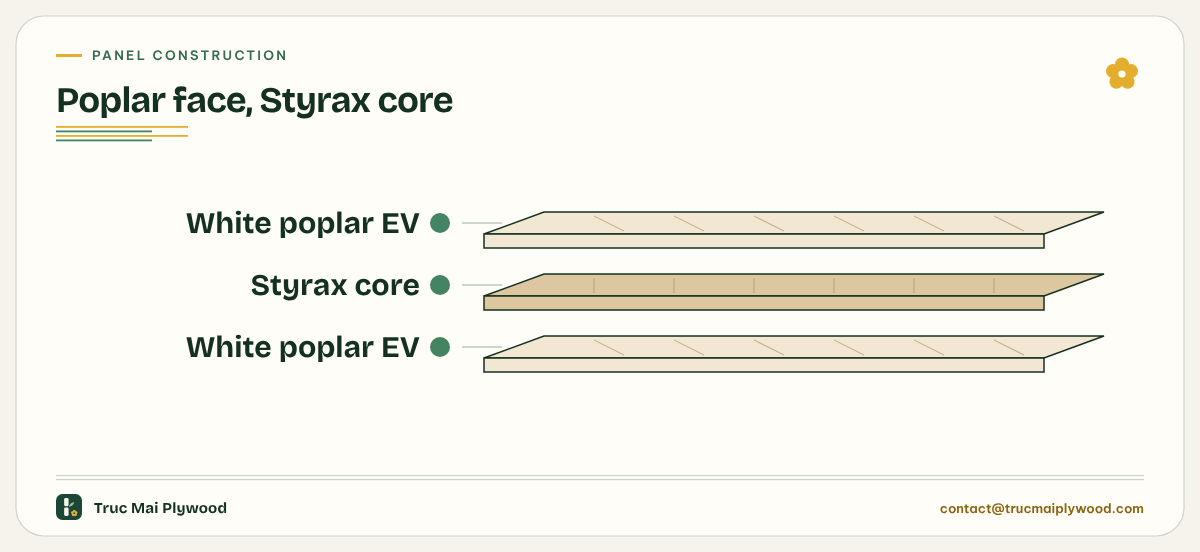
No. A poplar face identifies the visible veneer only. The inner core can be Styrax, Eucalyptus, Acacia, Pine or a specified combination in the Vietnamese furniture-panel range.
The same distinction applies to birch-faced plywood. A decorative birch face over Vietnamese core veneers is a birch-faced product, not an all-birch panel. The face may control the look under a clear finish; the core has greater influence on the edge construction and much of the sheet mass.
Engineered veneer adds another naming complication. White poplar EV is a reconstituted veneer made from plantation poplar, supplied as a face material. It is not a promise of poplar inner plies. A buyer selecting a repeatable pale appearance should specify the engineered face separately from the core.
How do veneer joints affect the finished panel?
Core joining matters because gaps, overlaps and poorly aligned veneers can appear as weak spots at a routed edge or telegraph through a finished face. A well-assembled panel uses a deliberate veneer layout and checks the core before pressing.
In the Truc Mai furniture/interior line, an A-grade stitched core and sanded faces are the normal construction. Stitching can run across and along the sheet, with the outer inner plies commonly stitched and additional plies stitched on request. Commercial panels can use a different joining approach to match their intended use.
For a cabinet maker, the key inspection is the cut edge where hinges, screws and exposed joinery will be installed. Ask for a photograph of the full panel edge and a routed sample. If the finished edge is concealed by lipping, the acceptance criteria can differ from those for a clear-coated exposed edge.
Which face grades belong on the specification?
Face and back grades should be written as a pair and agreed against an approved sample. A single word such as “premium” does not tell a buyer which repairs, colour variation or visible defects will be accepted.
International appearance classifications and trade grades are separate systems. The ISO 2426-2:2020 preview identifies hardwood plywood surface appearance classes E, I, II, III and IV. Common trading labels such as B/BB or BB/CC need the supplier’s own defect definitions rather than an assumed direct equivalence.
For an exposed cabinet door, examine colour matching and patches on the actual face. For an unseen back, the buyer can approve a different appearance. Keep the grade language in the sample approval and the order line so the warehouse inspection uses the same reference.
What thickness and sheet size should be ordered?
Specify thickness and sheet dimensions from the furniture cut list, then select the core and surface finish. The available Truc Mai furniture and commercial range is 3–40 mm, including standard 1220 × 2440 mm and 1250 × 2500 mm formats and a shorter 1220 × 2280 mm furniture sheet.
For thin panels at 3–5 mm, the construction uses five plies. An 18 mm furniture panel normally uses 11–13 plies, most often 11. These are construction details that help a buyer compare two apparently identical offers without relying on a product name alone.
Sanded and calibrated furniture panels can be specified at ±0.3 mm thickness tolerance; commercial and packing panels use their own agreed tolerances. Length and width tolerance is ±2 mm. Write the relevant tolerance on the order rather than assuming every grade shares the same machining target.
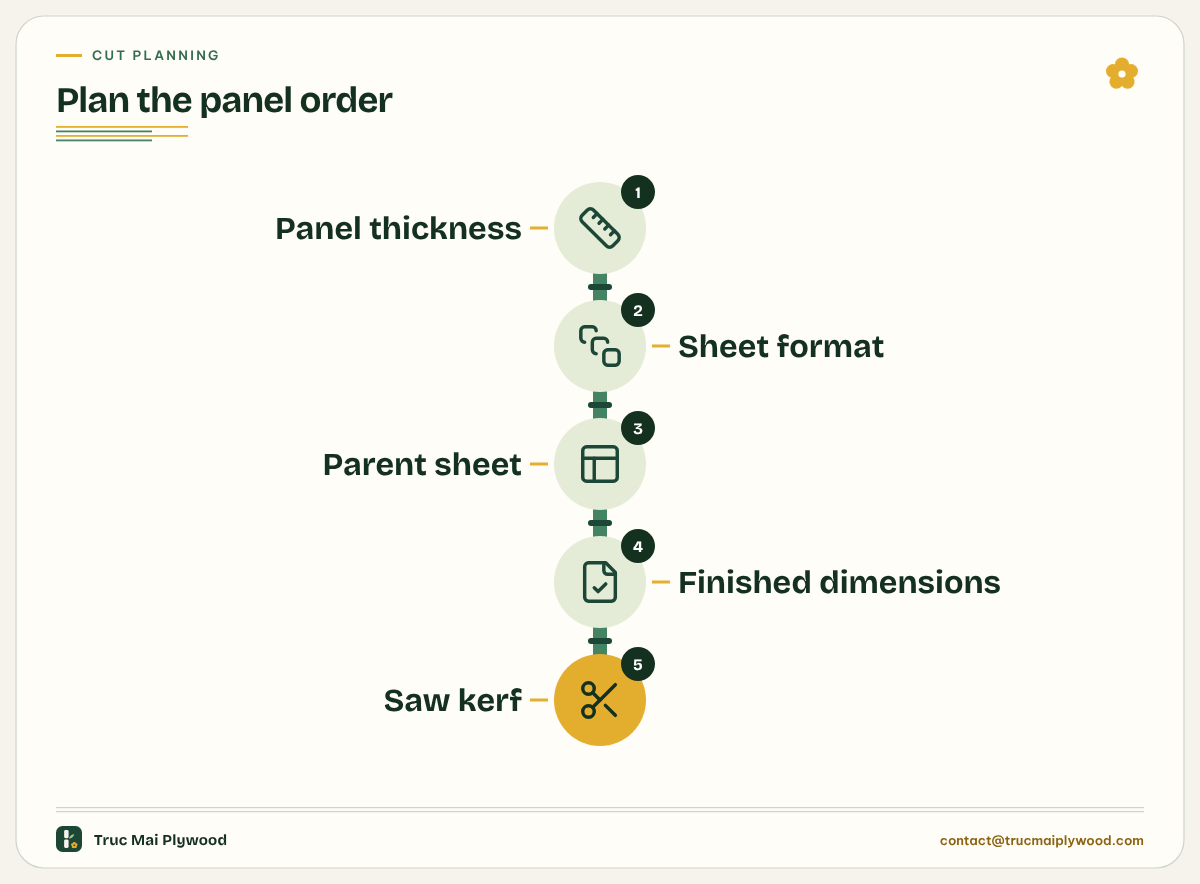
A cut-to-size order can divide a standard sheet into halves, thirds, quarters or six pieces, with labels following the buyer’s cut list. A cut drawing should identify the parent sheet and the finished dimensions, including allowance for the saw kerf. 18 mm panel specification is useful when the furniture programme uses that thickness.
Which adhesive and emission specification belong together?
Write the adhesive system and the formaldehyde emission requirement as two separate specification lines. Adhesive chemistry describes bonding; an emission limit describes the finished panel’s measured release under a named test.
For dry interior applications, UF resin is a common plywood adhesive. The US Forest Products Laboratory adhesive reference describes UF’s limitations under prolonged wetting and distinguishes it from moisture-resistant adhesive systems. A buyer requesting higher bond durability should state the intended service conditions and the test requirement rather than assuming a colour or species proves water resistance.
For US regulated hardwood plywood with veneer core, 40 CFR 770.10 gives a formaldehyde emission limit of 0.05 ppm under the specified test framework. Truc Mai holds CARB Phase 2 and TSCA Title VI third-party certification for veneer-core hardwood plywood in the 3–25 mm scope. Request the documents for the exact ordered configuration; the wider commercial thickness range is described separately.
Can a core species make plywood structural?
No. A core species by itself does not make a plywood sheet a structural-rated product. Structural use requires the relevant product standard, grade, bond performance and marking for the intended application.
The US NIST PS 1-22 structural plywood standard sets out structural plywood classifications and performance requirements. Its Exposure 1 and Exterior bond classes describe moisture exposure conditions for structural panels. Those classifications should not be inferred from a commercial furniture-panel description.
For wardrobes, cabinet carcasses and interior decorative parts, the useful questions are different: finish quality, core joints, fastener holding, panel flatness and the load in the assembled furniture. Keep the intended application on the first line of the RFQ so the proposed construction fits the job.
How can buyers check a supplier’s core declaration?
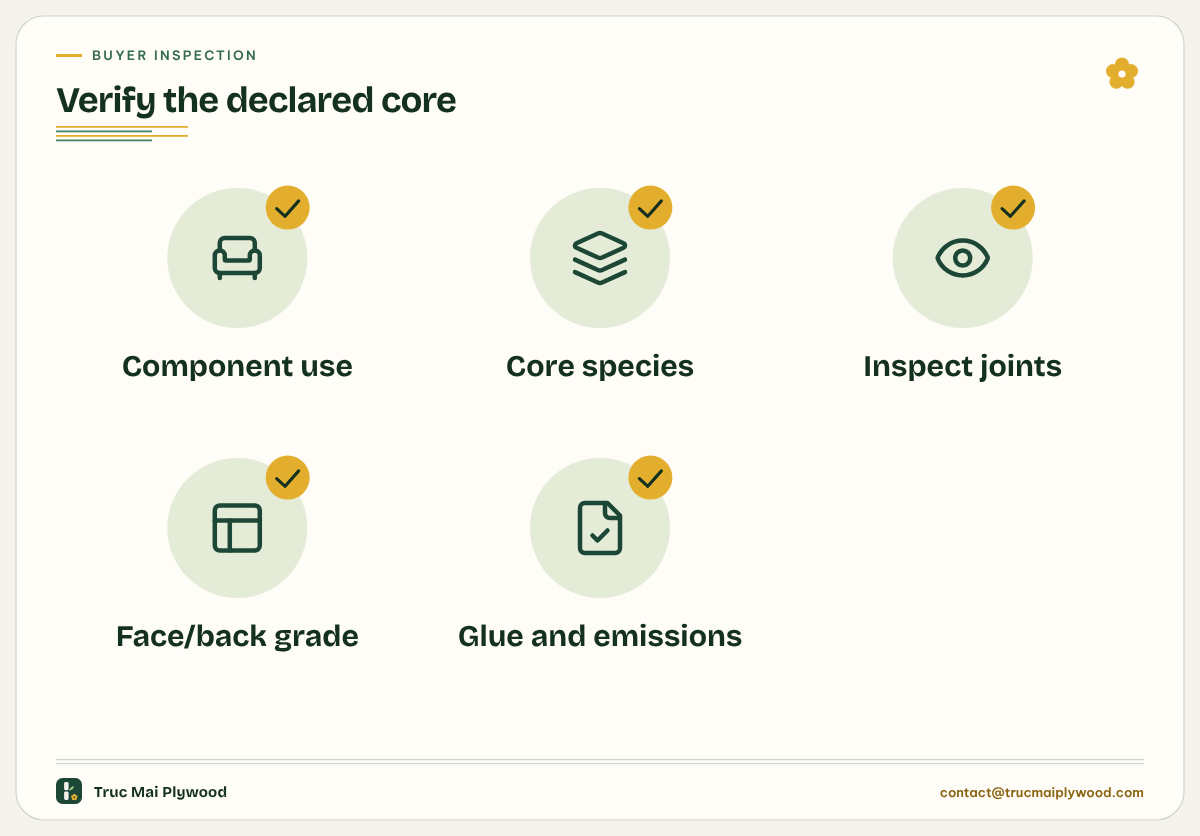
A buyer can check a core declaration through a documented sample approval and a repeatable inspection plan. The process is straightforward and works for both poplar-core imports and Vietnamese hardwood-core alternatives.
- State the application. Identify cabinet carcass, shelf, drawer, door or another furniture component and note which edges remain visible.
- Name each layer. Specify face, back and inner core species; write any permitted mixed-core construction explicitly.
- Approve an edge sample. Photograph the full thickness, inspect joints and route or drill a trial component.
- Agree the surface. Record the face/back grade pair, sanding and approved colour sample.
- Record the tests. Match adhesive, emission and any required bond report to the ordered panel configuration.
- Inspect the production lot. Compare sample edges, thickness readings and face quality with the approved specification.
A factory quotation is easier to compare when these items are on one sheet. The plywood RFQ checklist offers a practical structure for sending them to suppliers.
What should a furniture importer ask about traceability?
Ask for species, origin records and the documents needed for the destination market. For a decorative panel, the face veneer and the inner core may come from different supply chains, so both should appear in the traceability discussion.
Truc Mai can supply EUDR due-diligence information for the Vietnamese core and imported face veneer, including origin records and geolocation files. For eligible FSC 100% products, the chain-of-custody claim is identified on the sales documentation under certificate SA-COC-014545, licence FSC-C196493.
A traceability file is most useful when it connects the exact product description with the source materials. If the face is engineered veneer, ask for the veneer origin record as well as the core wood record. This keeps a visually similar replacement panel from silently changing the declared material composition.
How should two plywood quotations be compared?
Compare two offers against one common construction schedule, not against the phrase “poplar plywood” in the subject line. A quoted sheet can differ in core grade, joining, face veneer, adhesive, calibration and packing even when the nominal dimensions match.
| Quotation field | What the buyer should write |
|---|---|
| Intended use | Cabinet carcass, door, shelf or other part |
| Face and back | Species, appearance grade pair and finish |
| Core | Species or approved mixed-species schedule |
| Construction | Ply arrangement and joining method |
| Bond and emission | Adhesive type plus separate test requirement |
| Dimensions | Thickness, width, length and tolerances |
| Delivery unit | Full sheets or labelled cut components |
| Evidence | Approved sample and relevant certificate files |
When a supplier proposes a substitution, ask which line changes and why. A lighter core might simplify handling; a denser core might be preferred for a particular fixing design. Those are useful choices when the rest of the specification is held constant.
How can a buyer order a Vietnamese alternative?
Order a Vietnamese hardwood-core panel by naming the application, core species, face veneer, adhesive and emission specification, dimensions, finish, packing and quantity. A pale face can be retained while the inner core changes to a locally supplied species.
Start with a sample that shows the full edge and the intended finish. The mill can then quote the agreed construction and provide the relevant documents. Ordering plywood samples describes the sample route, while the plywood RFQ checklist helps turn the approved sample into a repeatable order.
Send the furniture cut list, destination port and desired packing arrangement with the enquiry. Specify whether the order is for full sheets or labelled cut components. That gives the manufacturer the information needed to prepare a comparable quotation rather than guessing from a generic “poplar core” description.
Send your specification to contact@trucmaiplywood.com or through the quotation form.
Questions buyers ask
Can I specify a white face without a poplar core?
Yes. A white poplar or engineered veneer face can be bonded to a Styrax, Acacia, Eucalyptus or Pine core; name both layers separately on the purchase specification.
Is red-faced poplar plywood red throughout?
No. Red-faced describes the visible surface colour or veneer treatment, not the species of every internal ply. Request an edge photograph and a written core-species declaration.
Does a birch face mean the core is birch?
No. Birch-faced plywood describes the outer veneer. Ask for the species of the internal plies if an all-birch construction is required.
What does combi core mean on a quotation?
Combi core means a mixed-species construction. A supplier should identify the species and placement of the inner veneers rather than relying on the shorthand.
Can I order a lighter plywood sheet for cabinet doors?
Yes. Discuss a lighter core such as Styrax, along with the specified door size, face, thickness and flatness requirements.
Are poplar plywood and poplar-faced plywood interchangeable names?
No. Poplar plywood is ambiguous without a layer schedule; poplar-faced plywood identifies the visible veneer, whereas poplar-core plywood identifies the inner veneers.
Should I specify an emission class or an adhesive?
Specify both independently. The adhesive describes the bonding system; the emission requirement identifies the test and limit for the finished panel.
Can plywood sheets be supplied already cut for furniture production?
Yes. Truc Mai offers labelled cut-to-size panels based on the agreed parent sheet and cut list, including halves, thirds, quarters or six-piece patterns.
Does FSC certification automatically cover every sheet from a certified mill?
No. The invoice must identify the eligible product and its FSC claim, with the seller's chain-of-custody certificate code.
What evidence should accompany a sample panel?
Ask for an edge view, a face/back sample, a written construction schedule and the test documents relevant to the ordered configuration.