
Fir plywood vs spruce plywood is chiefly a choice of veneer species, appearance and the finished panel specification. Spruce is often pale and understated; Douglas-fir can show stronger reddish growth-ring contrast. Pine adds a warm, sometimes knotty alternative. For furniture buyers, compare the face sample, core, adhesive and finish together.

Fir plywood vs spruce plywood: what changes in the finished sheet?
Fir plywood and spruce plywood differ first in the wood species used for their veneers, not in an automatic ranking of complete panels. A spruce face may look quieter and paler; a Douglas-fir face often shows more pronounced growth rings. The core, glue line, sanding and face grade still determine whether either sheet suits a furniture order.
| Buying criterion | Spruce-faced plywood | Fir-faced plywood | Pine-faced plywood |
|---|---|---|---|
| Typical face impression | Light, relatively subtle figure | Species-dependent; Douglas-fir often shows redder contrast | Cream to amber, often expressive growth rings |
| Knots | Select by face grade and approved sample | Select by face grade and approved sample | Clear or knotty appearance can be specified |
| Grain | Often restrained in white spruce | Douglas-fir often has visible ring bands | Stronger ring contrast in many pines |
| Core | Must be identified separately | Must be identified separately | Must be identified separately |
| Main buying decision | Pale, restrained interior finish | Grain-led decorative finish | Warm furniture or joinery face |
The USDA Forest Products Laboratory’s wood appearance tables distinguish nearly white spruce from orange-red or red Douglas-fir. Those are descriptions of wood species, rather than promises about every plywood sheet. A veneer cut, matching method and finishing system can change the appearance considerably.
A useful purchasing comparison starts with three full-size face samples under the intended room lighting. Examine the face at a distance, then check close-up knot repairs, veneer joins and sanding marks. The chosen face is only one part of the purchase specification.
What are the differences between pine plywood and spruce plywood?
Pine plywood usually has a warmer face with more visible growth-ring contrast, while spruce plywood often has a paler face with quieter grain. For cabinets, shelving, wall linings and furniture fronts, compare actual veneer samples for colour, knots and finish response. Core construction and adhesive must be specified separately.
Pine is not one uniform colour. Eastern white pine may be creamy with light reddish tones; ponderosa and southern pines can have more conspicuous growth-ring contrast. White and black spruce are often almost white, whereas Sitka spruce can be more reddish. The USDA physical-properties chapter provides species-level descriptions that help explain why a photograph labelled simply ‘pine’ is a poor purchase specification.
For a clear, painted cabinet interior, the buyer may favour an even surface and minimal repairs over a named softwood. For a natural-finish furniture line, the grain pattern may be the point of choosing pine. In either case, ask for a face/back grade pair, a reference sample and the same coating trial on each option.
Pine-faced plywood is part of Truc Mai Plywood’s furniture and commercial panel range. Its pine-faced plywood specification can be used as the starting point for a face sample and a written core choice. That is different from claiming that the mill’s pine panels contain pine in every layer.
Fir vs pine plywood: which should a furniture buyer specify?
Pine is a practical choice for a warm, characterful face; Douglas-fir is a candidate when pronounced straight growth-ring figure is wanted. A pale true-fir face is another appearance direction, so ‘fir’ must be clarified before the supplier selects veneer.
The word fir covers distinct commercial woods. Douglas-fir is Pseudotsuga; balsam and white fir are Abies. A catalogue that says only ‘fir plywood’ leaves an important identification gap. Ask for the species or an approved physical sample, then evaluate it against pine under the intended finish.
For cabinet doors, consider whether adjacent panels will be book-matched or sequence-matched. A large uninterrupted door exposes variation that disappears on narrow rails or drawer dividers. A rustic pine programme may welcome knots, while a minimalist fir-faced programme may need fewer visible interruptions. The required appearance should be recorded as an observable acceptance criterion, not an adjective.
If the order will be painted, run a primer trial and inspect raised grain and any resin-related marks after drying. If the face will be clear coated, check colour shift after the full finish schedule. The interior plywood selection guide explains how the decorative decision fits into the wider panel specification.
Are spruce, fir and pine actually different kinds of plywood?
Yes, when those names identify the veneer species, but they do not describe a complete construction. Plywood consists of bonded wood veneers arranged with their grain directions typically alternating between adjacent layers. A visible softwood face can cover a core made from another species.
That distinction matters when a buyer compares a pale spruce sheet from one region with a pine-faced sheet from another. The visible colour may be the only common feature. The number of plies, veneer thickness, core joints and adhesive system can all differ. Ask the supplier to identify the face, back and core independently.
In North American timber trading, SPF means spruce-pine-fir as a commercial grouping. It is useful shorthand in certain lumber markets, but not an adequate finished plywood description. Likewise, ‘softwood plywood’ tells you about the broad material category without fixing the face species, appearance or bond performance.
The NIST PS 1-22 structural plywood standard illustrates why this distinction matters: its grading system covers veneer quality, species groups and panel construction as separate attributes. Furniture buyers should use that distinction to ask better questions, without treating a decorative panel as a structural product.
How do colour, grain and knots affect the finished face?
Colour, grain and knots affect both the look of the sheet and the amount of sorting needed to achieve a consistent furniture run. The buyer should judge all three on finished samples from the proposed face grade.
A rotary-cut face can show broad, repeating grain movement. A sliced veneer can show a different figure from the same species. Join lines may become more visible after stain, especially when adjacent veneer leaves absorb coating differently. Matching instructions are therefore part of the decorative specification.
Knots need a more precise vocabulary than ‘good’ or ‘bad’. A sound, tight knot can be part of an intentionally natural face. A loose knot, open split or conspicuous patch may be unacceptable on a clean furniture front. The grade needs to say which are permitted and where. A photographed defect limit alongside the approved sample gives production staff a clearer target than a generic grade letter.
The USDA describes how earlywood and latewood take stain differently, changing ring contrast. Test the proposed clear finish, stain or paint on actual veneer rather than predicting the final colour from an unfinished thumbnail. Keep one signed sample for the buyer and one for the factory.
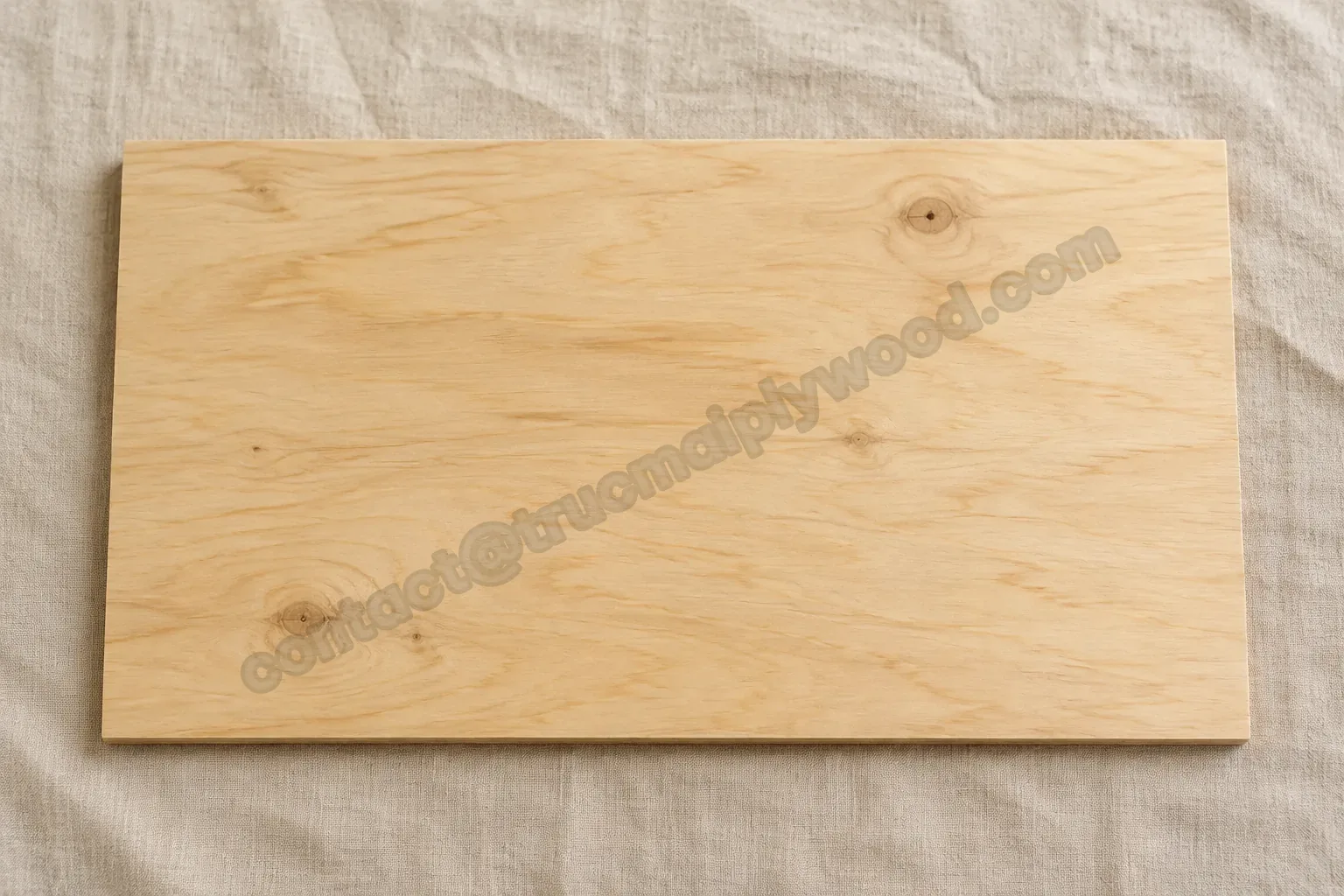
Does softwood species determine plywood strength or weight?
No. Species contributes to veneer properties, but finished plywood strength and weight also reflect the lay-up, core, adhesive, thickness and moisture content. A comparison of fir and spruce faces alone cannot establish the performance of the complete panel.
The USDA mechanical-properties tables show distinct properties for clear Douglas-fir, balsam fir and spruce species. Those figures are for wood test specimens, not interchangeable design values for an unspecified plywood assembly. Knots and grain deviation further influence the properties of real veneer.
For furniture parts, specify the panel performance that matters: flatness, thickness consistency, edge machining, screw holding or a test agreed for the assembly. A face veneer chosen for colour may contribute little to the purchasing decision about a shelf’s deflection if the core construction changes between offers.
When transport weight is material, request a measured sheet weight for the exact build. The hardwood core versus softwood plywood comparison helps separate core density from decorative face species. It is the correct comparison for logistics, rather than assigning a universal kilogram figure to ‘spruce plywood’.
Which softwood face works for cabinets, shelves and wall panels?
Spruce suits a restrained pale appearance, pine suits warm visible grain, and Douglas-fir suits projects seeking stronger ring contrast. Those are aesthetic starting points; the face grade and complete panel build decide the actual purchase.
For cabinet interiors, a clean sanded face, consistent colour and an appropriate emission specification often matter more than dramatic figure. Shelves require particular attention to thickness and support spacing. Wall linings are judged across large surfaces, where variation in knot density can become conspicuous once panels are installed side by side.
For door fronts, ask to see a set of neighbouring sheets rather than a single hero sample. For drawer sides, machining quality and a sound edge may outrank face appearance. For painted furniture, a prepared face with limited repairs can save finishing work even when its natural grain is not visually special.
The pine versus birch sheets comparison is useful when the design team wants a more neutral, fine-grained alternative. Birch-faced plywood should be specified as birch-faced rather than assumed to have birch throughout the core.
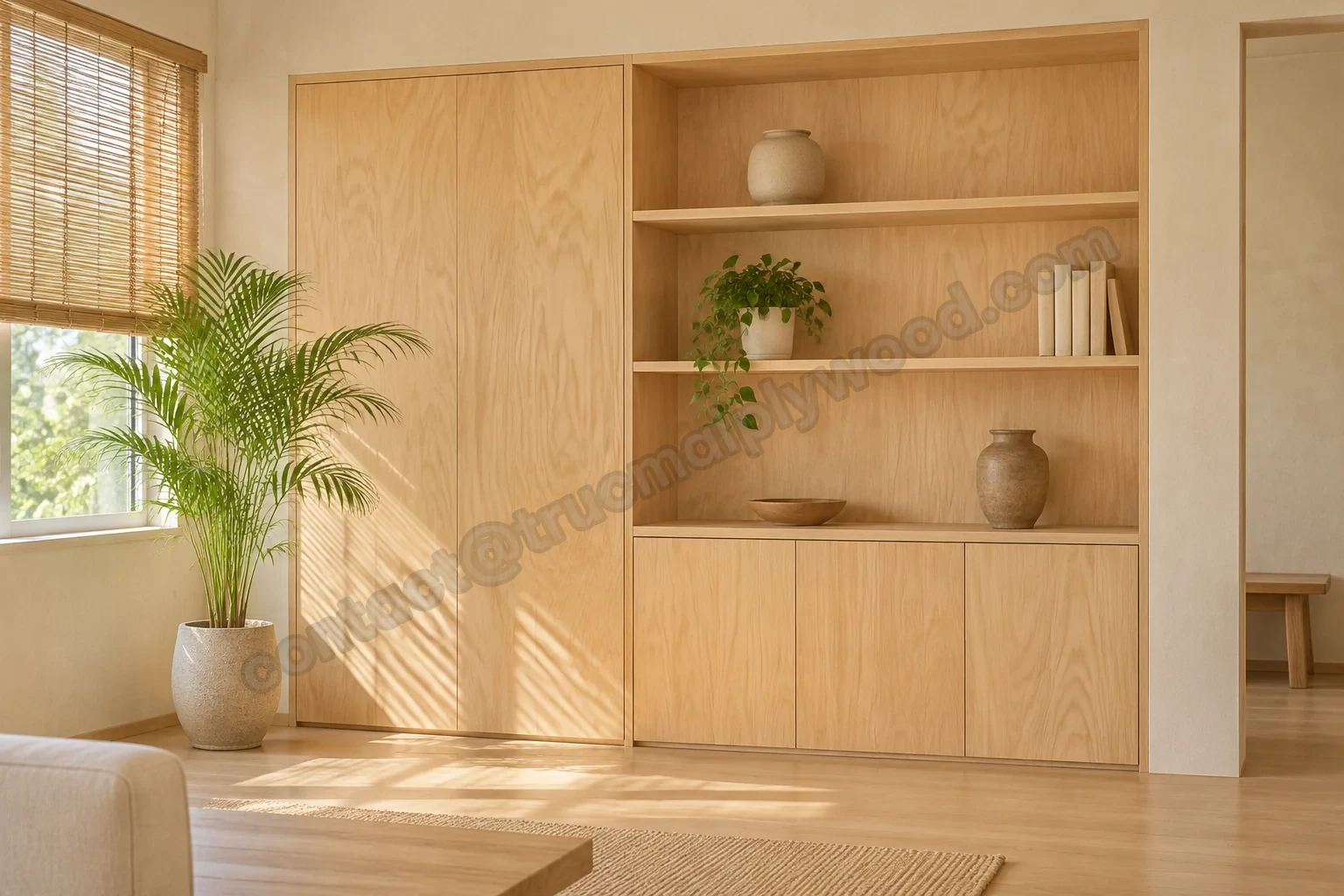
How should buyers assess sanding, coating and edge quality?
Use a three-part inspection: check the face in raking light, run the intended finish, and machine an edge. A face that looks attractive on a loose sheet may behave differently after routing, painting or edge banding.
First, examine sanding scratches across and along the grain. The finishing line may exaggerate scratches that were almost invisible on raw veneer. Second, coat a sample with the actual primer, stain or lacquer system and inspect it after curing. Third, cut and rout the edge to expose any core gaps or loose joints.
A decorative face does not repair a weak core. Where exposed edges are part of the design, ask for a core construction that machines cleanly and a reference photograph of the finished edge. For concealed edges, consistency and reliable edge-band adhesion may be the priorities.
Truc Mai Plywood offers sanded and calibrated furniture faces and UV-ready panels. UV-ready means the surfaces are prepared for the buyer’s own UV coating process. Write that finish preparation into the order alongside the face sample, rather than treating a veneer name as a complete finishing instruction.
What do glue and exposure classes tell you about a softwood panel?
Glue and exposure classifications describe bond performance, not the appearance of fir, spruce or pine. The same visible face can be paired with different adhesive systems for different intended environments.
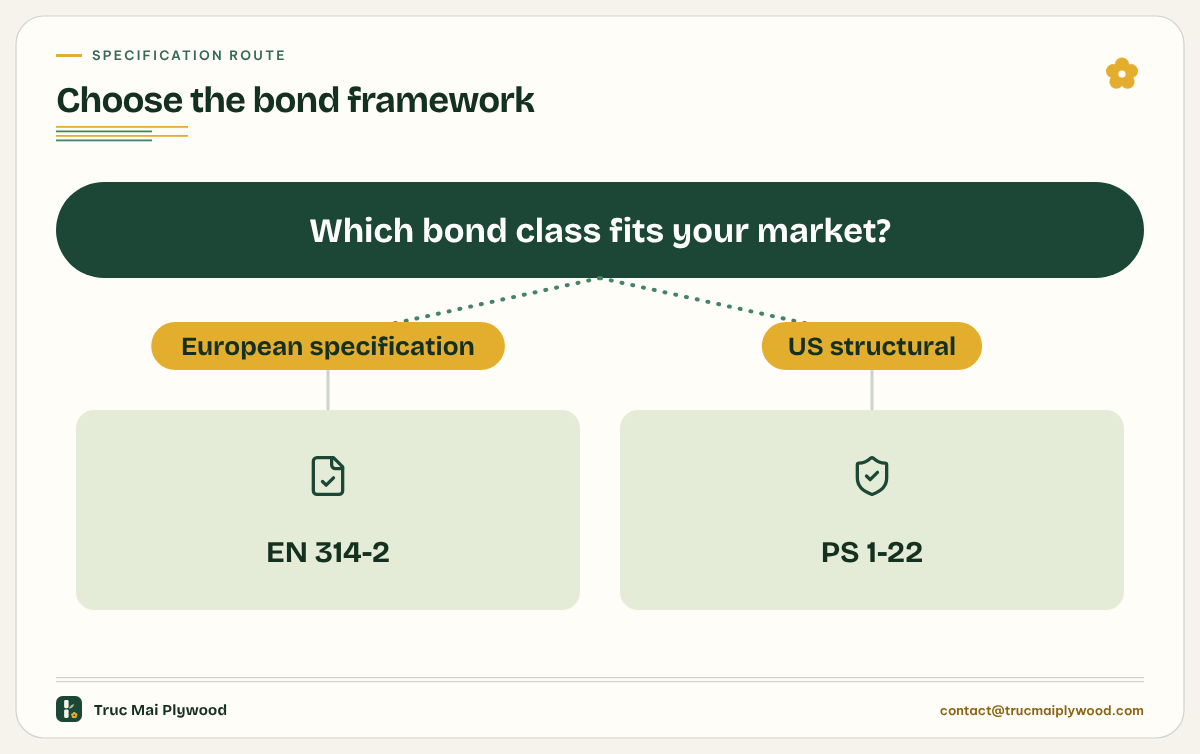
For a European specification, EN 314-2 identifies bond classes for dry, humid and exterior conditions. EN 636 separately classifies plywood by intended service environment. A bond test on a defined panel construction is the useful evidence, rather than a claim that one softwood species is inherently waterproof.
In the United States, PS 1-22 uses Exposure 1 and Exterior as its bond classifications for structural plywood. Those terms should not be copied onto an unrelated decorative sheet merely because its face is Douglas-fir. The buyer should request the appropriate test report and scope for the exact product being supplied.
The USDA wood-adhesives chapter distinguishes the moisture behaviour of urea-formaldehyde, melamine-containing and phenolic adhesive families. Adhesive selection and formaldehyde emission are separate specification lines, even when both concern the same bonded panel.
Which emission documents matter for interior plywood?
The relevant emission document is the one covering the intended market and the actual panel construction. Face species alone says nothing about formaldehyde release from the adhesive system.
For US hardwood plywood with veneer core, 40 CFR Part 770 specifies a formaldehyde emission limit of 0.05 ppm under the applicable test framework. The standard’s product definition and certification scope must match the supplied goods. The European framework uses different methods and units, so results should be compared against the corresponding market requirement.
Truc Mai holds CARB Phase 2 and TSCA Title VI certification for hardwood plywood with veneer core in the certified thickness and ply range. For a purchase order, identify the covered construction and obtain the relevant certificate documents before production. This is especially important when a decorative face or core combination changes.
A buyer comparing two otherwise similar faces should keep the emission requirement identical on both RFQs. That isolates the actual appearance decision and prevents an attractive veneer from concealing a different adhesive or testing basis.
How should face grade and plywood thickness be written on an RFQ?
Write the face and back grades as a pair, identify the core and specify the nominal thickness and tolerance. A phrase such as ‘premium fir plywood’ leaves too many variables open for two suppliers to quote the same construction.
The grade language should be accompanied by a reference sample. Regional trade designations such as B/BB or BB/CC are not universal equivalents of the appearance grades used in every formal standard. A photograph can help during initial sourcing, but an approved physical sample is a stronger reference for colour, patches and veneer joins.
For Truc Mai furniture panels, thickness is specified by order across the mill’s 3–40 mm range, with calibrated furniture tolerances available at ±0.3 mm. Sheet formats include 1220 × 2440 mm and 1250 × 2500 mm. Record the agreed sheet size and whether the buyer needs a sanded, calibrated or overlay-ready face.
The plywood RFQ checklist gives a line-by-line format. A comparable tender makes every bidder quote the same application, core, face, glue, emission class, dimensions, finish and packing method.
Can a Vietnamese mill supply pine faces on a different core?
Yes. A pine face can be laid over a Styrax, Acacia, Eucalyptus or Pine core, with the construction chosen for the furniture application. The visible face and the core should be written as distinct fields on the purchase order.
A stitched core can improve the continuity of the internal lay-up, while calibrated sanding prepares the surface for subsequent furniture finishing. The outer face veneer is selected for appearance, and the internal veneer arrangement is selected for the requested sheet characteristics. That division of roles gives buyers more control than an all-purpose ‘softwood plywood’ label.
The mill in Ha Hoa, Phu Tho produces furniture/interior and commercial plywood, with pine among its available face veneers. Spruce and fir are useful comparison species in this article, not a statement that they are standard stocked faces at this mill. The buyer can request other faces against a sample and the proposed build.
For furniture orders, the panel sample process lets the buyer check the face, edge and coating response before the final specification is agreed. Include a photo of the intended finished component when requesting the sample.
What does the 40HC loading model show for core choices?
The 40HC planning model shows that the core changes sheet weight and the number of sheets that fit a container. The following figures describe specified Styrax, Acacia and Eucalyptus core builds, not a measurement of fir, spruce or pine face density.
| Core | Thickness (mm) | Sheet size (mm) | Packs | Sheets/pack | Sheets | Volume (m³) | kg/sheet | Total kg | Weight-capped |
|---|---|---|---|---|---|---|---|---|---|
| Styrax | 12 | 1220 × 2440 | 18 | 83 | 1494 | 53.4 | 17.9 | 26680 | No |
| Acacia | 12 | 1220 × 2440 | 16 | 83 | 1328 | 47.4 | 20.7 | 27510 | No |
| Eucalyptus | 12 | 1220 × 2440 | 15 | 80 | 1200 | 42.9 | 23.2 | 27860 | Yes |
| Styrax | 15 | 1220 × 2440 | 18 | 66 | 1188 | 53.0 | 22.3 | 26520 | No |
| Acacia | 15 | 1220 × 2440 | 16 | 66 | 1056 | 47.2 | 25.9 | 27350 | No |
| Eucalyptus | 15 | 1220 × 2440 | 15 | 64 | 960 | 42.9 | 29.0 | 27860 | Yes |
| Styrax | 18 | 1220 × 2440 | 18 | 55 | 990 | 53.0 | 26.8 | 26520 | No |
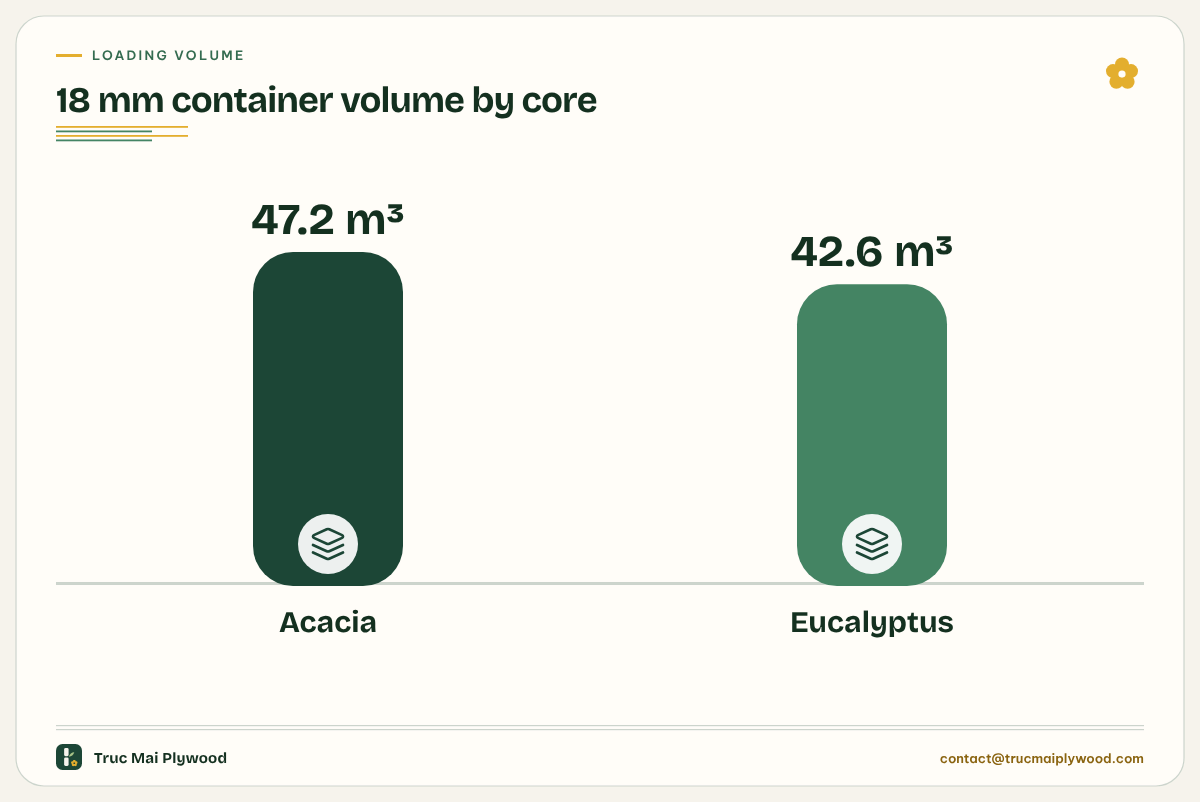
| Acacia | 18 | 1220 × 2440 | 16 | 55 | 880 | 47.2 | 31.1 | 27350 | No |
| Eucalyptus | 18 | 1220 × 2440 | 15 | 53 | 795 | 42.6 | 34.8 | 27690 | Yes |
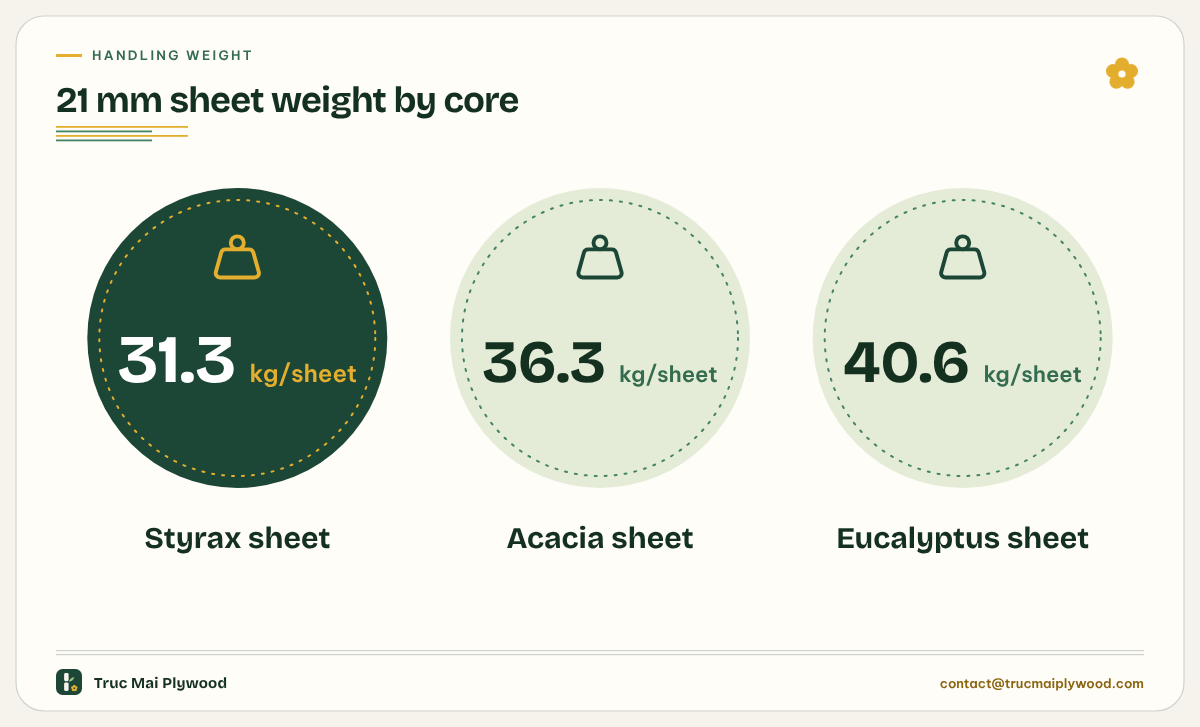
| Styrax | 21 | 1220 × 2440 | 18 | 47 | 846 | 52.9 | 31.3 | 26440 | No |
| Acacia | 21 | 1220 × 2440 | 16 | 47 | 752 | 47.0 | 36.3 | 27270 | No |
| Eucalyptus | 21 | 1220 × 2440 | 15 | 45 | 675 | 42.2 | 40.6 | 27430 | Yes |
Model basis: 40HC, panels only; 18 packs for Styrax, 16 for Acacia and 15 for Eucalyptus; pack height 1,000 mm; sheets per pack are the rounded-down pack-height calculation, capped against a 28,000 kg planning payload. Reference densities are Styrax 500 kg/m³, Acacia 580 kg/m³ and Eucalyptus 650 kg/m³. The payload is a planning input; carrier and route determine the shipment limit. These are calculated planning figures rather than loading records.
The model gives a practical lesson for a face-veneer RFQ: do not assume the face species sets the shipment quantity. Ask for the finished panel weight and packing layout. The container volume by thickness table covers the wider size and thickness options.
How should buyers compare samples from different mills?
Use the same written specification and the same inspection routine for every mill. Otherwise a pale spruce sample with a different core and finish may appear better simply because it is not being compared with an equivalent sheet.
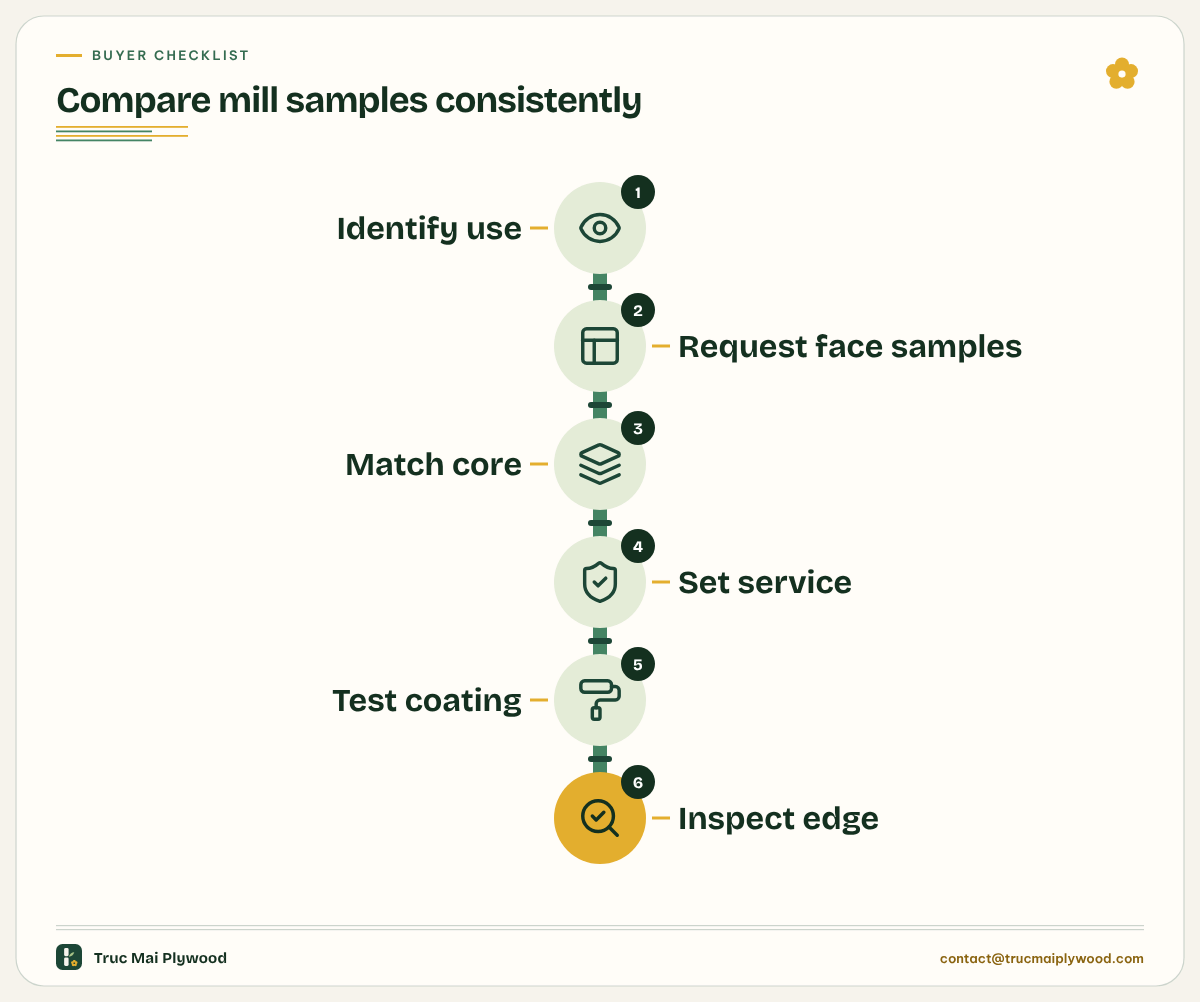
- Fix the intended use. Identify visible furniture surfaces, concealed cabinet parts or packing components.
- Name the face and back. Request a species designation and appearance sample for each exposed side.
- Hold the core constant. Ask for the same core grade, joining method and nominal construction in each quotation.
- Specify bonding and emissions separately. State the service condition, adhesive requirement and market document set.
- Test the finish. Apply the real coating schedule, then inspect colour, grain raising and repairs.
- Check machining. Cut a representative edge and inspect joints, voids and surface tear-out.
- Approve the packing plan. Match the sheet label, pack count and destination documentation to the order.
The mill verification checklist is useful before paying a deposit. It helps distinguish a repeatable production specification from an attractive sample that has no documented route into the purchase order.
How are cut-to-size softwood-faced panels specified?
Cut-to-size panels are ordered from a defined parent sheet and an agreed cut list. The face direction, finished dimensions and labels must all be shown on the drawing, especially when the grain should run consistently across a furniture set.
A standard sheet can be split into lengthwise halves, thirds, quarters or six parts according to the approved pattern. For example, 610 × 2440 mm is a lengthwise half of the common 1220 × 2440 mm format. A buyer should provide the intended finished piece sizes and indicate which dimension follows the face grain. The factory then sets the exact cutting pattern and labels against the order.
For a veneer-faced cabinet programme, ask for the sequence of parts within each pack so the assembly line can keep matching faces together. For parts that will be painted, prioritise machining allowance and a clean edge. In both cases, record whether measurements refer to cut blanks or finished components.
A practical cut list includes the part identifier, quantity, length, width, grain direction, face side and packing group. This information prevents an otherwise acceptable sheet from arriving in a form that causes unnecessary sorting or recutting at the furniture plant.
What should go into the final softwood-face quotation request?
Send the application, face sample reference, core, adhesive and emission requirement, sheet or cut size, packing plan and quantity. A complete request lets a mill prepare a comparable offer and a production sample without guessing which part of ‘fir plywood’ matters most.
Specify whether the surface will be painted, stained or clear coated. Add the intended destination market and discharge port, because document requirements and shipping arrangements follow the destination. Where the face is visible, include the acceptance sample and photographs of acceptable knot patterns and repairs.
For a Truc Mai Plywood enquiry, the next step is to request a quotation with the furniture application, pine or other requested face, chosen core, glue/emission specification, dimensions, cut list and container quantity. Keep the approved sample reference on the order so purchasing, production and receiving teams assess the same panel.
Questions buyers ask
Is Douglas-fir the same as true fir?
No. Douglas-fir belongs to Pseudotsuga, whereas true firs belong to Abies. Ask for the botanical or commercial species designation before comparing quotations.
What does SPF mean on a timber specification?
SPF groups spruce, pine and fir species in a commercial timber category. It does not identify a single face veneer or establish a plywood performance grade.
Can a pine face be paired with a hardwood core?
Yes. Pine-faced plywood can use a different core species, so specify the face and the core on separate lines.
Do knots automatically mean a plywood panel is defective?
No. Sound knots can be an accepted appearance feature; loose knots, repairs and open defects should be judged against the agreed face sample.
Can I order a clear face on one side only?
Yes. A decorative face and a more economical back can be specified as a face/back pair, with an approved sample defining each side.
Is spruce always lighter than pine?
No. Density changes with the exact species and moisture content; a comparison of species names alone does not establish the weight of finished panels.
Should I stain a sample before approving a face?
Yes. Test the actual sanding and coating schedule on a representative sample because earlywood and latewood absorb stain differently.
Does a higher ply count mean a stronger panel?
No. Veneer quality, grain direction, bonding, core construction and the finished panel test determine performance; count alone is insufficient.
Are face grades the same in Europe and North America?
No. Face appearance terminology and panel grading systems differ. Use a named standard where applicable and agree a physical appearance sample for decorative work.
What information belongs on a sample label?
Identify face species, face/back grade, core, thickness, adhesive and emission specification, finish preparation and sample reference so the production order can match it.