
Fir plywood commonly means Douglas-fir veneer plywood in North American trade. Structural sheets need a recognised grade and bond classification; decorative sheets are chosen by face quality, core and finish. For interior joinery, pine-faced Vietnamese plywood is an alternative when appearance, machining and the written panel specification match the project. Compare face grades, bond classes and sample quality before choosing a panel for cabinets or other interior work.
What is fir plywood?
Fir plywood is a layered wood panel made with fir veneers, most commonly Douglas-fir in North American trade. Douglas-fir is Pseudotsuga menziesii, a species identified in the USDA Forest Service wood reference. A product described simply as “fir” needs a species declaration and a construction specification before it can be compared with another panel.
How do Douglas-fir and pine-faced panels differ?
Douglas-fir and pine can both give a recognisable softwood grain, but the actual veneer cut, knots, colour variation and finishing treatment decide the appearance. Buyers should judge full-size veneer samples under the finish they intend to use rather than order from a species name alone.
For interior furniture, a pine-faced Vietnamese panel offers an alternative when the buyer wants a softwood appearance without specifying a North American structural grade. Pine plywood is the relevant product family. Radiata pine and slash pine (Pinus elliottii) faces should be specified separately, as a request for “pine” alone leaves the visual target unclear. A sample approval can fix knot allowance, face matching, colour range and back-face grade.
What do BC fir plywood, G1S and DF mean?
BC fir plywood usually describes a B-grade face paired with a C-grade back in the seller’s grade vocabulary. G1S means good one side in retail shorthand, but the buyer still needs the supplier’s written face criteria. DF commonly abbreviates Douglas-fir. None of these shorthand labels substitutes for a recognised panel mark, especially when a sheet is intended to carry a structural load.
The NIST PS 1-22 standard describes formal veneer grades and separates panel appearance from bond classification. It identifies grades by the face and back combination. The familiar A-C grade is listed under Exterior panels, while C-D belongs to Exposure 1. Some grade pairs occur in both bond categories, so a face/back description by itself is insufficient.
What is the difference between AC fir and CD fir plywood?
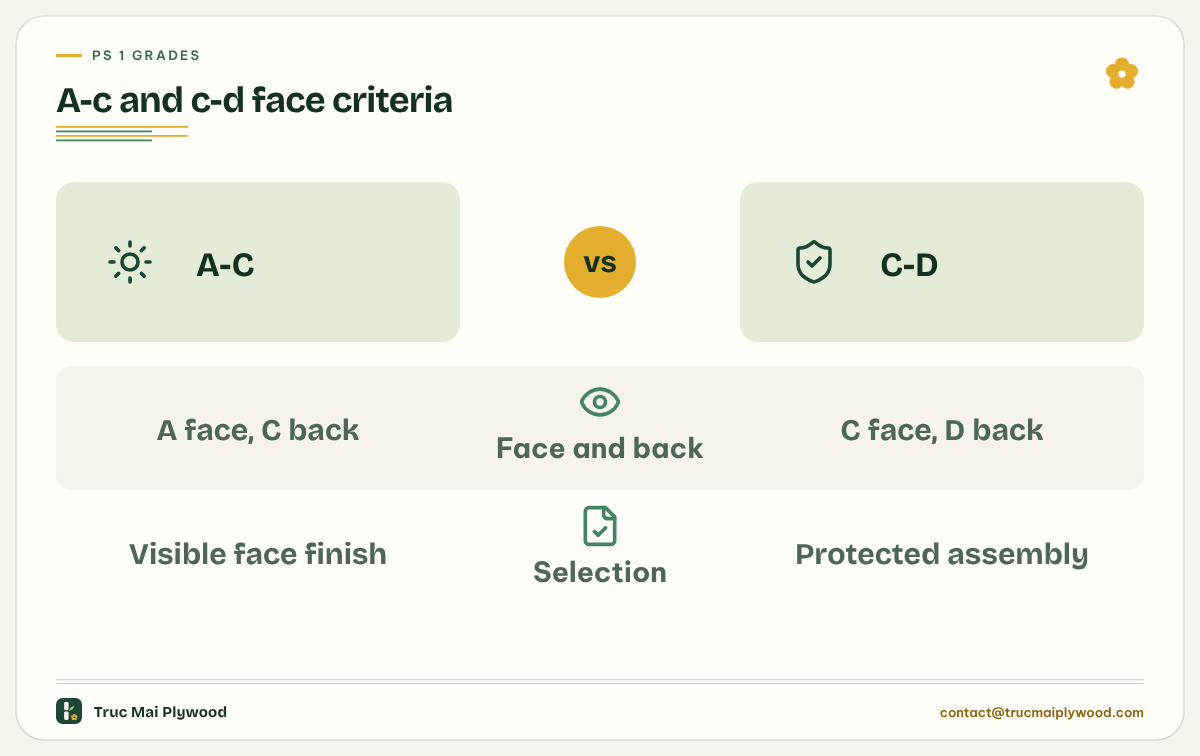
A-C fir plywood places a higher-appearance A veneer on the face and a C veneer on the reverse. C-D uses lower appearance grades and is commonly selected where the faces will be concealed. Under PS 1-22, A-C appears in the Exterior table and C-D in the Exposure 1 table. The distinction affects permissible veneer defects and bond classification, not just whether the sheet looks smooth.
| Buying description | Face and back | Main selection question |
|---|---|---|
| A-C, PS 1 Exterior | A face, C back | Will one visible face need sanding and finishing? |
| C-D, PS 1 Exposure 1 | C face, D back | Is the sheet specified for a protected structural assembly? |
| B-C, seller’s decorative description | B face, C back | Which actual grade system and bond class apply? |
| Pine-faced furniture plywood | Approved face/back sample | What appearance and machining quality must the finished component achieve? |
Is fir plywood suitable for cabinets and interior joinery?
Yes, fir plywood can be used for cabinets and interior joinery when its face, flatness and finishing behaviour suit the design. Test the intended stain or clear coat on a real offcut before approving the visible finish.
Check for patches, sanding scratches and veneer splits that become more obvious after coating. For cabinet carcasses, look beyond the show face: examine core voids, thickness consistency and whether the panel edges accept the planned joint. Plywood for kitchen cabinets discusses the selection criteria in more detail.
An alternative interior panel can be made with a pine face over Styrax, Eucalyptus, Acacia or Pine core. The face determines much of the look; the core changes weight, cutting behaviour and the feel of the assembled unit. Specify the face and core independently, particularly where a light carcass is more important than matching the timber species throughout.
Is fir plywood appropriate for roofing, flooring and exterior walls?
Structural fir plywood with the appropriate PS 1 or PS 2 classification can be specified for roof, floor and wall assemblies. The panel stamp, span rating, bond class, support spacing and project design determine the application. A decorative fir-faced panel without structural certification is a different material.
PS 1-22 identifies Exposure 1 for panels that may experience moisture during construction but are not intended for permanent weather exposure. Exterior addresses repeated wetting and redrying or long-term exposure. These categories describe bond durability, while the structural grade and design still determine load-bearing suitability. Read the official PS 1-22 text when writing a project specification.
A non-structural furniture or commercial plywood panel should instead be assigned to cabinetry, wall lining, display fittings or other interior uses supported by its own specification. A decorative pine face is not a route to a structural rating. This distinction matters especially when substituting an imported panel for a locally stocked sheet.
How do 1/2 fir plywood and 5/8 spruce plywood compare?
A 1/2-inch fir sheet and a 5/8-inch spruce sheet are different nominal thickness choices, not interchangeable performance grades. Thickness changes stiffness, weight, edge geometry and compatibility with fittings. Check the actual measured thickness and the performance marking required by the application.
Canadian listings may use 1/2 spruce plywood, 5/8 spruce plywood and 1/2 fir plywood as shopping terms. For a furniture job, compare thickness in millimetres and the machining tolerance. For construction, match the specified performance category, grade and support conditions. A cabinet component designed around a metric panel also needs its groove, hinge and edge-band details checked before a nominal imperial substitute is accepted.
Truc Mai’s interior range uses listed thicknesses from 3 to 40 mm. The common cabinet options include 12, 15 and 18 mm, with the thickness and tolerance written on the order. 18 mm hardwood plywood is a useful reference for an interior panel specification.
Which panel sizes and thickness tolerances should buyers specify?
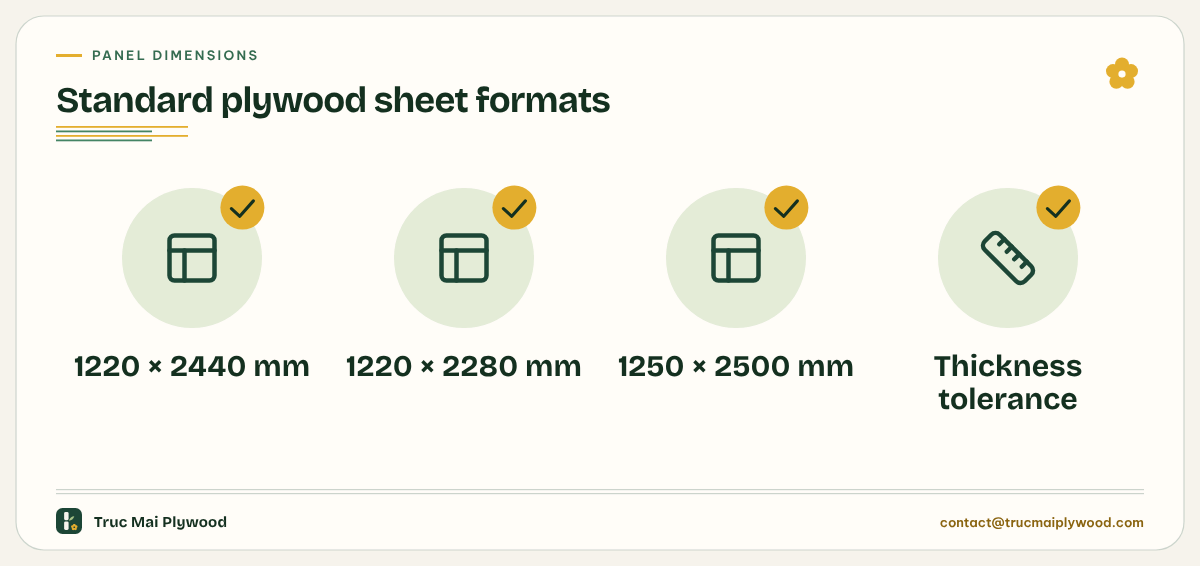
Specify nominal size, measured thickness, sanding and tolerances on separate order lines. The standard Truc Mai formats are 1220 × 2440 mm, 1220 × 2280 mm and 1250 × 2500 mm. Custom sheets are limited to the available production format. A furniture maker should choose the sheet that gives the cleanest cutting yield, then lock the actual panel thickness to the joinery drawings.
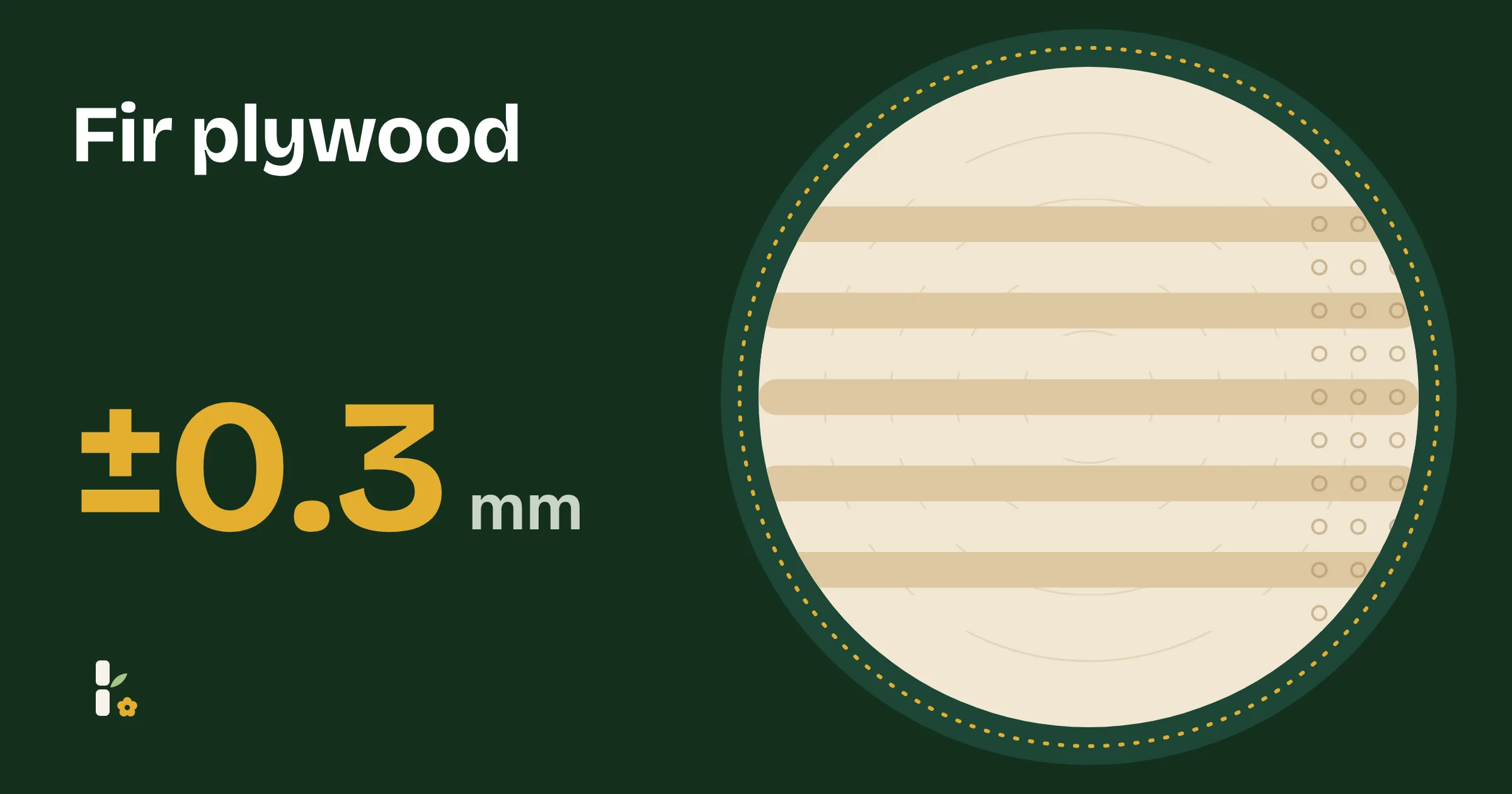
Sanded and calibrated furniture panels can be ordered to ±0.3 mm thickness tolerance; other constructions use the tolerance agreed for their line. Length and width tolerance is ±2 mm. The finished face and back are graded as a pair against the approved sample. This makes a quote comparable at the machining stage rather than merely at the sheet-count stage.
The EN 315 plywood dimensional standard gives standardised methods and dimensional requirements, which should be distinguished from a mill’s tighter contractual target. A buyer should put the required tolerance in the purchase order instead of assuming that every fir, pine or spruce sheet uses the same measurement rule.
How do face veneer, core and ply count affect machining?
Face veneer controls the visible surface, while core lay-up controls much of the edge quality and machining response. A clean face can still sit above gaps that appear during routing. Inspect whether the veneer layers are joined tightly and whether the exposed edge needs banding before the component can be installed.
For thin interior panels, Truc Mai uses a five-ply build at 3, 4 and 5 mm. At 18 mm, the usual construction is 11 to 13 plies, most often 11. Face veneer is generally 0.2 to 0.5 mm, so a buyer planning deep sanding should allow for the face’s limited thickness. The core veneer and lay-up need their own inspection.
Stitched core plies improve continuity before pressing. If edges will be visible, an approved edge sample is as useful as a photograph of the face. Cut-to-size plywood panels are an option for buyers who want labelled components rather than full sheets.
What adhesive and moisture performance should be requested?
Specify adhesive type, bond performance and formaldehyde emission as three distinct requirements. A fir sheet labelled exterior should be checked against its recognised bond classification. A pine-faced interior panel should be assessed against its intended environment and its stated adhesive system. A generic description such as “waterproof glue” cannot replace the relevant test report.
The USDA Forest Service chapter on wood adhesives describes urea-formaldehyde (UF) as primarily suited to interior panels and phenol-formaldehyde (PF) as an exterior adhesive. Truc Mai’s standard interior construction uses UF glue at E0 emission. Its moisture-resistant construction uses a different adhesive formulation and is specified separately. The emission grade does not indicate the bond class.
For European specifications, EN 314-2 distinguishes bond Classes 1, 2 and 3. The corresponding water pre-treatments are described in EN 314-1; a test on a particular panel build is the basis for assigning the class. If a project calls for EN 636, specify the required service condition and its evidence rather than infer it from a veneer species.
What formaldehyde documentation matters for North American furniture?
For US hardwood plywood with veneer core, TSCA Title VI specifies 0.05 ppm formaldehyde emission. The limit appears in 40 CFR 770.10. The regulation also defines its covered hardwood plywood category separately from structural plywood certified to PS 1 or PS 2. The importer therefore needs to identify the product category before choosing which compliance documents apply.
Truc Mai holds CARB Phase 2 and EPA TSCA Title VI third-party certification for hardwood plywood with veneer core, within the certified 3–25 mm thickness scope. Its certificate reference is CARB/EPA 26053, mill ICTT-26053, with TPC-43. The scope should be matched to the actual ordered construction and the paperwork supplied for that shipment.
What do FSC and origin documents tell the buyer?
FSC Chain of Custody documents trace an eligible product claim through certified sellers. The FSC Chain of Custody standard requires the certificate code and the applicable claim to appear on sales documentation for certified products.
Truc Mai holds FSC licence FSC-C196493 and Chain of Custody certificate SA-COC-014545. Eligible products on its certified product schedule can be sold with an FSC 100% claim. A buyer ordering pine-faced or other interior plywood should identify the required claim in the purchase specification so that the invoice and shipment records match the ordered item. Verify an FSC licence code shows the verification route.
For European furniture supply, origin records for both the core and the face veneer are useful. Truc Mai supplies origin records and geolocation files for its EUDR due-diligence dossier; the face veneer origin file guide explains what the buyer should inspect.
How should a buyer inspect samples before ordering?
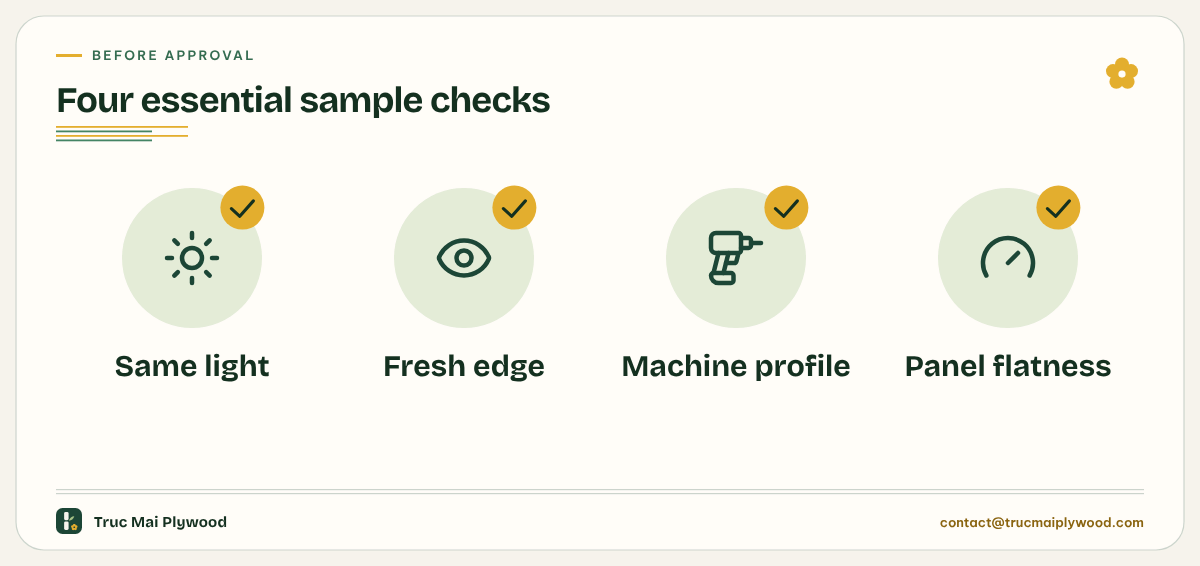
Approve a full face, an exposed edge and a finished test piece before fixing the order. The sample should therefore represent the agreed face grade, back grade, core and finish preparation. If a panel will be painted, run the paint process on the sample; if it will be stained, judge the grain after staining.
A practical sequence is:
- Compare fir and pine face samples under the same light, viewing direction and finish.
- Cut a fresh edge and inspect inner veneer joints, gaps and thickness.
- Machine the intended groove, hinge pocket or CNC profile and inspect tear-out.
- Check panel flatness after the workshop’s normal conditioning period.
- Sign off a labelled reference sample and attach its specification to the order.
Truc Mai offers free samples. New buyers arrange their courier collection, with the courier cost credited against a real order. The sample-ordering process helps turn an appearance enquiry into an agreed production reference.
How does core choice change 40HC container planning?
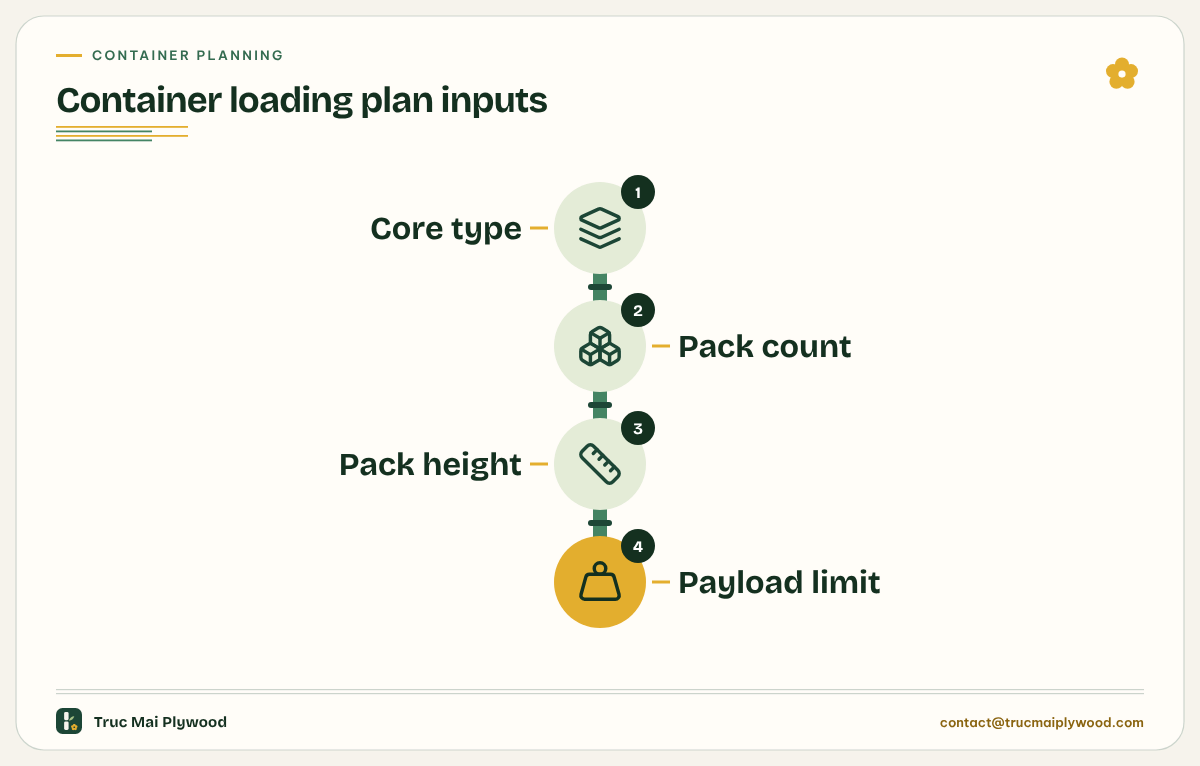
Core density changes how many interior plywood sheets fit in a 40HC. The following figures come directly from the supplied packing calculation, for 1220 × 2440 mm panels. They are planning figures for panels only, not shipment records. A lighter Styrax core can fill more volume before reaching the weight constraint, while denser Eucalyptus sheets can reach the payload first.
| Core | Thickness | Sheet size (mm) | Packs | Sheets/pack | Sheets | Volume (m³) | kg/sheet | Total kg | Weight capped |
|---|---|---|---|---|---|---|---|---|---|
| Styrax | 12 mm | 1220x2440 | 18 | 83 | 1494 | 53.4 | 17.9 | 26680 | No |
| Acacia | 12 mm | 1220x2440 | 16 | 83 | 1328 | 47.4 | 20.7 | 27510 | No |
| Eucalyptus | 12 mm | 1220x2440 | 15 | 80 | 1200 | 42.9 | 23.2 | 27860 | Yes |
| Styrax | 15 mm | 1220x2440 | 18 | 66 | 1188 | 53.0 | 22.3 | 26520 | No |
| Acacia | 15 mm | 1220x2440 | 16 | 66 | 1056 | 47.2 | 25.9 | 27350 | No |
| Eucalyptus | 15 mm | 1220x2440 | 15 | 64 | 960 | 42.9 | 29.0 | 27860 | Yes |
| Styrax | 18 mm | 1220x2440 | 18 | 55 | 990 | 53.0 | 26.8 | 26520 | No |
| Acacia | 18 mm | 1220x2440 | 16 | 55 | 880 | 47.2 | 31.1 | 27350 | No |
| Eucalyptus | 18 mm | 1220x2440 | 15 | 53 | 795 | 42.6 | 34.8 | 27690 | Yes |
| Styrax | 21 mm | 1220x2440 | 18 | 47 | 846 | 52.9 | 31.3 | 26440 | No |
| Acacia | 21 mm | 1220x2440 | 16 | 47 | 752 | 47.0 | 36.3 | 27270 | No |
| Eucalyptus | 21 mm | 1220x2440 | 15 | 45 | 675 | 42.2 | 40.6 | 27430 | Yes |
The calculation uses 18 packs for Styrax, 16 for Acacia and 15 for Eucalyptus, with packs approximately 1,000 mm high. Sheets per pack are limited by thickness and the 28,000 kg planning payload, using reference densities of 500, 580 and 650 kg/m³ respectively. Packaging weight and the carrier’s route-specific limit must be checked in the actual loading plan. For more detail, see cubic metres per 40HC by thickness.
Can pine-faced panels be cut and labelled at the mill?
Yes, cut-to-size interior plywood can be supplied as labelled components. The cut pattern is agreed from the buyer’s sheet size and cut list. Common examples include a sheet divided lengthwise into two 610 × 2440 mm pieces, three 1200 × 800 mm pieces, or four 1220 × 610 mm pieces. A six-piece pattern can also be agreed for furniture parts.
Ask the mill to show which parent sheet is used, how the pieces are oriented with the face grain and where the saw kerf falls. Labels should match the furniture maker’s part numbers so that the components can be sorted at assembly without opening every pack.
How should a fir-versus-pine plywood RFQ be written?
A useful RFQ states the application first, then fixes the construction and delivery details. For an interior joinery order, send the intended use, face species, acceptable face/back sample, core species, adhesive and emission requirement, thickness, sheet size, cutting pattern, packing and quantity. Add the destination port so that the shipping term is unambiguous.
If the project requires a structural fir panel, specify the recognised structural standard and grade instead of asking an interior plywood factory to infer them. For a furniture panel, ask for a documented sample and a written tolerance. The plywood RFQ checklist helps buyers check that two offers describe the same build.
Truc Mai’s minimum order is one 40HC. Production is normally 15–45 days after the deposit, with FOB Hai Phong, CFR or CIF terms available. A standard order uses a 30% deposit and a 70% balance against the scanned bill of lading. The buyer can request a quotation for pine-faced interior panels with the agreed core, thickness and packing specification.
Send your specification to contact@trucmaiplywood.com or through the quotation form.
Questions buyers ask
Can I use fir plywood for a painted cabinet door?
Yes. Choose a sanded appearance face, inspect repairs and test the primer and paint on a sample before ordering.
Does G1S tell me the plywood core species?
No. G1S describes a good face in trade shorthand; the core species and construction must be specified separately.
Is BC fir the same as AC fir?
No. The face/back appearance grades differ, and the applicable standard and bond classification must also be checked.
Can a pine face be put over a Styrax core?
Yes. Pine-faced furniture plywood can use Styrax core, with the face and core stated separately on the order.
What is the easiest way to compare face colour?
Compare full-face samples under the same lighting and apply the intended finish to both samples.
Should I order by nominal inch thickness alone?
No. Write the actual required millimetre thickness and tolerance, especially for CNC grooves and cabinet fittings.
Are all fir-faced sheets structural?
No. A structural designation requires the appropriate panel standard, grade and marking; face species alone is insufficient.
Can mixed products share one 40HC?
Yes. One or two products are usual; larger mixes can be agreed and the loading plan must reflect each core and thickness.
What is the most useful sample for a CNC buyer?
A sample with the approved face and core that can be cut using the intended router bit and edge treatment.
What should appear on an FSC sales document?
For eligible FSC products, the seller certificate code and the claim for the relevant product must appear on the sales document.