
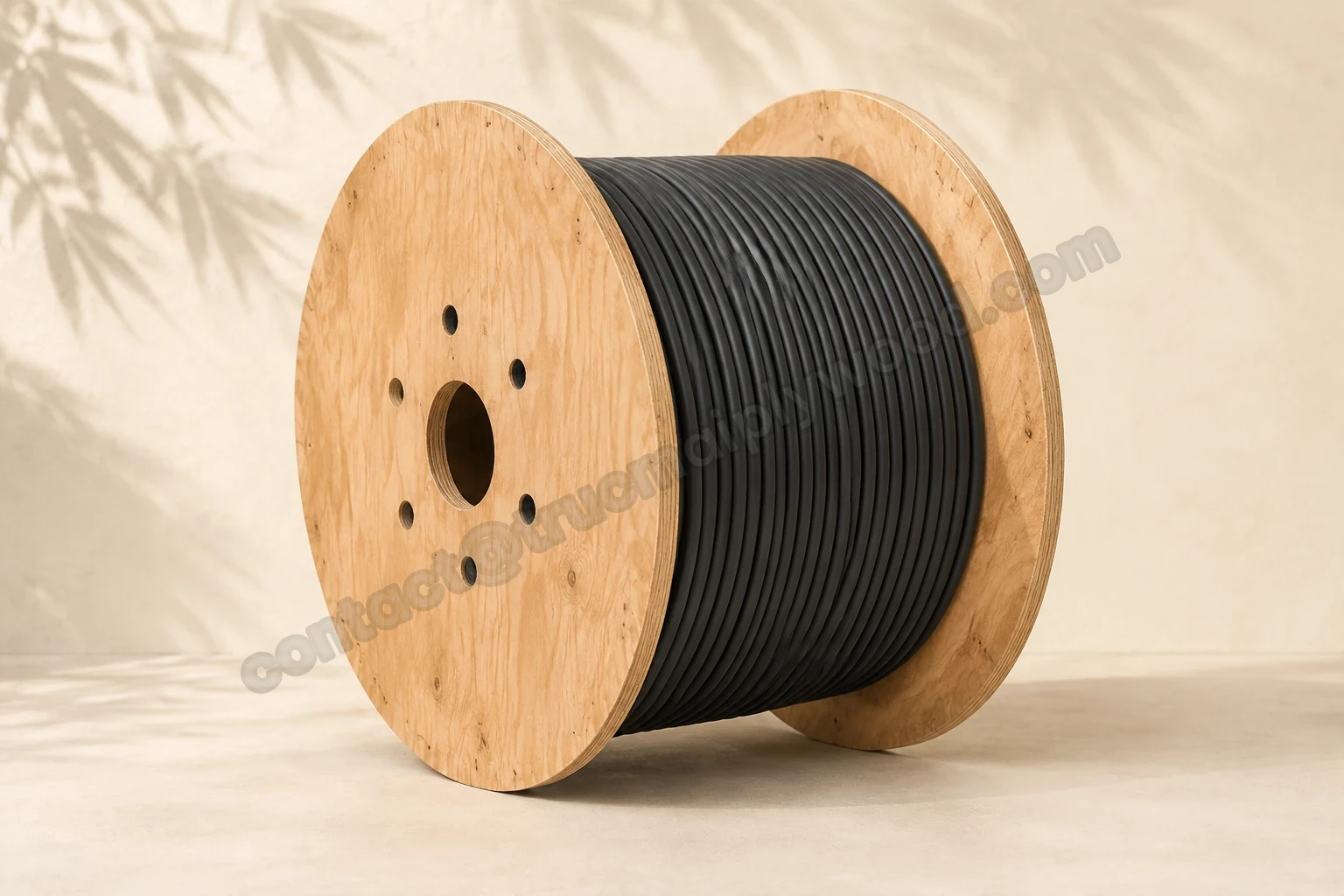
A wooden cable reel uses two circular flanges to contain wound cable around a central barrel. Commercial packing plywood can be supplied as flat flange stock, with core, thickness, bond and cut pattern selected for the reel maker’s drawing. The practical purchase unit is a documented panel specification and a labelled, container-scale cutting plan.
What plywood is used for cable drum flanges?
Commercial veneer-core packing plywood is used for cable drum flanges, with thickness and construction chosen for the reel maker’s duty. Flanges are the circular end plates of a wooden cable reel; the barrel between them supports the winding. The completed drum also needs a hub, connectors and fasteners.
Choose the sheet by the reel drawing rather than by the name “plywood reel”. The drawing should show the outside diameter, central arbor opening, bolt-circle or tie-rod holes, barrel interface, edge treatment and expected cable load. Those details determine whether a particular sheet construction is appropriate. For a useful starting point, compare packing plywood panels with the intended flange specification.
The buyer should identify whether the reel is for factory winding, a single shipment or a returnable handling system. A flange that travels through several handling cycles has different inspection and assembly requirements from one that stays in protective packaging. This distinction belongs in the drum design, not in a generic plywood grade name.
How does a wooden cable reel carry and protect cable?
A wooden cable reel has two side flanges, a cylindrical barrel and an arbor opening through which the reel can rotate. The cable winds around the barrel; the flanges keep the turns from moving sideways. Drum design also governs how the reel is lifted, rolled, restrained and unwound.
The flange is therefore asked to resist several different actions. Winding introduces lateral pressure, lifting can concentrate force near the hub, and transport can bring impacts to the rim. The assembly designer determines the loads and the fastener arrangement. For purchasing, record the barrel diameter, traverse width and flange outside diameter as separate dimensions. A panel thickness by itself says little about the finished reel’s capacity.
A practical drawing includes the intended direction of rotation and the clearance needed for cable ends. The flange faces should be consistent enough to allow the assembler to locate holes and seat hardware without compensating for uneven stock.
Which core construction should a reel maker specify?
Styrax, Acacia and Eucalyptus are practical Vietnamese veneer-core options for commercial flange stock. Truc Mai Plywood also offers Pine and mixed-species cores, using the approved construction for the order. The core species affects mass, handling and how much sheet volume fits in a container.
A flange blank needs well-laid veneers and a defined acceptance rule for gaps and repairs around the hub and fastener positions. For a drilled component, the centre zone deserves special attention because the arbor hole and bolt pattern interrupt the plies. Ask the mill to identify the face/back grade pair and core joining method against an approved sample rather than relying on a vague “industrial grade” label.
The choice between a stitched furniture core and a loose-laid packing core is a manufacturing decision linked to the hole pattern and finished part. Vietnamese plywood quality by grade gives a useful framework for agreeing a grade by specimen and written acceptance criteria.
What thickness and sheet format can be ordered?
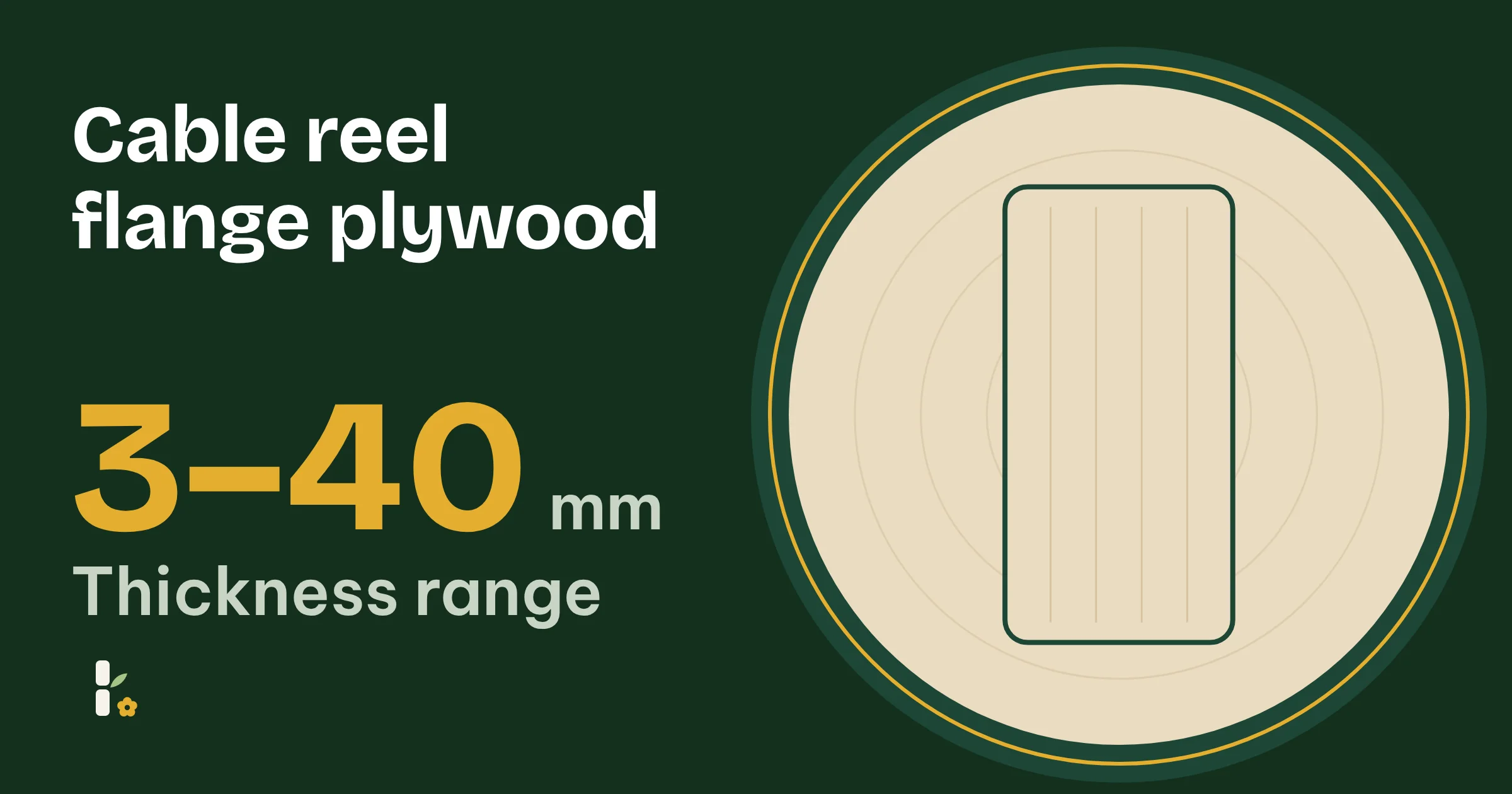
The available plywood thickness range is 3–40 mm, with common order points including 12, 15, 18 and 21 mm. Truc Mai supplies 1220 × 2440 mm and 1250 × 2500 mm formats, as well as 1220 × 2280 mm sheets. A flange diameter must fit inside the chosen parent sheet or an agreed cut layout.
The sheet format sets the maximum circular blank that can be nested from a single piece. A reel maker can purchase full sheets for its own CNC routing or order rectangular mill-cut stock for a downstream circular machining operation. For circles, send the finished outside diameter, kerf allowance and any hold-down margin required by the machining shop.
For dimensional control, the order states the thickness tolerance. Sanded and calibrated furniture panels can be specified at ±0.3 mm; commercial grade commonly uses ±0.5 mm. Length and width tolerance is ±2 mm. Those figures describe supplied panels, not the accuracy of holes subsequently drilled by the drum assembler. See 18 mm loading specifications for another panel specification example.
How should glue and moisture exposure be specified?
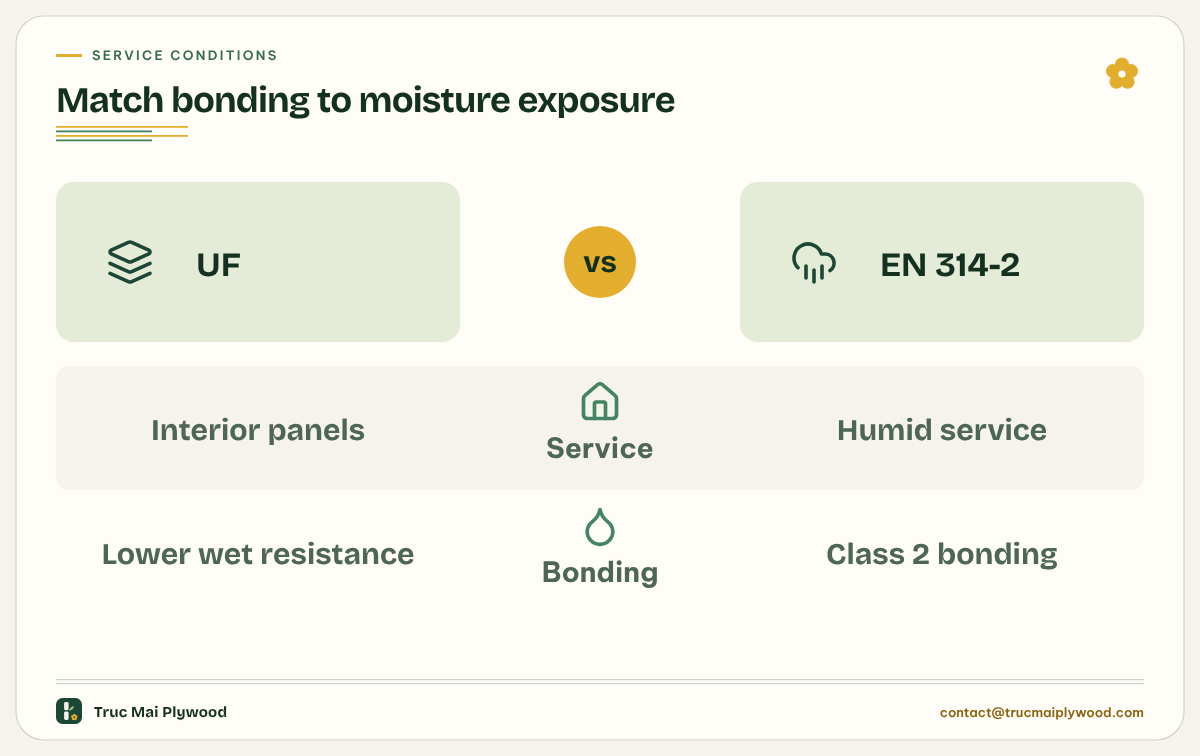
Specify the adhesive system and the emission requirement on separate lines. For dry interior packing applications, UF adhesive is an established panel-bond option. Where the reel is exposed to damp conditions, request a bond specification appropriate to the actual storage and transport cycle.
The USDA Forest Products Laboratory describes UF adhesives as suited principally to interior panels and identifies their lower resistance to prolonged wetting in its Wood Handbook, chapter 10. A name such as “waterproof” is less useful than an agreed exposure condition and a relevant bond test. For a humid-service requirement, EN 314-2 distinguishes Class 2 bonding from Class 1 dry bonding; the test and report need to match the ordered panel build.
A cable drum may be stored outdoors even when the plywood itself is intended as a packing component. Specify whether the finished assembly will be covered, sheltered or directly wetted. The reel maker then chooses protective detailing, including edge finishing and hardware, for that service.
What does a useful flange cutting drawing contain?
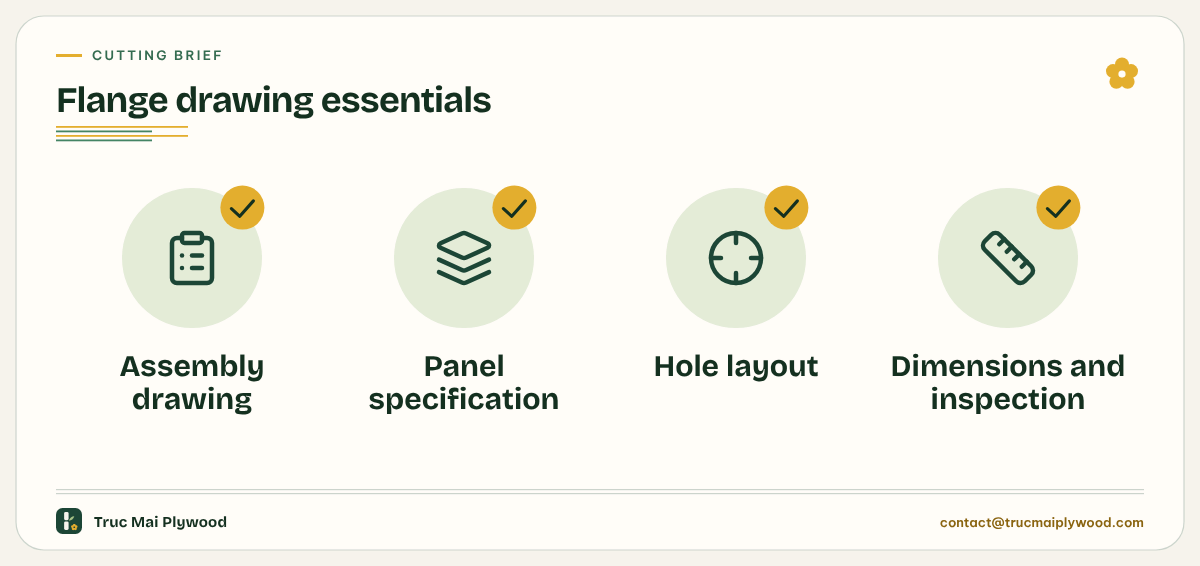
A cutting drawing needs the flange outside diameter, centre-hole diameter, hole coordinates and the required number of identical pieces. For a plywood flange, the drawing should also identify which face is the reference face, the machining allowance and any marking position.
A simple purchasing sequence is:
- Issue the reel assembly drawing with the intended cable and handling duty.
- Identify the parent plywood thickness, core, face condition and adhesive requirement.
- Mark every centre hole, bolt circle, slot and edge detail on the flange drawing.
- State the acceptable finished dimensions and inspection method.
- Approve the rectangular blank or circular machining route before packing instructions are finalised.
A mill-cut rectangle is a preparation stage, not the finished round flange. Mill-cut plywood panels explains the order option, while the reel maker’s own routing drawing controls the final circle.
How many rectangular blanks come from one sheet?
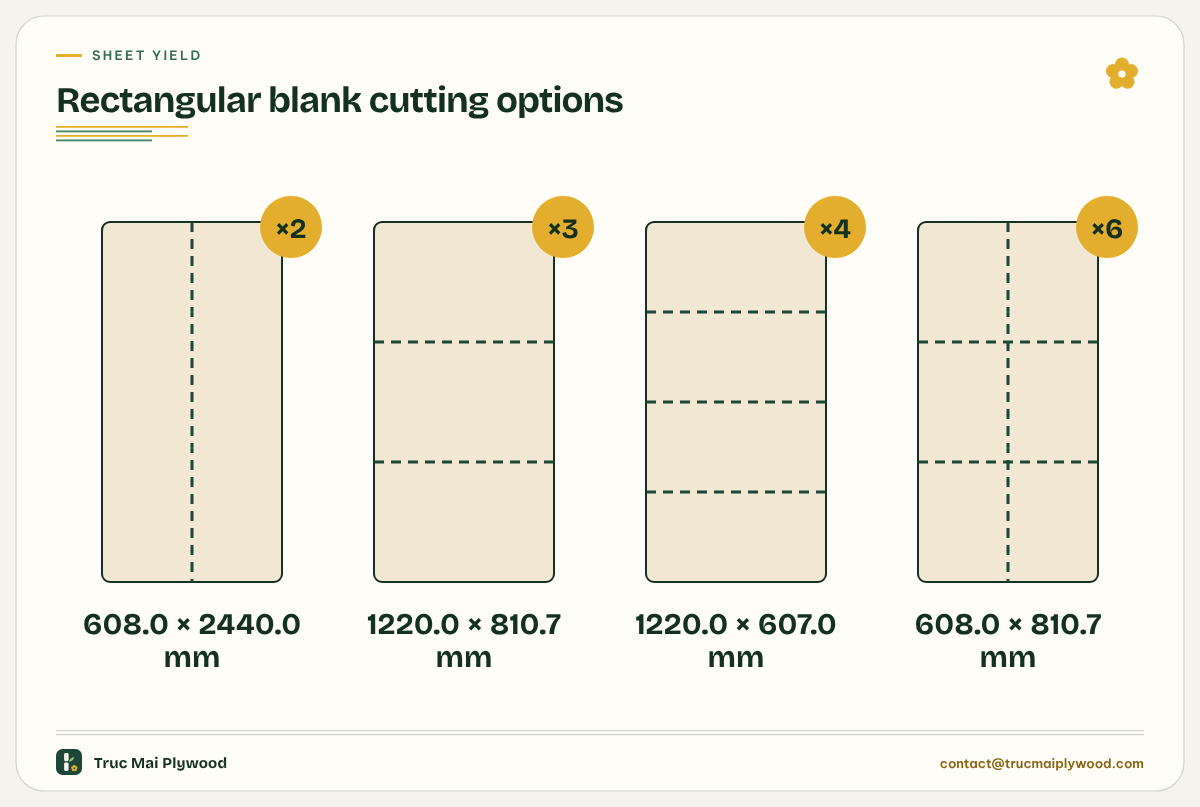
A standard sheet can be divided into 2, 3, 4 or 6 labelled pieces for a cut-to-size order. The following cutting model uses a 1220 × 2440 mm parent sheet and a 4 mm saw kerf per cut. The “nominal” column shows the geometric division before kerf; the “actual” column deducts the stated saw loss. These are rectangular pieces, not circular flanges.
| Cut plan | Parent (mm) | Saw cuts | Kerf per cut (mm) | Pieces | Nominal piece (mm) | Actual piece (mm) |
|---|---|---|---|---|---|---|
| 2 pieces | 1220 × 2440 | 1 | 4 | 2 | 610.0 × 2440.0 | 608.0 × 2440.0 |
| 3 pieces | 1220 × 2440 | 2 | 4 | 3 | 1220.0 × 813.3 | 1220.0 × 810.7 |
| 4 pieces | 1220 × 2440 | 3 | 4 | 4 | 1220.0 × 610.0 | 1220.0 × 607.0 |
| 6 pieces | 1220 × 2440 | 3 | 4 | 6 | 610.0 × 813.3 | 608.0 × 810.7 |
The cut list agreed by email is the controlling dimension for production. A nominal half-sheet width is therefore a useful commercial label, while the saw-kerf-adjusted width is the manufacturing calculation. An irregular flange layout may yield a different number of usable circular blanks than the rectangular count above.
How much plywood fits in a 40HC container?
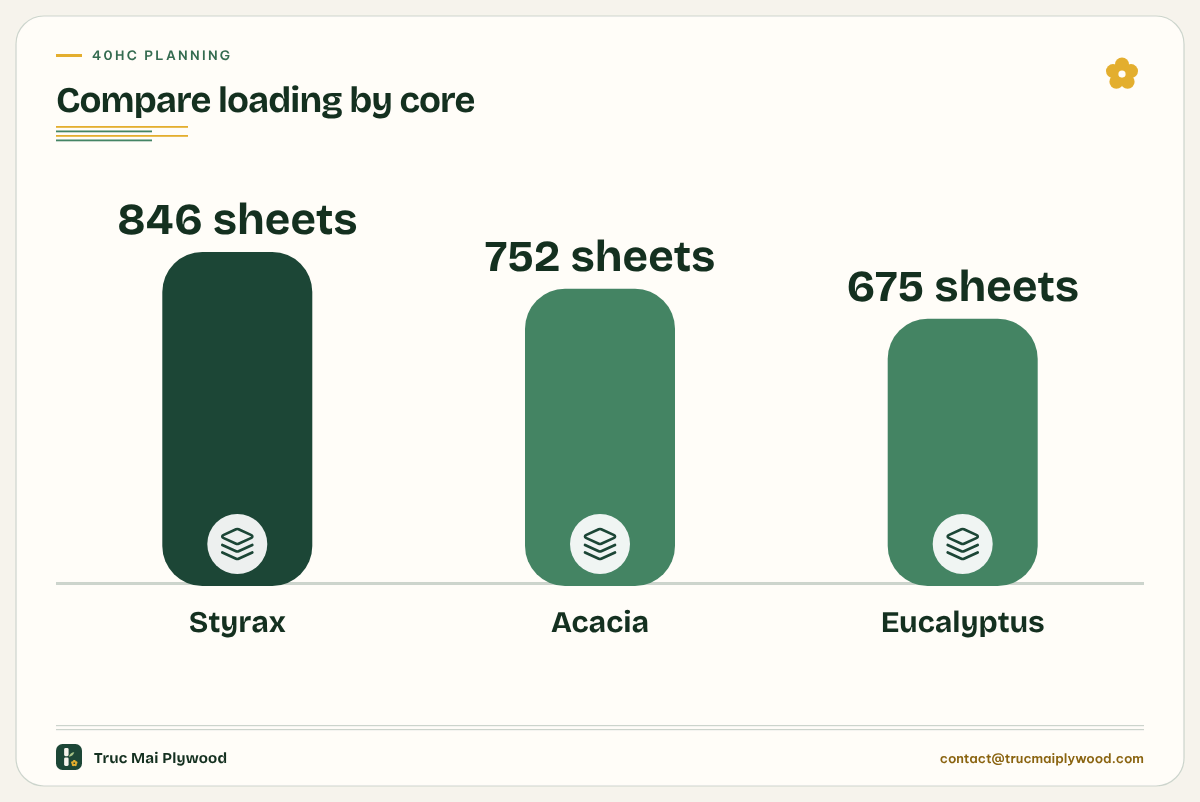
The 40HC planning model varies by core and panel thickness. It uses 18 packs for Styrax, 16 for Acacia and 15 for Eucalyptus, with packs about 1,000 mm high. Sheets per pack are calculated from pack height divided by thickness and rounded down, then capped at a 28,000 kg planning payload. Reference densities are 500 kg/m³ for Styrax, 580 kg/m³ for Acacia and 650 kg/m³ for Eucalyptus. Figures cover panels only, not a verified shipment record.
| Core | Thickness (mm) | Parent (mm) | Packs | Sheets/pack | Weight-capped | Sheets | m³ | kg/sheet | Total kg |
|---|---|---|---|---|---|---|---|---|---|
| Styrax | 12 | 1220 × 2440 | 18 | 83 | false | 1494 | 53.4 | 17.9 | 26680 |
| Acacia | 12 | 1220 × 2440 | 16 | 83 | false | 1328 | 47.4 | 20.7 | 27510 |
| Eucalyptus | 12 | 1220 × 2440 | 15 | 80 | true | 1200 | 42.9 | 23.2 | 27860 |
| Styrax | 15 | 1220 × 2440 | 18 | 66 | false | 1188 | 53.0 | 22.3 | 26520 |
| Acacia | 15 | 1220 × 2440 | 16 | 66 | false | 1056 | 47.2 | 25.9 | 27350 |
| Eucalyptus | 15 | 1220 × 2440 | 15 | 64 | true | 960 | 42.9 | 29.0 | 27860 |
| Styrax | 18 | 1220 × 2440 | 18 | 55 | false | 990 | 53.0 | 26.8 | 26520 |
| Acacia | 18 | 1220 × 2440 | 16 | 55 | false | 880 | 47.2 | 31.1 | 27350 |
| Eucalyptus | 18 | 1220 × 2440 | 15 | 53 | true | 795 | 42.6 | 34.8 | 27690 |
| Styrax | 21 | 1220 × 2440 | 18 | 47 | false | 846 | 52.9 | 31.3 | 26440 |
| Acacia | 21 | 1220 × 2440 | 16 | 47 | false | 752 | 47.0 | 36.3 | 27270 |
| Eucalyptus | 21 | 1220 × 2440 | 15 | 45 | true | 675 | 42.2 | 40.6 | 27430 |
A buyer should use the model to compare cores, then prepare the actual shipment against the booked payload, packaging mass and verified gross weight. A cut-blank order also changes pack handling and labelling. For the broader loading method see 40HC volume by thickness.
How many cut pieces does that container plan represent?
For 12 mm sheets, the piece-count model multiplies each parent-sheet count in the 40HC table by the selected rectangular cut. It retains the same sheet count for each core and does not represent a circular-flange yield. The following rows are the complete supplied cut-to-container calculation.
| Core | Thickness (mm) | Cut pieces per sheet | Parent (mm) | Parent sheets | Rectangular pieces |
|---|---|---|---|---|---|
| Styrax | 12 | 2 | 1220 × 2440 | 1494 | 2988 |
| Styrax | 12 | 3 | 1220 × 2440 | 1494 | 4482 |
| Styrax | 12 | 4 | 1220 × 2440 | 1494 | 5976 |
| Styrax | 12 | 6 | 1220 × 2440 | 1494 | 8964 |
| Acacia | 12 | 2 | 1220 × 2440 | 1328 | 2656 |
| Acacia | 12 | 3 | 1220 × 2440 | 1328 | 3984 |
| Acacia | 12 | 4 | 1220 × 2440 | 1328 | 5312 |
| Acacia | 12 | 6 | 1220 × 2440 | 1328 | 7968 |
| Eucalyptus | 12 | 2 | 1220 × 2440 | 1200 | 2400 |
| Eucalyptus | 12 | 3 | 1220 × 2440 | 1200 | 3600 |
| Eucalyptus | 12 | 4 | 1220 × 2440 | 1200 | 4800 |
| Eucalyptus | 12 | 6 | 1220 × 2440 | 1200 | 7200 |
Use these piece counts to estimate labelling and pack segregation. The cutting shop still needs to nest each round flange within the actual rectangle, allow for its routing path and separate rejects or test pieces from the accepted count. For a multi-diameter order, issue one line per drawing revision and destination pack.
Should a supplier deliver flat panels or circular flanges?
Flat plywood panels are the straightforward supply route when the reel maker controls CNC routing and drilling. A rectangular mill-cut blank reduces handling at the assembly shop but still leaves the circle, hub opening and holes to be machined.
Compare quotations on the same deliverable. One quotation may be for full sheets, another for labelled rectangular blanks, and another for finished circular components. The purchase description must distinguish them. For Truc Mai’s stated cut-to-size service, the buyer submits a sheet and cut list; the mill agrees the exact rectangular dimensions and labels before packing.
A useful acceptance sequence is to approve a flat sample, trial the cutter path and inspect the first machined flange at the assembler. Check for delamination at the rim, torn veneer around holes and exposed core gaps where hardware bears on the panel. Those observations can then be converted into a concise sample-based purchasing specification.
How should flange quality be checked before assembly?
Inspect the panel surface, thickness, edge condition and core around planned machining positions before committing a full cutting run. For repeat orders, retain the approved face/back sample and a dimensioned cutting drawing as the inspection reference.
A practical receiving checklist is to measure panel thickness at representative positions, inspect both faces for patches or splits, check that cut pieces are square and correctly labelled, and verify that the intended hole locations avoid unacceptable core defects. After routing, inspect the flange rim and arbor opening again. Edge tear-out is easier to remedy before the hub and barrel are assembled.
The European EN 315 dimensional-tolerance preview distinguishes panel dimensional tolerances from the tighter component machining dimensions that a buyer may require. Write the latter directly onto the reel drawing instead of assuming a panel standard governs the finished flange.
What documents matter for export packing?
A shipment specification should identify the plywood product, pack count, sheet or cut-piece dimensions and the destination’s documentary requirements. Commercial invoice, packing list and bill of lading form the core shipment set; certificates and origin records are added for the ordered configuration.
The International Plant Protection Convention’s ISPM 15 standard includes cable drums and reels among wood packaging articles, while exempting packaging made wholly from processed plywood. Solid-wood pallets, battens or dunnage used alongside plywood fall within the relevant wood-packaging treatment rules. Specify the material of every component, rather than treating the entire reel as plywood.
For an EU-bound order, origin documentation and geolocation data may be relevant to the importer’s timber due diligence. Keep the shipment document schedule aligned with the actual product and destination. See shipping documents per container and plywood in export packing for adjacent procurement steps.
How are traceability and formaldehyde documents handled?
Traceability is recorded at product and shipment level. For eligible FSC 100% plywood, the sales documents carry the product claim and the seller’s chain-of-custody certificate code, as described in FSC-STD-40-004. The Truc Mai FSC licence is FSC-C196493 and its chain-of-custody certificate is SA-COC-014545; FSC licence verification explains how buyers check identifiers.
Formaldehyde emission is a different specification from glue bond performance. Where the order calls for US hardwood-plywood compliance, the scope of Truc Mai’s CARB Phase 2 and TSCA Title VI third-party certification is veneer-core hardwood plywood at 3–25 mm. The US 40 CFR Part 770 sets the hardwood-plywood veneer-core emission limit at 0.05 ppm under the applicable test regime. The order’s certificate and test documents should identify the matching panel configuration.
For EU orders, the mill can provide origin records and geolocation files for the Vietnamese core and imported face veneer, enabling the importer’s due-diligence workflow. Keep product claims, timber-origin evidence and emission paperwork as distinct document lines.
How can a buyer compare plywood flange quotations?
Compare like-for-like construction, cutting scope and shipment basis. The lowest quoted line is difficult to interpret when one mill supplies full sheets and another supplies pre-cut blanks, or when core density and face preparation differ.
Use a comparison grid with the same headings for each supplier: parent sheet, core species, ply construction, adhesive, emission specification, thickness tolerance, face/back grade, cutting drawing revision, labels, pack configuration and shipping terms. A specimen that can be drilled and routed successfully is more informative than a face-grade name alone.
A buyer who needs regular container volumes should also ask how the mill segregates drawing revisions and identifies packs. The plywood RFQ checklist provides a starting structure. Ask for plywood samples before fixing a repeating production specification.
What should go into the final flange-plywood RFQ?
Send the application, reel drawing and required quantity together. A complete RFQ names the cable type and reel duty, the selected veneer core, adhesive and emission specification, face/back condition, panel thickness, sheet format, cut pattern, pack labels and destination port.
For a factory-direct order, Truc Mai Plywood’s standard minimum is one 40HC. Production is normally 15–45 days after the deposit, according to the agreed order. State whether the buyer wants full sheets or labelled mill-cut rectangles; include the circular flange drawing as the assembler’s machining reference. For an initial purchase, request a sample that can be routed and drilled on the actual line.
Send the drawing, panel specification and packing schedule through the quotation request. The quotation can then identify the agreed core, cut list and container plan on one set of documents.
Questions buyers ask
Can a plywood flange be drilled for an arbor?
Yes. Supply the arbor-hole diameter, position, hole pattern and the reel maker’s drawing with the cutting order.
Are plywood reel flanges suitable for repeated use?
Re-use is determined by the assembled reel design, handling and inspection of the flange edges, hub and fasteners after each trip.
Can the face be left unsanded?
Yes. Commercial packing panels can be supplied unsanded or lightly sanded; specify the face condition on the order.
Is a plywood flange the same as a completed cable drum?
No. The flange is a circular end component. A complete drum also needs a barrel, connection hardware and an assembly specification.
Can different panel thicknesses share a shipment?
Yes. Mixed products can be agreed for a container; pack identification and the final loading plan distinguish the thicknesses.
What should the reel maker send for a sample?
Send a flange drawing, panel thickness, intended winding duty, hole positions and required edge finish so a sample matches the planned production.
Do cable drum flanges need a decorative face?
No. Packing applications generally prioritise a sound core, predictable machining and the specified face condition over decorative veneer.
How are cut panels identified?
A cut-to-size order can include labels agreed with the buyer, with each size and packing group matched to the cut list.
Can an FSC claim be shown on a packing plywood invoice?
Eligible FSC 100% products carry the product claim and seller certificate code on the relevant sales documents.
Is a 40HC order suitable for several flange diameters?
Yes. The buyer can submit several flange drawings and a packing schedule for an agreed mixed-product order.