
plywood 8 mm is a slim veneer-built panel suited to supported cabinet backs, drawer bottoms, decorative linings and lightweight interior components. The nearest imperial designation is 5/16 inch. Buyers should specify the finished thickness, face grade, core, adhesive and sheet format together, then compare cut yield and packing before placing a repeat order.
What is plywood 8 mm, and where does it fit?
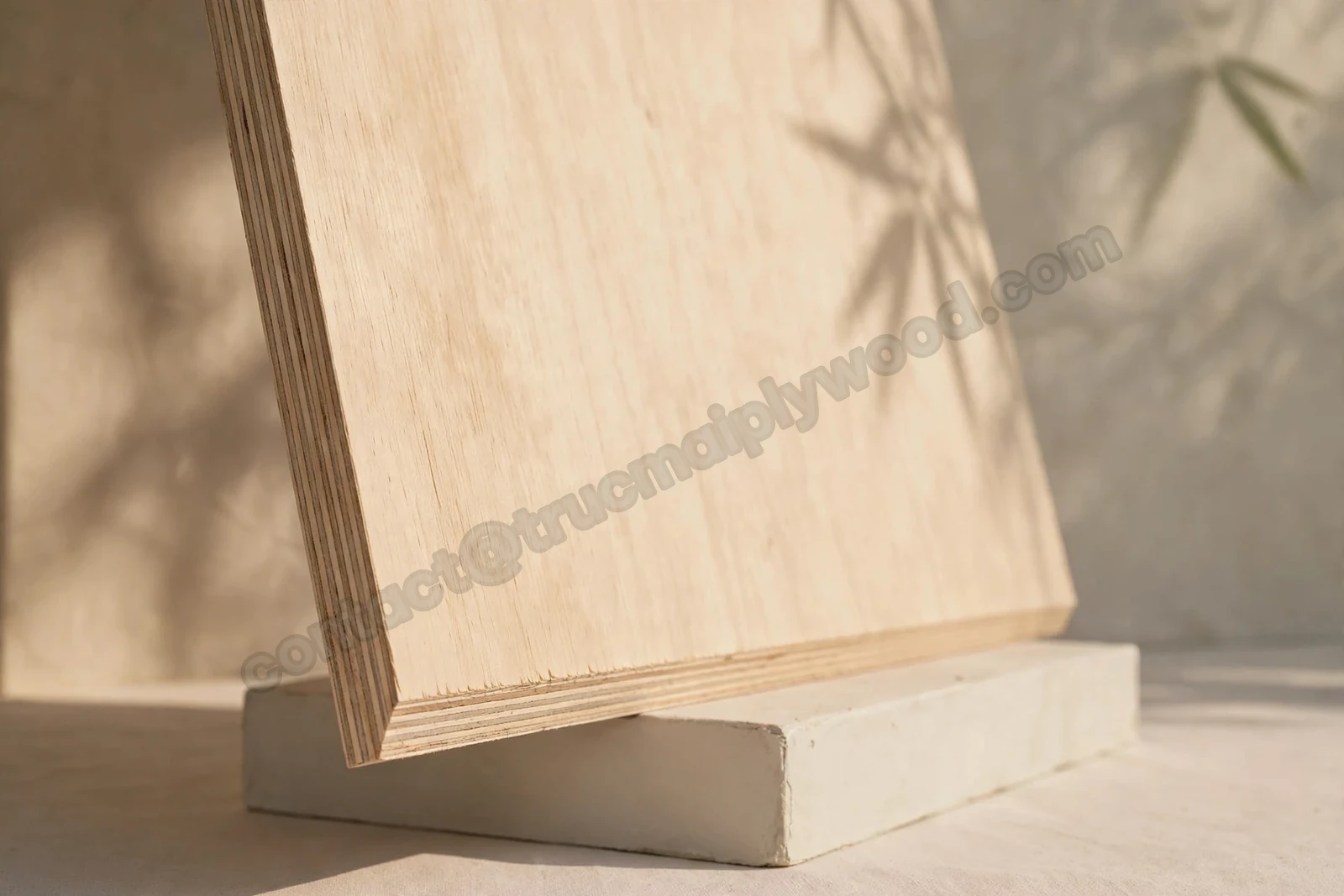
plywood 8 mm is a nominally eight-millimetre panel assembled from bonded wood veneers, normally with adjacent grain directions crossing to improve dimensional stability. It sits between very thin backing materials and thicker cabinet construction panels. Its most useful role is as a supported component, where a full-size board can be cut into repeatable parts without the mass of a heavy carcass sheet.
For a furniture purchasing team, the number alone is only the beginning of the specification. An attractive face may hide a different core, joining method or adhesive system. A smooth surface matters when a component will be painted; consistent edge quality matters when the component will be machined or exposed. A panel used inside a framed cabinet needs different checks from one expected to carry a shelf load.
The useful comparison is with the neighbouring thin plywood panels and the wider process of choosing plywood thickness. Rather than buying by a single label, decide what the component must do and what the finished part must look like. Truc Mai Plywood manufactures furniture and commercial plywood in Ha Hoa, Phu Tho, Vietnam, and quotes the construction against the order specification.
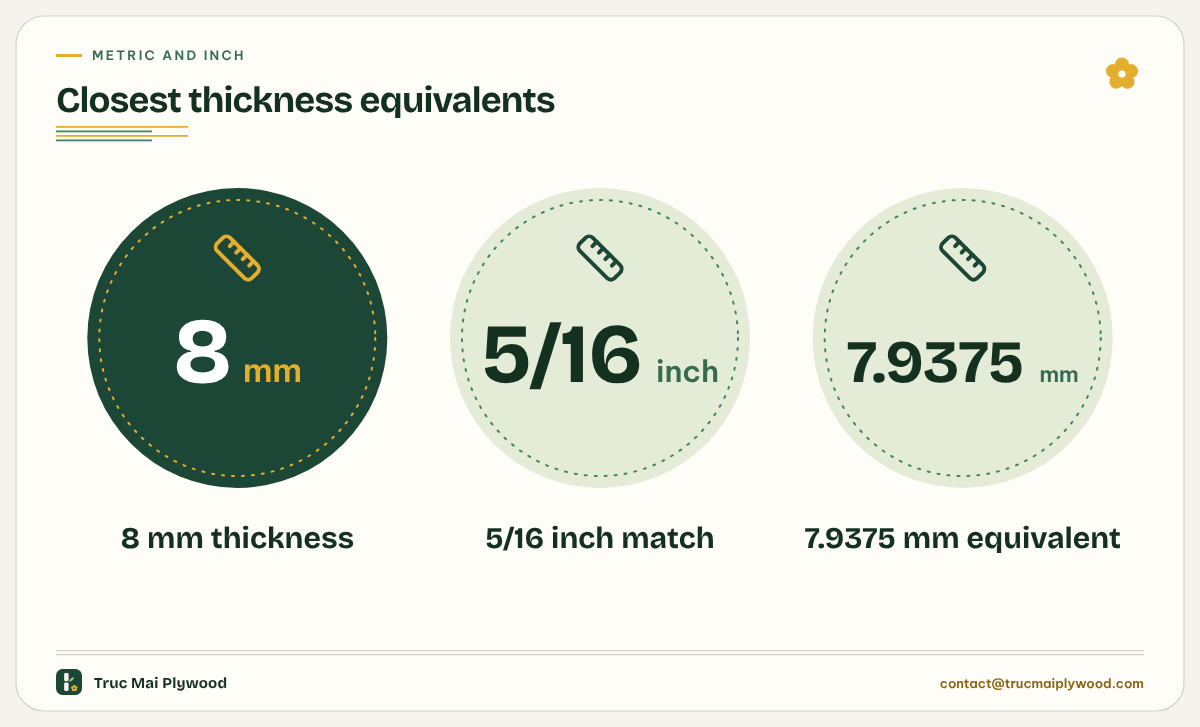
Is 8 mm ply the same as 5/16 inch plywood?
The nearest common fractional-inch match to 8 mm is 5/16 inch, which is 7.9375 mm. The difference is small in ordinary conversation but can matter when a panel slides into a machined groove, fits a pre-cut profile or is assembled alongside components made to an imperial drawing.
| Designation | Thickness meaning | Purchase-order treatment |
|---|---|---|
| 8 mm ply | Nominal metric thickness | Write 8 mm and the finished-panel tolerance |
| 5/16 in plywood | Nominal fractional-inch thickness | Write the drawing dimension and acceptance tolerance |
| 8 inch plywood | An entirely different dimension | Clarify whether the buyer means panel width or thickness |
In UK listings, 8mm ply board and 8mm plywood sheets often describe a size category rather than a fully specified construction. In North American documents, 5/16 may be the familiar nominal label. The correct approach is to translate the drawing into one agreed finished thickness, then use that same number in the order, inspection sheet and cutting programme.
The US National Institute of Standards and Technology publishes PS 1-22 for structural plywood, where nominal performance categories and panel tolerances have defined meanings. That structural specification is a separate product framework from furniture plywood. Use the furniture order’s own dimensional acceptance criteria for this panel.
Which furniture and interior uses suit an 8 mm panel?
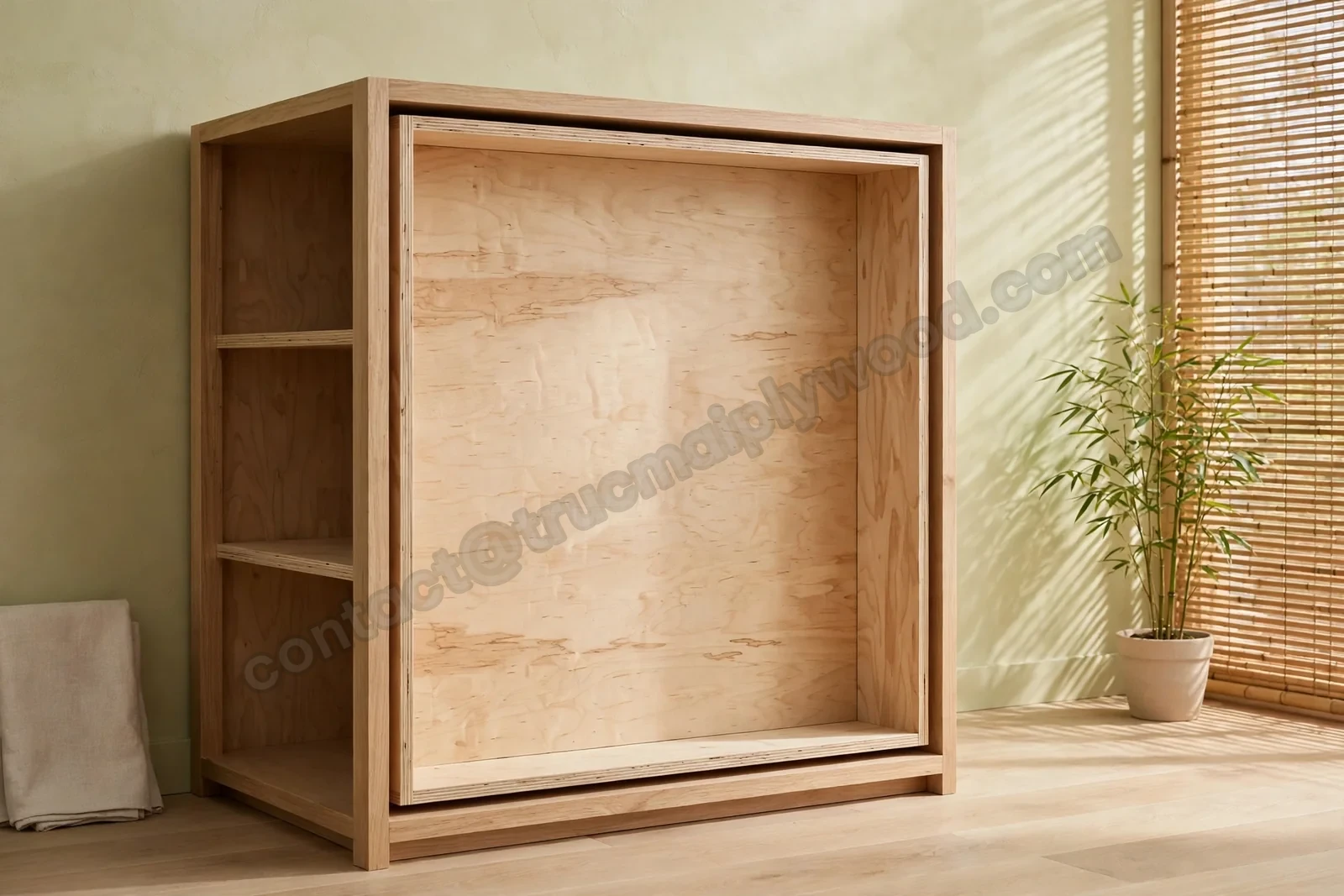
Supported cabinet backs, drawer bottoms, lightweight partitions, display components and decorative linings are practical starting points for 8 mm panels. In each case, the frame, groove, fastening pattern and expected handling decide whether the thickness is adequate. A panel that is fully captured in a groove behaves differently from a wide panel fastened only at its corners.
For cabinet backs, first inspect the groove width and the way the back braces the assembled unit. A back that is nailed over the carcass needs a different edge and fixing detail from a recessed back. For drawer bottoms, measure the unsupported opening and consider what the drawer will hold. A shallow stationery drawer and a wide storage drawer present different demands.
For wall linings and display work, the finish and substrate often matter more than a theoretical strength figure. A prepared face can take paint or a decorative surface, while a lighter core helps installers handle larger components. The fixing schedule and substrate must carry the installation. An 8 mm panel can also be a useful sample thickness for furniture prototypes before the full cutting schedule is finalised.
An 8 mm sheet is not the default choice for long, heavily loaded shelves or a primary cabinet carcass. Compare the geometry and fittings against 18 mm plywood specifications where a thicker component is required.
How does 8 mm compare with 6, 9 and 12 mm?
Eight millimetres occupies a narrow but useful space between lighter backing and more substantial interior panels. The most useful comparison is not which number sounds stronger, but which assembly provides the required support while keeping the intended profile and finish.
| Thickness | Typical purchasing question | Practical distinction |
|---|---|---|
| 6 mm | Is a thin backing sufficient? | Useful where the component is closely supported |
| 8 mm | Is additional rigidity needed without a thick part? | Suits supported backs and lightweight fit-out components |
| 9 mm | Does the local drawing call for the next nominal size? | Check groove and hardware dimensions |
| 12 mm | Will the component carry more load or span farther? | Allows a more substantial part and edge |
The sheet’s stiffness also depends on veneer species, grain orientation, bond and support conditions. Comparing two boards by thickness alone can conceal a core difference. A buyer should ask for a representative edge sample and the actual construction rather than infer equal performance from similar names.
When matching an existing production line, the best thickness is often the one that runs through its tooling with the least adjustment. Confirm the finished thickness at the acceptance points that matter to the assembly, not merely on the supplier’s catalogue line.
What core and veneer faces should buyers specify?
Choose the core for weight, machining and the required face appearance, then choose the visible veneer separately. Available core options include Styrax, Eucalyptus, Acacia and Pine, including mixed-species constructions. Face options include engineered veneer (EV), poplar, bleached poplar, birch, okoume, bintangor, pine, eucalyptus, gurjan and other agreed veneers.
A birch-faced board uses birch as the visible veneer; that description does not imply birch throughout. The same distinction applies to okoume-faced or bintangor-faced plywood. A purchase order should therefore carry independent lines for the face veneer, back veneer and core species. That is especially important when a buyer compares quotations that use the same decorative name.
The furniture line normally uses a stitched A-grade core with sanded faces. Commercial panels can use an AB core, with loose-laid or jointed construction and an unsanded or lightly sanded finish. Core stitching closes gaps across and along the sheet; the outer plies are commonly stitched. The visible face should be judged against an approved physical sample, including colour, repairs, grain and sanding marks.
For a pale interior finish, an EV face can provide a consistent visual direction. For visible natural grain, specify the desired veneer and face/back grade pair. Buyers seeking traceability of imported faces can review the face veneer origin files used in the order documentation.
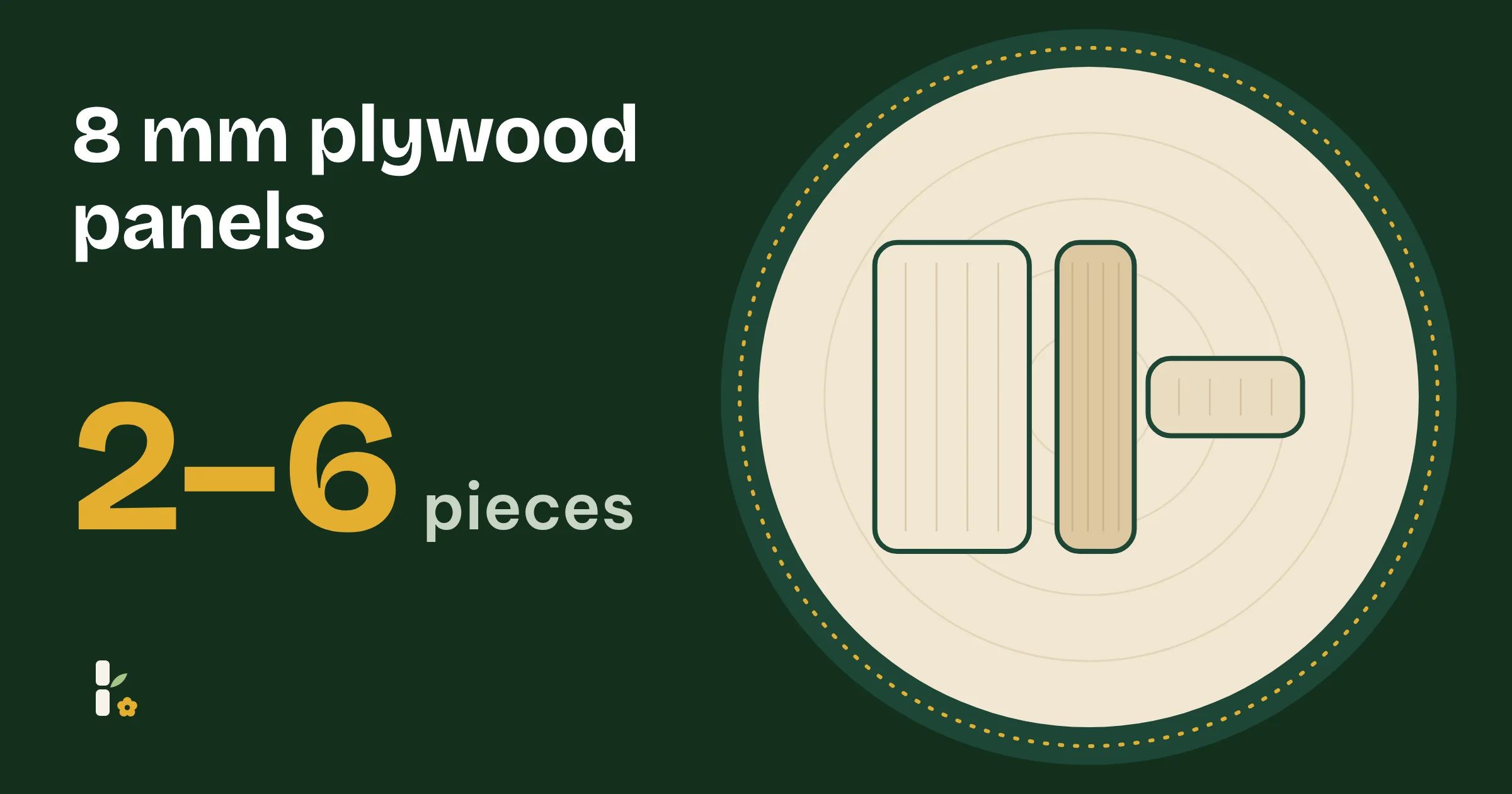
Which sheet sizes and cut-to-size formats are available?
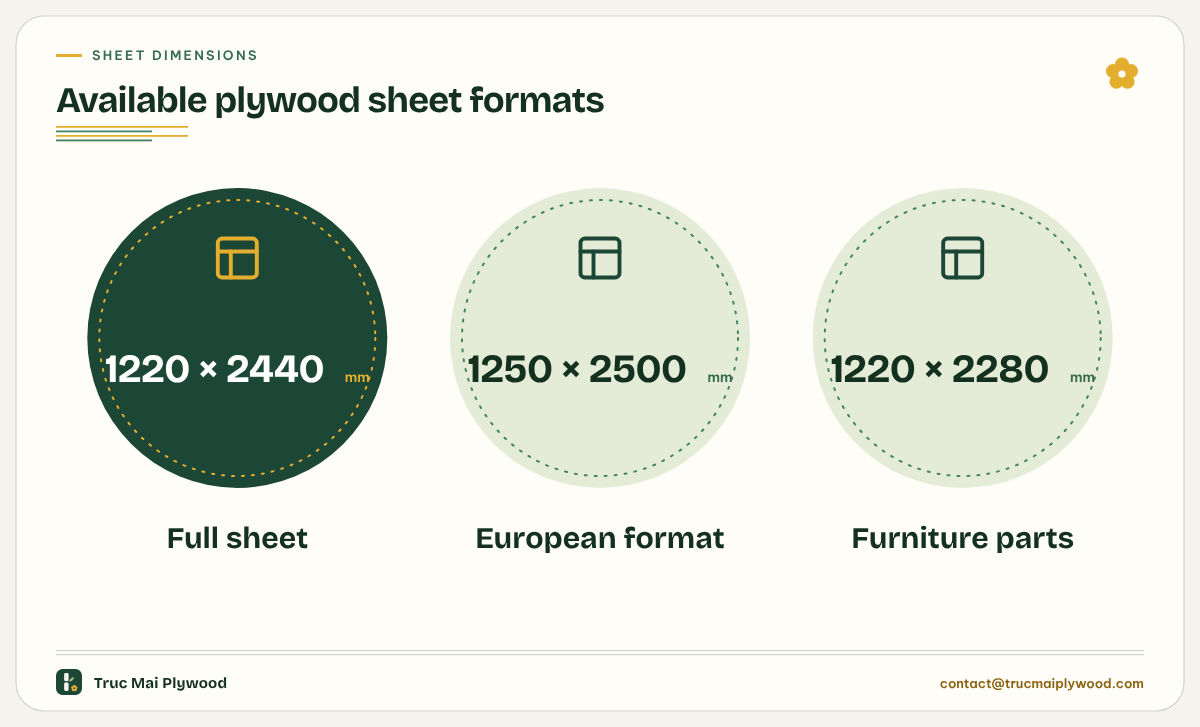
The principal full-sheet formats are 1220 × 2440 mm and 1250 × 2500 mm, with 1220 × 2280 mm also available for furniture components. The 1220 × 2440 format is the familiar 8 × 4 ft board. The European-format sheet can help a factory align its nesting programme with larger part dimensions.
Cut-to-size supply starts with the parent sheet and the buyer’s actual cutting drawing. Common patterns include two lengthwise pieces at 610 × 2440 mm, three pieces at 1200 × 800 mm, or four pieces at 1220 × 610 mm. Six-piece patterns are also available. The mill agrees exact piece sizes and labels by email against the cut list.
The useful question is whether the requested component can be nested economically in the nominated parent sheet while leaving a suitable allowance for the saw cut and trimming. Two buyers asking for the same nominal piece size may need different layouts if one has a directional veneer and the other allows rotation. Grain direction should therefore be marked on the drawing whenever the face is visible.
For repeat components, provide a part identifier, finished dimensions, grain direction, number of pieces per assembly and required packaging sequence. The cut-to-size plywood panels page explains how the option fits into an order. Keep the master cutting list under revision control so labels, drawings and packing counts stay aligned.
What tolerance and surface preparation belong on the order?
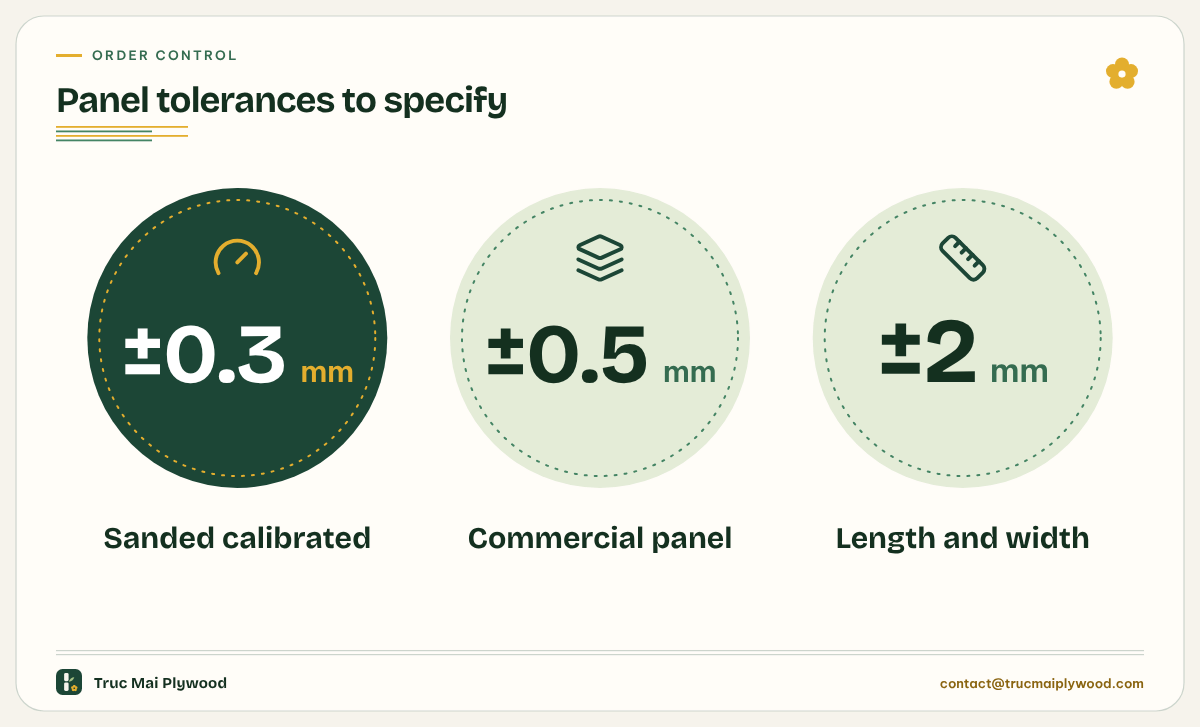
A sanded, calibrated furniture panel can be specified at ±0.3 mm thickness tolerance; commercial panels are commonly ordered at ±0.5 mm, while packing-grade requirements are broader. The agreed tolerance belongs beside the nominal finished thickness, not in a separate general note that the production team might miss.
Length and width are specified at ±2 mm for the mill’s panel formats. Buyers with close-fitting grooves should measure their tooling and specify the actual finished requirement rather than assume the same tolerance works for every component. A face intended for paint or laminate needs a suitable surface preparation, and visible edges need inspection after machining.
The useful incoming inspection checks are straightforward: measure thickness at agreed locations, check face flatness and sanding consistency, inspect edges for gaps, and compare face appearance against the approved reference. Record the inspection method and sampling plan with the order. A single attractive sample does not substitute for a production specification.
For decorative furniture, specify sanded and calibrated faces. A UV-ready panel means its surfaces are prepared for the buyer’s own coating process; it is not a pre-coated UV product. This distinction affects the buyer’s finishing workflow and the surface inspection at receipt.
How should glue, emissions and moisture exposure be described?
Adhesive type, bond performance and formaldehyde emission are three separate specification lines. For interior panels, the mill’s standard construction uses UF adhesive at E0 emission. The buyer should put the adhesive system and the emission requirement on separate lines so that a test for one is not mistaken for evidence of the other.
For US-bound veneer-core hardwood plywood within the certified scope, Truc Mai holds CARB Phase 2 and EPA TSCA Title VI certification covering 3–25 mm. The federal 40 CFR Part 770 sets a 0.05 ppm emission standard for hardwood plywood with veneer core under its specified testing framework. An 8 mm configuration falls inside the certified thickness range, with the certified product type and documentation matched to the order.
European buyers should specify their relevant emission requirement and the test method rather than treat the trade term E0 as a universal European numerical class. A panel used in a dry furniture interior has a different exposure profile from one in a damp service environment. The buyer’s application and the agreed adhesive system should be recorded together.
Bond testing concerns the integrity of the glue line after defined treatment. Emission testing concerns released formaldehyde under defined test conditions. A satisfactory result on one test is not a substitute for the other. This separation makes quotations and incoming documentation much easier to compare.
How do appearance grades and edge construction affect quality?
The approved face sample and the edge build are the two fastest checks when comparing 8 mm furniture panels. A smooth face can still conceal gaps or overlaps within the core, while a well-built core can carry a face that is unsuitable for a visible cabinet door or display panel.
Specify the face and back as a pair. An appearance designation such as A/B or BB/CC needs the supplier’s own defect allowance and reference sample; the trade label alone does not describe every acceptable knot, patch or colour difference. Photograph the approved sample under consistent light, but keep the physical reference available for production inspection.
At the edge, look for continuous veneers, closed joints and a clean machined profile. For a part that will be edge-banded, test the chosen adhesive and banding process on an actual sample. For an exposed edge, check whether the veneer stack produces the appearance the furniture designer expects.
The key is to match the grade to the component. A concealed back can use a different face/back combination from a visible retail fixture. Paying for an appearance that will never be seen is less useful than allocating inspection effort to the core and machining performance that affect assembly.
What does the 40HC planning table tell a repeat buyer?
The 40HC model below gives panel-only planning quantities for the listed core and thickness combinations, including 12, 15, 18 and 21 mm comparison lines. These rows are provided as context for buyers deciding whether a thinner or thicker product mix makes better use of the container. There is no calculated 8 mm row in the supplied model, so no 8 mm loading figure is asserted here.
The basis is a 40HC planning model with 18 packs for Styrax, 16 for Acacia and 15 for Eucalyptus; approximately 1,000 mm pack height; sheets per pack rounded down from pack height divided by thickness, then limited by a 28,000 kg planning payload. Reference densities are 500, 580 and 650 kg/m³ respectively. These are panel-only planning figures, not actual shipment records; the carrier and route set the final payload.
| Core | Thickness (mm) | Sheet (mm) | Packs | Sheets/pack | Sheets | Volume (m³) | kg/sheet | Total kg | Weight capped |
|---|---|---|---|---|---|---|---|---|---|
| Styrax | 12 | 1220x2440 | 18 | 83 | 1494 | 53.4 | 17.9 | 26680 | No |
| Acacia | 12 | 1220x2440 | 16 | 83 | 1328 | 47.4 | 20.7 | 27510 | No |
| Eucalyptus | 12 | 1220x2440 | 15 | 80 | 1200 | 42.9 | 23.2 | 27860 | Yes |
| Styrax | 15 | 1220x2440 | 18 | 66 | 1188 | 53.0 | 22.3 | 26520 | No |
| Acacia | 15 | 1220x2440 | 16 | 66 | 1056 | 47.2 | 25.9 | 27350 | No |
| Eucalyptus | 15 | 1220x2440 | 15 | 64 | 960 | 42.9 | 29.0 | 27860 | Yes |
| Styrax | 18 | 1220x2440 | 18 | 55 | 990 | 53.0 | 26.8 | 26520 | No |
| Acacia | 18 | 1220x2440 | 16 | 55 | 880 | 47.2 | 31.1 | 27350 | No |
| Eucalyptus | 18 | 1220x2440 | 15 | 53 | 795 | 42.6 | 34.8 | 27690 | Yes |
| Styrax | 21 | 1220x2440 | 18 | 47 | 846 | 52.9 | 31.3 | 26440 | No |
| Acacia | 21 | 1220x2440 | 16 | 47 | 752 | 47.0 | 36.3 | 27270 | No |
| Eucalyptus | 21 | 1220x2440 | 15 | 45 | 675 | 42.2 | 40.6 | 27430 | Yes |
For a mixed load, separate the quantities by thickness and core before building the packing plan. The denser core can consume the remaining weight allowance before all available floor space is used. Packaging weight, real sheet weight and the booked container limit are checked in the final plan. The 40HC loading by thickness reference provides the broader comparison across the regular range.
This table is useful in negotiations because it exposes the assumed construction rather than offering an unexplained container count. A repeat buyer can compare the model against an actual packing list and then use the measured results for subsequent orders.
Which documents matter for EU and US import orders?
The order file should connect the product specification to its origin, applicable certificates and shipping papers. For an EU import, the mill can provide an EUDR due-diligence dossier with origin records and geolocation data for both core timber and face veneer. The European Commission’s 13 July 2026 EUDR update confirms application from 30 December 2026 for large and medium operators and relevant existing timber-regulation micro and small operators, and from 30 June 2027 for other micro and small operators.
For FSC-eligible orders, the mill’s chain-of-custody licence is FSC-C196493 and its certificate is SA-COC-014545. The available output claim is FSC 100% for eligible products, with the claim recorded on the applicable sales documents. The certificate and product configuration should be connected in the order paperwork rather than inferred from a general factory statement.
A shipment file normally includes the commercial invoice, packing list, bill of lading and origin paperwork, with other documents determined by destination and agreed shipment terms. For EU-bound goods, the documentation set can include EUR.1 and relevant origin and geolocation files. For US-bound products, match the formaldehyde certificate to the ordered veneer-core configuration.
The documents per container checklist helps purchasing and logistics teams reconcile the order with the shipping file. Prepare the document list before loading so the draft documents can be checked against the actual packed quantities.
How should a buyer compare quotations and place a repeat order?
Start with the intended application and an approved sample, then issue one specification sheet to every supplier being compared. Two offers labelled “8mm plywood” can differ in core grade, veneer species, joining method, sanding and emission specification. A common RFQ format makes the difference visible without relying on broad quality adjectives.
- Application: describe the component, support, machining and finish.
- Construction: name the core species, joining method and face/back grade pair.
- Adhesive and emission: give each requirement its own line, including the required supporting document.
- Dimensions: write nominal thickness, finished tolerance, parent sheet and any cut list.
- Packing: specify labels, packs, mixed products and quantities by part number.
- Logistics: state the destination port and the required shipping terms.
A physical sample is especially useful when the face is decorative or the part has a narrow groove. Compare the actual cut edge and finish response rather than only the front face. The sample ordering process provides a practical starting point, and writing a plywood RFQ helps organise the fields.
The standard mill order is one 40HC, with production normally taking 15–45 days after the deposit. Available shipping terms are FOB Hai Phong, CFR and CIF. For repeat business, retain the approved sample, signed specification and labelled packing pattern as the reference set for the next order.
Send the application, core, glue/emission requirement, face/back veneer, sheet size or cut list, packing preference, quantity and destination port through the quotation request. A clear first specification is the quickest route to a useful comparison and a repeatable production order.
Questions buyers ask
Can 8 mm plywood be ordered as a full 8 × 4 sheet?
A full 1220 × 2440 mm sheet is the familiar 8 × 4 ft format. State the exact metric dimensions on the purchase order.
Can 8 mm plywood be painted?
Yes. Select a smooth sanded face, prepare the edges and follow the coating maker’s primer and finishing instructions.
Does 8 mm plywood work for drawer bottoms?
Yes, for supported drawer bottoms sized to the drawer and its contents. Check the groove, support and expected load before choosing the construction.
Can a buyer specify a birch face without a birch core?
Yes. Birch-faced plywood describes the outer veneer; the core species is a separate line in the specification.
Should the buyer specify face and back separately?
Yes. Record the approved face and back appearance as a pair, with the reference sample and finish requirement.
Can I order labelled cut panels?
Yes. Supply the parent-sheet dimensions, cut list, quantity by size and label text for the packed components.
Are FSC documents included for every plywood shipment?
FSC 100% claims apply to eligible products covered by the certificate and are identified on the relevant sales documents. Ask for the eligible product configuration in the order specification.
What is the minimum order from the mill?
The standard minimum is one 40HC container. Mixed products can be agreed when the packing plan is set.
Can I request a physical sample before placing an order?
Yes. Samples are available, and new buyers arrange their courier collection.
Which delivery terms are available?
The available terms are FOB Hai Phong, CFR and CIF. State the destination port when requesting the shipping option.