
plywood 20mm and 21 mm are thick sheet options for furniture carcasses, shelves and machined components. Choose by the finished drawing, core construction and permitted thickness variation, not thickness alone. Truc Mai Plywood lists 21 mm in its standard range; a 20 mm requirement should be written explicitly on the enquiry.
What does plywood 20mm mean on a purchase order?
A 20 mm plywood sheet has a nominal thickness of 20 millimetres, while a 21 mm sheet is specified at 21 millimetres. The nominal figure is a purchasing dimension, not a description of face quality, core species, adhesive or finished surface. A label such as “20mm ply board” may identify a stock line, but an importer needs the complete specification.
A furniture drawing starts with the finished assembly. For a cabinet side, check the groove, connector length, edge band and adjoining door clearances. For a shelf, record the clear span and intended load. Then select a panel thickness that fits the machining programme. The guide to choosing plywood thickness explains how neighbouring sizes are compared before a cutting list is released.
A useful specification distinguishes three dimensions: the nominal panel thickness, the allowed deviation at delivery, and the finished size after machining. For example, a cabinet drawing may reserve a fixed opening for a shelf, while the joinery process removes material from a groove. Those are different checks. Record the drawing revision beside the panel specification so that the purchaser and workshop are evaluating the same version.
A thickness request also needs a face description. A 20 mm plywood sheet with a decorative veneer, a melamine overlay or a sanded unfinished face is not the same purchasing item. State whether the buyer needs a ready-to-laminate surface, an exposed timber face or a finished decorative surface. The approved sample should show the face and back, not only the edge.
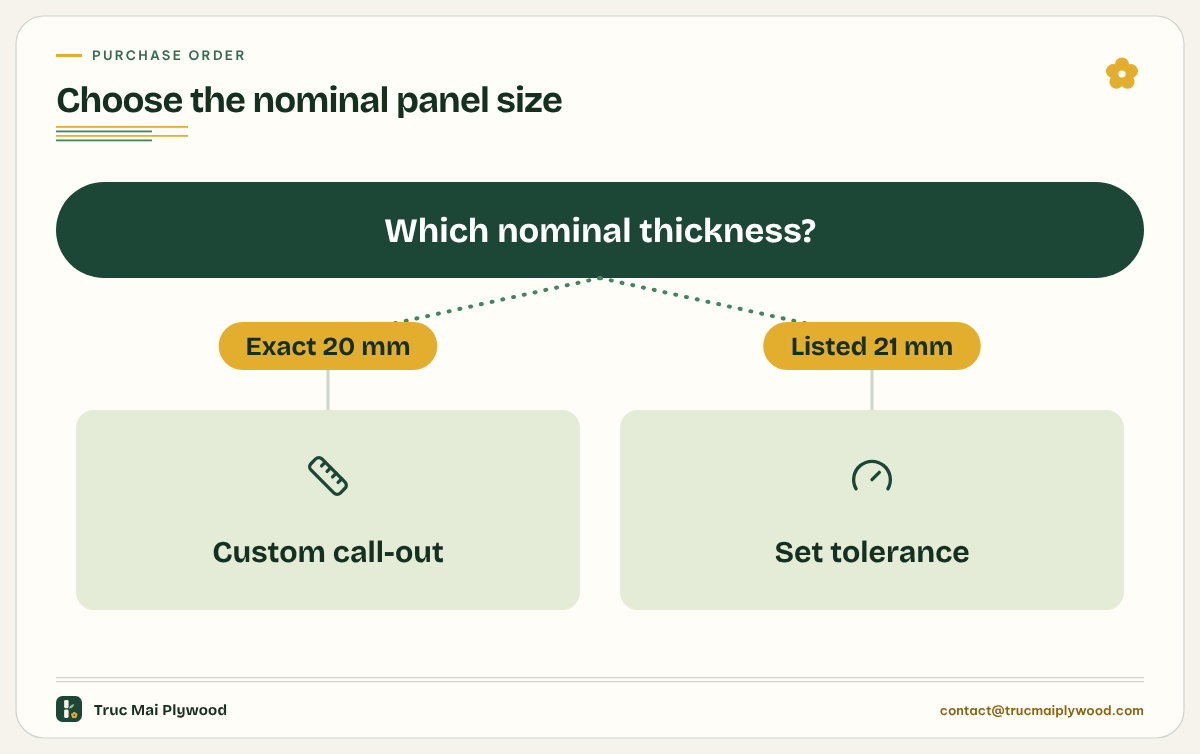
The standard Truc Mai thickness list includes 18 and 21 mm within its 3–40 mm range. A request for exactly 20 mm belongs on the enquiry as a distinct nominal dimension, with the finished tolerance written beside it. That prevents a quotation for a nearby stock thickness from being mistaken for an exact match.
When is 21 mm preferable to 18 mm for cabinets?
A 21 mm panel is useful when a cabinet design needs a thicker edge, deeper machining allowance or a particular finished appearance. It can give a visibly heavier carcass edge and more material around routed features, although the load capacity of a completed cabinet also depends on its joints, span, fastening and support.
Start by checking the hardware drawing. Confirmat screws, dowels, hinges and routed rebates each need sufficient material around the machining feature. The cabinet maker should approve the edge distances and drill depths rather than transferring an 18 mm drilling programme unchanged to 21 mm stock. If an existing assembly is designed around 18 mm, increasing thickness changes inside clearances and component lengths.
For a side-by-side procurement comparison, use the 18 mm plywood specification. Ask the supplier for a sample showing the actual face, edge and calibrated thickness. A smooth face alone does not show whether the inner veneers are well joined.
Where do 20 and 21 mm panels work best in furniture?
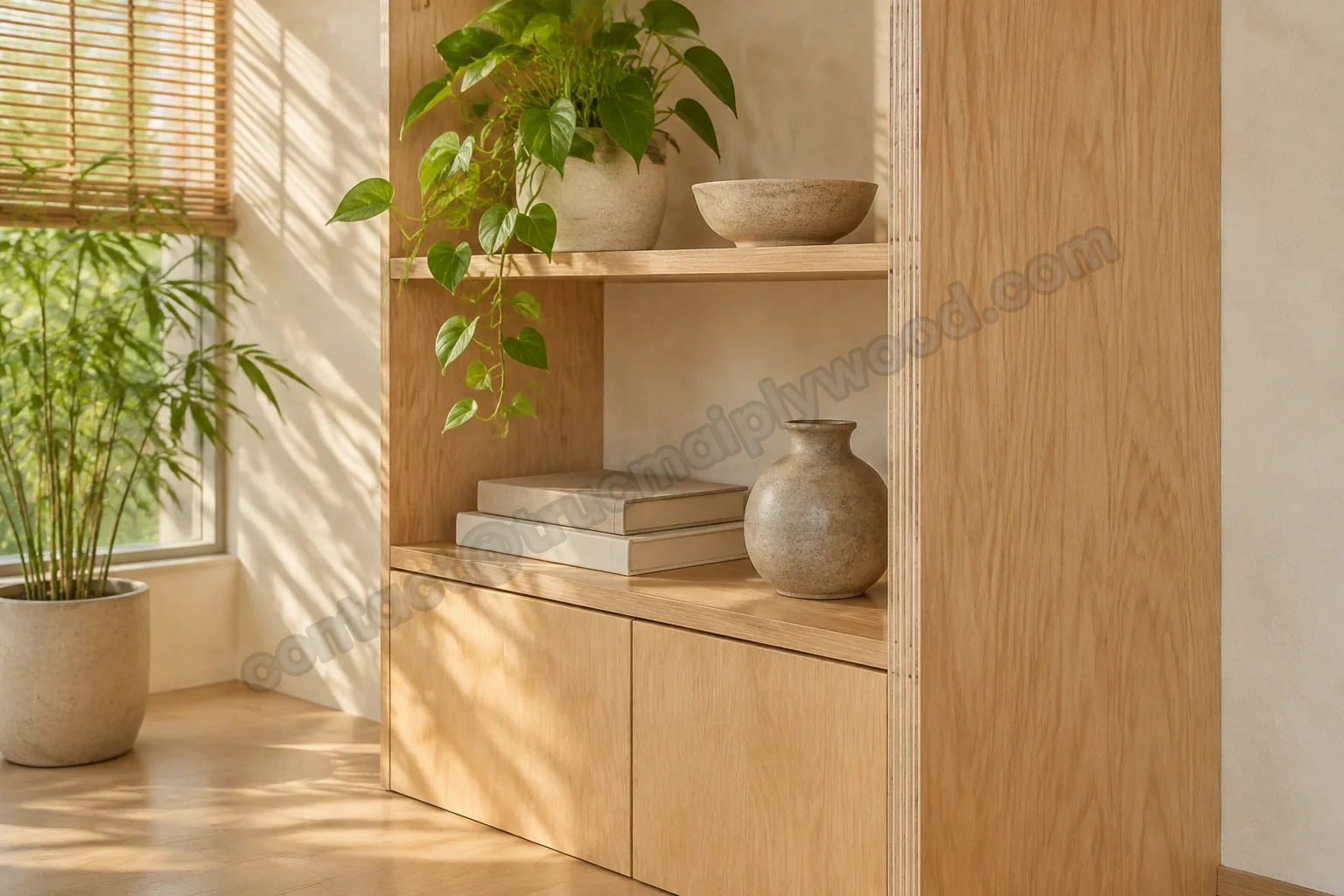
Thicker panels suit cabinet carcasses, wide furniture components, shelving with carefully designed supports, counters, work surfaces and parts where a substantial exposed edge is wanted. The exact choice comes from the assembly drawing rather than an assumed universal shelf span.
A tall cupboard may use a thick side panel for a particular edge detail, while its back can be much thinner. A long shelf needs a separate stiffness and deflection check; thickness, core stiffness, grain direction, support spacing and the contents all matter. The same panel can perform differently when installed with another support arrangement.
For exposed shelving, specify which face will be visible and whether both sides need the same appearance. For veneered cabinet doors, check flatness, face balance and the finishing system. For parts with repeated grooves, ask to inspect the core at the groove line. These checks reveal more about the finished furniture than the thickness number alone.
How do 20 and 21 mm compare with neighbouring thicknesses?
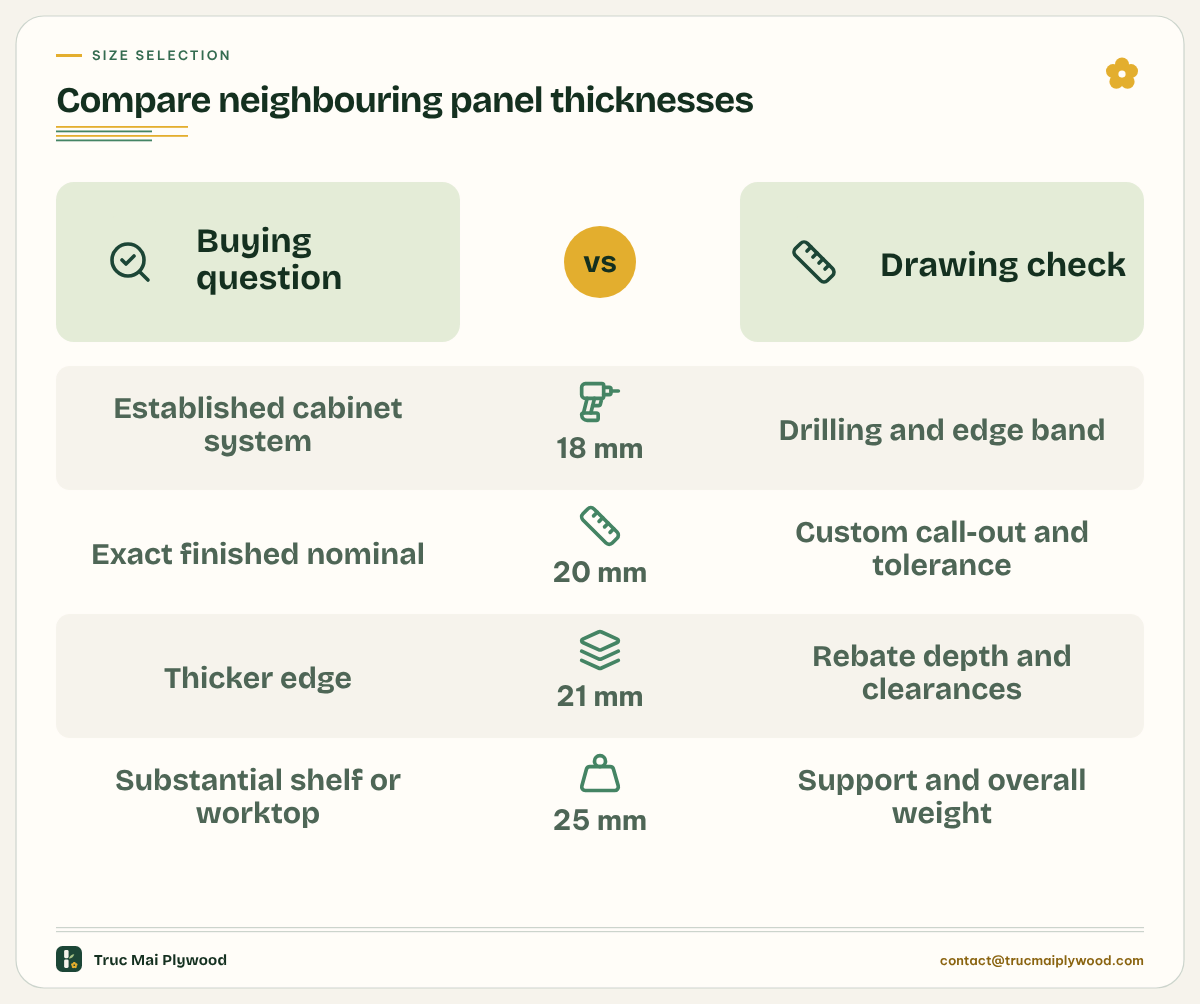
The practical comparison is between the drawing’s nominal dimension, the edge detail and the total material used. A thicker panel can be selected for machining room or appearance; a thinner one can be appropriate where the furniture design provides sufficient support. Neither thickness automatically establishes a load rating.
| Nominal panel | Typical purchasing question | Drawing check |
|---|---|---|
| 15 mm | Can the design use a lighter carcass component? | Joint design and panel support |
| 18 mm | Does the established cabinet system fit? | Hardware drilling and edge band |
| 20 mm | Is an exact finished nominal dimension required? | Custom thickness call-out and tolerance |
| 21 mm | Does the design call for a thicker edge? | Rebate depth and assembly clearances |
| 25 mm | Is a substantial shelf or worktop edge desired? | Support design and overall weight |
The 15 mm specification and 25 mm panel overview cover the adjacent purchasing decisions. Keep the selected thickness consistent across the cut list, packing labels and inspection record.
Which core gives a clean edge and reliable machining?
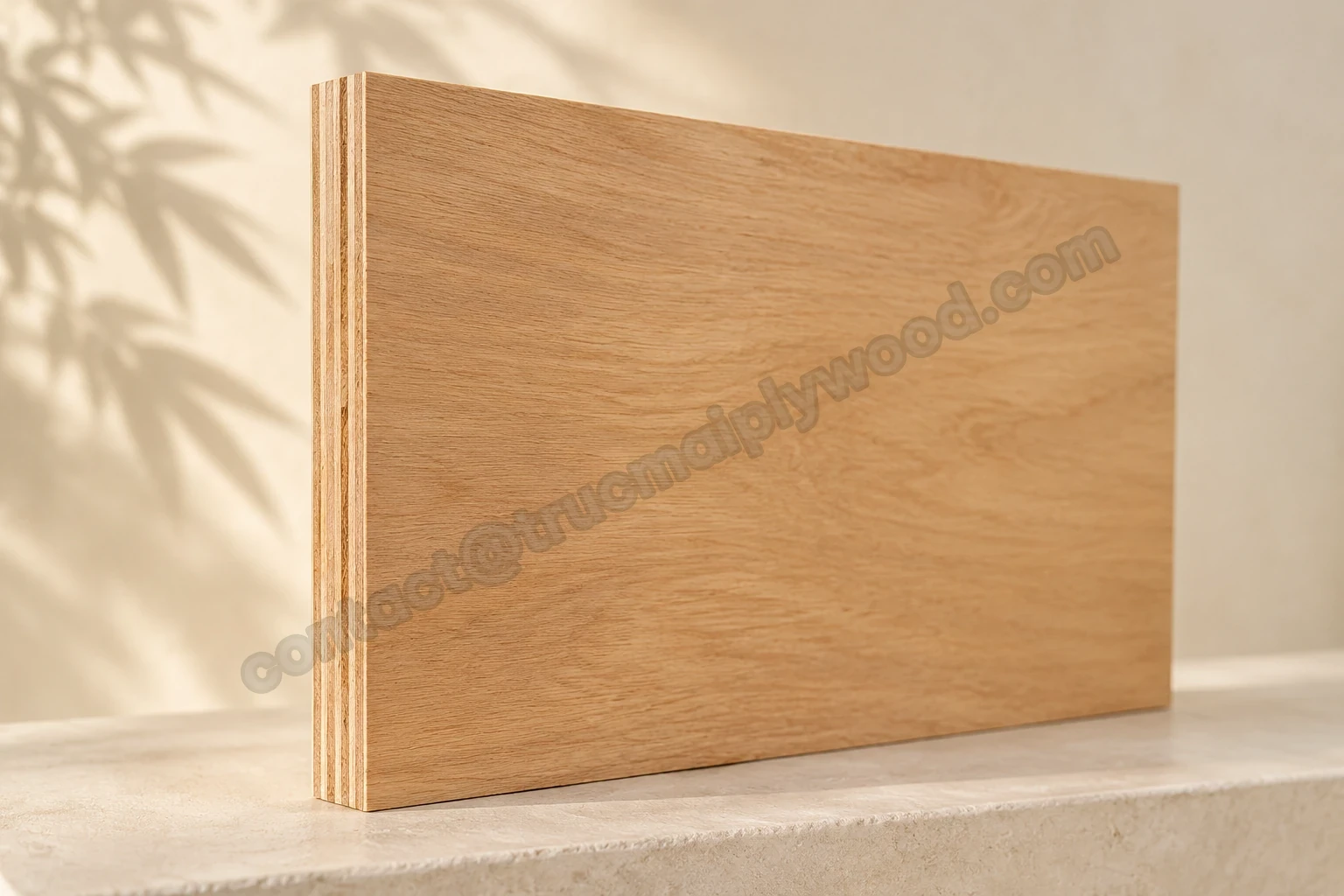
A well-joined veneer core gives the cutter a more consistent edge than a core with open gaps. For furniture panels, Truc Mai’s usual build uses an A-grade stitched core and sanded faces; the commercial line uses an AB core that may be loose-laid or jointed. Those are different constructions even when the outside sheet looks similar.
Styrax, Eucalyptus, Acacia and Pine cores are offered, as well as combinations. The core should be specified by species and construction, because the species affects sheet weight and the joining method affects the exposed edge. Core stitching can run across and along the sheet; the outer 2–4 plies are commonly stitched, with all plies available by order.
Inspect a fresh cross-cut at several positions, including the middle and corners. Look for continuous veneer, well-closed joins, a consistent glue line and no local opening where a connector will be drilled. When the final edge is left visible, agree the acceptable edge appearance against a physical sample before production.
Which faces and finishes suit a thicker plywood sheet?
Choose the face for the visible finish and the core for the machining requirement. Available faces include engineered veneer (EV), Poplar, bleached Poplar, Birch, Okoume, Bintangor, Pine, Eucalyptus, Gurjan and Sapele. Birch-faced plywood means birch veneer over the specified Vietnamese core, rather than an all-birch construction.
A clear finish puts greater emphasis on veneer matching, colour and the approved face-grade sample. Painted furniture may favour a prepared, even face, while melamine- or high-pressure laminate-faced panels arrive with a decorative surface. UV-ready panels have prepared faces for the buyer’s own UV coating; they are not factory UV-coated.
Ask for face and back grades as a pair. State the finish on both sides, grain orientation and whether the edge will be banded, painted or displayed. Compare the birch-faced plywood range when the appearance of a light timber veneer is central to the design.
What thickness tolerance should the buyer specify?
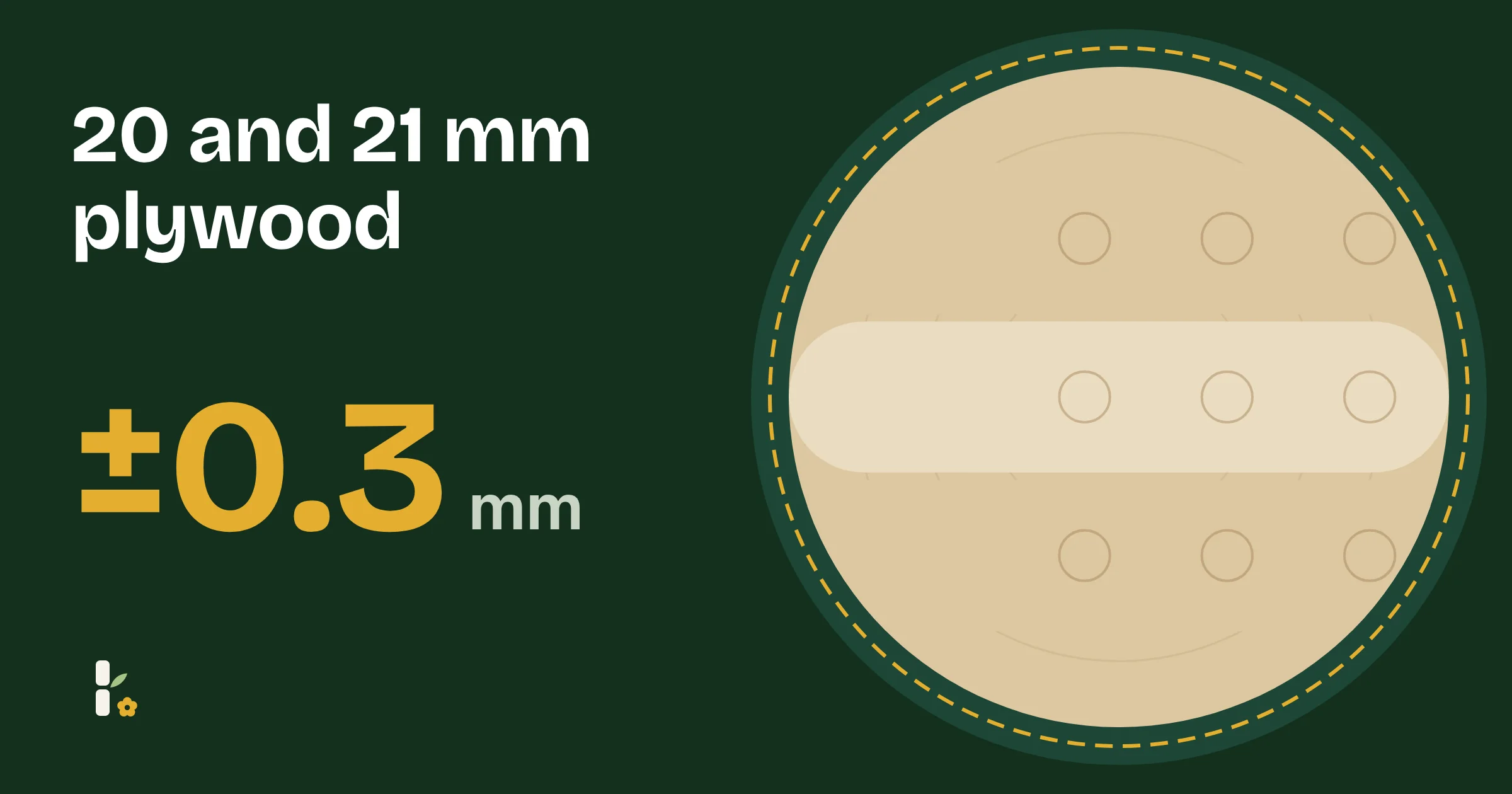
Write the tolerance on the order beside the nominal thickness. Truc Mai uses ±0.3 mm for sanded, calibrated furniture panels, with the wider ±0.3–0.5 mm range set by the agreed specification. Length and width tolerance is ±2 mm. A purchase order for 21 mm should therefore name the chosen tolerance rather than assume a shop label provides it.
Measure several points across each sample sheet, avoiding damaged edges, and record both the measured thickness and the surface finish. A nominally thick board with variable sanding can cause trouble when grooves are cut on a fixed machine setting. The buyer should agree the measurement method and the sampling points before the first production batch.
The European dimensional standard EN 315:2000 sets dimensional tolerance rules for plywood. An order-specific calibrated tolerance is a separate commercial specification; it should appear explicitly on the supplier’s confirmation.
How do glue and emission requirements affect the specification?
Adhesive type, bond performance and formaldehyde emission are three separate lines of a plywood specification. Truc Mai’s default furniture build uses UF glue at E0 emission; a different moisture requirement calls for an agreed adhesive build and appropriate testing. Do not use the emission label as a substitute for a bond-test result.
The USDA Forest Products Laboratory Wood Handbook describes UF as an interior-panel adhesive with comparatively limited resistance to repeated wetting, while melamine and phenolic systems have different moisture-resistance characteristics. The report for the actual panel construction is the useful evidence when a buyer needs a specified bond performance.
For US-bound veneer-core hardwood plywood, 40 CFR Part 770 sets the TSCA Title VI formaldehyde limit at 0.05 ppm. Truc Mai’s CARB P2 and TSCA Title VI certification covers veneer-core hardwood plywood from 3 to 25 mm. The formaldehyde limits explainer separates US and European test regimes.
What are the sheet sizes and cut-to-size options?
Standard sheet formats are 1220 × 2440 mm, 1220 × 2280 mm and 1250 × 2500 mm. The buyer can also order labelled furniture parts cut from a standard sheet, with the exact finished dimensions agreed from the drawing and cutting list.
The mill can split a sheet lengthwise into two 610 × 2440 mm pieces, divide an agreed format into three 1200 × 800 mm pieces, or arrange a four-piece pattern such as 1220 × 610 mm. Six-piece layouts are also available. A 1220 × 610 mm quarter-sheet pattern can be cut from a 1220 × 2440 mm parent sheet under the agreed cutting plan.
Cutting layouts should identify grain direction, saw allowance, the number of finished pieces, permissible edge defects and labels for assembly. A nominal panel width is not automatically the usable width after saw cuts. For a parts order, send the original sheet size and a dimensioned sketch rather than only a count of pieces. See cut-to-size plywood panels for the order format.
How much does 21 mm plywood weigh per sheet?
Core species changes the weight of a 21 mm sheet more than the face veneer choice. For 1220 × 2440 mm panels, the planning model gives 31.3 kg per Styrax-core sheet, 36.3 kg for Acacia and 40.6 kg for Eucalyptus. These are calculated panel weights using reference core densities, not individual weighbridge measurements.
Weight matters to both the cabinet maker and the importer. A heavier sheet needs suitable lifting and storage arrangements, while a container can reach its payload limit before its internal space is full. In furniture production, the weight of the finished part also depends on how much material is removed by cutting and machining.
For sample evaluation, weigh complete panels and compare them with the specification rather than infer species from weight alone. A panel can combine core species, and moisture content and overlays also affect mass. When a furniture project is sensitive to handling weight, ask for the actual sample construction and finished-part dimensions.
How many 21 mm sheets fit in a 40HC container?
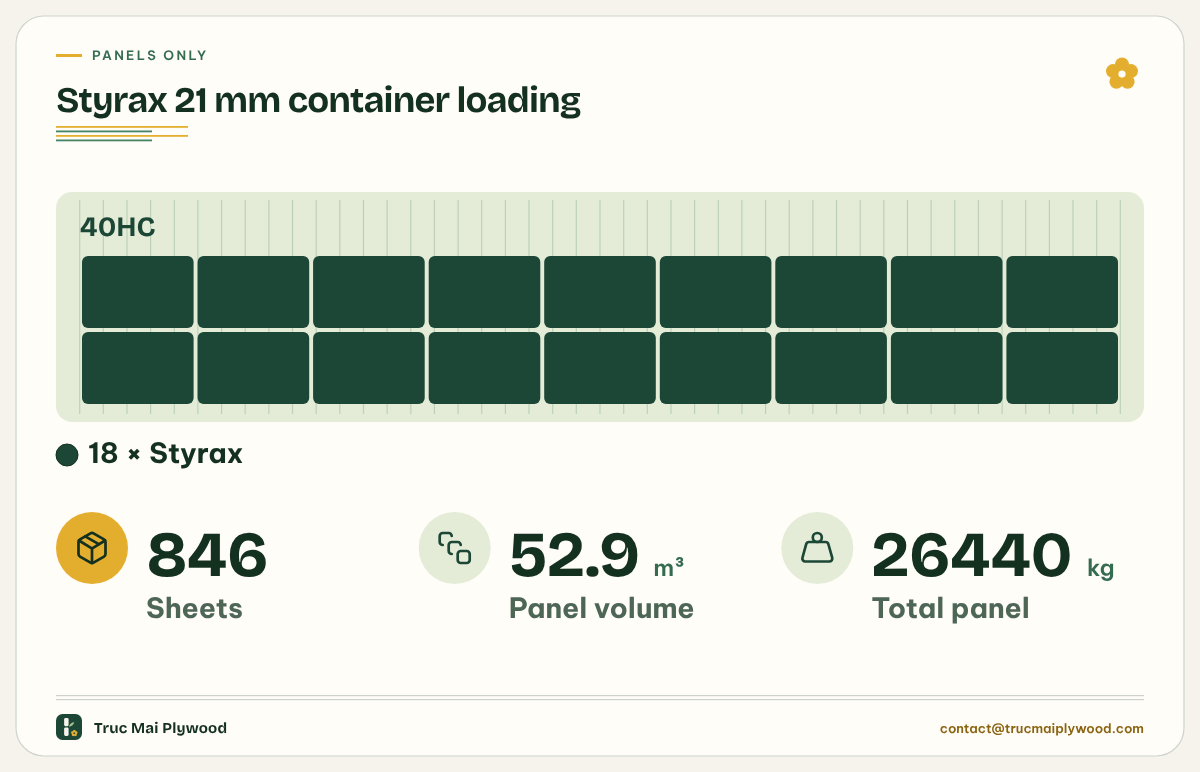
The 40HC planning model gives 846 Styrax-core sheets, 752 Acacia-core sheets and 675 Eucalyptus-core sheets at 1220 × 2440 × 21 mm. The values below reproduce every supplied calculation row, including panel volume and calculated panel mass.
| Core | Thickness | Sheet size (mm) | Packs | Sheets per pack | Sheets | Panel volume (m³) | kg per sheet | Total panel kg | Weight-capped |
|---|---|---|---|---|---|---|---|---|---|
| Styrax | 21 | 1220x2440 | 18 | 47 | 846 | 52.9 | 31.3 | 26440 | No |
| Acacia | 21 | 1220x2440 | 16 | 47 | 752 | 47.0 | 36.3 | 27270 | No |
| Eucalyptus | 21 | 1220x2440 | 15 | 45 | 675 | 42.2 | 40.6 | 27430 | Yes |
Calculation basis: 40HC planning model, panels only. Maximum packs by core: Styrax 18, Acacia 16, Eucalyptus 15. Pack height 1,000 mm; sheets per pack are pack height divided by thickness, rounded down and capped by a 28,000 kg planning payload. Reference densities are Styrax 500 kg/m³, Acacia 580 kg/m³ and Eucalyptus 650 kg/m³. This is a planning figure rather than a loading record; the carrier and route determine the permitted payload.
When comparing these three cores, do not treat the calculated total panel kilograms as the verified gross mass on the shipping paperwork. The packing operation adds pallet materials, protection and securing equipment. The final loading team checks actual weights against the transport booking, then produces the shipment packing list. This distinction matters when a buyer asks the supplier to maximise sheet count: the densest core may be constrained by payload rather than available floor space.
Packaging weight and actual sheet weights belong in the final loading check. The container loading by thickness table provides the wider comparison without treating cubic metres as a fixed shipment allowance.
How should a buyer compare two 21 mm quotations?
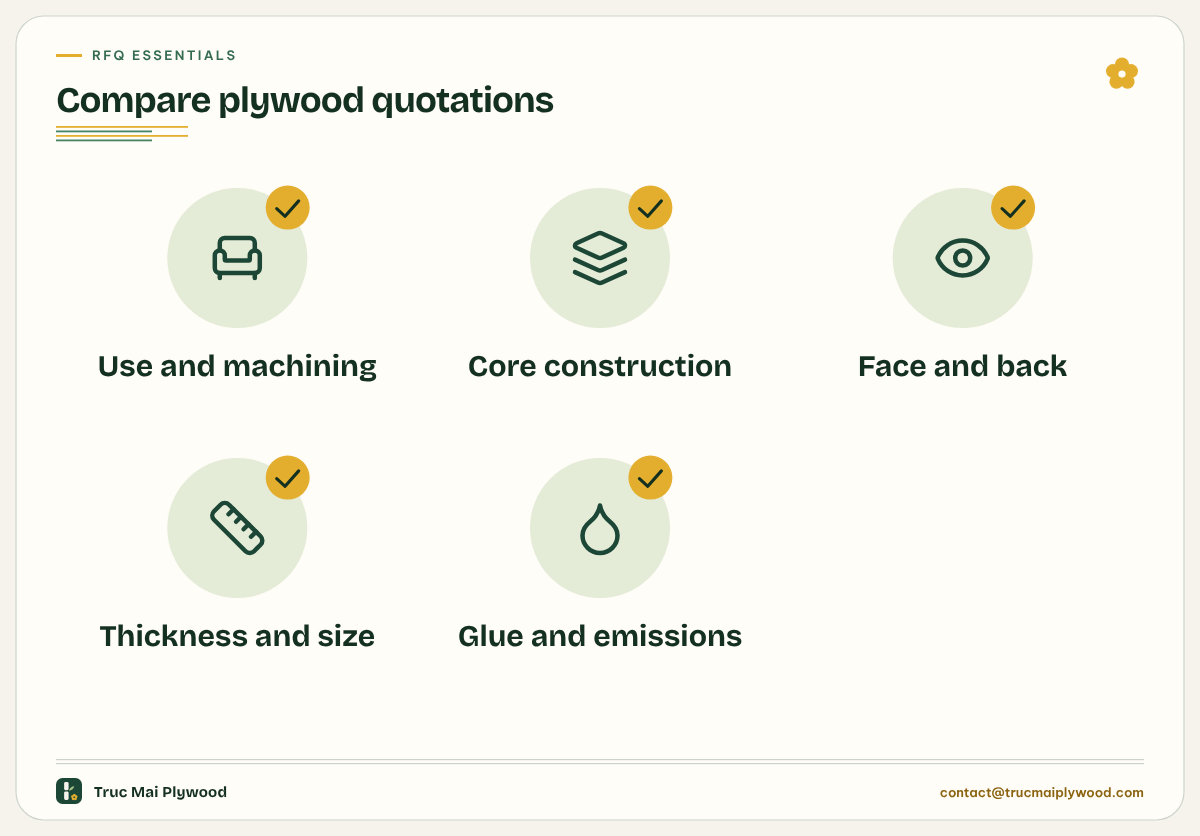
Compare the construction line by line before comparing commercial terms. Two sheets described as 21 mm hardwood plywood can have different core joining, face preparation, density and surface grades. A clear quotation names those differences so the buyer can match each offer to the same furniture drawing.
- State the finished use and the machining operations, including any visible edges.
- Record the core species, core grade and whether veneers are stitched or loose-laid.
- Name the face and back grades, the overlay or finishing preparation, and grain direction.
- Specify the nominal thickness, thickness tolerance and full sheet dimensions.
- State adhesive and emission requirements as separate items, with the relevant evidence.
- Add cut-piece labels, pack quantities, destination and the proposed inspection method.
A buyer can use the plywood RFQ checklist to keep these lines identical between suppliers. Ask for a cross-cut sample and an agreed appearance sample when machining or face matching matters. The sample is the reference for the approved build, not merely a colour illustration.
How should the panels be stored, machined and finished?
Store plywood flat, supported and protected from liquid water before it enters the furniture line. Keep packs on level supports so panels are not bent during storage, and allow the material to reach the workshop conditions before precision machining. The finishing plan should cover both faces and exposed edges where the intended use requires it.
Use a suitable sharp saw blade and a supported cutting setup to reduce tear-out on decorative faces. For routed parts, make a test pass on the approved sample before running a full production batch. Check the first finished components against the assembly drawing, especially slot width, edge quality and the location of hardware holes.
A clear finish reveals veneer colour and repairs; an opaque finish puts more emphasis on surface smoothness and edge preparation. Agree whether edge banding is applied before or after the finishing operation. Separate finished-part inspection from incoming-sheet inspection, because a sound sheet can still be damaged by a poor cutting setup.
Which documents should accompany a furniture plywood order?
The purchase file should contain the approved panel specification, sample reference, relevant certificate documents and the shipping document set. Truc Mai supplies commercial invoice, packing list, bill of lading and the agreed origin and treatment paperwork. For eligible FSC 100% products, the FSC claim appears on the relevant sales and shipping documents.
The mill holds FSC chain-of-custody licence FSC-C196493 and certificate SA-COC-014545, alongside ISO 9001:2015 quality-management certification and ISO 14001:2015 environmental-management certification for plywood manufacturing. These credentials describe different things: chain of custody, quality management and environmental management. A panel’s emission and bond requirements still belong in its product specification.
For EU import orders, the mill can supply origin records and geolocation files for the Vietnamese core and imported face veneer. Keep the relevant documents matched to the exact material configuration on the order. The packing list should also identify each thickness and core type when a container carries more than one panel specification.
What should be sent to request a 20 or 21 mm panel quotation?
Send the application, nominal thickness, core construction, adhesive and emission specification, face and back grades, sheet format, cut list, packing instructions, quantity and destination port. State 20 mm explicitly if that dimension is essential; for a listed 21 mm option, include the selected tolerance and sample requirements.
Truc Mai Plywood manufactures furniture and commercial plywood in Ha Hoa, Phu Tho, Vietnam, with annual capacity around 60,000 m³. Its standard minimum order is one 40HC, and production normally runs 15–45 days after the deposit. The quotation should identify the construction being offered and the proposed shipment terms.
Request plywood samples with a labelled edge cross-section and the intended face finish. Attach the furniture drawing and the required cut-piece identifiers to the enquiry. That gives the mill enough information to prepare a matching sample, a pack plan and a written order specification.
Send your specification to contact@trucmaiplywood.com or through the quotation form.
Questions buyers ask
Is 20 mm plywood the same as 21 mm plywood?
No. The nominal thicknesses are 20 mm and 21 mm respectively. A buyer should specify the exact nominal thickness and permitted tolerance rather than treating the labels as interchangeable.
Can a 20 mm ply board be cut for cabinet parts?
Yes. Supply the cut list, finished dimensions, face direction and edge treatment so the cutting plan follows the furniture drawing.
Is birch-faced plywood made with a birch core?
Not necessarily. Birch-faced plywood describes the face veneer; the core species must be specified separately.
Can I order 21 mm plywood with melamine faces?
Yes. Truc Mai offers melamine-faced furniture panels; agree the face finish, core, edge treatment and thickness on the order.
Are 20 mm plywood sheets available in 1250 × 2500 mm?
That sheet format is within the mill range. The exact thickness and cutting schedule are set on the purchase specification.
What is the difference between face grade and core grade?
Face grade describes the visible veneer appearance. Core grade and joining describe the internal veneer construction, which affects machining and edge quality.
Do I need to seal exposed plywood edges?
Seal edges where the finish system or service environment calls for it. Specify the finishing process before cutting so the machining allowance is correct.
Can a mixed container include 21 mm and thinner plywood?
Yes. Mixed loads are arranged by agreement, with separate pack labels and a combined weight plan.
Does a CARB certificate cover a 40 mm panel?
No. The Truc Mai CARB P2 and TSCA Title VI certificate covers veneer-core hardwood plywood from 3 to 25 mm.
How should I specify the face grain direction?
State whether the grain must run along the long or short finished edge, and mark the orientation on the cutting drawing.