
Rubberwood vs acacia is primarily a choice of appearance and processing specification. Rubberwood offers pale, relatively uniform furniture timber; Acacia mangium brings brown heartwood and contrasting sapwood. Both can be machined and joined for interior furniture. For plywood, distinguish the decorative face from the inner core before comparing quotations.
Rubberwood vs acacia: what are the main differences?
Rubberwood is generally pale and even-coloured, while Acacia mangium has contrasting brown heartwood and lighter sapwood. Both suit furniture when drying, machining and finishing are specified. The Forest Research Institute Malaysia describes their appearance and processing characteristics in its timber technology bulletin.
| Buyer criterion | Rubberwood, Hevea brasiliensis | Acacia, A. mangium | Purchasing implication |
|---|---|---|---|
| Appearance | Pale cream, comparatively even | Brown heartwood, lighter sapwood | Choose matched pale sets or deliberate contrast |
| Density | Density varies by age and growing conditions | Density varies by age and growing conditions | Specify species, moisture condition and measured lot |
| Grain | Generally straight, sometimes interlocked | Usually straight, sometimes interlocked | Check tear-out on the machined profile |
| Drying | Dries relatively quickly with proper stacking | Requires careful control to limit defects | Inspect conditioned samples, not fresh boards |
| Jointing | Finger-jointing and lamination are practical | Finger-jointing and lamination are practical | Inspect glue lines and joint placement |
| Typical furniture look | Consistent, light-toned painted or stained work | Characterful, mixed-toned natural finishes | Approve a finished colour range |
The density ranges overlap. That is why a purchase order should not translate the word ‘acacia’ into a single weight, hardness or strength number. Specify the botanical name and the intended finished appearance separately.
Rubberwood vs acacia for furniture: which should you choose?
Choose rubberwood for pale, colour-matched interior furniture and Acacia mangium for a more varied natural-wood appearance. Both work for tables, cabinets, shelves and furniture parts when their dimensions, drying and finish are properly specified. The FAO assessment of rubberwood utilisation identifies furniture and wood-based panels as established uses.
For a painted cabinet programme, the colour of the unfinished wood matters less than surface preparation, joinery and finishing trials. A pale starting material can make colour matching easier, while a brown-and-cream acacia board may need a more deliberate finishing schedule. For a clear-coated tabletop, the decision reverses: acacia’s visible contrast may be the desired feature.
When the order is for panels rather than solid timber, compare the core and face separately. The cabinet-grade plywood specification gives a more useful starting point than a solid-wood comparison for a cabinet carcass.
Rubberwood vs birch: which material is more suitable?
Birch is the better reference when a buyer wants a pale hardwood face on plywood; rubberwood is a practical choice for solid-wood furniture components. These are different product decisions. Birch-faced plywood uses a birch surface veneer, while the plywood core can be made from another species.
The National Wood Flooring Association’s 2023 species guide lists birch at 1,260 lbf on its Janka comparison chart. That figure concerns solid wood and cannot be assigned to a thin birch veneer over a different core. Rubberwood is described in the USDA species sheet as a workable furniture-component timber with a pale surface.
For plywood purchasing, write ‘birch-faced’ and specify the core construction; do not assume the sheet is made entirely from birch. A sample of birch-faced plywood should be assessed for veneer matching, face preparation, edge quality and finish response. A solid rubberwood sample should instead be assessed for jointing, dimensional movement and the intended furniture profile.
Is rubberwood harder than acacia?
No universal hardness ranking is valid for every acacia: the answer depends on the acacia species and the test method. The National Wood Flooring Association lists short-leaf acacia at 2,200 lbf and big-leaf acacia at 1,430 lbf on its Janka chart, but those entries do not define the hardness of Acacia mangium.
A Janka value measures resistance to indentation under a defined test. It does not measure screw holding, stiffness, glue performance or service life. The NWFA technical publication separates hardness from shrinkage and other working properties. Ask the seller for a test tied to the named species and moisture condition when indentation resistance drives the design.
What do the botanical names tell a buyer?
Hevea brasiliensis identifies rubberwood, while Acacia mangium identifies one particular acacia. The botanical name matters because ‘acacia’ is also used for other woods with different density, colour and mechanical characteristics. FRIM’s species comparison is specifically about rubberwood and A. mangium.
Ask for the scientific name on the specification sheet, the origin country and the processing form: sawn boards, finger-jointed strips, laminated blanks, veneer or plywood. A photograph of an attractive finished tabletop cannot establish which core veneers sit inside a panel. The end grain or a clean plywood edge answers a different question from a face photograph.
How do colour and grain affect batch matching?
Rubberwood is usually easier to group into pale, similar-looking sets; Acacia mangium commonly needs explicit heartwood-and-sapwood acceptance rules. FRIM describes a light rubberwood appearance and a distinct colour boundary between the sapwood and heartwood of A. mangium.
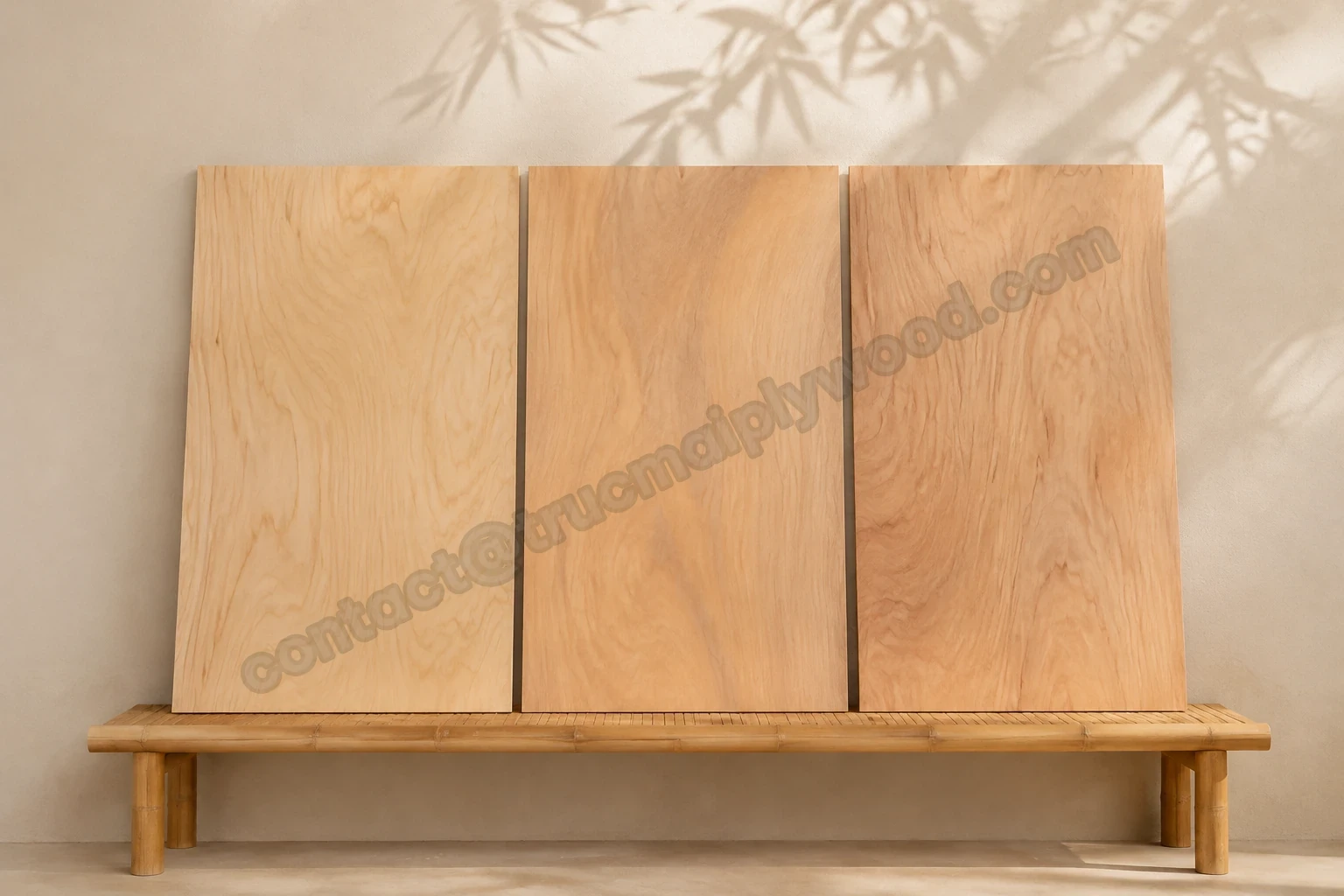
For clear-coated furniture, request a set of finished reference boards under the same lighting used for approval. A single close-up sample hides the variation across a full dining table or cabinet door. Ask the maker to show adjacent boards, end joints and the edge of the finished component. Decide whether sapwood is acceptable, whether boards should be book-matched and whether a mixed-colour look is intentional.
Ordering plywood samples is a practical way to compare the actual surfaces before specifying the production run.
How should drying and moisture be assessed?
Both timbers need controlled drying before precision furniture machining. The USDA Forest Products Laboratory notes that rubberwood can warp severely without closely spaced stickers and weighted stacks, and that freshly cut lumber needs prompt stain and insect control. Its rubberwood technical sheet explains the handling concerns.
FRIM reports that rubberwood can be dried efficiently with suitable procedures, while Acacia mangium requires care to control defects. Buyers should ask how the timber was dried, conditioned and stored before machining. Moisture should be measured in representative pieces, including thick sections and pieces from different positions in the stack.
Which timber machines and glues more predictably?
Both rubberwood and Acacia mangium can be sawn, machined, finger-jointed and laminated. FRIM’s timber technology bulletin describes satisfactory working and jointing characteristics for both, while the USDA sheet notes that rubberwood planes smoothly but may split when nailed.
Ask for a production-representative machined sample with the actual cutter profile. The adhesive system belongs in the component specification, not in the species name. For plywood, the buyer should state the glue type and emission requirement as separate lines. A timber species cannot by itself establish an emission class or a bond test result.
What changes when acacia is used inside plywood?
Acacia can be a plywood core veneer rather than a decorative face. That distinction changes how the buyer evaluates the material: core jointing, gaps, lay-up and thickness control become more important than the natural colour of the solid timber.
Truc Mai Plywood manufactures furniture and commercial panels with Acacia, Eucalyptus, Styrax, Pine or combined-species cores. Rubberwood is not a core option in this range. A buyer can therefore compare an acacia-core panel against a lighter Styrax-core panel without confusing either with a solid rubberwood tabletop.
For a furniture panel, request the face and back grade, core species, core joining method, thickness, sanding and adhesive system on one specification. A decorative face can be engineered veneer, poplar, birch or another approved veneer. The hardwood plywood for importers overview explains how to distinguish a face choice from a construction choice.
How do core weight and shipping volume compare?
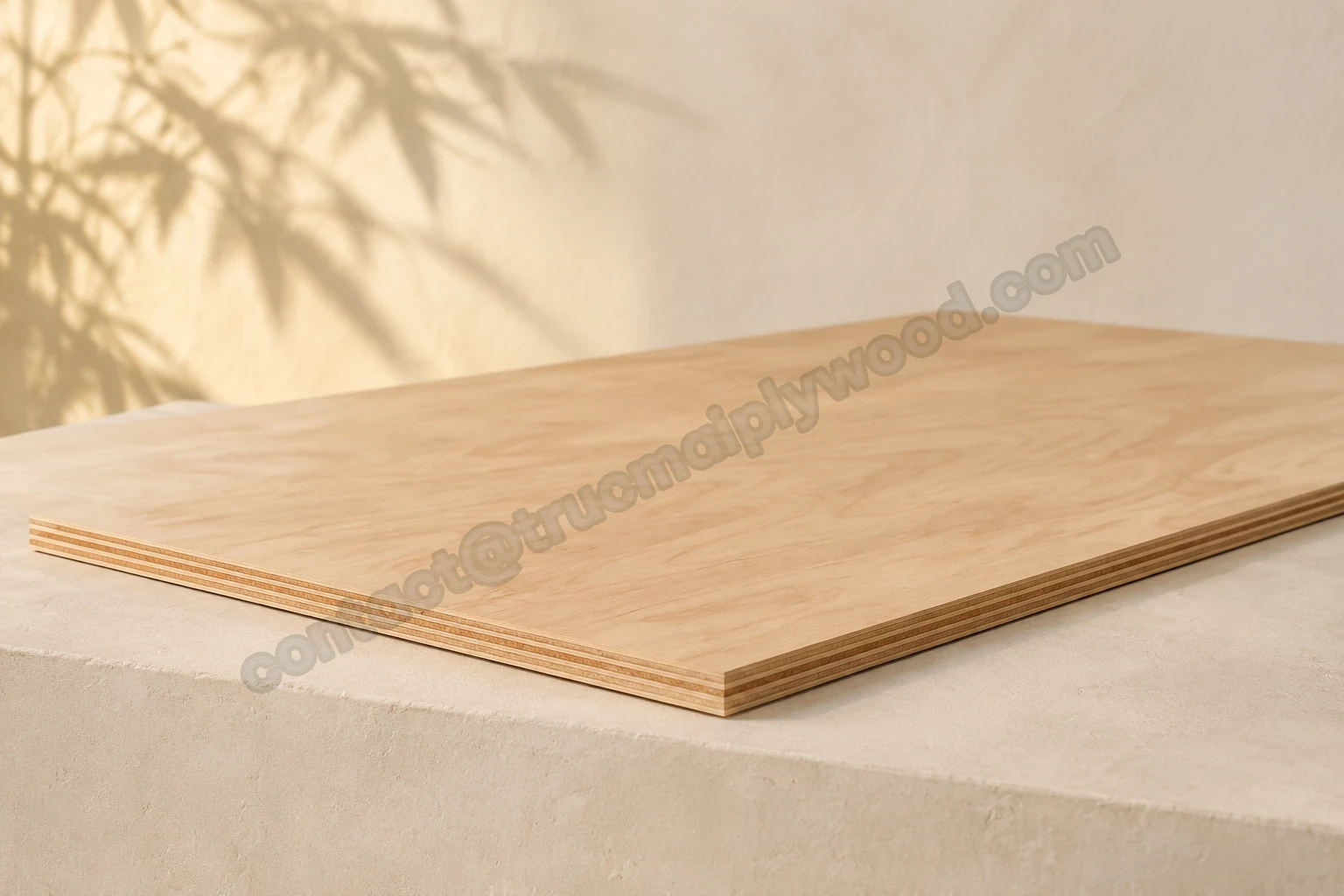
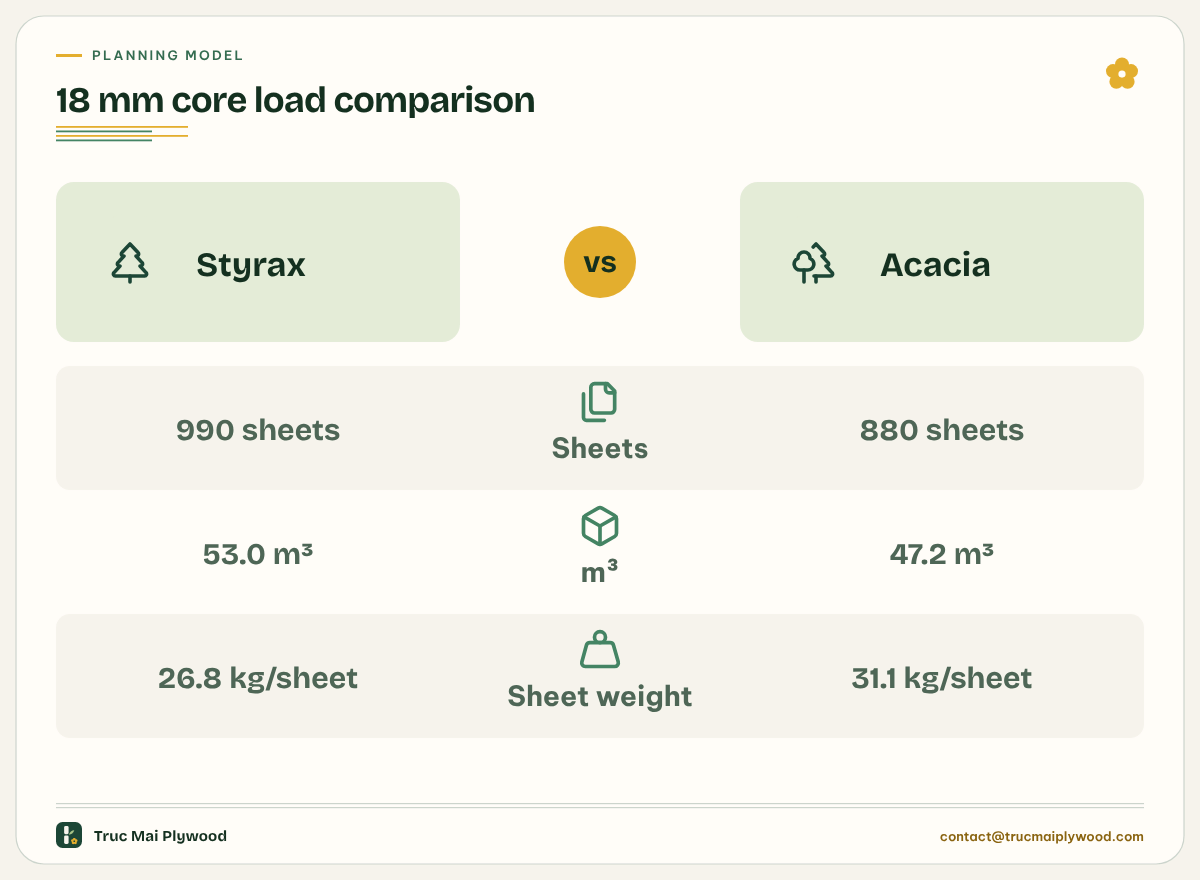
Acacia-core plywood weighs more than Styrax-core plywood in the supplied planning model. The following figures are calculated 40HC planning values, not shipment records. They describe plywood sheets, not solid rubberwood or solid acacia timber.
The model uses 1220 × 2440 mm sheets, a 1,000 mm pack height, core-dependent pack counts and a 28,000 kg planning cargo payload. Reference densities are Styrax 500 kg/m³, Acacia 580 kg/m³ and Eucalyptus 650 kg/m³. Actual loading uses the booking limit and weighed packs, including packaging. The container loading by thickness article covers the loading method.
| Core | Thickness (mm) | Sheet size (mm) | Packs | Sheets/pack | Weight capped | Sheets | m³ | kg/sheet | Total kg |
|---|---|---|---|---|---|---|---|---|---|
| Styrax | 12 | 1220x2440 | 18 | 83 | No | 1494 | 53.4 | 17.9 | 26680 |
| Acacia | 12 | 1220x2440 | 16 | 83 | No | 1328 | 47.4 | 20.7 | 27510 |
| Eucalyptus | 12 | 1220x2440 | 15 | 80 | Yes | 1200 | 42.9 | 23.2 | 27860 |
| Styrax | 15 | 1220x2440 | 18 | 66 | No | 1188 | 53.0 | 22.3 | 26520 |
| Acacia | 15 | 1220x2440 | 16 | 66 | No | 1056 | 47.2 | 25.9 | 27350 |
| Eucalyptus | 15 | 1220x2440 | 15 | 64 | Yes | 960 | 42.9 | 29.0 | 27860 |
| Styrax | 18 | 1220x2440 | 18 | 55 | No | 990 | 53.0 | 26.8 | 26520 |
| Acacia | 18 | 1220x2440 | 16 | 55 | No | 880 | 47.2 | 31.1 | 27350 |
| Eucalyptus | 18 | 1220x2440 | 15 | 53 | Yes | 795 | 42.6 | 34.8 | 27690 |
| Styrax | 21 | 1220x2440 | 18 | 47 | No | 846 | 52.9 | 31.3 | 26440 |
| Acacia | 21 | 1220x2440 | 16 | 47 | No | 752 | 47.0 | 36.3 | 27270 |
| Eucalyptus | 21 | 1220x2440 | 15 | 45 | Yes | 675 | 42.2 | 40.6 | 27430 |
What should an importer specify for plywood faces and cores?
Specify the finished use, face, core, adhesive and dimensional tolerance before requesting a panel quotation. A furniture maker comparing a light decorative face with an acacia core needs a different document from a buyer comparing two solid timber species.
A practical order line includes the intended application, face and back veneer, core species, core joining, nominal thickness, sheet dimensions, sanding, glue type, emission requirement, packing method and quantity. Include the destination port so that the shipment plan matches the order. Use the plywood RFQ checklist to put these fields in a consistent sequence.
For a visible cabinet door, approve both faces and the finished sample. For a concealed carcass, inspect the edge and core continuity. For a laminated panel, inspect the actual overlay bond and edge finish. A vague ‘hardwood plywood’ label leaves these decisions unresolved.
How do face grades differ from core grades?
Face grade describes visible veneer appearance; core grade and joining describe what sits between the faces. An attractive surface does not reveal voids or overlaps within the panel. A buyer therefore needs both an approved face sample and a written core construction.
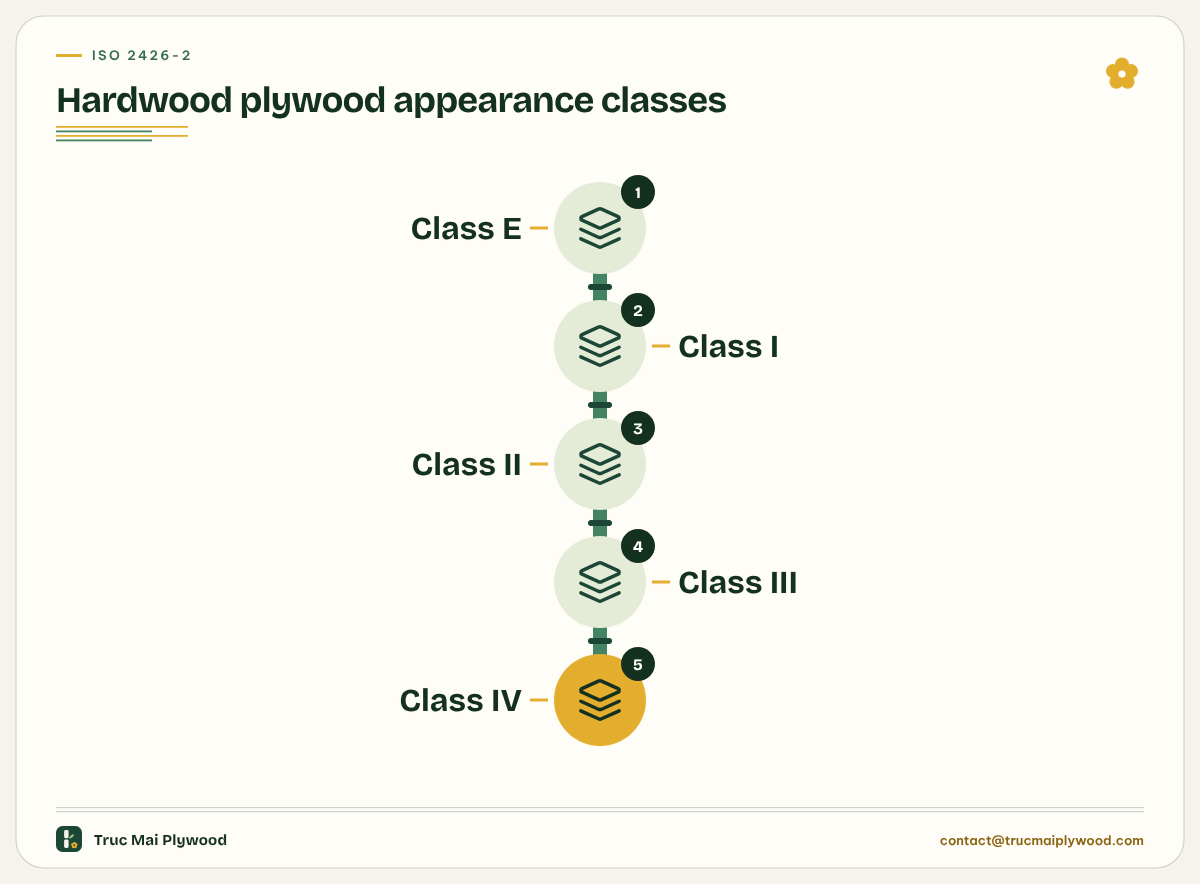
The ISO 2426-2 hardwood plywood preview sets out appearance classes E, I, II, III and IV. Commercial terms such as B/BB or AB should be defined by the seller’s approved sample and specification, rather than treated as automatic equivalents of those classes.
Inspect a complete sheet under even lighting and check the edge at several positions. Record the permitted repairs, patches and colour variation for each face. Separately, describe core veneer joints, gaps and sanding. This prevents an attractive sample face from concealing a different construction in the order.
How do emission rules enter a furniture specification?
For hardwood plywood sold in the United States, TSCA Title VI sets a 0.05 ppm formaldehyde emission limit for hardwood plywood with veneer or composite core. The US EPA regulation, 40 CFR Part 770 identifies the product categories and test framework.
Truc Mai Plywood holds CARB Phase 2 and TSCA Title VI third-party certification for hardwood plywood with veneer core in the 3–25 mm scope. The certificate identifier is CARB/EPA 26053, mill ICTT-26053. Buyers should match the quoted panel configuration to that scope and specify the documents required with the order.
For European furniture, the REACH formaldehyde restriction applies to wood-based articles under the relevant chamber conditions. The European Commission’s formaldehyde restriction notice explains the product restriction. State the test method and result units on the purchase specification rather than converting a US ppm result into a European chamber value.
How can buyers check timber origin documents?
Ask for species identification, production origin and the chain of transaction documents that correspond to the shipment. For a plywood panel, the decorative face and the core can have different origins, so one origin statement for the whole sheet may omit relevant information.
For EU-bound plywood, the due-diligence file can include plot geolocation and origin records for both components. The European Commission’s due-diligence guidance explains the operator’s collection of origin and plot information and the steps for assessing risk. The document pack should let the buyer connect the supplied species and quantities to the actual goods.
Where an FSC 100% product is ordered, check the certificate code and the FSC claim on the relevant sales documents. The FSC licence verification guide explains the document check. Traceability is a documentation question, separate from whether the finished surface is pale or dark.
What should a factory sample inspection cover?
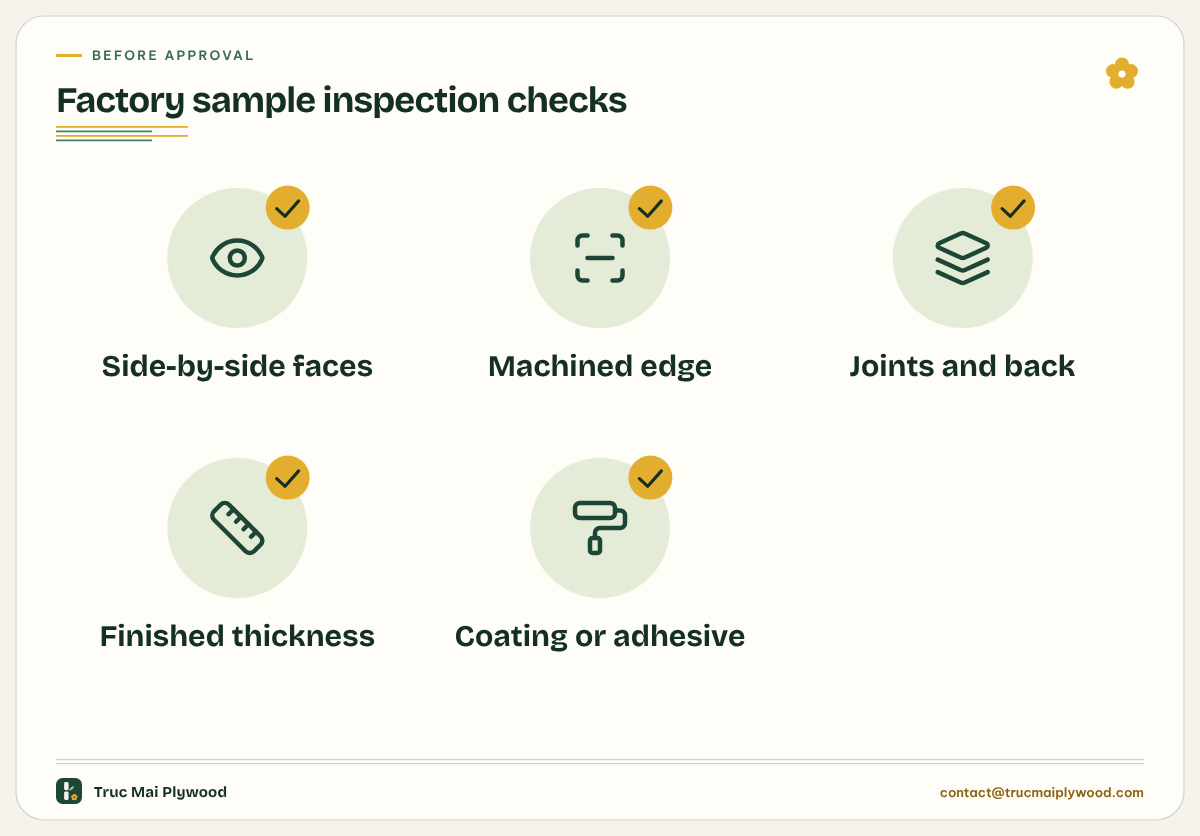
Inspect one representative finished component and one exposed edge or end-grain sample before signing off the specification. These two views reveal different defects: the finished surface shows colour and coating, while the exposed material shows joining and construction.
- Compare several boards or sheets side by side under the approved lighting.
- Check the actual machined edge for tear-out, splits and surface defects.
- Inspect glued joints and the back face, not only the photographed front.
- Measure finished thickness and record the accepted tolerance.
- Test the intended coating or adhesive on the actual material.
- Keep the approved sample and written inspection criteria with the purchase order.
For panel suppliers, the mill verification checklist adds a useful document and production-capability check. A sample inspection should match the intended order, rather than a showroom display selected for appearance alone.
Which cut sizes suit furniture production?
Cut-to-size plywood reduces repeated cutting at the furniture workshop. Standard 1220 × 2440 mm sheets can be split lengthwise into 610 × 2440 mm halves or cross-cut into 1220 × 610 mm quarters. Other layouts can be agreed from the source sheet and the buyer’s cut list.
Truc Mai offers labelled cut panels from standard sheets. The buyer supplies the finished part dimensions, the orientation of the face grain, the cut pattern and the labelling convention. For a mixed cabinet programme, grouping similar components by sheet and finish helps reduce sorting on arrival.
A cut list should distinguish finished size from the nominal sheet size and should account for saw kerf. A dimension written without orientation may put the grain across the wrong axis on a visible door. The cut-to-size plywood panel page provides the product context for this service.
How should a buyer compare two supplier quotations?
Compare two quotations against the same written specification and the same approved sample. Otherwise the offers may differ in core construction, face grade, glue, finishing or packing even when both say ‘hardwood plywood’.
For solid timber, request botanical name, moisture condition, dimensions, grade rules, jointing, finish and packaging. For plywood, add the face/back grade pair, core veneer specification, ply construction, bond and emission requirements, and cut sizes. Keep the shipping terms separate from material quality.
The next step is to send the application, face and core choice, thickness, sheet or part sizes, quantity and destination port through the plywood quotation checklist.
Send your specification to contact@trucmaiplywood.com or through the quotation form.
Questions buyers ask
Can rubberwood be stained dark?
Yes. Rubberwood accepts stain, but test the intended stain and clear coat on the actual production stock to check colour consistency.
Does acacia always have dark heartwood?
No. Acacia mangium commonly shows pale sapwood beside brown heartwood, and the visible mix changes with cutting and sorting.
Is rubberwood suitable for painted cabinets?
Yes. Its relatively even pale appearance suits painted interior components after appropriate preparation and sealing.
Can acacia be used for veneered plywood?
Yes. Acacia veneer can form part of a plywood core; the face veneer and core specification are separate decisions.
Does rubberwood come from a rubber tree?
Yes. Rubberwood is the timber of Hevea brasiliensis, a tree cultivated for natural latex.
Can an acacia core have a birch face?
Yes. Birch-faced plywood describes the visible birch veneer, while the inner veneers can be acacia or another specified core species.
What should a timber sample show?
Ask for the actual face colour, edge or end grain, machining quality and a finished sample under the intended lighting.
Should I specify a botanical name for acacia?
Yes. Acacia is a broad trade description, so the botanical name helps match the quoted material to the tested species.
Is an FSC label enough to identify a timber species?
No. FSC documentation addresses certified material claims; botanical identity should also appear in the material specification.
Can a plywood buyer order cut panels?
Yes. Provide the source sheet, finished piece dimensions, cut pattern, edge requirements and labels with the order.