
Red oak plywood combines the recognisable open grain of red oak veneer with a cross-laminated panel core. Buyers should specify veneer cut, face grade, actual thickness and core before comparing offers. For repeat furniture production, okoume and engineered veneer provide alternative face appearances with a defined sample and finish. Record the approved reference for each production order.
What is red oak plywood?
Red oak plywood is a decorative wood panel with a red oak veneer face bonded to a multi-ply core. The oak determines the visible grain; the inner veneers determine much of the panel weight, screw behaviour and dimensional response. A listing that says only “oak plywood” omits the construction information a cabinet factory needs.
Red oak belongs to a group of oak species, rather than a single guaranteed botanical identity. The US Forest Products Laboratory describes the red oak group and its open earlywood pores in its oak identification note. The name on a commercial invoice should therefore be supported by the veneer supplier’s species identification where that distinction matters.
A visible face can be attractive while the back is utility grade. Agree both sides, not merely the photograph of the front.
How does red oak grain differ from white oak?
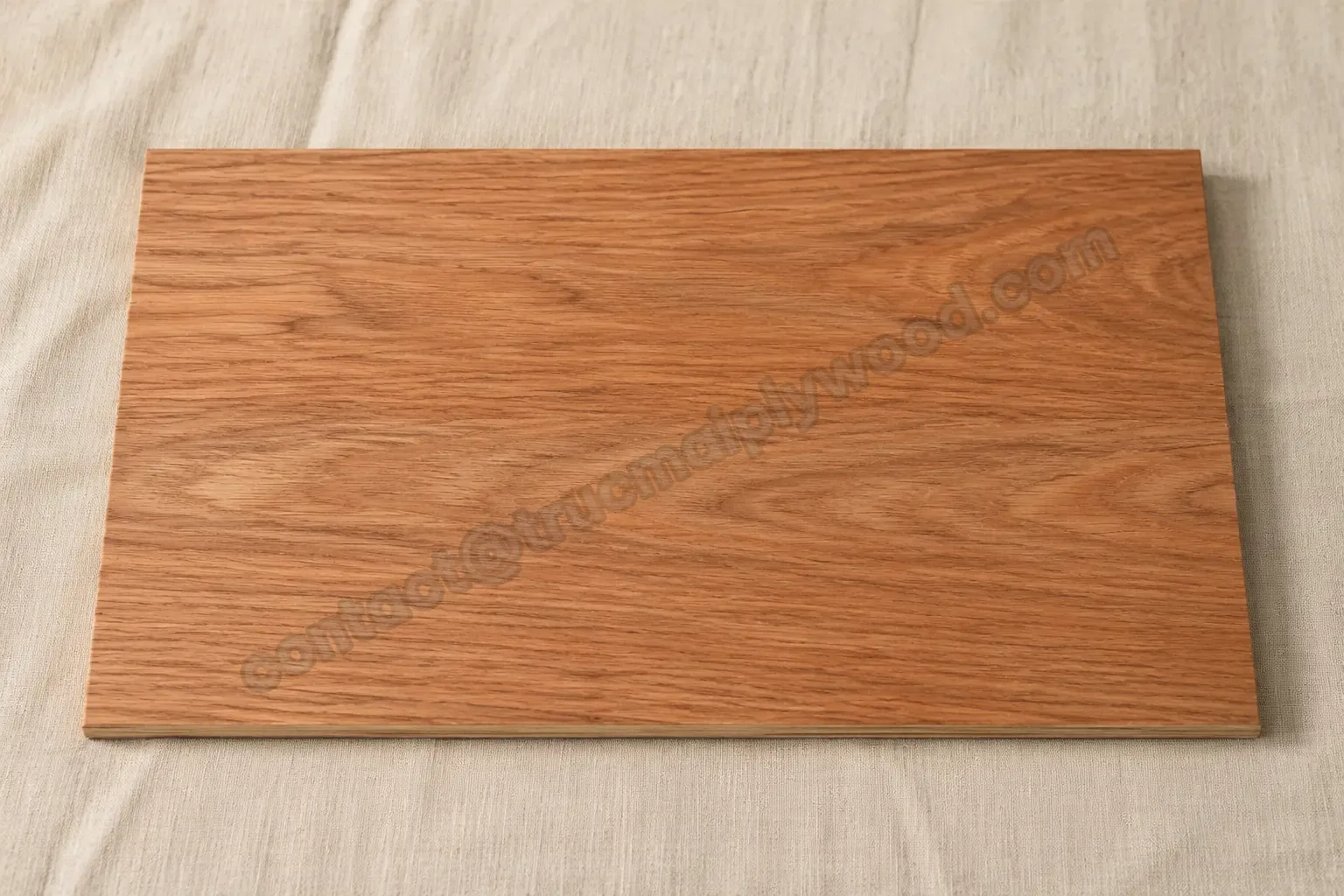
Red oak commonly has a warm pink or reddish cast and pronounced open pores. White oak often looks more neutral, but colour alone is an unreliable way to identify the group. The Forest Products Laboratory explains the diagnostic pore differences in the official technical note.
For furniture production, the practical decision is whether the finished doors must match a reference sample. Two boards sold under the same species group can look different after staining. Approve a finished sample under the lighting used in the room, with the direction of grain marked.
The USDA Wood Handbook explains why oak’s large vessels create a coarse texture and why surface fillers change the finished appearance. A colour photograph alone cannot communicate this texture.
Which veneer cut gives the required figure?
Plain-sliced red oak typically shows broad cathedral-like grain; quarter-sawn material gives straighter lines and may reveal rays. Rotary-cut veneer can show a broader, less uniform pattern across a sheet. The cut is a face specification, not a statement about the core.
The USDA description of plainsawn and quartersawn wood distinguishes growth-ring orientation and the resulting figure. For a cabinet door run, agree the face cut, the sequence of matching leaves and whether adjacent doors need a continuous visual flow.
Ask the supplier to photograph several consecutive faces rather than selecting a single exceptional panel. Mark the approved direction on the cutting schedule, particularly when tall doors and horizontal drawer fronts share one kitchen.
What do 1/4 and 3/4 red oak plywood mean?
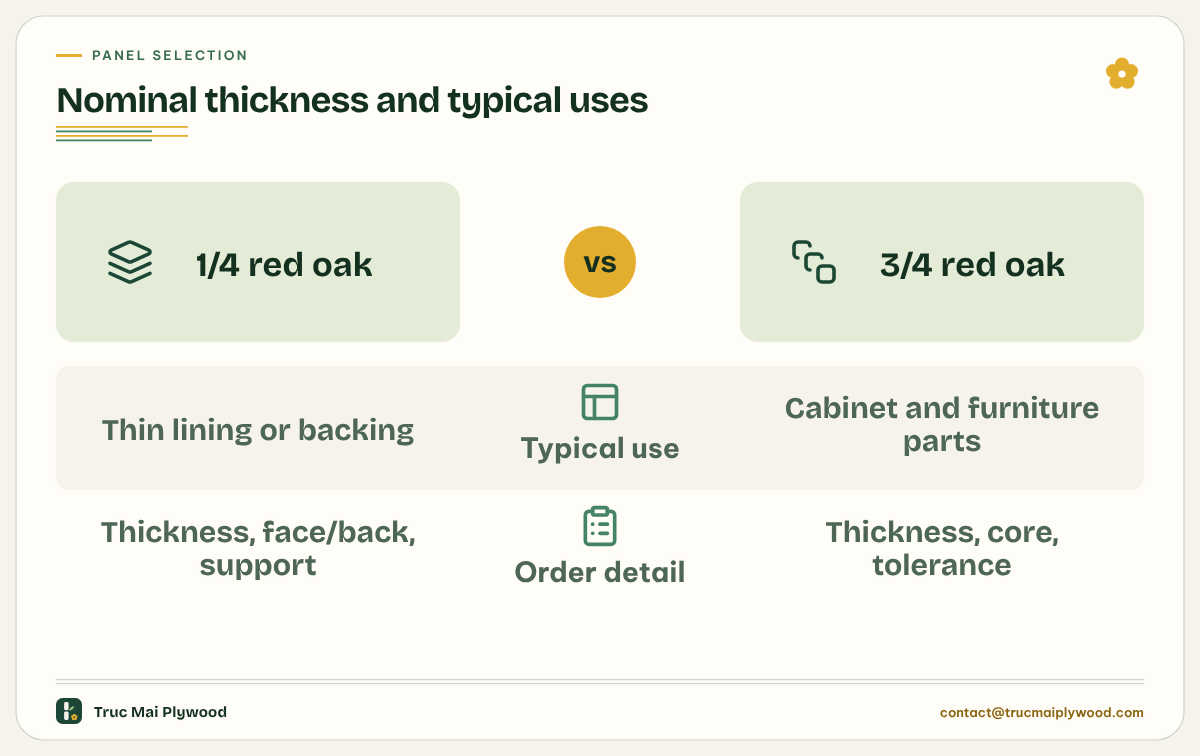
The expressions 1/4 red oak plywood and 3/4 red oak plywood are nominal inch-size buying terms. A 1/4-inch panel is commonly considered for backs, liners and light infill; a 3/4-inch panel is commonly considered for cabinet boxes, shelves and furniture components. Neither nominal label establishes the measured thickness.
In a metric export specification, write the intended millimetre thickness and tolerance explicitly. A cabinet shop cutting grooves or machining concealed hinges needs a real thickness measurement, not a retail shelf label.
| Buyer term | Typical discussion | What to put on the order |
|---|---|---|
| 1/4 red oak plywood | Thin lining or backing | Measured thickness, face/back and support |
| 3/4 red oak plywood | Cabinet and furniture parts | Measured thickness, core and tolerance |
| Red oak plywood 4x8 | Full-sheet procurement | 1220 × 2440 mm, trim and grain direction |
| Quarter sawn red oak plywood | Straight-grain decorative face | Veneer cut, matching sequence and sample |
For cabinet production, see the cabinet-grade plywood selection criteria before deciding whether the back needs the same face as the front.
What does a 4x8 red oak plywood specification include?
A 4 × 8 ft red oak plywood enquiry should name the sheet size, veneer cut, face/back pair, core, measured thickness, adhesive specification and intended finish. The usual metric full sheet is 1220 × 2440 mm. A separate 1250 × 2500 mm format serves many European cutting plans.
A usable purchasing line might read: “Decorative red oak veneer face, approved straight-grain sample, balanced back, agreed veneer core, measured thickness per drawing, full sheet, grain along the long edge, labelled packs.” This separates the appearance requirements from the machining requirements.
For visible shelving, also specify which edges receive lipping or banding. For concealed cabinet backs, a utility back may be acceptable, while a double-sided partition requires two display faces. Put these choices into the drawing rather than relying on the grade name.
How are red oak face grades compared?
Red oak veneer face grades must be compared against an agreed visual standard and sample, including knots, mineral marks, repairs, colour range and allowable joint lines. Trade labels such as A/B or B/BB are not a universal appearance scale.
The buyer should inspect a full-face photograph alongside a cut sample. A small swatch cannot show how a prominent cathedral grain repeats over a wide door. State whether colour sorting is required across an entire furniture set or only within each pack.
For a two-sided item, approve a face/back pair and photograph the reverse. The front might need continuous figure while the back needs a sound, clean surface only. Write the acceptance rules once on the purchase specification so that the sampling team and production team use the same reference. Use the cabinet-grade plywood criteria when assessing the face/back pair.
How do cores affect cabinet performance?
Core choice affects panel weight, edge machining and the way a screw engages the layers. A red oak face does not mean the core is red oak. Veneer-core construction can use different wood species and different lay-up methods.
Truc Mai Plywood manufactures furniture and commercial plywood in Ha Hoa, Phu Tho, with Styrax, Eucalyptus, Acacia and Pine cores or specified combinations. Its red oak natural face is an on-request veneer option rather than a fixed stock promise. The mill’s regular face options include poplar, engineered veneer and okoume.
Buyers should request a photographed cut edge, then test their actual hinge and edge-banding operations on the sample. For high-visibility cabinetry, consistent core lay-up and face preparation are more useful than an unqualified “hardwood core” description. The hardwood face options comparison helps separate species appearance from construction.
Which kitchen components suit red oak veneer panels?
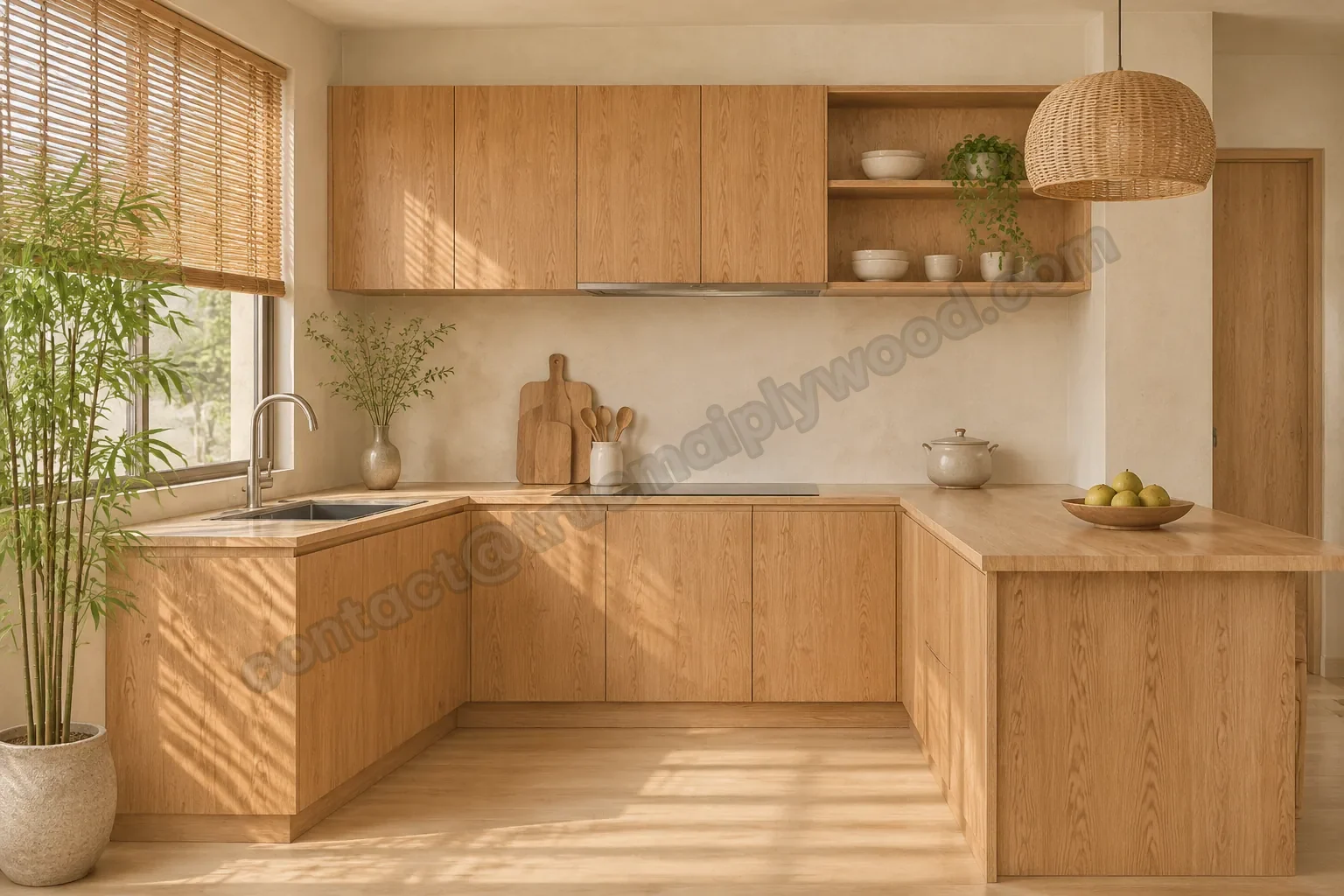
Yes, red oak veneer plywood suits dry interior kitchen cabinetry when the panel construction and finish are selected for the intended location. Doors, decorative ends, shelves and carcass parts place different demands on the face and edges.
For a natural finish, sample the pore filler and topcoat together. For painted doors, a smoother face may reduce visible grain texture. Where splashes or repeated cleaning occur, protect exposed edges and machine openings with the specified finish system.
Plan visible grain continuity before nesting. A door and its adjacent drawer fronts can be cut from one sheet, but rotating parts for maximum yield may change the figure direction. Agree whether visual matching or material yield takes priority. The plywood for kitchen cabinets guide covers the broader panel selection.
How do red oak, okoume and engineered veneer compare?
Red oak offers a distinct open-grain oak appearance; okoume usually gives a more subdued decorative face; engineered veneer provides a controlled repeated pattern. The choice is primarily a design and finishing decision, followed by core and supply planning.
| Face | Visual character | Useful purchasing question |
|---|---|---|
| Natural red oak | Pronounced open grain, variable figure | Which cut and colour range are approved? |
| Okoume | More even, generally softer-looking figure | Which face grade and finish sample apply? |
| Engineered veneer | Repeated designed figure | Which pattern reference and face orientation apply? |
For repeat cabinet programmes, compare an actual stained or coated sample, not raw veneer photographs. An engineered pattern can reduce the sorting burden when many identical doors must look alike. A natural face can be preferred when the variation itself is part of the design. Explore okoume-faced plywood and engineered veneer panels as distinct options, not substitutes with identical appearance.
What finishing tests should a buyer request?
A finishing trial should use the proposed veneer, sanding preparation and production coating. Check stain absorption, pore filling, sheen, adhesion and the visibility of repaired areas. Record the recipe alongside the approved sample so a later order can be judged against the same appearance.
The USDA Wood Handbook notes that open-grained woods can need fillers. That matters especially for a smooth contemporary door: an unfilled oak surface can show pronounced texture even beneath a clear coating.
Ask for a face sample large enough to show at least one representative grain transition. Photograph it before and after finishing, with a consistent light source. Also coat a cut edge where edge sealing is part of the finished article.
Which emission and certification documents matter?
For US-bound hardwood plywood with veneer core, the applicable TSCA Title VI formaldehyde limit is 0.05 ppm under 40 CFR 770.10. A buyer should match the certification scope to the panel type and thickness on the purchase order.
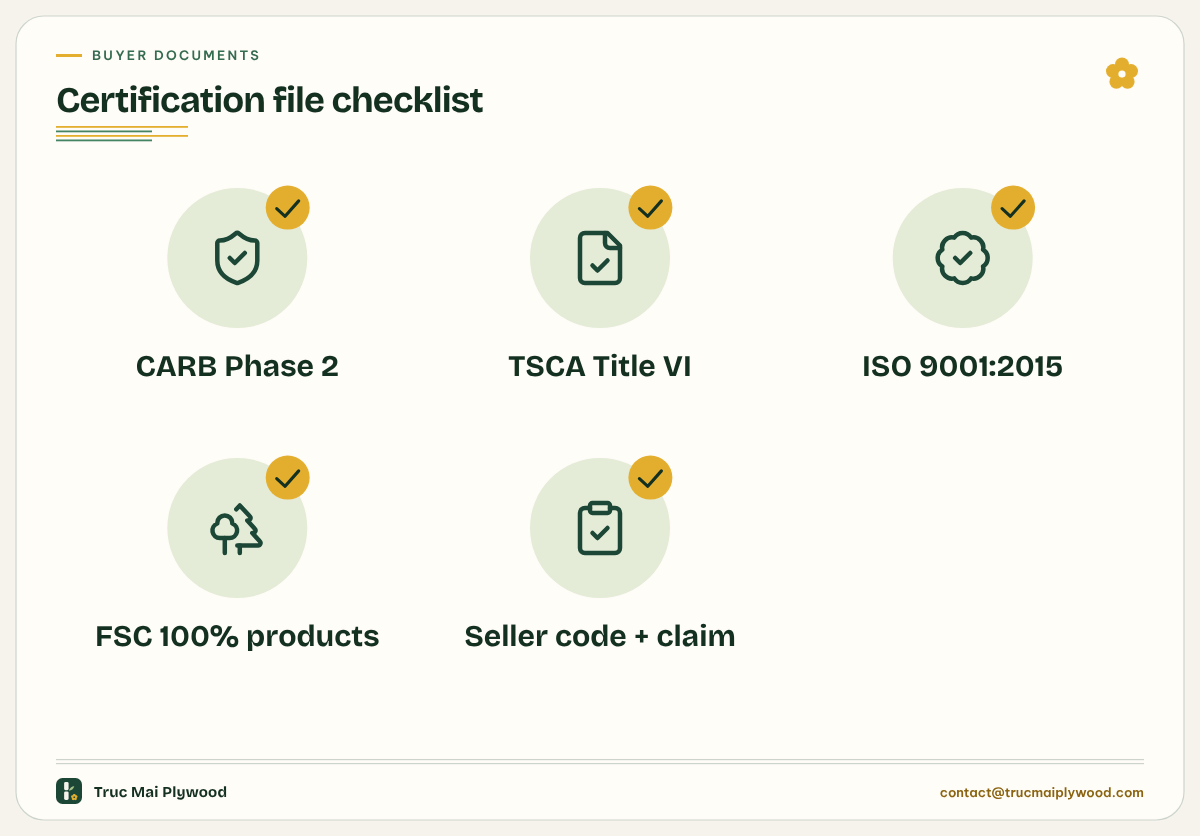
The Truc Mai certificate covers CARB Phase 2 and TSCA Title VI hardwood plywood with veneer core at 3–25 mm, with certificate CARB/EPA 26053, mill ICTT-26053 and certifier TPC-43. The company also holds ISO 9001:2015 certification for plywood manufacturing quality management.
FSC chain of custody is a separate question. Eligible FSC 100% products are documented under certificate SA-COC-014545 and licence FSC-C196493. The FSC chain-of-custody standard, section 5.1 requires the seller’s certificate code and the product claim on sales documents. Buyers can use the FSC licence verification instructions when assembling a supplier file.
Where can buyers find red oak plywood suppliers canada?
Yes. Canadian buyers can source red oak plywood through domestic panel distributors and through overseas manufacturers offering an agreed natural oak face. For small mixed orders, local distribution simplifies sheet-by-sheet purchasing. For repeat full-container programmes, compare factory proposals against one identical construction schedule.
Request the same information from each candidate: actual face species, veneer cut, front/back grade, core species, measured thickness, sheet dimensions, finish sample, packing and shipment paperwork. Ask whether the supplier stocks red oak faces or purchases them against a confirmed order. These two supply models have different implications for colour continuity on subsequent batches.
For imports into Canada, clarify the consignee, port and required origin documents with the customs broker before ordering. A Canadian distributor’s stock panel and a mill-made panel may share a retail product name while differing in core lay-up and appearance rules. Compare sample against sample rather than catalogue photograph against catalogue photograph. Use the supplier shortlist checklist to compare the documentation.
How should a buyer compare sample offers?
Compare two offers only after their construction and acceptance criteria have been normalised. A useful sample set includes a full-face view, edge cross-section, measured thickness, finished colour panel and packing label. Each should carry the same reference code as the quotation.
Ask the factory to show both the best-looking face and an ordinary production face. The latter is more informative for a repeated furniture programme. Examine how the back is prepared, whether the edge shows gaps and whether the intended machining exposes repairs.
A structured plywood RFQ checklist helps avoid comparing unlike products. The ordering samples page explains how to request physical pieces for finishing and machining trials. Preserve one approved sample at the buyer’s workshop and one at the mill.
How are cut-to-size pieces planned?
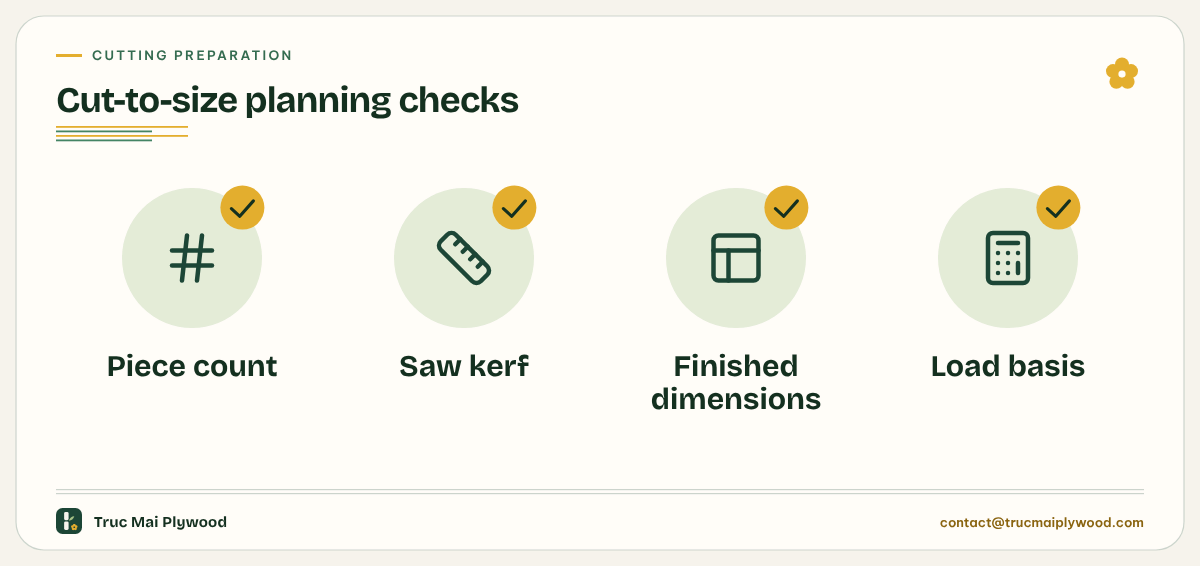
Cut-to-size orders begin with a parent sheet and an approved cutting diagram. A standard sheet can be divided into 2, 3, 4 or 6 labelled pieces. The following calculated examples use a 4 mm saw kerf for each cut, so the finished dimension is smaller than a simple nominal division.
The calculations below are from the supplied cut and packing model. The 40HC rows are planning figures based on the model’s parent-sheet counts; they are not shipment records. For other cut patterns, agree the actual finished size and grain orientation before production.
| Model row | Parent / core | Cuts / kerf | Result |
|---|---|---|---|
| cut2-1220x2440 | 1220x2440 | 2 / 4 mm | pieces: 2, piece_w_mm: 608.0, piece_l_mm: 2440.0, nominal_w_mm: 610.0, nominal_l_mm: 2440.0 |
| cut3-1220x2440 | 1220x2440 | 3 / 4 mm | pieces: 3, piece_w_mm: 1220.0, piece_l_mm: 810.7, nominal_w_mm: 1220.0, nominal_l_mm: 813.3 |
| cut4-1220x2440 | 1220x2440 | 4 / 4 mm | pieces: 4, piece_w_mm: 1220.0, piece_l_mm: 607.0, nominal_w_mm: 1220.0, nominal_l_mm: 610.0 |
| cut6-1220x2440 | 1220x2440 | 6 / 4 mm | pieces: 6, piece_w_mm: 608.0, piece_l_mm: 810.7, nominal_w_mm: 610.0, nominal_l_mm: 813.3 |
| cut2-40hc-styrax-12 | 1220x2440 | 2 / model mm | 2988 cut pieces from 1494 parent panels |
| cut3-40hc-styrax-12 | 1220x2440 | 3 / model mm | 4482 cut pieces from 1494 parent panels |
| cut4-40hc-styrax-12 | 1220x2440 | 4 / model mm | 5976 cut pieces from 1494 parent panels |
| cut6-40hc-styrax-12 | 1220x2440 | 6 / model mm | 8964 cut pieces from 1494 parent panels |
| cut2-40hc-acacia-12 | 1220x2440 | 2 / model mm | 2656 cut pieces from 1328 parent panels |
| cut3-40hc-acacia-12 | 1220x2440 | 3 / model mm | 3984 cut pieces from 1328 parent panels |
| cut4-40hc-acacia-12 | 1220x2440 | 4 / model mm | 5312 cut pieces from 1328 parent panels |
| cut6-40hc-acacia-12 | 1220x2440 | 6 / model mm | 7968 cut pieces from 1328 parent panels |
| cut2-40hc-eucalyptus-12 | 1220x2440 | 2 / model mm | 2400 cut pieces from 1200 parent panels |
| cut3-40hc-eucalyptus-12 | 1220x2440 | 3 / model mm | 3600 cut pieces from 1200 parent panels |
| cut4-40hc-eucalyptus-12 | 1220x2440 | 4 / model mm | 4800 cut pieces from 1200 parent panels |
| cut6-40hc-eucalyptus-12 | 1220x2440 | 6 / model mm | 7200 cut pieces from 1200 parent panels |
For furniture parts, the label should carry the panel reference, part count, grain direction and destination cutting group. See mill cut-to-size panels for the ordering format.
What should appear on the final purchase order?
A complete red oak veneer plywood order gives the application first, then the approved face, core, glue and emission requirement, thickness, sheet or cut size, packing and quantity. Include a sample reference and the intended destination port.
The mill can prepare a drawing-based quotation for repeated cabinet parts, including panel labels and agreed face orientation. For a natural oak request, attach the colour and cut sample so the quotation is tied to an actual appearance standard.
Use the quotation contact page with the cut list and destination details. The useful next step is a production sample that can be machined and finished by the buyer, rather than another generic species description.
Questions buyers ask
Does red oak veneer have open pores?
Yes. Red oak has conspicuous pores; a filled-pore finish looks smoother than an unfilled finish.
Can I order a matching back veneer?
Specify whether the back must match the visible face or can use a utility grade; the two arrangements serve different applications.
Are 1/4 and 3/4 inch red oak sheets interchangeable?
No. The nominal thicknesses suit different joinery details and require separate support and fastening decisions.
Is red oak plywood suitable for painted cabinets?
It can be painted, but its pronounced grain may show through; a smoother face is often preferable for a flat painted finish.
What should a red oak veneer sample show?
Ask for the intended cut, face grade, stain or finish and a visible edge showing the proposed core.
Can an FSC certificate cover every order automatically?
No. The eligible product and its FSC claim must be identified on the sales documentation.
What is the difference between rotary and sliced oak veneer?
Rotary peeling and slicing expose different grain figures; ask for photographs and a physical approved sample of the exact cut.
Should I specify grain direction on cabinet doors?
Yes. State whether the grain runs vertically or horizontally and how adjacent doors should be matched.