
Poplar wood is a light-coloured hardwood used in furniture, interior joinery and plywood veneer. Its relatively low density, fine texture and workable grain make it attractive for painted panels and pale faces. Buyers should distinguish true Populus species from yellow-poplar, then specify the veneer grade, core, adhesive and finish separately.
Which tree species are traded as poplar?
Poplar wood is timber from trees in the genus Populus, including several aspens, cottonwoods and true poplars. In timber trading, the name also appears beside unrelated yellow-poplar, Liriodendron tulipifera. The distinction matters because a botanical name is more precise than a colour description or the word “poplar” on a quotation.
A buyer ordering pale face veneer should request the common and scientific species names, face origin and an approved appearance sample. “Poplar” alone does not identify a particular log source, colour range or panel construction. A natural veneer face and an engineered veneer face can both look pale while having very different patterns and production routes.
The US Forest Service species account identifies yellow-poplar as Liriodendron tulipifera, a member of the magnolia family. That is a useful warning against treating all timber sold as poplar as one interchangeable species.
What colour is poplar wood?
Poplar wood is generally pale cream to light yellow or greyish white, sometimes with greenish or darker streaks depending on species and the part of the log. Sapwood and heartwood can differ noticeably. A pale sample is therefore a better colour reference than a generic species name.
For furniture panels, buyers usually judge a face at full sheet scale. A small swatch can hide a colour transition that becomes obvious across a cabinet door. Natural colour bands may be attractive for a clear finish but less desirable beneath a very light translucent coating.
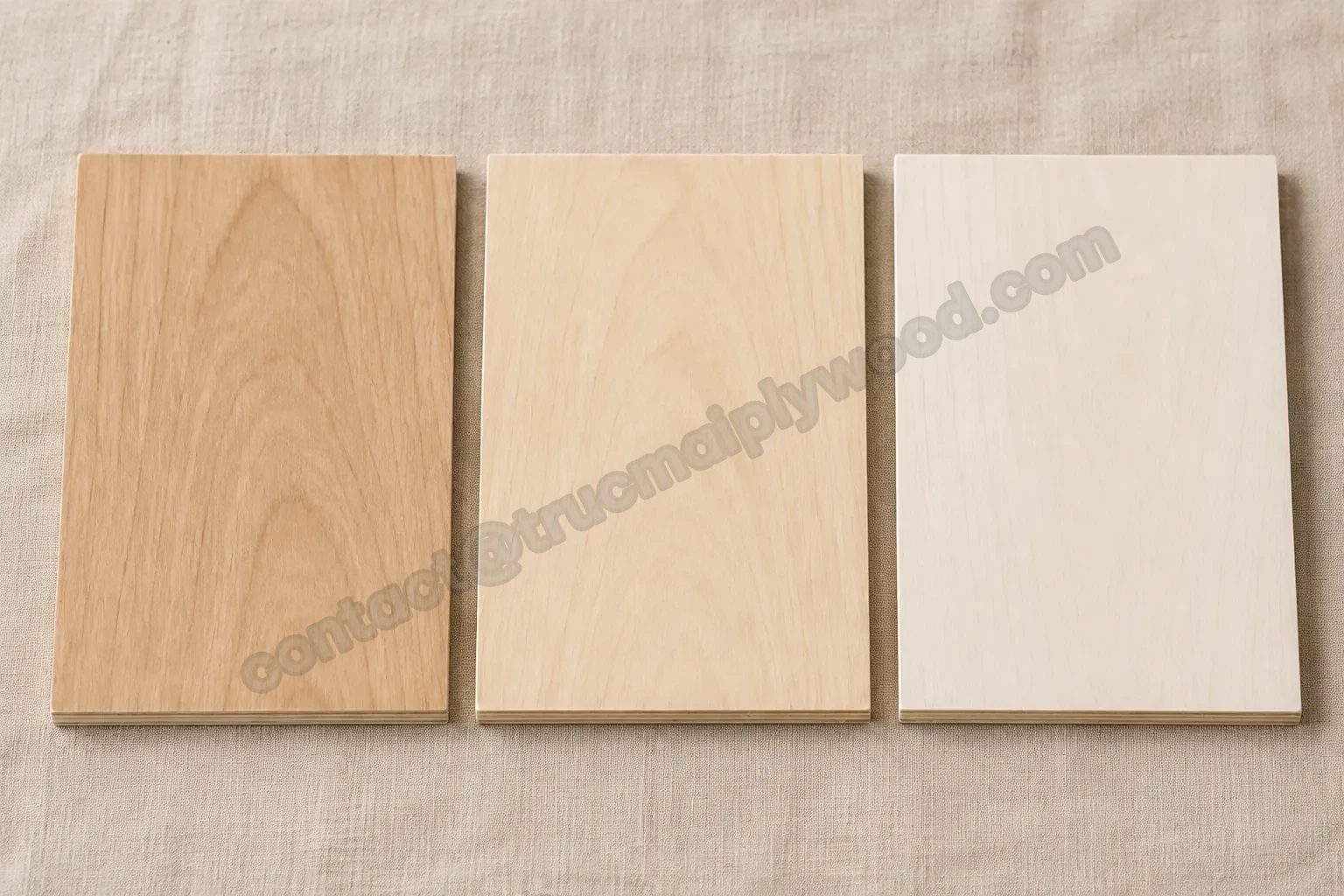
Specify whether the face is intended for paint, clear lacquer, stain or an overlay. For a clean white appearance, bleached poplar plywood and bleached white faces are separate conversations from natural veneer grading. A bleached face is an appearance treatment, not a promise that every board has the same grain.
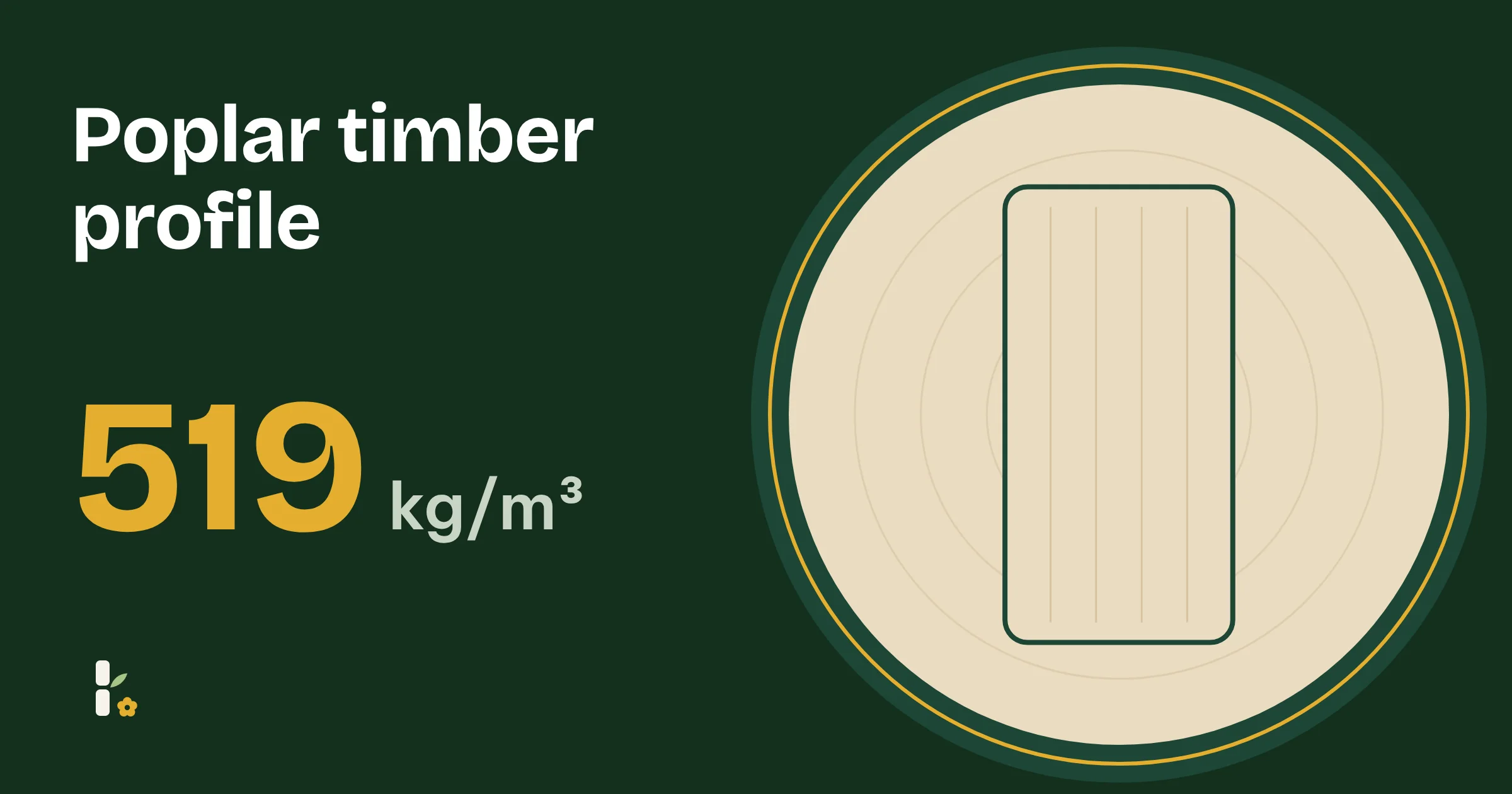
How heavy is poplar timber?
Poplar is relatively light for a hardwood, but a species name alone does not give a shipping weight. Density changes with species and moisture content, and a plywood sheet’s weight also reflects its core, glue and thickness.
For perspective, a 2024 Forest Products Journal study hosted by the US Forest Service found that yellow poplar showed the lowest mean density of all the hardwood lumber samples it tested. Those measurements describe Liriodendron, not every Populus species and not a Truc Mai plywood panel.
For actual panel freight, use the declared core and measured sheet weight. The following planning model concerns Styrax, Acacia and Eucalyptus cores rather than poplar cores. It illustrates why a pale poplar face does not determine the weight of the complete sheet.
| Core | Thickness (mm) | Sheet size (mm) | Packs | Sheets per pack | Sheets per 40HC | Volume (m³) | kg/sheet | Total kg | Weight-capped |
|---|---|---|---|---|---|---|---|---|---|
| Styrax | 12 | 1220 × 2440 | 18 | 83 | 1494 | 53.4 | 17.9 | 26680 | No |
| Acacia | 12 | 1220 × 2440 | 16 | 83 | 1328 | 47.4 | 20.7 | 27510 | No |
| Eucalyptus | 12 | 1220 × 2440 | 15 | 80 | 1200 | 42.9 | 23.2 | 27860 | Yes |
| Styrax | 15 | 1220 × 2440 | 18 | 66 | 1188 | 53.0 | 22.3 | 26520 | No |
| Acacia | 15 | 1220 × 2440 | 16 | 66 | 1056 | 47.2 | 25.9 | 27350 | No |
| Eucalyptus | 15 | 1220 × 2440 | 15 | 64 | 960 | 42.9 | 29.0 | 27860 | Yes |
| Styrax | 18 | 1220 × 2440 | 18 | 55 | 990 | 53.0 | 26.8 | 26520 | No |
| Acacia | 18 | 1220 × 2440 | 16 | 55 | 880 | 47.2 | 31.1 | 27350 | No |
| Eucalyptus | 18 | 1220 × 2440 | 15 | 53 | 795 | 42.6 | 34.8 | 27690 | Yes |
| Styrax | 21 | 1220 × 2440 | 18 | 47 | 846 | 52.9 | 31.3 | 26440 | No |
| Acacia | 21 | 1220 × 2440 | 16 | 47 | 752 | 47.0 | 36.3 | 27270 | No |
| Eucalyptus | 21 | 1220 × 2440 | 15 | 45 | 675 | 42.2 | 40.6 | 27430 | Yes |
Table basis: 40HC planning model, panels only. Styrax, Acacia and Eucalyptus use respectively 18, 16 and 15 packs; packs are planned at 1,000 mm high, with sheets per pack rounded down and capped by a 28,000 kg cargo planning payload. Reference core densities are respectively 500, 580 and 650 kg/m³. The model is a planning figure, not a loading record; carrier and route set the actual payload. All rows reproduce the supplied calculation without adjustment.
What are the disadvantages of poplar wood?
Yes, poplar wood dents more readily than many dense hardwoods, and its pale colour can show staining differences or mineral streaks. For exposed furniture edges, high-wear worktops and parts needing strong screw retention, construction and surface protection deserve particular attention.
The disadvantages are application-specific. A painted cabinet back does not face the same wear as a desk edge. The light, workable nature that makes poplar useful for concealed parts also makes it less attractive when the buyer wants the visual figure of oak or walnut. Natural face veneer may need careful selection to keep adjoining doors visually consistent.
In plywood, the face is only one component. Thin face veneer can be damaged by aggressive sanding, while an uneven substrate may show through a smooth finish. Ask for a face sample, edge cross-section and surface preparation description. A decorative face should not be mistaken for a statement about the strength or moisture resistance of the core. See cabinet grade plywood for a panel-level comparison.
Is poplar a cheap wood?
Yes, poplar is commonly positioned as an economical furniture timber compared with many decorative hardwoods, particularly for painted or concealed parts. That is a market-position description, not a fixed price: species, grade, supply region, processing and appearance selection all affect an offer.
For a plywood buyer, “economical” should be evaluated at the finished-component level. A face that accepts the intended paint cleanly may reduce rework; a poorly matched face may require more filling, sanding or rejected parts. A lower-cost raw face is not useful if the cabinet maker needs a premium clear finish.
Compare quotes against the same face grade, veneer thickness, core construction and surface preparation. The plywood RFQ guide shows how to specify these fields without allowing different constructions to be compared as though they were identical.
Is poplar plywood real wood?
Yes, poplar plywood contains real wood veneer, and a poplar-faced plywood panel has a genuine wood face. The core may be made from another wood species; “poplar-faced” does not mean that every ply is poplar.
Plywood consists of bonded veneer layers, commonly with alternating grain directions. This cross-lamination moderates movement compared with a similarly oriented solid-wood assembly. The USDA Wood Adhesives chapter explains the contribution of bonded crossing layers to dimensional behaviour.
Truc Mai Plywood offers poplar-faced plywood over Vietnamese Styrax, Eucalyptus, Acacia or Pine cores, including combined-species constructions. A product description should name the face and core separately, with the face/back grades written as a pair. That is more informative than “real wood” alone.
Why is poplar used for plywood faces?
Yes, poplar is used for plywood faces because its light colour, relatively fine texture and workable veneer make it suitable for paint-grade and pale interior surfaces. A uniform-looking face helps the buyer create doors, drawer fronts and cabinet components with a consistent finishing system.
A face veneer is cut thinly from wood and bonded over a thicker panel structure. It gives the visible surface its colour and grain without requiring the entire panel to use the same species. The best veneer choice therefore starts with the desired finish, not with a claim that one species is universally superior.
The US Forest Service veneer research paper reports that yellow-poplar can be rotary cut and that its veneer generally dries flat without splits, end waviness or buckle. That observation concerns yellow-poplar specifically; it is useful evidence for how a light hardwood can perform in veneer manufacture, rather than a test of every poplar supply.
How does poplar veneer peel from a log?
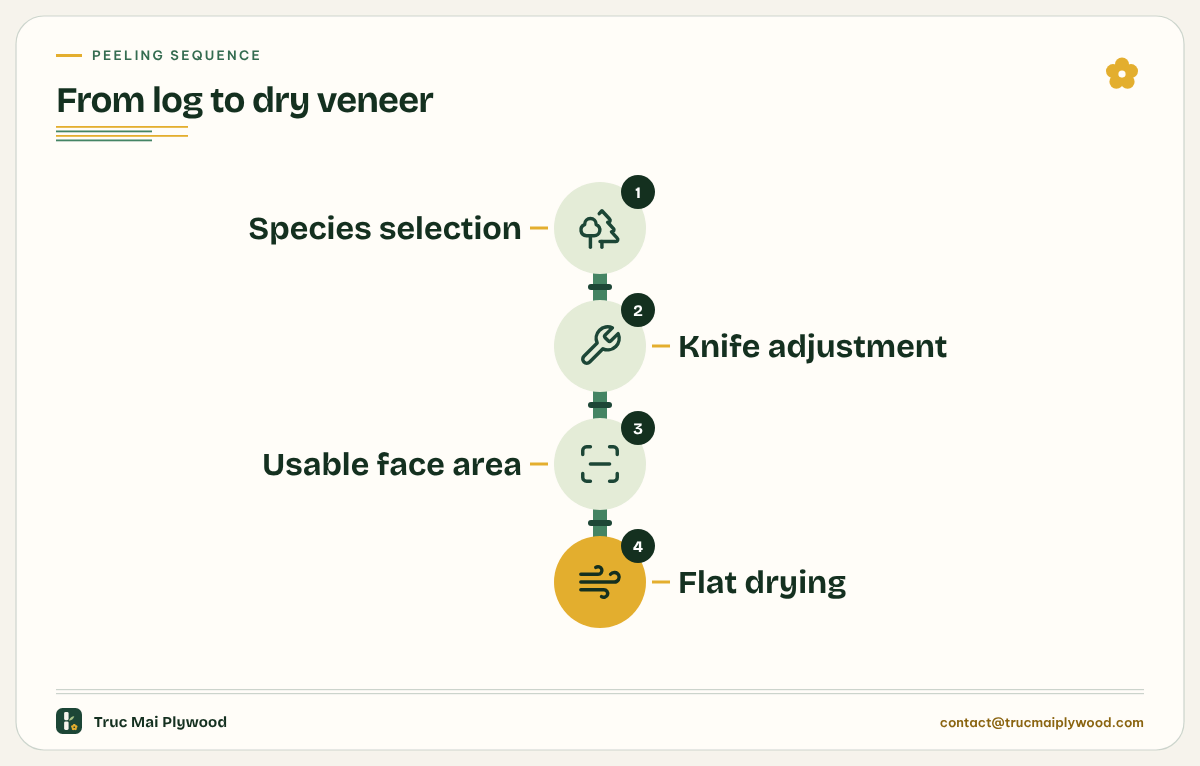
Rotary peeling turns a prepared log against a knife to produce a continuous ribbon of veneer. The mill then clips the ribbon into usable leaves, dries them, sorts them by appearance and prepares them for panel lay-up.
The practical sequence for a buyer is:
- Identify the log species. The veneer species determines the expected colour and cutting response.
- Set the cut. Knife condition and pressure-bar adjustment affect surface checking and fibre tear.
- Clip defects. The usable face area matters more than the gross ribbon length.
- Dry the veneer. Drying must leave a sufficiently flat leaf for bonding and subsequent sanding.
- Grade the face. Match the accepted colour and defect pattern to a full-size reference.
The same US Forest Service veneer paper describes the cutting and drying behaviour of yellow-poplar. For an order, request photographs of the actual face selection and the finished panel surface rather than treating a species handbook as a shipment inspection.
What happens when poplar veneer dries?
Poplar veneer loses moisture and changes dimension during drying. Flatness, splits, waviness and surface checking are important because the face must lie against the substrate without creating a visible defect after pressing.
A dried veneer leaf should be evaluated for usable area and condition, not merely for its nominal thickness. A curled edge can complicate lay-up; an overly rough face may demand sanding that removes too much decorative wood. The mill’s clipping and sorting decisions affect the finish seen by the furniture maker.
The veneer paper cited above notes generally flat drying for yellow-poplar. For natural Populus veneer, buyers should judge the specific supplied face rather than transfer a finding from a different genus without checking the sample.
Which poplar wood uses suit furniture production?
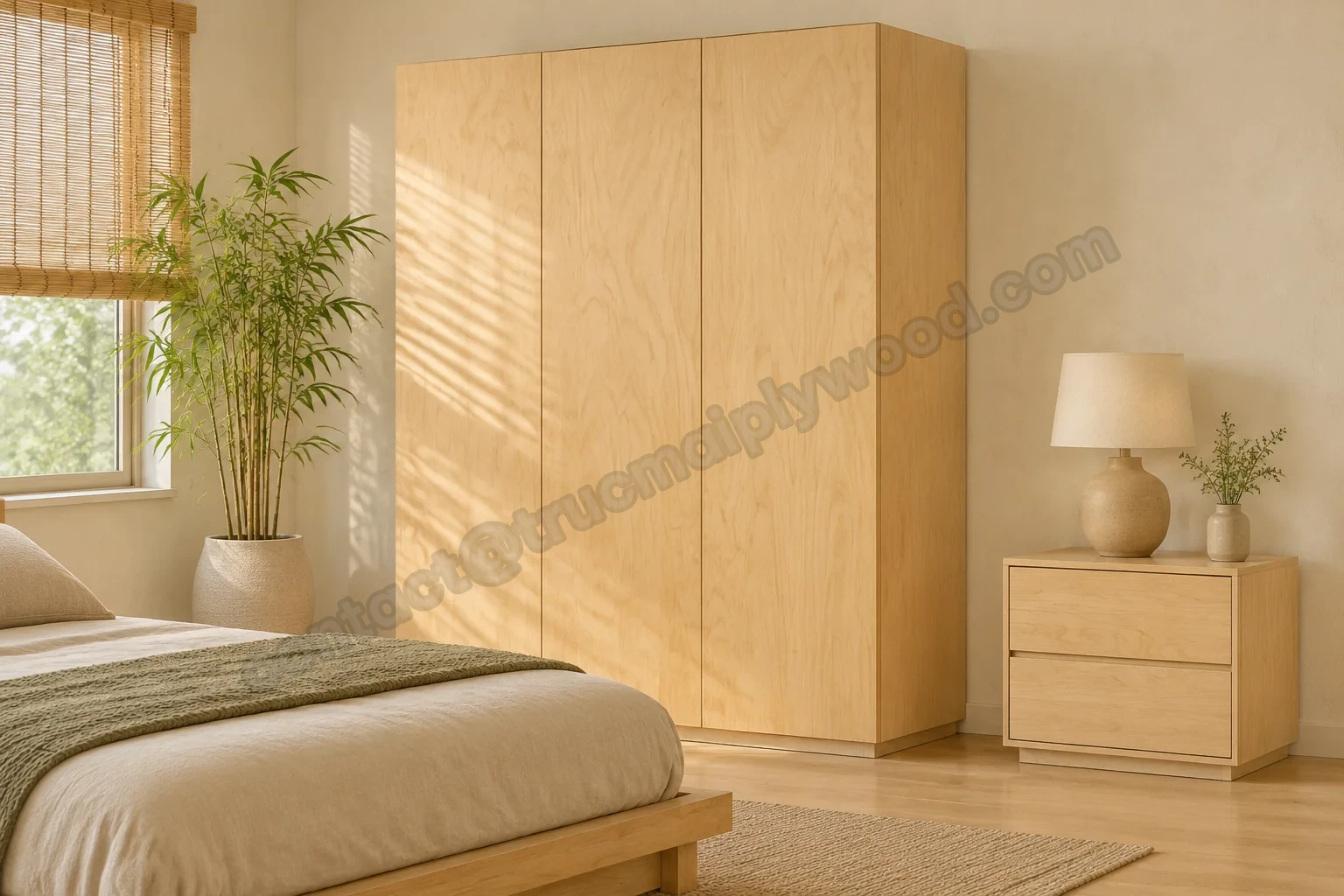
Poplar wood uses include painted joinery, concealed furniture parts, cabinet components, plywood faces and decorative interior panels. The right form of poplar depends on whether the buyer needs solid timber, thin veneer or a finished plywood sheet.
A cabinet maker seeking a pale surface might select natural poplar veneer. A production line seeking a highly repeatable grain might prefer engineered veneer panels. A hidden drawer component may place greater value on predictable machining and sheet yield than on the face’s natural figure.
The US Forest Service yellow-poplar account identifies furniture parts, core stock and rotary-cut veneer among established uses of that species. The distinction between solid timber and plywood remains important: the finished panel’s performance comes from the complete construction.
Natural poplar, bleached poplar or engineered veneer?
Natural poplar shows the wood’s original grain and colour variation; bleached poplar aims for a lighter appearance; engineered veneer offers a designed, repeatable figure. These are three different specifications for the visible face.
| Face option | Appearance priority | What to approve |
|---|---|---|
| Natural poplar | Genuine grain and pale colour | Colour range, knots, repairs, face/back grade |
| Bleached poplar | Lighter and more even tone | Accepted shade, surface finish, both faces |
| Engineered veneer | Repeatable pattern | Pattern direction, batch match, coating sample |
Engineered veneer can be made from reconstituted poplar wood. The buyer should distinguish the raw species from the manufacturing method and compare finished samples under the intended light. See face veneer origin files when origin documentation is part of the purchasing specification.
How should buyers specify a poplar-faced panel?
Specify the application, face grade, core, adhesive and emission requirement, thickness, sheet size and packing arrangement. A clear order line makes the face selection and the panel construction separately inspectable.
For furniture/interior panels, Truc Mai uses stitched core construction and sanded faces. Its standard thickness range is 3–40 mm, with sheet formats including 1220 × 2440, 1220 × 2280 and 1250 × 2500 mm. Thickness tolerance is written on the order; calibrated furniture panels can be specified at ±0.3 mm.
Ask for a face/back grade pair agreed against the sample. Describe whether the buyer will paint, laminate or apply a UV coating. “UV-ready” means the faces are prepared for the buyer’s coating process, not that a UV finish has already been applied.
The where poplar plywood works topic helps separate visible door faces from concealed cabinet parts. Where parts are cut at the mill, provide a drawing with finished dimensions and grain direction.
Which adhesive and emission details belong on the order?
Adhesive type and formaldehyde emission are separate specification lines. For an interior panel, the order should identify the adhesive system, the required emission evidence and the panel configuration covered by that evidence.
The US eCFR, 40 CFR Part 770 sets a 0.05 ppm formaldehyde limit for hardwood plywood with veneer core under TSCA Title VI. The applicable testing and certification framework is part of that regulation. A wood species name or face colour cannot substitute for emission documentation.
Truc Mai holds CARB Phase 2 and TSCA Title VI certification for veneer-core hardwood plywood in the 3–25 mm range. Buyers should write the intended panel thickness and request the relevant certificate documents for the ordered configuration. For interior use, UF glue at E0 emission is the mill’s default specification, with the emission class stated separately from the glue.
How can a buyer judge face quality before a full order?
Approve a physical sample that shows the target colour, visible defects, surface preparation and finish response. The sample should represent the actual face grade, rather than a hand-selected photograph of an exceptional sheet.
Check both sides. Run a fingertip across the surface to find raised grain or sanding ridges, and inspect the sheet in raking light for repairs or patches. For a painted panel, make a coating trial using the buyer’s primer and topcoat. For clear finishing, compare adjacent samples side by side.
Ask for a cross-section showing the core and face thickness. A good-looking face cannot reveal internal gaps, jointing method or the adhesive system. The ordering plywood samples page gives the practical next step for comparing constructions before an order.
What should an importer send with a poplar plywood RFQ?
Send the application, face choice, core species, adhesive and emission specification, panel dimensions, packing instructions, quantity and destination port. Attach a reference image or sample code for the required face appearance.
For cut components, send a dimensioned cut list and identify which edges will remain visible. A standard sheet can be split lengthwise or into multiple labelled furniture parts, with the final cutting pattern agreed against the selected sheet size. This is particularly useful when the buyer assembles repeat furniture components rather than selling full sheets.
State whether the finish will be paint, laminate or clear coating. That single decision often changes the face grade and preparation more than a generic request for “premium poplar”. A complete RFQ allows the mill to return a construction and sample that can be checked against the actual end use. Use the plywood RFQ guide to organise these fields.
Send your specification to contact@trucmaiplywood.com or through the quotation form.
Questions buyers ask
Does poplar accept paint well?
Yes. Its fine, relatively even texture makes it useful for painted interior joinery; prepare and prime the face before the finish coat.
Can poplar veneer be stained dark?
Yes, but test the stain on the approved veneer sample first. Natural colour variation and absorption can make a dark stain look uneven.
Is poplar suitable for kitchen cabinets?
Poplar-faced plywood is suitable for dry interior cabinet components when the panel construction and finish match the application. Specify the core, face grade and emission requirement together.
What does bleached poplar mean?
Bleached poplar is poplar face veneer treated for a lighter, more uniform appearance. It describes the face finish, not the core species.
How should I inspect a poplar face sample?
Check the full face in daylight for colour bands, knots, patches and sanding marks. Compare both sides with the approved reference sample.
Can poplar be used under laminate?
Yes. The panel needs a suitably flat, prepared surface and the correct bonding process for the chosen laminate.
Which documents identify veneer origin?
Ask for the wood species, country of harvest and the relevant origin and traceability records for both face and core.
What sheet size should I specify?
Write the finished width and length in millimetres, the thickness, and whether the order is full sheets or cut components.
Is poplar a hardwood or softwood?
Botanically, Populus is a hardwood genus, although its timber is relatively light and soft compared with many other hardwoods.