
LVL furniture rails and bed slats use lengthwise laminated veneers to make repeatable, straight components for upholstered frames, beds and interior joinery. Specify the finished section, grain direction, adhesive, moisture condition and machining before ordering. Truc Mai Plywood supplies non-structural LVL for furniture and frame stock, with cut-to-size options for production lines.

What makes LVL furniture different from ordinary plywood?
LVL furniture stock uses veneers with their grain running predominantly along the component length. This arrangement suits long rails and narrow slats that need consistent orientation from one production run to the next. Ordinary plywood alternates grain directions to make a sheet suited to wider panel applications. The APA engineered-wood glossary defines laminated veneer lumber by its primarily lengthwise fibres.
For a furniture factory, this distinction changes the drawing. Identify the long axis of every part and indicate the face that will receive staples, screws or upholstery. A narrow component cut across the intended grain direction is a different product. The non-structural LVL range is intended for furniture, door and frame stock rather than building beams.
Where does LVL work in upholstered furniture frames?
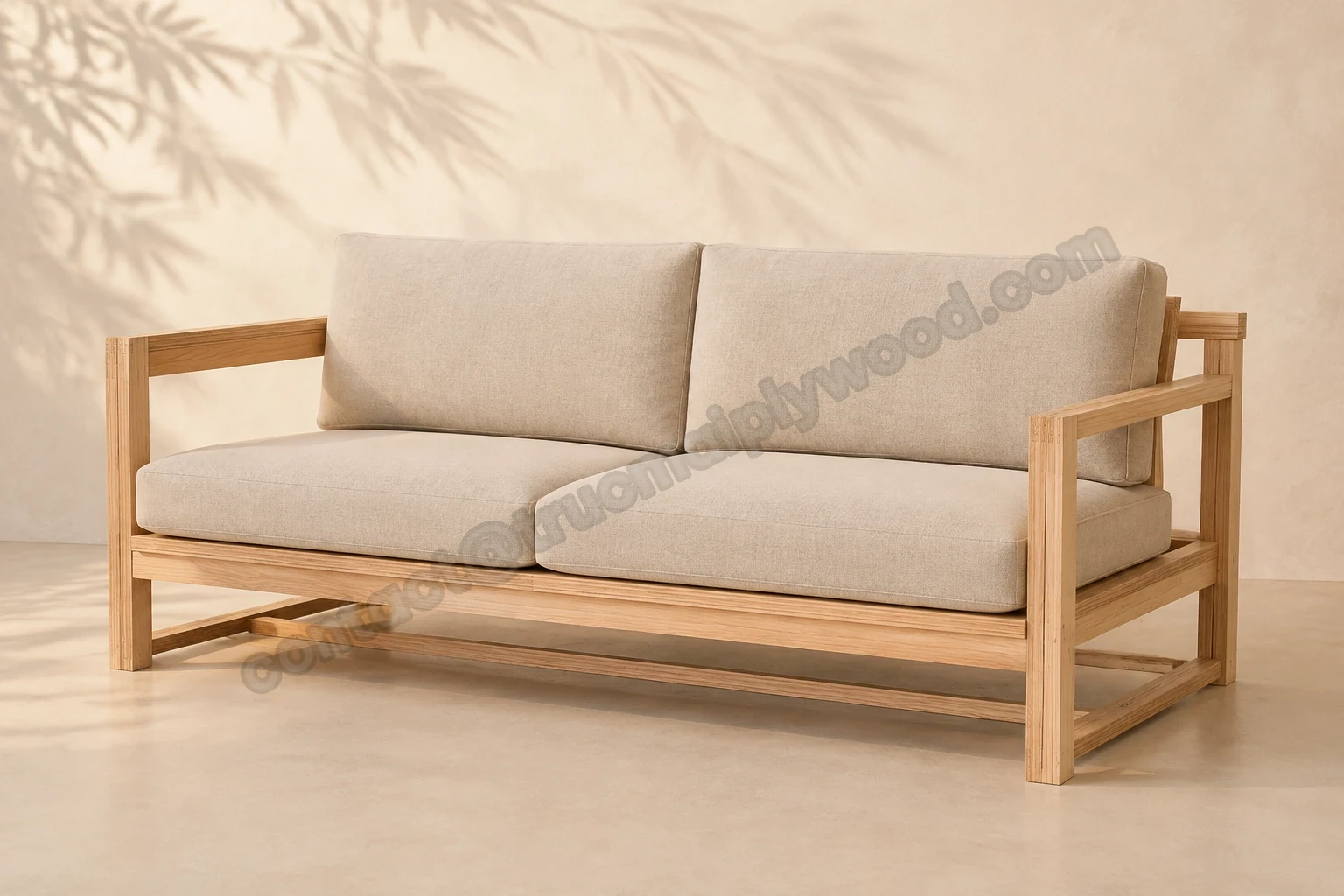
LVL works in straight seat-frame rails, back-frame members and concealed crosspieces when the finished assembly has been tested for its intended loading. Upholstery producers value repeatable sections because a jig can reference the same faces and edges through successive batches. The buyer should identify each rail by its function rather than ordering one generic timber plank for an entire sofa.
A seat rail may receive staples along an exposed edge, while a crosspiece may take fasteners through its face. These operations impose different local demands on the veneer edges. Send a drawing showing staple lines, drilled holes, joint locations and the surfaces that remain visible after upholstery. A component can be straight and accurately cut yet unsuitable if its fastening arrangement splits the edge. Use the LVL door and frame stock specification route for related concealed frame parts.
Why choose LVL timber planks for bed slats?
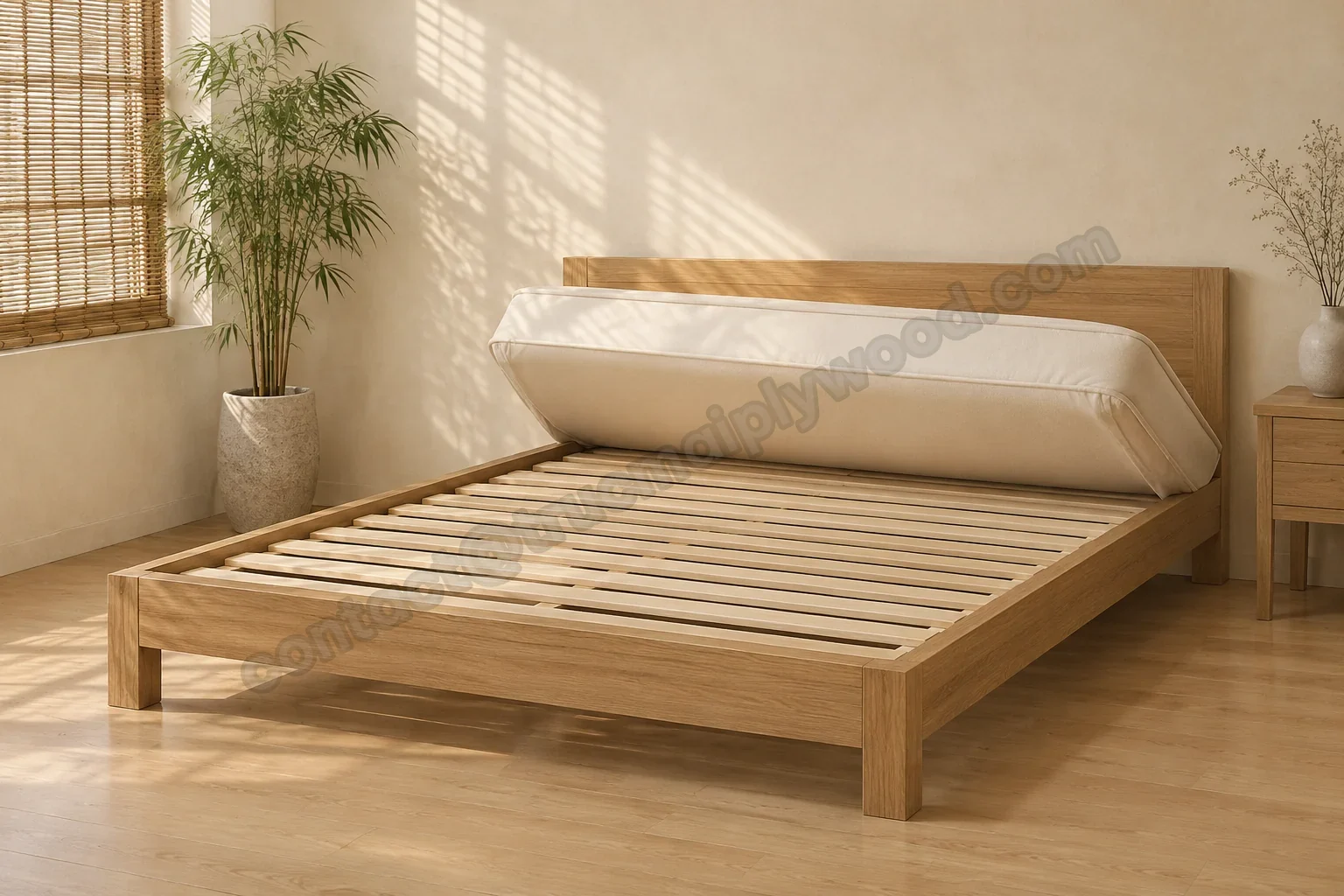
LVL timber planks can be made into repeatable bed slats with controlled section, length and grain direction. Bed manufacturers should select a slat profile by testing the complete bed base, including supports, spacing, attachments and the mattress system. The required response is an assembly property, not a universal property of a named wood product.
A rigid platform and a flexible slatted base demand different sections. Record the support span and whether each slat is fixed, clipped or free to move in its holder. Compare prototypes after repeated loading, looking for permanent set, edge damage and loosening at the supports. The LVL slats for beds product route separates this use from general frame stock.
How do rails and slats compare with solid sawn timber?
Choose LVL when consistent lengthwise veneer orientation and a repeatable machined section are more valuable than the appearance of a solid-wood grain pattern. Solid timber can be preferable for exposed decorative parts, carved shapes and designs that specifically require a natural solid-wood face. Both materials need incoming inspection and assembly testing.
| Buying criterion | LVL rail or slat | Solid sawn timber |
|---|---|---|
| Grain arrangement | Primarily parallel veneers | Natural continuous wood grain |
| Visible appearance | Layered edge | Solid-wood edge |
| Repeat order | Specify veneer build and finished section | Specify species, grading and finished section |
| Machining | Check glue lines and edge quality | Check knots, grain run-out and splits |
| Assembly | Validate joints and fasteners | Validate joints and fasteners |
The comparison concerns furniture components. The WoodWorks explanation of veneer orientation describes structural composite lumber construction, but structural design values from that category must not be transferred to a furniture rail without relevant product evidence.
Which section dimensions belong on the drawing?
Put the finished width, thickness and length on every part drawing, followed by the measurement datum and tolerance. A factory needs to know which dimension is the visible edge, which is the fastening face and whether dimensions apply before or after sanding. Avoid a single ambiguous dimension labelled “size”.
| Drawing field | What to write | Inspection point |
|---|---|---|
| Section | Finished width × thickness, mm | Calliper at agreed positions |
| Length | Finished end-to-end length, mm | End stops or tape |
| Grain | Longitudinal direction arrow | Veneer direction at ends |
| Ends | Square, radius or profile | Template or gauge |
| Edge | Exposed or concealed | Visual and tactile check |
| Tolerance | Separate limits for each dimension | Approved drawing |
The LVL sections and sizes page provides the related ordering vocabulary. When comparing a mill quote with a finished-part drawing, establish whether the quote includes final profiling, sanding and cutting.
What does a bed factory need to test before approving a slat?
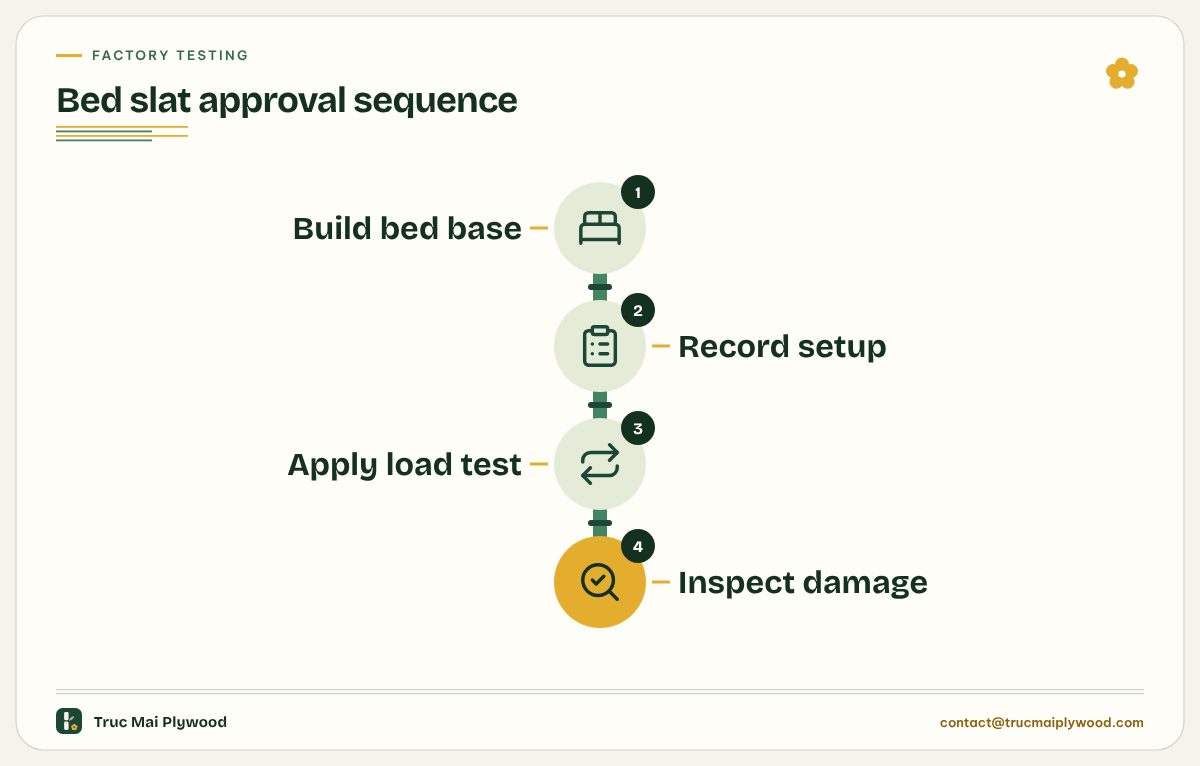
Test the slat in the actual bed base with the specified support arrangement and mattress interface. A loose sample flexed by hand gives no repeatable acceptance criterion. Define the load cycle, deflection measurement, recovery period and visible damage checks in the buyer’s test protocol.
- Build a representative bed base with the intended supports and spacing.
- Record the slat section, length, orientation and installation method.
- Apply the factory’s agreed static and repeated-load procedure.
- Inspect for splitting, permanent deformation and support movement.
- Retain the approved sample and signed test record as the production reference.
Testing the full assembly also exposes differences between end holders, centre supports and fasteners. If the product line changes its support spacing, repeat the relevant validation rather than assuming the previous slat result transfers.
How should glue and moisture exposure be specified?
Specify the adhesive system and the expected service environment as separate lines. For dry interior furniture, an interior bonding system can be appropriate. Parts near recurring damp conditions need a bond specification backed by testing for that exposure. The USDA Forest Products Laboratory wood-adhesives chapter explains why urea-formaldehyde adhesives have lower wetting resistance than melamine or phenolic systems.
A glue name by itself does not establish a particular bond-test class. Specify the relevant test method and acceptance level if the contract requires one. Equally, an emission designation concerns formaldehyde release rather than wet-bond durability. State whether the component is an indoor bed slat, an interior door rail or stock intended for a more demanding humidity environment. The LVL moisture considerations resource addresses storage and handling.
How should furniture manufacturers assess fastener holding?
Assess screws, staples and dowels in the finished section and at the actual edge distances. A fastening test on a wide sample can conceal splitting that appears after the rail is cut narrow. Test the orientation of each fastener against the veneer layers and repeat the operation using production tools.
For upholstered frames, inspect staple penetration, leg clinching where relevant and damage around the staple line. For bed frames, check the joint under assembly and repeated service loading. For door stock, examine hinge screw positions and the machining that removes veneer near the edge. Document tool settings, drill size and the approved fastener so the purchasing specification and production process describe the same joint. The LVL sections and sizes guide can help keep the section description consistent.
What machining details should be fixed before a repeat order?
Fix the cut list, end geometry, hole pattern, surface preparation and pack identification before approving repeat production. A mill can supply stock for the buyer’s machining line or a more finished component, but those are different order lines. Mark every machining feature against a datum so parts can be checked in a jig.
An efficient trial uses the buyer’s normal saw, router, drill and fastening equipment. Record splintering at the end grain, glue-line exposure after profiling and any change in section during sanding. Keep a signed master drawing with a revision code. If the buyer changes a hole position, issue a new revision rather than adding an instruction in a shipment email. Carry that revision into the written RFQ.
Can LVL rails be supplied cut to size?
Yes. Cut-to-size is an available ordering option, with exact dimensions agreed from the buyer’s cut list and stock format. Truc Mai also supplies labelled panels cut from standard sheets; for example, a standard sheet can be divided into two lengthwise, three, four or six pieces according to the approved cutting pattern. LVL rail cutting is specified by its own finished section and length, rather than by assuming a panel-cut pattern fits a rail.
The cut-to-size panels page explains the related panel service. For furniture rails, list the quantity of each length and identify whether the factory should supply blanks or finished ends. If different furniture models share a section, consolidate the section specification while retaining separate part codes for the different lengths.
Which quality checks matter at goods receipt?
Check section, length, straightness, edge condition, veneer bonding appearance and pack identity against the approved sample and drawing. Select samples from more than one pack rather than inspecting only the most accessible bundle. Record the batch code with any nonconformity so the supplier can identify the affected production.
A practical receiving sheet has separate fields for dimensional readings, visual defects and machining trials. Straightness can be checked against the buyer’s fixture; a visible glue line is evaluated against the agreed appearance standard rather than treated automatically as failure. Keep the measured part and photograph alongside its pack label. That evidence is much more useful for corrective action than a general message saying the timber was poor. Use the sample-order process when arranging a comparison batch.
What documents matter for US-bound furniture components?
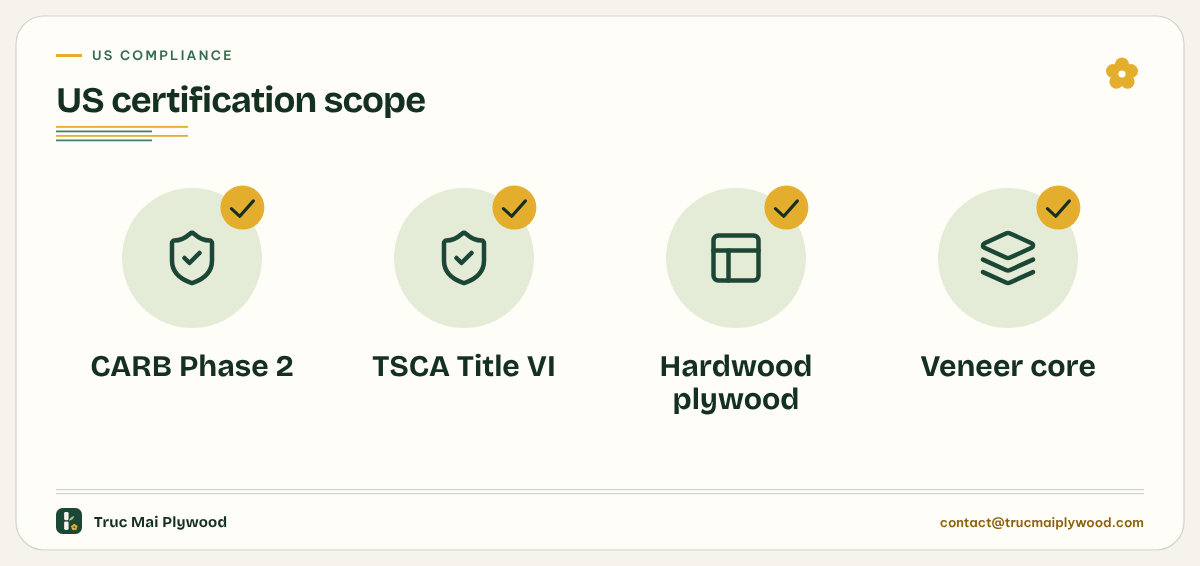
Classify the actual material before requesting a formaldehyde certificate. The US Environmental Protection Agency’s TSCA Title VI FAQ identifies regulated hardwood plywood, medium-density fibreboard and particleboard, while excluding structural composite lumber manufactured to its specified standard. Non-structural furniture LVL needs product-specific classification; the certificate for a different plywood product is not automatically evidence for that LVL.
Truc Mai holds CARB Phase 2 and TSCA Title VI certification for hardwood plywood with veneer core in the specified certified range. For an LVL order, request documentation tied to the actual rail or slat construction and intended US use. Keep material identity, adhesive declaration and the buyer’s applicable import requirements together with the order file.
What does an FSC order require?
An FSC order requires an eligible product, the correct output claim and the seller’s certificate code on the sales documentation. The FSC Chain of Custody standard sets out the sales-document requirements in section 5.1.
Truc Mai Plywood holds FSC licence FSC-C196493 and Chain of Custody certificate SA-COC-014545, with FSC 100% as its available claim for eligible products. Specify FSC eligibility on the LVL order line and check the current product scope before attaching the claim to those components. For the buyer’s procurement file, the FSC licence verification page explains the code-checking route.
How should a buyer compare LVL suppliers?
Compare suppliers against one controlled component specification and the same acceptance tests. Ask for the veneer orientation, adhesive system, finished section tolerance, machining scope, packing method and product-specific supporting documents. A quotation based only on “LVL timber” leaves too many differences unresolved.
For a first order, ask each mill to label a sample with its proposed construction and provide a written deviation list against the drawing. Run those samples through the same assembly station. Inspect the fit, fastening and finish before comparing production terms. The sample-order process and RFQ writing guide provide practical checklists for the purchasing team.
How should rails and slats be packed for a factory line?
Pack each section and length under a separate part code with the agreed quantity and orientation. Protect machined ends, keep bundles supported during handling and make the identification visible without unpacking the whole load. The receiving team should be able to route a pack directly to the correct assembly station.
Specify whether the buyer needs mixed part codes on one pallet or separate pallets by model. For narrow slats, use supports that avoid concentrated bending during forklift movement. A packing list should distinguish raw blanks from finished components, because the same outside section can look identical in a closed bundle while needing different downstream machining. Align the part codes with the LVL slats for beds order specification where applicable.
For procurement teams changing from solid wood, keep the first approval narrow. Choose one furniture model and one rail section, then make a trial batch using the actual fixtures and fasteners. Track rejection reasons by part code: dimension, visible veneer defect, machining tear-out, joint failure or packing damage. Separate a material defect from a drawing error or an assembly-tool setting. A rail rejected because its hole is misplaced needs a different corrective action from a rail rejected because the edge split during stapling.
The factory drawing should show which faces are reference surfaces. Mark the top, bottom and long axis on the drawing and on the prototype pack. The operator can then place each blank in the fixture consistently. If the part is reversible, state that explicitly; if the part has a preferred orientation, make it visible before the first cut. Keep the approved sample beside the production jig during the initial run.
A repeat-order review should compare the approved drawing revision with the new purchase order, packing list and sample label. When the furniture model changes, record whether the change affects only length or also section, hole position, adhesive requirement or surface preparation. This simple distinction allows shared stock where the engineering requirements really match, while preventing an old component code from being used for a new joint design.
What should the final LVL furniture RFQ contain?
Send a component drawing and a line-by-line bill of materials showing application, section, length, grain direction, glue and emission requirement, face or edge finish, machining, packing and quantity. Add the destination port and the intended delivery term. The buyer’s acceptance tests and approved sample should carry the same drawing revision as the order.
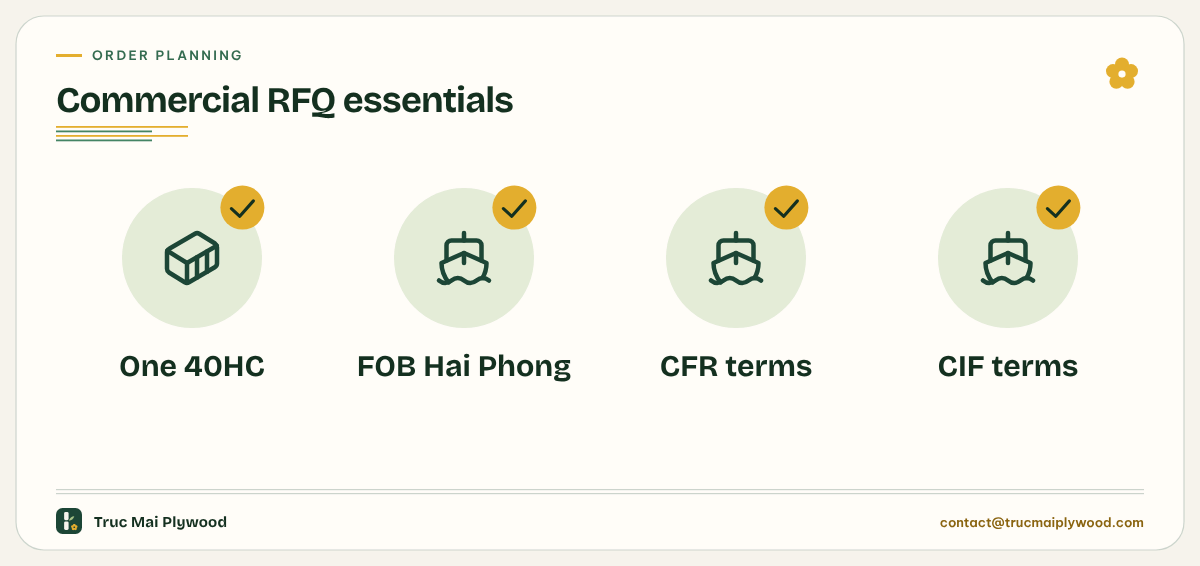
Truc Mai Plywood manufactures furniture and commercial plywood in Ha Hoa, Phu Tho, Vietnam and offers non-structural LVL for furniture applications. The standard minimum is one 40HC, with FOB Hai Phong, CFR or CIF terms. Submit the specification through the quotation route listed in the LVL product page so the response can identify the requested build rather than a generic timber plank.
Send your specification to contact@trucmaiplywood.com or through the quotation form.
Questions buyers ask
Can I order LVL as unfinished rails?
Yes. Specify an unfinished surface and the machining allowance on the drawing.
Can the slat ends be rounded?
Yes, end profiles can be defined on the buyer’s machining drawing; agree whether profiling happens before or after delivery.
Should I specify nominal or finished thickness?
Use finished thickness and a written tolerance so incoming inspection measures the same dimension as the drawing.
Can I mix slat and rail specifications?
Yes. List each section and length separately and identify each pack by item code.
Does LVL need a decorative face?
Concealed furniture rails usually need an acceptable bonding and machining surface rather than a decorative veneer grade.
What should a prototype order include?
Provide a cut list, assembly drawing and a small evaluation programme covering machining, fastening and fit.
How should LVL be labelled at receipt?
Use the buyer’s part code, section, length, batch identification and quantity on each pack.
Can I specify pre-drilled holes?
Yes. Put hole diameter, centre positions and edge distances on a controlled drawing.
Is LVL the same as plywood?
No. LVL aligns most veneer grain lengthwise, while ordinary plywood uses cross-laid veneers.
Can I use one rail for several furniture models?
Yes, where the same section, hole positions and performance requirements are validated across those models.