
12mm hardwood plywood is a mid-range furniture and interior panel, commonly ordered as a 1220 × 2440 mm sheet. Compare its core, face, ply construction and weight before choosing a thickness. Truc Mai Plywood manufactures panels from 3 to 40 mm and provides core-specific 40HC planning figures for import orders.
Do they make 1/4 in thick plywood?
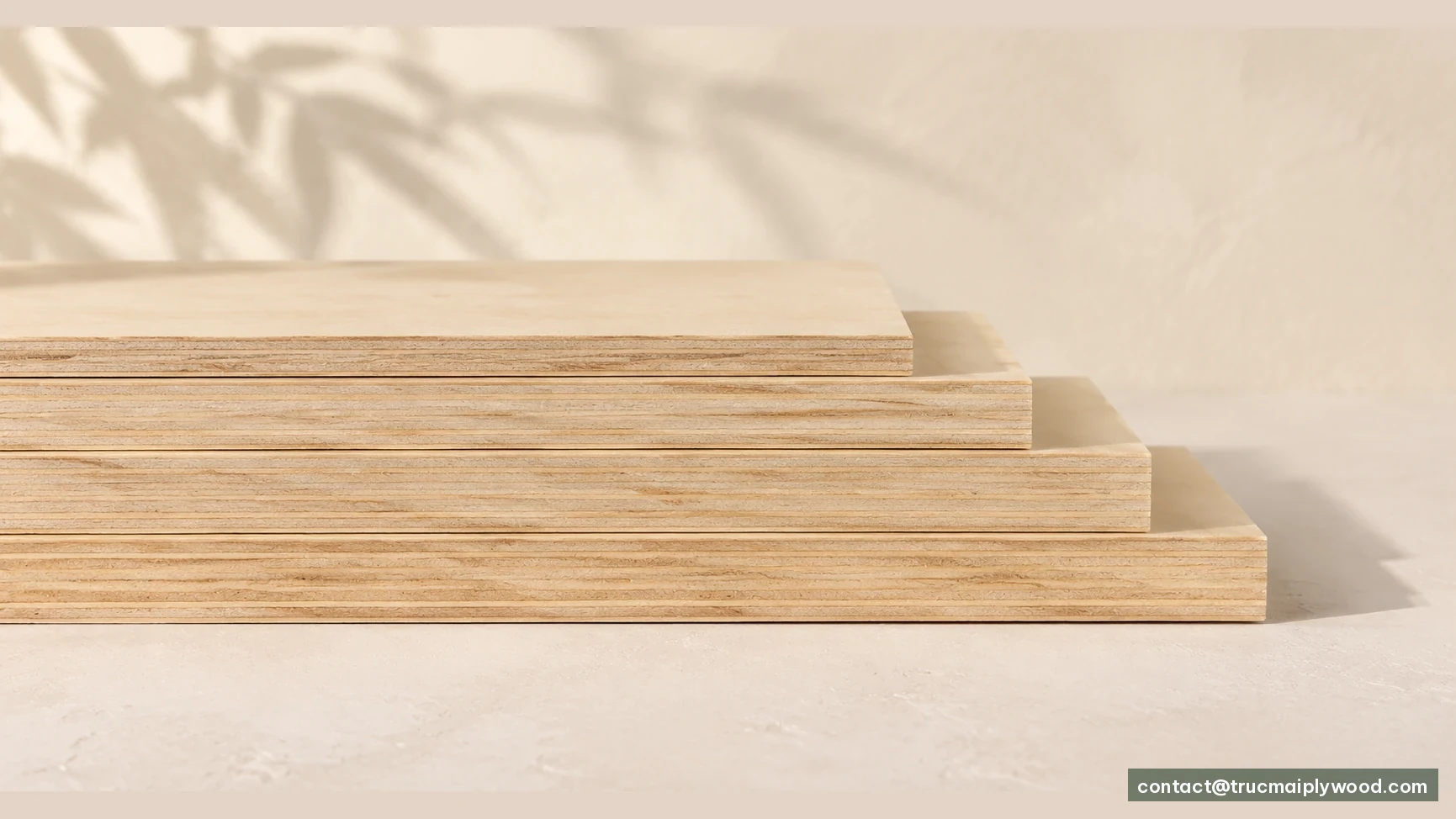
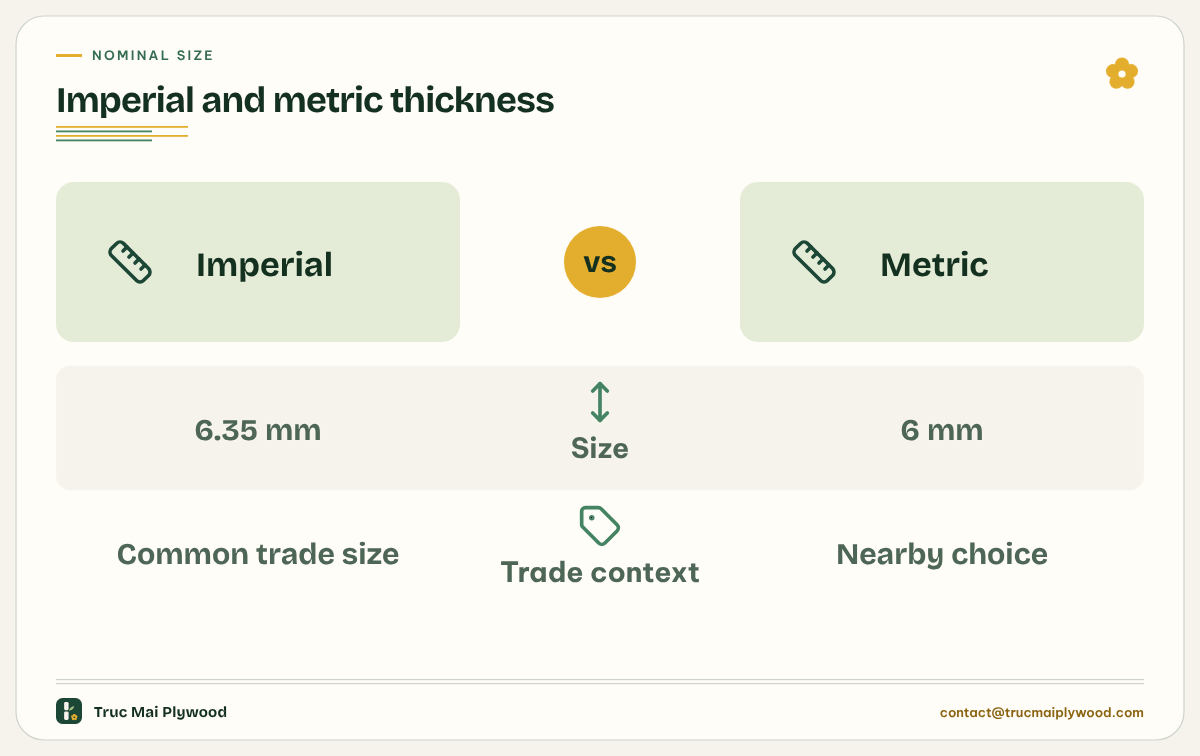
Yes. Quarter-inch plywood is a common imperial trade size, equivalent to 6.35 mm. A 6 mm metric sheet is a nearby choice, but the two dimensions are different. Buyers specifying slots, rebates or tight-fitting components should state the finished thickness in millimetres rather than using the inch name alone.
In the Truc Mai range, 3, 4 and 5 mm panels have five plies, while 6 mm construction is agreed for the order. The face veneer and internal cross-bands matter more to a thin door skin than the marketing shorthand. See the thin plywood panels range for the available construction options.
A quarter-inch request should also identify the application: a cabinet back, drawer base and visible decorative lining need different face specifications. Ask for a cut sample with a measured edge, especially when matching an existing groove. A nominal dimension alone cannot tell a workshop how tightly a panel will fit after sanding and finishing.
What is the thickest 4x8 plywood you can buy?
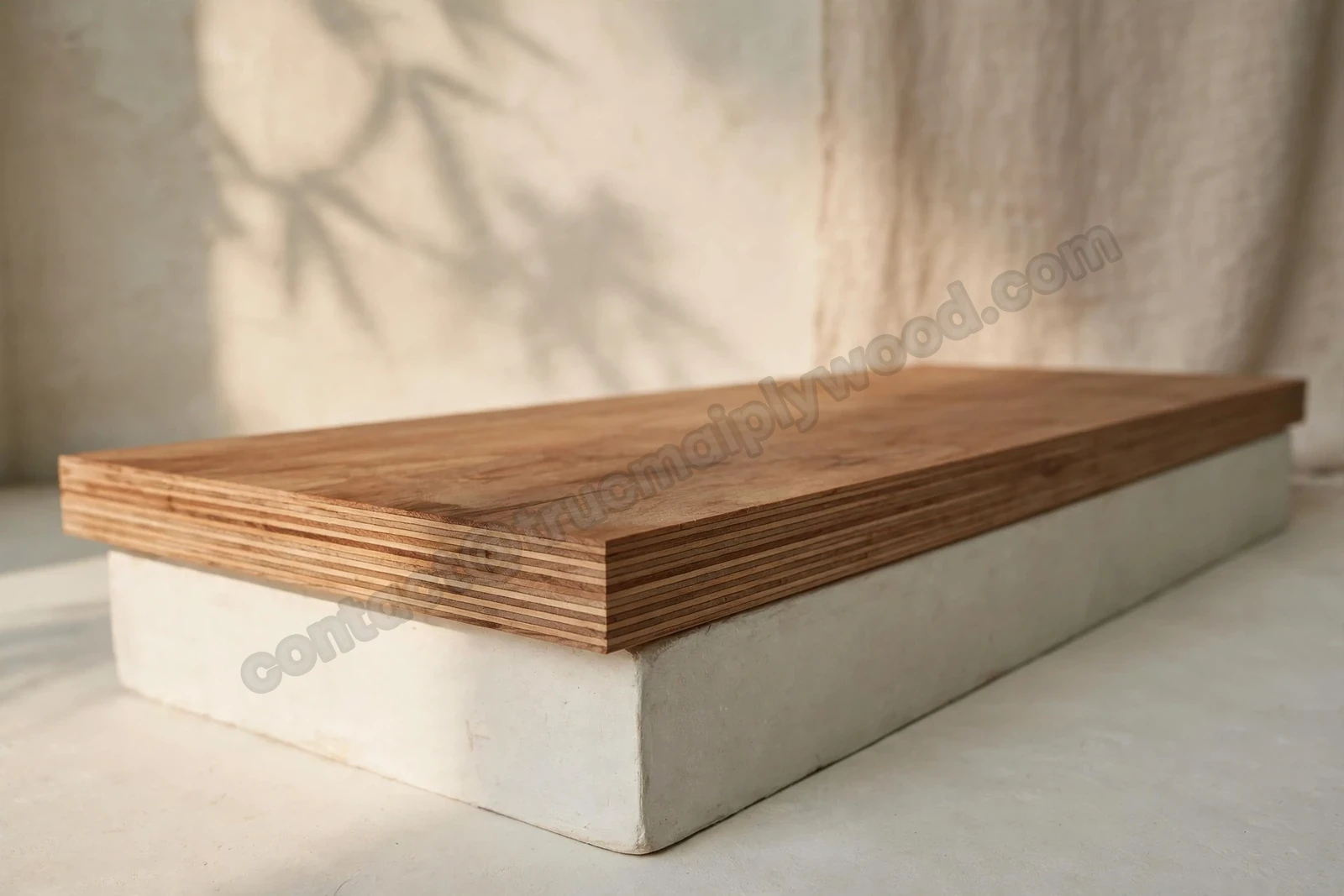
In Truc Mai’s 4 × 8 ft range, 40 mm is the thickest listed panel. The 1220 × 2440 mm format is the common 4 × 8 ft sheet; availability elsewhere is determined by each supplier’s catalogue rather than a universal maximum. This range covers furniture, interior and commercial plywood, not structural decking.
A thicker sheet uses more wood per square metre, adds weight to handling and changes the fixing detail. Thick furniture components may be made from one panel or from a separately designed assembly. Compare the required edge appearance, screw holding, span and finishing method before selecting a maximum thickness merely because it is offered.
The US NIST PS 1-22 structural plywood standard covers structural grades and performance categories. It is useful for understanding why an imperial structural label is a different purchasing specification from a decorative hardwood plywood panel. A buyer should never substitute one product category for the other on the strength of a similar thickness name.
How many plies does 12mm hardwood ply have?
12mm hardwood plywood has an order-specified ply count rather than one fixed count across all veneer builds. For comparison, Truc Mai’s 3–5 mm panels are five-ply and its 18 mm panels are usually 11–13 plies, most often 11. A 12 mm order therefore needs its own written lay-up rather than a count borrowed from another thickness.
Ask for an edge photograph and a sample with the face and back identified. Check whether the core is stitched, whether cross-bands are continuous and whether the panel is calibrated after pressing. A count alone does not describe the quality of the core joints or the flatness of the finished sheet.
The furniture line uses an A-grade stitched core and sanded faces; commercial panels use an AB core with loose-laid or jointed construction and lighter sanding. These are different products even when both are sold as 12 mm. Specify the intended cabinet part, finished thickness and face/back sample together. The cabinet-grade plywood selection discussion explains why face quality matters to visible interiors.
What does a sheet of 9mm hardwood ply weigh?
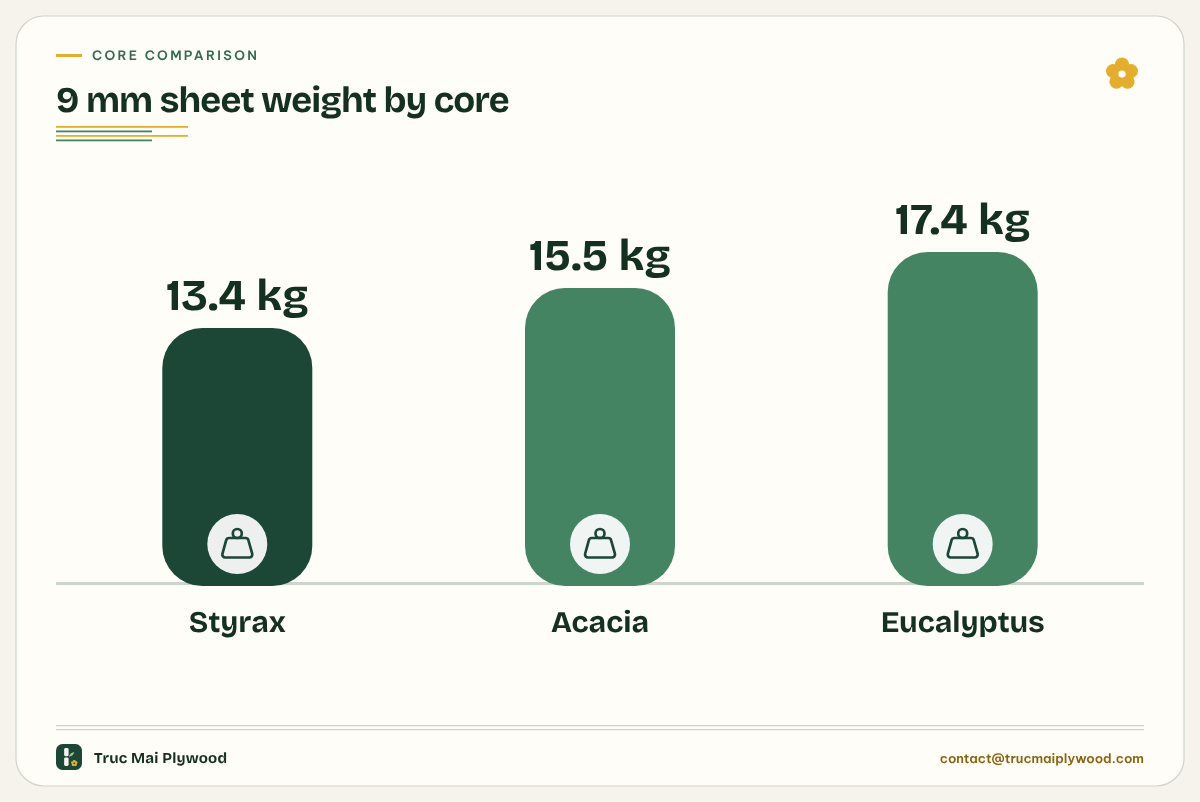
A 9 mm, 1220 × 2440 mm sheet weighs 13.4 kg on Styrax core, 15.5 kg on Acacia or 17.4 kg on Eucalyptus in the supplied planning model. The difference is driven by core density, not by a change in nominal face size. These are calculated panel weights, with the full model below.
Weight is useful when comparing hand loading, cabinet hardware, delivery handling and freight payload. Ask whether the quoted weight describes the bare panel, a packed bundle or a measured shipment. The table distinguishes individual sheet mass from total planned panel mass so that a purchasing team does not use the wrong number for a container booking.
For the same nominal thickness, a heavier core may suit a different machining or fixing requirement. Density by itself does not certify screw withdrawal, bending strength or any structural rating. Request a sample of the actual core and face construction when the application has demanding fixing or surface requirements.
What is the cheapest hardwood plywood?
Commercial-grade hardwood plywood with a simpler face specification is generally the lowest-cost option for concealed interior uses. The right comparison is between panels that meet the same application, thickness and acceptance sample, rather than between different grades described only as hardwood plywood.
A furniture-grade stitched core and carefully selected visible face require different processing from an AB loose-laid commercial core. An engineered-veneer face may offer a consistent decorative appearance; natural birch, okoume and other face choices answer different design requirements. None of these face names tells you the core species.
To compare suppliers, send one common specification: dimensions, veneer face/back pair, core species, glue type, emission class, sanding, packaging and quantity. Then compare the returned sample, specification sheet and packing plan. The plywood RFQ checklist gives the fields in a practical order.
Which thicknesses are listed alongside 12mm hardwood plywood for furniture orders?
The listed range is 3, 4, 5, 6, 9, 12, 15, 18, 21, 25, 30 and 40 mm. A merchant may also advertise 3.6, 5.5 or 22 mm, but those names should be checked against the finished-thickness requirement. Buyers looking for 25mm hardwood plywood or 15mm hardwood plywood can use the same specification method as for thinner sheets.
For drawer bottoms and door skins, start by assessing the thin-panel options and the grooves into which they fit. For cabinet sides, partitions and shelving, assess the span, edge detail and fixing arrangement. For thicker interior components, assess the handling weight and how the edges will be finished. A thickness list is a starting point for a component design, not a performance classification.
If the drawing says 1/2 inch, 1/4 inch or 8x4 hardwood ply, retain that original notation in the enquiry and add the required metric finished size. This avoids silently substituting a nominal conversion for a measured fit.
What sheet formats can be ordered?
The standard formats are 1220 × 2440 mm, 1220 × 2280 mm and 1250 × 2500 mm. The first is commonly called 4x8 hardwood plywood or 8x4 hardwood ply in the UK; the European format provides a slightly different cutting envelope. A custom rectangular finished piece can be cut from a parent sheet (derived nesting dimensions in the supplied CALC.json, not a standard stocked sheet size).
Sheet dimensions affect nesting efficiency and the number of usable furniture parts, even when the thickness and face are unchanged. Check grain direction on the visible face before rotating a rectangular part to improve yield. A layout that fits geometrically may still be unsuitable when every door face must run with the grain in the same direction.
The 1220 × 2280 mm panel is an option for shorter furniture components. For non-standard dimensions, the mill works from a cut list and agrees the final piece size by email.
How are 40HC planning quantities calculated?
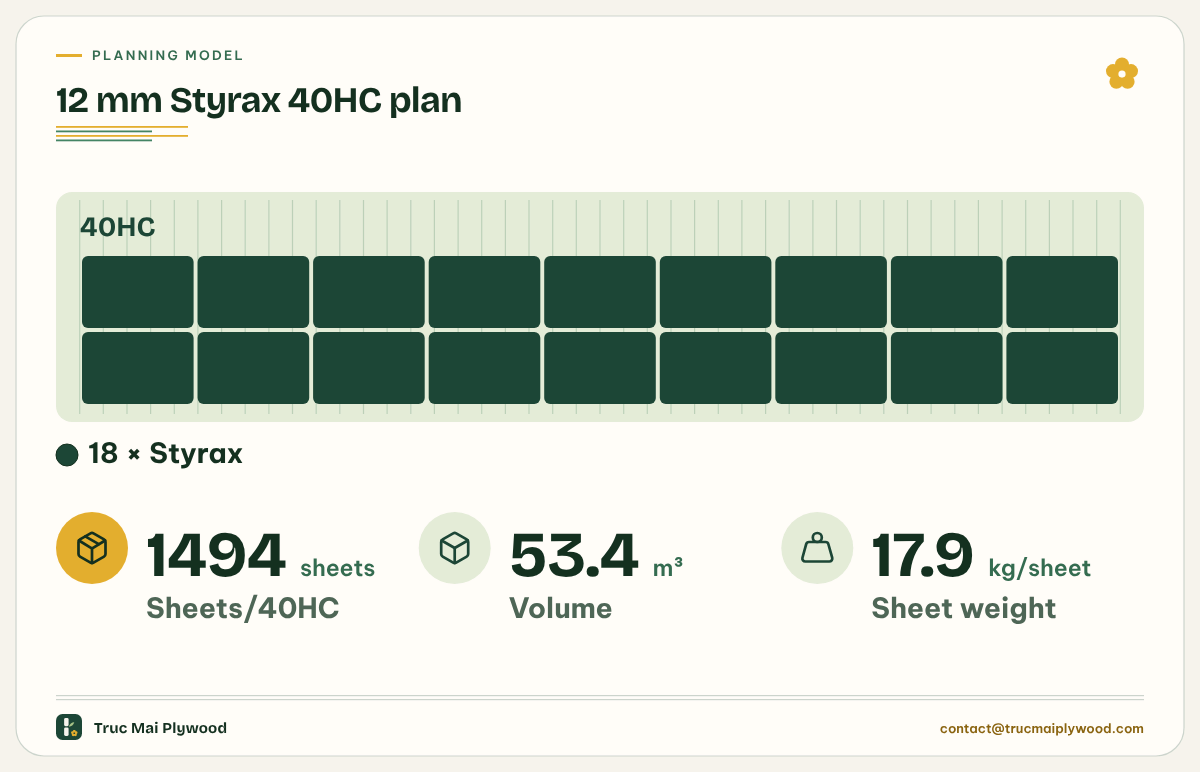
The following 40HC figures are a planning model for bare panels, not mill loading records. The model uses a 1,000 mm pack-height basis, 28,000 kg planning payload, and densities of 500 kg/m³ for Styrax, 580 kg/m³ for Acacia and 650 kg/m³ for Eucalyptus. It limits the planned sheets by pack geometry and panel weight; packaging and the carrier’s booked limit are checked when the actual load is arranged.
The three core columns are deliberately kept separate. A purchasing team can take a row directly into a draft packing schedule and compare how many sheets fit for the same thickness. The full container volume comparison covers the related logistics questions. Figures below preserve every input-model value, including rounded individual-sheet mass and the separate total-mass field.
40HC model: every thickness and core, 1220 × 2440 mm
| Core | Thickness (mm) | Packs | Sheets/pack | Sheets/40HC | Volume (m³) | kg/sheet | Total kg | Weight capped |
|---|---|---|---|---|---|---|---|---|
| Styrax | 3 | 18 | 333 | 5994 | 53.5 | 4.5 | 26760 | No |
| Acacia | 3 | 16 | 333 | 5328 | 47.6 | 5.2 | 27600 | No |
| Eucalyptus | 3 | 15 | 321 | 4815 | 43.0 | 5.8 | 27950 | Yes |
| Styrax | 4 | 18 | 250 | 4500 | 53.6 | 6.0 | 26790 | No |
| Acacia | 4 | 16 | 250 | 4000 | 47.6 | 6.9 | 27620 | No |
| Eucalyptus | 4 | 15 | 241 | 3615 | 43.0 | 7.7 | 27980 | Yes |
| Styrax | 5 | 18 | 200 | 3600 | 53.6 | 7.4 | 26790 | No |
| Acacia | 5 | 16 | 200 | 3200 | 47.6 | 8.6 | 27620 | No |
| Eucalyptus | 5 | 15 | 192 | 2880 | 42.9 | 9.7 | 27860 | Yes |
| Styrax | 6 | 18 | 166 | 2988 | 53.4 | 8.9 | 26680 | No |
| Acacia | 6 | 16 | 166 | 2656 | 47.4 | 10.4 | 27510 | No |
| Eucalyptus | 6 | 15 | 160 | 2400 | 42.9 | 11.6 | 27860 | Yes |
| Styrax | 9 | 18 | 111 | 1998 | 53.5 | 13.4 | 26760 | No |
| Acacia | 9 | 16 | 111 | 1776 | 47.6 | 15.5 | 27600 | No |
| Eucalyptus | 9 | 15 | 107 | 1605 | 43.0 | 17.4 | 27950 | Yes |
| Styrax | 12 | 18 | 83 | 1494 | 53.4 | 17.9 | 26680 | No |
| Acacia | 12 | 16 | 83 | 1328 | 47.4 | 20.7 | 27510 | No |
| Eucalyptus | 12 | 15 | 80 | 1200 | 42.9 | 23.2 | 27860 | Yes |
| Styrax | 15 | 18 | 66 | 1188 | 53.0 | 22.3 | 26520 | No |
| Acacia | 15 | 16 | 66 | 1056 | 47.2 | 25.9 | 27350 | No |
| Eucalyptus | 15 | 15 | 64 | 960 | 42.9 | 29.0 | 27860 | Yes |
| Styrax | 18 | 18 | 55 | 990 | 53.0 | 26.8 | 26520 | No |
| Acacia | 18 | 16 | 55 | 880 | 47.2 | 31.1 | 27350 | No |
| Eucalyptus | 18 | 15 | 53 | 795 | 42.6 | 34.8 | 27690 | Yes |
| Styrax | 21 | 18 | 47 | 846 | 52.9 | 31.3 | 26440 | No |
| Acacia | 21 | 16 | 47 | 752 | 47.0 | 36.3 | 27270 | No |
| Eucalyptus | 21 | 15 | 45 | 675 | 42.2 | 40.6 | 27430 | Yes |
| Styrax | 25 | 18 | 40 | 720 | 53.6 | 37.2 | 26790 | No |
| Acacia | 25 | 16 | 40 | 640 | 47.6 | 43.2 | 27620 | No |
| Eucalyptus | 25 | 15 | 38 | 570 | 42.4 | 48.4 | 27570 | Yes |
| Styrax | 30 | 18 | 33 | 594 | 53.0 | 44.7 | 26520 | No |
| Acacia | 30 | 16 | 33 | 528 | 47.2 | 51.8 | 27350 | No |
| Eucalyptus | 30 | 15 | 32 | 480 | 42.9 | 58.0 | 27860 | Yes |
| Styrax | 40 | 18 | 25 | 450 | 53.6 | 59.5 | 26790 | No |
| Acacia | 40 | 16 | 25 | 400 | 47.6 | 69.1 | 27620 | No |
| Eucalyptus | 40 | 15 | 24 | 360 | 42.9 | 77.4 | 27860 | Yes |
How does the mill cut standard sheets into labelled pieces?
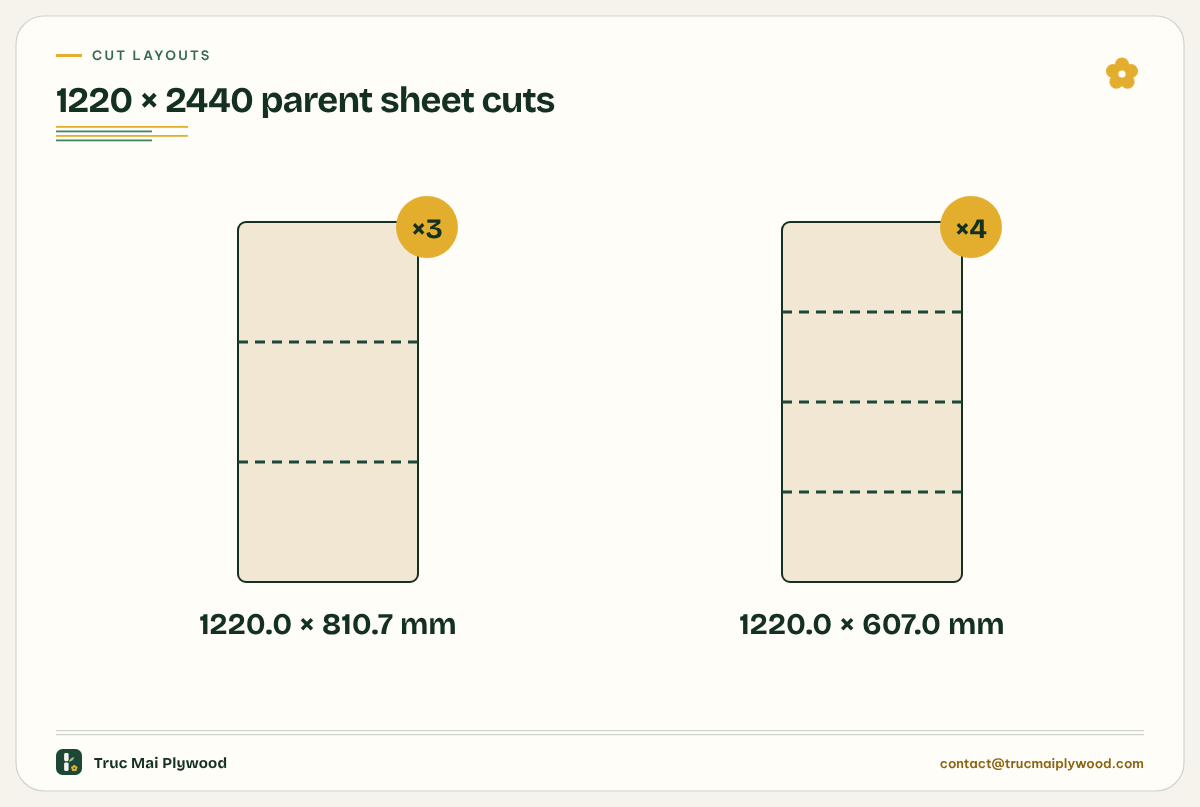
Cut-to-size orders use two, three, four or six pieces per parent sheet. The table below records the input model’s nominal dimensions alongside the modelled dimensions after a 4 mm saw kerf. The finished cutting drawing takes precedence over a nominal division because saw width removes material.
For example, halving the nominal parent width does not give the finished strip width: the supplied saw-kerf model deducts material from the cut. A buyer needing an exact width should send the cut list rather than only the desired number of pieces. Label each part with its assembly reference, identify the face grain direction, and state whether the pieces are to be stacked by size or by cabinet unit. See cut-to-size plywood panels.
| Model ID | Parent | Pieces | Kerf (mm) | Saw cuts | Nominal W × L (mm) | Modelled W × L (mm) |
|---|---|---|---|---|---|---|
| cut2-1220x2440 | 1220x2440 | 2 | 4 | 1 | half width × 2440.0 | kerf-adjusted half width × 2440.0 |
| cut3-1220x2440 | 1220x2440 | 3 | 4 | 2 | 1220.0 × 813.3 | 1220.0 × 810.7 |
| cut4-1220x2440 | 1220x2440 | 4 | 4 | 3 | 1220.0 × quarter length | 1220.0 × 607.0 |
| cut6-1220x2440 | 1220x2440 | 6 | 4 | 3 | half width × 813.3 | kerf-adjusted half width × 810.7 |
What cutting yield does a custom rectangular piece give?
The supplied CALC.json nesting rows derive a custom rectangular piece from either listed parent format; this is a calculated cut size, not a published mill stock dimension. Their percentage is a modelled area yield for that exact layout, not a general yield for mixed cabinet parts. Identical rows are retained because the input contains them separately.
Before committing to a production cutting programme, group components by face veneer, grain direction, finished thickness and edge treatment. Parts with the same outer dimensions may still require different orientation. The cutting list should also state whether a finishing allowance is included in the required final dimension.
| Model ID | Parent | Requested piece | Kerf (mm) | Layout | Pieces | Area yield (%) |
|---|---|---|---|---|---|---|
| piece-custom-from-1220x2440 | 1220x2440 | custom rectangular piece | 4 | 1 across x 1 along (piece turned: piece turned) | 1 | 96.7 |
| piece-custom-from-1250x2500 | 1250x2500 | custom rectangular piece | 4 | 1 across x 1 along (piece turned: piece turned) | 1 | 92.2 |
| piece-custom-from-1220x2440 | 1220x2440 | custom rectangular piece | 4 | 1 across x 1 along (piece turned: piece turned) | 1 | 96.7 |
| piece-custom-from-1250x2500 | 1250x2500 | custom rectangular piece | 4 | 1 across x 1 along (piece turned: piece turned) | 1 | 92.2 |
| piece-custom-from-1220x2440 | 1220x2440 | custom rectangular piece | 4 | 1 across x 1 along (piece turned: piece turned) | 1 | 96.7 |
| piece-custom-from-1250x2500 | 1250x2500 | custom rectangular piece | 4 | 1 across x 1 along (piece turned: piece turned) | 1 | 92.2 |
| piece-custom-from-1220x2440 | 1220x2440 | custom rectangular piece | 4 | 1 across x 1 along (piece turned: piece turned) | 1 | 96.7 |
| piece-custom-from-1250x2500 | 1250x2500 | custom rectangular piece | 4 | 1 across x 1 along (piece turned: piece turned) | 1 | 92.2 |
| piece-custom-from-1220x2440 | 1220x2440 | custom rectangular piece | 4 | 1 across x 1 along (piece turned: piece turned) | 1 | 96.7 |
| piece-custom-from-1250x2500 | 1250x2500 | custom rectangular piece | 4 | 1 across x 1 along (piece turned: piece turned) | 1 | 92.2 |
How many cut pieces does the 40HC model produce?
The following figures multiply the model’s 3 mm parent-sheet quantities by the specified pieces per sheet. They are piece counts for planning a cut programme, not a separate loading measurement. Cutting changes the number of units to handle and label; it does not create additional parent-sheet volume.
Count full sheets, cut pieces and labelled bundles separately on the order and packing list.
| Model ID | Core | Thickness (mm) | Parent | Pieces/sheet | Parent sheets | Cut pieces |
|---|---|---|---|---|---|---|
| cut2-40hc-styrax-3 | Styrax | 3 | 1220x2440 | 2 | 5994 | 11988 |
| cut3-40hc-styrax-3 | Styrax | 3 | 1220x2440 | 3 | 5994 | 17982 |
| cut4-40hc-styrax-3 | Styrax | 3 | 1220x2440 | 4 | 5994 | 23976 |
| cut6-40hc-styrax-3 | Styrax | 3 | 1220x2440 | 6 | 5994 | 35964 |
| cut2-40hc-acacia-3 | Acacia | 3 | 1220x2440 | 2 | 5328 | 10656 |
| cut3-40hc-acacia-3 | Acacia | 3 | 1220x2440 | 3 | 5328 | 15984 |
| cut4-40hc-acacia-3 | Acacia | 3 | 1220x2440 | 4 | 5328 | 21312 |
| cut6-40hc-acacia-3 | Acacia | 3 | 1220x2440 | 6 | 5328 | 31968 |
| cut2-40hc-eucalyptus-3 | Eucalyptus | 3 | 1220x2440 | 2 | 4815 | 9630 |
| cut3-40hc-eucalyptus-3 | Eucalyptus | 3 | 1220x2440 | 3 | 4815 | 14445 |
| cut4-40hc-eucalyptus-3 | Eucalyptus | 3 | 1220x2440 | 4 | 4815 | 19260 |
| cut6-40hc-eucalyptus-3 | Eucalyptus | 3 | 1220x2440 | 6 | 4815 | 28890 |
How should thickness tolerances be written on the order?
Specify the finished nominal thickness and a tolerance against the approved panel sample. Truc Mai’s sanded and calibrated furniture line offers ±0.3 mm; commercial grade is typically ±0.5 mm, and packing grade ±0.5–1.0 mm. Length and width tolerance is ±2 mm.
For tight cabinet joinery, compare a measured sample with the machining programme and state whether coating changes the finished dimension.
The EN 315 dimensional-tolerance standard addresses plywood dimensions as a general European standard; the commercial order should still state the agreed factory tolerance explicitly.
How do face veneers and cores change the specification?
A face name describes the visible veneer, not necessarily the timber inside the panel. Birch-faced plywood uses an imported birch face on a Vietnamese core. Other available faces include engineered veneer, poplar, bleached poplar, okoume, bintangor, pine, eucalyptus, gurjan and sapele.
The core choices are eucalyptus, acacia, styrax, pine and combinations of those species. Core selection influences weight, handling and the look of a machined edge. Specify the face/back pair separately from the core, especially when an importer is comparing samples from different factories. The birch-faced plywood page shows how to describe that construction without implying an all-birch panel.
For visible furniture, request photographs of both surfaces and a cut edge. For veneered parts that will be painted, ask for a sanded reference panel and describe the buyer’s finishing process. For a concealed back, focus on flatness, the core build and the fit of the finished piece rather than a decorative face that will never be seen.
Which glue and emission details belong in a hardwood plywood RFQ?
Glue type, bond performance and formaldehyde emission are three separate specification lines. The standard interior build uses UF glue at E0 emission; moisture-resistant formulations can be specified for a different service requirement. A boiling-water bond test is not an emission test.
The USDA Forest Products Laboratory Wood Handbook chapter on adhesives describes UF as predominantly an interior-panel adhesive with limited resistance to wetting, while phenolic adhesives have a different exterior exposure profile. Name the required bond test when service conditions demand it instead of treating an adhesive name as a test certificate.
For US-regulated hardwood plywood, 40 CFR Part 770 sets a 0.05 ppm formaldehyde emission limit for veneer-core hardwood plywood. Truc Mai holds CARB Phase 2 and TSCA Title VI third-party certification for its veneer-core hardwood plywood from 3 to 25 mm. The Phase 2 emission limits resource gives the related buying context.
What documentation should accompany a bulk furniture-panel order?
The purchase specification should be mirrored in the sample approval, order confirmation and packing documentation. For FSC 100% products within the certified scope, the invoice carries the FSC claim and certificate code. The FSC chain-of-custody standard sets out the sales-document requirements.
For EU due diligence, the mill supplies origin records and geolocation files covering core wood and face veneer. For US shipments, align the regulated panel type and thickness with the applicable emission certification. These document paths are easier to verify when the order identifies the face veneer, core, glue and finished dimensions without relying on an informal product nickname.
A sample should carry the same grade and construction description as the order. If several cabinet components use different panels, assign each a separate line and pack label. This reduces ambiguity when the receiving team checks the container and the production team releases material to machining.
What should a buyer send for a 12 mm plywood quotation?
Send a complete 12 mm specification: intended furniture component, core species, glue and emission class, face/back veneer, finished sheet size, tolerance, sanding, cut list, packing and quantity. Include the destination port and whether the order needs labelled parts.
A clear enquiry can distinguish cabinet carcass panels from visible doors, state which faces will receive a coating and identify the approved appearance sample. If the buyer wants multiple thicknesses, list each line separately rather than requesting one generic hardwood plywood mix. The mill can then prepare a consistent production and packing schedule.
For the next step, use the quotation request with the drawing and component list, or start by ordering plywood samples for the exact face and core combination. Include the required delivery format so the sample and the later order can be compared on the same basis.
Questions buyers ask
Is 12 mm plywood the same as half-inch plywood?
No. Half an inch is 12.7 mm, so a nominal 12 mm metric panel is thinner. Put the exact millimetre requirement on the order.
Can I order 5.5 mm hardwood plywood?
5.5 mm is a trade size, while the listed Truc Mai range includes 5 and 6 mm. Specify whether a finished 5.5 mm panel or an alternative thickness is required.
Is 22 mm hardwood plywood available?
22 mm appears in some merchant catalogues. Truc Mai lists 21 and 25 mm as standard thicknesses, with other specifications discussed against the cut list.
Which face veneer suits a painted cabinet?
A sanded, calibrated furniture face is a practical starting point. Request an approved sample for the paint system and specify whether both faces will be visible.
Can birch-faced plywood have an acacia core?
Yes. Birch describes the face veneer; the core can be acacia or another specified Vietnamese core species.
Do I need a different thickness for cabinet doors and carcasses?
Door size, hinge fixing, finish and carcass span affect the choice. Agree a separate panel specification for each component rather than buying every part at one thickness.
How do I specify face and back quality?
State the face/back grade pair and approve a reference sample. Grade names used by different sellers are not automatically equivalent.
Can a mill label cut pieces for assembly?
Yes. Truc Mai offers labelled cut-to-size panels based on the agreed sheet and cut list.
Is FSC 100% available for plywood orders?
Truc Mai holds FSC chain-of-custody certification FSC-C196493. Eligible FSC 100% products carry the claim and certificate code on sales documentation.
Does a 40HC table include pallet weight?
The planning table here models panels only. Final dispatch planning accounts for packaging, the carrier booking and the actual verified gross mass.