
Plywood 4x4 means a nominal four-foot-square half sheet, described by its nominal four-foot-square footprint. A saw removes material, so two exact halves cannot come from a 1220 × 2440 mm parent without reducing their finished length. Factory-cut panels are specified by finished dimensions, cut pattern and packing quantity, not the nickname alone.
What does plywood 4x4 mean in a purchase order?
Plywood 4x4 is a nominal four-foot-square panel, ordered by its finished width and length in millimetres. It is a convenient half-sheet format for distributors, cabinet workshops and small-project stock. The expression tells you the approximate face area, but not the actual dimensions after sawing, the thickness, the face grade or the construction.
The factory-cut plywood panels programme uses a specified parent sheet and cutting list. It covers furniture and commercial plywood, with the resulting pieces identified for packing. This is useful when a distributor needs repeatable bundles rather than mixed shop-floor remnants.
Which half-sheet dimensions should buyers distinguish?
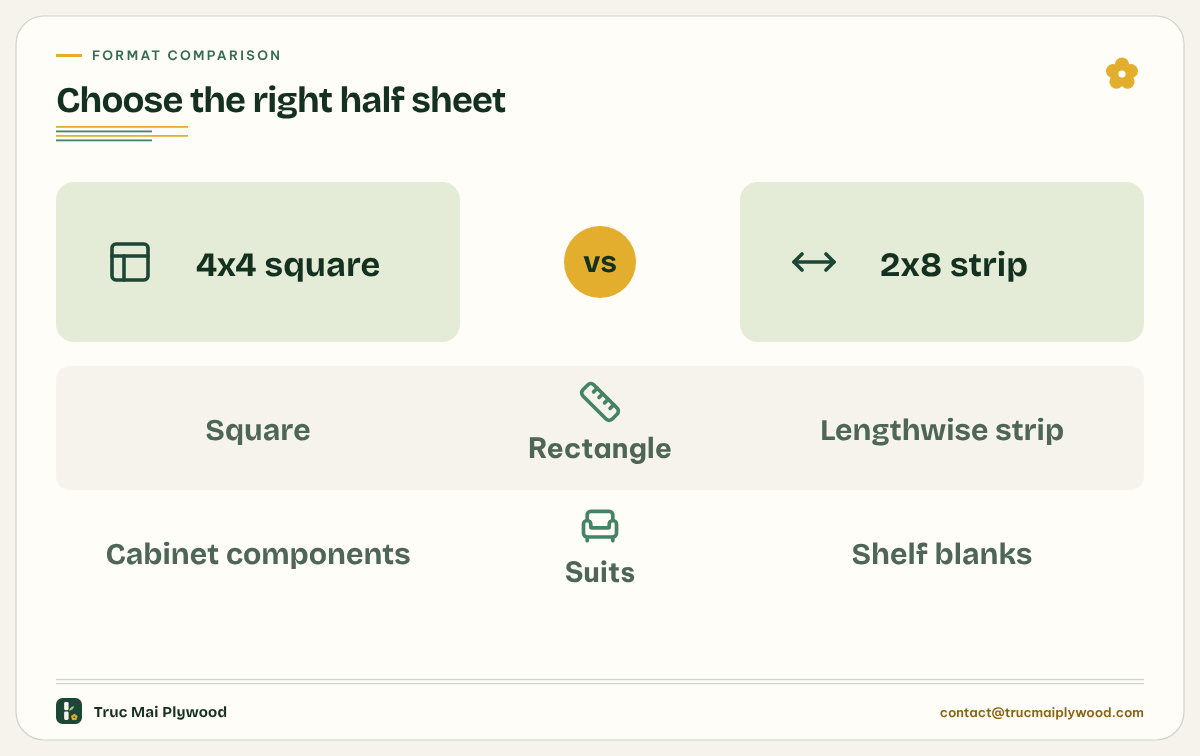
Two different rectangles can each be called a half sheet: a nominal 4x4 square and a nominal 2x8 lengthwise strip. Both represent half the area of a 4x8 parent before blade loss. The shape, however, determines which furniture components can be nested inside it.
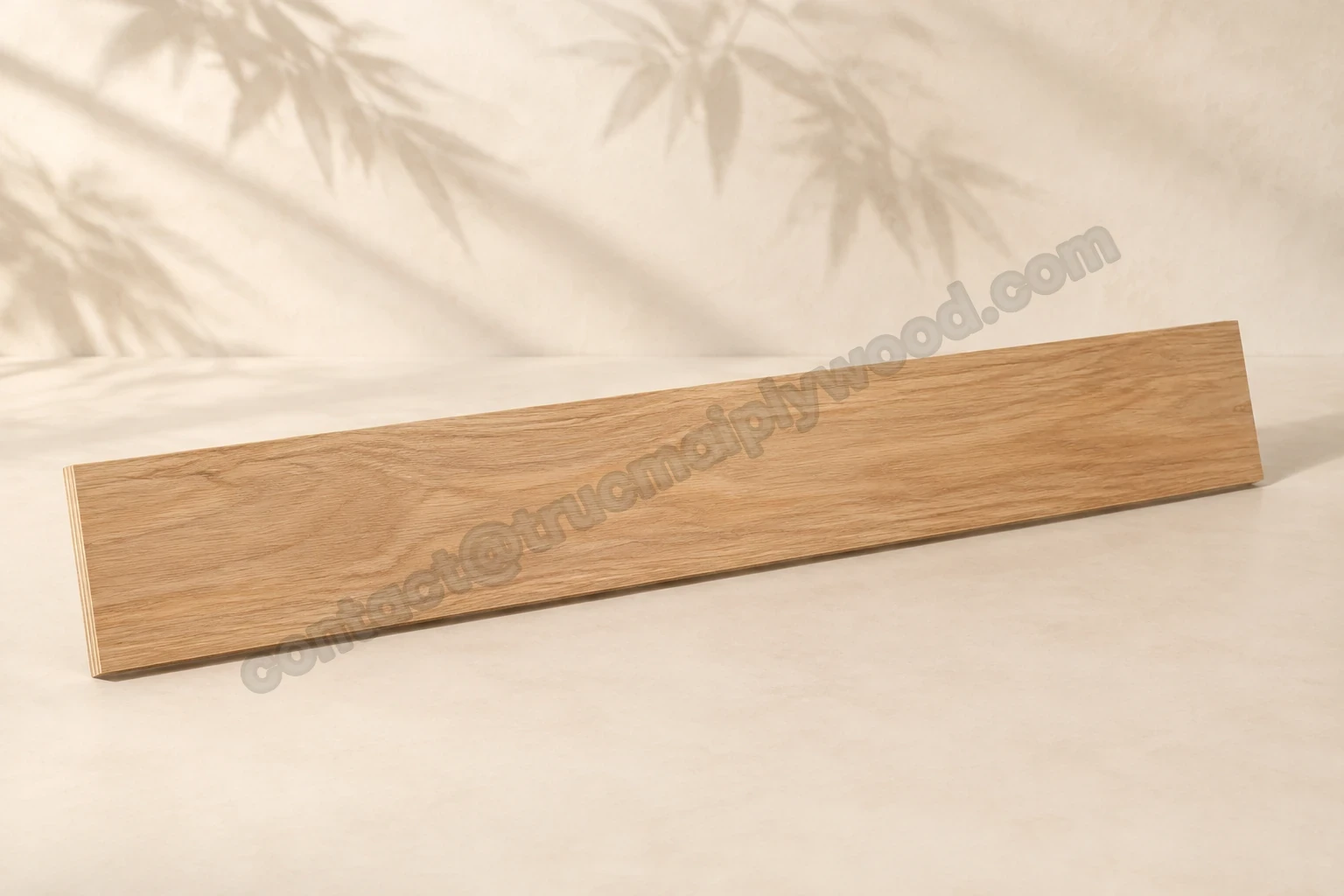
A 4x4 square suits square cabinet components, smaller work surfaces and compact merchandising packs. A 2x8 strip suits long narrow components such as shelf blanks or tall cabinet strips. If a customer says only “half sheet plywood”, ask for the drawing orientation and the longer-edge grain direction.
The trade size 1220 × 2440 mm is also documented in the US National Institute of Standards and Technology’s PS 1-22 structural plywood standard. That document establishes dimensions for a different, structural product category; a furniture plywood order uses its own agreed manufacturing specification.
How does saw kerf change the finished cut size?
A 4 mm saw kerf removes a narrow strip on each cut in the supplied calculation model. Divide the available dimension after subtracting the blade losses, not the original parent dimension. A centre cut across a 2440 mm sheet consumes material, leaving two pieces slightly shorter than the nominal half length.
For repeat orders, write the actual finished measurement in the cut schedule and use the nominal name only for catalogue identification. Where the finished dimension must be exactly 1220 mm square, a 1250 × 2500 mm parent offers additional trimming allowance. It also permits the mill to square the edges before packing.
The table below preserves the supplied cutting model’s figures, including its 4 mm kerf and the direction of the cut. The model’s third-sheet and sixth-sheet layouts are rectangular grid examples, not a universal nesting prescription.
| Pattern | Parent (mm) | Saw cuts | Kerf (mm) | Pieces | Nominal piece (mm) | Modelled finished piece (mm) |
|---|---|---|---|---|---|---|
| 2-way | 1220 × 2440 | 1 | 4 | 2 | 610.0 × 2440.0 | a lengthwise strip, reduced by the saw kerf |
| 3-way | 1220 × 2440 | 2 | 4 | 3 | 1220.0 × 813.3 | 1220.0 × 810.7 |
| 4-way | 1220 × 2440 | 3 | 4 | 4 | 1220.0 × 610.0 | a quarter panel, reduced by the saw kerf |
| 6-way | 1220 × 2440 | 3 | 4 | 6 | 610.0 × 813.3 | 608.0 × 810.7 |
Which 2x4, 6x3, 3x8 and 4x6 formats are useful?
A plywood 2x4 project panel is a nominal two-foot by four-foot rectangle. It is a common format for smaller shelves, drawer components and trial runs. A plywood 6x3 rectangle is longer and wider, often a better match for furniture components that cannot fit a compact square. A 3x8 strip uses the full long direction of a standard sheet while reducing its width.
A 4x6 plywood sheet, also described as a 6x4 plywood sheet or plywood 6 x 4, is a nominal intermediate rectangle. It can be a useful stock-keeping format for a merchant serving workshops that do not need full 4x8 panels. Its cut leaves a remaining area; whether that area can become a second saleable component is a cutting-list decision.
How should a three-piece or six-piece cut be planned?
A three-piece plan divides a parent into repeated panels along the chosen axis; a six-piece plan uses a grid. The model above gives the dimensions for those patterns after blade loss. For a 1200 × 800 mm furniture part, the mill can choose a parent and trim arrangement around that exact required size rather than silently substitute a nominal third.
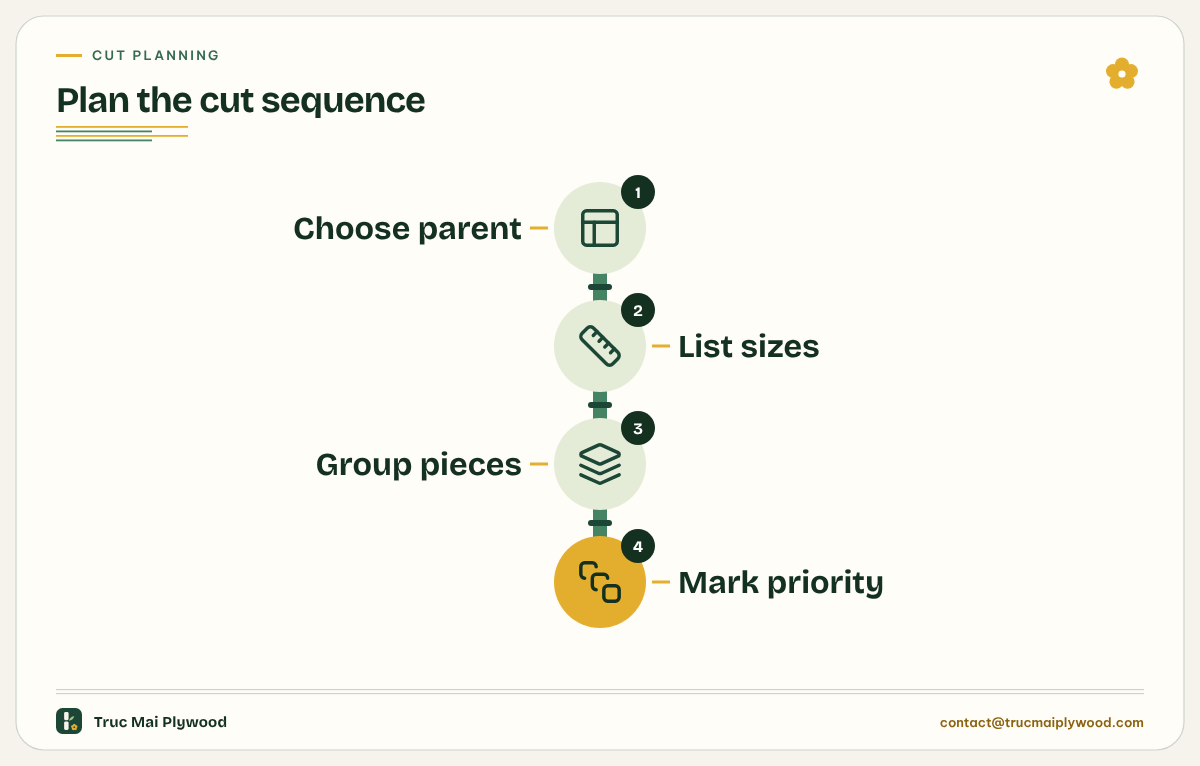
A buyer can send the cut schedule in four steps:
- List each finished panel width and length in millimetres, with the grain direction marked on the drawing.
- Group pieces by common thickness, face/back specification and core so they can come from the same parent construction.
- Mark the priority pieces first, then allocate useful remaining areas to approved smaller parts.
- Specify bundle labels, piece counts and acceptable edge finish before the mill issues the packing plan.
For a narrow custom-width panel, the parent sheet and cut sequence must be chosen to deliver that finished size. A larger European-format parent is an option. The shorter furniture sheets page explains another parent format used when the buyer’s parts are shorter.
When is an offcut usable rather than waste?
An offcut becomes usable stock when it matches an approved component size, face quality and grain direction. Its value comes from having a destination in the order, not merely from being a leftover rectangle. A narrow strip might suit internal drawer dividers; a wider piece might become a box end or cabinet reinforcement.
For example, the modelled 4-way cut produces four quarter panels after kerf allowance from a 1220 × 2440 mm sheet; any remaining usable stock needs its own approved dimensions. Separate usable remnants into their own cut-list lines. Record the finished size and number of pieces, and do not merge them into the main part quantity. This avoids a common receiving problem: the invoice shows one count while the bundles contain several unlabelled shapes.
Which plywood construction should be selected for small panels?
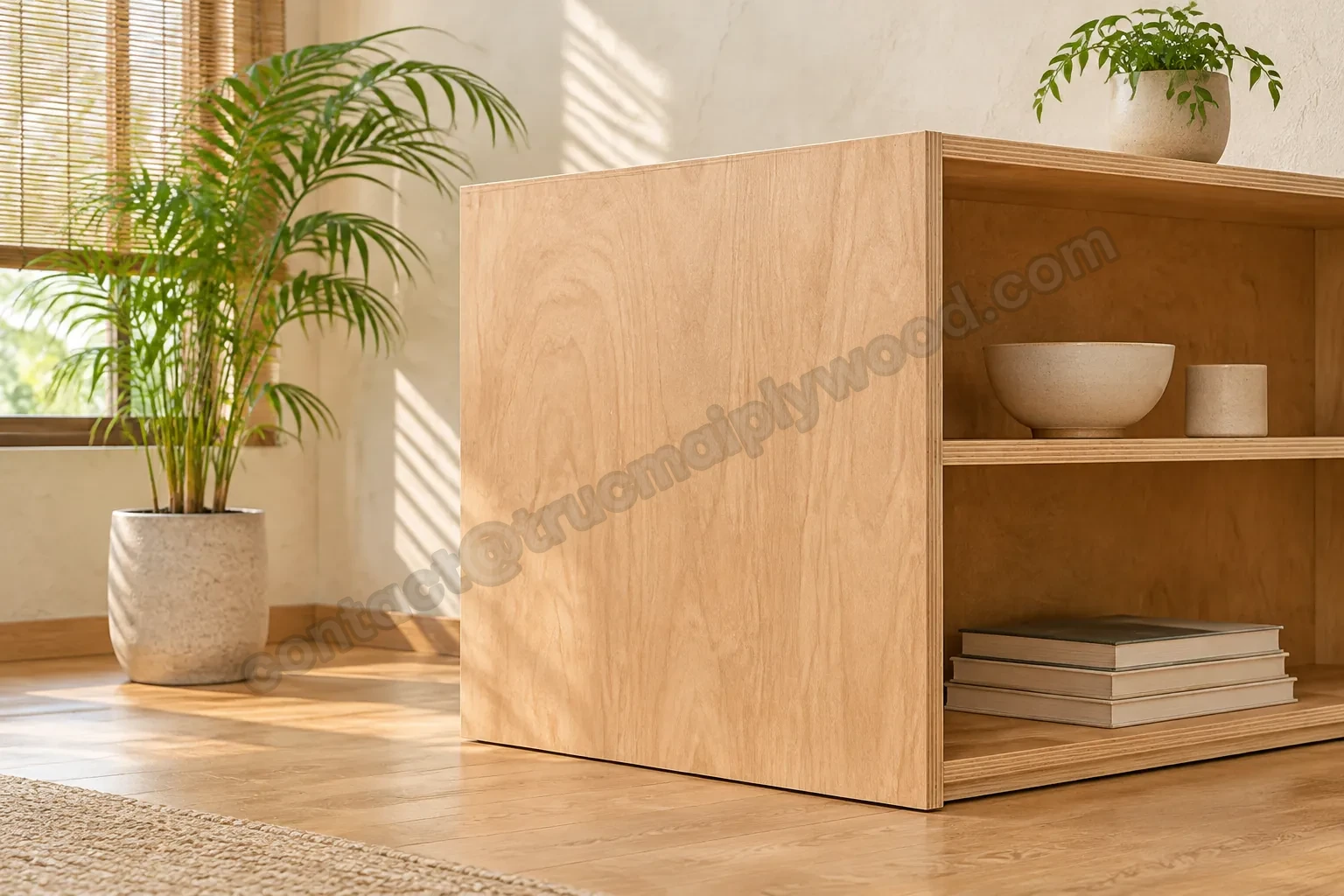
Choose the construction by application, not by the reduced sheet area. Furniture-facing components normally need a more consistent face and prepared surface; hidden packing components can use a different core and surface specification. A cut 4x4 sheet retains the face, adhesive system and core of its parent.
Truc Mai Plywood manufactures furniture/interior and commercial panels using Styrax, Eucalyptus, Acacia or Pine cores and selected combinations. Face options include poplar, engineered veneer, birch, okoume and other agreed decorative veneers. A birch-faced panel has birch veneer on a Vietnamese core, rather than a stack of birch plies.
The USDA Forest Products Laboratory’s Wood Handbook explains why veneer selection, adhesive and layer arrangement affect plywood properties. Those variables remain important even when the finished panel is small. Buyers can use the cabinet plywood selection reference to define visible and concealed furniture parts separately.
What thickness and dimensional tolerance should be written?
Specify the nominal panel thickness and the accepted manufacturing tolerance as separate lines. The available furniture and commercial plywood range is 3–40 mm; common order thicknesses include 3, 4, 5, 6, 9, 12, 15, 18, 21, 25, 30 and 40 mm. The final cut size is recorded in millimetres, with a length/width tolerance of ±2 mm.
For sanded, calibrated furniture panels the thickness tolerance can be ±0.3 mm; other constructions use the tolerance agreed on the order. Small panels are often assembled into boxes or cabinets, where a consistent thickness matters more than the catalogue’s rounded inch label.
The thin plywood panels range is relevant for backs, light dividers and similar interior components. For drawer grooves and rebates, the workshop should design against the agreed actual thickness rather than assume that a nominal inch fraction is an exact conversion.
What do face grain and edge quality change after cutting?
Face grain direction changes the visual result and the way a component is laid out on the parent. A long panel with the grain running along its length may be desirable for a shelf or door component, while a square decorative panel can be rotated to suit the intended appearance.
Mark the visible face and back in the drawing, particularly when the two sides have different grades. For the modelled 2-way lengthwise cut, each strip, reduced in width by the saw kerf, retains the parent face grain orientation. For furniture work, state whether cut edges will be concealed, banded or left visible. The cutting process exposes the veneer layers along the edge, so edge treatment should be chosen with the finished assembly in mind.
How many full sheets fit in a 40HC by core and thickness?
The supplied 40HC model gives different full-sheet counts for Styrax, Acacia and Eucalyptus cores. It uses 1220 × 2440 mm parent sheets, 1,000 mm pack height, a 28,000 kg planning cargo payload and reference core densities of 500, 580 and 650 kg/m³ respectively. Pack allowances are 18 for Styrax, 16 for Acacia and 15 for Eucalyptus, with sheets per pack capped by the model’s weight rule.
The table reproduces all container rows from the supplied calculation, without replacing its rounded values. It is a panels-only planning model; actual booking payload and packed weight determine the final shipping arrangement. For other thicknesses, see container volumes by thickness.
| Core | Thickness (mm) | Parent (mm) | Packs | Sheets/pack | Weight capped | Sheets | m³ | kg/sheet | Total kg |
|---|---|---|---|---|---|---|---|---|---|
| Styrax | 12 | 1220 × 2440 | 18 | 83 | No | 1494 | 53.4 | 17.9 | 26680 |
| Acacia | 12 | 1220 × 2440 | 16 | 83 | No | 1328 | 47.4 | 20.7 | 27510 |
| Eucalyptus | 12 | 1220 × 2440 | 15 | 80 | Yes | 1200 | 42.9 | 23.2 | 27860 |
| Styrax | 15 | 1220 × 2440 | 18 | 66 | No | 1188 | 53.0 | 22.3 | 26520 |
| Acacia | 15 | 1220 × 2440 | 16 | 66 | No | 1056 | 47.2 | 25.9 | 27350 |
| Eucalyptus | 15 | 1220 × 2440 | 15 | 64 | Yes | 960 | 42.9 | 29.0 | 27860 |
| Styrax | 18 | 1220 × 2440 | 18 | 55 | No | 990 | 53.0 | 26.8 | 26520 |
| Acacia | 18 | 1220 × 2440 | 16 | 55 | No | 880 | 47.2 | 31.1 | 27350 |
| Eucalyptus | 18 | 1220 × 2440 | 15 | 53 | Yes | 795 | 42.6 | 34.8 | 27690 |
| Styrax | 21 | 1220 × 2440 | 18 | 47 | No | 846 | 52.9 | 31.3 | 26440 |
| Acacia | 21 | 1220 × 2440 | 16 | 47 | No | 752 | 47.0 | 36.3 | 27270 |
| Eucalyptus | 21 | 1220 × 2440 | 15 | 45 | Yes | 675 | 42.2 | 40.6 | 27430 |
How many cut pieces can a 40HC carry in the planning model?
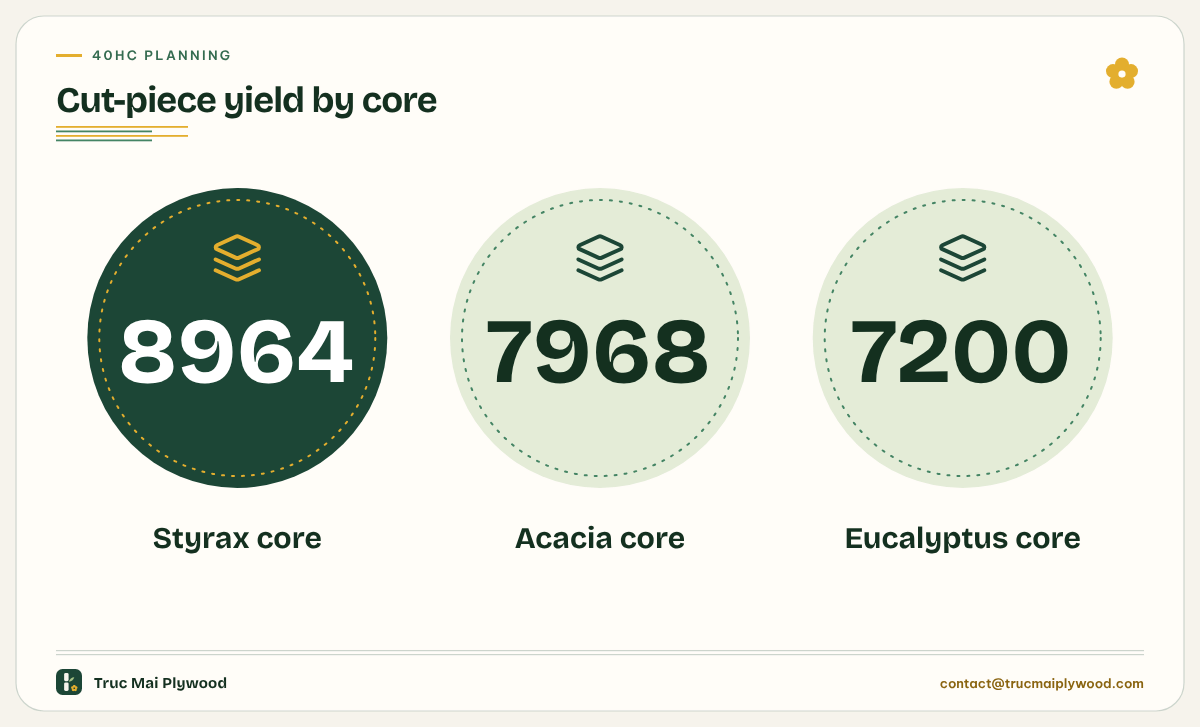
The number of pieces is the number of parent sheets in the model multiplied by the selected two-, three-, four- or six-piece cutting pattern. This is a count of finished pieces from those parent sheets, before allowances for packaging and the final shipping plan. A distributor ordering quarter sheets should compare piece count with bundle size, not with the number of full-sheet packs alone.
The next table reproduces every supplied cut-to-container row for 12 mm parent sheets. All values retain the calculation file’s basis: 4 mm kerf per cut, the same parent-sheet count by core as the container table, and only the four listed cut patterns.
| Core | Thickness (mm) | Parent (mm) | Cut pattern | Parent sheets | Cut pieces |
|---|---|---|---|---|---|
| Styrax | 12 | 1220 × 2440 | 2 | 1494 | 2988 |
| Styrax | 12 | 1220 × 2440 | 3 | 1494 | 4482 |
| Styrax | 12 | 1220 × 2440 | 4 | 1494 | 5976 |
| Styrax | 12 | 1220 × 2440 | 6 | 1494 | 8964 |
| Acacia | 12 | 1220 × 2440 | 2 | 1328 | 2656 |
| Acacia | 12 | 1220 × 2440 | 3 | 1328 | 3984 |
| Acacia | 12 | 1220 × 2440 | 4 | 1328 | 5312 |
| Acacia | 12 | 1220 × 2440 | 6 | 1328 | 7968 |
| Eucalyptus | 12 | 1220 × 2440 | 2 | 1200 | 2400 |
| Eucalyptus | 12 | 1220 × 2440 | 3 | 1200 | 3600 |
| Eucalyptus | 12 | 1220 × 2440 | 4 | 1200 | 4800 |
| Eucalyptus | 12 | 1220 × 2440 | 6 | 1200 | 7200 |
How should small panels be packed and labelled?
Pack small panels by identical finished dimensions and construction. A bundle label should identify the product, thickness, core, face/back grade, dimensions, piece count and order reference. Separating sizes reduces counting errors at the importer’s warehouse and avoids forcing the customer to sort mixed pieces before delivery to a workshop.
The cut plan and packing plan should be reviewed together. The factory may produce multiple sizes from one parent, but the finished pieces can require separate stacks. Shorter panels are easier to handle individually; mixed stacks, however, complicate checking and loading. A sensible order balances cutting yield with repeatable bundle counts.
For container documentation, the commercial invoice and packing list describe the shipped products, while the bill of lading identifies the shipment. The shipping paperwork reference covers the wider document set. Keep the cut schedule aligned with the packing list so a receiving team can reconcile units without reconstructing the original full sheets.
Which quality and emissions documents belong with a cut-panel order?
Specify the same emission and quality requirements for the cut panels as for the parent construction. A cutting operation does not create a new adhesive system or change which thicknesses fall within a certificate’s scope. The buyer should identify the panel build, thickness and destination market before requesting the document set.
For US-bound hardwood plywood with veneer core, 40 CFR Part 770 sets the TSCA Title VI formaldehyde emission limit at 0.05 ppm under the specified testing framework. Truc Mai’s CARB Phase 2 and TSCA Title VI certification covers hardwood plywood with veneer core in the 3–25 mm range; it is identified by certificate CARB/EPA 26053.
FSC 100% is available for eligible products under chain-of-custody certificate SA-COC-014545, with the applicable claim written on sales documentation. For EU imports, the order file can include origin records and geolocation information for both core wood and face veneer. These records should be matched to the ordered material and shipment rather than treated as a generic catalogue attachment.
How should an importer compare factory-cut panels with retail project sheets?
Compare the finished part specification and the handling unit, not just the trade size. Retail project sheets are convenient for buying a few pieces, but their listings may use nominal measurements, thickness filters and mixed face options. A container order is evaluated on uniformity across bundles, packing quantities, construction and documented dimensions.
Start with a sample of the required surface and edge. Inspect the visible face, back, flatness, thickness and cut squareness. Then compare the mill’s proposed cutting diagram with the buyer’s component drawing. The best yield on paper is unhelpful if the resulting parts have the grain turned the wrong way or require further trimming at the destination.
The ordering samples page explains how to arrange physical samples. The National Institute of Standards and Technology’s voluntary product standards programme distinguishes voluntary structural plywood standards from the commercial specification a buyer agrees with a supplier. That distinction matters when comparing unrelated retail categories.
What should be included in a factory cut-to-size RFQ?
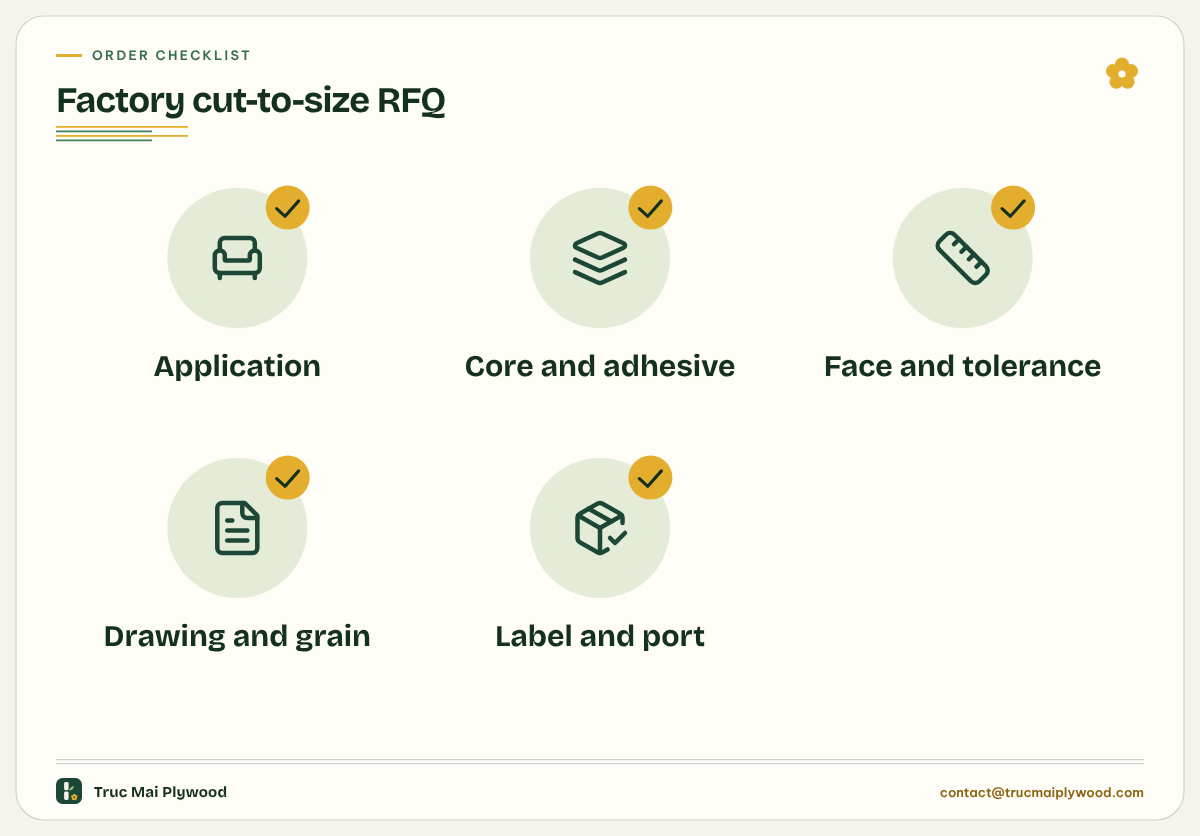
A workable request for quotation contains the intended application, exact finished sizes, plywood construction, quantity per size and packing instructions. Those details let the mill select the parent format and prepare a cut schedule before production.
Write the request in this order:
- State the application: cabinet, drawer, furniture component, shop stock or packing panel.
- Give the core species or acceptable alternatives, then the adhesive and emission specification.
- Define the face and back, surface preparation, thickness and dimensional tolerance.
- Attach the finished-size drawing, grain direction and quantity for each two-, three-, four- or six-piece layout.
- Identify how each size should be labelled and bundled, the total container mix and the destination port.
- Request a sample and the proposed cut diagram for approval alongside the order specification.
Use the plywood RFQ checklist to keep the fields consistent between suppliers. Truc Mai’s standard minimum order is one 40HC; production is normally 15–45 days after the agreed deposit. Send the cut list and intended application with the quotation request so the response can be based on a buildable packing plan.
Send your specification to contact@trucmaiplywood.com or through the quotation form.
Questions buyers ask
Can a 4x4 sheet fit in a passenger car?
A nominal 4x4 panel is roughly 1220 mm square. Measure the vehicle opening and the actual finished panel before arranging collection.
Is 4x4 plywood the same as a quarter sheet?
No. A 4x4 panel is nominally half the area of a 4x8 sheet; a 2x4 panel is nominally one quarter.
Can the mill label different cut sizes separately?
Yes. Put each finished size, quantity and identification on the cut list so bundles can be labelled for receiving.
Are 6x4 and 4x6 plywood the same?
Both names describe the same nominal rectangle rotated. Specify which direction the face grain should run relative to the longer edge.
Can plywood offcuts be included in an order?
Useful remnants can be assigned to an approved secondary part in the cutting schedule. List their accepted dimensions separately from the primary parts.
Can I order a 4x4 birch sheet with a Vietnamese core?
Yes. Specify birch-faced plywood and the required core, rather than assuming an all-birch construction.
Does the cut change the plywood emission classification?
Cutting changes panel dimensions, not the original tested adhesive or core construction. Match the certificate to the ordered panel type and thickness.
Can thin plywood be cut into small panels?
Yes. Factory cutting can be specified for thin furniture and commercial plywood, with the part dimensions and edge finish on the order.
Should the drawing show the nominal or finished size?
Show the finished size in millimetres, including the permitted tolerance. Put the nominal trade name in a separate description field.
How should small panels be identified at delivery?
Identify bundles by product, face/back, core, thickness, finished width and length, quantity and purchase-order reference.