
For 5/8 vs 3/4 plywood, choose 15 mm for supported cabinet parts and 18 mm for longer shelves, heavily loaded bases and hardware-intensive joints. The inch fractions are not exact names for those metric sizes. Compare finished thickness, core construction and loading before changing a cutting list or ordering a container.
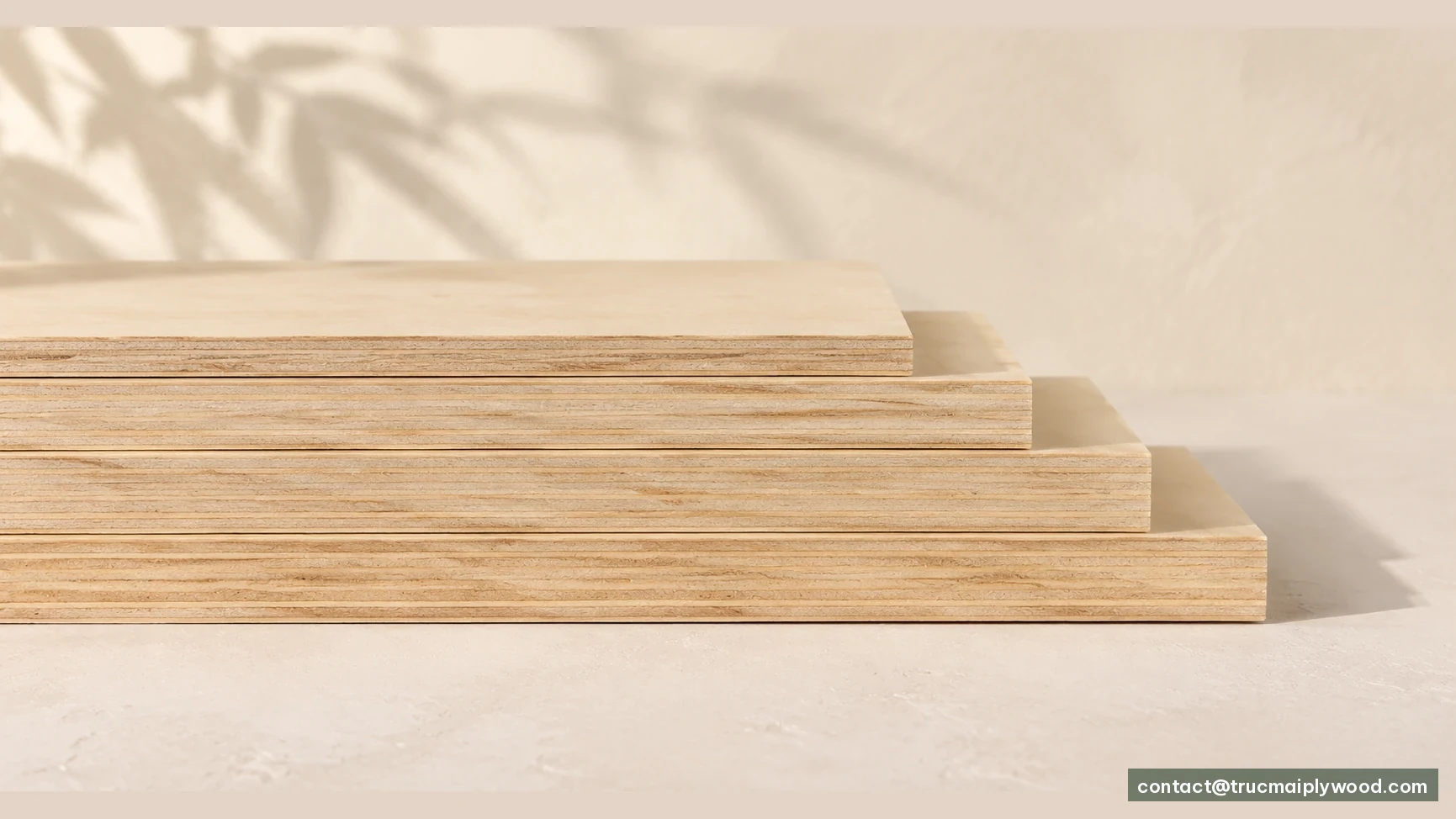
What does 5/8 vs 3/4 plywood mean in millimetres?
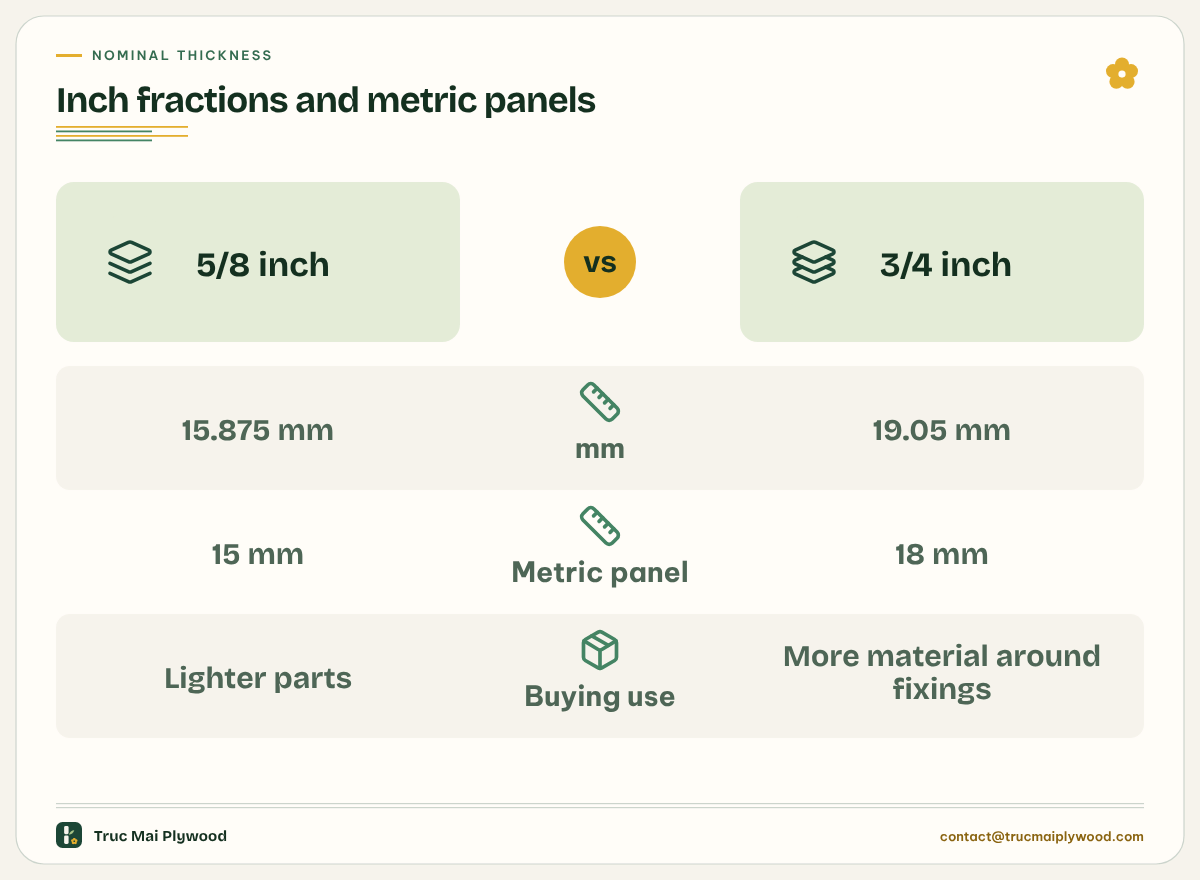
5/8 inch is 15.875 mm and 3/4 inch is 19.05 mm, a difference of 3.175 mm. Metric furniture panels sold as 15 mm and 18 mm are thinner than those exact inch fractions. Specify finished thickness on cabinet drawings and purchase orders so grooves, exposed edges and hinge positions match the supplied panels.
| Dimension | Fractional inch designation | Metric furniture panel | Buying implication |
|---|---|---|---|
| Thinner option | 5/8 in = 15.875 mm | 15 mm | Lighter parts and more sheets per shipment |
| Thicker option | 3/4 in = 19.05 mm | 18 mm | More material around fixings and greater section stiffness |
| Difference | 1/8 in = 3.175 mm | 3 mm | Recheck grooves, edge banding and hardware |
The NIST PS 1-22 structural plywood standard uses performance categories with permitted thickness ranges. That structural classification is useful for understanding why an inch label is not an exact calliper reading; it does not turn an interior furniture panel into structural plywood. For metric purchasing, use the drawing’s finished dimension.
Which thickness works better for cabinet sides?
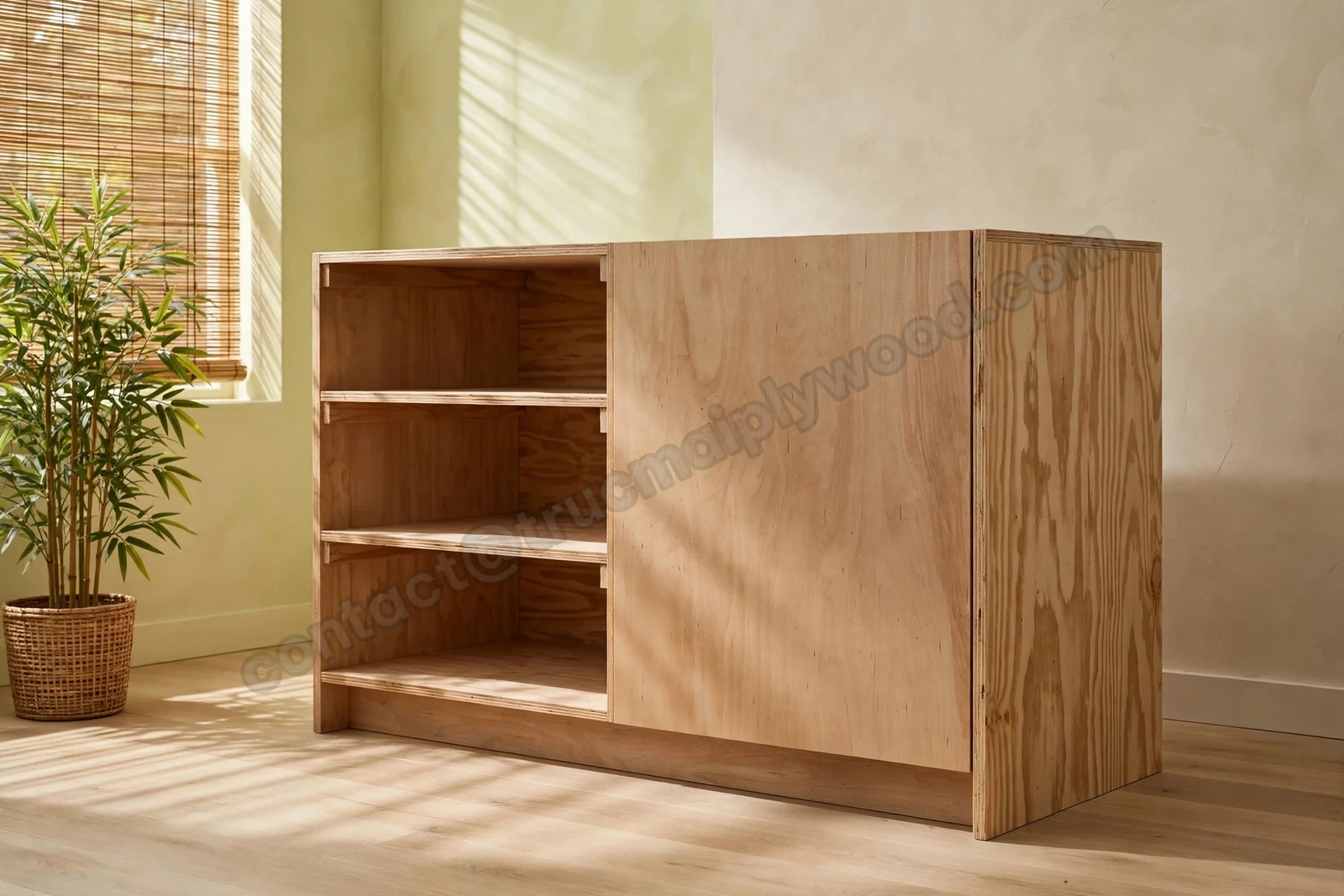
18 mm is the safer starting point for a tall cabinet side carrying shelves, doors and fittings; 15 mm works well in compact, adequately supported carcasses. The side panel does more than cover an opening. It locates shelves, takes fasteners, holds hinges or mounting plates, and keeps the box square when moved.
For a tall wardrobe, a long pantry unit or a cabinet with several adjustable shelves, the extra section gives the designer more room for fittings and a stiffer wall. For a short bedside unit with a rigid back and closely fixed top and bottom, 15 mm may provide the required performance with less material. Both choices should be judged against the actual assembly, not the thickness label alone.
An efficient factory drawing separates the exposed side from internal dividers. The exposed side may need an attractive veneer and calibrated surface, while an internal divider can use a different face grade. See cabinet plywood selection for the wider specification choices.
Which is better for shelves that carry books or crockery?
18 mm is generally preferable for a long or heavily loaded shelf; 15 mm suits shorter shelves with close supports. Shelf deflection is often the visible failure: a panel can remain intact yet sag enough to look poor or interfere with a door.
The USDA Forest Products Laboratory Wood Handbook covers the mechanical properties of wood-based panels and the equations used to analyse bending. For an otherwise identical rectangular section, bending stiffness rises strongly with thickness. That comparison is a geometry principle, not a tested load rating for any particular plywood.
A shelf’s clear span, support condition, loading duration, veneer direction and core lay-up all matter. A fixed shelf joined into both sides behaves differently from a loose shelf resting on four pins. A solid front lipping can stiffen an edge; a narrow shelf carrying cups is a different problem from a deep bookcase shelf. Request a representative shelf test or a design calculation for the proposed span instead of copying an unsupported universal weight limit.
Can 15 mm replace 18 mm in a kitchen cabinet?
Yes, in selected supported components, but not as a blanket substitution throughout the cabinet. Start with the actual function of each part and the joint detail. A side with a rigid back, a short fixed divider and a lightly loaded infill panel do not face the same demands as a wide sink-unit base or a long shelf.
A practical substitution review follows this order:
- Mark each part as side, base, top, shelf, divider, back or door.
- Record clear spans, supports and the heaviest expected use.
- Check screw engagement, dowel position, hinge fixing and groove depth.
- Verify edge-banding width, finished dimension and face grade.
- Prototype the parts that govern stiffness or joint performance before releasing the revised cutting list.
This part-by-part approach avoids paying for excess material where the cabinet does not need it, while retaining thickness where it contributes to fit and service life. The furniture and interior plywood range covers both thicknesses with selectable faces and cores.
How do 15 mm and 18 mm compare for doors and hinges?
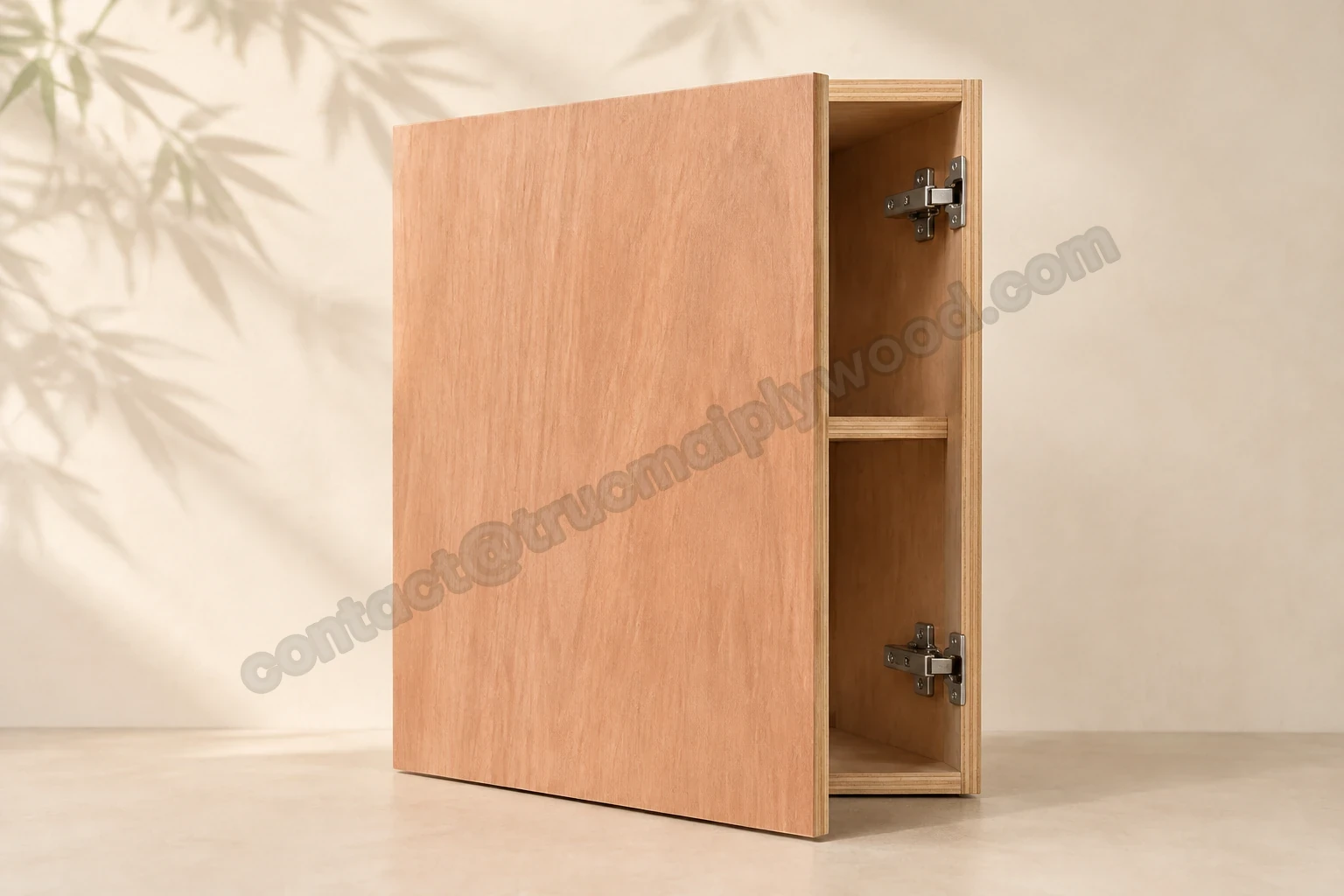
18 mm gives more material around hinge and fixing details; 15 mm can suit doors designed for thinner stock. A cabinet door is a moving panel, so weight, flatness, edge integrity and the hardware system all enter the decision. A thicker door may feel more substantial but also puts more weight on its hinges.
Check the hardware manufacturer’s minimum door thickness, cup depth, boring distance and screw length. A hinge cup that is appropriate in one thickness can leave too little material beneath the recess in another. A framed or narrow door may accept a thinner panel; a large flat door needs careful attention to balanced face construction and storage conditions.
Specify both faces, not just the visible face. A balanced panel finish and a consistent lay-up help the fabricator manage flatness. The approved sample should show the surface appearance and the edge that the customer will see after trimming.
Is 16 mm vs 18 mm plywood the same comparison?
No. The 16 mm vs 18 mm choice is a smaller dimensional change than 15 mm vs 18 mm, although the same design checks apply. A 16 mm callout is a separate specification, not a convenient label to attach to any panel sold as 5/8 inch.
North American drawings often use fractional categories while European cabinet software and hardware catalogues frequently work in millimetres. An imported cabinet programme can therefore contain a mix of nominal inch names and exact metric machining instructions. Keep a single unit system in the production drawing and put the required finished panel thickness on every item.
When a buyer requests a thickness outside a mill’s listed standard set, ask for the available calibrated build and a sample. The thickness selection overview is a useful starting point for separating a nominal category from a finished dimension.
Does a thicker panel always mean stronger plywood?
No. Thickness increases section capacity in a comparable construction, but core quality and lay-up can outweigh the label. A well-made 15 mm sheet with sound bonded veneers may outperform a poorly made thicker panel in an application that is sensitive to voids, delamination or screw holding.
Inspect a clean cross-section for gaps, overlapping veneers and inconsistent core thickness. For furniture panels, look at whether core plies are stitched or jointed and whether the face has been properly sanded. Truc Mai Plywood offers Styrax, Acacia, Eucalyptus and Pine cores, with combined constructions available for different weight and appearance targets.
Ask for the face/back grade pair, the core construction and the adhesive system as separate order lines. The term hardwood plywood describes a broad product family; it is not a bending-strength certificate. Where an assembly has a demanding load requirement, a tested build and an agreed acceptance method are more useful than a species name alone.
How much does the core change sheet weight?
Core selection changes weight even when the sheet dimensions and thickness stay fixed. A lighter core makes handling easier and can allow more volume in a shipping container. A denser core may suit a buyer’s machining or fixing preferences, but density is only one characteristic of a finished panel.
The loading model below uses reference core densities of 500 kg/m³ for Styrax, 580 kg/m³ for Acacia and 650 kg/m³ for Eucalyptus. Those are planning inputs rather than a weighing report for an individual order. Face veneers, adhesive, moisture and the particular core mix affect the measured sheet weight.
For buyers supplying cabinet workshops, sheet weight affects manual handling, rack design and the number of panels that can be moved per trip. Compare like with like: identical sheet size, nominal thickness and face specification. The 15 mm sheet specification and 18 mm sheet specification can be used as adjacent purchasing references.
How many 15 mm and 18 mm sheets fit in a 40HC?
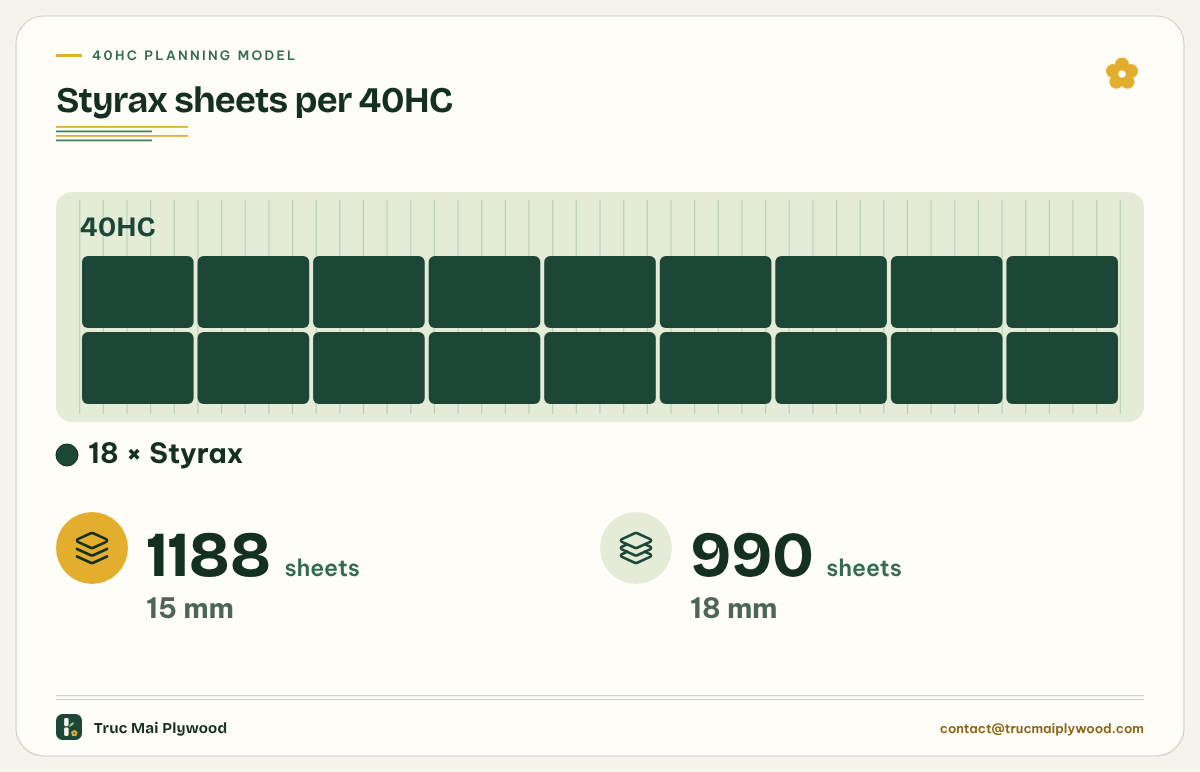
The planning count is higher for 15 mm sheets than for 18 mm sheets within the same core and pack arrangement. The following table reproduces every supplied calculator row, including the 12 mm reference that helps buyers compare a lighter component. All panels are 1220 × 2440 mm.
| Core | Thickness (mm) | Packs | Sheets/pack | Sheets/40HC | Volume (m³) | kg/sheet | Total kg | Weight capped |
|---|---|---|---|---|---|---|---|---|
| Styrax | 12 | 18 | 83 | 1494 | 53.4 | 17.9 | 26680 | No |
| Acacia | 12 | 16 | 83 | 1328 | 47.4 | 20.7 | 27510 | No |
| Eucalyptus | 12 | 15 | 80 | 1200 | 42.9 | 23.2 | 27860 | Yes |
| Styrax | 15 | 18 | 66 | 1188 | 53.0 | 22.3 | 26520 | No |
| Acacia | 15 | 16 | 66 | 1056 | 47.2 | 25.9 | 27350 | No |
| Eucalyptus | 15 | 15 | 64 | 960 | 42.9 | 29.0 | 27860 | Yes |
| Styrax | 18 | 18 | 55 | 990 | 53.0 | 26.8 | 26520 | No |
| Acacia | 18 | 16 | 55 | 880 | 47.2 | 31.1 | 27350 | No |
| Eucalyptus | 18 | 15 | 53 | 795 | 42.6 | 34.8 | 27690 | Yes |
Model basis: 40HC planning model, panels only. Packs per core: Styrax 18, Acacia 16, Eucalyptus 15. Pack height is 1,000 mm; sheets per pack are the rounded-down pack-height/thickness result, then capped against a 28,000 kg planning cargo payload. Reference densities are Styrax 500, Acacia 580 and Eucalyptus 650 kg/m³. The carrier and route set the shipment limit; actual packing also includes pallet and wrapping weight. These are planning figures, not a loading record.
Notice that the change in thickness primarily changes the count of usable sheets. The planned cubic metres remain much closer within each core than across the three cores. A purchasing team ordering cabinet components should therefore compare parts produced per sheet as well as sheets per container. See the container volume reference for the broader thickness range.
How should a buyer compare sheet yield and waste?
Compare finished usable components per standard sheet, not simply the area of the incoming board. A thinner sheet can reduce the amount of plywood used per part, but the layout still determines how many parts come off a sheet. Grain direction, visible-face orientation, edge trimming and saw kerf decide whether a cutting pattern is practical.
For a cabinet programme, group the cutting list by thickness first. Within each thickness, separate parts requiring a continuous decorative grain from parts where rotation is acceptable. A large door may consume the same footprint in either thickness, while a batch of small dividers can be nested more efficiently if the workshop standardises their dimensions.
Mill cut-to-size options include lengthwise halves at 610 × 2440 mm, thirds at 1200 × 800 mm and quarters at 1220 × 610 mm, as well as six-piece arrangements. The exact part dimensions and labels are agreed from the customer’s cutting list and parent sheet. Request a cutting diagram that shows kerf, trimming and grain direction before comparing yields.
What changes in machining and edge finishing?
The thickness change affects tooling settings, grooves, edge banding and assembly tolerances. A CNC programme built for one panel thickness can produce a loose joint or an uneven face if it is run unchanged on another. The cutting geometry may look identical on screen while the depth reference is wrong.
Check the actual calibrated panel with a calliper at several positions before a production run. Truc Mai’s sanded furniture panels can be specified at ±0.3 mm thickness tolerance; other constructions are written to the order. The aim is to give the machining team a repeatable finished dimension, not just a label printed on a pack.
For exposed plywood edges, review the visible ply pattern and the surface finish. For edge-banded components, the band width and trimming allowance must match the finished panel. For dowelled or screwed joints, verify hole centrelines and remaining material. A single trial assembly is often more revealing than a stack of nominal dimensions on a purchase sheet.
Which face and core should be specified for interior furniture?
Choose the face for appearance and the core for the part’s machining, weight and construction needs. A birch-faced panel has a birch surface veneer, not necessarily a birch core. Other available face choices include engineered veneer, Poplar, bleached Poplar, Okoume, Bintangor, Pine, Eucalyptus, Gurjan and Sapele.
A pale engineered veneer can suit a consistent interior finish, while a natural veneer makes grain character part of the design. If the buyer will apply its own UV coating, request a UV-ready sanded face. If the final component needs a factory-applied decorative surface, specify melamine or HPL facing as its own line item.
Approve the face and back together, preferably against a physical sample. A cabinet maker should also ask whether the core is stitched and how it is sanded. These details influence edge appearance and the quality of machining even when the invoice names the same thickness and wood species.
Do glue and emissions requirements change with thickness?
Glue bond performance and formaldehyde emissions are separate specifications for either thickness. A furniture panel made with UF resin at E0 emission has an adhesive description and an emission description; neither automatically supplies a moisture-exposure rating.
For US hardwood plywood with veneer core, 40 CFR Part 770 sets a 0.05 ppm formaldehyde emission standard under TSCA Title VI. The brand’s CARB Phase 2 and TSCA Title VI certification covers veneer-core hardwood plywood in the 3–25 mm range, which includes the two sizes discussed here. The certification scope and the buyer’s actual panel build should match the order documents.
For an interior cabinet, specify the use environment and the adhesive system separately from the required emission documentation. An occasional damp cleaning environment is not the same as continuous water exposure. A test method and report for the agreed configuration make the comparison more meaningful than shorthand labels alone.
What should be written on the 15 mm or 18 mm purchase order?
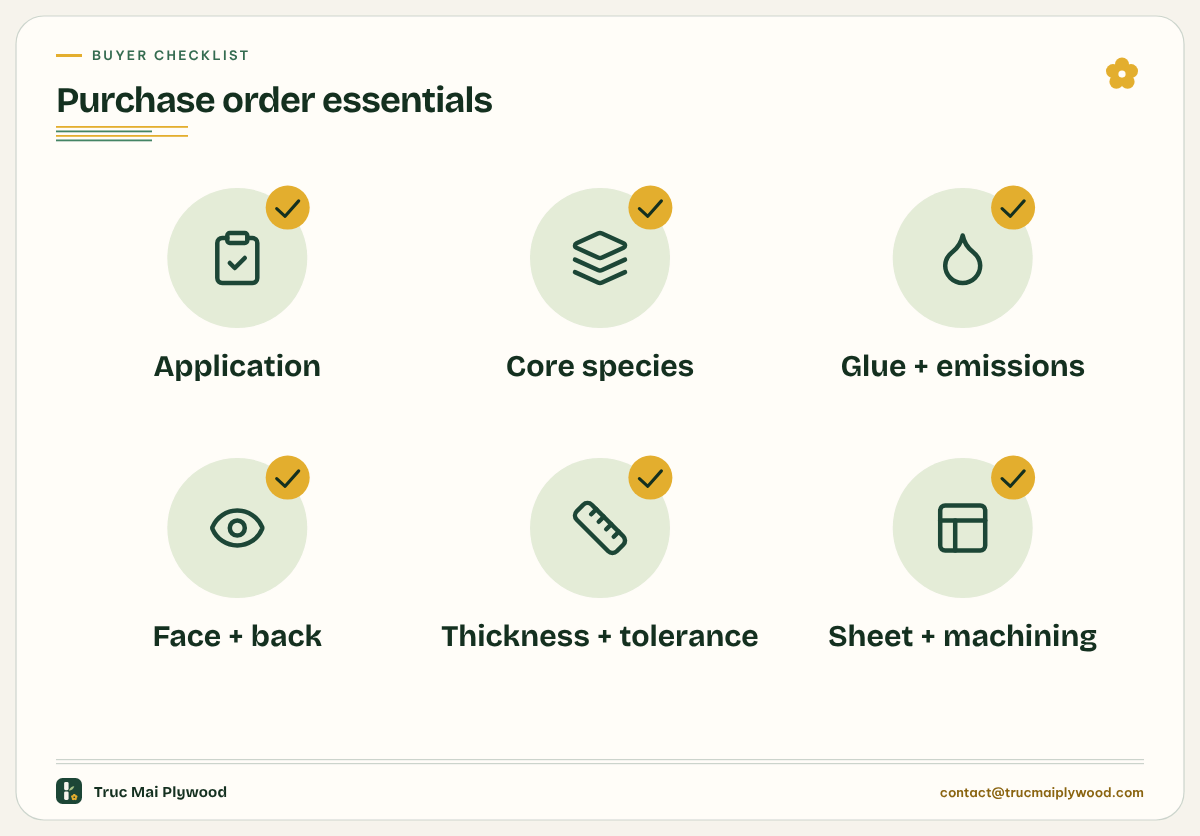
Write a complete panel specification, with thickness as one line rather than the whole product description. This is especially important when a factory is supplying a mix of cabinet carcass parts, decorative doors and interior dividers.
- State the application and the component type, including any critical shelf span.
- Identify the core species or approved mixed-core construction.
- State the adhesive system and emission requirement as distinct items.
- Name the face/back veneer or overlay and the approved appearance sample.
- Give the finished thickness, tolerance, sheet dimensions and machining direction.
- Attach the cutting list, part labels, packing instructions, quantities and destination port.
For a first order, ordering plywood samples helps establish the approved edge and surface. The plywood RFQ checklist turns these details into a quotation-ready specification. Truc Mai Plywood manufactures furniture and commercial plywood in Ha Hoa, Phu Tho, Vietnam, with production capacity around 60,000 m³ per year. Send the application, core, glue/emission requirement, face, dimensions, packing, quantity and port to contact@trucmaiplywood.com for a matched 15 mm or 18 mm offer.
Send your specification to contact@trucmaiplywood.com or through the quotation form.
Questions buyers ask
Can I use 15 mm plywood for a cabinet back?
Yes. A framed cabinet back can use 15 mm plywood where its fixing pattern and service load suit the design; many backs need less material.
Is 18 mm plywood the same as 3/4 inch?
No. An 18 mm sheet is a metric product, while 3/4 inch is 19.05 mm as a fraction. Specify finished thickness on the purchase order.
Is 15 mm plywood the same as 5/8 inch?
No. A 15 mm sheet is thinner than the 15.875 mm mathematical equivalent of 5/8 inch.
Can 15 mm panels be used for cabinet doors?
Yes, for suitable door dimensions, hinge details and face construction. Check the door maker’s hardware requirements and the panel’s flatness.
Which plywood makes a lighter drawer?
A 15 mm panel of the same core, face and area weighs less than an 18 mm panel. Drawer bottoms can often use an even thinner design.
Can a factory mix 15 mm and 18 mm in one shipment?
Yes. Mixed thicknesses can be packed by agreement with a separate count and marking for each item.
Does sanding change the stated plywood thickness?
Sanding removes surface material, so the purchase order should specify finished thickness and tolerance rather than the unsanded blank.
Should I choose a denser core for stronger shelves?
Core density alone does not establish bending strength. Compare tested panel properties, lay-up, span and load for the proposed shelf.
What does a face/back grade pair mean?
It identifies the appearance specification of each surface. Agree the grade pair against an approved sample before production.
Can I request labelled cut-to-size parts?
Yes. Send the cutting list, orientation and labels with the sheet specification so parts can be packed for assembly.