
Reconstituted veneer is real wood reorganised into a repeatable decorative grain. Thin wood sheets are coloured, bonded into a block and sliced again to create consistent faces for furniture plywood. Buyers choose it when cabinets, doors and fitted interiors need a coordinated appearance across panels and repeat orders, while specifying the core and adhesive separately.
What is reconstituted veneer?
Reconstituted veneer is genuine wood that has been reorganised to produce a selected, repeatable grain pattern. It is also called recon veneer, engineered veneer or EV. The manufacturing process changes the arrangement and colour of thin wood leaves, rather than printing an imitation on plastic. A decorative face can resemble a familiar timber figure or present a deliberately uniform pattern. The wood fibres remain visible in the finished surface.
For EV plywood and available face constructions, the veneer is bonded to a plywood core. Truc Mai Plywood offers white poplar EV made from plantation poplar (Populus deltoides) as a decorative face for furniture and interior panels. The face is sourced as veneer; the plywood construction is produced at the mill in Ha Hoa, Phu Tho, Vietnam.
How is engineered veneer made?
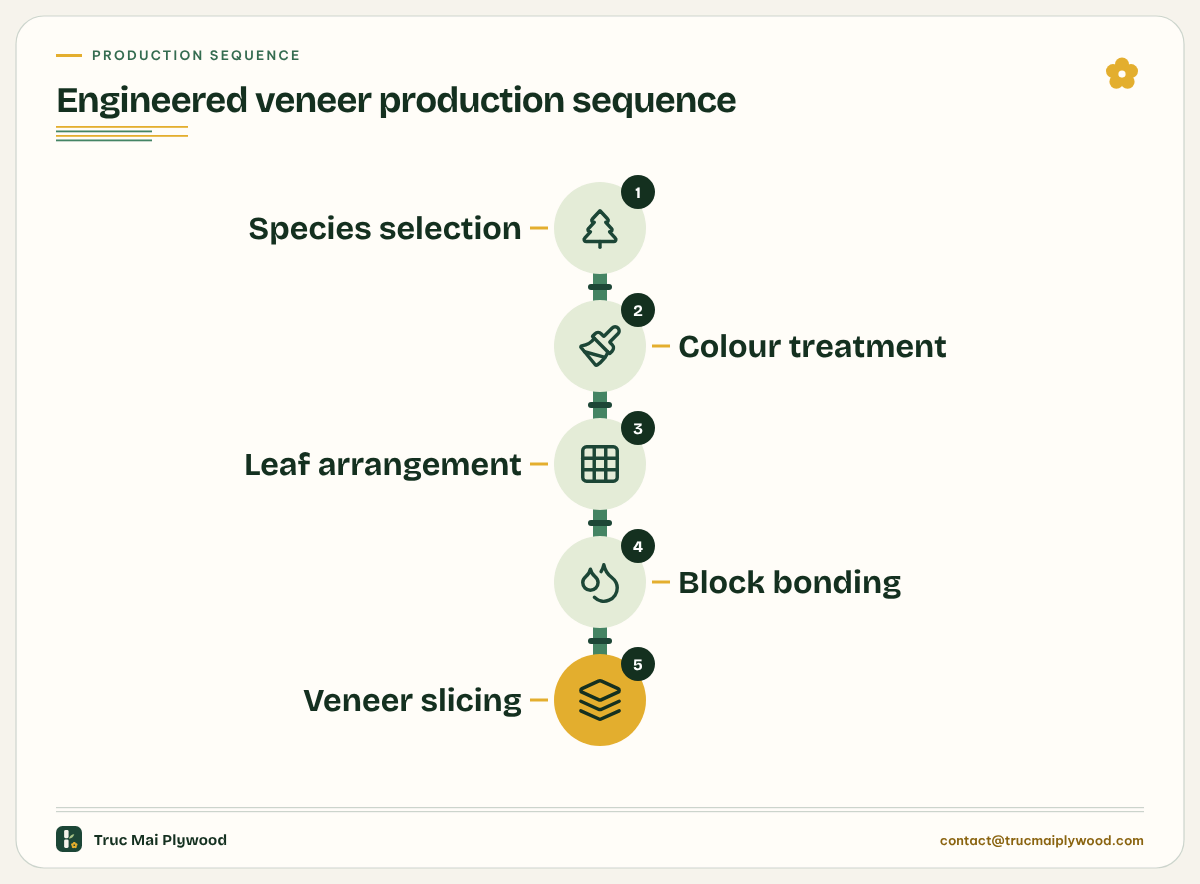
Engineered veneer is made by colouring thin wood veneers, assembling them in a controlled sequence, bonding the stack and slicing the resulting block into new decorative sheets. The grain design comes from the orientation, thickness and colour of the leaves in the reconstructed block. This is why repeat runs can have a more coordinated appearance than unrelated natural logs.
- Select and prepare wood leaves. The processor chooses a suitable wood species and prepares sheets with consistent handling characteristics.
- Colour the sheets. Dyes or colour treatments are used to build the intended tone through the reconstruction stock.
- Arrange the grain. Leaves are stacked, offset or reoriented to produce the required straight, cathedral or decorative figure.
- Bond and press the block. Adhesive holds the arranged leaves together while the block is consolidated.
- Slice new faces. The bonded block is cut into thin veneer sheets, exposing the designed grain repeatedly.
- Sort and inspect. The processor checks colour, figure, sheet integrity and visible defects before the faces are applied to panels.
The USDA Forest Products Laboratory’s wood-adhesives chapter explains why veneer surface preparation, moisture control, adhesive spread and pressing affect bonded wood products. Those principles matter both when a veneer block is made and when its finished face is pressed onto plywood. Ask for a finished panel sample, rather than judging the loose veneer alone.
What is EV plywood?
EV plywood is plywood with an engineered veneer face bonded over a layered wood core. The term describes the visible facing, not the species of every ply. A face can look remarkably regular while the cross-section shows ordinary cross-laminated veneers beneath it. Buyers ordering cabinets or doors should therefore specify the face, core, thickness, glue and emission requirement as distinct items.
The face and back may be matched or deliberately different. A visible cabinet door needs a selected front appearance; a concealed back can use another approved grade. A panel used for an exposed open shelf often benefits from closer front-to-back matching. The finish also matters: an unfinished sanded face and a coated finished component are different deliverables.
See plywood for interior applications when deciding whether a decorative veneer, melamine face or HPL face fits the furniture design. EV is especially useful when a designer wants a wood surface with a consistent visual rhythm rather than a flat printed colour.
What is engineered veneer plywood used for?
Engineered veneer plywood is used for cabinet doors, wardrobes, drawer fronts, shelves, decorative wall linings, shopfitting and other interior furniture parts. These applications place different demands on flatness, edge finish and the visibility of the reverse side. A door front is judged at eye level; a cabinet carcass panel may be judged mainly at its exposed edge.
For repeat furniture ranges, the useful decision is to identify which surfaces must look alike after finishing. Record whether the grain should run vertically on doors, horizontally on drawers, or continuously across adjacent fronts. The cutting plan and veneer orientation should be approved together, since a well-matched face can look inconsistent when pieces are rotated during fabrication.
How does engineered veneer plywood differ from natural veneer?
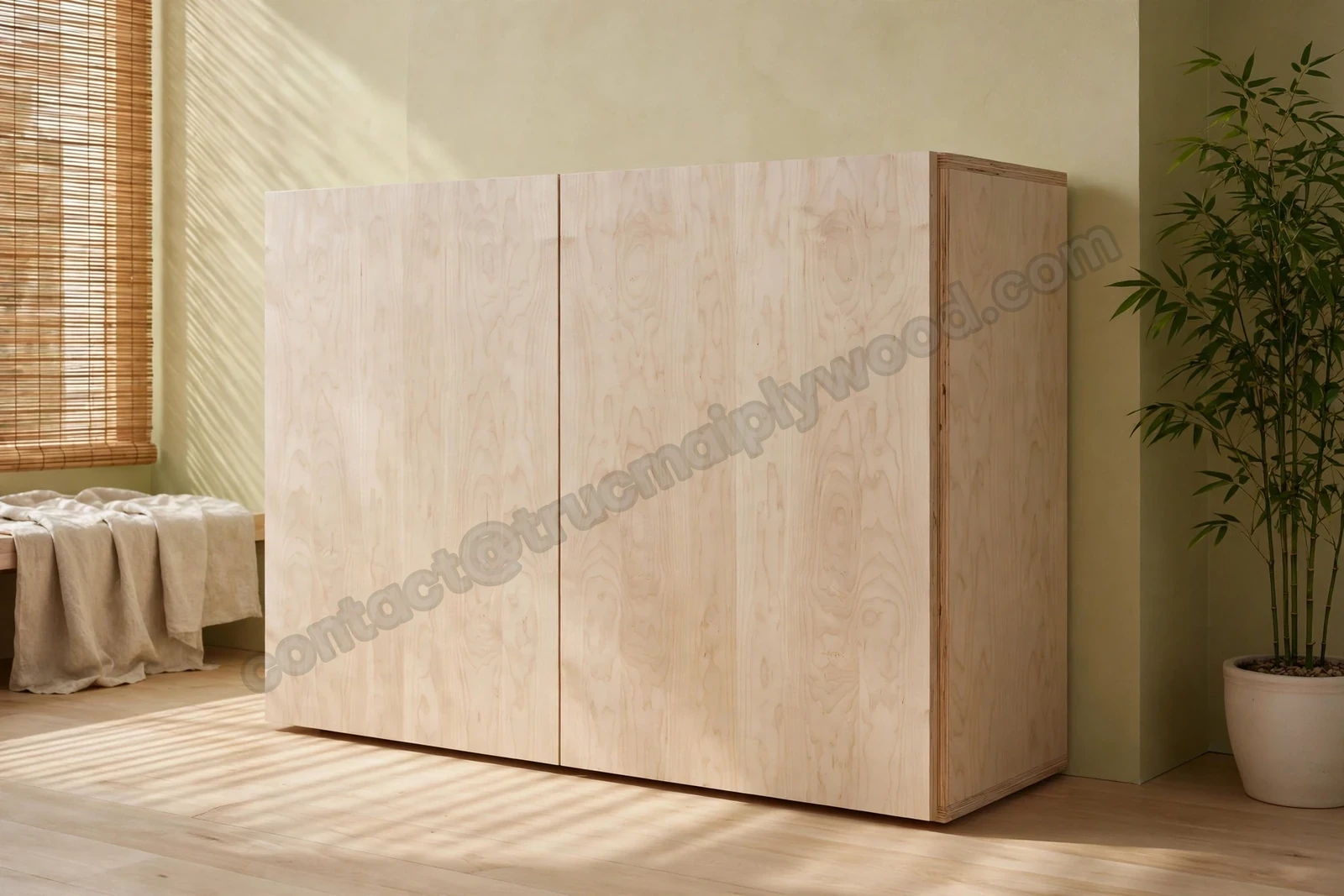
Engineered veneer offers a designed grain and more repeatable appearance, while natural veneer preserves the distinctive figure of the individual log. Both are wood faces, and both can show natural fibre behaviour. Neither description alone tells the buyer the panel’s core quality or bonding performance.
| Buying point | Engineered or reconstituted veneer | Natural veneer |
|---|---|---|
| Visual pattern | Designed and repeated across the production sequence | Changes with log, cut and position |
| Colour selection | Colour is incorporated during reconstruction | Natural tone varies by timber and cut |
| Matching | Easier to specify a recurring pattern reference | Requires closer selection of leaves and flitches |
| Character | Regular figure suits coordinated furniture ranges | Individual figure suits distinctive feature work |
| Sample approval | Approve colour and reconstruction pattern | Approve species, cut, figure and matching method |
| Finished appearance | Depends on sanding, coating and lighting | Also depends on sanding, coating and lighting |
How stable is engineered veneer colour against natural veneer?
Engineered veneer normally gives a more consistent starting colour across matching production runs because its leaves are selected and coloured to a target design. Natural veneer varies with the log and the position of each leaf. That distinction is most useful when a buyer needs replacement doors or later furniture batches to sit beside the first installation.
Colour stability has two meanings that should not be confused. Batch matching describes how closely new sheets resemble an approved reference. Colourfastness in use describes what happens after light, heat, cleaning and coating exposure. Reconstruction supports batch matching; colourfastness is assessed on the finished surface and its intended conditions.
For repeat orders, retain a signed physical master sample and a finished control panel. Compare new samples under the same lighting and at the same viewing angle. Record the finish system, because clear lacquer, pigmented stain and different sheen levels can make the same underlying face appear different. For a large cabinet programme, request a small run of adjacent fronts to check the overall effect before releasing the full cut list.
What veneer species and core combinations can buyers specify?
The face species and core species are separate choices. Truc Mai uses imported engineered white poplar veneer for EV faces and offers Styrax, Eucalyptus, Acacia and Pine cores, including combinations where the construction calls for them. The core is selected for weight, machining and the intended furniture part; the face is selected for appearance.
A buyer who wants a light interior panel can discuss a Styrax core. Another buyer may prefer a denser construction for a different machining or handling requirement. Keep the face design fixed while comparing core samples: that isolates the structural and weight differences without changing the decorative target. Ask to see a trimmed cross-section so the veneer layers, core joints and face bonding can be inspected directly.
Which sheet and face specifications belong on an EV plywood order?
An EV plywood order should state the approved face reference, core construction, panel dimensions, tolerance, surface preparation, adhesive and emission class. These details make the order reproducible and let the buyer compare offers for the same build rather than the same product nickname.
| Specification | Available Truc Mai configuration or buying instruction |
|---|---|
| EV face | White poplar engineered veneer; approved pattern and colour sample |
| Face veneer thickness | Typically 0.3 mm; 0.4 mm also available for EV supply |
| Core options | Styrax, Eucalyptus, Acacia, Pine or agreed mixed core |
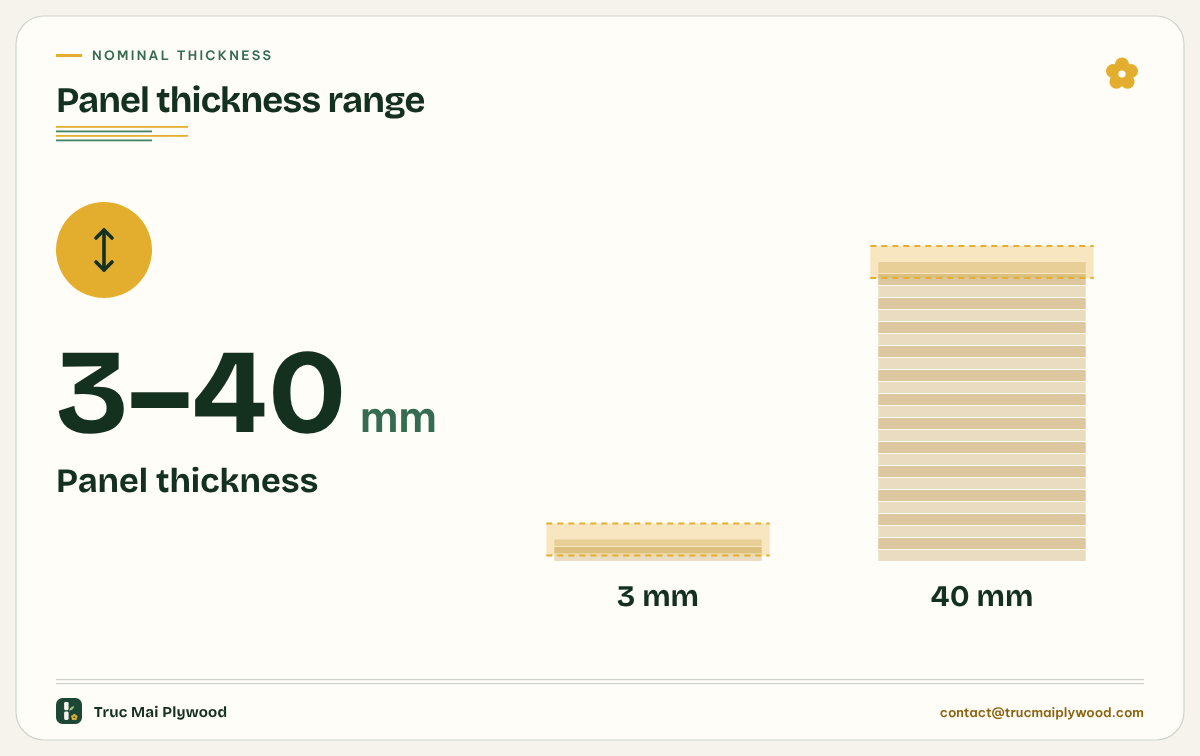
| Panel thickness | 3–40 mm range |
| Common sheets | 1220 × 2440 mm; 1250 × 2500 mm; 1220 × 2280 mm |
| Sanded furniture-panel tolerance | ±0.3 mm when specified and calibrated |
| Surface | Sanded and calibrated; UV-ready means prepared for buyer-applied coating |
| Face grading | Written as a front/back pair against an approved sample |
The plywood RFQ checklist helps convert a visual sample into a purchase specification. For visible furniture, include the grain direction and the finish reference in the same email as the sheet dimensions.
How should an engineered veneer face be graded?
An engineered veneer face should be graded against an approved appearance sample and a written front/back specification. The grade needs to describe the defects and colour variation the buyer will accept, rather than relying on an unexplained letter code. The acceptable figure is often easier to communicate with an actual face sheet than with a grade name alone.
Check the face under raking light for open joints, local colour bands, raised fibres, glue marks and sanding scratches. Inspect a finished sample as well, because coating can reveal surface marks that are less obvious on unfinished veneer. For cabinets with repeated door fronts, inspect several sheets together to see whether the pattern rhythm and tone remain coherent at installation scale.
A useful approval pack contains the loose face reference, a full panel face, a cross-section and a finished sample. Mark the approved front and back clearly so that the supplier and furniture factory inspect the same surface.
What do adhesive and formaldehyde specifications mean for EV plywood?
Adhesive type, bond performance and formaldehyde emission are three different specifications. A panel can be described as UF-bonded for interior furniture while its emission performance is documented separately. A decorative EV face does not determine the emissions result of the completed plywood construction.
For the United States, 40 CFR Part 770 sets a formaldehyde emission limit of 0.05 ppm for regulated hardwood plywood with veneer core, measured against the applicable ASTM E1333 basis. The US Environmental Protection Agency’s compliance guidance also explains how the covered panel construction and laminated-product rules are distinguished. Buyers should request the certification covering the actual ordered configuration.
Truc Mai holds CARB Phase 2 and TSCA Title VI third-party certification for hardwood plywood with veneer core within the certified 3–25 mm product scope. For the specific decorative panel, put the emission requirement and certificate documentation on the purchase order rather than assuming every face or thickness has the same regulatory treatment.
How can a buyer verify EV veneer origin and FSC documents?
Verify the veneer origin through its species description, supplier traceability records and the order’s chain-of-custody documents. For EU-bound plywood, origin records should identify both the face veneer and the core wood. A decorative face sourced internationally is part of the material traceability file, even when the plywood itself is pressed in Vietnam.
The face veneer origin-file explanation shows how buyers can structure the request. Truc Mai supplies plot geolocation and origin records for both face and core in its EU due-diligence dossier. Keep the face and core documents aligned with the bill of materials for the actual ordered panel.
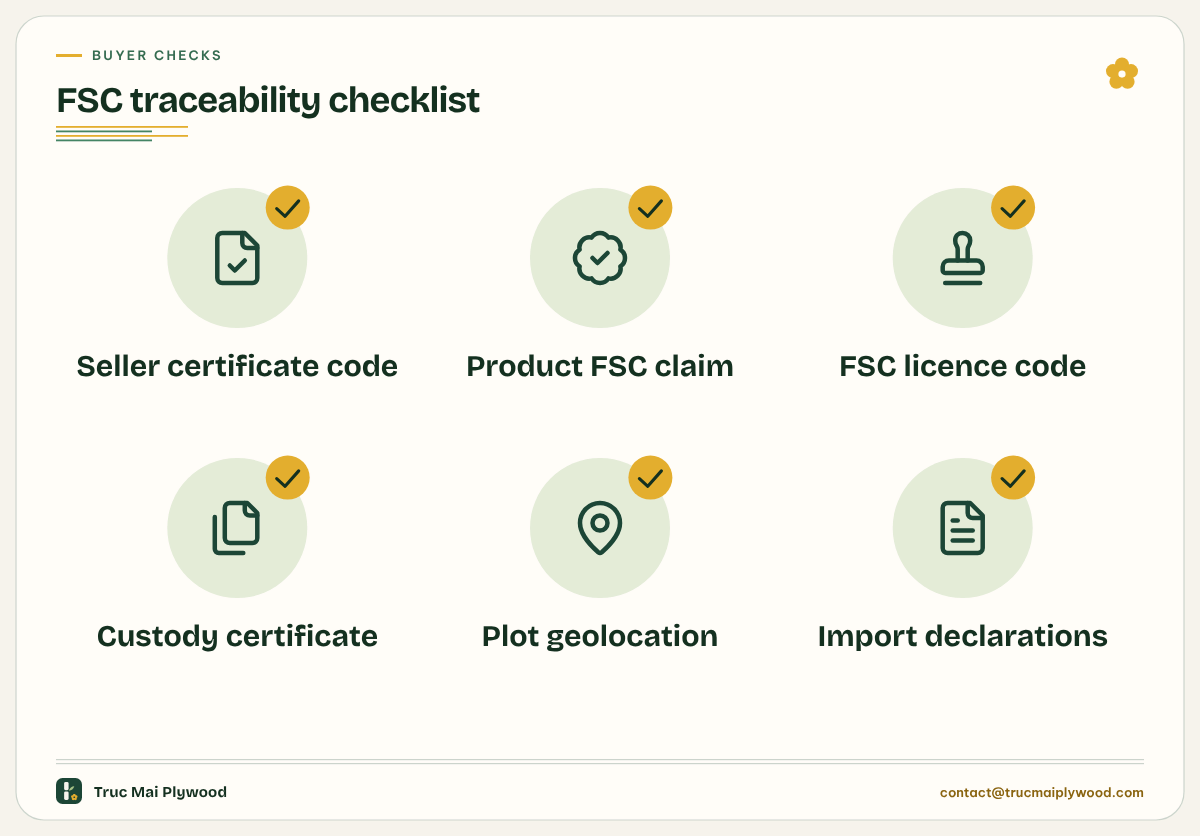
Under FSC-STD-40-004, the seller’s certificate code and the FSC claim for each eligible product belong on sales documents. Truc Mai’s FSC licence is FSC-C196493 and its chain-of-custody certificate is SA-COC-014545; eligible products are sold with an FSC 100% claim. Buyers can follow the FSC licence verification steps when checking documentation.
Can EV plywood be cut to size for furniture production?
Yes, EV plywood can be supplied as labelled cut-to-size furniture panels when the buyer provides a cutting list and grain direction. Cutting should be planned from the selected parent sheet so the resulting pieces and their face orientation match the assembly drawing.
Examples include a lengthwise half-sheet at 610 × 2440 mm, a three-piece pattern at 1200 × 800 mm, and a quarter-sheet at 1220 × 610 mm. Six-piece layouts are also available by agreement. The exact cut pattern is agreed against the original sheet size and saw allowance; a labelled bundle helps the receiving furniture line distinguish left, right, top and bottom parts.
The cut-to-size panel options are relevant when the buyer wants less in-house cutting and consistent grain orientation across repeated components. Send the drawing before the sample is approved, since a change in grain direction can change how the face appears on the finished door.
How many EV plywood sheets fit in a 40HC container?
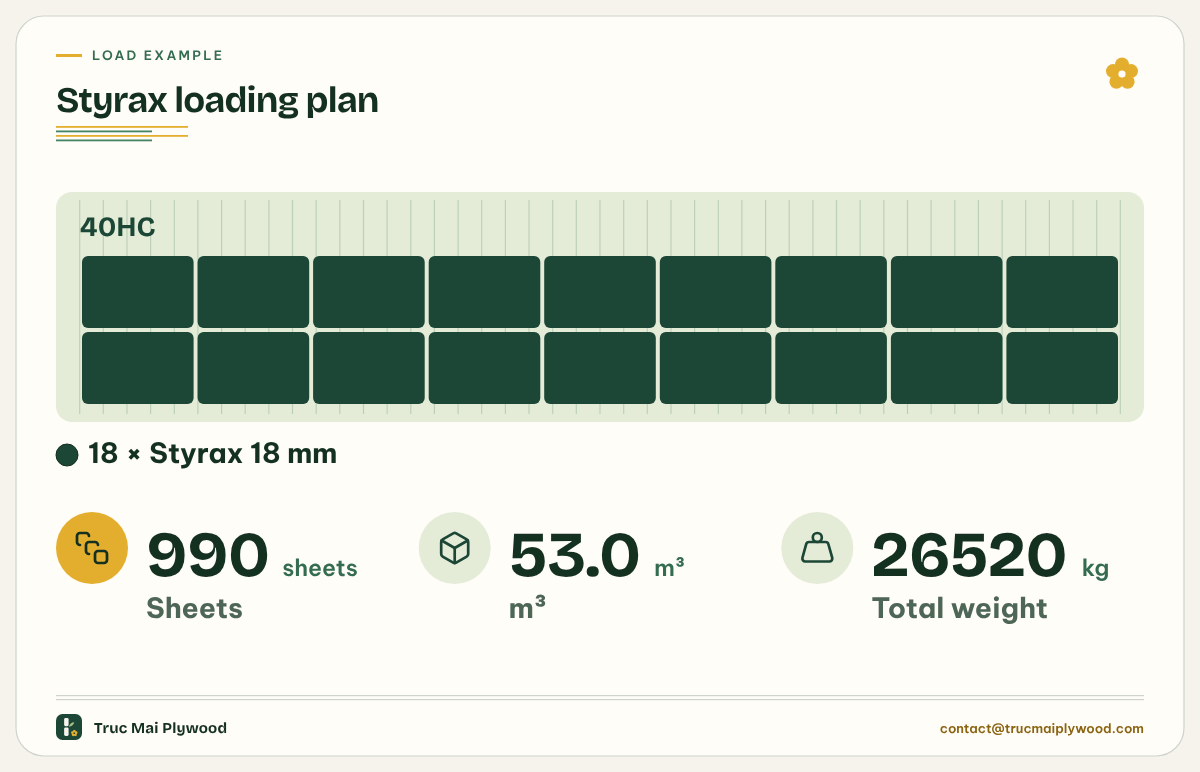
A 40HC planning load changes with core density and panel thickness, even when the decorative EV face stays the same. The following rows are the supplied planning calculations for 1220 × 2440 mm sheets, not a record of shipped containers. The model uses a 28,000 kg cargo planning payload, approximate 1,000 mm pack height and core-specific packing limits; real loading uses weighed panels and the carrier’s booking allowance.
| Core | Thickness (mm) | Sheet size (mm) | Packs | Sheets/pack | Weight capped | Sheets | m³ | kg/sheet | Total kg |
|---|---|---|---|---|---|---|---|---|---|
| Styrax | 12 | 1220x2440 | 18 | 83 | No | 1494 | 53.4 | 17.9 | 26680 |
| Acacia | 12 | 1220x2440 | 16 | 83 | No | 1328 | 47.4 | 20.7 | 27510 |
| Eucalyptus | 12 | 1220x2440 | 15 | 80 | Yes | 1200 | 42.9 | 23.2 | 27860 |
| Styrax | 15 | 1220x2440 | 18 | 66 | No | 1188 | 53.0 | 22.3 | 26520 |
| Acacia | 15 | 1220x2440 | 16 | 66 | No | 1056 | 47.2 | 25.9 | 27350 |
| Eucalyptus | 15 | 1220x2440 | 15 | 64 | Yes | 960 | 42.9 | 29.0 | 27860 |
| Styrax | 18 | 1220x2440 | 18 | 55 | No | 990 | 53.0 | 26.8 | 26520 |
| Acacia | 18 | 1220x2440 | 16 | 55 | No | 880 | 47.2 | 31.1 | 27350 |
| Eucalyptus | 18 | 1220x2440 | 15 | 53 | Yes | 795 | 42.6 | 34.8 | 27690 |
| Styrax | 21 | 1220x2440 | 18 | 47 | No | 846 | 52.9 | 31.3 | 26440 |
| Acacia | 21 | 1220x2440 | 16 | 47 | No | 752 | 47.0 | 36.3 | 27270 |
| Eucalyptus | 21 | 1220x2440 | 15 | 45 | Yes | 675 | 42.2 | 40.6 | 27430 |
The table preserves the model values for comparison. Use the core selection and finished panel weight to prepare the loading plan; packaging weight and verified gross mass are checked with the final booking. The container document checklist covers the paperwork accompanying a finished shipment.
What samples should be approved before a repeat EV order?
Approve a finished colour sample, a full-face appearance reference and a cut edge before the first repeat order. A small swatch is useful for choosing a pattern, but the complete sheet shows whether the reconstruction figure looks coherent at furniture scale. The finished control sample records the combined effect of veneer colour, sanding and coating.
The sample ordering process provides a practical starting point. New buyers can receive free samples and arrange their courier; the courier cost can be credited against an actual order.
How should buyers compare EV plywood suppliers?
Compare suppliers using the same physical appearance reference, panel construction and documented test scope. Start with the intended furniture part, then issue one specification that every quotation must answer. Ask each supplier to show a cross-section, a finished face and a written front/back grade. A comparison based only on the name ‘EV plywood’ hides the differences that affect the furniture line.
What information should go in the first EV plywood enquiry?
Send the intended furniture application, a face photograph or physical sample reference, the desired core, glue and emission requirement, front/back grade, sheet dimensions, cut list, volume and destination port. State whether the panels will be coated by the buyer or supplied ready for the buyer’s coating line. Include the grain direction for any door or drawer component.
For an order discussion, the buyer can request a matching face sample and a written construction sheet before finalising the purchase specification. This makes the next step concrete: the mill can compare the requested appearance with the available EV face and prepare a panel build that suits the furniture application.
Send your specification to contact@trucmaiplywood.com or through the quotation form.
Questions buyers ask
Can recon veneer be stained after delivery?
Yes, a finish can be applied to a suitable prepared face. Test the selected stain on an approved offcut because factory colour and later stain interact.
Is engineered veneer printed plastic?
No. Engineered veneer is wood sliced from a reconstructed wood block; a printed decorative film is a different facing material.
Does EV veneer have a real wood grain?
Yes. Its fibres are wood, while the grain figure is arranged through the reconstruction process.
Can EV faces be used on kitchen cabinets?
Yes. Specify the cabinet substrate, edge treatment and finish together; the face veneer is only one part of the finished component.
Should I order face and back as a pair?
Yes. State the approved appearance of each side and whether the reverse must match the front.
What samples should a furniture buyer approve?
Approve a full face sample, an edge cross-section and a finished colour sample under the lighting used for inspection.
Can I specify a different core with the same face?
Yes. Styrax, Eucalyptus, Acacia and Pine are available core choices, and the face design can remain the same while the core changes.
Is engineered veneer suitable for outdoor exposure?
Choose a separately tested panel and finish system for the intended exposure; a decorative face alone is not a weather-resistance classification.
What should the invoice show for FSC panels?
The seller’s certificate code and the FSC claim for each eligible product should appear on sales documents under the FSC chain-of-custody standard.
Can EV plywood be cut to furniture-part dimensions?
Yes. Provide the cutting drawing, grain direction and piece labels so the mill can agree a cut list before packing.