
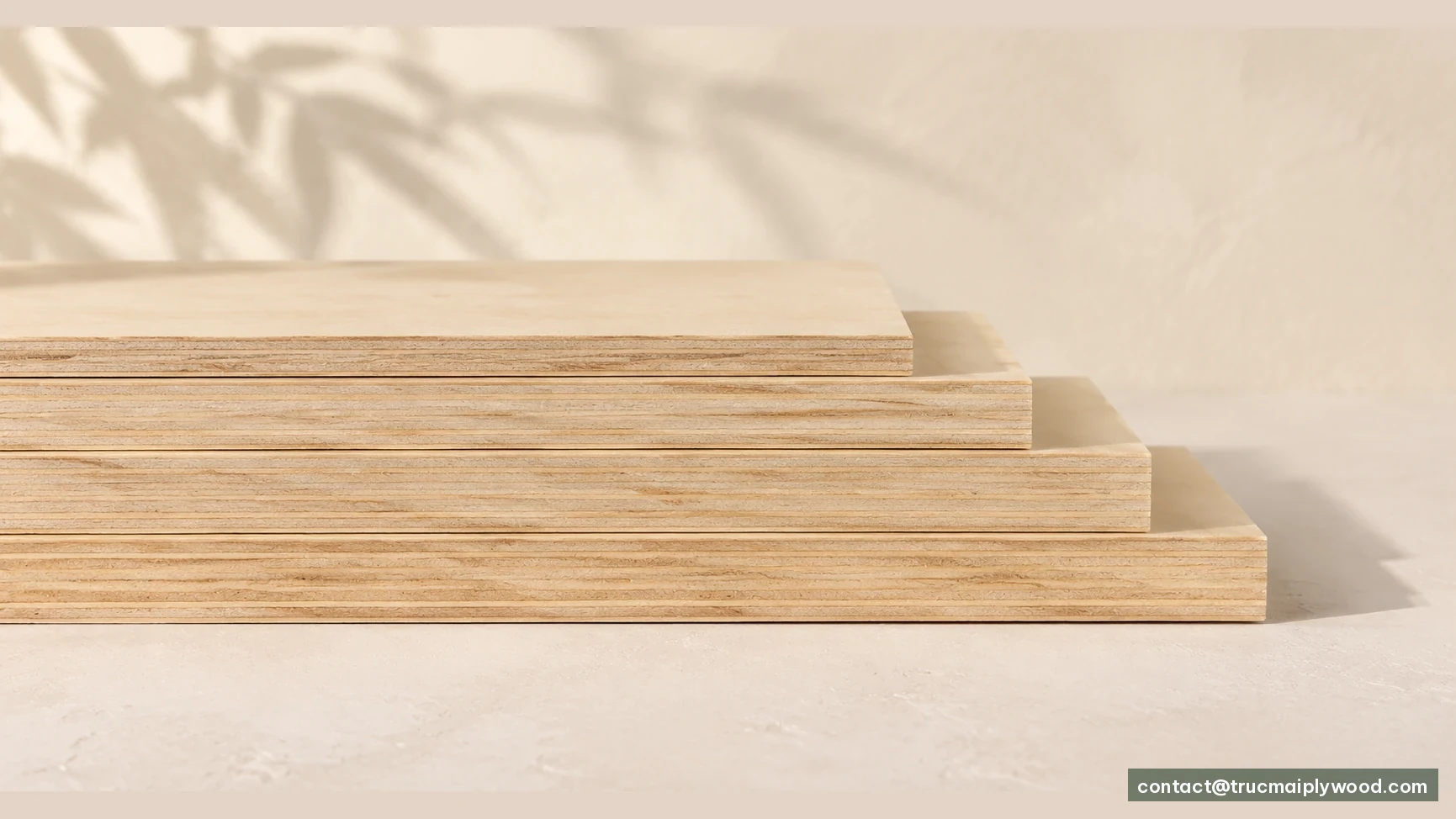
2440 x 1220 plywood is the metric 4 × 8 ft panel, measuring 2440 mm long and 1220 mm wide. It is a standard export format for furniture, cabinetry and commercial plywood. Thickness, core density and packing pattern determine how many sheets fit in a 40HC, while face quality and machining requirements determine the right specification.
What does 2440 x 1220 plywood mean?
2440 x 1220 plywood means a rectangular sheet 2440 mm long and 1220 mm wide, conventionally called the metric 4 × 8 ft format. In an order, the two numbers identify the panel footprint, not its thickness, wood species, grade or adhesive. Write the thickness as a third dimension, such as 1220 × 2440 × 18 mm, to prevent a size-only enquiry being treated as a complete specification.
A listing headed “2440 mm x 1220 mm plywood” describes the same footprint as “1220 mm x 2440 mm”. The order of the two horizontal dimensions changes with the seller’s convention. For cutting, however, the grain direction and the orientation of each part still matter. A door blank with vertical grain cannot simply be rotated to improve yield without changing the appearance.
The NIST PS 1-22 structural plywood standard also refers to a 1220 × 2440 mm (48 × 96 in) sheet. That is a useful dimensional reference, not a structural rating for a furniture panel.
How does the metric 4 × 8 sheet compare with other sizes?
The 1220 × 2440 mm format is the metric counterpart of the familiar 4 × 8 ft sheet. Buyers comparing imperial and metric catalogues should order by the stated millimetres rather than assuming that a trade nickname is a cutting tolerance. The width is the short side and the length is the long side.
| Sheet designation | Width | Length | Purchasing use |
|---|---|---|---|
| Metric 4 × 8 | 1220 mm | 2440 mm | Standard furniture and commercial panels |
| Short furniture sheet | 1220 mm | Shorter format | Parts where the full length is unnecessary |
| European format | 1250 mm | 2500 mm | Wider or longer cutting layouts |
The alternative 1220 × 2280 mm panels can reduce unused length for repeated components. The 1250 × 2500 mm format gives extra working area for cutting layouts that need it. These are different purchasing formats, so quote comparisons should show the exact sheet dimension on every line.
Which thicknesses are offered in 1220 × 2440 mm plywood?
The furniture and commercial range covers 3–40 mm. Listed nominal thicknesses are 3, 4, 5, 6, 9, 12, 15, 18, 21, 25, 30 and 40 mm. The correct choice follows the part design, fixing method and finish, rather than the sheet footprint alone.
Thin panels suit backs, drawer bottoms and other light interior components where the product design permits. Mid-range panels are often specified for cabinet parts, shelving components and furniture carcasses. Thicker panels can be used for substantial interior assemblies and machined furniture elements. The finished assembly determines the necessary stiffness and fixing details; the thickness label by itself does not describe load performance.
At this mill, 3–5 mm panels use five plies. An 18 mm furniture build usually has 11–13 plies, most often 11. Buyers can compare the 18 mm loading and specification reference when preparing a detailed order. For 6 mm, the ply arrangement is written into the agreed construction rather than assumed from the nominal thickness.
Which core changes the weight and loading capacity?
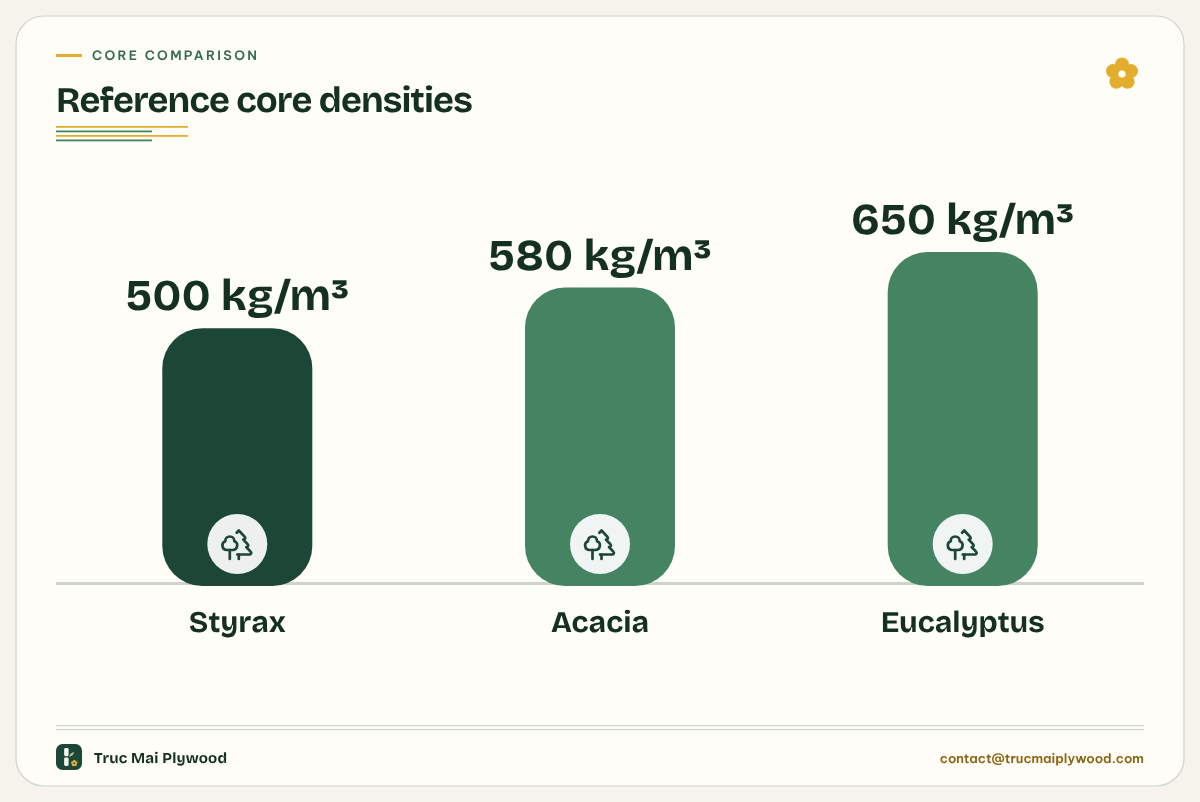
Styrax, Acacia and Eucalyptus cores produce different sheet weights at the same dimensions. The packing model uses reference densities of 500, 580 and 650 kg/m³ respectively. These are model inputs, so use the order’s specified core when comparing freight quantities, pallet handling and sheet mass.
The available core choices also include Pine and combinations of species. Core construction matters to the buyer beyond weight: examine the edge for gaps, the regularity of veneers and the way individual core pieces are joined. A stitched core is often selected for furniture work where a consistent interior construction helps subsequent machining. Commercial panels can use a different jointing arrangement.
A birch face does not make the core birch. Likewise, a poplar face does not identify a poplar core. Separate face and core in the RFQ, then compare the same construction between quotations.
How many sheets of 1220 × 2440 mm plywood fit in a 40HC by thickness?
The 40HC planning table below gives the complete sheet count by thickness and core for the 1220 × 2440 mm footprint. It is a panels-only calculation, not a loading record. Read the sheet count alongside the pack count and modelled cargo mass, because the same container space can carry different quantities of lighter and heavier plywood.
Calculation basis: 40HC planning model; Styrax 18 packs, Acacia 16 packs and Eucalyptus 15 packs; nominal pack height 1,000 mm; sheets per pack derived from pack height divided by thickness and rounded down, then capped by a 28,000 kg planning payload. Reference densities are Styrax 500, Acacia 580 and Eucalyptus 650 kg/m³. The carrier and route determine the operational payload. Values below reproduce the supplied calculation unchanged.
| Core | Thickness (mm) | Size (mm) | Packs | Sheets/pack | Weight capped | Sheets/40HC | m³ | kg/sheet | Total kg |
|---|---|---|---|---|---|---|---|---|---|
| Styrax | 3 | 1220 × 2440 | 18 | 333 | No | 5994 | 53.5 | 4.5 | 26760 |
| Acacia | 3 | 1220 × 2440 | 16 | 333 | No | 5328 | 47.6 | 5.2 | 27600 |
| Eucalyptus | 3 | 1220 × 2440 | 15 | 321 | Yes | 4815 | 43.0 | 5.8 | 27950 |
| Styrax | 4 | 1220 × 2440 | 18 | 250 | No | 4500 | 53.6 | 6.0 | 26790 |
| Acacia | 4 | 1220 × 2440 | 16 | 250 | No | 4000 | 47.6 | 6.9 | 27620 |
| Eucalyptus | 4 | 1220 × 2440 | 15 | 241 | Yes | 3615 | 43.0 | 7.7 | 27980 |
| Styrax | 5 | 1220 × 2440 | 18 | 200 | No | 3600 | 53.6 | 7.4 | 26790 |
| Acacia | 5 | 1220 × 2440 | 16 | 200 | No | 3200 | 47.6 | 8.6 | 27620 |
| Eucalyptus | 5 | 1220 × 2440 | 15 | 192 | Yes | 2880 | 42.9 | 9.7 | 27860 |
| Styrax | 6 | 1220 × 2440 | 18 | 166 | No | 2988 | 53.4 | 8.9 | 26680 |
| Acacia | 6 | 1220 × 2440 | 16 | 166 | No | 2656 | 47.4 | 10.4 | 27510 |
| Eucalyptus | 6 | 1220 × 2440 | 15 | 160 | Yes | 2400 | 42.9 | 11.6 | 27860 |
| Styrax | 9 | 1220 × 2440 | 18 | 111 | No | 1998 | 53.5 | 13.4 | 26760 |
| Acacia | 9 | 1220 × 2440 | 16 | 111 | No | 1776 | 47.6 | 15.5 | 27600 |
| Eucalyptus | 9 | 1220 × 2440 | 15 | 107 | Yes | 1605 | 43.0 | 17.4 | 27950 |
| Styrax | 12 | 1220 × 2440 | 18 | 83 | No | 1494 | 53.4 | 17.9 | 26680 |
| Acacia | 12 | 1220 × 2440 | 16 | 83 | No | 1328 | 47.4 | 20.7 | 27510 |
| Eucalyptus | 12 | 1220 × 2440 | 15 | 80 | Yes | 1200 | 42.9 | 23.2 | 27860 |
| Styrax | 15 | 1220 × 2440 | 18 | 66 | No | 1188 | 53.0 | 22.3 | 26520 |
| Acacia | 15 | 1220 × 2440 | 16 | 66 | No | 1056 | 47.2 | 25.9 | 27350 |
| Eucalyptus | 15 | 1220 × 2440 | 15 | 64 | Yes | 960 | 42.9 | 29.0 | 27860 |
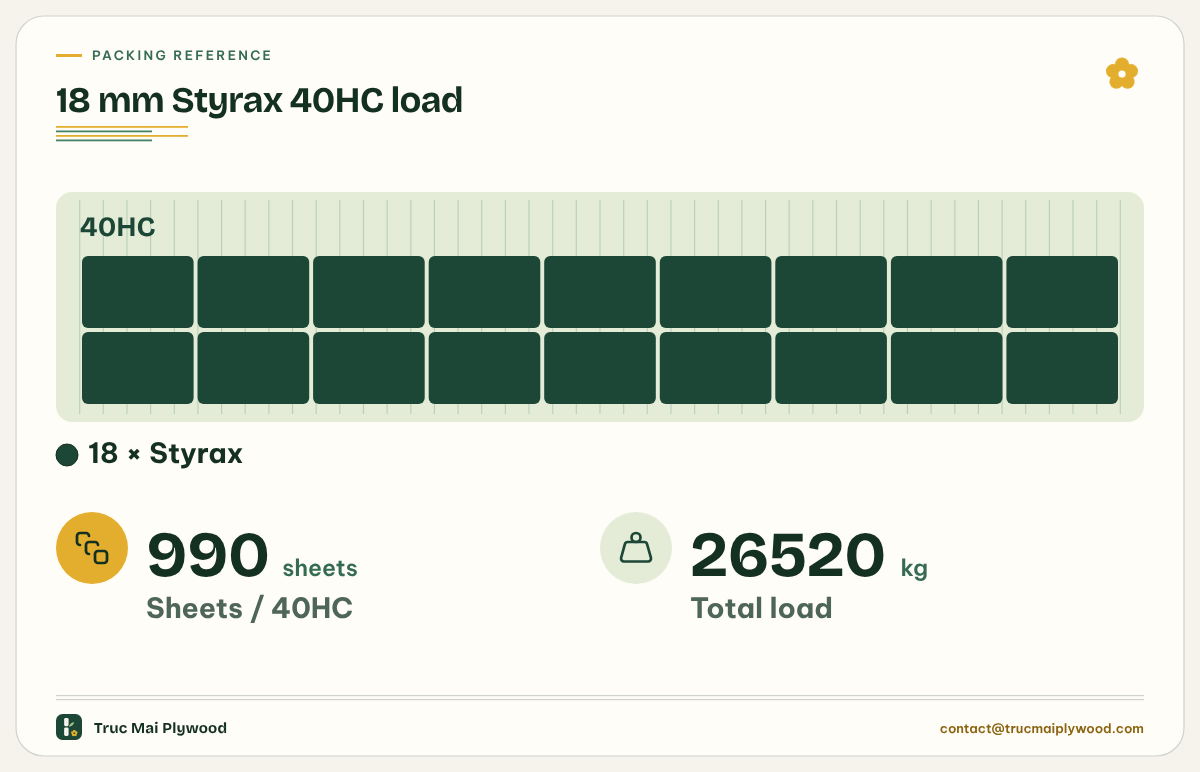
| Styrax | 18 | 1220 × 2440 | 18 | 55 | No | 990 | 53.0 | 26.8 | 26520 |
| Acacia | 18 | 1220 × 2440 | 16 | 55 | No | 880 | 47.2 | 31.1 | 27350 |
| Eucalyptus | 18 | 1220 × 2440 | 15 | 53 | Yes | 795 | 42.6 | 34.8 | 27690 |
| Styrax | 21 | 1220 × 2440 | 18 | 47 | No | 846 | 52.9 | 31.3 | 26440 |
| Acacia | 21 | 1220 × 2440 | 16 | 47 | No | 752 | 47.0 | 36.3 | 27270 |
| Eucalyptus | 21 | 1220 × 2440 | 15 | 45 | Yes | 675 | 42.2 | 40.6 | 27430 |
| Styrax | 25 | 1220 × 2440 | 18 | 40 | No | 720 | 53.6 | 37.2 | 26790 |
| Acacia | 25 | 1220 × 2440 | 16 | 40 | No | 640 | 47.6 | 43.2 | 27620 |
| Eucalyptus | 25 | 1220 × 2440 | 15 | 38 | Yes | 570 | 42.4 | 48.4 | 27570 |
| Styrax | 30 | 1220 × 2440 | 18 | 33 | No | 594 | 53.0 | 44.7 | 26520 |
| Acacia | 30 | 1220 × 2440 | 16 | 33 | No | 528 | 47.2 | 51.8 | 27350 |
| Eucalyptus | 30 | 1220 × 2440 | 15 | 32 | Yes | 480 | 42.9 | 58.0 | 27860 |
| Styrax | 40 | 1220 × 2440 | 18 | 25 | No | 450 | 53.6 | 59.5 | 26790 |
| Acacia | 40 | 1220 × 2440 | 16 | 25 | No | 400 | 47.6 | 69.1 | 27620 |
| Eucalyptus | 40 | 1220 × 2440 | 15 | 24 | Yes | 360 | 42.9 | 77.4 | 27860 |
The table records all model rows at their supplied precision. For booking and loading, the actual pack weights and the carrier’s approved payload control the final plan.
What determines the number of sheets in a crate?
A pack count starts with nominal sheet thickness and the agreed stacking height. The model uses 1,000 mm as the reference height; a thinner sheet therefore gives more sheets per pack. For heavy cores, the mass limit can reduce the count before the stack reaches its geometric height.
The pack must also suit forklift handling, edge protection and unloading at the destination. Ask for the final packing list by thickness, core, pack number and sheets per pack. This makes warehouse receiving and inventory reconciliation much easier than a container-level cubic-metre figure alone.
For further comparison, the m³ per 40HC by thickness reference explains why cubic metres can remain relatively stable while the sheet count changes sharply. A mixed load needs its own pack schedule instead of borrowing a single-product table.
How should a buyer choose face veneer for a 4 × 8 sheet?
Choose the visible surface first, then specify its grade against an approved sample. Furniture faces may use engineered veneer (EV), poplar, bleached poplar, birch, okoume, bintangor, pine, eucalyptus, gurjan or sapele. A decorative face can be paired with a different back grade when only one surface remains visible in the finished cabinet.
For light-coloured interiors, the buyer may prioritise a consistent tone and a smooth sanded face. For natural veneer work, grain pattern and colour range deserve more attention. For overlay work, specify the substrate flatness and the exact surface preparation expected by the laminating process. The name of the face species alone does not specify these details.
On a birch-faced plywood order, the birch is a face veneer over the selected Vietnamese core. That distinction should appear in both the sample label and the quotation. It prevents a decorative-face offer being mistaken for an all-birch panel.
Which surface and edge checks matter on arrival?
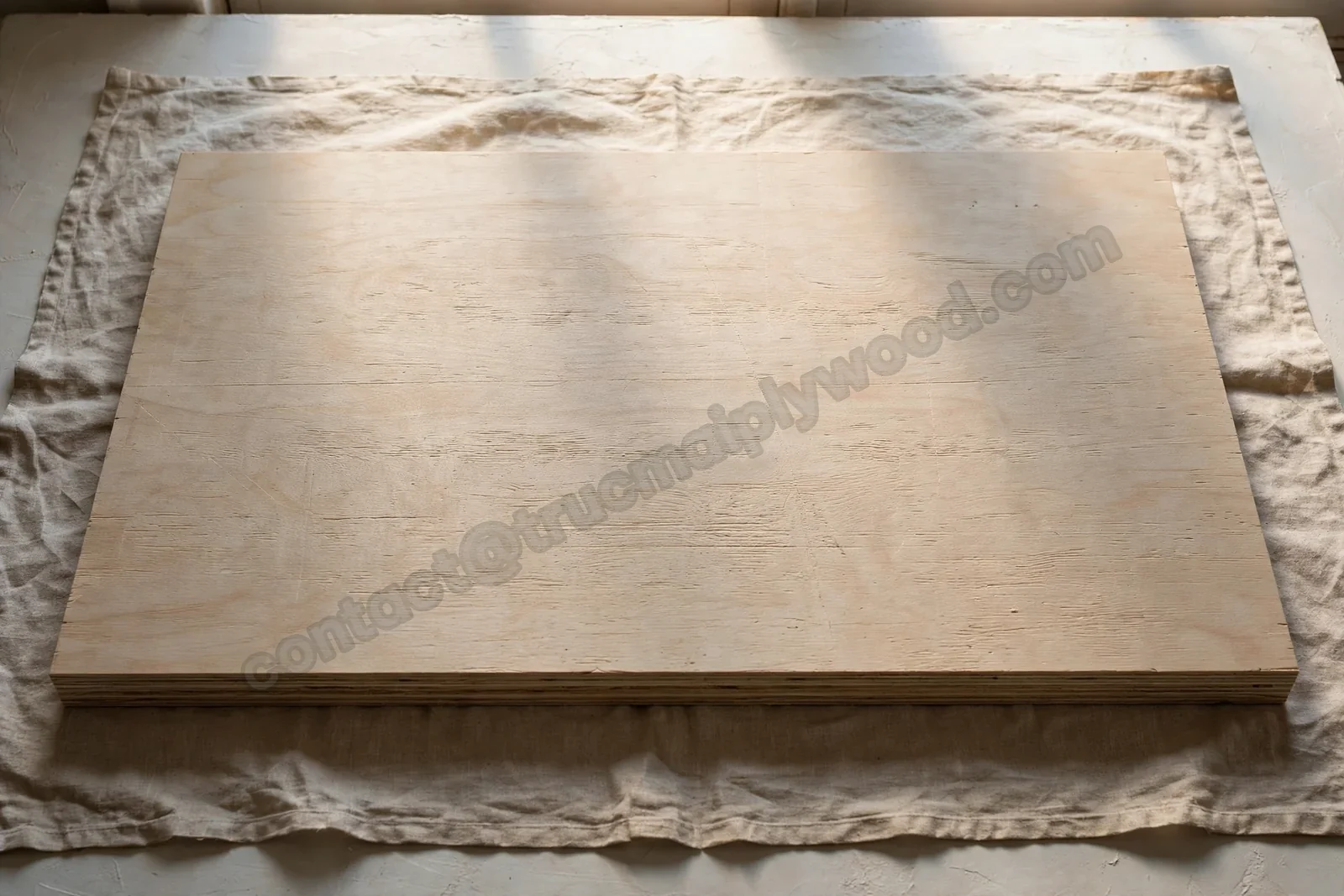
Check both faces, all four edges and representative sheets from different packs. The useful inspection is tied to the end use: a clear-finished door front needs a different face appearance from a hidden cabinet back or packing panel.
- Compare colour, grain and visible repairs with the approved face and back samples.
- Measure thickness at several points away from damaged edges, recording the agreed tolerance.
- Inspect edges for voids, overlaps and loose veneer pieces.
- Check sheet squareness and dimensions before releasing a cutting batch.
- Record pack identity and any visible transport damage before unpacking the whole shipment.
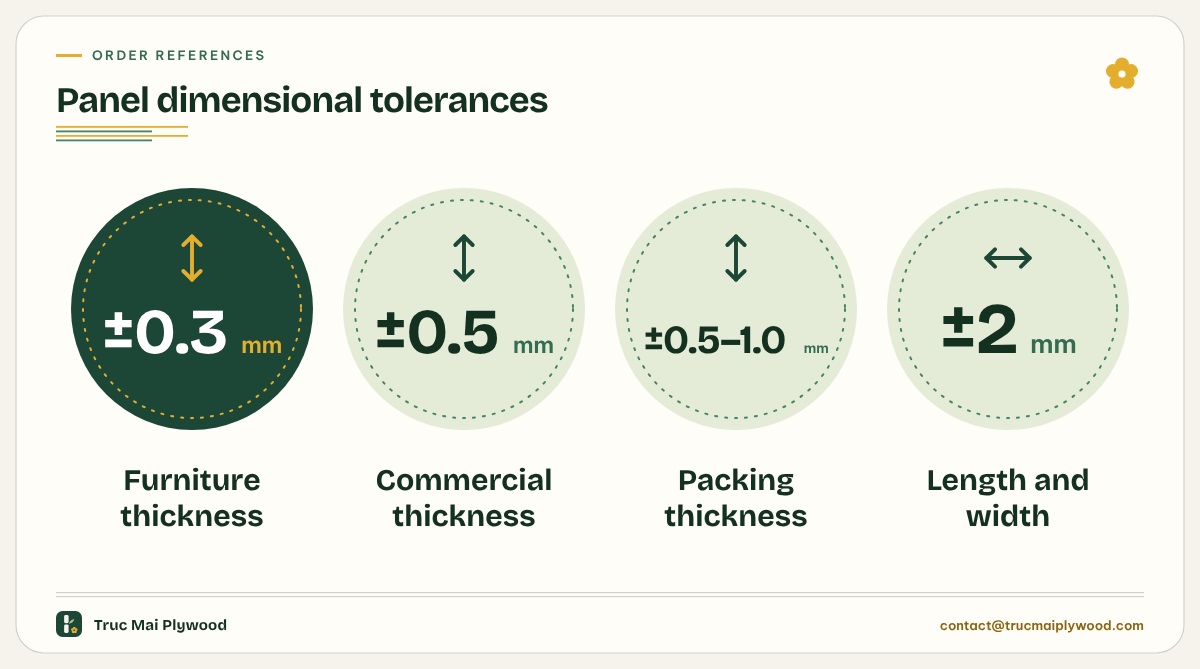
Truc Mai’s sanded and calibrated furniture panels can be specified at ±0.3 mm thickness tolerance; commercial panels use ±0.5 mm, and packing panels ±0.5–1.0 mm. Length and width tolerance is ±2 mm. Record the actual agreed tolerance on the purchase order, rather than borrowing a number from a general catalogue.
How does cutting the standard sheet work?
Cutting starts with a part list, grain orientation and finished piece dimensions. A buyer may order a full sheet or mill-cut labelled components. Common layouts include splitting a standard sheet into two lengthwise strips, three parts, four shorter sections or six pieces. The exact pieces are agreed from the buyer’s cut list and available parent sheet.
A two-way lengthwise split gives nominal 610 × 2440 mm strips before allowing for the cutting method. A four-way split across the length gives nominal 1220 × 610 mm sections. A three-part cutting request may target 1200 × 800 mm components; these need an agreed cutting layout and saw allowance. Truc Mai also cuts narrower components from a 1250 × 2500 mm parent sheet when the nesting arrangement calls for it.
Send a drawing that labels the finished dimension, grain direction and part code. The mill cut-to-size panel option is designed for this workflow. Cutting a whole-sheet order after arrival moves sawdust, labour and offcut handling to the buyer’s warehouse; cutting at origin shifts those tasks into the manufacturing plan.
How should an importer compare nominal and actual dimensions?
Compare the purchase-order dimension with measured panels and the stated tolerance. Nominal thickness is a commercial specification, while actual thickness is a measured property of the manufactured sheet. A calibrated surface can support a closer target than a rough unsanded panel, but the tolerance still belongs on the order.
The European EN 315 dimensional standard is a separate reference for plywood dimensions and tolerances. For example, its general length and width tolerance is ±3.5 mm at the stated test moisture condition. A mill’s tighter agreed order tolerance is a distinct contractual specification, not an automatic certification to the standard. Keep the measuring method consistent across suppliers so that comparisons are meaningful.
If the panels will pass through CNC nesting, edge banding or a press, record the machine’s acceptable thickness variation and finished-part allowance. That is more useful than asking whether a supplier’s plywood is simply “accurate”.
Which adhesive and emission specification should accompany the size?
Specify the adhesive system and the emission requirement on separate lines. UF glue at E0 emission is a mill configuration for interior panels; the buyer’s E0 specification should identify its test method and limit. Moisture-exposure requirements are a different purchasing decision from formaldehyde emissions.
For United States-bound regulated hardwood plywood, the US EPA TSCA Title VI guide states a formaldehyde emission limit of 0.05 ppm for veneer-core hardwood plywood. The mill’s CARB Phase 2 and TSCA Title VI certification covers veneer-core hardwood plywood from 3–25 mm, not the thicker formats. Specify the relevant product build and request the corresponding documentation.
An interior cabinet order should therefore state its face, core, adhesive, emission class and thickness together. A change of glue or core is a change of specification even when the 4 × 8 footprint stays the same.
Which documents support EU and US orders?
The document set follows the destination market and the particular plywood construction. For EU orders, origin and timber traceability records are important alongside commercial documents. The European Commission EUDR overview describes due diligence covering production-plot geolocation and legal production. The mill supplies origin records and geolocation files for both core wood and face veneer so the importer can prepare its own due diligence statement.
FSC 100% is available for eligible products covered by the mill’s FSC chain-of-custody certificate, FSC-C196493, with the claim shown on the relevant sales documents. ISO 9001:2015 covers the plywood manufacturing quality management system. These identifiers and documents serve different purposes: chain of custody, management systems and product emission certification should each be checked against the order line.
A typical shipment file includes invoice, packing list, bill of lading and applicable origin or phytosanitary documents. The documents per container reference helps buyers organise the file before dispatch.
What should go into a 2440 × 1220 plywood RFQ?
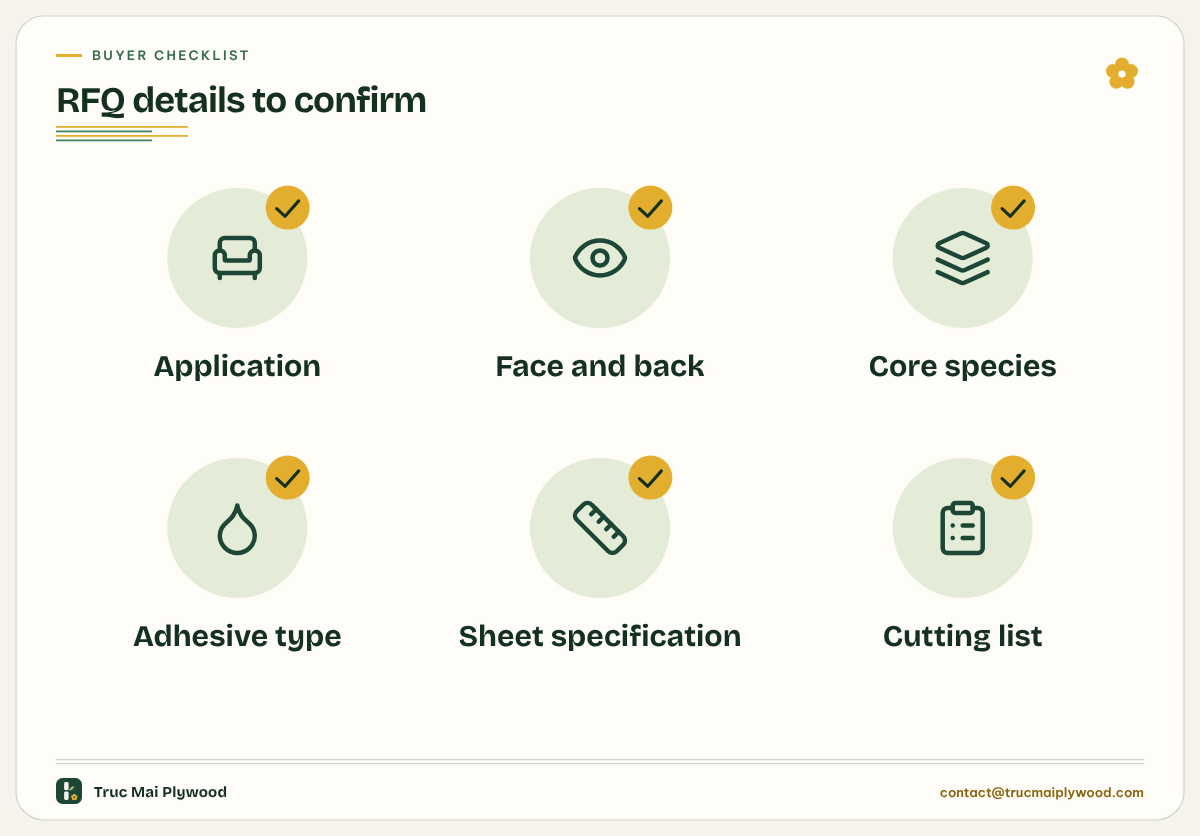
An effective RFQ identifies the application and every variable that changes the build. A buyer ordering cabinetry should start with the visible surfaces and the machining process, then move to the core, bond, emissions and logistics. This prevents two quotations with the same sheet size from concealing different constructions.
- State the furniture or commercial application and whether both faces will show.
- Name the face veneer and approve a face/back grade pair.
- Specify the core species and any core-jointing requirement.
- Give the adhesive type and emission requirement separately.
- Write the sheet footprint, nominal thickness and order tolerance.
- Attach a cutting list if parts must be labelled and cut at the mill.
- State packing, quantity, destination port and requested shipment documents.
The plywood RFQ checklist offers a fuller purchasing structure. Truc Mai Plywood manufactures furniture and commercial plywood in Ha Hoa, Phu Tho, Vietnam, with an annual capacity of around 60,000 m³. For a first specification, ordering samples is a practical way to settle appearance and edge construction before volume production.
Send your specification to contact@trucmaiplywood.com or through the quotation form.
Questions buyers ask
Can the grain direction run along the 2440 mm edge?
Yes. State the required face-grain direction in the purchase specification and approved sample, especially when parts will be cut across the sheet.
Is a nominal 4 by 8 sheet exactly four feet wide?
The metric panel is 1220 × 2440 mm. It is sold as the 4 × 8 format; use millimetres for cutting and purchasing dimensions.
Can both faces be decorative?
Yes. Specify the face and back grade as a pair and approve samples for both surfaces.
Is the sheet suitable for a painted cabinet?
Yes. Choose a sanded face and state the paint preparation, filling and edge treatment required by the finishing process.
Can I mix thicknesses in one shipment?
Yes. A mixed container can be arranged by agreement, with a separate pack count and mass for each thickness.
What should be marked on cut panels?
Use the buyer’s part code, finished dimensions, grain direction and pack identification on the cutting schedule.
Is the same plywood face available on different cores?
Yes. Veneer faces can be specified over different available core constructions, with a sample agreed for each build.
Do I need a separate drawing for machining?
A dimensioned cutting schedule is the practical starting point. Mark grain direction, edge finish and any part identification needed for assembly.
Can the supplier send samples before the order?
Yes. Request representative face and edge samples against the intended core and finish.
Is an E0 designation the same as a bond class?
No. Emission designation and adhesive bond performance are separate specifications and require different evidence.