
A veneer log is timber selected to be cut into thin wood sheets rather than sawn boards. Rotary peeling turns the log against a knife to produce a long ribbon; plain slicing cuts separate sheets from a flitch. Plywood commonly uses peeled core veneers, while sliced faces serve projects requiring a particular grain pattern.

What is a veneer log?
A veneer log is timber selected for conversion into thin wood sheets by peeling or slicing. Its value lies in recoverable clear wood, cutting behaviour and the appearance of the sheets. A straight log with few defects produces more usable veneer than one with extensive knots, rot or deep end splits.
The USDA Forest Service report on veneer log quality distinguishes appearance-grade veneer logs from logs intended for less visible uses. The buyer’s desired output matters: a log suitable for broad rotary sheets may not produce the decorative figure sought from a sliced flitch. Species, grain, colour and defect location all influence the choice.
A veneer log is not itself a plywood grade. Plywood is graded after veneer selection, assembly, bonding and finishing. For a buyer, the useful question is whether the log and cutting method can deliver the face appearance or core continuity specified in the finished panel.
Rotary vs plain sliced veneer: what changes?
Rotary peeling makes a continuous ribbon; plain slicing makes successive individual sheets. Both use a knife, but the log meets it differently. A rotary lathe spins a centred bolt against a long knife. A slicer advances a prepared section of the log, called a flitch, past its knife. The cut changes the visible relationship between annual rings and the sheet surface.
| Buyer comparison | Rotary peeled veneer | Plain sliced veneer |
|---|---|---|
| Starting wood | Centred log or bolt | Prepared half-log or flitch |
| Cutting action | Rotating log against knife | Repeated straight slicing strokes |
| Output | Continuous ribbon, clipped into sheets | Separate leaves requiring arrangement |
| Typical figure | Broad, varied grain | Cathedral or flat-cut figure on suitable species |
| Common plywood role | Core plies and selected faces | Decorative face and back |
| Matching decision | Sheet selection and joint placement | Sequence, matching and orientation of leaves |
| Procurement emphasis | Sheet continuity, defects, thickness | Figure, colour, leaf sequence, matching |
The USDA technical account of peeling and slicing describes the equipment and the effects of knife settings on veneer quality. Neither process makes a face automatically superior. A buyer specifying a cabinet door must judge the finished face, not merely the word sliced on a quotation.
Why does plywood use rotary peeled veneer?
Plywood uses rotary peeled veneer because the lathe produces broad sheets efficiently for layered panel construction. The continuous ribbon can be clipped to useful dimensions, sorted by quality and laid across adjacent plies. This makes rotary peeling especially practical for inner layers that need consistent coverage rather than a carefully repeated decorative figure.
The FAO description of plywood production follows rotary cutting through clipping, drying, assembly and pressing. The process does not end at the lathe: holes, splits, roughness and moisture still need control before a sheet is fit for gluing. Face veneers may also be rotary peeled where their appearance meets the agreed sample.
For furniture plywood, a core made from well-selected peeled veneers can support a separate decorative surface. That distinction helps a purchaser compare a panel with a fine face on a sound core against one that simply advertises an attractive species name.
How is a log prepared before peeling or slicing?
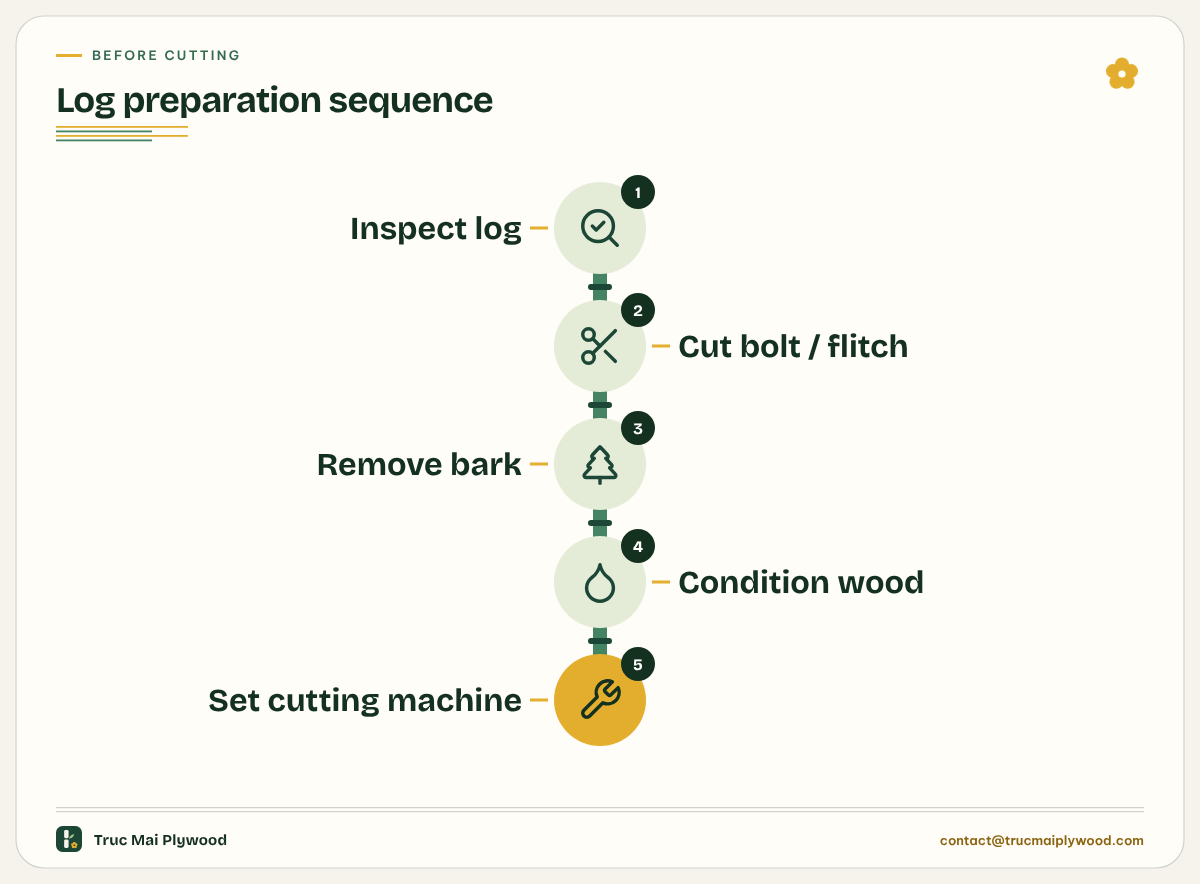
Preparation starts with sorting, cutting to length and removing bark. The mill then selects conditioning suited to the species and the intended veneer. Heat and moisture can soften the wood for a cleaner knife cut, while debarking protects the knife blade from grit and bark contamination.
- Inspect the log: record species and assess straightness, end checks, knots and visible damage.
- Cross-cut to a bolt or flitch: plan the cutting length and the position of obvious defects.
- Remove bark: protect the knife and expose the wood surface.
- Condition the wood: apply the heating or moisture treatment appropriate to the material.
- Set the cutting machine: align the log or flitch, knife and pressure bar before production.
- Inspect the first sheets: check thickness, tear-out and surface quality before continuing.
The USDA’s veneer processing research paper explains why storage, conditioning and machine adjustment affect the sheets obtained from the same timber. The buyer sees those decisions later as face quality and panel consistency.
What does the grain look like after each cut?
Rotary veneer often shows sweeping, irregular figure, while plain slicing can reveal repeated cathedral patterns. The annual rings intersect the cut surface differently. The appearance also changes with species, the log’s growth history and which side of the sheet faces outward.
For a clear-coated cabinet run, compare full-size samples placed side by side in the intended orientation. The distinction is especially visible across adjoining doors: one face may look calm individually yet create abrupt colour or figure changes when repeated. A supplier should identify whether the order needs a continuous visual field, a deliberate match or simply a consistent general grade.
A sliced leaf may be arranged with neighbouring leaves from the same flitch. Rotary faces can be selected and joined too, but they do not automatically reproduce the repeating pattern associated with a sequenced sliced bundle.
What are book matching, slip matching and random matching?
Book matching reverses alternate leaves; slip matching places consecutive leaves in the same face orientation. Random matching mixes selected leaves without preserving a strict sequence. These are face assembly choices, not separate veneer-cutting technologies.
| Match | Arrangement | Appearance to check |
|---|---|---|
| Book | Adjacent leaves opened like book pages | Mirrored grain and possible light-dark reversal |
| Slip | Consecutive leaves laid in the same direction | Repeated figure without mirror reversal |
| Random | Leaves selected and placed without fixed sequence | More varied grain across the surface |
A purchase order should name the match only where it matters to the visible result. Include a photograph of the approved arrangement and the required orientation on the finished part. For large cabinet elevations, the panel layout is as important as the leaf-to-leaf join.
How do lathe checks affect veneer quality?
Lathe checks are small cracks that develop on the loose side as veneer bends away from the knife. Sliced veneer can also have an open and a tight side. Deep checks may become visible under finishing or affect the surface presented to the adhesive.
Knife sharpness, pressure-bar setting, wood conditioning and cutting speed influence the result. The USDA’s technical treatment of knife and pressure-bar settings places check depth among the important quality observations. For a visible face, ask for a finished sample under the actual coating rather than relying on a raw veneer photograph.
Inspect for surface tearing, raised fibres and open checks after sanding. A smooth-looking dry sheet can behave differently once glue, pressure and finishing enter the process. The relevant acceptance point is the assembled panel surface.
How are veneer sheets clipped, dried and graded?
The next operations are clipping, drying and sorting into usable veneer groups. Clipping removes irregular edges and selected defects. Drying prepares the veneer for adhesive application; sorting keeps suitable faces separate from material intended for inner plies.
The FAO process description identifies these stages before assembly. For the buyer, moisture control and the distribution of repairs matter because a good-looking log can still yield unsuitable sheets if the cut or drying process damages them.
A face grade should be agreed by sample, with front and back specified separately. An internal ply has a different job: its joins and gaps affect the lay-up even when they will never be visible. The purchase specification should therefore describe both the exposed face and the hidden construction.
How does veneer cutting affect plywood construction?
Cutting method influences the available sheet dimensions and appearance, while lay-up determines how the veneers work together. Plywood normally alternates grain direction across layers. The core species, veneer joints, adhesive system and pressing process are separate specifications from the visible face cut.
At Truc Mai Plywood in Ha Hoa, Phu Tho, furniture and commercial panels use Vietnamese Eucalyptus, Acacia, Styrax or Pine cores, including combinations of those species. Decorative options include birch, poplar, Okoume, Bintangor, Pine, Eucalyptus and engineered veneer. A birch-faced panel identifies the face; it does not imply that every internal ply is birch.
For a decorative specification, compare birch-faced plywood with poplar plywood by the face sample and core build. For an alternative with a repeatable manufactured pattern, review engineered veneer faced plywood. These choices answer different visual requirements without changing the need for sound internal bonding.
When is sliced veneer the better furniture face?
Choose sliced veneer when a controlled decorative figure is central to the design. A repeated sequence can help align visible door fronts, wall panels or furniture components. It is particularly useful when the designer specifies how the grain must run across adjoining parts.
The purchasing package should include the face species, cut, matching pattern, face/back pairing and finish sample. If a project has several cabinet fronts, show their positions on an elevation drawing. A sample board without the intended layout may conceal mismatches that become obvious at installation.
For utilitarian interiors, a carefully selected rotary face can serve just as well. The right decision follows the appearance standard and the approved sample rather than a blanket preference for one machine.
How should buyers specify face thickness and grade?
Specify veneer thickness, face grade and finish preparation as separate lines. Truc Mai’s face veneers are commonly supplied in the 0.2–0.5 mm range, with 0.3 mm typical for European furniture orders. These dimensions describe the face layer, not the finished plywood thickness.
Ask the mill to identify acceptable knots, repairs, colour variation and joint visibility on both sides. Specify whether the panel will be clear coated, painted or covered with another decorative layer. For cabinet grade plywood, a sample-based surface standard makes a grade name useful to the purchasing and inspection teams.
A grade code on its own is insufficient where suppliers use different trade naming systems. Photographs of accepted and rejected examples, together with the physical reference sample, make the order easier to inspect consistently.
How can a buyer verify veneer origin and traceability?
Traceability starts with the species and origin records for the actual veneer supply. A face imported separately from the core has its own upstream chain. A plywood purchase file should distinguish the two rather than treating the finished panel’s manufacturing country as the origin of every wood component.
For EU procurement, request the plot and species data relevant to the wood used, then align the records with the order and shipment. The face veneer origin files page explains the document trail for imported decorative faces. The EU Commission’s due diligence guidance describes the information operators gather for covered products.
For repeat sourcing, keep the face species and origin documentation tied to the approved construction. This prevents an appearance-equivalent substitution from silently changing the documentation needed by the importer.
How do cut-to-size panels change the purchasing calculation?
A cut list turns a standard plywood sheet into labelled furniture parts, with saw kerf reducing the finished dimensions. The table below uses the supplied cutting model, including a 4 mm kerf for each indicated saw cut. Nominal divisions are shown alongside the calculated finished dimensions so buyers can see where material is lost.
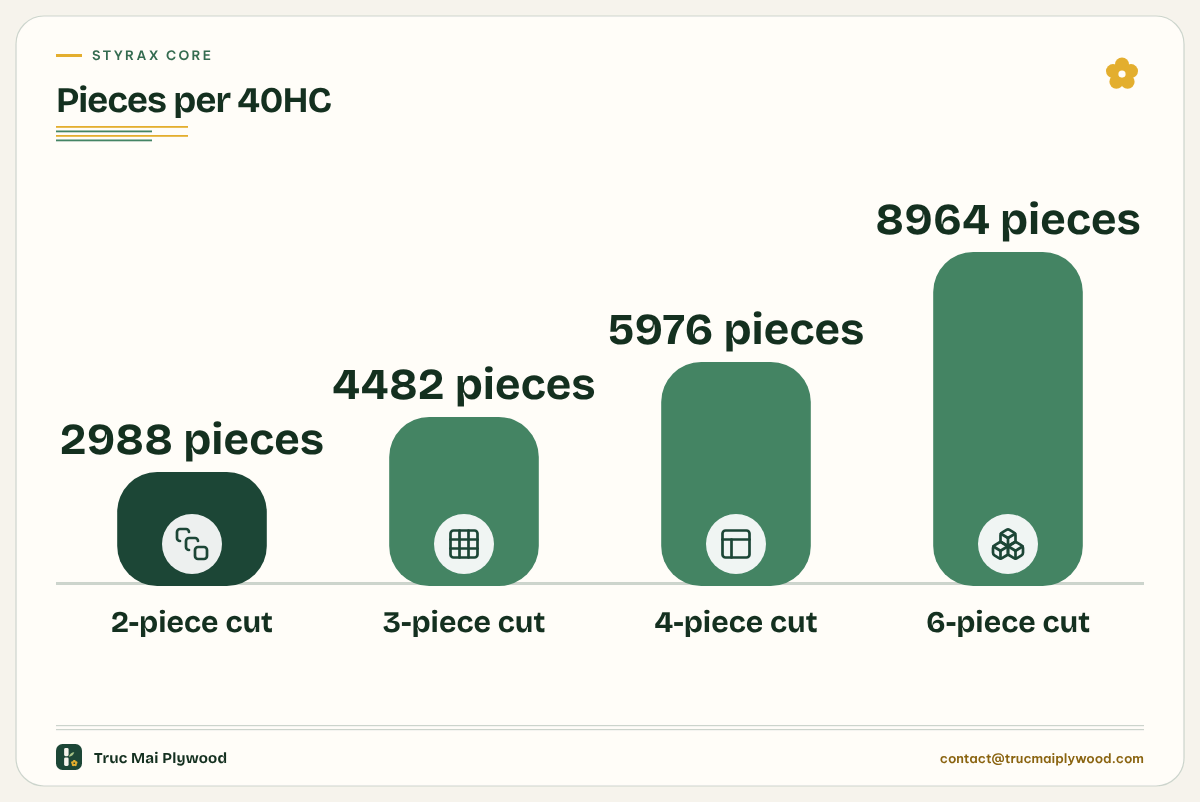
Cutting model basis: Cut a standard sheet into 2 (lengthwise), 3, 4 or 6 pieces; saw kerf 4 mm per cut; never 8. piece = (parent - kerfs)/pieces; nominal = parent/pieces. Pieces per 40HC = sheets per 40HC x pieces.
| Model row | Core | Parent sheet | Cut pieces | Kerf (mm) | Saw cuts | Finished piece (mm) | Nominal piece (mm) | Sheets per 40HC | Pieces per 40HC |
|---|---|---|---|---|---|---|---|---|---|
| cut2-1220x2440 | — | 1220x2440 | 2 | 4 | 1 | 608.0 × 2440.0 | 610.0 × 2440.0 | — | 2 |
| cut3-1220x2440 | — | 1220x2440 | 3 | 4 | 2 | 1220.0 × 810.7 | 1220.0 × 813.3 | — | 3 |
| cut4-1220x2440 | — | 1220x2440 | 4 | 4 | 3 | 1220.0 × 607.0 | 1220.0 × 610.0 | — | 4 |
| cut6-1220x2440 | — | 1220x2440 | 6 | 4 | 3 | 608.0 × 810.7 | 610.0 × 813.3 | — | 6 |
| cut2-40hc-styrax-12 | Styrax | 1220x2440 | 2 | — | — | — | — | 1494 | 2988 |
| cut3-40hc-styrax-12 | Styrax | 1220x2440 | 3 | — | — | — | — | 1494 | 4482 |
| cut4-40hc-styrax-12 | Styrax | 1220x2440 | 4 | — | — | — | — | 1494 | 5976 |
| cut6-40hc-styrax-12 | Styrax | 1220x2440 | 6 | — | — | — | — | 1494 | 8964 |
| cut2-40hc-acacia-12 | Acacia | 1220x2440 | 2 | — | — | — | — | 1328 | 2656 |
| cut3-40hc-acacia-12 | Acacia | 1220x2440 | 3 | — | — | — | — | 1328 | 3984 |
| cut4-40hc-acacia-12 | Acacia | 1220x2440 | 4 | — | — | — | — | 1328 | 5312 |
| cut6-40hc-acacia-12 | Acacia | 1220x2440 | 6 | — | — | — | — | 1328 | 7968 |
| cut2-40hc-eucalyptus-12 | Eucalyptus | 1220x2440 | 2 | — | — | — | — | 1200 | 2400 |
| cut3-40hc-eucalyptus-12 | Eucalyptus | 1220x2440 | 3 | — | — | — | — | 1200 | 3600 |
| cut4-40hc-eucalyptus-12 | Eucalyptus | 1220x2440 | 4 | — | — | — | — | 1200 | 4800 |
| cut6-40hc-eucalyptus-12 | Eucalyptus | 1220x2440 | 6 | — | — | — | — | 1200 | 7200 |
The container rows are derived planning figures, with pieces calculated from the sheet count for each core and cut pattern. For physical production, the cut list must specify the finished dimension rather than treating the nominal division as the finished dimension. Compare the options with panels cut at the mill before approving labels and pack quantities.
What belongs in a veneer-faced plywood RFQ?
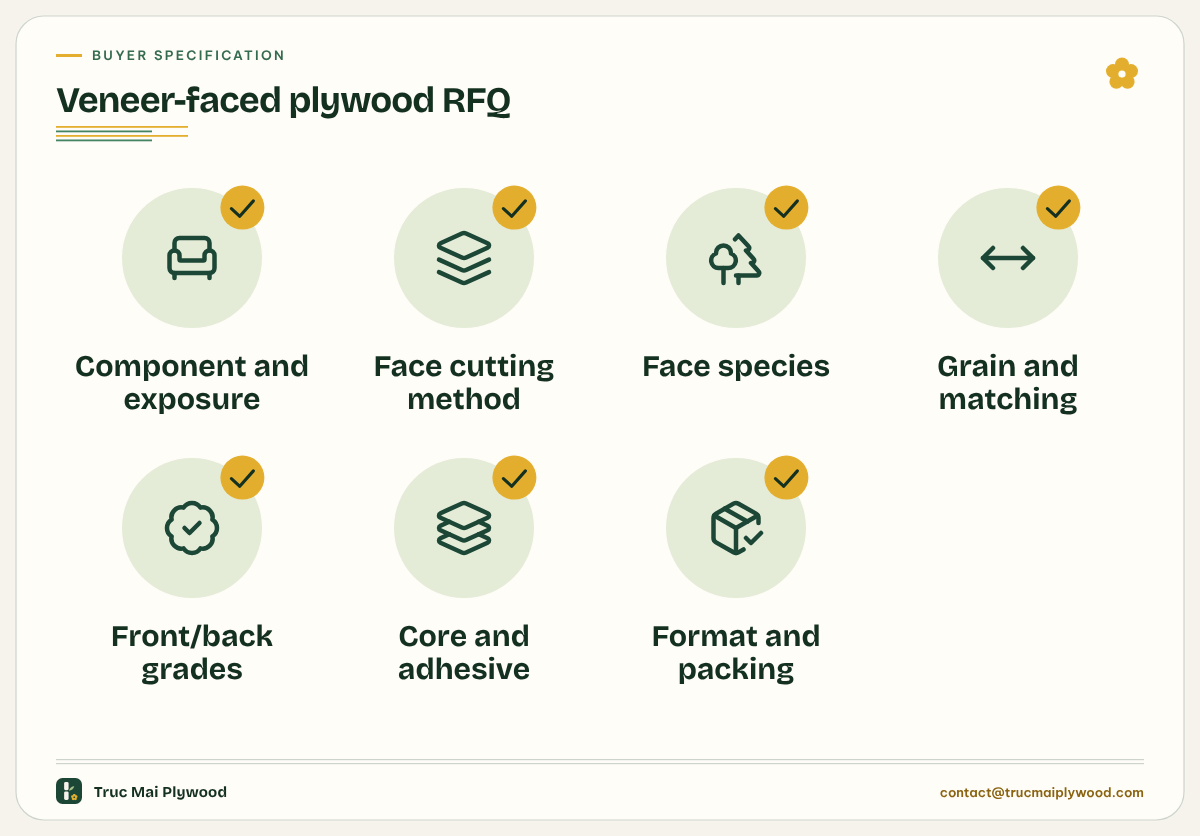
An effective request for quotation identifies the finished application first, then the face and internal build. A buyer who writes only “rotary veneer plywood” leaves the mill to choose too many important details. Use the following sequence when sending a purchasing enquiry.
- Name the furniture component and whether the face is exposed.
- Specify rotary peeled, plain sliced or an approved equivalent face appearance.
- State face species, grain orientation, matching and the front/back grade pair.
- Define the core species, panel thickness, adhesive and emission specification separately.
- Provide the sheet format, finished cut list, labels and packing instruction.
- Attach the approved sample and state the quantity and destination port.
Use the plywood RFQ checklist to keep competing offers on the same basis. For appearance-sensitive orders, request physical samples before agreeing the final face standard. This creates an inspection reference for the mill and for the buyer receiving the goods.
How should a buyer inspect the first production panels?
Inspect a representative group of full panels against the approved sample and order specification. Begin with the surface under consistent light, then check joints, edge construction, thickness and the actual cut pieces. An attractive veneer face does not replace inspection of the finished panel.
Record whether the grain direction matches the cutting plan and whether adjacent visible parts work together. Inspect repaired areas after the intended surface treatment where practical. Check the panel edges for open gaps or irregular joints and compare measurements with the agreed tolerances. Truc Mai’s sanded, calibrated furniture panels can be specified at ±0.3 mm thickness tolerance, with the acceptance requirement written on the order.
A repeat order becomes easier when the first inspection records the face reference, accepted repairs and panel arrangement. The practical next step is to send the face sample, construction specification and cut list together with the quotation enquiry.
Send your specification to contact@trucmaiplywood.com or through the quotation form.
Questions buyers ask
Can one plywood panel have a sliced face and peeled core?
Yes. The decorative face and the inner veneers serve different purposes, so a sliced hardwood face can be bonded to a rotary-peeled plywood core. Specify both separately.
Does rotary veneer always show wild grain?
No. The appearance changes with species, log geometry and the position of the cut. Review a full-size face sample rather than judging the cutting method alone.
Is birch-faced plywood made entirely from birch?
No. Birch-faced plywood identifies the surface species, not necessarily the core. Truc Mai offers birch face veneer on Vietnamese core species.
Can I request the same grain layout on repeat orders?
Yes. Agree a reference sample, face grade, matching method and permitted colour range before production. Natural veneer still shows individual wood variation.
Which face works for painting rather than clear coating?
A smooth, sanded and calibrated face with controlled repairs is the starting point. Choose the surface against the paint system and an approved sample.
Does a thicker decorative face mean a stronger plywood panel?
No. Panel performance also depends on core construction, adhesive bonding and the complete lay-up. Specify face thickness for appearance and finishing needs.
What should a veneer face sample show?
Ask for a representative panel showing colour, grain, repairs, joints and the intended finish. An isolated small swatch can hide the overall pattern.
Are rotary peeled sheets used only inside plywood?
No. Rotary peeled veneer can also be selected for visible faces. Its broad sheet format can be useful where a continuous natural grain is wanted.
Can cut-to-size panels be labelled for assembly?
Yes. Truc Mai offers labelled cut-to-size furniture panels against an agreed cutting list and packing instruction.