
cnc cut plywood works best when the sheet lies flat, thickness is calibrated and inner veneers leave few open gaps at the toolpath. For furniture nesting, select a sound, sanded core and specify both faces, thickness tolerance and acceptable edge defects. Cutter geometry and hold-down then determine whether the finished components emerge clean.
Which cnc cut plywood is best for CNC routing?
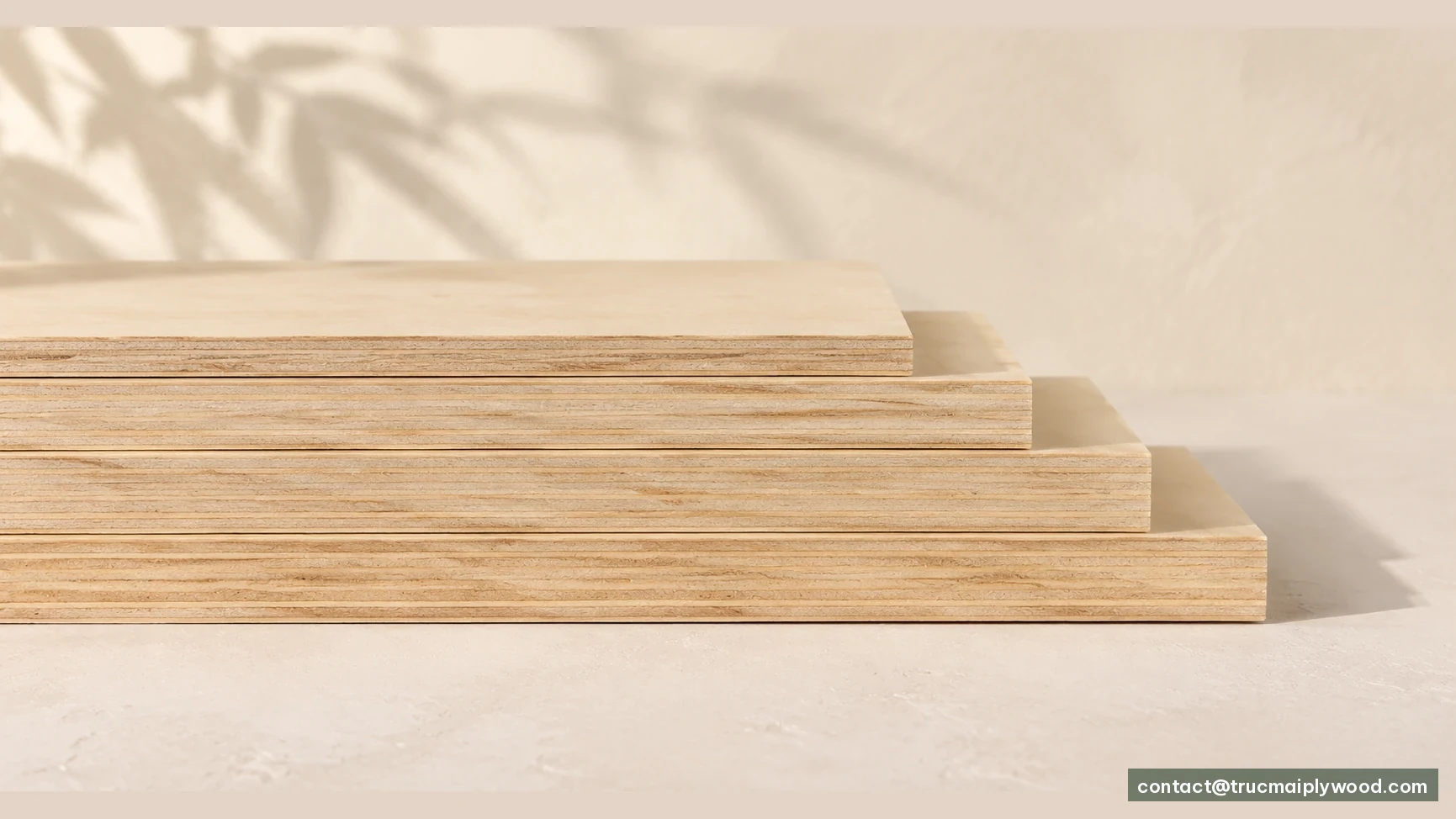
Calibrated furniture plywood with a closely joined core is the first choice for CNC routing of cabinet and interior components. The best face depends on the finish: sanded veneer for paint or lamination, selected decorative veneer for exposed grain, and a factory-faced panel when the finished surface is part of the order.
A CNC router follows programmed coordinates, but it cannot correct a sheet that rocks on the bed, varies sharply in thickness or opens a large cavity along a cut edge. Material selection therefore starts with the part: a cabinet side needs predictable thickness for grooves and hardware; a decorative screen needs a clean visible face; a narrow rail needs sound inner plies to survive machining and handling.
| Buyer priority | Panel feature to specify | What to examine on a sample |
|---|---|---|
| Repeatable grooves | Calibrated thickness | Thickness across the full sheet and at corners |
| Clean exposed edges | Joined, low-gap inner veneers | Freshly routed cross-section |
| Reliable vacuum holding | Flat, even sheet | Contact with the spoilboard |
| Decorative cabinet doors | Approved face/back pair | Grain, repairs and edge chipping |
| High-volume nesting | Consistent panel construction | Results from several sheets, not one coupon |
For furniture lines, birch-faced plywood means a birch decorative face over a specified core, rather than an all-birch construction. Truc Mai Plywood offers furniture panels with stitched cores and sanded, calibrated faces, including Styrax, Acacia, Eucalyptus and Pine core choices. An approved sample establishes the face/back appearance. Ask for a representative routed edge alongside the face sample, because a flawless top veneer can hide gaps in the middle.
Is poplar plywood suitable for CNC?
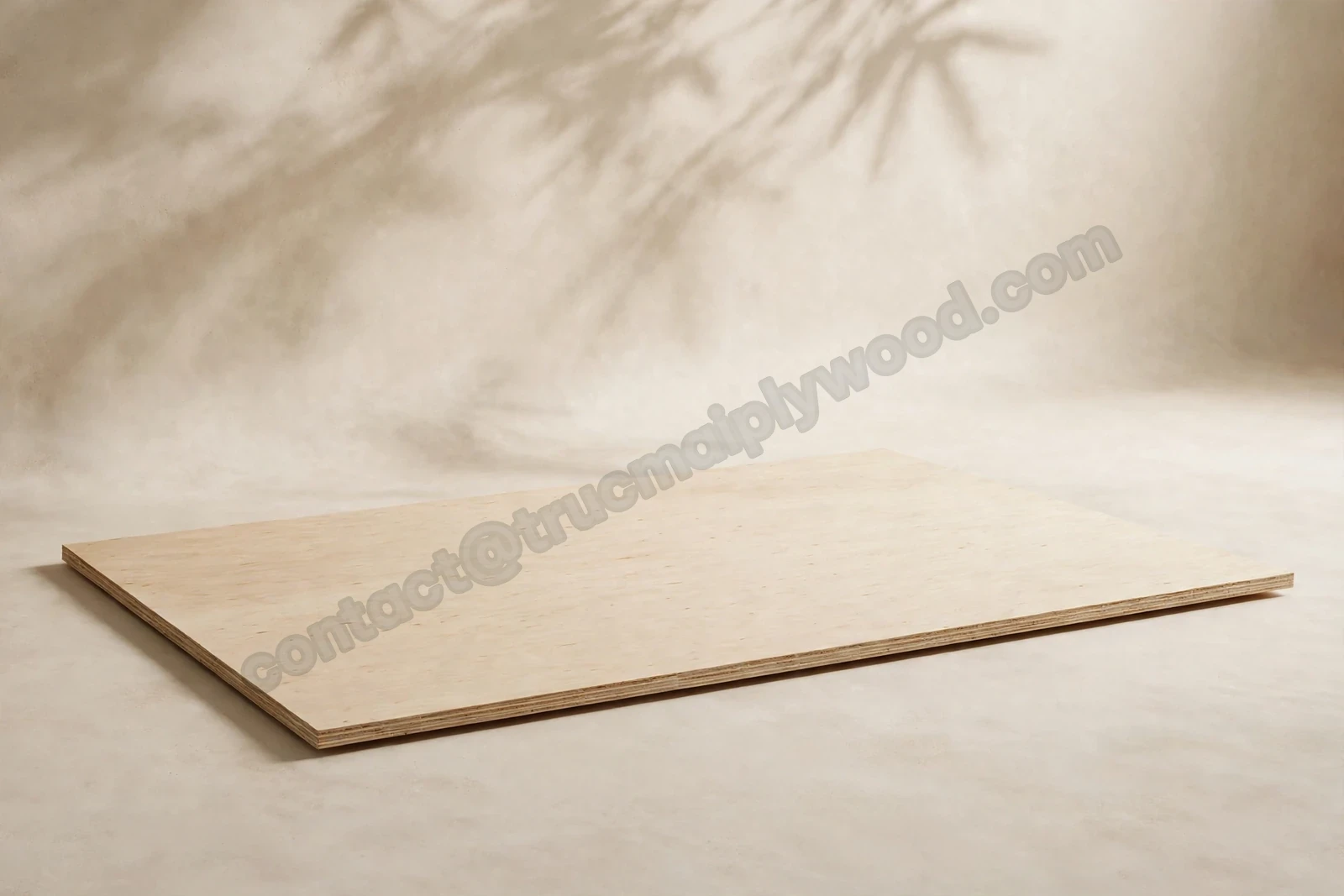
Yes, poplar-faced plywood can be suitable for CNC-routed furniture when the core construction, surface preparation and toolpath meet the intended finish. A poplar face is a surface choice; it does not identify the species or quality of every internal ply.
For painted cabinet components, a smooth poplar face provides a useful starting surface. For visible clear-coated parts, inspect grain and colour consistency against the approved sample. For narrow parts, the integrity of the inner veneers is more important than the name of the decorative face. Compare the same routed contour in a face veneer and a cross-grain edge, then check whether fibres lift around drilled holes.
Truc Mai’s poplar plywood range includes poplar and bleached-poplar faces on Vietnamese wood cores. Buyers can specify an engineered veneer face when repeatable appearance is a higher priority than natural grain variation. The factory’s face veneers are thin relative to the core, so routing quality still depends heavily on core joints and the cutter’s exit direction.
A useful acceptance sample includes an outside profile, an internal opening and a drilled fixing position. Examine all three after sanding and after the proposed finish. This separates a material that merely cuts from one that gives acceptable finished furniture parts.
What bit for plywood?
A compression spiral cutter is a strong starting choice for through-cutting plywood when both faces must stay clean. Use a downcut spiral for a shallow top-face groove and an upcut spiral when clearing chips from a deeper pocket matters most.
| Cutter geometry | Typical plywood task | Face to inspect first |
|---|---|---|
| Compression spiral | Full-depth nested profiles | Both faces and the entry point |
| Downcut spiral | Surface rebates and shallow grooves | Bottom of the cut and chip packing |
| Upcut spiral | Deep slots and chip evacuation | Top veneer and part lift |
The compression tool has opposing cutting directions along its flute. Its first cutting pass must reach the downcut section for the top veneer to benefit; a very shallow first pass can act like an upcut. Match the cutting length, diameter and flute geometry to the panel thickness and the machine’s hold-down capacity.
Do not copy a spindle-speed setting from an unrelated machine. Obtain the cutter maker’s chip-load guidance and establish a test programme using the actual core, adhesive, overlay and bit diameter. Record the bit identification, feed, spindle speed, pass depth and observed edge condition. The right test gives the workshop a repeatable starting recipe rather than an isolated attractive sample.
Why does plywood chip on a CNC?
Plywood chips when the cutter pulls unsupported surface fibres away at entry, exit or along a poorly supported veneer joint. A blunt edge, unsuitable flute direction, weak vacuum hold-down and internal gaps can intensify the damage.
First identify which face fails. Top-face splintering with an upcut tool points towards cutting direction or compression engagement. Bottom-face breakout suggests poor spoilboard support or a downcut exiting through the underside. A torn strip beside an internal cavity indicates a panel construction problem rather than a spindle-setting problem.
- Mark the damaged face and photograph the toolpath position.
- Inspect the bit for wear and confirm the intended flute sections are engaged.
- Check sheet contact, vacuum zones, tabs and remaining part size.
- Route a fresh sample with the same cutter but revised entry or pass sequence.
- Cut through a different region of the sheet to distinguish a local core gap from a recurring machining fault.
Dust removal is part of cut quality and workshop safety. The US Occupational Safety and Health Administration’s woodworking guidance identifies routers among high-dust operations and recommends local exhaust ventilation close to the source. Keep extraction working while evaluating a new cutter, rather than treating a clear edge as the only measure of success.
What should importers look for in CNC-ready plywood?
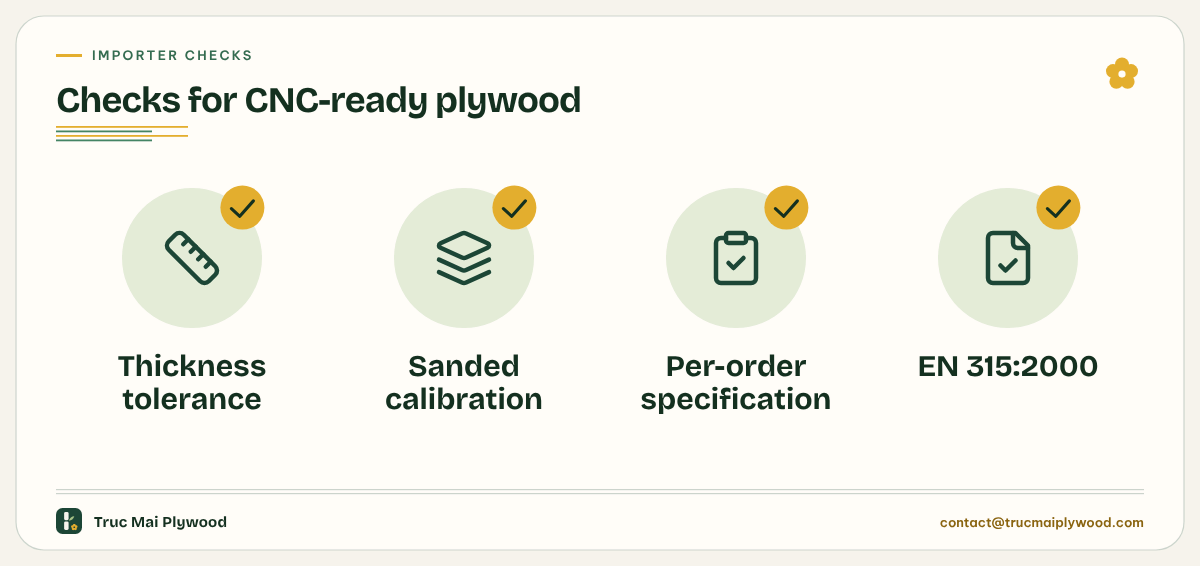
Importers should buy a documented panel construction, not the phrase “CNC-ready”. Specify core joining, sanded thickness tolerance, flatness acceptance, face grade and a routed-edge sample for the intended furniture part.
Start the purchase specification with the machining operation. A factory making door panels needs different visible-face priorities from a line producing hidden drawer bottoms. Ask for a cross-section photograph and an actual cut sample from the proposed grade. The supplier should identify the core species and whether the core veneers are stitched or loosely laid.
Truc Mai’s sanded and calibrated furniture line is quoted at ±0.3 mm thickness tolerance, while other constructions are specified per order. This is a purchase tolerance, not a machine accuracy figure. Write the measurement locations and acceptance method on the order. For wider dimension context, EN 315:2000 is the European plywood dimensional-tolerance standard; a buyer’s tighter agreed machining specification belongs on the purchase order.
Request samples before approving the volume run. The sample-order process provides a practical route to compare face appearance, cut edges and hardware holes using the same CNC programme.
How does panel flatness affect a nesting table?
A flat panel gives vacuum hold-down the best chance of keeping every nested component at the programmed cutting height. Bowed corners and local waves create leakage paths, leave unsupported areas and shift the effective depth of grooves.
Place the sheet on a clean spoilboard before starting the programme. Inspect whether the corners sit down and whether the centre rises. If the machine uses vacuum zones, cover unused zones and inspect the gasket and spoilboard condition. Where the workpiece becomes small after surrounding cuts, tabs or onion-skin passes may help retain it until the last operation.
Ask the supplier for flat sheets packed on level supports. On receipt, store the packs off the floor with even bearing and keep sheets acclimatised to the workshop before machining. A panel that arrives flat can still distort when exposed unevenly to moisture or heat. For long narrow components, cut a trial part and recheck its shape after release from the parent sheet.
How should thickness and ply construction be specified?
Specify nominal thickness, agreed tolerance, core build and the machining features that must fit. Cabinet grooves, dowel holes and hardware recesses make thickness consistency a functional requirement, not simply a cosmetic preference.
Truc Mai supplies a 3–40 mm plywood range. Its 3–5 mm thin panels have five plies, while a typical 18 mm furniture panel has 11–13 plies, most often 11. These are construction facts for the quoted line; the buyer should use the approved sample and order specification for the actual panel being cut.
For a CNC furniture programme, thickness influences the cutter’s effective engagement and the depth of a blind groove. If two nominally equal sheets differ across a batch, a fixed-depth toolpath may produce visibly different rebates. Use a consistent reference face and verify thickness before setting the production toolpath.
The 18 mm panel specification is a useful companion for buyers building common cabinet carcases. Put thickness, face/back grade and core on separate lines rather than compressing them into a vague “furniture grade” description.
How can a buyer detect internal voids before production?
Cut and inspect representative cross-sections before releasing a nested production batch. Open gaps, overlapping veneers and loose joints show up on a fresh edge more clearly than on the sanded face.
Examine an outside contour, a small internal window and a narrow strip. A large open gap at a screw position may reduce holding quality; a gap near an exposed edge creates extra filling and sanding. Record the location and size of defects against an agreed sample or written acceptance criterion, and distinguish occasional cosmetic repairs from continuous core openings.
For repeat orders, keep a labelled reference piece from the approved panel. The quality team can compare later deliveries against the same routed features. An attractive top face is useful evidence of face preparation, but it does not replace the cut-edge inspection. Stitched inner veneers help keep the core aligned during lay-up; the sample verifies the finished result.
Which plywood faces suit cabinet doors and visible furniture?
Choose the face by the finishing route: decorative veneer for a clear finish, prepared veneer for painting, or an already faced sheet for a consistent decorative surface. Each route changes what a clean CNC edge looks like.
A natural veneer needs careful grain orientation so adjacent cabinet doors read as a set. Engineered veneer offers a more repeatable pattern, while melamine and high-pressure laminate faces demand attention to brittle edge breakout. For a finished-face panel, test the actual overlay with the proposed cutter rather than using bare plywood as the test material.
A factory-prepared UV-ready surface means the buyer can apply its own UV coating after machining; it is not a factory-applied coating. Keep face selection and adhesive/emission requirements separate in the order. If the component will be printed rather than veneered, the panel-face printing discussion covers a different finishing path.
How should a CNC nest account for grain, kerf and part retention?
A nesting layout should reserve cutter width, protect grain orientation and keep small components attached until the final pass. Material yield calculated from rectangles alone misses these practical constraints.
Start with a cutting list that records finished dimensions and visible-face direction. Arrange paired door components so their grain runs consistently. Reserve tool clearance between profiles and at the sheet edge. Place small parts where vacuum support remains available after adjacent components are cut, then set tabs or a finishing pass for the remaining bridges.
For cut-to-size blanks, the saw kerf must also be deducted from the parent sheet. The planning examples below use the supplied 4 mm saw-kerf model. These are saw-cut blank dimensions, not CNC router tool diameters. The nominal division of a parent sheet is larger than the usable equal piece after the saw removes material. A buyer should therefore send finished dimensions rather than relying on the shorthand “half sheet” or “quarter sheet”.
What do saw-kerf calculations mean for cut-to-size blanks?
The following table reproduces the supplied cutting calculations without changing the values. Basis: Cut a standard sheet into 2 (lengthwise), 3, 4 or 6 pieces; saw kerf 4 mm per cut; piece = (parent - kerfs)/pieces; nominal = parent/pieces. Pieces per 40HC = sheets per 40HC × pieces.. The nominal dimensions show the uncut division; usable dimensions account for the stated saw cuts.
| Parent sheet | Pieces | Kerf (mm) | Saw cuts | Usable piece W × L (mm) | Nominal W × L (mm) |
|---|---|---|---|---|---|
| 1220x2440 | 2 | 4 | 1 | 608.0 × 2440.0 | 610.0 × 2440.0 |
| 1220x2440 | 3 | 4 | 2 | 1220.0 × 810.7 | 1220.0 × 813.3 |
| 1220x2440 | 4 | 4 | 3 | 1220.0 × 607.0 | 1220.0 × 610.0 |
| 1220x2440 | 6 | 4 | 3 | 608.0 × 810.7 | 610.0 × 813.3 |
These dimensions illustrate the distinction between a nominal split and a finished blank. Truc Mai offers labelled panels cut from standard sheets in two, three, four or six pieces, with the exact piece sizes agreed from the cutting list. A 1200 × 800 mm blank is one possible order format, rather than an automatic result of dividing every parent sheet into thirds. See cut-to-size plywood panels for the ordering route.
How many CNC blanks can a 40HC plan produce?
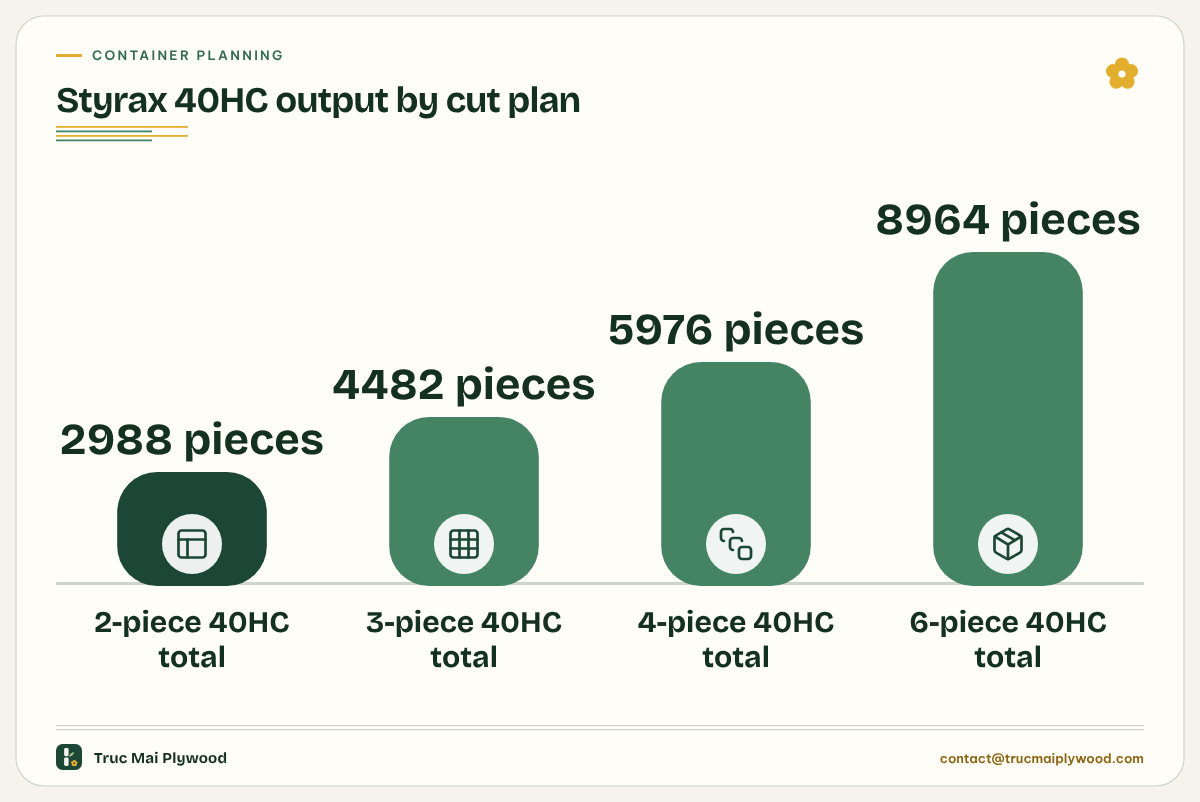
The supplied 40HC planning table uses 12 mm sheets, the named core, the 1220 × 2440 mm parent format and the same cut counts as above. It lists theoretical piece counts from whole-sheet loading plans, rather than measured shipment totals. Basis: Cut a standard sheet into 2 (lengthwise), 3, 4 or 6 pieces; saw kerf 4 mm per cut; piece = (parent - kerfs)/pieces; nominal = parent/pieces. Pieces per 40HC = sheets per 40HC × pieces..
| Core | Thickness (mm) | Parent (mm) | Pieces per sheet | Sheets | Pieces |
|---|---|---|---|---|---|
| Styrax | 12 | 1220x2440 | 2 | 1494 | 2988 |
| Styrax | 12 | 1220x2440 | 3 | 1494 | 4482 |
| Styrax | 12 | 1220x2440 | 4 | 1494 | 5976 |
| Styrax | 12 | 1220x2440 | 6 | 1494 | 8964 |
| Acacia | 12 | 1220x2440 | 2 | 1328 | 2656 |
| Acacia | 12 | 1220x2440 | 3 | 1328 | 3984 |
| Acacia | 12 | 1220x2440 | 4 | 1328 | 5312 |
| Acacia | 12 | 1220x2440 | 6 | 1328 | 7968 |
| Eucalyptus | 12 | 1220x2440 | 2 | 1200 | 2400 |
| Eucalyptus | 12 | 1220x2440 | 3 | 1200 | 3600 |
| Eucalyptus | 12 | 1220x2440 | 4 | 1200 | 4800 |
| Eucalyptus | 12 | 1220x2440 | 6 | 1200 | 7200 |
These figures help a procurement team reconcile piece demand with full-sheet quantities. Packing materials, actual sheet weights and the shipping booking must be checked when turning the plan into a loading instruction. A workshop receiving pre-cut blanks should also consider bundle identification, sequence of machining operations and handling damage at exposed edges. The container planning table explains the underlying core-weight difference.
What machining trial should a furniture factory run?
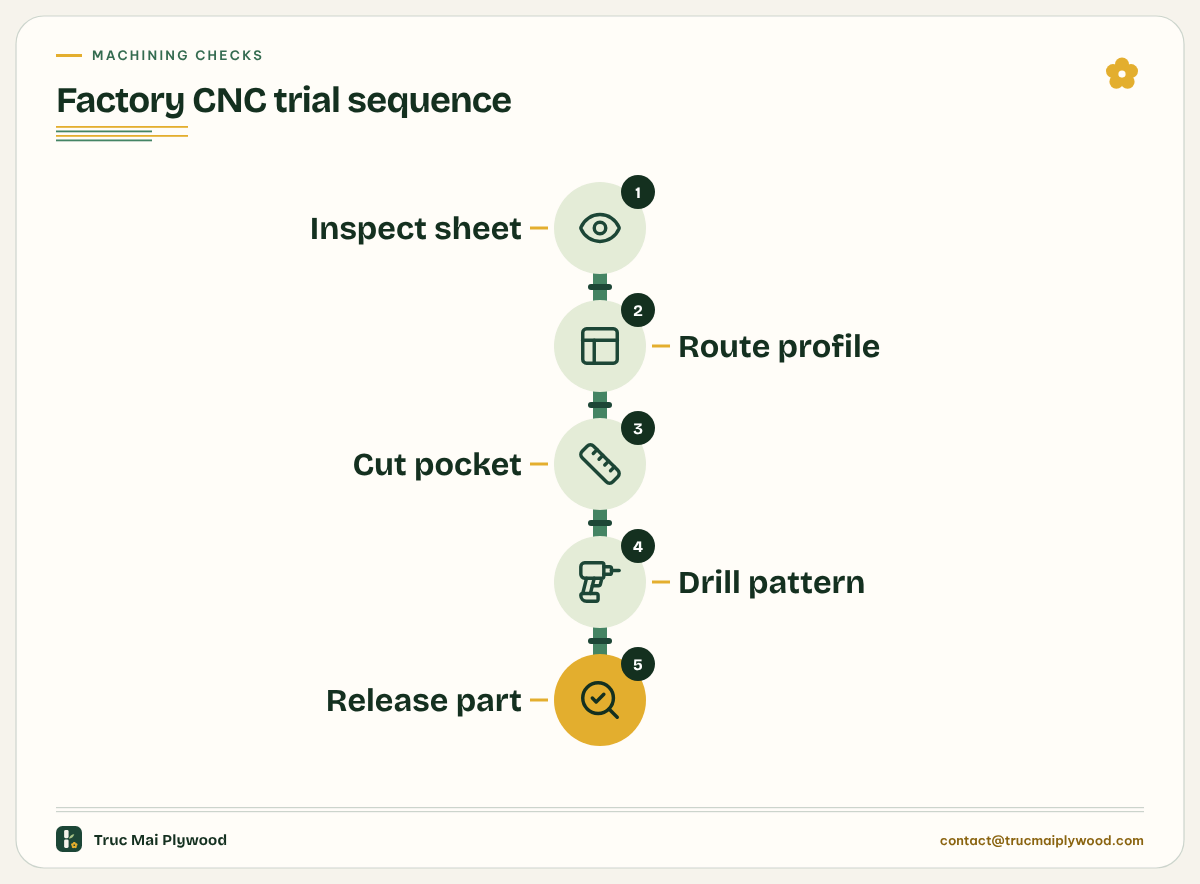
Run a trial using the production cutter, intended face, actual hold-down and a representative nested drawing. A small straight cut alone misses the most expensive failure modes in cabinet manufacture.
- Inspect the incoming sheet for bow, face damage and thickness consistency.
- Route an outside profile and a small inside corner to check tear-out and radius.
- Cut a pocket or rebate at the programmed depth and measure the fit with its mating part.
- Drill the hardware pattern and check breakout at both faces.
- Release a narrow part from the nest and inspect its edge, shape and remaining tabs.
- Apply the intended finish to the sample and record any newly visible defects.
Keep the trial part, cutting file and tool settings together. If a replacement shipment behaves differently, this record gives the supplier and workshop a shared basis for investigation. It also distinguishes a bad sheet from a worn cutter or a deteriorating spoilboard. For a separate cutting process, compare the laser-cutting sheet discussion rather than assuming CNC router results transfer unchanged.
Which documents matter for UK, EU and US buyers?
Ask for product specifications, emission documentation where applicable and traceability records matching the purchased panel construction. The documents should identify the actual goods rather than merely listing certificates held by a business.
For the US, 40 CFR Part 770 sets a 0.05 ppm formaldehyde limit for hardwood plywood with veneer core under TSCA Title VI. Truc Mai holds CARB Phase 2 and TSCA Title VI certification for hardwood plywood with veneer core in the 3–25 mm thickness scope, under certificate CARB/EPA 26053. Match the order to that scope.
For FSC-labelled supply, the FSC chain-of-custody standard requires the certificate code and product claim on sales documents. Truc Mai’s FSC 100% eligible products are supplied with the corresponding claim. For EU buyers, origin records and plot geolocation files for both core wood and face veneer form part of the due-diligence dossier. These files support the importer’s regulatory process and also identify which material construction was ordered.
Separate the documents needed to import the plywood from the drawing needed to machine it. The first establishes traceability and product compliance; the second establishes part dimensions, tolerances and finish.
How should the purchase order describe CNC nesting stock?
Write a complete, measurable panel specification, then attach the approved sample and cut drawing. A short material name does not tell a supplier which defects the nesting line can tolerate.
The plywood RFQ checklist is a starting point. For CNC furniture work, the order line should contain the application, core species and joining method, glue and emission specification, face/back pair, thickness and tolerance, sheet size, pack labelling and quantity. Add the destination port and the intended surface finish. Where pieces are supplied pre-cut, provide the exact blank sizes and their label scheme.
A useful acceptance note describes the actual inspection: thickness measured across a panel, a routed-edge sample, acceptable repairs on the face, and the required packing protection. That is more actionable than calling the plywood “premium CNC grade”. Include a photo of a rejected edge beside the accepted reference if a specific defect repeatedly causes scrap.
Truc Mai manufactures furniture and commercial plywood in Ha Hoa, Phu Tho, Vietnam, with annual production around 60,000 m³. The mill can quote calibrated furniture panels and cut-to-size blanks against a written specification. Send the cutting list, target face and core, panel thickness, quantities and delivery destination to request a quotation and sample arrangement.
Send your specification to contact@trucmaiplywood.com or through the quotation form.
Questions buyers ask
Can CNC nesting cut a complete kitchen cabinet from plywood?
Yes. A nesting programme can cut cabinet sides, shelves and doors from plywood sheets; joinery, edging and hardware operations are planned separately.
Should I order finished sizes or standard sheets?
Order standard sheets for flexible in-house nesting, or labelled cut-to-size blanks when the cutting list is stable and shipping smaller pieces improves handling.
Do I need to seal exposed CNC-cut edges?
Seal or edge-band exposed plywood edges according to the cabinet finish and service environment; machining exposes the veneer layers.
Does veneer direction affect CNC furniture parts?
Yes. Keep grain direction consistent on visible faces and orient long decorative parts in the nesting file before optimising yield.
Can a CNC router machine melamine-faced plywood?
Yes. Choose tooling and support for a brittle decorative surface, then test the entry and exit edges on the actual overlay.
What drawing format should I send for CNC parts?
Send a dimensioned cutting list and the file format accepted by the workshop, with units, material thickness, grain direction and machining notes.
Can a supplier label pre-cut plywood pieces?
Yes. Truc Mai offers labelled cut-to-size panels from standard sheets, with dimensions agreed from the buyer’s cutting list.
Is FSC 100% plywood available for furniture parts?
Truc Mai holds FSC chain-of-custody licence FSC-C196493. Eligible FSC 100% products carry the applicable claim on sales documents.
How do I check plywood emission compliance for US cabinetry?
Check the panel construction and certificate scope against TSCA Title VI, then match the purchased thickness and product type to the documents.
Can I mix plywood thicknesses in one shipment?
Yes. Specify the sheet count, core and face for each thickness; mixed-product container packing is agreed with the supplier.