
Alternate plywood is a trade term used in India for panels whose inner veneers combine different wood species or alternate core materials. It is neither a quality grade nor a bond classification. For furniture orders, inspect the cross-section, veneer joints, adhesive specification and finished face before comparing a mixed core with a full-core panel.

What does alternate-core construction mean?
Alternate plywood is plywood sold with an alternating or mixed-species veneer core, rather than an agreed single-species core throughout. In Indian trade descriptions, the word often identifies the inner construction, while the face may be a different timber altogether. A buyer should read it as a request for a lay-up drawing, not as a standardised grade.
Ordinary plywood already alternates the direction of the grain in adjacent veneers. The Bureau of Indian Standards plywood lesson explains this cross-lamination principle. That construction is common to both mixed-species and single-species panels. The extra question for an alternate core is which species is in each inner position, how the pieces are joined and whether the panel is balanced about its centre.
An Indian enquiry might say “alternate core with Gurjan face”, but that does not identify the core species. Gurjan in that phrase describes the visible veneer. Buyers who want a repeatable product should specify the inner wood independently from the outer face. See cores, glue and plies for the wider specification vocabulary.
Is alternate plywood good or bad?
Yes, alternate plywood can be good for dry-interior furniture when its core is sound, balanced and matched to the application. A poor specimen has gaps, overlapping joints, weak bonding or uneven thickness; these defects matter more than the trade label. For visible cabinets, a smooth face and sound edge machining are particularly important.
Inspect a fresh cross-cut rather than relying on the top veneer. Look for tight adjoining pieces, consistent ply placement and a centre that is not noticeably displaced. Turn the offcut over: a balanced construction puts corresponding veneers in comparable positions above and below the middle. Press and examine the edges for openings, then machine a trial piece with the same saw and router used in production.
A mixed core can be a sensible purchasing choice when the maker controls its veneer selection and joining. Conversely, a single-species core with poorly fitted inner veneers can be troublesome. The useful purchasing question is not “good or bad?” but “what happens when the panel is cut, edged, drilled and finished?” A sample answers that question faster than an adjective on an invoice. The mill verification checklist offers a further inspection reference.
Alternate vs commercial plywood: what is the difference?
Alternate describes core composition; commercial plywood describes a broad selling category. The terms can apply to the same sheet. In India, commercial plywood commonly appears in general-purpose furniture enquiries, while “alternate” adds a construction detail. They are not two opposing standard grades.
| Purchase question | Alternate-core description | Commercial-plywood description |
|---|---|---|
| Main meaning | Mixed or alternating inner wood | General-use market category |
| Core species | Must be named in the order | Must also be named in the order |
| Face appearance | Separate face/back specification | Separate face/back specification |
| Bond and moisture use | Requires adhesive and test specification | Requires adhesive and test specification |
| Evidence to compare | Edge section and lay-up | Edge section, lay-up and finish |
| Practical buying unit | Identical size, thickness and construction | Identical size, thickness and construction |
The Bureau of Indian Standards identifies IS 303:2024 as the specification for general-purpose plywood. This is useful context for Indian buyers: a product category and a factory’s particular core recipe answer different questions. A test result should name the panel and applicable method, not merely repeat the marketing name.
What is full core plywood?
Full core plywood is a trade expression for a closely fitted inner veneer build, commonly contrasted with cores containing visible openings or poorly joined pieces. Some sellers use “full core” to imply one species throughout, while others use it to describe coverage and joint quality. The purchase order should settle which meaning is intended.
Ask for an edge photograph from several points along the sheet and an actual cut sample. A centre veneer may contain joined strips yet still cover the full panel area; a visually continuous edge may hide internal gaps farther from the cut. For precision furniture parts, specify the permitted core openings, joint arrangement and whether the outer inner plies are stitched. Agree a reference sample before production using the ordering plywood samples process.
A full-core full-panel offer should identify the sheet dimensions and whether the core is continuous across the full width. If the buyer needs clean exposed edges, core voids are especially costly to repair after machining. The same logic applies to painted shelves and laminated carcasses: the finish can conceal the core, but routing exposes it.
Is red core plywood good?
Yes, red core plywood can be suitable for furniture, but red colour alone is not a quality test. The appearance may reflect the wood species, heartwood proportion or other material characteristics. It does not identify a particular bond class, density, preservative treatment or formaldehyde result.
Request the scientific or commercial species name and inspect a fresh edge under neutral light. Compare the number of inner veneers, their continuity and the soundness of their joints. A red-looking centre with tightly fitted veneers may machine well; an attractive colour with large gaps still produces weak edges. Colour should be recorded as an appearance observation, never substituted for the material specification.
For a decorative order, the face veneer is often the buyer’s real visual concern. A Gurjan-faced plywood enquiry should therefore state both the face selection and the core recipe. This prevents an appealing face description from hiding an unspecified interior.
Which Vietnamese cores can match an Indian alternate-core brief?
Eucalyptus, Acacia, Styrax and Pine, or a combination of these species, provide practical core choices for a Vietnamese furniture-plywood brief. Truc Mai Plywood manufactures commercial and interior panels in Ha Hoa, Phu Tho, using these core options. Its production range allows the face and the core to be selected independently.
Eucalyptus is useful where a buyer prioritises a denser-feeling panel. Styrax is a lighter reference choice for packing and freight planning. Acacia sits between those reference densities in the supplied model. Pine is another specified core option, and a combined core can balance weight and machining requirements. None of these descriptions replaces a sample: veneer quality and joining remain visible in the cut edge.
A purchaser comparing a familiar Indian trade term with a Vietnamese offer should write the actual species arrangement in the RFQ. “Alternate” alone gives the mill too much interpretative freedom. The Acacia and Eucalyptus core comparison and combined-core construction are useful companion specifications.
How should the veneer layers be arranged?
A balanced, cross-laid veneer stack is the starting point for a stable furniture panel. Adjacent plies usually have perpendicular grain directions, and the positions around the central ply should be considered together. The Indian government’s wood-carpentry training text illustrates three-ply and multi-ply arrangements and the function of cross-grain construction.
For a mixed-species build, ask the mill to show the core sequence from face to back. A lay-up sketch is more informative than a photograph of the finished face. It shows where the heavier veneers sit and whether corresponding positions are matched. Also request the joining method: loose-laid inner pieces and stitched inner pieces are different manufacturing choices.
At this mill, the furniture/interior line normally uses an A-grade stitched core and sanded faces; the commercial line uses an AB core with a looser or jointed build and less face preparation. These are separate order constructions. If the edge will remain visible, the buyer can request a tighter inner build and an approved cut-edge sample.
How do thickness and ply count affect a panel?
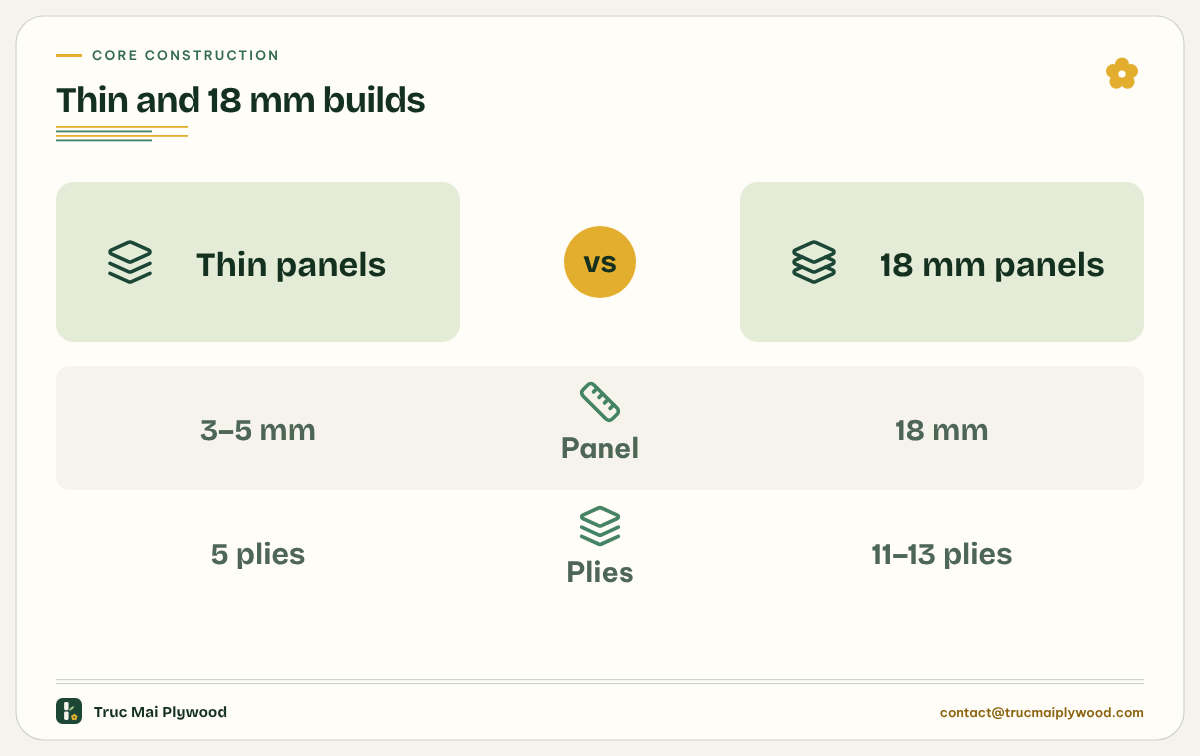
Thickness and ply count jointly affect the edge pattern, but the correct number of plies follows the agreed construction. A buyer specifying only thickness has left the core build open. For thin decorative parts, veneer selection is especially important because there is little material available for sanding and machining.
The available furniture and commercial thickness range is 3–40 mm. The 3–5 mm panels use five plies, while 6 mm is constructed to order. At 18 mm the usual build is 11–13 plies, most often 11. An order for a thin cabinet back is therefore a different manufacturing brief from an order for thick shelves or door stock.
Do not assume more plies automatically means a better panel. Veneer quality, glue spread, joint continuity and pressing quality still matter. A carefully assembled thicker veneer can outperform a poorly joined stack with more layers in the intended operation. Record the nominal thickness, measured tolerance and ply count on the approved sample.
What face and back should a furniture buyer specify?
Specify the visible face and reverse face as a grade pair, backed by an approved physical sample. A core choice does not select the surface. Poplar, bleached Poplar, engineered veneer (EV), Birch, Okoume, Bintangor, Pine, Eucalyptus, Gurjan and Sapele are examples of face options in this supply range.
The Indian standards plywood lesson distinguishes face veneer from inner core veneer. This distinction matters when a buyer requests a pale cabinet interior, a patterned door skin or a paint-ready substrate. For Birch, specify birch-faced plywood rather than assuming the whole panel is Birch. The visible species and the hidden species can come from different supply chains.
Write the face/back pair against a sample, including accepted repairs and colour variation. For laminated parts, add the surface preparation required before the buyer’s coating or overlay. UV-ready means prepared for the buyer’s UV coating process, not UV coating applied at the plywood mill.
Which adhesive and emission specification belongs on the order?
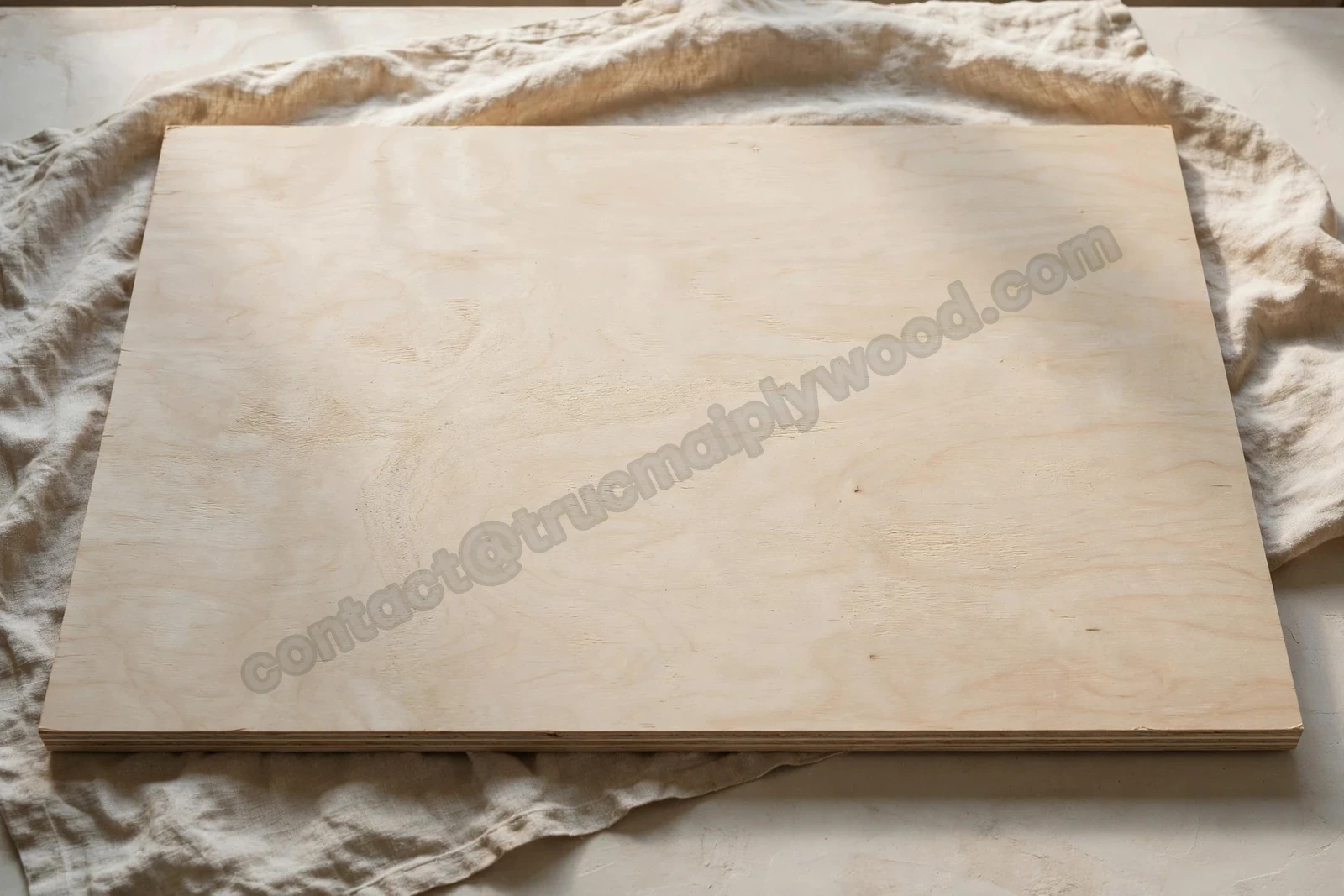
Adhesive type, moisture performance and formaldehyde emission are three separate order fields. A dry-interior cabinet brief can name UF adhesive and the agreed emission grade; a wetter application needs a separately specified bonding system and supporting test evidence. “E0 glue” confuses the adhesive with the emission classification.
For US-bound hardwood plywood with veneer core, 40 CFR Part 770 sets a formaldehyde emission standard of 0.05 ppm under the specified testing framework. The regulation also defines veneer core and composite core separately. Its composite-core category refers to particleboard or MDF constructions, not a mix of Eucalyptus and Acacia veneers. This difference prevents an incorrect regulatory classification in an import specification.
For Truc Mai’s certified range, CARB Phase 2 and EPA TSCA Title VI cover hardwood plywood with veneer core in the 3–25 mm scope. Buyers can identify the applicable certificate as CARB/EPA 26053 and the mill as ICTT-26053. Specify the intended market, thickness and documentary requirements in the same line as the core build.
How should buyers inspect core gaps and edge machining?
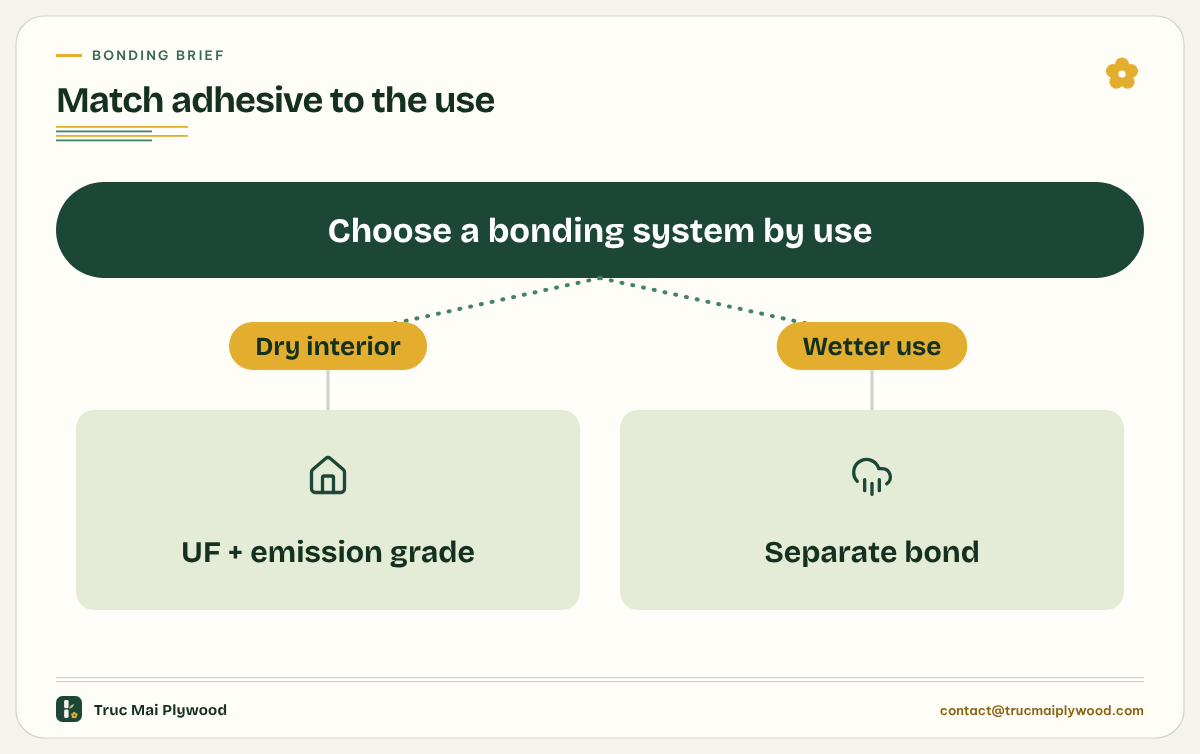
Inspect the cut edge, then perform a representative machining trial before approving a core. A smooth sanded face can conceal loose inner pieces, so the first inspection should reveal the material that will be drilled, routed or edged in the furniture factory.
- Cut a sample from the centre and another near the outer region of the panel.
- Compare veneer coverage and joint placement across both pieces.
- Route a groove and drill the intended fixing holes at the actual production settings.
- Apply the proposed edge band or finishing system and inspect for openings.
- Record any acceptable repair pattern against the signed sample.
For veneered cabinet fronts, inspect the face under raking light as well. A good core with a poorly prepared surface still causes rework at finishing. The buyer should use one inspection sheet for both the core and the face rather than letting different departments approve them separately.
What sizes and cutting options should go on the cut list?
Start with the parent sheet, then give each finished part’s length, width, grain direction and label. Standard choices include 1220 × 2440 mm, 1220 × 2280 mm and 1250 × 2500 mm. Cut-to-size is an order option, with the final piece layout agreed by email.
Examples include a lengthwise half sheet at 610 × 2440 mm, a three-part layout around 1200 × 800 mm, or a four-part layout around 1220 × 610 mm. Six-part cutting can also be arranged. Saw kerf, trimming allowances and the orientation of decorative grain belong on the drawing rather than in a generic catalogue size.
Ask for each bundle to be labelled to the cutting schedule. For mixed-core furniture parts, the label can also distinguish core build, face grade and component destination. This reduces confusion when similar-looking panels feed different cabinet or door production lines.
How does core selection change a 40HC loading plan?
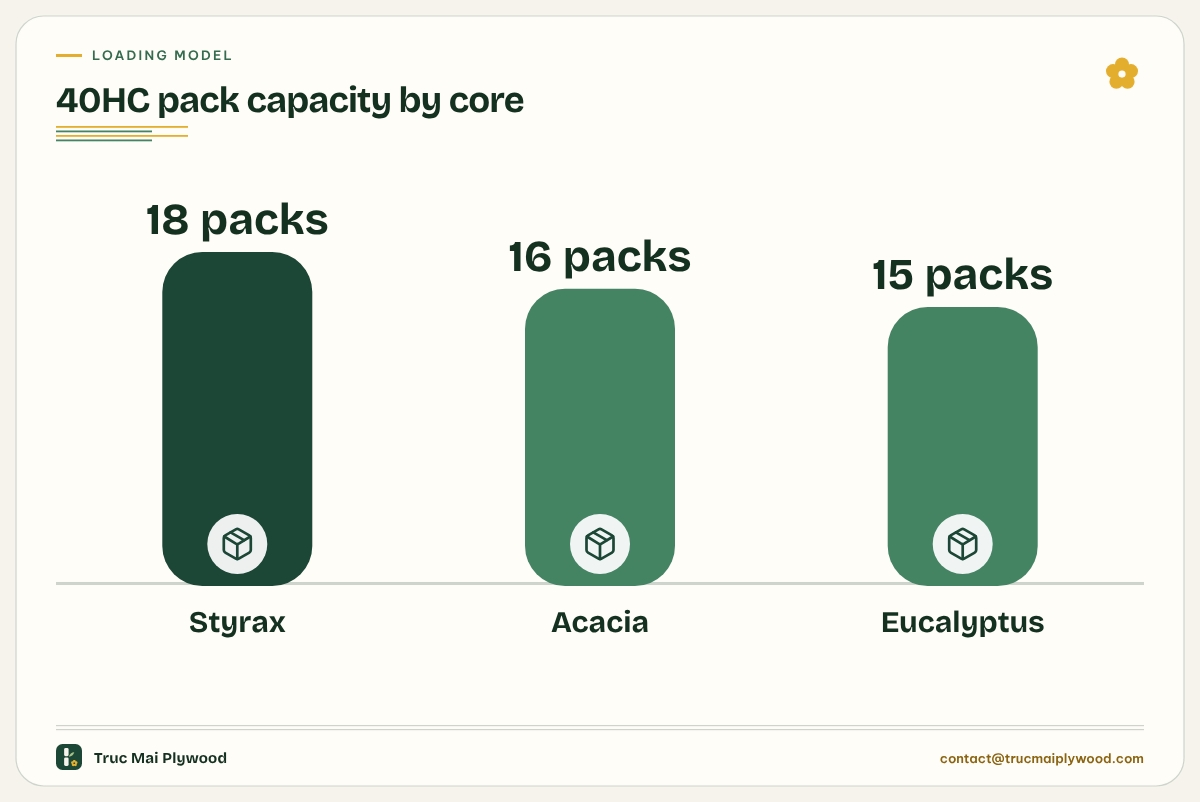
The core changes the shipment weight and therefore the practical sheet count in a 40HC planning model. The following figures are the supplied model’s values for 1220 × 2440 mm panels, shown unchanged. They are planning figures for panels only, rather than recorded shipment weights.
| Core | Thickness | Packs | Sheets/pack | Sheets | Volume | kg/sheet | Total kg | Weight capped |
|---|---|---|---|---|---|---|---|---|
| Styrax | 12 mm | 18 | 83 | 1494 | 53.4 m³ | 17.9 | 26680 | No |
| Acacia | 12 mm | 16 | 83 | 1328 | 47.4 m³ | 20.7 | 27510 | No |
| Eucalyptus | 12 mm | 15 | 80 | 1200 | 42.9 m³ | 23.2 | 27860 | Yes |
| Styrax | 15 mm | 18 | 66 | 1188 | 53.0 m³ | 22.3 | 26520 | No |
| Acacia | 15 mm | 16 | 66 | 1056 | 47.2 m³ | 25.9 | 27350 | No |
| Eucalyptus | 15 mm | 15 | 64 | 960 | 42.9 m³ | 29.0 | 27860 | Yes |
| Styrax | 18 mm | 18 | 55 | 990 | 53.0 m³ | 26.8 | 26520 | No |
| Acacia | 18 mm | 16 | 55 | 880 | 47.2 m³ | 31.1 | 27350 | No |
| Eucalyptus | 18 mm | 15 | 53 | 795 | 42.6 m³ | 34.8 | 27690 | Yes |
| Styrax | 21 mm | 18 | 47 | 846 | 52.9 m³ | 31.3 | 26440 | No |
| Acacia | 21 mm | 16 | 47 | 752 | 47.0 m³ | 36.3 | 27270 | No |
| Eucalyptus | 21 mm | 15 | 45 | 675 | 42.2 m³ | 40.6 | 27430 | Yes |
Model basis: 40HC planning model, panels only; Styrax 18 packs, Acacia 16 packs and Eucalyptus 15 packs; approximately 1,000 mm pack height; sheets per pack from pack height divided by thickness, rounded down and limited by the model’s 28,000 kg planning payload. Reference densities: Styrax 500 kg/m³, Acacia 580 kg/m³ and Eucalyptus 650 kg/m³. The carrier and route determine the booked cargo limit, and actual sheet weights are checked for the final plan.
This comparison is useful because the heaviest-looking core is not always the most efficient export choice. If the customer buys by the cubic metre but consumes panels by the piece, both the sheet count and the weight matter. The container loading guide expands the thickness comparison beyond the selected rows above.
Which documents matter for an overseas order?
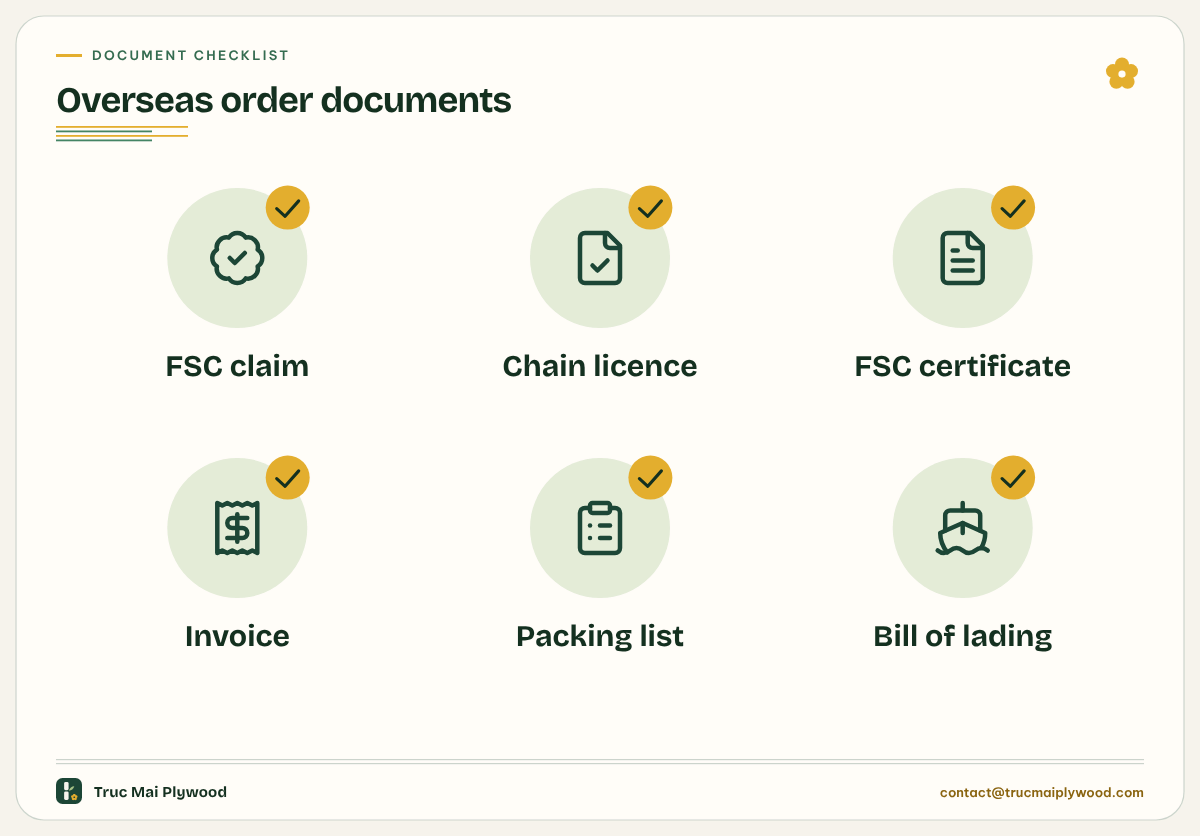
A useful document set connects the material description to the shipment and the intended market. For a furniture panel, start with the approved construction sheet, sample reference and applicable emission evidence. The commercial invoice, packing list, bill of lading and origin documentation then identify what was shipped.
For eligible FSC 100% products, the sales documents carry the FSC claim and certificate identification. The relevant chain-of-custody licence is FSC-C196493, with certificate SA-COC-014545. For EU-bound orders, the supply dossier can include origin records and plot geolocation files for the Vietnamese core and imported face veneer, allowing the importer to prepare its due-diligence statement.
Do not let the phrase “alternate plywood” replace a species declaration. The inner wood and outer face should be separately traceable in the purchasing records. This is especially important when a decorative face arrives from a different country from the core logs.
How can an importer compare two factory quotations?
Compare quotations only after the same application, core build, face, adhesive, size and packing have been written into both enquiries. Otherwise the apparent price difference may be a difference in the panel itself. Use the plywood RFQ checklist to keep each response on the same basis.
Ask for the same sample dimensions and the same machining test. Check whether each quotation assumes a stitched or loose-laid core, whether both faces are sanded and whether the face/back grade is paired against a sample. Record thickness tolerance explicitly. For calibrated furniture panels, a ±0.3 mm specification is available; commercial panels are commonly specified at ±0.5 mm.
Also compare production lead time separately from sea transit time. The normal production window is 15–45 days after the deposit, with the final schedule tied to the agreed order. A quotation with a faster factory date does not necessarily produce an earlier arrival at the destination port.
What should a buyer send for a sample and quotation?
Send one complete panel specification and a cut-edge inspection requirement. The mill can then return a sample and a quotation for the actual build rather than for a loosely defined “alternate” category. The ordering plywood samples page explains the sample route, while the mill verification checklist helps buyers compare documentation before payment.
Include the intended furniture application, core species and layer arrangement, adhesive and emission requirement, face/back grade, nominal thickness, parent sheet or cut list, packing method, quantity and destination port. Attach a photograph of the edge quality you want reproduced, along with the face sample. If a red core or full-core appearance is important, describe the observable acceptance criteria rather than relying on those words alone.
The next step is to request a sample of that construction, inspect the cross-cut and approve the order sheet. This gives both the buyer and the production team a common reference when the first container is prepared.
Send your specification to contact@trucmaiplywood.com or through the quotation form.
Questions buyers ask
Can alternate-core plywood be used for wardrobes?
Yes. Specify a dry-interior adhesive system, the face finish, panel thickness and the core-joint quality for wardrobe carcasses.
Does alternate-core mean alternating grain directions?
No. Cross-grain veneer construction is normal plywood practice; alternate-core is a trade description for the mix or sequence of inner wood species.
Can I order a single-species Eucalyptus core?
Yes. Eucalyptus is one of the core options offered for furniture and commercial plywood, alongside Acacia, Styrax and Pine.
What face should I specify for a decorative cabinet?
Choose the visible veneer and approved face/back sample separately from the core. Birch-faced, EV-faced and other decorative surfaces can be specified over a Vietnamese core.
Is a full-core panel automatically heavier?
No. Weight follows the species, density, moisture and thickness, rather than the full-core label.
Can alternate-core plywood be cut into furniture components?
Yes. Supply the cut list, grain direction, edge finish and labels with the panel order.
Which test report should I request for glue performance?
Request the bond-test method, conditioning, result and exact panel construction. An adhesive name alone does not state a tested bond class.
What should be shown on the plywood packing list?
The order should identify the core construction, face, size, thickness, grade and quantity; the shipping packing list records the actual loaded packs.
Can an imported veneer face have a Vietnamese core?
Yes. Face species and core species are separate order fields; the face veneer origin should be recorded for relevant due-diligence files.
How do I compare samples from two mills?
Compare samples of the same thickness, veneer face, adhesive specification and core arrangement, then inspect the cut edges and machining results.